tow SAAB 9-3 2002 Owner's Manual
[x] Cancel search | Manufacturer: SAAB, Model Year: 2002, Model line: 9-3, Model: SAAB 9-3 2002Pages: 256, PDF Size: 11.55 MB
Page 174 of 256
174 Starting and driving
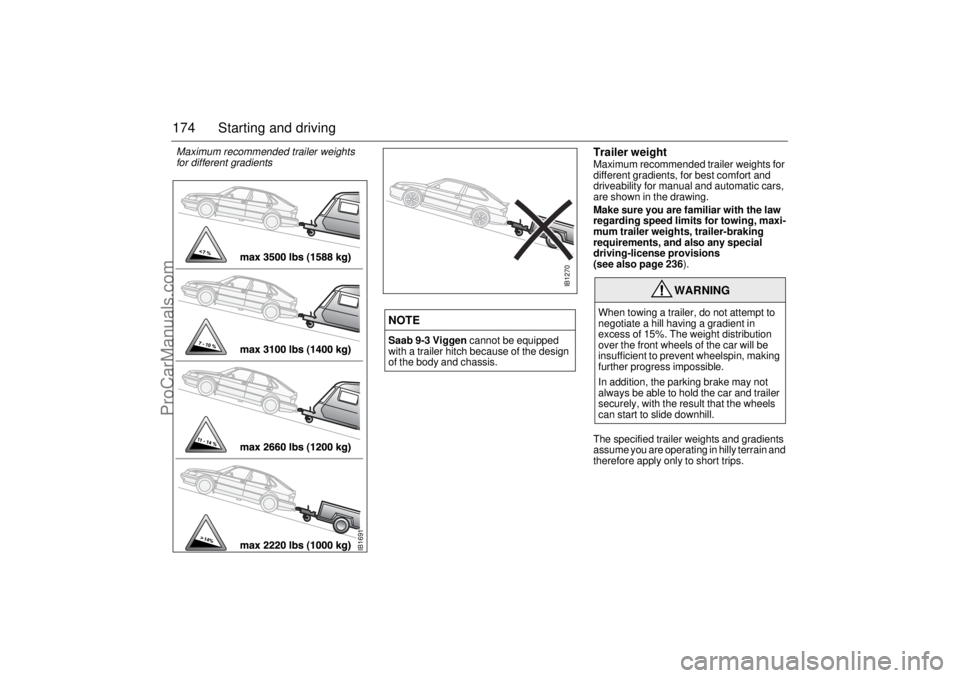
Trailer weightMaximum recommended trailer weights for
different gradients, for best comfort and
driveability for manual and automatic cars,
are shown in the drawing.
Make sure you are familiar with the law
regarding speed limits for towing, maxi-
mum trailer weights, trailer-braking
requirements, and also any special
driving-license provisions
(see also page 236).
The specified trailer weights and gradients
assume you are operating in hilly terrain and
therefore apply only to short trips.
NOTESaab 9-3 Viggen cannot be equipped
with a trailer hitch because of the design
of the body and chassis.
WARNING
When towing a trailer, do not attempt to
negotiate a hill having a gradient in
excess of 15%. The weight distribution
over the front wheels of the car will be
insufficient to prevent wheelspin, making
further progress impossible.
In addition, the parking brake may not
always be able to hold the car and trailer
securely, with the result that the wheels
can start to slide downhill.
IB1691
Maximum recommended trailer weights
for different gradients
IB1270
ProCarManuals.com
Page 175 of 256

175 Starting and driving
Recommendations for driving in
hilly terrainThe following time limits are based on the
capacity of the cooling system in warm
weather, i.e. approximately 86°F (30°C).
The following time limits are based on the
capacity of the cooling system in hot
weather, i.e. approximately 104°F (40°C).It is important to consider the following when
driving a car with automatic transmission up
long inclines.
Use Normal mode when driving with a cara-
van or trailer on hilly roads. The adaptive
gear change pattern function will prevent
the transmission overheating.
Rises in coolant temperature are indicated
by the temperature gauge in the main instru-
ment panel.
The following may also occur:
A/C compressor is switched off
Gear change pattern is altered
The CHECK message TRANSMISSION
OVERHEATING appears on the SID
If TRANSMISSION OVERHEATING
appears on the SID, stop the car as soon as
it is safe to do so and wait until the message
has been extinguished. When driving sub-
sequent to the transmission oil overheating,
select either 3rd gear or Drive, whichever
will allow the engine to run at 3,000 rpm and
maintain the speed of traffic or a safe speed;
see page 159.Do not drive continuously with the WINTER
mode selected in hilly country when you are
towing a trailer, as this will increase fuel con-
sumption and risk overheating the transmis-
sion.
Driving considerationsAlways take extra care when towing a
trailer, as the car’s handling will be different
and its braking effect reduced. The trailer’s
braking system and suspension also have a
considerable effect on these characteris-
tics, see also "Driving with a load" page
178.
Select position 1 when descending steep
hills. Gradient
of hill, % Maximum
trailer
weight, lbs.
(kg)Maximum dura-
tion, minutes
6-7 3330 (1500) Unlimited
8-9 3330 (1500) 15 max.
10-15 1890 (850) 15 max.
Gradient
of hill, % Maximum
trailer
weight, lbs.
(kg)Maximum dura-
tion, minutes
6-7 2000 (900) Unlimited
8-9 2000 (900) 15 max.
10-15 1000 (450) 15 max.
WARNING
Remember to use engine-braking (selec-
tor position 1, 2, or 3) to spare the brakes
when you are driving on a long or steep
downhill slope.
Brake failure can result from overheated
brakes!
NOTEIf the “Automatic transmission fault
indicator” warning comes on, cease
towing until the problem has been recti-
fied.
ProCarManuals.com
Page 176 of 256
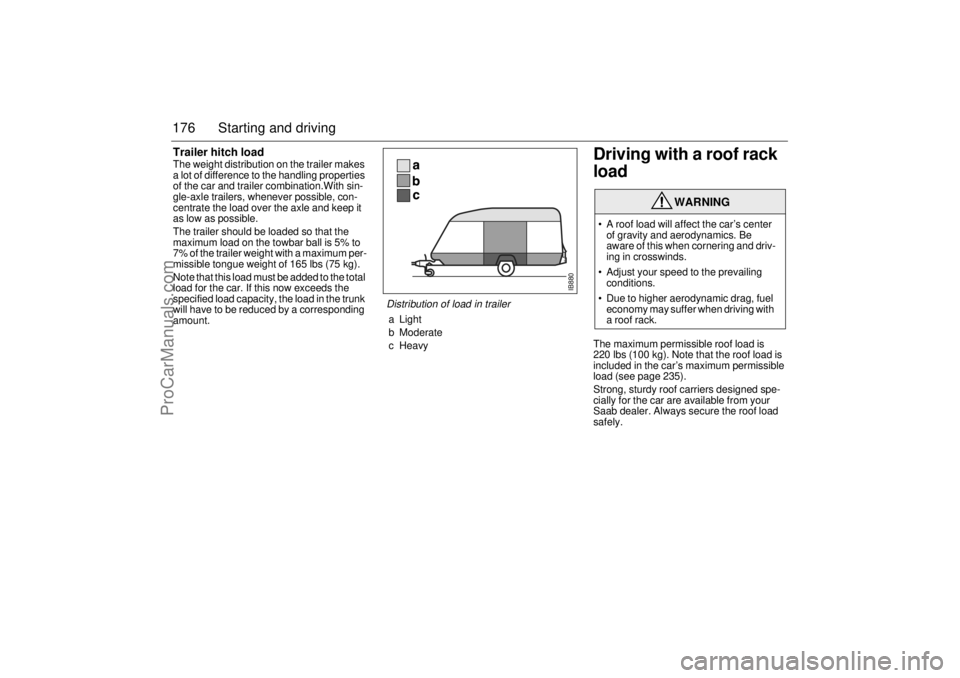
176 Starting and drivingTrailer hitch loadThe weight distribution on the trailer makes
a lot of difference to the handling properties
of the car and trailer combination.With sin-
gle-axle trailers, whenever possible, con-
centrate the load over the axle and keep it
as low as possible.
The trailer should be loaded so that the
maximum load on the towbar ball is 5% to
7% of the trailer weight with a maximum per-
missible tongue weight of 165 lbs (75 kg).
Note that this load must be added to the total
load for the car. If this now exceeds the
specified load capacity, the load in the trunk
will have to be reduced by a corresponding
amount.
Driving with a roof rack
loadThe maximum permissible roof load is
220 lbs (100 kg). Note that the roof load is
included in the car’s maximum permissible
load (see page 235).
Strong, sturdy roof carriers designed spe-
cially for the car are available from your
Saab dealer. Always secure the roof load
safely.
WARNING
A roof load will affect the car’s center
of gravity and aerodynamics. Be
aware of this when cornering and driv-
ing in crosswinds.
Adjust your speed to the prevailing
conditions.
Due to higher aerodynamic drag, fuel
economy may suffer when driving with
a roof rack.
IB880
Distribution of load in trailer aLight
b Moderate
cHeavy
ProCarManuals.com
Page 177 of 256
177 Starting and driving
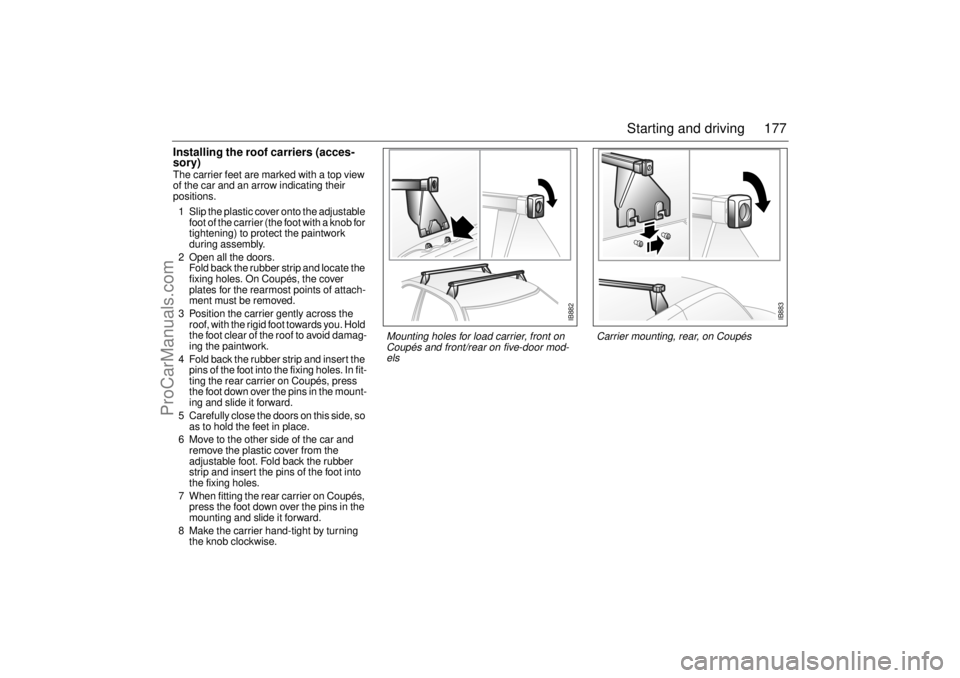
Installing the roof carriers (acces-
sory) The carrier feet are marked with a top view
of the car and an arrow indicating their
positions.
1 Slip the plastic cover onto the adjustable
foot of the carrier (the foot with a knob for
tightening) to protect the paintwork
during assembly.
2 Open all the doors.
Fold back the rubber strip and locate the
fixing holes. On Coupés, the cover
plates for the rearmost points of attach-
ment must be removed.
3 Position the carrier gently across the
roof, with the rigid foot towards you. Hold
the foot clear of the roof to avoid damag-
ing the paintwork.
4 Fold back the rubber strip and insert the
pins of the foot into the fixing holes. In fit-
ting the rear carrier on Coupés, press
the foot down over the pins in the mount-
ing and slide it forward.
5 Carefully close the doors on this side, so
as to hold the feet in place.
6 Move to the other side of the car and
remove the plastic cover from the
adjustable foot. Fold back the rubber
strip and insert the pins of the foot into
the fixing holes.
7 When fitting the rear carrier on Coupés,
press the foot down over the pins in the
mounting and slide it forward.
8 Make the carrier hand-tight by turning
the knob clockwise.
IB882
IB883
Mounting holes for load carrier, front on
Coupés and front/rear on five-door mod-
els Carrier mounting, rear, on Coupés
ProCarManuals.com
Page 179 of 256
179 Starting and driving
Driving with the trunk lid
openAvoid driving with the trunk lid partly or fully
open, since exhaust fumes can be drawn
into the cabin.
If you must drive with the trunk lid open, all
windows and the sunroof (if fitted) must be
closed and the cabin fan on at its highest
speed setting.Driving in deep waterTowing the car
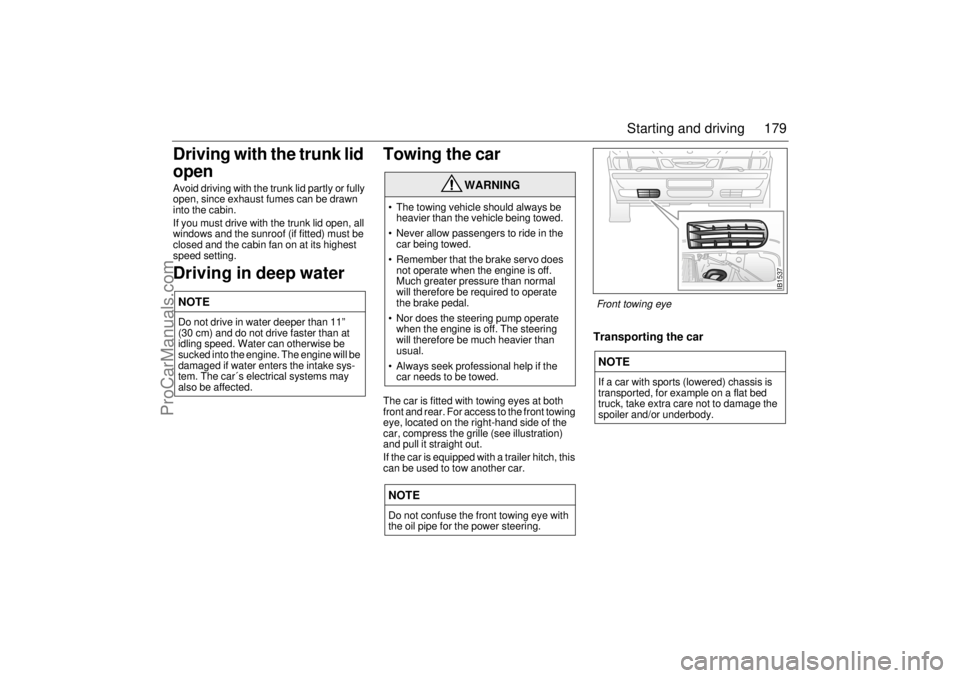
The car is fitted with towing eyes at both
front and rear. For access to the front towing
eye, located on the right-hand side of the
car, compress the grille (see illustration)
and pull it straight out.
If the car is equipped with a trailer hitch, this
can be used to tow another car.
Transporting the car NOTE
Do not drive in water deeper than 11”
(30 cm) and do not drive faster than at
idling speed. Water can otherwise be
sucked into the engine. The engine will be
damaged if water enters the intake sys-
tem. The car´s electrical systems may
also be affected.
WARNING
The towing vehicle should always be
heavier than the vehicle being towed.
Never allow passengers to ride in the
car being towed.
Remember that the brake servo does
not operate when the engine is off.
Much greater pressure than normal
will therefore be required to operate
the brake pedal.
Nor does the steering pump operate
when the engine is off. The steering
will therefore be much heavier than
usual.
Always seek professional help if the
car needs to be towed. NOTEDo not confuse the front towing eye with
the oil pipe for the power steering.
NOTEIf a car with sports (lowered) chassis is
transported, for example on a flat bed
truck, take extra care not to damage the
spoiler and/or underbody.
IB1537
Front towing eye
ProCarManuals.com
Page 180 of 256
180 Starting and driving
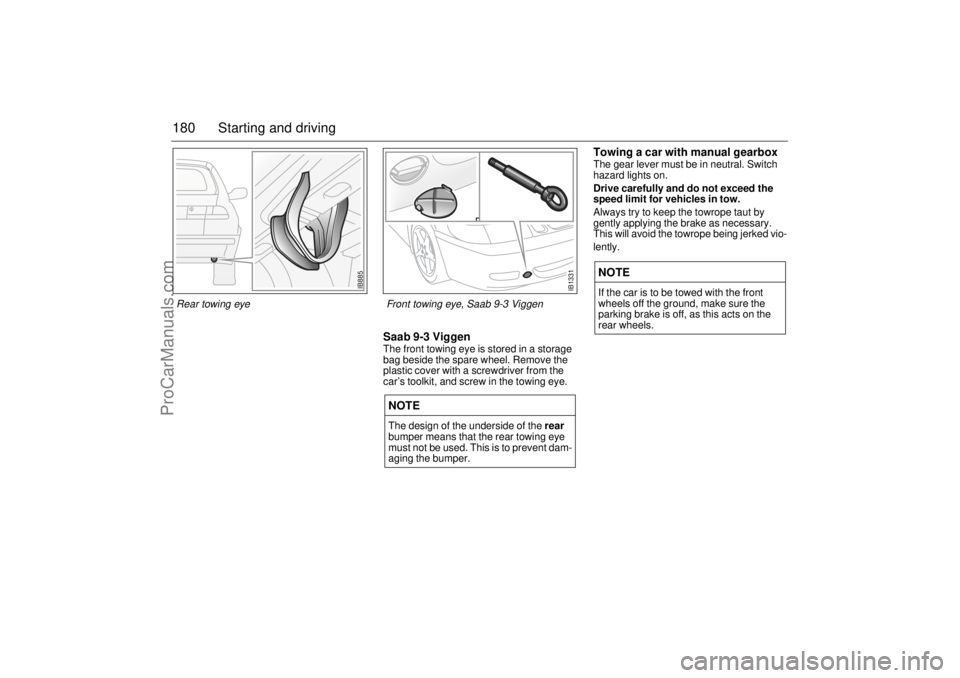
Saab 9-3 ViggenThe front towing eye is stored in a storage
bag beside the spare wheel. Remove the
plastic cover with a screwdriver from the
car’s toolkit, and screw in the towing eye.
Towing a car with manual gearboxThe gear lever must be in neutral. Switch
hazard lights on.
Drive carefully and do not exceed the
speed limit for vehicles in tow.
Always try to keep the towrope taut by
gently applying the brake as necessary.
This will avoid the towrope being jerked vio-
lently.
NOTEThe design of the underside of the rear
bumper means that the rear towing eye
must not be used. This is to prevent dam-
aging the bumper.
NOTEIf the car is to be towed with the front
wheels off the ground, make sure the
parking brake is off, as this acts on the
rear wheels.
IB885
Rear towing eye
IB1331
Front towing eye, Saab 9-3 Viggen
ProCarManuals.com
Page 181 of 256

181 Starting and driving
Towing a car with automatic
transmission The following rules must be observed if a
car with automatic transmission is to be
towed.
The gear selector must be in the N position.
Switch hazard lights on.
Drive carefully and do not exceed the
speed limit for vehicles in tow.
Always try to keep the towrope taut by
gently applying the brake as necessary.
This will avoid the towrope being jerked vio-
lently.1 Selector lever in position N.
2 The local regulations on towing speeds
must be followed.
The highest permissible towing speed is
30 mph (50 km/h), unless the legal limit
is lower. The longest permissible towing
distance is 30 miles (50 km). If the car
has to be transported farther than that,
summon a tow truck. A flat bed tow truck
is the preferred method to tow.
The engine cannot be started by towing or
pushing the car. In emergency, the engine
can be started as described in the section
”Jump starting”.
Jump startingIf your battery has run down, you may want
to use another vehicle and some jumper
cables to start your Saab. Follow the steps
below to do it safely.
NOTEThe car must be towed front first.
If the car is to be towed with the front
wheels off the ground, make sure the
parking brake is off, as this acts on the
rear wheels.
WARNING
Batteries can cause injury. They can be
dangerous because:
They contain acid that can burn you.
They contain gas that can explode or
ignite.
They contain enough electricity to
injure you.
If you do not follow these steps exactly,
some or all of these things can hurt you.
ProCarManuals.com
Page 191 of 256
191 Car care
Transmission fluidManual transmissionCheck and top up the fluid in accordance
with the service program.
If original fluid cannot be obtained for top-
ping up, Dextron III (synthetic fluid) auto-
matic transmission fluid can be used. If so,
the car should be taken to an authorized
Saab dealer as soon as possible to have the
reason for low fluid level corrected and orig-
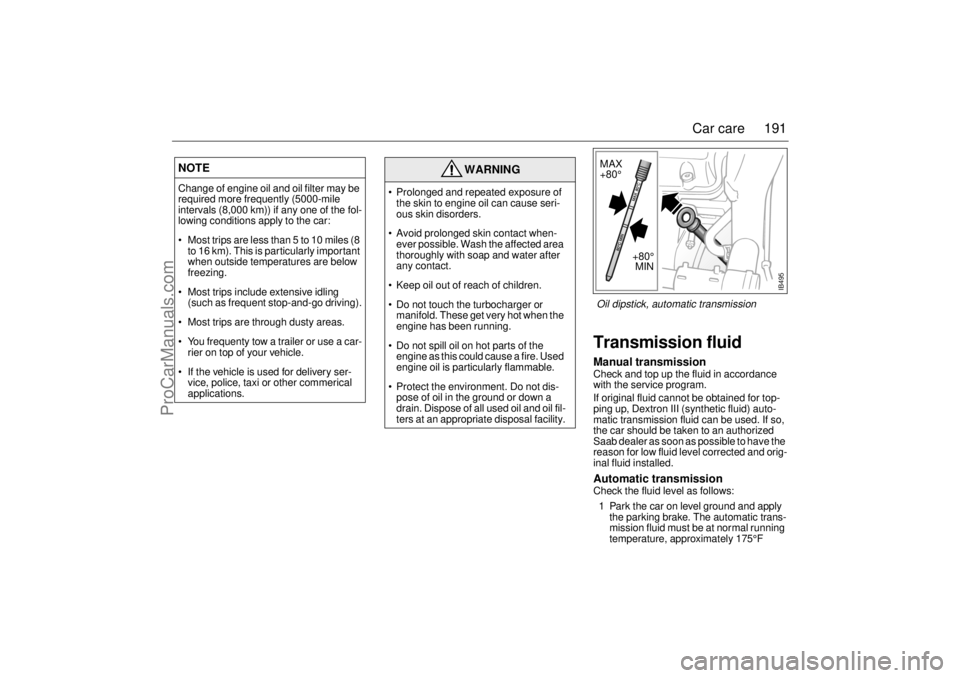
inal fluid installed.Automatic transmissionCheck the fluid level as follows:
1 Park the car on level ground and apply
the parking brake. The automatic trans-
mission fluid must be at normal running
temperature, approximately 175°F
NOTEChange of engine oil and oil filter may be
required more frequently (5000-mile
intervals (8,000 km)) if any one of the fol-
lowing conditions apply to the car:
Most trips are less than 5 to 10 miles (8
to 16 km). This is particularly important
when outside temperatures are below
freezing.
Most trips include extensive idling
(such as frequent stop-and-go driving).
Most trips are through dusty areas.
You frequenty tow a trailer or use a car-
rier on top of your vehicle.
If the vehicle is used for delivery ser-
vice, police, taxi or other commerical
applications.
WARNING
Prolonged and repeated exposure of
the skin to engine oil can cause seri-
ous skin disorders.
Avoid prolonged skin contact when-
ever possible. Wash the affected area
thoroughly with soap and water after
any contact.
Keep oil out of reach of children.
Do not touch the turbocharger or
manifold. These get very hot when the
engine has been running.
Do not spill oil on hot parts of the
engine as this could cause a fire. Used
engine oil is particularly flammable.
Protect the environment. Do not dis-
pose of oil in the ground or down a
drain. Dispose of all used oil and oil fil-
ters at an appropriate disposal facility.
+80°
MIN MAX
+80°
IB495
Oil dipstick, automatic transmission
ProCarManuals.com
Page 201 of 256
201 Car care
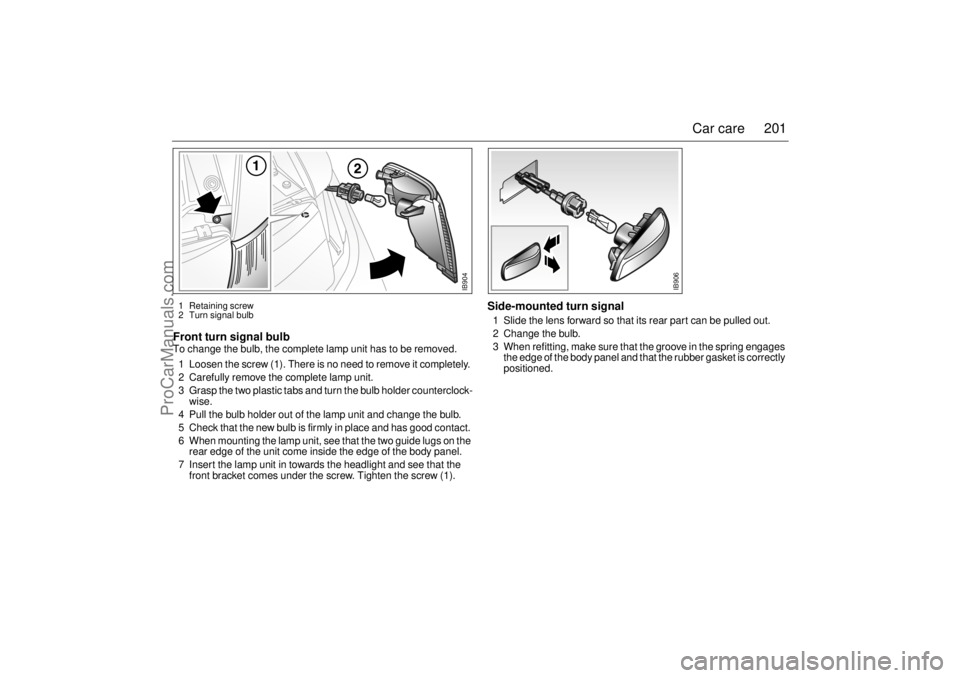
Front turn signal bulb To change the bulb, the complete lamp unit has to be removed.
1 Loosen the screw (1). There is no need to remove it completely.
2 Carefully remove the complete lamp unit.
3 Grasp the two plastic tabs and turn the bulb holder counterclock-
wise.
4 Pull the bulb holder out of the lamp unit and change the bulb.
5 Check that the new bulb is firmly in place and has good contact.
6 When mounting the lamp unit, see that the two guide lugs on the
rear edge of the unit come inside the edge of the body panel.
7 Insert the lamp unit in towards the headlight and see that the
front bracket comes under the screw. Tighten the screw (1).
Side-mounted turn signal1 Slide the lens forward so that its rear part can be pulled out.
2 Change the bulb.
3 When refitting, make sure that the groove in the spring engages
the edge of the body panel and that the rubber gasket is correctly
positioned.
IB904
1 Retaining screw
2 Turn signal bulb
IB906
ProCarManuals.com
Page 215 of 256

215 Car care
When changing a wheel, take the tool kit out
first, then the spare wheel.
Changing a wheel
NOTE
To avoid damaging an alloy wheel with a
flat tire, this can be placed outside up in
the spare-wheel well but only while driv-
ing to the closest workshop.
A general rule is that all heavy loads must
be well secured in the luggage compart-
ment, see page 142.
WARNING
The car jack is designed solely for use
in changing a wheel or fitting snow
chains. It must not be used to support
the car during repair work or servicing.
Never crawl under a car that is
supported only by a jack.
Special care must be taken if the car is
on a slope – use wheel chocks!
Position chocks, one ahead and one
behind, the wheel that is diagonally
opposite to the one to be changed.
Switch on the hazard warning lights if
the car is on a road.
Apply the parking brake and leave the
car in gear (1st or reverse). Automatic
transmission: move selector to the
P position.
Ensure that everybody is out of the car
before jacking it up.
Never start the engine while the car is
jacked up.
The jack must stand on a firm, level
surface.
Stow the jack in the place provided for
it under the panel in the floor of the
trunk. Secure it properly to avoid injury
to passengers in the event of a crash.
Do not use the jack for any purpose
other than for jacking up the car.
If light-alloy wheels have been fitted to
the car for several years and a change
is made to steel wheels, the threads
for the wheel bolts in the brake discs
should be cleaned before the thinner
steel wheels are fitted. The innermost
threads in the holes may be clogged
with sand, salt and rust so that the cor-
rect tightening torque cannot be
achieved.
IB1261IB1262
Spare wheel (under the carpet in the
trunk), Saab 9-3 Viggen
ProCarManuals.com