belt SAAB 9-3 2002 Owner's Guide
[x] Cancel search | Manufacturer: SAAB, Model Year: 2002, Model line: 9-3, Model: SAAB 9-3 2002Pages: 256, PDF Size: 11.55 MB
Page 140 of 256
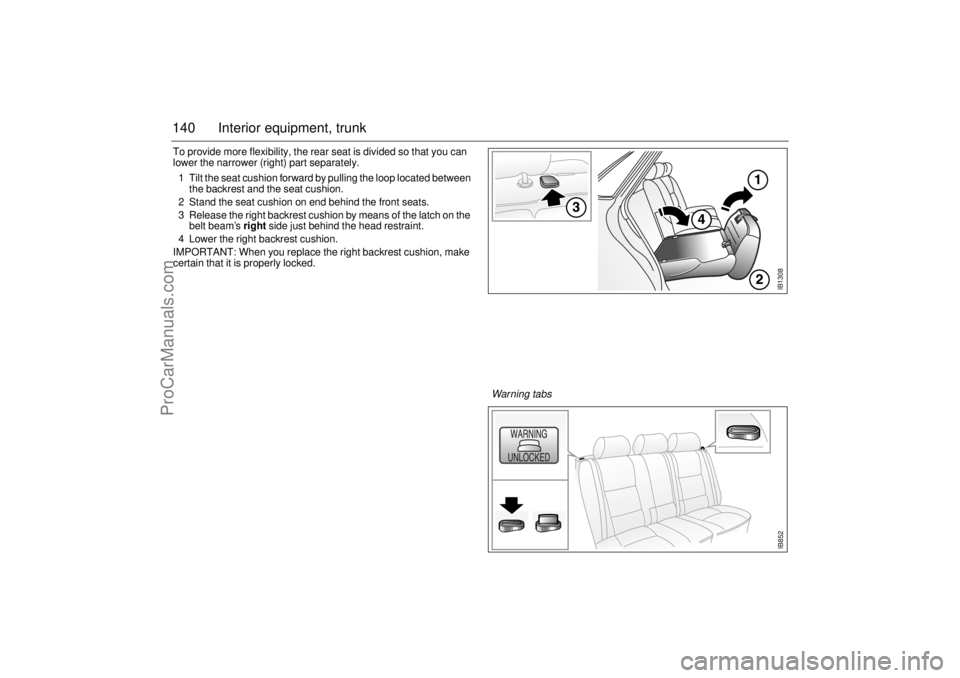
140 Interior equipment, trunkTo provide more flexibility, the rear seat is divided so that you can
lower the narrower (right) part separately.
1 Tilt the seat cushion forward by pulling the loop located between
the backrest and the seat cushion.
2 Stand the seat cushion on end behind the front seats.
3 Release the right backrest cushion by means of the latch on the
belt beam’s right side just behind the head restraint.
4 Lower the right backrest cushion.
IMPORTANT: When you replace the right backrest cushion, make
certain that it is properly locked.
IB1308IB852
Warning tabs
ProCarManuals.com
Page 142 of 256
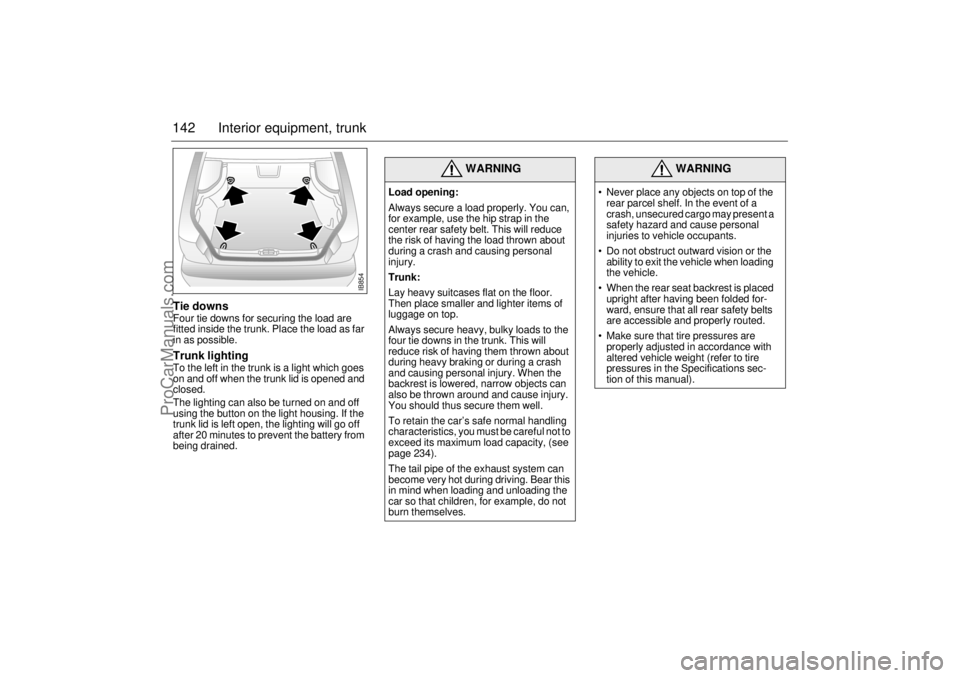
142 Interior equipment, trunkTie downsFour tie downs for securing the load are
fitted inside the trunk. Place the load as far
in as possible.Trunk lightingTo the left in the trunk is a light which goes
on and off when the trunk lid is opened and
closed.
The lighting can also be turned on and off
using the button on the light housing. If the
trunk lid is left open, the lighting will go off
after 20 minutes to prevent the battery from
being drained.
WARNING
Load opening:
Always secure a load properly. You can,
for example, use the hip strap in the
center rear safety belt. This will reduce
the risk of having the load thrown about
during a crash and causing personal
injury.
Trunk:
Lay heavy suitcases flat on the floor.
Then place smaller and lighter items of
luggage on top.
Always secure heavy, bulky loads to the
four tie downs in the trunk. This will
reduce risk of having them thrown about
during heavy braking or during a crash
and causing personal injury. When the
backrest is lowered, narrow objects can
also be thrown around and cause injury.
You should thus secure them well.
To retain the car’s safe normal handling
characteristics, you must be careful not to
exceed its maximum load capacity, (see
page 234).
The tail pipe of the exhaust system can
become very hot during driving. Bear this
in mind when loading and unloading the
car so that children, for example, do not
burn themselves.
WARNING
Never place any objects on top of the
rear parcel shelf. In the event of a
crash, unsecured cargo may present a
safety hazard and cause personal
injuries to vehicle occupants.
Do not obstruct outward vision or the
ability to exit the vehicle when loading
the vehicle.
When the rear seat backrest is placed
upright after having been folded for-
ward, ensure that all rear safety belts
are accessible and properly routed.
Make sure that tire pressures are
properly adjusted in accordance with
altered vehicle weight (refer to tire
pressures in the Specifications sec-
tion of this manual).
IB854
ProCarManuals.com
Page 184 of 256
184 Starting and drivingDriving considerations
with compact spare
wheel/tire fitted The following should be observed when the
compact spare wheel (T115/70 R16) is
installed:
The compact spare is light and easy to
handle when changing the wheel. Do not
drive farther than necessary with the com-
pact spare fitted – the maximum life of the
wheel is only just over 2000 miles
(3,500 km). Have the standard wheel
repaired and reinstalled as soon as possi-
ble.Points to bear in mind when driving with a
compact spare wheel:
The car’s ground clearance is reduced
with the compact spare fitted.
Only one compact spare wheel may be
used at any time.
Take care not to hit the curb.
Do not fit snow chains.
Leave the wheel cover off, so that the
warning text is readily visible.
For long tripsBefore starting off on a long journey, it is
advisable to have your car inspected by
your Saab dealer.
Obtain a few important items to take along
on your journey such as spare bulbs, wiper
blades, fuses, a Poly-V belt and the like.
You can check some points yourself before-
hand:
Make sure that the engine is in good con-
dition.
Check that no oil or fuel leaks out of the
engine or gearbox/transmission.
Check the coolant and power steering
fluid levels. Check also for leaks.
Inspect the Poly-V belt and replace it if it
shows any signs of wear.
Check the battery charge.
Check the tires for tread pattern and air
pressure, including the compact spare
wheel.
Take an extra car key/remote control and
keep it separate, see also page 36.
Check the brakes.
Check all bulbs.
Check for the presence of the tool kit and
the jack in the car.
WARNING
Do not exceed 50 mph (80 km/h) as the
tire can overheat and adversely affect the
handling of the car.
The tire should be inflated to 60 psi
(420 kPa).
NOTETo avoid damaging a punctured alloy
wheel this can be placed outside up in the
spare-wheel well but only while driving to
the closest dealer.
A general rule is that all heavy loads must
be well secured in the luggage compart-
ment, see page 142.
ProCarManuals.com
Page 185 of 256
185 Car care
IB944
Hood release handle ....... 186
Engine .............................. 188
Engine bay ....................... 187
Engine oil ......................... 190
Transmission fluid .......... 191
Coolant ............................. 192
Air filter ............................ 193
Brake- clutch fluid and
brake pads ..................... 194
Power steering ................ 195
Battery .............................. 195
Drive belt .......................... 197
Wipers and washers ....... 198
Wiper blades .................... 198
Changing bulbs ............... 200
Fuses ................................ 206
Wheels.............................. 211 Safety belts ....................... 218
Upholstery and trim ......... 219
Textile carpeting .............. 219
Engine bay ........................ 220
Washing ............................ 220
Waxing and polishing ...... 221
Touching up the paint ..... 221
Anti-corrosion treatment . 222
Recovery and/or recy-
cling of automotive mate-
rials .................................. 224
Air conditioning (A/C
system) ........................... 226 Car care
ProCarManuals.com
Page 187 of 256
187 Car care
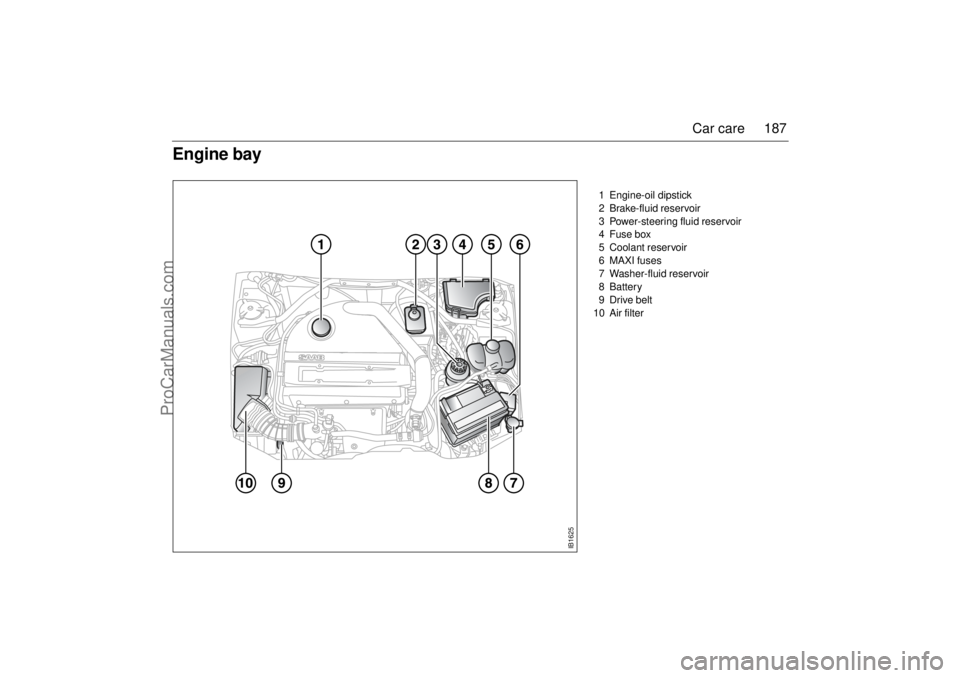
1 Engine-oil dipstick
2 Brake-fluid reservoir
3 Power-steering fluid reservoir
4 Fuse box
5 Coolant reservoir
6 MAXI fuses
7 Washer-fluid reservoir
8Battery
9Drive belt
10 Air filter
Engine bay
IB1625
ProCarManuals.com
Page 197 of 256
197 Car care
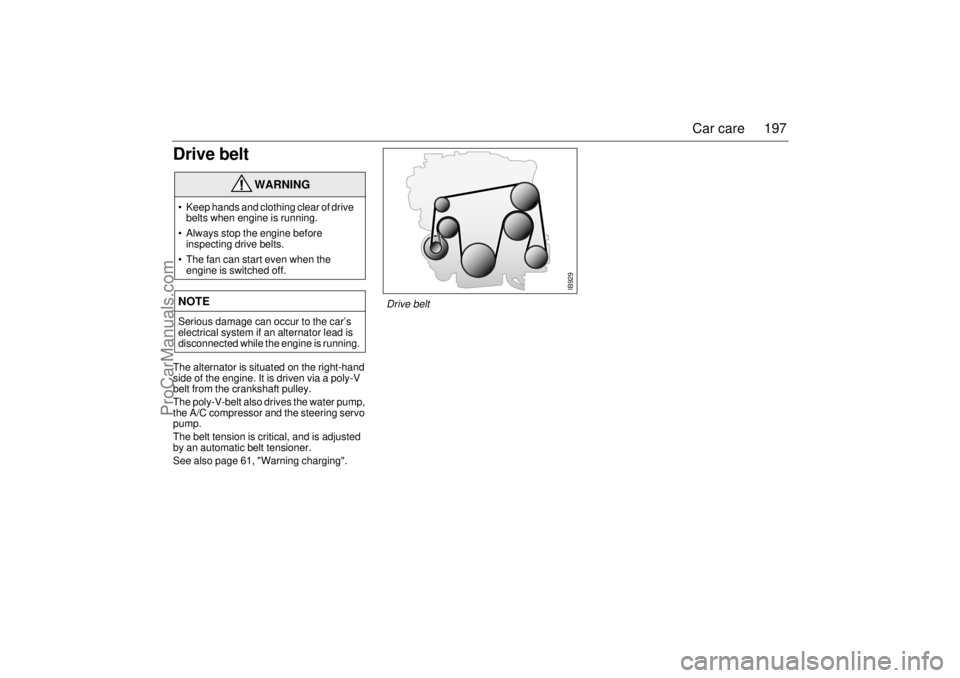
Drive beltThe alternator is situated on the right-hand
side of the engine. It is driven via a poly-V
belt from the crankshaft pulley.
The poly-V-belt also drives the water pump,
the A/C compressor and the steering servo
pump.
The belt tension is critical, and is adjusted
by an automatic belt tensioner.
See also page 61, "Warning charging".
WARNING
Keep hands and clothing clear of drive
belts when engine is running.
Always stop the engine before
inspecting drive belts.
The fan can start even when the
engine is switched off.NOTESerious damage can occur to the car’s
electrical system if an alternator lead is
disconnected while the engine is running.
IB929
Drive belt
ProCarManuals.com
Page 205 of 256
205 Car care
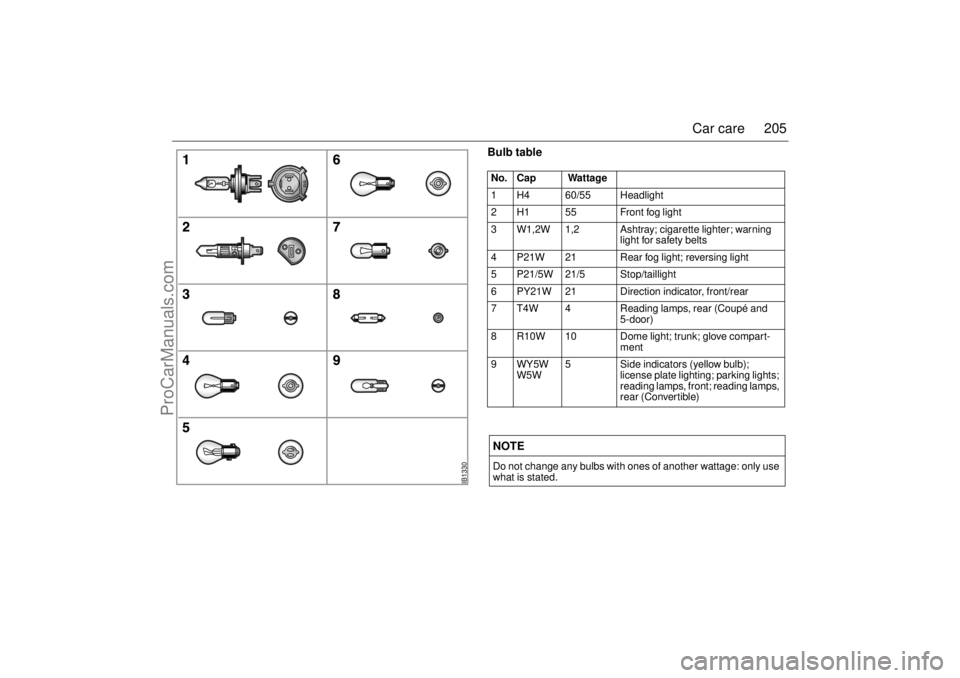
Bulb tableNo. Cap Wattage
1 H4 60/55 Headlight
2 H1 55 Front fog light
3 W1,2W 1,2 Ashtray; cigarette lighter; warning
light for safety belts
4 P21W 21 Rear fog light; reversing light
5 P21/5W 21/5 Stop/taillight
6 PY21W 21 Direction indicator, front/rear
7 T4W 4 Reading lamps, rear (Coupé and
5-door)
8 R10W 10 Dome light; trunk; glove compart-
ment
9WY5W
W5W5 Side indicators (yellow bulb);
license plate lighting; parking lights;
reading lamps, front; reading lamps,
rear (Convertible) NOTEDo not change any bulbs with ones of another wattage: only use
what is stated.
IB1330
ProCarManuals.com
Page 207 of 256
207 Car care
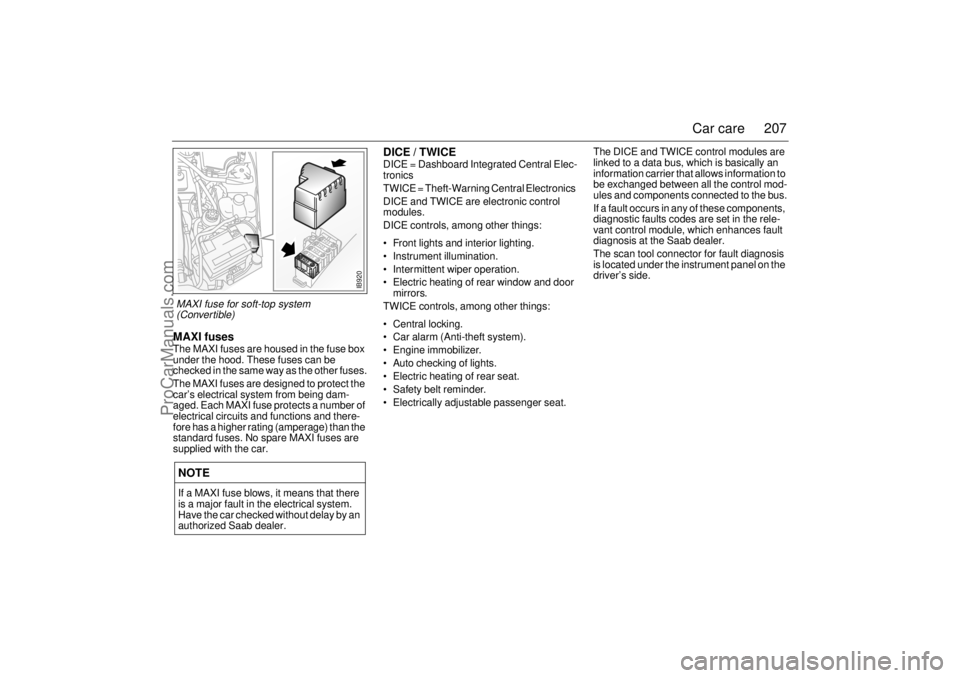
MAXI fusesThe MAXI fuses are housed in the fuse box
under the hood. These fuses can be
checked in the same way as the other fuses.
The MAXI fuses are designed to protect the
car’s electrical system from being dam-
aged. Each MAXI fuse protects a number of
electrical circuits and functions and there-
fore has a higher rating (amperage) than the
standard fuses. No spare MAXI fuses are
supplied with the car.
DICE / TWICEDICE = Dashboard Integrated Central Elec-
tronics
TWICE = Theft-Warning Central Electronics
DICE and TWICE are electronic control
modules.
DICE controls, among other things:
Front lights and interior lighting.
Instrument illumination.
Intermittent wiper operation.
Electric heating of rear window and door
mirrors.
TWICE controls, among other things:
Central locking.
Car alarm (Anti-theft system).
Engine immobilizer.
Auto checking of lights.
Electric heating of rear seat.
Safety belt reminder.
Electrically adjustable passenger seat.The DICE and TWICE control modules are
linked to a data bus, which is basically an
information carrier that allows information to
be exchanged between all the control mod-
ules and components connected to the bus.
If a fault occurs in any of these components,
diagnostic faults codes are set in the rele-
vant control module, which enhances fault
diagnosis at the Saab dealer.
The scan tool connector for fault diagnosis
is located under the instrument panel on the
driver’s side.
NOTEIf a MAXI fuse blows, it means that there
is a major fault in the electrical system.
Have the car checked without delay by an
authorized Saab dealer.
IB920
MAXI fuse for soft-top system
(Convertible)
ProCarManuals.com
Page 218 of 256
218 Car care
Flat spottingAll tires get hot, especially on long journeys
or when the car is driven hard. After the car
has been parked with hot tires and the tires
have cooled down, a flat spot can form in the
tire, where it is in contact with the ground.
The same can occur if the car has not been
moved for a long time.
Flat spots can cause vibration that can be
felt through the steering wheel, similar to
that experienced when the wheels need bal-
ancing. Flat spots of this type disappear
once the tires get hot again, usually after
10–15 miles (20–25 km) of driving at cruis-
ing speed.
Safety beltsA check should be made periodically to
ensure that the safety belts are working
properly.
Hold the diagonal strap and pull it sharply.
The safety belt should lock and it should
not be possible to withdraw it further.
A sharp tug on the belt should cause the
inertia reel to lock. Check the floor anchor-
age points for corrosion damage. If a belt is
worn or has any fraying edges, it should be
replaced.
Safety belts must not come into contact with
substances such as polishes, oil or chemi-
cals. If the belts get dirty, wash them with
warm water and a detergent or have them
replaced.
WARNING
Safety belts and belt pretensioners that
were in use in a serious crash must be
replaced even if they are not visibly
damaged.
No attempt must be made to repair, or
modify the function of, safety belts.
IB923
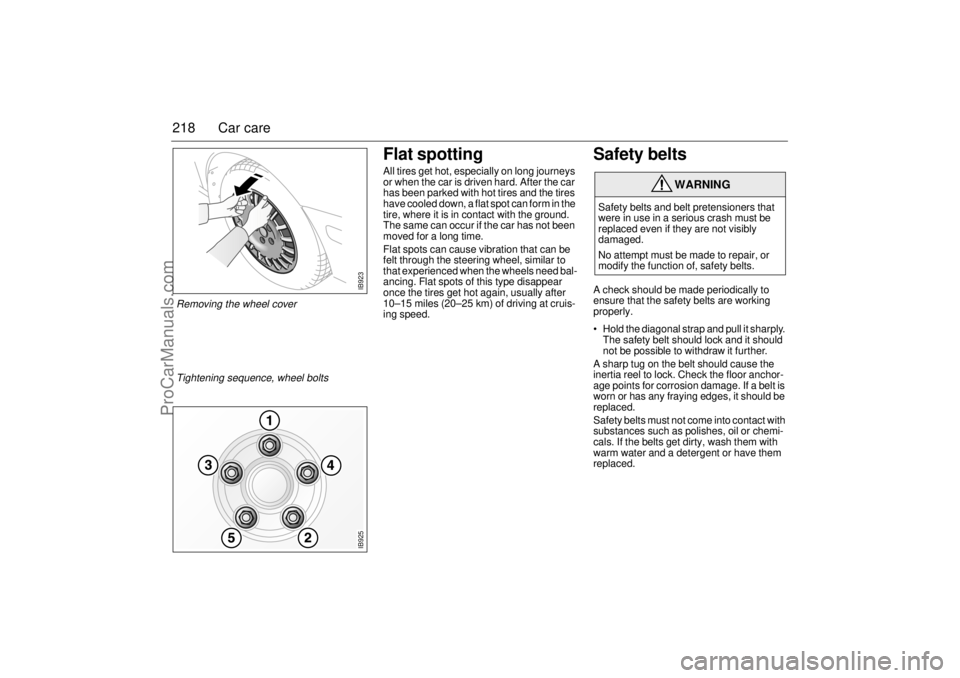
Removing the wheel cover
IB925
Tightening sequence, wheel bolts
ProCarManuals.com
Page 226 of 256
226 Car careAir conditioning
(A/C system)
Fault diagnosis If a fault occurs in the A/C system, there are
a number of checks you can perform your-
self. If the fault persists, however, have the
system checked by an authorized Saab
dealer.Important!
When the A/C system is in operation, mois-
ture from the air will condense on the evap-
orator. When the car is then parked, this
condensation will drip off the evaporator
and form a small pool of water on the
ground. This is normal. The warmer the
ambient air and the higher the humidity, the
greater the amount of condensation formed.Inadequate cooling:
a Make sure that the temperature and
air-distribution controls are in the
appropriate settings, see page 81.
b Check that the condenser (forward of
the radiator) has not become clogged
with dirt and insects.
c Make sure that the drive belt for the com-
pressor is not slipping, see page 197.
d Check the fuses for the ventilation fans
and compressor, see page 208.
NOTE The A/C system is designed for use
with R134a refrigerant.
Refrigerant handling requires special
equipment and special procedures for
charging and draining the system.
All repairs and adjustments on the A/C
system must be carried out by a Saab
dealer authorized for this kind of work.
Never mix R134a and R12 refriger-
ants.
WARNING
The A/C system is pressurized. Do not
break any connections or undo A/C
system components.
Escaping refrigerant gas can cause
visual impairment or other injury.
ProCarManuals.com