wheel SAAB 9-3 2002 Workshop Manual
[x] Cancel search | Manufacturer: SAAB, Model Year: 2002, Model line: 9-3, Model: SAAB 9-3 2002Pages: 256, PDF Size: 11.55 MB
Page 215 of 256

215 Car care
When changing a wheel, take the tool kit out
first, then the spare wheel.
Changing a wheel
NOTE
To avoid damaging an alloy wheel with a
flat tire, this can be placed outside up in
the spare-wheel well but only while driv-
ing to the closest workshop.
A general rule is that all heavy loads must
be well secured in the luggage compart-
ment, see page 142.
WARNING
The car jack is designed solely for use
in changing a wheel or fitting snow
chains. It must not be used to support
the car during repair work or servicing.
Never crawl under a car that is
supported only by a jack.
Special care must be taken if the car is
on a slope – use wheel chocks!
Position chocks, one ahead and one
behind, the wheel that is diagonally
opposite to the one to be changed.
Switch on the hazard warning lights if
the car is on a road.
Apply the parking brake and leave the
car in gear (1st or reverse). Automatic
transmission: move selector to the
P position.
Ensure that everybody is out of the car
before jacking it up.
Never start the engine while the car is
jacked up.
The jack must stand on a firm, level
surface.
Stow the jack in the place provided for
it under the panel in the floor of the
trunk. Secure it properly to avoid injury
to passengers in the event of a crash.
Do not use the jack for any purpose
other than for jacking up the car.
If light-alloy wheels have been fitted to
the car for several years and a change
is made to steel wheels, the threads
for the wheel bolts in the brake discs
should be cleaned before the thinner
steel wheels are fitted. The innermost
threads in the holes may be clogged
with sand, salt and rust so that the cor-
rect tightening torque cannot be
achieved.
IB1261IB1262
Spare wheel (under the carpet in the
trunk), Saab 9-3 Viggen
ProCarManuals.com
Page 216 of 256
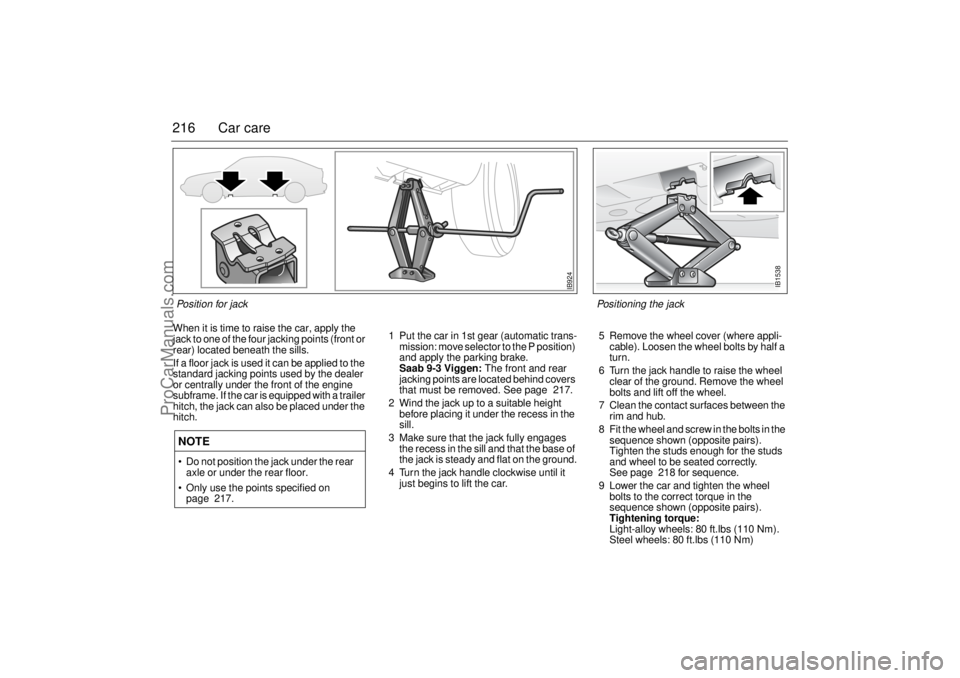
216 Car careWhen it is time to raise the car, apply the
jack to one of the four jacking points (front or
rear) located beneath the sills.
If a floor jack is used it can be applied to the
standard jacking points used by the dealer
or centrally under the front of the engine
subframe. If the car is equipped with a trailer
hitch, the jack can also be placed under the
hitch. 1 Put the car in 1st gear (automatic trans-
mission: move selector to the P position)
and apply the parking brake.
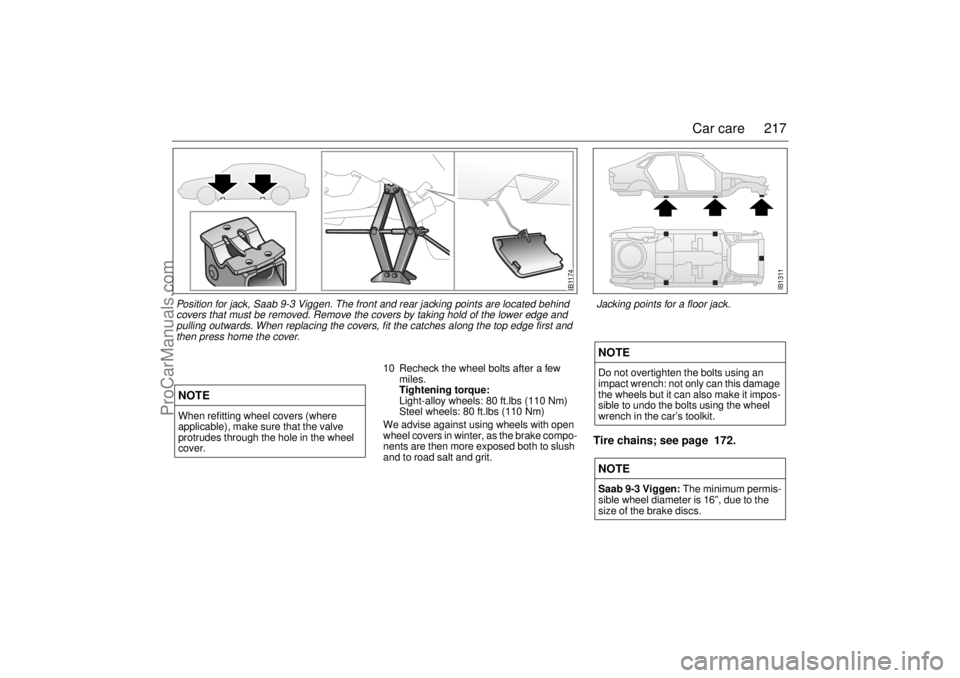
Saab 9-3 Viggen: The front and rear
jacking points are located behind covers
that must be removed. See page 217.
2 Wind the jack up to a suitable height
before placing it under the recess in the
sill.
3 Make sure that the jack fully engages
the recess in the sill and that the base of
the jack is steady and flat on the ground.
4 Turn the jack handle clockwise until it
just begins to lift the car. 5 Remove the wheel cover (where appli-
cable). Loosen the wheel bolts by half a
turn.
6 Turn the jack handle to raise the wheel
clear of the ground. Remove the wheel
bolts and lift off the wheel.
7 Clean the contact surfaces between the
rim and hub.
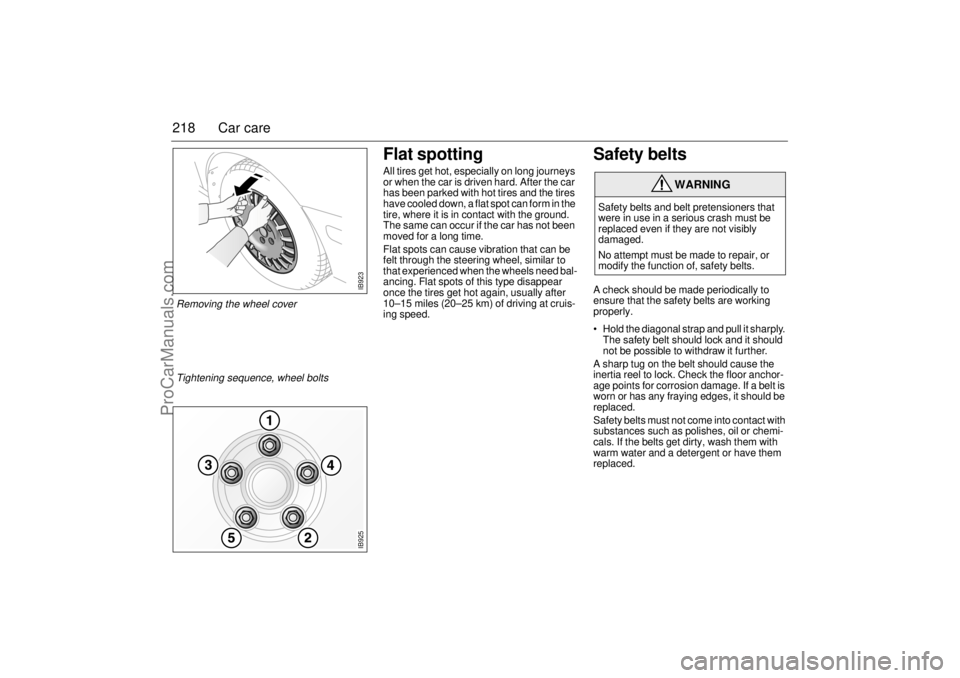
8 Fit the wheel and screw in the bolts in the
sequence shown (opposite pairs).
Tighten the studs enough for the studs
and wheel to be seated correctly.
See page 218 for sequence.
9 Lower the car and tighten the wheel
bolts to the correct torque in the
sequence shown (opposite pairs).
Tightening torque:
Light-alloy wheels: 80 ft.lbs (110 Nm).
Steel wheels: 80 ft.lbs (110 Nm)NOTE Do not position the jack under the rear
axle or under the rear floor.
Only use the points specified on
page 217.
IB924
Pos i ti o n for j ack
IB1538
Positioning the jack
ProCarManuals.com
Page 217 of 256
217 Car care
10 Recheck the wheel bolts after a few
miles.
Tightening torque:
Light-alloy wheels: 80 ft.lbs (110 Nm)
Steel wheels: 80 ft.lbs (110 Nm)
We advise against using wheels with open
wheel covers in winter, as the brake compo-
nents are then more exposed both to slush
and to road salt and grit.
Tire chains; see page 172. NOTE
When refitting wheel covers (where
applicable), make sure that the valve
protrudes through the hole in the wheel
cover.
NOTEDo not overtighten the bolts using an
impact wrench: not only can this damage
the wheels but it can also make it impos-
sible to undo the bolts using the wheel
wrench in the car’s toolkit.NOTESaab 9-3 Viggen: The minimum permis-
sible wheel diameter is 16”, due to the
size of the brake discs.
IB1174
Position for jack, Saab 9-3 Viggen. The front and rear jacking points are located behind
covers that must be removed. Remove the covers by taking hold of the lower edge and
pulling outwards. When replacing the covers, fit the catches along the top edge first and
then press home the cover.
IB1311
Jacking points for a floor jack.
ProCarManuals.com
Page 218 of 256
218 Car care
Flat spottingAll tires get hot, especially on long journeys
or when the car is driven hard. After the car
has been parked with hot tires and the tires
have cooled down, a flat spot can form in the
tire, where it is in contact with the ground.
The same can occur if the car has not been
moved for a long time.
Flat spots can cause vibration that can be
felt through the steering wheel, similar to
that experienced when the wheels need bal-
ancing. Flat spots of this type disappear
once the tires get hot again, usually after
10–15 miles (20–25 km) of driving at cruis-
ing speed.
Safety beltsA check should be made periodically to
ensure that the safety belts are working
properly.
Hold the diagonal strap and pull it sharply.
The safety belt should lock and it should
not be possible to withdraw it further.
A sharp tug on the belt should cause the
inertia reel to lock. Check the floor anchor-
age points for corrosion damage. If a belt is
worn or has any fraying edges, it should be
replaced.
Safety belts must not come into contact with
substances such as polishes, oil or chemi-
cals. If the belts get dirty, wash them with
warm water and a detergent or have them
replaced.
WARNING
Safety belts and belt pretensioners that
were in use in a serious crash must be
replaced even if they are not visibly
damaged.
No attempt must be made to repair, or
modify the function of, safety belts.
IB923
Removing the wheel cover
IB925
Tightening sequence, wheel bolts
ProCarManuals.com
Page 222 of 256
222 Car careTwo-coat enamelAs the name implies, two-coat enamel is
applied in two operations. The first coat, the
base color, contains the pigment, metal
flakes and binder. The second coat consists
of a clear enamel, which provides the final
gloss for the paintwork and protects the
base from moisture and environmental con-
taminants.
Touch-up stone-chip damage as follows:
1 Thoroughly clean the damaged area.
2 Then apply the primer, base color, and
finally, the enamel. To achieve the best
finish, apply two or three coats of primer.
Anti-corrosion
treatmentThe entire car is corrosion-protected at the
factory in different stages by an electrolytic
immersion coating and a polyester-based
protective coating to protect against corro-
sion caused by stones flung up by the
wheels. A thin penetrating anti-rust oil is
also applied in cavities and body members.
In addition to conventional anti-corrosion
treatment like painting, underbody treat-
ment and cavity treatment, most of the body
panel surfaces are galvanized. These
include the hood, the doors and the under-
body.
The anti-corrosion treatment on the under-
side of the car and inside the wheel arches
is particularly exposed to constant wear and
possible damage, the degree of which will
obviously depend on driving conditions.
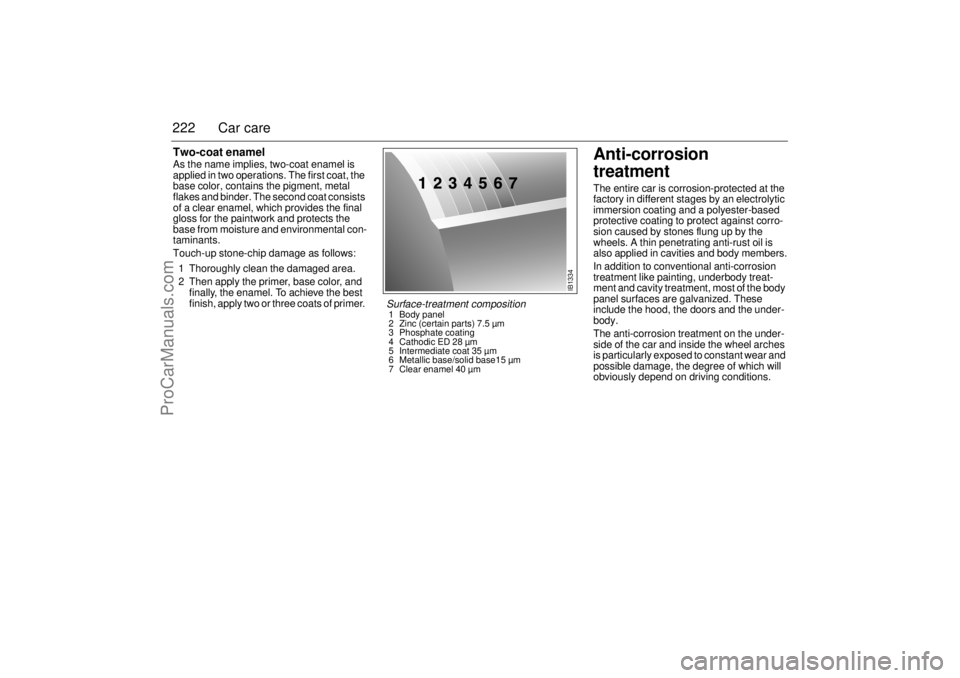
IB1334
Surface-treatment composition 1 Body panel
2 Zinc (certain parts) 7.5 µm
3 Phosphate coating
4 Cathodic ED 28 µm
5 Intermediate coat 35 µm
6 Metallic base/solid base15 µm
7 Clear enamel 40 µm
ProCarManuals.com
Page 223 of 256
223 Car care
What causes rust?Steel body panels of automobiles are sub-
ject to rusting whenever air and moisture
manage to penetrate the protective finish.
Body panels may rust through if the process
is unchecked. Rusting can occur wherever
water is trapped or where the car’s panels
are continuously damp.
Damage to paint and undercoating by
stones, gravel and minor crashes immedi-
ately exposes metal to air and moisture.
Road salts used for de-icing will collect on
the bottom of the car and promote rusting.
Areas of the country with high humidity have
a greater potential for rust problems, espe-
cially where salt is used on roads or there is
moist sea air. Industrial pollution (fallout)
may also damage paint and promote rust-
ing.
Preventive maintenanceThe following procedures are necessary to
help protect against rusting. Refer also to
the terms and conditions of the Performa-
tion Limited Warranty described in the war-
ranty booklet.
1Wash the car frequently, and wax at
least twice a year. Under adverse con-
ditions, where there is a rapid buildup of
dirt, sand or road salt, wash your car at
least once a week. After extreme expo-
sure to salted snow or slush, evidenced
by a white film on the car, wash the car
immediately. Frequent washing will pre-
vent paint damage from acid rain and
other airborne contaminants such as
tree sap and bird droppings. If any of
these contaminants are noticed on the
car the finish should be washed immedi-
ately.
Begin washing by rinsing the entire car
with water to loosen and flush off heavy
concentrations of dirt (include the
underbody).
Sponge the car with a solution of either
a good quality car soap or mild general
purpose (dish washing) detergent and
water.
Rinse car thoroughly with clean water.
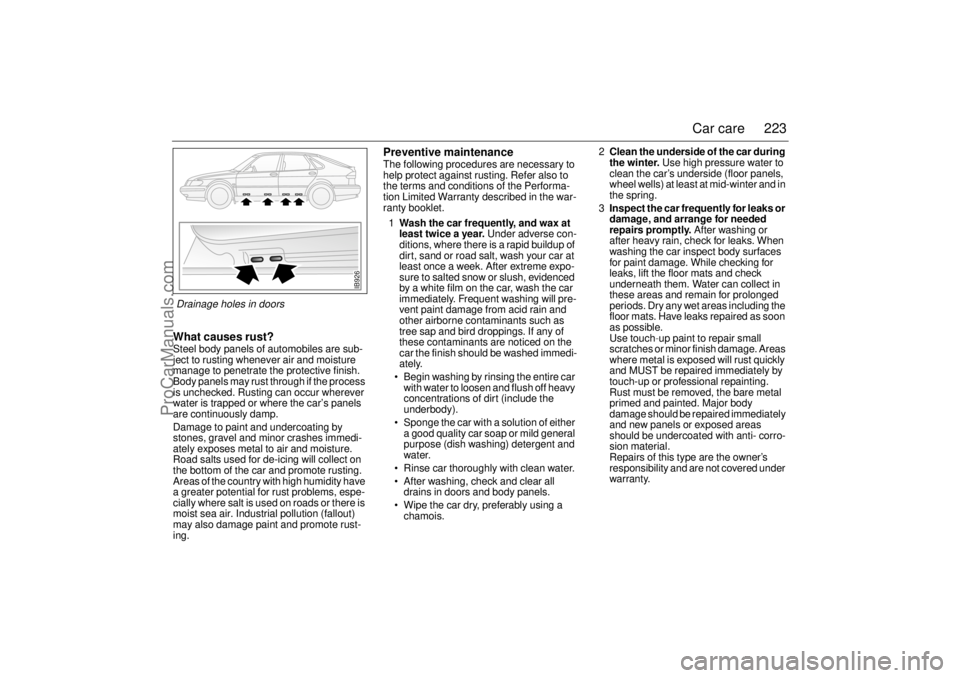
After washing, check and clear all
drains in doors and body panels.
Wipe the car dry, preferably using a
chamois.2Clean the underside of the car during
the winter. Use high pressure water to
clean the car’s underside (floor panels,
wheel wells) at least at mid-winter and in
the spring.
3Inspect the car frequently for leaks or
damage, and arrange for needed
repairs promptly. After washing or
after heavy rain, check for leaks. When
washing the car inspect body surfaces
for paint damage. While checking for
leaks, lift the floor mats and check
underneath them. Water can collect in
these areas and remain for prolonged
periods. Dry any wet areas including the
floor mats. Have leaks repaired as soon
as possible.
Use touch-up paint to repair small
scratches or minor finish damage. Areas
where metal is exposed will rust quickly
and MUST be repaired immediately by
touch-up or professional repainting.
Rust must be removed, the bare metal
primed and painted. Major body
damage should be repaired immediately
and new panels or exposed areas
should be undercoated with anti- corro-
sion material.
Repairs of this type are the owner’s
responsibility and are not covered under
warranty.
IB926
Drainage holes in doors
ProCarManuals.com
Page 224 of 256

224 Car careInspect the undercoating and touch up if
necessary. Pay particular attention to the
fenders and wheel housings, which are
exposed to abrasion by flying gravel, etc. If
the composition has worn or flaked off, the
steel must be thoroughly cleaned and dried
before a fresh coat is applied. The cleaning
is best done with a scraper and a steel wire
brush, followed by washing with solvent.
Apply the new coating thinly, otherwise it
may run off or fall off when dry.
Recovery and/or
recycling of automotive
materialsA typical car consists of metals (65–75%),
plastics (10–15%), rubber (5%) and small
quantities of glass, wood, paper and tex-
tiles.
Some of these materials can be recycled,
while others can be recovered in chemical
processes for reuse in new products or as a
source of energy.
While the Saab 9-3 was still at the draw-
ing-board stage, Saab engineers were
giving serious consideration to how the
maximum quantity of materials could be
reclaimed from the car on its eventual
scrapping. To facilitate sorting, plastic parts,
for instance, have been marked to identify
the precise nature of the plastic.Approximately 90% of the materials in the
car can be recycled or recovered, where
facilities exist.
Before the car is scrapped, all the oils and
other fluids that could pollute the environ-
ment should be recovered from the car. It
may be of interest in this context to learn that
the refrigerant used in the Saab 9-3’s A/C
and ACC systems (R134a) contains neither
CFCs nor any other chlorine compounds
ProCarManuals.com
Page 225 of 256
225 Car care
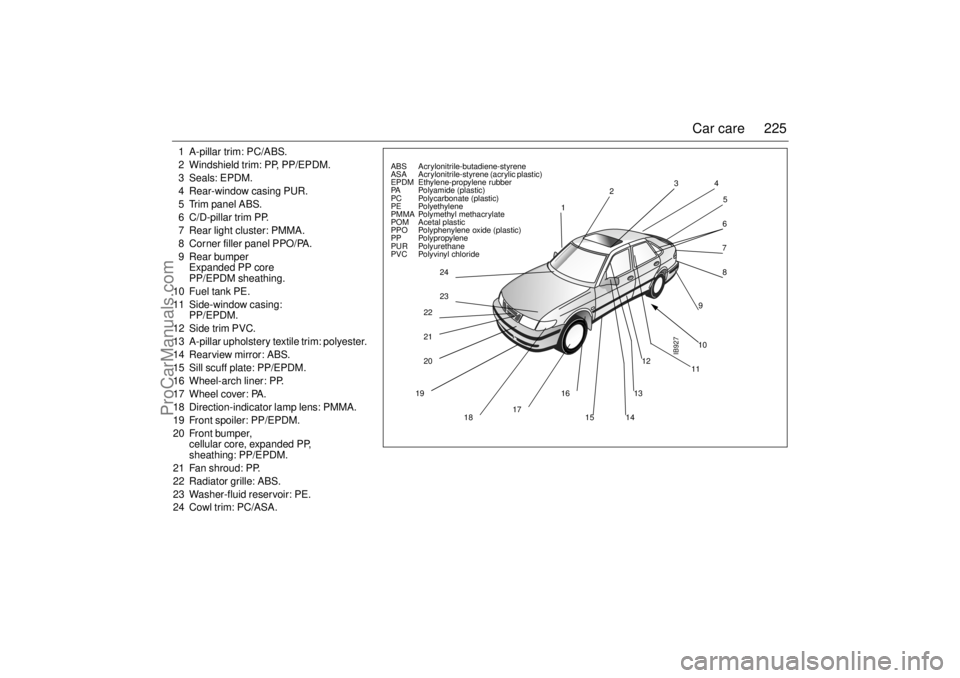
1 A-pillar trim: PC/ABS.
2 Windshield trim: PP, PP/EPDM.
3 Seals: EPDM.
4 Rear-window casing PUR.
5 Trim panel ABS.
6 C/D-pillar trim PP.
7 Rear light cluster: PMMA.
8 Corner filler panel PPO/PA.
9 Rear bumper
Expanded PP core
PP/EPDM sheathing.
10 Fuel tank PE.
11 Side-window casing:
PP/EPDM.
12 Side trim PVC.
13 A-pillar upholstery textile trim: polyester.
14 Rearview mirror: ABS.
15 Sill scuff plate: PP/EPDM.
16 Wheel-arch liner: PP.
17 Wheel cover: PA.
18 Direction-indicator lamp lens: PMMA.
19 Front spoiler: PP/EPDM.
20 Front bumper,
cellular core, expanded PP,
sheathing: PP/EPDM.
21 Fan shroud: PP.
22 Radiator grille: ABS.
23 Washer-fluid reservoir: PE.
24 Cowl trim: PC/ASA.
IB927
19 20 21 22 23 24 1 2 3 4
18 1716
15 14 13 12
11 7
10 98 6 5 ABS Acr ylonitrile-butadiene-styrene
ASA Acrylonitrile-styrene (acrylic plastic)
EPDM Ethylene-propylene rubber
PA Polyamide (plastic)
PC Polycarbonate (plastic)
PE Polyethylene
PMMA Polymethyl methacrylate
POM Acetal plastic
PPO Polyphenylene oxide (plastic)
PP Polypropylene
PUR Polyurethane
PVC Polyvinyl chloride
ProCarManuals.com
Page 234 of 256
234 Technical dataGeneral dimensionsOverall length, with bumper(s):
Coupé/5-door/Convertible____________ 182.3" (4629 mm)
Viggen __________________________ 182.7” (4639 mm)
Overall width, including door mirrors _____ 76.2" (1936 mm)
Maximum height ____________________ 56.2" (1428 mm)
Maximum height when the soft top is being
operated (Convertible) ______________approx. 87"
approx. 2200 mm
Wheelbase ________________________ 102.6" (2605 mm)
Tr a c k :
front, Coupé/5-door/Convertible _______ 57.2" (1452 mm)
front, Viggen ______________________ 57.7” (1466 mm)
rear, Coupé/5-door/Convertible _______ 56.8" (1442 mm)
rear, Viggen ______________________ 57.3” (1456 mm)
Ground clearance at max. weight _______ approx. 3.9"
(100 mm)
Number of occupants, incl. driver:
Coupé and 5-door _________________ 5
Convertible _______________________ 4
Turning circle:
measured at vehicle extremities _______ 36.4 ft. (11.1 m)
curb to curb_______________________ 34.4 ft. (10.5 m)
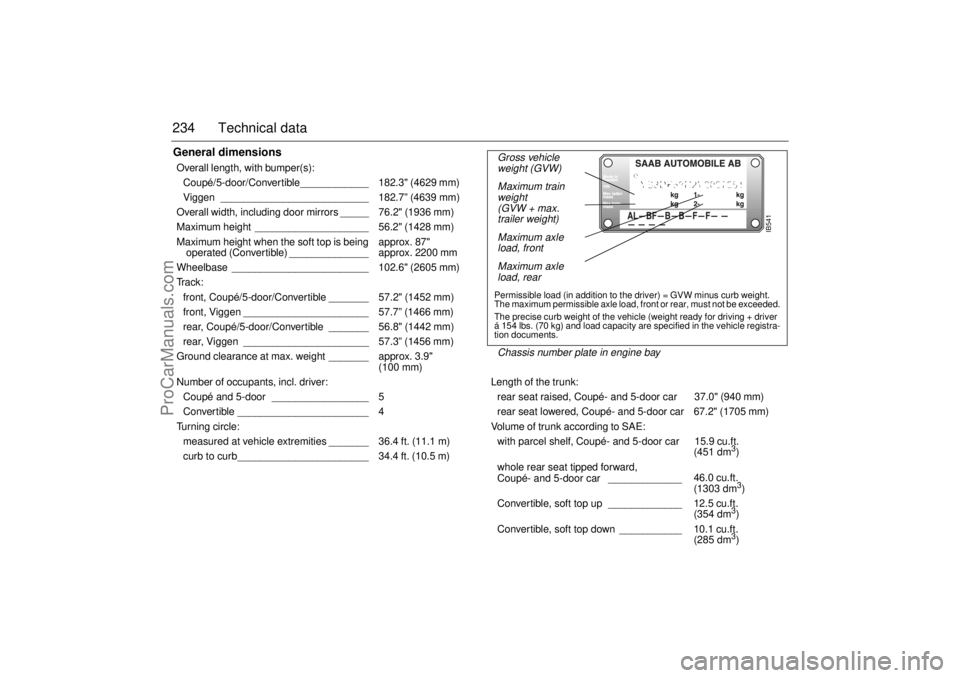
Gross vehicle
weight (GVW)
Maximum train
weight
(GVW + max.
trailer weight)
Maximum axle
load, front
Maximum axle
load, rear Permissible load (in addition to the driver) = GVW minus curb weight.
The maximum permissible axle load, front or rear, must not be exceeded.
The precise curb weight of the vehicle (weight ready for driving + driver
á 154 lbs. (70 kg) and load capacity are specified in the vehicle registra-
tion documents.Chassis number plate in engine bay Length of the trunk:
rear seat raised, Coupé- and 5-door car 37.0" (940 mm)
rear seat lowered, Coupé- and 5-door car 67.2" (1705 mm)
Volume of trunk according to SAE:
with parcel shelf, Coupé- and 5-door car 15.9 cu.ft.
(451 dm
3)
whole rear seat tipped forward,
Coupé- and 5-door car _____________ 46.0 cu.ft.
(1303 dm3)
Convertible, soft top up _____________ 12.5 cu.ft.
(354 dm3)
Convertible, soft top down ___________ 10.1 cu.ft.
(285 dm3)
IB541
ProCarManuals.com
Page 235 of 256

235 Technical data
Weight ready for driving (i.e. with full fuel
tank, washer- fluid reservoir, standard
tools and spare wheel)
Coupé ___________________________ 2980-3170 lbs.
(1350-1440 kg)
Viggen, Coupé ____________________ 3130-3160 lbs.
(1420-1435 kg)
5-door ___________________________
3020-3220 lbs.
(1370-1460 kg)
Viggen, 5-door ____________________ 3170-3210 lbs
(1440-1455 kg)
Convertible _______________________ 3110-3300 lbs.
(1410-1495 kg)
Viggen, Convertible ________________ 3250-3260 lbs.
(1475-1480 kg)Gross vehicle weight (GVW)
Coupé ___________________________ 3930-4060 lbs.
(1785-1840 kg)
Viggen, Coupé ____________________ 4060 lbs. (1840 kg)
5-door __________________________ 3980-4100 lbs.
(1805-1860 kg)
Viggen, 5-door ____________________ 4100 lbs. (1860 kg)
Convertible ______________________ 3940-4020 lbs.
(1785-1825 kg)
Viggen, Convertible ________________ 3990 lbs. (1810 kg)
Maximum axle load
front ____________________________ 2300 lbs. (1045 kg)
rear ____________________________ 1930 lbs. (875 kg)
Weight distribution:
Curb weight, front/rear ______________ approx. 62/38 %
GVW, front/rear ___________________ approx. 58/42%
ProCarManuals.com