engine SAAB 9-3 2003 Owners Manual
[x] Cancel search | Manufacturer: SAAB, Model Year: 2003, Model line: 9-3, Model: SAAB 9-3 2003Pages: 256, PDF Size: 21.66 MB
Page 231 of 256

231 Maintenance and owner assistance
Engine oil and filter changesChanging the engine oil and filter is required
at every service point. Use only a Saab
approved long-life oil filter and engine oils
meeting the SAE viscosity ratings and API
service classifications stated in the “Techni-
cal data” section of this Owner’s Manual.
The use of extra additives in the oil is not
necessary and is not recommended, and
may be harmful to turbochargers.
More frequent oil changes are recom-
mended if your vehicle is operated under
any of the following conditions:
Most trips are less than 5–10 miles (8–
16 km). This is particularly important
when outside temperatures are below
freezing.
Most trips include extensive idling
(frequent stop-and-go traffic).
Most trips are through dusty areas (such
as construction zones).
If the vehicle is used for delivery service,
police, taxi or other commercial applica-
tions.
If your driving habits match this description,
have the engine oil and filter changed in-
between normal services at 5,000 mile
(8,000 km) intervals. These conditions
cause the engine oil to break down faster.
The Warranties and Service Record Book-
let has provisions to record extra oil
changes.
Service record retentionIt is the owner’s responsibility to retain ser-
vice records. If possible, you should keep
copies of all shop work orders for all service
and repairs, whenever performed. As indi-
cated in the new car and emission control
system warranties, it is important to docu-
ment that all necessary maintenance has
been done.
HOW THE SERVICE RECORD IS ORGA-
NIZED
The service record is comprised of a main-
tenance log and a separate log sheet for list-
ing any additional service and repairs.
There are five coupons at the front of the
section, three of which are for documenting
extra engine oil and filter changes, one for
extra automatic transmission fluid services
necessary for severe service conditions,
one for brake fluid changes and one for
coolant flushes. These are followed by log
sheets for all normal scheduled mainte-
nance in the order it is to be performed,
beginning with the “First Service”.HOW TO USE THE SERVICE RECORD
COUPONS
When the car is brought to a Saab dealer for
scheduled maintenance, present the War-
ranties & Service Record Booklet to the ser-
vice manager. When the technician has
completed the service, the technician will
sign the maintenance record. The person
responsible for quality assurance at the
dealership will also sign and stamp the
record with the dealer identification stamp.
ProCarManuals.com
Page 235 of 256
235 Technical data
General particulars _____ 236
Engine _______________ 238
Engine oil _____________ 238
Fuel__________________ 240
Engines ______________ 240
Electrical system_______ 240
Drive belt _____________ 240
Manual transmission ___ 241
Automatic transmission _ 241
Suspension ___________ 242
Steering ______________ 242
Brake system__________ 242
Wheels and tires _______ 243
Plates and labels _______ 246
Technical data
ProCarManuals.com
Page 238 of 256

238 Technical dataEngine Engine oilType: Four cylinders,
double overhead
camshafts,
16 valves, two
balancer shafts,
dual-mass flywheel
Cylinder bore_______________________ 3.386'' (86 mm)
Stroke ____________________________ 3.386'' (86 mm)
Swept volume ______________________ 122 cu.in. (1.998 l)
Idling speed________________________ 670 rpm
Antifreeze _________________________ Saab-approved
antifreeze
Coolant capacity ____________________ 7.5 qts. (7.1 l)
Oil grade
:
We recommend the use of Saab or Mobile oils, available from
you Saab dealer, for regular oil changes.
These oils are specially developed from high-quality compo-
nents to meet the demands of extended service intervals (max.
18,000 miles (30,000 km) or 2 years). Saab and Mobil oils are
tested and approved in accordance with the GM standard for
long-life oils. Such gasoline engine oils are given the designa-
tion GM-LL-A 025. The requirements are the same for diesel
oils, though these are given the designation GM-LL-B 025.
To ensure optimum engine performance, with regard to lu-
brication, the ability to dissolve residues and the neutrali-
sation of combustion products in the oil, for a service
interval of 18,000 miles (30,000 km) or a maximum of
2 years, the engine oil used must fulfil GM-LL-A 025 (gaso-
line engines) or GM-LL-B 025 (diesel engines).
Only oil of the above grades may be used.
Oils of the above grades contain the additives required for
the engine to function well. We advise against the use of
further additives.
The gasoline engine oil is unique in that not only does it fulfil the
stringent requirements demanded by API and ACEA standards
but also meets ACEA requirements for fuel-saving properties.
ProCarManuals.com
Page 239 of 256

239 Technical data
Other grade classifications:API and ACEA designations can also be found on the packag-
ing alongside the GM designations GM-LL-A 025 and
GM-LL-B 025. Oil for gasoline engines classified in accordance
with API standards (American Petroleum Institute) can include
SH (since 1993), SJ (since 1996) and SL (from 2001) classes.
SL class oils fulfil the most stringent requirements. These grade
classes are most often combined with the corresponding class-
es for diesel engines. The class designations for diesel engines
begin with the letter "C" (Commercial). For example, a grade
combination suitable for both types of engine could be API SJ/
CF or SL/CF.
Under ACEA nomenclature, oils are divided into Class A for
petrol engines and Class B for diesel engines. There is a further
class for heavy diesel engines. Each class is divided into
three or four (diesel) grades where grades 2 and 3 (diesel: 4)
normally encompass products comprising semi and fully-
synthetic components.
In the same way as in the API system, gasoline and diesel en-
gine specifications are combined for products that can be used
in both types of engine. For example, a grade designation could
be ACEA A2/B2 or ACEA A3/B3-B4.
Viscosity:
The viscosity of oil is classified according to the SAE standard
(SAE: Society of Automobile Engineers). Nowadays, multigrade
oils are always used in cars. The properties of these oils facili-
tate starting the car in cold weather but mean that the oil is also
sufficiently viscous to coat all moving parts under all operating
conditions.
Multigrade oils are graded with two viscosities, e.g. 0W-30,
where the 0W meets certain viscosity requirements at –22°F (–
30°C), while the 30 fulfils requirements at a temperature of
212°F (100°C).
The approved gasoline engine oil, GM-LL-A 025, has a vis-
cosity of SAE 0W-30.
Oil capacity, including filter (oil change) __ 6.3 qts. (6.0 l)
ProCarManuals.com
Page 240 of 256
240 Technical dataFuel
EnginesElectrical system
Drive belt
Fuel tank capacity ___________________ 16.3 U.S. gal. (62 l)
For optimum performance
Saab recommends:
2.0t (175 hp) ______________________ Unleaded 90 AON
2.0 Turbo (210 hp) _________________ Unleaded 93 AON2.0t EcopowerRating, EEC at 5500 rpm ____________ 175 hp (129 kW)
Maximum torque, EEC at 2500 rpm ____ 195 ft.lb. (265 Nm)
Compression ratio__________________ 9.5:12.0 Turbo EcopowerRating, EEC at 5500 rpm ____________ 210 hp (147 kW)
Maximum torque, EEC at 2500 rpm ____ 221 ft.lb. (300 Nm)
Compression ratio__________________ 9.5:1Voltage ___________________________ 12 V
Battery capacity ____________________ 60 or 70 Ah
Starter motor_______________________ 1.8 kW
Alternator rating: ____________________ 140 A/14 V
Firing order ________________________ 1-3-4-2
Spark plugs________________________ NGK PFR6T-10G
Electrode gap ______________________ 0.9–1.0 mm
Outside length______________________ 40.472'' (1028 mm)
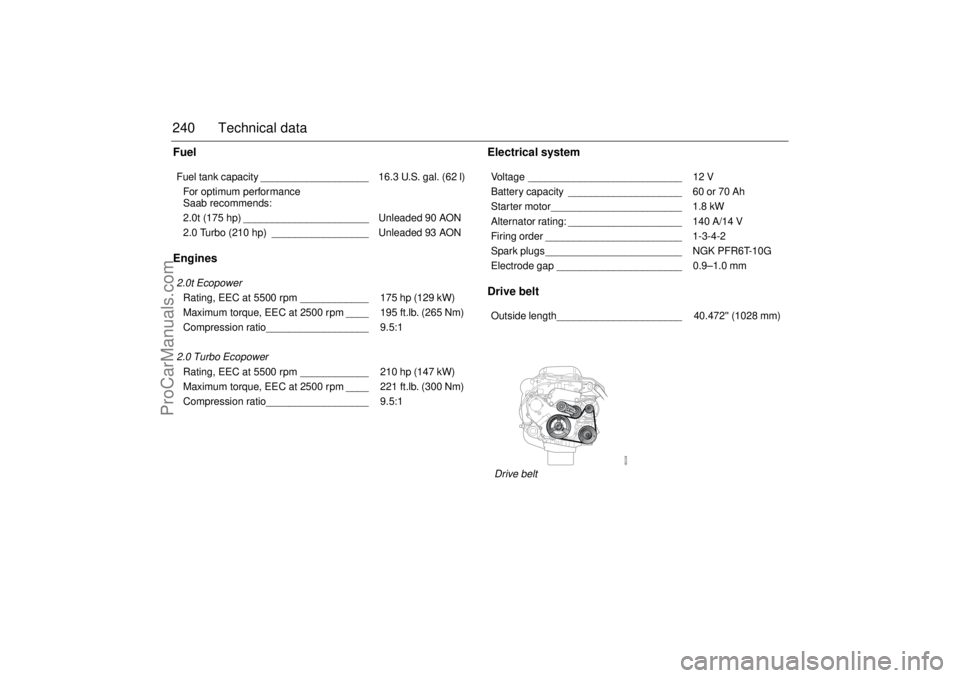
Drive belt
ProCarManuals.com
Page 244 of 256

244 Technical dataRecommended tire/engine combinationsRF = Reinforcement (tire with reinforced sidewalls)
2.0t 2.0 Turbo
Summer tires
215/60 R15 94 H x –
215/55 R16 93 H x –
215/50 R17 91 W or
225/45 R17 91 Wxx
225/45 R18 91 W x x
Winter (snow) tires
195/65 R15 91 Q x –
195/65 R15 95 Q RF x –
205/55 R16 91 Q x x
215/55 R16 93 Q x x
205/50 R17 93 Q RF x x
Wheel sizes
6.5 x 15" – –
6.5 x 16" x x
7 x 17" x x
7.5 x 18" (accessory) x x
ProCarManuals.com
Page 246 of 256
246 Technical data
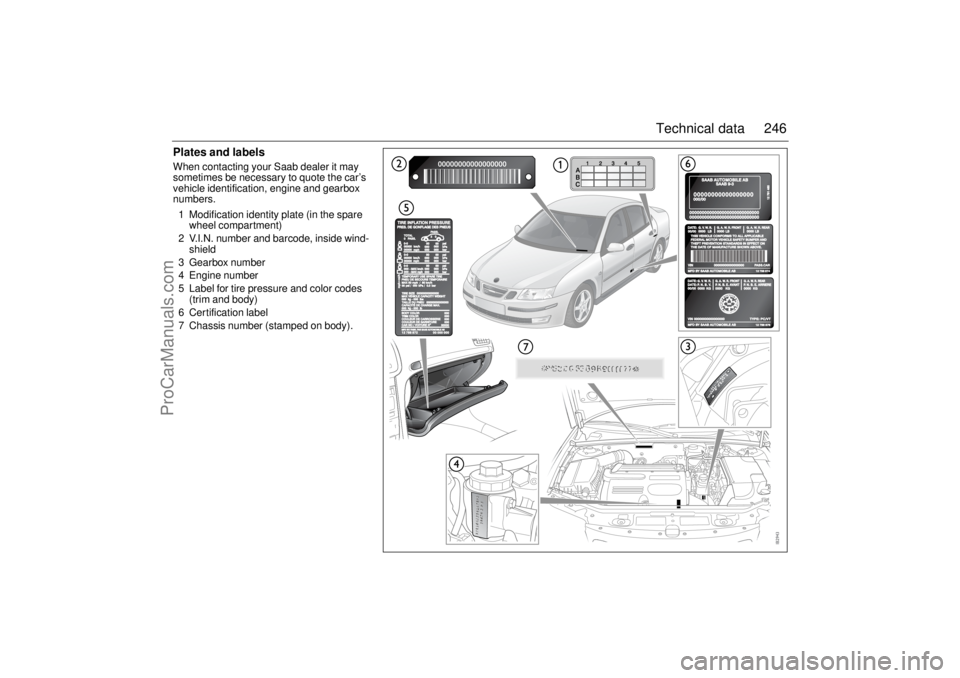
Plates and labelsWhen contacting your Saab dealer it may
sometimes be necessary to quote the car’s
vehicle identification, engine and gearbox
numbers.
1 Modification identity plate (in the spare
wheel compartment)
2 V.I.N. number and barcode, inside wind-
shield
3 Gearbox number
4 Engine number
5 Label for tire pressure and color codes
(trim and body)
6 Certification label
7 Chassis number (stamped on body).
ProCarManuals.com
Page 247 of 256

247 Technical data1 Region ________Y = Nor thern Europe
2 Country _______S = Sweden
3 Manufacturer ___3 = Saab Automobile AB
4 Product line ____F = 9-3
5 Model series ___B = 9-3 Linear
D = 9-3 Arc
F = 9-3 Vector6 Body version ___4 = 4-door
7 Gearbox _______5 = 5-speed manual
6 = 6-speed manual
9 = 5-speed automatic
8 Engine variant __S = 2.0t
Y = 2.0 Turbo
9 Check digit_____0-9 or X
10 Model year ____3 = 2003
11 Factory _______1 = Trollhättan
12 Serial number __000001-999999 Position: 1234567891011 12
||||||||| | | |
Vehicle identifi-
cation number:Y S 3 F D 4 5 S X 3 1 016584
||||||
1 2 3 4 5 6 = identification codes for certain chassis components
ProCarManuals.com
Page 249 of 256
249 Technical data
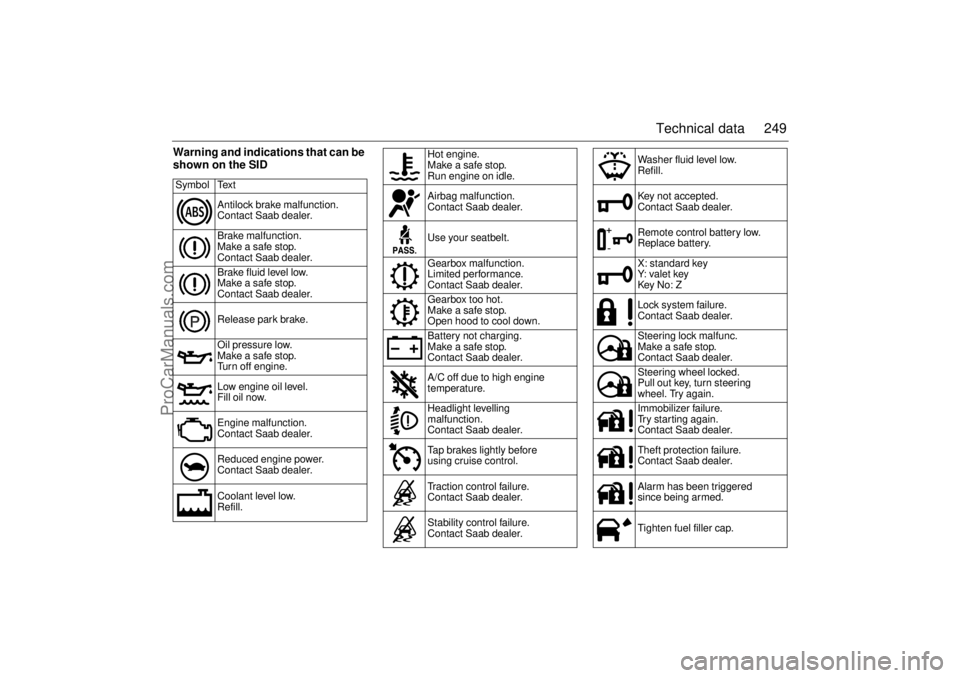
Warning and indications that can be
shown on the SIDSymbol Text
Antilock brake malfunction.
Contact Saab dealer.
Brake malfunction.
Make a safe stop.
Contact Saab dealer.
Brake fluid level low.
Make a safe stop.
Contact Saab dealer.
Release park brake.
Oil pressure low.
Make a safe stop.
Turn off engine.
Low engine oil level.
Fill oil now.
Engine malfunction.
Contact Saab dealer.
Reduced engine power.
Contact Saab dealer.
Coolant level low.
Refill.
Hot engine.
Make a safe stop.
Run engine on idle.
Airbag malfunction.
Contact Saab dealer.
Use your seatbelt.
Gearbox malfunction.
Limited performance.
Contact Saab dealer.
Gearbox too hot.
Make a safe stop.
Open hood to cool down.
Battery not charging.
Make a safe stop.
Contact Saab dealer.
A/C off due to high engine
temperature.
Headlight levelling
malfunction.
Contact Saab dealer.
Tap brakes lightly before
using cruise control.
Traction control failure.
Contact Saab dealer.
Stability control failure.
Contact Saab dealer.
Washer fluid level low.
Refill.
Key not accepted.
Contact Saab dealer.
Remote control battery low.
Replace battery.
X: standard key
Y: va l e t key
Key No: Z
Lock system failure.
Contact Saab dealer.
Steering lock malfunc.
Make a safe stop.
Contact Saab dealer.
Steering wheel locked.
Pull out key, turn steering
wheel. Try again.
Immobilizer failure.
Try starting again.
Contact Saab dealer.
Theft protection failure.
Contact Saab dealer.
Alarm has been triggered
since being armed.
Tighten fuel filler cap.
ProCarManuals.com
Page 251 of 256

251 Index
Index
AA/C
__________________________ 82
ABS brakes
___________________ 142
ACC
_________________________ 84
Adjustment, steering wheel
________ 98
Air conditioning
_________________ 82
Air filter
______________________ 178
Air pressure, tyres
______________ 207
Airbag
________________________ 26
Anchorage eyes
_______________ 118
Anti-corrosion treatment
_________ 220
Antilock braking system _________ 142
Anti-spin
_____________________ 144
Ashtrays _____________________ 108
Autochecking of lights, warning and
indicator lights
_________________ 58
Autodimming
______________ 111
, 112
Automatic climate control (ACC)
____ 84
Automatic transmission
__________ 134
Automatic tyre pressure monitoring
207
BBattery
______________________ 182
Bedding-in of new brake pads
____ 132
Before towing a trailer
___________ 160
Bonnet
______________________ 172Bootlid, driving when open
_______ 163
Bootlid, opening
________________ 41
Brake fluid, grade ______________ 242
Brakes
_______________________ 141
Braking ______________________ 141
Bulb changing
_________________ 188
Bulb table
____________________ 198
CCabin lighting
_________________ 105
Car alarm
_____________________ 46
Car transport __________________ 166
Care of air conditioning
__________ 225
Change of address notification
____ 232
Changing bulbs
________________ 188
Changing engine oil
____________ 177
Changing the battery, remote control
44
Changing wheels
______________ 214
Changing wiper blades
__________ 186
Checking the number of
remote controls
________________ 43
Checks before towing a trailer
____ 160
Child safety
____________________ 21
Child safety locks, rear doors
______ 42
Child seats
____________________ 21
Cigarette lighter
________________ 108
Cleaning the engine bay
_________ 218
Cleaning upholstery
____________ 217
Climate control system, manual
____ 79
Compact spare
________________ 212Compass
_____________________ 115
Condensation water, A/C
_________ 82
Coolant
______________________ 179
Cruise control
_________________ 140
Cup holder
____________________ 107
DDate codes, tyres
______________ 212
Deep water, driving through
______ 163
Direction indicator stalk switch _____ 75
Direction indicators
______________ 75
Donor battery, boost starting
______ 168
Door handles
___________________ 38
Door mirrors __________________ 110
Drive belt
_____________________ 185
Drive belt, length
_______________ 240
Driver’s seat with memory
_________ 19
Driving at night
________________ 163
Driving in cold climates
__________ 155
Driving in deep water
____________ 163
Driving in hot climates ___________ 156
Driving techniques
______________ 153
Driving with a heavy load on
hilly roads
___________________ 136
Driving with a load
______________ 162
Driving with a roof load
__________ 161
Driving with the bootlid open
______ 163
Driving with the compact
spare wheel
__________________ 167
ProCarManuals.com