warning SAAB 9-3 2003 Owners Manual
[x] Cancel search | Manufacturer: SAAB, Model Year: 2003, Model line: 9-3, Model: SAAB 9-3 2003Pages: 256, PDF Size: 21.66 MB
Page 189 of 256
189 Car care
Bi-Xenon headlight, main and dipped beam (certain
variants only)Xenon headlights produce roughly three times as much light as
halogen bulbs and have a significantly longer service life.
The lamp units consist of a gas discharge lamp containing xenon.
When the lights are switched on a very high voltage activates the
xenon gas. The lamps soon reach full intensity.
Cars with Bi-Xenon headlights have automatic levelling. The level-
ling system comprises two sensors, one on the front suspension and
one on the rear suspension, and a control unit by the engine bay fuse
box. Headlight alignment is adjusted automatically to the car’s load
to prevent dazzling drivers in oncoming traffic.
If a fault is detected in the system, the following message will be dis-
played on the SID:
WARNING
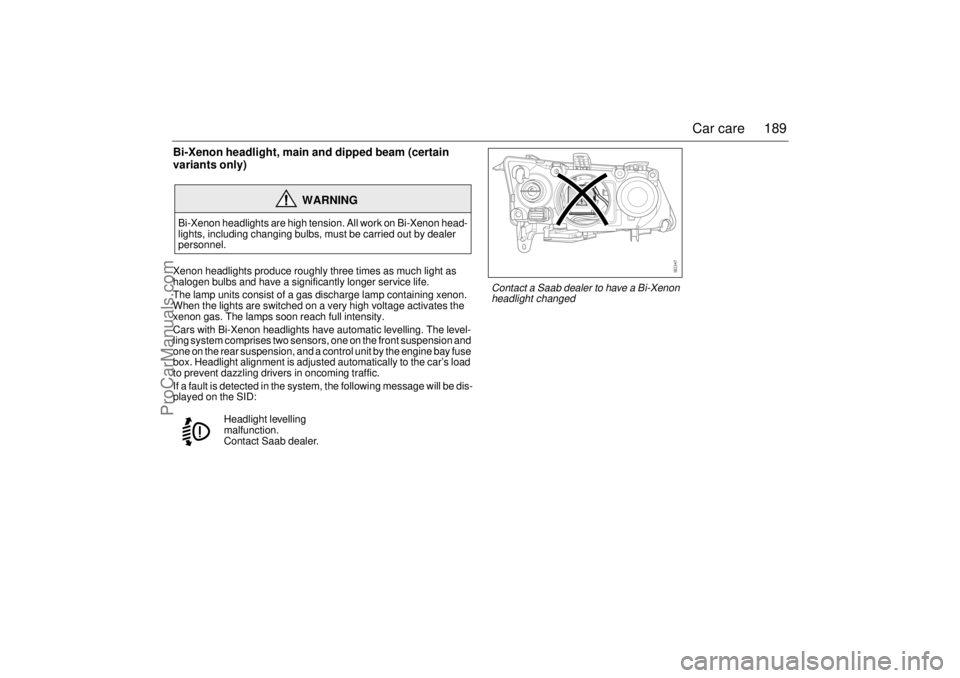
Bi-Xenon headlights are high tension. All work on Bi-Xenon head-
lights, including changing bulbs, must be carried out by dealer
personnel.
Headlight levelling
malfunction.
Contact Saab dealer.
Contact a Saab dealer to have a Bi-Xenon
headlight changed
ProCarManuals.com
Page 193 of 256

193 Car care
Side-mounted turn signal bulbs1 Slide the lamp fitting forward so that its
rear end can be pulled out.
2 Turn the bulb holder counterclockwise
and withdraw it from the lamp fitting.
Change the bulb.
3 To fit, engage the two catches on the
rear edge of the lamp fitting with the
edge of the opening. Then press in the
front edge of the lamp fitting so that the
groove in the spring engages the plastic
edge.
Front fog lights
1 Undo one screw in the wheel housing.
Lower the air shield.
2 Remove the protective cover. Release
the two spring clips securing the bulb.
3 Unplug the connector.
4 Change the bulb. Try not to touch the
glass part of the bulb with your fingers.
The height of the beam can be adjusted
using a screwdriver inserted through the
hole in the lower grille adjacent to the lens.
WARNING
Never crawl under a car that is
supported only by a jack.
Always use axle stands. Refer to
the information on jacks on pages 214
and 215.
ProCarManuals.com
Page 199 of 256
199 Car care
Fuses
The fuses are housed in three fuse panels:
one behind a hatch on the left-hand end of
the fascia, one in the engine bay (additional
small unit in front of battery) and one on the
left-hand side of the trunk. There is space
for spare fuses in the hatch on the left-hand
end of the fascia.
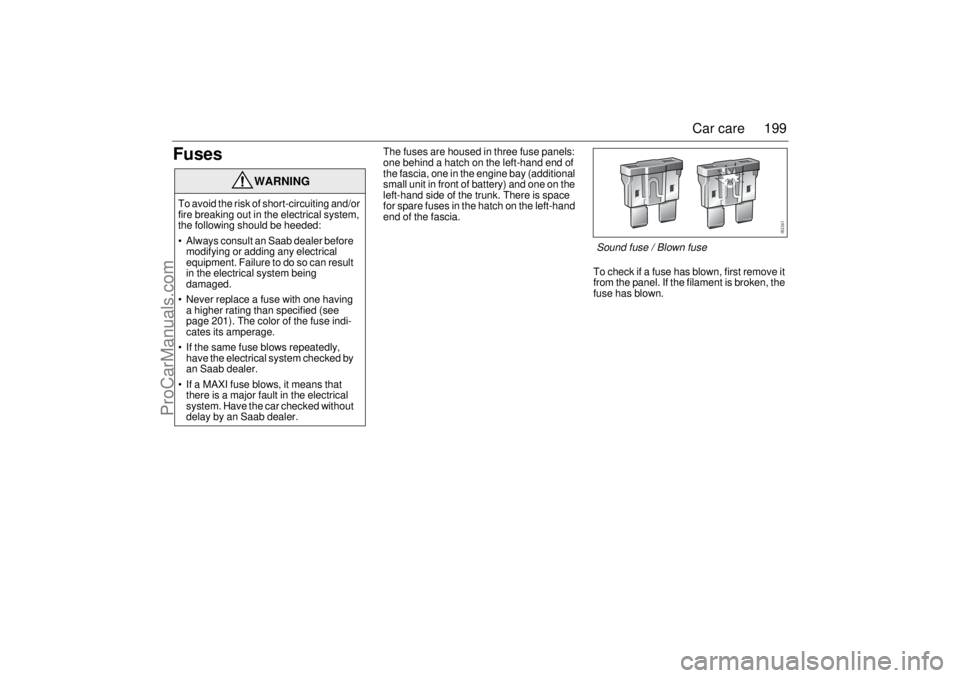
To check if a fuse has blown, first remove it
from the panel. If the filament is broken, the
fuse has blown.
WARNING
To avoid the risk of short-circuiting and/or
fire breaking out in the electrical system,
the following should be heeded:
Always consult an Saab dealer before
modifying or adding any electrical
equipment. Failure to do so can result
in the electrical system being
damaged.
Never replace a fuse with one having
a higher rating than specified (see
page 201). The color of the fuse indi-
cates its amperage.
If the same fuse blows repeatedly,
have the electrical system checked by
an Saab dealer.
If a MAXI fuse blows, it means that
there is a major fault in the electrical
system. Have the car checked without
delay by an Saab dealer.
Sound fuse / Blown fuse
ProCarManuals.com
Page 207 of 256

207 Car care
Tire pressure
Note: Low tire pressure also causes prema-
ture tire wear and increased fuel consump-
tion.
Adjust the tire pressure to match the current
load and speed of the car (see page 245).
The stated tire pressures apply to cold tires,
i.e. tires that are the same temperature as
the outside air temperature. Tire pressure
increases as the tires become warm (e.g.
during highway driving) by approximately
0.3 bar (4 psi). When the temperature of the
tires changes by 50°F (10°C), the tire pres-
sure will change 0.1 bar (2 psi).
Never reduce the pressure of a hot tire. If the
tires are hot when you check them, only
increase the pressure, if necessary.
Soft tires will cause faster wear than over-
pressurized tires.
If a valve is leaking, simply unscrew it and fit
a new one.
Note: Remember to adjust the tire pressure
if you change the load in the car or intend to
cruise at a speed that is substantially differ-
ent from normal.
Automatic tire pressure monitoring(option, certain variants only)
The pressure monitoring system consists of
a sensor in each wheel, a detector in each
wheel housing and a receiver. The sensors
are located inside the wheels directly adja-
cent to the air valves.
WARNING
Check the tire pressure at least once a
month and before long journeys. Under-
inflation can result in:
punctures
separation of the tire and tread
damage to the sidewalls
damage to the rims on poor roads
poor handling characteristics.
WARNING
The system is intended to aid the driver.
The driver is always ultimately responsi-
ble for ensuring that the tire pressure is
correct.NOTICEGreat care must be taken when changing
tires so as not to damage the sensors that
are integrated in the valves.
ProCarManuals.com
Page 208 of 256
208 Car careThe receiver is located in the trunk. Tire
pressure information is sent wirelessly to
the receiver.
The system checks the tire pressure when
the car is travelling over 18 mph (30 km/h).
The system is "self-learning", which means
that the position of the wheels can be
changed without requiring adjustments to
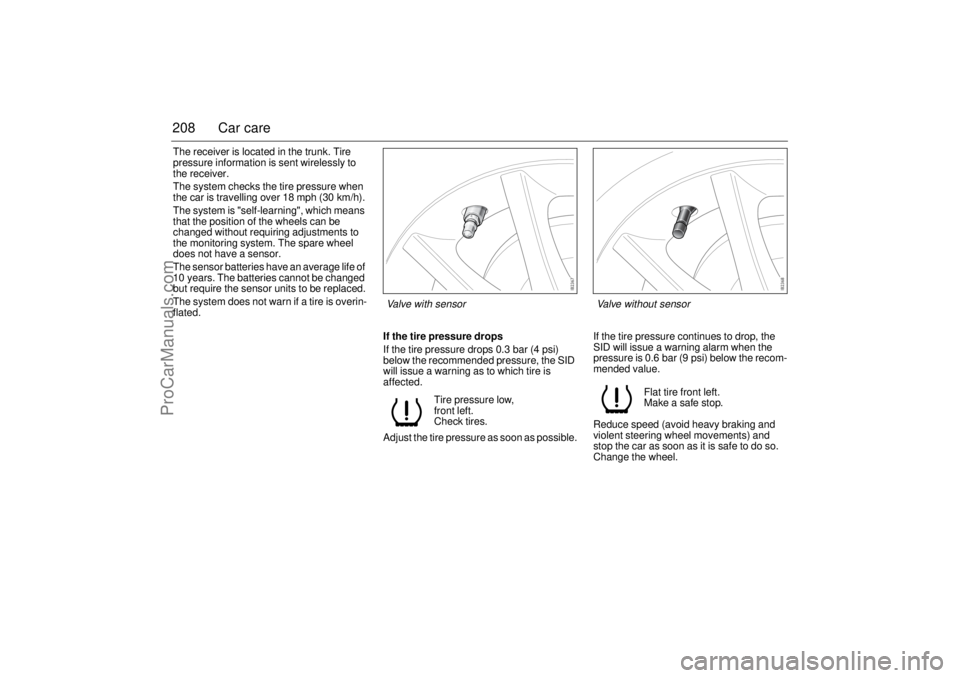
the monitoring system. The spare wheel
does not have a sensor.
The sensor batteries have an average life of
10 years. The batteries cannot be changed
but require the sensor units to be replaced.
The system does not warn if a tire is overin-
flated.
If the tire pressure drops
If the tire pressure drops 0.3 bar (4 psi)
below the recommended pressure, the SID
will issue a warning as to which tire is
affected.
Adjust the tire pressure as soon as possible.If the tire pressure continues to drop, the
SID will issue a warning alarm when the
pressure is 0.6 bar (9 psi) below the recom-
mended value.
Reduce speed (avoid heavy braking and
violent steering wheel movements) and
stop the car as soon as it is safe to do so.
Change the wheel. Tire pressure low,
front left.
Check tires.
Flat tire front left.
Make a safe stop.
Valve with sensor Valve without sensor
ProCarManuals.com
Page 209 of 256

209 Car care
Malfunction
The message shown above will be dis-
played on the SID if:
a wheel without pressure sensor is fitted
(e.g. spare wheel)
one, two or three pressure sensors are
broken or missing
two or more detectors are missing or
broken
the receiver malfunctions
a fault arises in the system.
The message shown above is not displayed
if none of the wheels have sensors, such as
if winter wheels without sensors are fitted.
Shifting the wheelsBecause of front wheel drive, the front tires
tend to wear faster than the rear ones. New
tires should always be fitted in pairs, so that
tires on the same axle have the same
amount of tread.
The wheels should be marked, L (left) and
R (right), when changing between summer
and winter (snow) tires. This ensures that
the direction of rotation of the wheels is the
same when they are refitted. Fit the tires in
best condition to the rear wheels.
Store wheels lying flat or hanging – never
standing upright.
Tire markingsAn example of the meaning of the different
markings in a tire size is given below for a
tire size of 195/65 R15 91H: Tire pressure
system failure.
Contact Saab dealer.
WARNING
When fitting just one new pair of tires,
these should be fitted to the rear wheels,
as these are more critical to the direc-
tional stability of the car (e.g. on braking
or in a skid). The existing rear wheels
should therefore be moved to the front.
Always move rear left to front left and rear
right to front right, so that the direction of
rotation remains the same.
195 Tire section width, mm
65 Aspect ratio, i.e. the section height
as a percentage of the section
width
R Radial ply
15 Wheel rim diameter 15 in at bead
seats
91 Tire load index
H Speed rating
Tire load indices
91 Tire approved for max. 1355 lbs.
(615 kg)
93 Max. 1433 lbs. (650 kg)
94 Max. 1477 lbs. (670 kg)
Speed ratings
S Tire approved for speeds up to
110 mph (180 km/h)
T Max. 118 mph (190 km/h)
H Max. 130 mph (210 km/h)
V Max. 149 mph (240 km/h)
W Max. 168 mph (270 km/h)
Y Max. 186 mph (300 km/h)
ProCarManuals.com
Page 210 of 256

210 Car careWinter tiresWinter (snow) tires are recommended for
winter climates where the majority of your
driving will be done on snow and ice. Winter
tires should be fitted to all four wheels to
maintain a proper balance. Your Saab
dealer can advise you of to the correct size
tire for your car (if different from the original
size) and also supply Saab approved winter
tires pre-mounted on steel or alloy rims.Tire quality grading (cars sold in
U.S.)New tires must be graded and labeled in
accordance with new Federal regulations.
Standard tests are conducted to measure
performance in the areas of traction and
temperature resistance. Refer to the tire
sidewall for the specific quality grades of the
tires provided on your new Saab. Compact
spare tires are exempt.
DOT QUALITY GRADES
Treadwear.
Traction AA, A, B, C.
Temperature A, B, C.
All passenger car tires must conform to Fed-
eral safety requirements in addition to these
grades.
Uniform Tire Quality Grading (US)Quality grades can be found where applica-
ble on the tire sidewall between tread shoul-
der and maximum section width. For exam-
ple:
Treadwear 200 Traction AA
Temperature ATreadwearThe treadwear grade is a comparative
rating based on the wear rate of the tire
when tested under controlled conditions on
a specified government test course. For
example, a tire graded 150 would wear one
and one half (1 1/2) times as well on the gov-
ernment course as a tire graded 100. The
relative performance of tires depends upon
the actual conditions of their use, however,
and may depart significantly from the norm
due to variations in driving habits, service
practices and differences in road character-
istics and climate.
TractionThe traction grades, from highest to lowest,
are AA, A, B and C. These grades represent
the tire’s ability to stop on wet pavement as
measured under controlled conditions on
specified government test surfaces of
asphalt and concrete. A tire marked C may
have poor traction performance.
WARNING
The traction grade assigned to a tire is
based on straight-ahead braking, traction
test and does not include acceleration,
cornering, hydroplaning or peak traction
characteristics.
ProCarManuals.com
Page 211 of 256
211 Car care
TemperatureThe temperature grades are A (the highest),
B, and C, representing the tire’s resistance
to the generation of heat and its ability to dis-
sipate heat when tested under controlled
conditions on a specified indoor laboratory
test wheel. Sustained high temperature can
cause the material of the tire to degenerate
and reduce tire life. Excessive temperature
can lead to sudden tire failure. The grade C
corresponds to a level of performance
which all passenger car tires must meet
under the Federal Motor Vehicle Safety
Standard No. 109.
Grades B and A represent higher levels of
performance on the laboratory test wheel
than the minimum required by law.
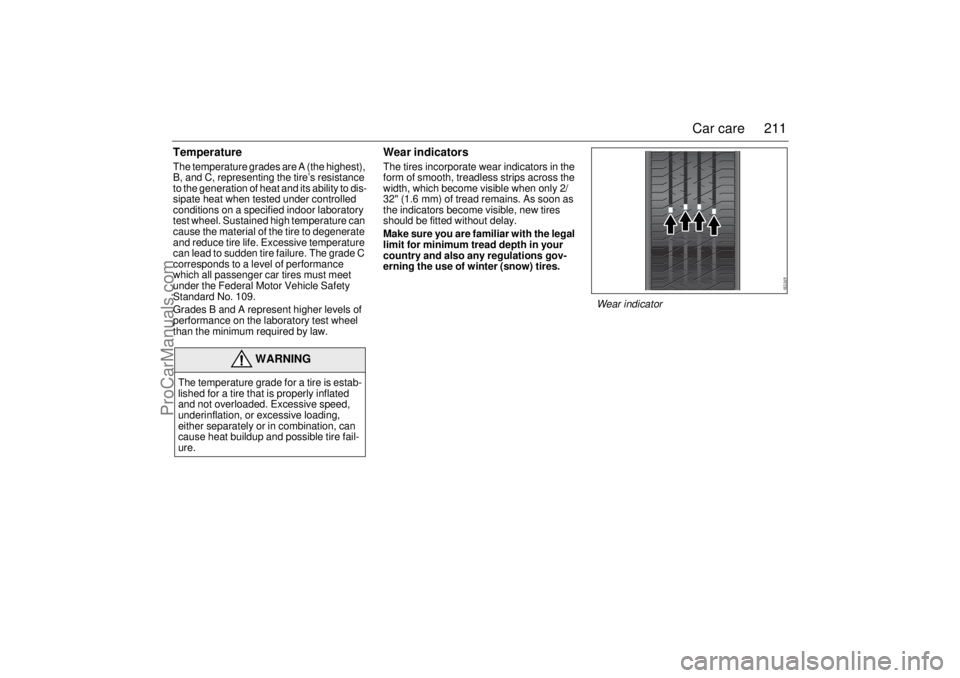
Wear indicatorsThe tires incorporate wear indicators in the
form of smooth, treadless strips across the
width, which become visible when only 2/
32" (1.6 mm) of tread remains. As soon as
the indicators become visible, new tires
should be fitted without delay.
Make sure you are familiar with the legal
limit for minimum tread depth in your
country and also any regulations gov-
erning the use of winter (snow) tires.
WARNING
The temperature grade for a tire is estab-
lished for a tire that is properly inflated
and not overloaded. Excessive speed,
underinflation, or excessive loading,
either separately or in combination, can
cause heat buildup and possible tire fail-
ure.
Wear indicator
ProCarManuals.com
Page 212 of 256
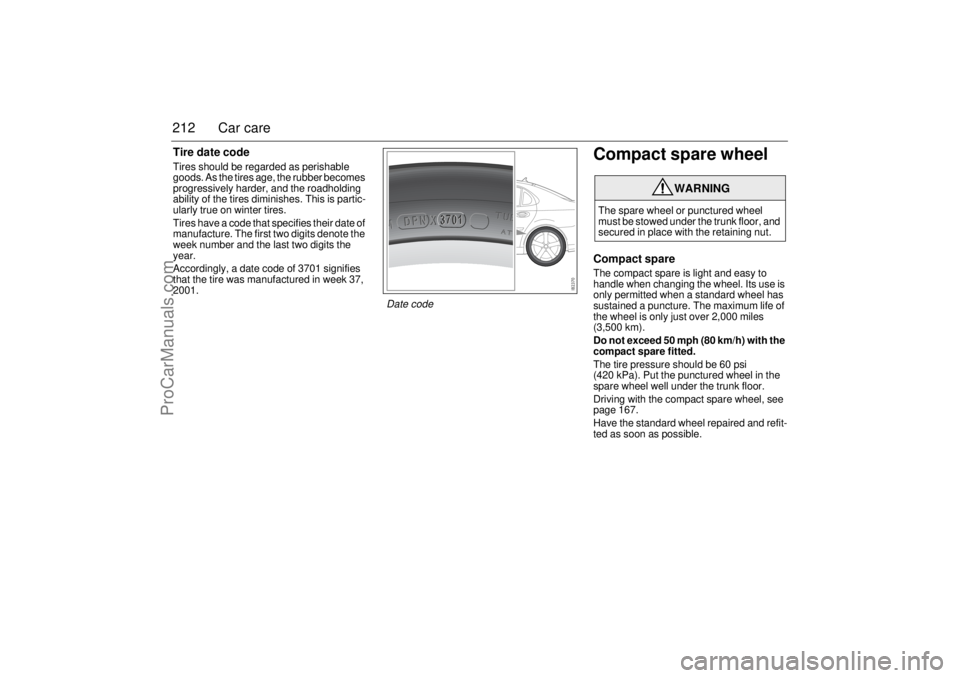
212 Car careTire date codeTires should be regarded as perishable
goods. As the tires age, the rubber becomes
progressively harder, and the roadholding
ability of the tires diminishes. This is partic-
ularly true on winter tires.
Tires have a code that specifies their date of
manufacture. The first two digits denote the
week number and the last two digits the
year.
Accordingly, a date code of 3701 signifies
that the tire was manufactured in week 37,
2001.
Compact spare wheelCompact spareThe compact spare is light and easy to
handle when changing the wheel. Its use is
only permitted when a standard wheel has
sustained a puncture. The maximum life of
the wheel is only just over 2,000 miles
(3,500 km).
Do not exceed 50 mph (80 km/h) with the
compact spare fitted.
The tire pressure should be 60 psi
(420 kPa). Put the punctured wheel in the
spare wheel well under the trunk floor.
Driving with the compact spare wheel, see
page 167.
Have the standard wheel repaired and refit-
ted as soon as possible.
WARNING
The spare wheel or punctured wheel
must be stowed under the trunk floor, and
secured in place with the retaining nut.
Date code
ProCarManuals.com
Page 213 of 256
213 Car care
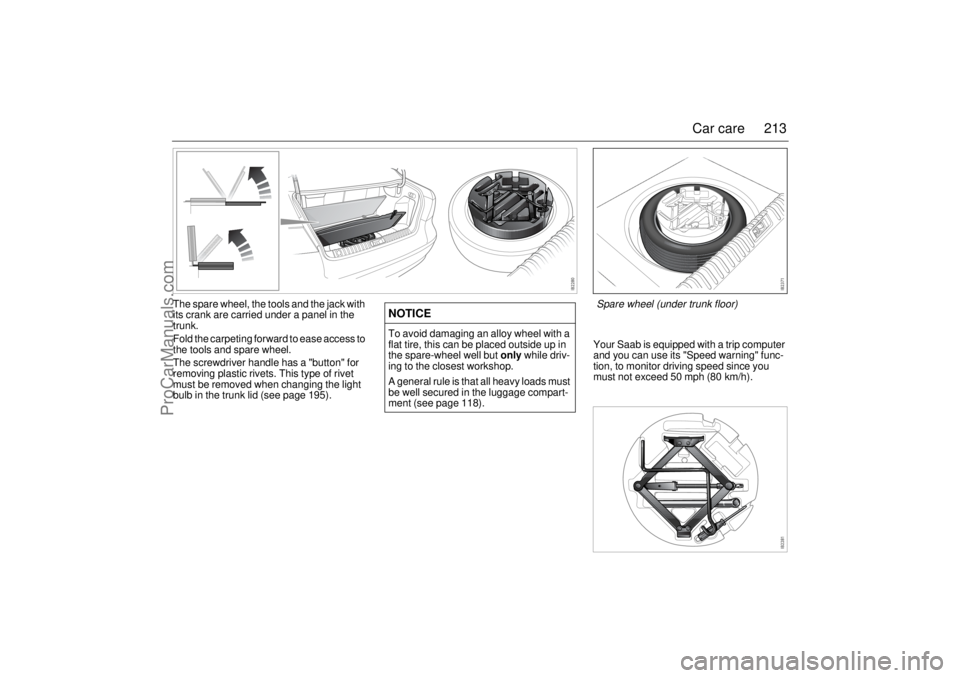
The spare wheel, the tools and the jack with
its crank are carried under a panel in the
trunk.
Fold the carpeting forward to ease access to
the tools and spare wheel.
The screwdriver handle has a "button" for
removing plastic rivets. This type of rivet
must be removed when changing the light
bulb in the trunk lid (see page 195).Your Saab is equipped with a trip computer
and you can use its "Speed warning" func-
tion, to monitor driving speed since you
must not exceed 50 mph (80 km/h).
NOTICETo avoid damaging an alloy wheel with a
flat tire, this can be placed outside up in
the spare-wheel well but only while driv-
ing to the closest workshop.
A general rule is that all heavy loads must
be well secured in the luggage compart-
ment (see page 118).
Spare wheel (under trunk floor)
ProCarManuals.com