warning SAAB 9-3 2003 Repair Manual
[x] Cancel search | Manufacturer: SAAB, Model Year: 2003, Model line: 9-3, Model: SAAB 9-3 2003Pages: 256, PDF Size: 21.66 MB
Page 109 of 256
109 Interior equipment
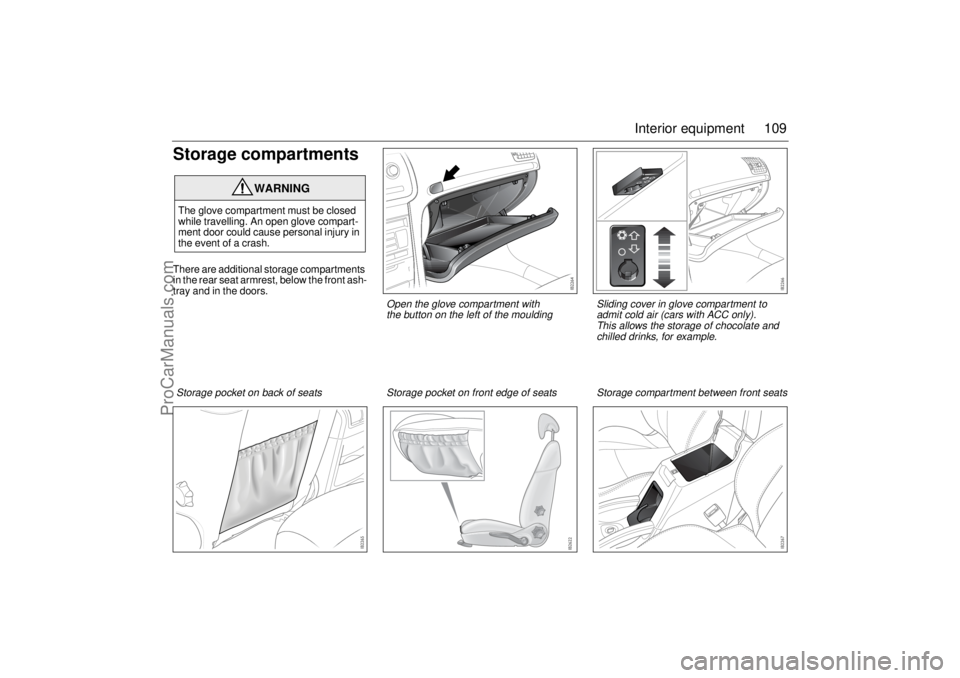
Storage compartmentsThere are additional storage compartments
in the rear seat armrest, below the front ash-
tray and in the doors.
WARNING
The glove compartment must be closed
while travelling. An open glove compart-
ment door could cause personal injury in
the event of a crash.
Sliding cover in glove compartment to
admit cold air (cars with ACC only).
This allows the storage of chocolate and
chilled drinks, for example.Storage compartment between front seats
Open the glove compartment with
the button on the left of the mouldingStorage pocket on front edge of seats
Storage pocket on back of seats
ProCarManuals.com
Page 112 of 256
112 Interior equipmentInterior rearview mirror with garage
opener, autodimming function and
compass (certain variants only)
Retain your original garage door opener
(transmitter) for future programming proce-
dures (i.e., new vehicle purchase). It is also
suggested that upon the sale of the vehicle,
the programmed garage opener buttons be
erased for security purposes, see page 113.Preparations for first-time programming
Before programming the garage opener for
the first time, you must delete any factory
codes.
Press and hold buttons 1 and 3 for about
20 seconds until the LED starts to flash.
This deletes the factory codes and initiates
the programming phase.
Programming the garage opener
The garage opener can record and store the
frequencies of three different remote con-
trols.
The battery in the remote control should be
fairly new for programming to work well.
1 Turn the ignition ON.
2 Hold your existing garage door opener
1–3 in. (3–7 cm) below the rearview
mirror. Sit where you can see the LED
(4) during programming.
3 Press the button on the remote control
and the desired button on the rear view
mirror at the same time.
4 The LED will now start to flash, slowly at
first and then rapidly. The rapidly flash-
ing LED indicates that programming is
complete and that you can release the
buttons.
The remote control may stop transmitting
during programming. If so, continue to hold
the button on the rearview mirror and
release and press the button on the remote
control every other second, "cycling" until
programming is completed.
WARNING
Make sure that people and objects are out
of the way of moving door or gate to
prevent potential harm or damage.
When programming the garage opener,
you may be operating a garage door or
gate operator.
Do not use the garage opener with any
garage door opener that lacks the safety
stop and reverse feature as required by
federal safety standards. (This includes
any garage door opener model manufac-
tured before April 1, 1982.). A garage
door opener which cannot detect an
object, signaling the door to stop and
reverse, does not meet current federal
safety standards. Using a garage door
opener without these features increases
risk of serious injury or death.
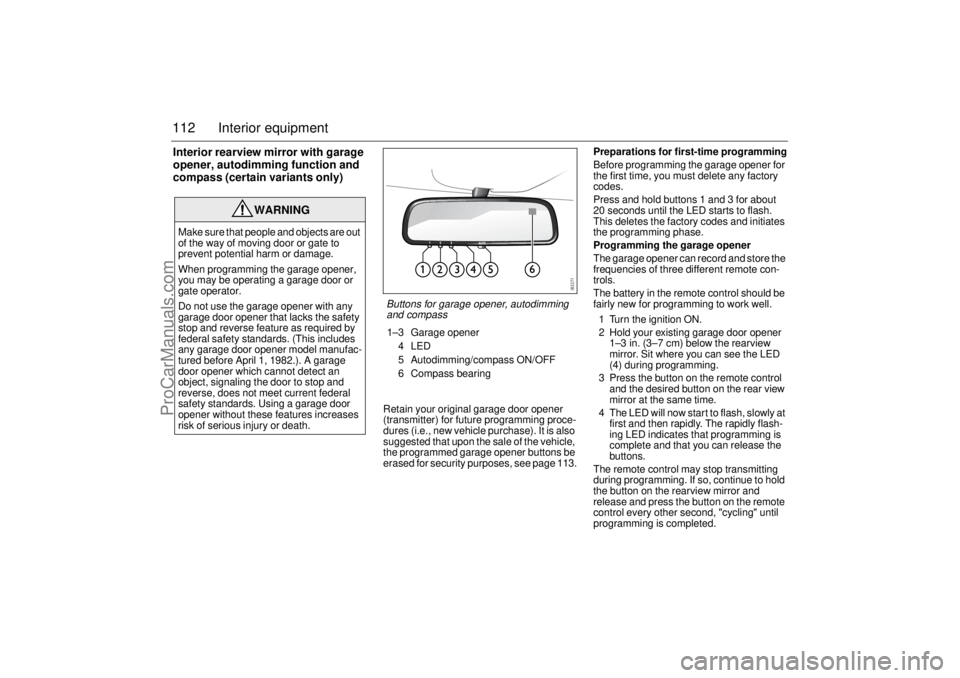
Buttons for garage opener, autodimming
and compass1–3 Garage opener
4LED
5 Autodimming/compass ON/OFF
6 Compass bearing
ProCarManuals.com
Page 116 of 256
116 Interior equipmentTrunkFolding down the rear seatFor greater flexibility, the rear seat is split so that the narrow and
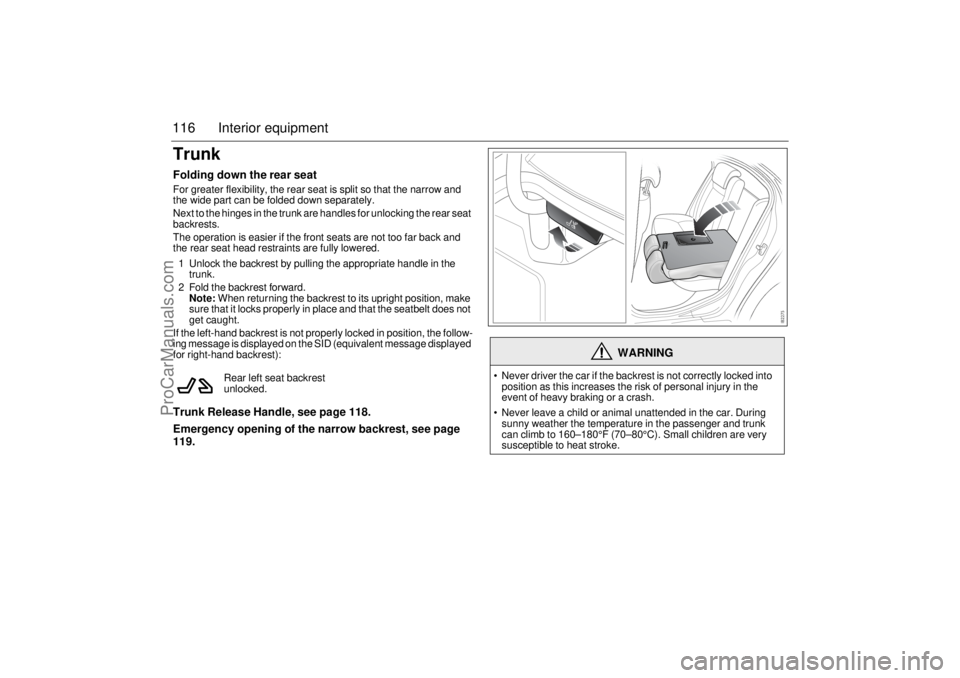
the wide part can be folded down separately.
Next to the hinges in the trunk are handles for unlocking the rear seat
backrests.
The operation is easier if the front seats are not too far back and
the rear seat head restraints are fully lowered.
1 Unlock the backrest by pulling the appropriate handle in the
trunk.
2 Fold the backrest forward.
Note: When returning the backrest to its upright position, make
sure that it locks properly in place and that the seatbelt does not
get caught.
If the left-hand backrest is not properly locked in position, the follow-
ing message is displayed on the SID (equivalent message displayed
for right-hand backrest):Trunk Release Handle, see page 118.
Emergency opening of the narrow backrest, see page
119.
Rear left seat backrest
unlocked.
WARNING
Never driver the car if the backrest is not correctly locked into
position as this increases the risk of personal injury in the
event of heavy braking or a crash.
Never leave a child or animal unattended in the car. During
sunny weather the temperature in the passenger and trunk
can climb to 160–180°F (70–80°C). Small children are very
susceptible to heat stroke.
ProCarManuals.com
Page 117 of 256
117 Interior equipment
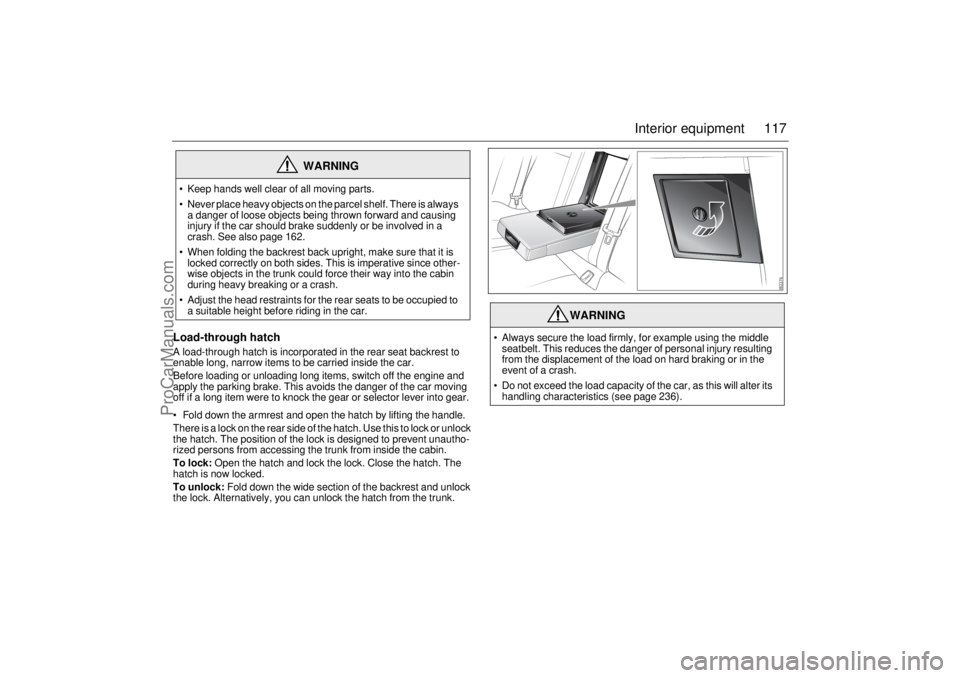
Load-through hatchA load-through hatch is incorporated in the rear seat backrest to
enable long, narrow items to be carried inside the car.
Before loading or unloading long items, switch off the engine and
apply the parking brake. This avoids the danger of the car moving
off if a long item were to knock the gear or selector lever into gear.
Fold down the armrest and open the hatch by lifting the handle.
There is a lock on the rear side of the hatch. Use this to lock or unlock
the hatch. The position of the lock is designed to prevent unautho-
rized persons from accessing the trunk from inside the cabin.
To lock: Open the hatch and lock the lock. Close the hatch. The
hatch is now locked.
To unlock: Fold down the wide section of the backrest and unlock
the lock. Alternatively, you can unlock the hatch from the trunk.
WARNING
Keep hands well clear of all moving parts.
Never place heavy objects on the parcel shelf. There is always
a danger of loose objects being thrown forward and causing
injury if the car should brake suddenly or be involved in a
crash. See also page 162.
When folding the backrest back upright, make sure that it is
locked correctly on both sides. This is imperative since other-
wise objects in the trunk could force their way into the cabin
during heavy breaking or a crash.
Adjust the head restraints for the rear seats to be occupied to
a suitable height before riding in the car.
WARNING
Always secure the load firmly, for example using the middle
seatbelt. This reduces the danger of personal injury resulting
from the displacement of the load on hard braking or in the
event of a crash.
Do not exceed the load capacity of the car, as this will alter its
handling characteristics (see page 236).
ProCarManuals.com
Page 118 of 256
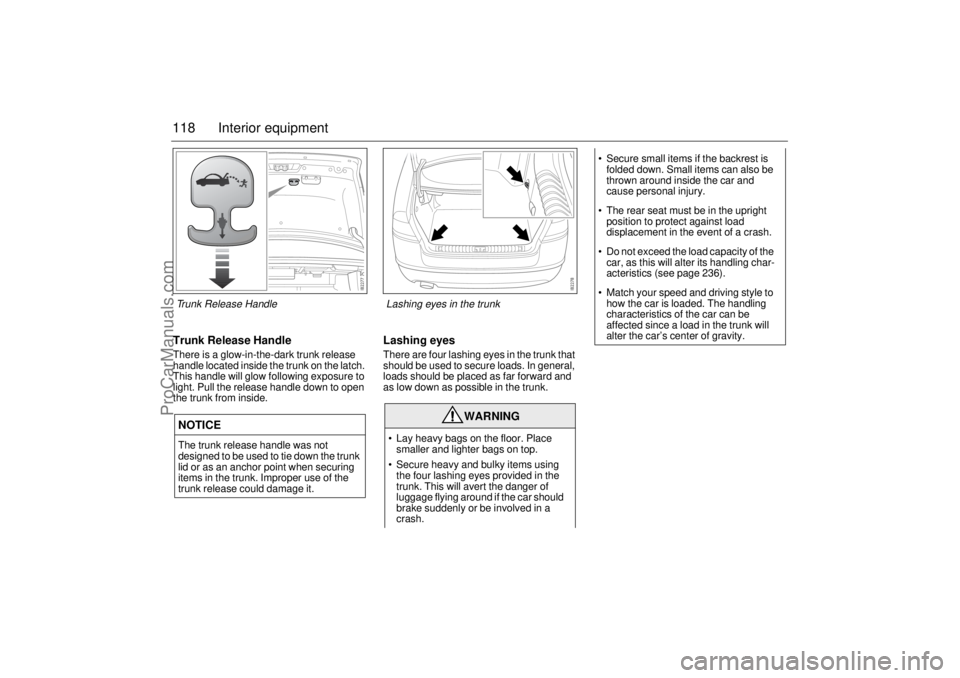
118 Interior equipmentTrunk Release HandleThere is a glow-in-the-dark trunk release
handle located inside the trunk on the latch.
This handle will glow following exposure to
light. Pull the release handle down to open
the trunk from inside.
Lashing eyesThere are four lashing eyes in the trunk that
should be used to secure loads. In general,
loads should be placed as far forward and
as low down as possible in the trunk.
NOTICEThe trunk release handle was not
designed to be used to tie down the trunk
lid or as an anchor point when securing
items in the trunk. Improper use of the
trunk release could damage it.
WARNING
Lay heavy bags on the floor. Place
smaller and lighter bags on top.
Secure heavy and bulky items using
the four lashing eyes provided in the
trunk. This will avert the danger of
luggage flying around if the car should
brake suddenly or be involved in a
crash.
Secure small items if the backrest is
folded down. Small items can also be
thrown around inside the car and
cause personal injury.
The rear seat must be in the upright
position to protect against load
displacement in the event of a crash.
Do not exceed the load capacity of the
car, as this will alter its handling char-
acteristics (see page 236).
Match your speed and driving style to
how the car is loaded. The handling
characteristics of the car can be
affected since a load in the trunk will
alter the car’s center of gravity.
Trunk Release Handle Lashing eyes in the trunk
ProCarManuals.com
Page 122 of 256
122 Starting and drivingIgnition switchThe ignition switch is located on the center
console between the front seats. In cars
with automatic transmission, the remote
control can only be removed when the
selector lever is in position P.NOTICETake care not to spill drinks or to drop
crumbs over the ignition switch. If dirt or
liquid gets into it, the switch may not
operate properly.
WARNING
• Always remove the remote control
before leaving children unattended in
the car.
Apply the parking brake before remov-
ing the remote control.
Never remove the remote control
while the car is moving. This will acti-
vate the steering wheel lock and make
it impossible to steer the car.
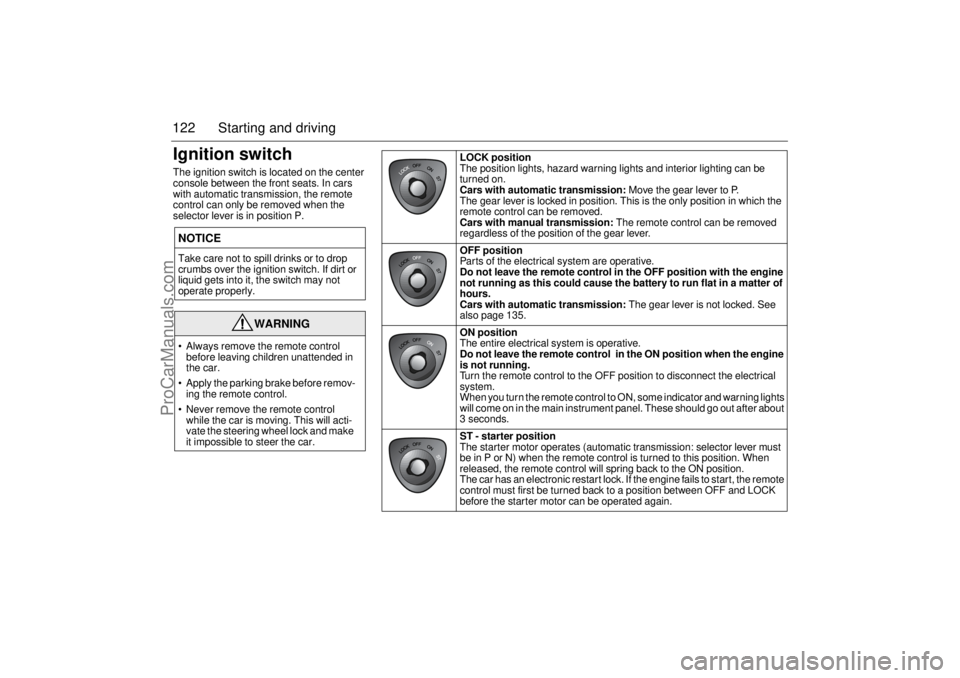
LOCK position
The position lights, hazard warning lights and interior lighting can be
turned on.
Cars with automatic transmission: Move the gear lever to P.
The gear lever is locked in position. This is the only position in which the
remote control can be removed.
Cars with manual transmission: The remote control can be removed
regardless of the position of the gear lever.
OFF position
Parts of the electrical system are operative.
Do not leave the remote control in the OFF position with the engine
not running as this could cause the battery to run flat in a matter of
hours.
Cars with automatic transmission: The gear lever is not locked. See
also page 135.
ON position
The entire electrical system is operative.
Do not leave the remote control in the ON position when the engine
is not running.
Turn the remote control to the OFF position to disconnect the electrical
system.
When you turn the remote control to ON, some indicator and warning lights
will come on in the main instrument panel. These should go out after about
3 seconds.
ST - starter position
The starter motor operates (automatic transmission: selector lever must
be in P or N) when the remote control is turned to this position. When
released, the remote control will spring back to the ON position.
The car has an electronic restart lock. If the engine fails to start, the remote
control must first be turned back to a position between OFF and LOCK
before the starter motor can be operated again.
ProCarManuals.com
Page 123 of 256
123 Starting and driving
Steering wheel lockThe steering wheel lock is electronic. The
lock engages when the remote control is
removed from the ignition and unlocks when
the remote control is inserted. A click can be
heard when the steering wheel lock locks
and unlocks.
If the car is parked with one front wheel
touching the curb, for example, you may
need to turn the steering wheel slightly
when you insert the remote control to allow
the steering wheel lock to unlock. If you do
not succeed on first attempt you must
remove the remote control before trying
again. Turn the steering wheel and insert
the remote control into the ignition switch.
If the steering wheel lock does not disen-
gage it will not be possible to turn the remote
control in the ignition switch.
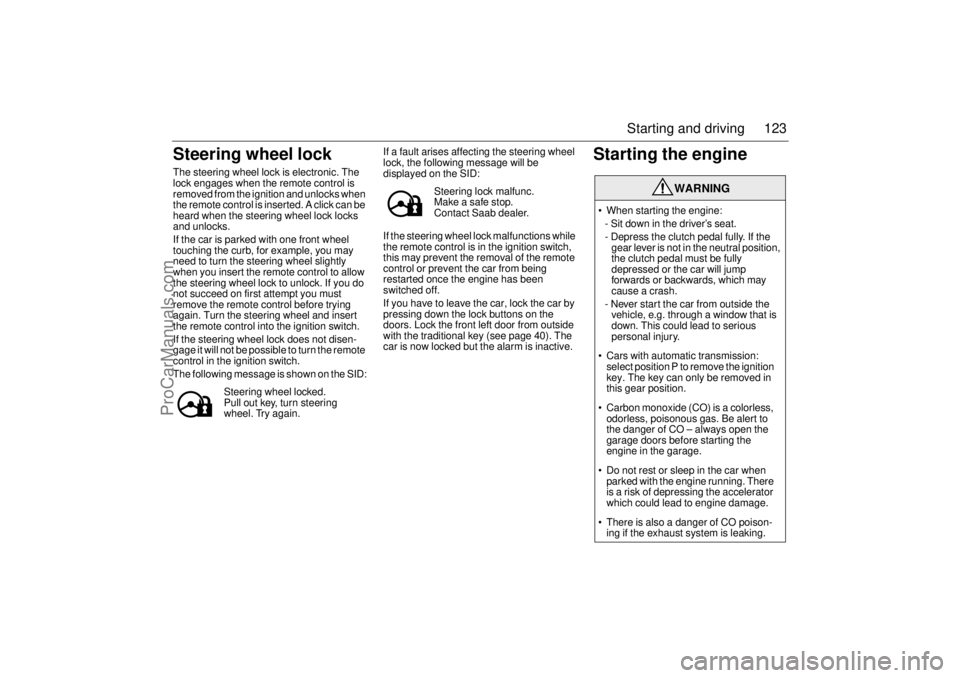
The following message is shown on the SID:If a fault arises affecting the steering wheel
lock, the following message will be
displayed on the SID:
If the steering wheel lock malfunctions while
the remote control is in the ignition switch,
this may prevent the removal of the remote
control or prevent the car from being
restarted once the engine has been
switched off.
If you have to leave the car, lock the car by
pressing down the lock buttons on the
doors. Lock the front left door from outside
with the traditional key (see page 40). The
car is now locked but the alarm is inactive.
Starting the engine
Steering wheel locked.
Pull out key, turn steering
wheel. Try again.
Steering lock malfunc.
Make a safe stop.
Contact Saab dealer.
WARNING
When starting the engine:
- Sit down in the driver’s seat.
- Depress the clutch pedal fully. If the
gear lever is not in the neutral position,
the clutch pedal must be fully
depressed or the car will jump
forwards or backwards, which may
cause a crash.
- Never start the car from outside the
vehicle, e.g. through a window that is
down. This could lead to serious
personal injury.
Cars with automatic transmission:
select position P to remove the ignition
key. The key can only be removed in
this gear position.
Carbon monoxide (CO) is a colorless,
odorless, poisonous gas. Be alert to
the danger of CO – always open the
garage doors before starting the
engine in the garage.
Do not rest or sleep in the car when
parked with the engine running. There
is a risk of depressing the accelerator
which could lead to engine damage.
There is also a danger of CO poison-
ing if the exhaust system is leaking.
ProCarManuals.com
Page 124 of 256

124 Starting and drivingDo not run the starter motor for more than
25 seconds at a time. Wait 20–30 seconds
before running the starter again, to give the
battery time to recover.
Avoid racing the engine or putting a heavy
load on it before it has warmed up. Let the
engine idle for at least 10 seconds and then
drive away as long as the engine oil warning
light has gone out to enable the engine to
attain its normal temperature as quickly as
possible
It is possible for air to enter the lubricating
system in conjunction with an oil or oil-filter
change, or if the car has been stored for
some time. This air can cause the hydraulic
cam followers to emit a ticking noise, which
can persist for up to 15 minutes after start-
ing. Although this is quite normal and does
not indicate any malfunction, it is advisable
not to exceed 3,000 rpm before the noise
has disappeared.
Starting the engineAvoid racing the engine or loading it heavily
before it has warmed up. Do not drive away
before the warning and indicator lights have
gone out.
The engine has an automatic choke and
should be started as follows:
Cars with manual transmission
To start the engine the clutch pedal must
be fully depressed.
1 Make sure the parking brake is applied.
2 Depress the clutch pedal but do not
touch the accelerator.
3 Start the engine. Let the remote control
spring back as soon as the engine has
started and is running smoothly.
Allow the engine to idle for about
10 seconds. Do not apply full throttle for at
least 3 minutes after starting.Cars with automatic transmission
The selector lever must be in the P or N
position.
1 The selector lever must be in the P or N
position.
2 Keep your foot on the brake pedal.
Note! Once the engine has started, the
brake pedal will sink. This is perfectly
normal.
3 Start the engine. Let the remote control
spring back as soon as the engine has
started and is running smoothly.
Allow the engine to idle for about
10 seconds. Do not apply full throttle for at
least 3 minutes after starting.
ProCarManuals.com
Page 126 of 256

126 Starting and drivingLimp-homeThe engine management system has a
diagnostic feature that checks a number of
internal functions. If a fault is detected in the
throttle valve, the engine management
system will set the throttle system to the
limp-home mode. This means:
idling control will be poor (uneven idling
since regulated by ignition and fuel
supply)
engine performance will be reduced
the cruise control will not function
the capacity of the A/C compressor will be
limited.If the diagnosis function detects a fault in the
engine management system, the light
"Engine malfunction (CHECK ENGINE)" in
the instrument panel will come on (see page
55). Have the car checked at a Saab dealer
as soon as possible.
The following message is shown on the SID:
Important considarations with
catalytic convertersThe catalytic converter is an emission con-
trol device incorporated in the car’s exhaust
system. It consists of a metal canister with a
honeycomb insert, the cells of which have
walls coated in a catalytic layer (precious
metal alloy).
To ensure that the catalytic converter con-
tinues to function properly, and also to avoid
damage to the converter and its associated
components, the following points must be
observed:
NOTICE If the engine sounds strange there is a
malfunction. Contact a Saab dealer
immediately.
The use of fuel with too low an octane
rating can cause serious engine
damage.
Reduced engine power.
Contact Saab dealer.
NOTICEIf "Engine malfunction (CHECK
ENGINE)" warning light starts to flash
(indicating that the engine is misfiring and
the catalytic converter can be damaged),
ease off the accelerator slightly. The light
should go out or start to shine constantly.
If the light continues to flash despite
easing off the accelerator, you may
continue to drive the car but at the mini-
mum throttle permitted by the current traf-
fic situation. Have the car checked as
soon as possible at a Saab dealer.
NOTICEUse only unleaded gasoline. Leaded
gasoline is detrimental to the catalyst and
oxygen sensor and will seriously impair
the function of the catalytic converter.
ProCarManuals.com
Page 127 of 256
127 Starting and driving
Have the car serviced regularly in accord-
ance with the service program.
Always be alert to any misfiring of the
engine (not running on all cylinders) and
any loss of power or performance. At the
first sign of a malfunction, reduce speed
and take the car to a Saab dealer.
If the engine fails to start (in severe cold
or if the battery is flat), the car can be
bump started (manual transmission only)
or started using jump leads to a donor
battery. However, as soon as you have
started the engine, it is important that it
runs on all cylinders. If it is misfiring, allow
it to idle for up to 5 minutes to give it time
to settle and run smoothly. If, after this
time, the engine still fails to run properly,
switch off the engine to avoid serious
damage to the catalytic converter.
Contact a Saab dealer for advice. Never park the car on dry grass or other
combustible material. The catalytic
converter gets very hot and could there-
fore start a fire.
Never drive off if the engine is misfiring.
If you bump start the car when the engine
is already at normal working temperature,
the engine must start to run on all cylin-
ders. Abort bump starting if the engine
fails to start immediately.
Failure to strictly follow these instructions
can result in damage to the catalytic con-
verter and associated components, and
could represent a breach of the warranty
conditions.
NOTICEIf the car runs out of gas, air may be drawn
in with the fuel, which, in turn, can cause
the catalytic converter to be damaged by
overheating.
WARNING
If the engine is being run with the car on a
rolling road or dynamometer, to ensure
adequate cooling, air must be blown into
the engine compartment and under the
car at a rate equivalent to the ram-air
effect that would obtain at the corre-
sponding road speed.
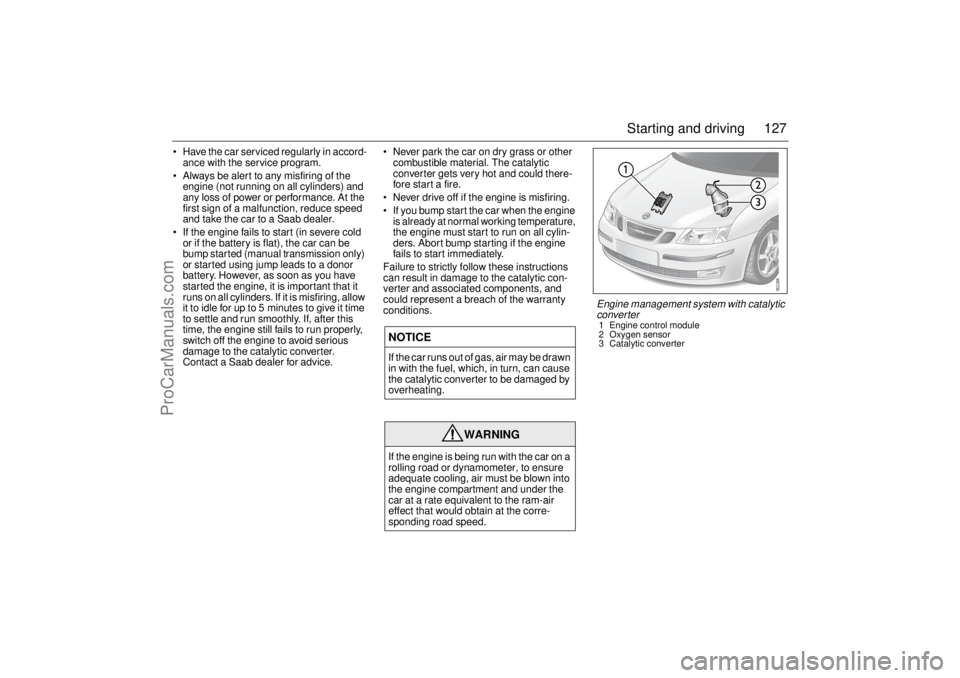
Engine management system with catalytic
converter1 Engine control module
2 Oxygen sensor
3 Catalytic converter
ProCarManuals.com