seats SAAB 9-3 2003 User Guide
[x] Cancel search | Manufacturer: SAAB, Model Year: 2003, Model line: 9-3, Model: SAAB 9-3 2003Pages: 256, PDF Size: 21.66 MB
Page 26 of 256
26 SafetyAirbag
Airbag system components Airbag in steering wheel
Airbag in instrument panel in front of
passenger seat
Side airbags in front seat backrests
Inflatable curtains along length of headlin-
ing (from front to rear roof pillars)
Safety belt pretensioners for front seats.
The airbag system supplements the protec-
tion provided by the safety belts to further
enhance the safety of occupants taller than
55 in. (140 cm).
When the system is activated at the moment
of impact, the airbag inflates and then
deflates through holes in the back. The
whole operation takes roughly 0.1 second,
quicker than the blink of an eye.
The steering wheel and passenger airbags
are so-called smart airbags. The driver and
passenger airbag system compensates for
safety belt usage, the force of the crash and
the position of the seats at the moment of
impact.
Stage I is activated if the force of the
impact is low or if the seat is close to the
steering wheel or fascia.
Stage II is activated in all other cases.
Note:
The sensor reacts differently depending on
whether or not the front safety belts on the
driver’s and passenger sides are used. Sit-
uations can therefore arise where only one
of the airbags inflates.If the force of the impact is small, the airbag
needs only to inflate to Stage I to provide
optimum protection. If the seat is positioned
far forward (the person occupying the seat
is fairly short), only Stage I is activated to
prevent injury caused by the airbag being
inflated with full force.
If only Stage I is activated at the moment of
impact, Stage II will be activated later. This
occurs when the airbag is already fully
inflated and thus does not affect the person
occupying the seat. Stage II is activated
here to render the gas generator harmless
(its activation is not noticeable to the occu-
pant).
WARNING
To reduce risk of death or serious injury:
Always wear your safety belt.
Always adjust your seat so that you
are as far back as possible but still
able to operate the pedals and reach
the steering wheel and controls
comfortably.
Passengers 12 and under or shorter
than 55 inches (140 cm) must always
travel in the rear seat as the car is fitted
with a passenger airbag.
Never fit a child seat in front of the
passenger airbag.
ProCarManuals.com
Page 31 of 256
31 Safety
Head protectionThe pillar trim and headlining are designed
to absorb energy, softening possible blows
to the head. After a crash, these items must
be changed in the seat positions that were
occupied. Never fit accessories to the pillar
trim or headlining as these could reduce the
effectiveness of the head protection and
inflatable curtain.
Side airbags
The side airbags, which protect the upper
body, are integrated in the outside edges of
the front seat backrests.
The front seats have safety belt pretension-
ers.
There are two sensors on each side of the
car, one at the rear of each door sill. The
side-impact protection is only activated on
the side of impact, while the safety belt pre-
tensioners on both sides are deployed. Keep feet on the floor – never put feet
up on the dash, on the seat or out of
the window.
Do not carry anything in your lap.
WARNING
This car is equipped with side airbags
and no extra seat cover should be
fitted. Failure to observe this warning
could result in the side airbags not
inflating as intended and thus not
providing the intended protection
either.
Never place any object in the area that
would be occupied by the inflated air-
bag.
For optimum protection, sit upright in
the seat, with your safety belt correctly
fastened.
The side-impact protection will only be
activated in the event of a side-on
crash or high-speed frontal crash
(airbags inflated to Stage II), but not in
the event of a rear-end crash or the car
rolling over.
Damage or wear to the seat cover, or
the seat seam, in the area of the side
airbag must immediately be repaired
by an authorized Saab dealer.
ProCarManuals.com
Page 32 of 256
32 Safety
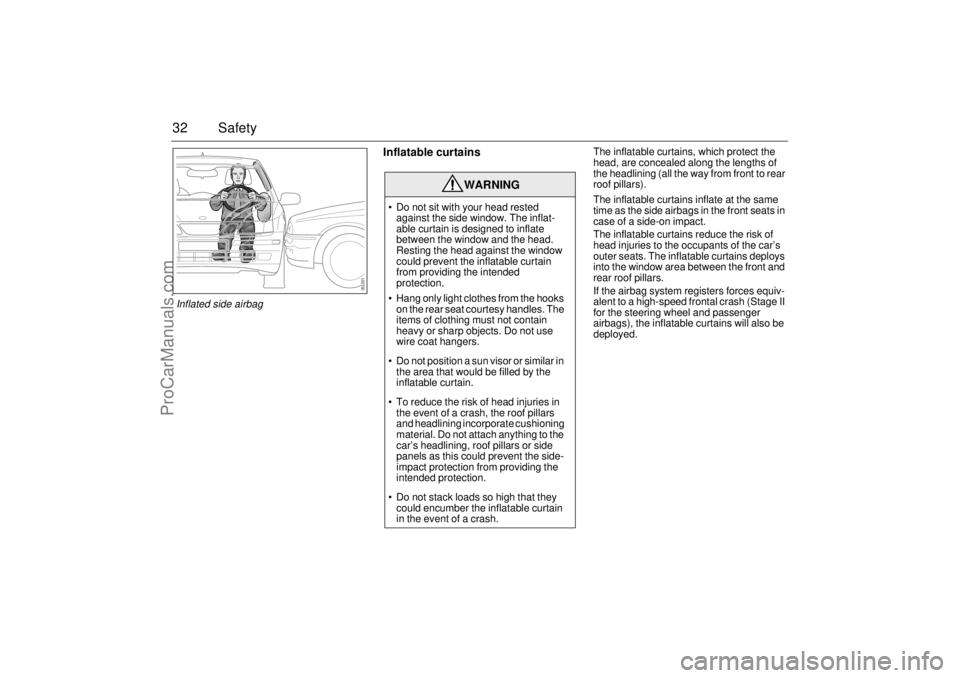
Inflatable curtains
The inflatable curtains, which protect the
head, are concealed along the lengths of
the headlining (all the way from front to rear
roof pillars).
The inflatable curtains inflate at the same
time as the side airbags in the front seats in
case of a side-on impact.
The inflatable curtains reduce the risk of
head injuries to the occupants of the car’s
outer seats. The inflatable curtains deploys
into the window area between the front and
rear roof pillars.
If the airbag system registers forces equiv-
alent to a high-speed frontal crash (Stage II
for the steering wheel and passenger
airbags), the inflatable curtains will also be
deployed.
WARNING
Do not sit with your head rested
against the side window. The inflat-
able curtain is designed to inflate
between the window and the head.
Resting the head against the window
could prevent the inflatable curtain
from providing the intended
protection.
Hang only light clothes from the hooks
on the rear seat courtesy handles. The
items of clothing must not contain
heavy or sharp objects. Do not use
wire coat hangers.
Do not position a sun visor or similar in
the area that would be filled by the
inflatable curtain.
To reduce the risk of head injuries in
the event of a crash, the roof pillars
and headlining incorporate cushioning
material. Do not attach anything to the
car’s headlining, roof pillars or side
panels as this could prevent the side-
impact protection from providing the
intended protection.
Do not stack loads so high that they
could encumber the inflatable curtain
in the event of a crash.
Inflated side airbag
ProCarManuals.com
Page 42 of 256
42 SecuritySwitches on front doorsThe central locking can also be operated
from inside the car using the button by each
front door handle.
Locking the car with the remote control
renders these buttons inoperative.
If you are sitting in the car and press the
button on the driver’s door, this will unlock
the driver’s door and fuel filler door. Press
the button a second time to unlock the
remaining doors and the trunk lid. The
button on the passenger door works in the
same way except that this first unlocks the
passenger door and fuel filler flap. In this
mode, the other doors cannot be opened
from outside the car.
If the car is left with one or more doors open,
the interior lighting will be switched off auto-matically after 20 minutes. This is to prevent
the battery from running flat. Also, if the car
has electrically adjustable seats, these will
cease to operate.
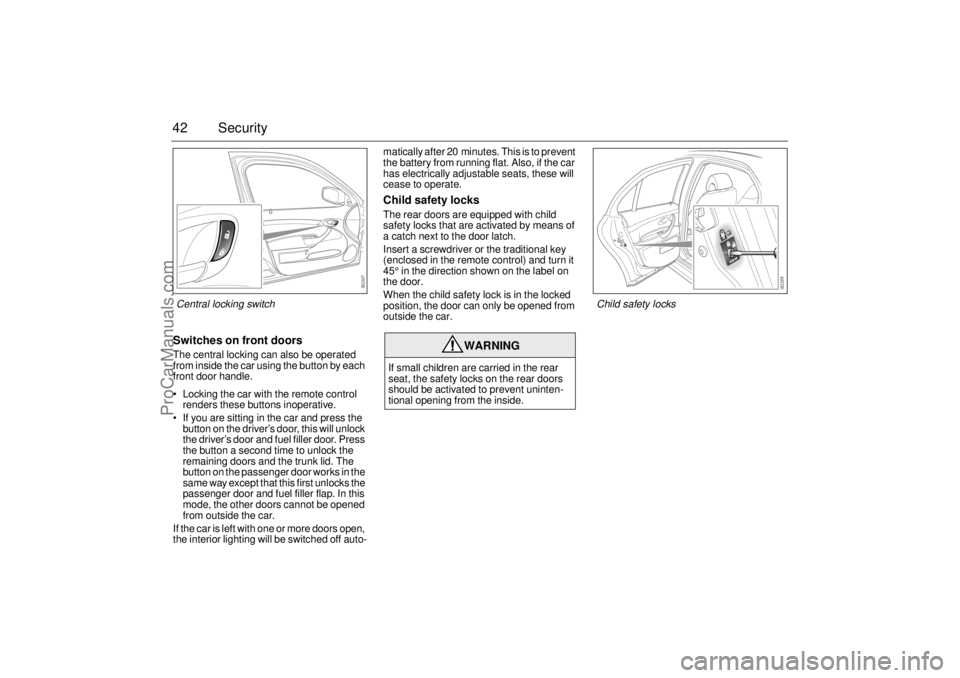
Child safety locksThe rear doors are equipped with child
safety locks that are activated by means of
a catch next to the door latch.
Insert a screwdriver or the traditional key
(enclosed in the remote control) and turn it
45° in the direction shown on the label on
the door.
When the child safety lock is in the locked
position, the door can only be opened from
outside the car.
WARNING
If small children are carried in the rear
seat, the safety locks on the rear doors
should be activated to prevent uninten-
tional opening from the inside.
Child safety locks
Central locking switch
ProCarManuals.com
Page 65 of 256
65 Instruments and controls
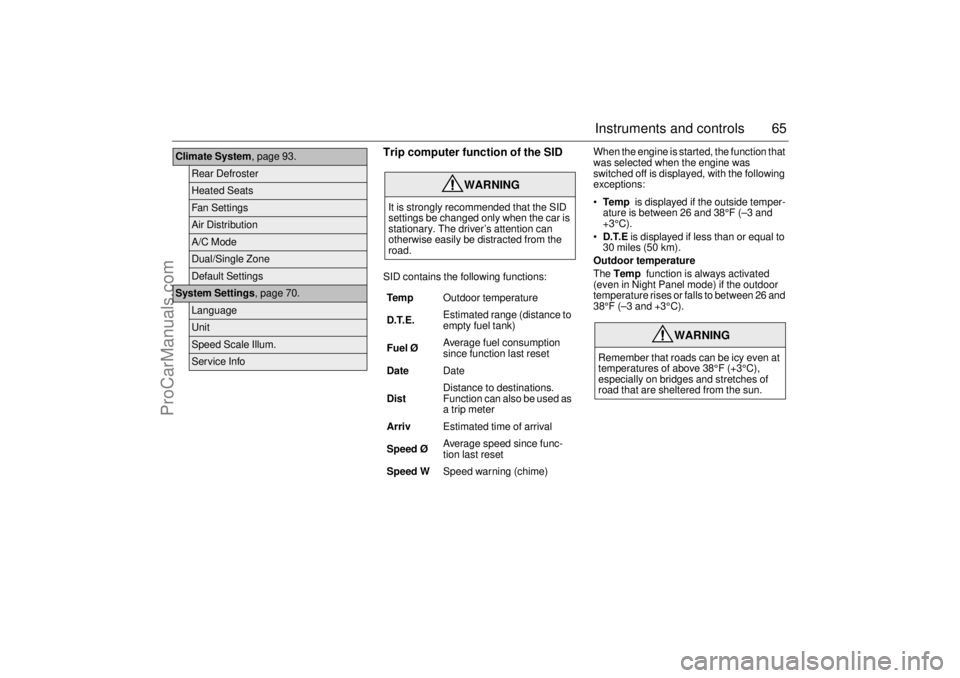
Trip computer function of the SIDSID contains the following functions:When the engine is started, the function that
was selected when the engine was
switched off is displayed, with the following
exceptions:
Te m p is displayed if the outside temper-
ature is between 26 and 38°F (–3 and
+3°C).
D.T.E is displayed if less than or equal to
30 miles (50 km).
Outdoor temperature
The Temp function is always activated
(even in Night Panel mode) if the outdoor
temperature rises or falls to between 26 and
38°F (–3 and +3°C).
Climate System, page 93.
Rear DefrosterHeated SeatsFan SettingsAir DistributionA/C ModeDual/Single ZoneDefault Settings
System Settings, page 70.
LanguageUnitSpeed Scale Illum.Service Info
WARNING
It is strongly recommended that the SID
settings be changed only when the car is
stationary. The driver’s attention can
otherwise easily be distracted from the
road.
Tem pOutdoor temperature
D.T.E. Estimated range (distance to
empty fuel tank)
Fuel ØAverage fuel consumption
since function last reset
DateDate
DistDistance to destinations.
Function can also be used as
a trip meter
ArrivEstimated time of arrival
Speed Ø Average speed since func-
tion last reset
Speed WSpeed warning (chime)
WARNING
Remember that roads can be icy even at
temperatures of above 38°F (+3°C),
especially on bridges and stretches of
road that are sheltered from the sun.
ProCarManuals.com
Page 83 of 256

83 Instruments and controls
This button is located under the fan speed
control.
Always switch off the heating as soon as the
rear window is free from ice and mist. It will
be turned off automatically after 12 minutes.
Refrain from placing sharp objects on the
parcel shelf, to avoid damaging the heating
element.The seat cushions and backrests of the front
seats are heated.
Seat heating is thermostatically controlled.
It can be switched on when the seat temper-
ature is below 102°F (+39°C) and is
switched off at temperatures above 105°F
(+41°C).
Switch off the seat heating once the seat is
warm.
Electrically heated rear
window/external mirrors
Electric heating, front
seats (option)
ProCarManuals.com
Page 92 of 256
92 Instruments and controlsCalibrationCalibration is performed automatically
every fifth time the car is started after having
been switched off for more than 2 hours.ProgrammingA number of functions can be customized
under Profiler (see page 93). Further cus-
tomizations can be made at a Saab dealer.The seat cushions and backrests of the front
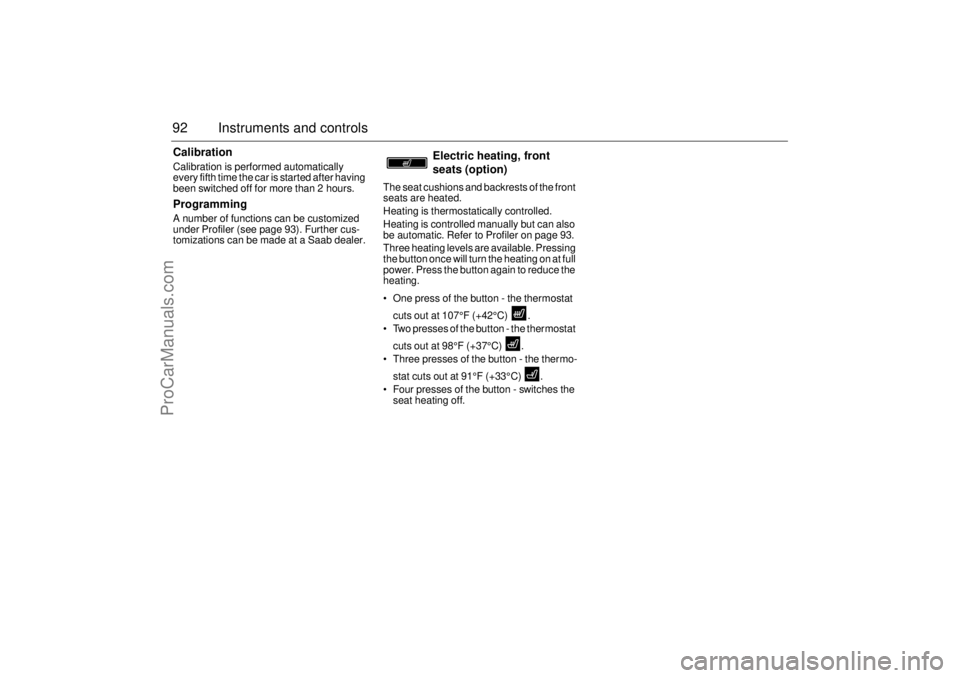
seats are heated.
Heating is thermostatically controlled.
Heating is controlled manually but can also
be automatic. Refer to Profiler on page 93.
Three heating levels are available. Pressing
the button once will turn the heating on at full
power. Press the button again to reduce the
heating.
One press of the button - the thermostat
cuts out at 107°F (+42°C) .
Two presses of the button - the thermostat
cuts out at 98°F (+37°C) .
Three presses of the button - the thermo-
stat cuts out at 91°F (+33°C) .
Four presses of the button - switches the
seat heating off.
Electric heating, front
seats (option)
ProCarManuals.com
Page 93 of 256
93 Instruments and controls
ProfilerSome of the functions of the ACC system
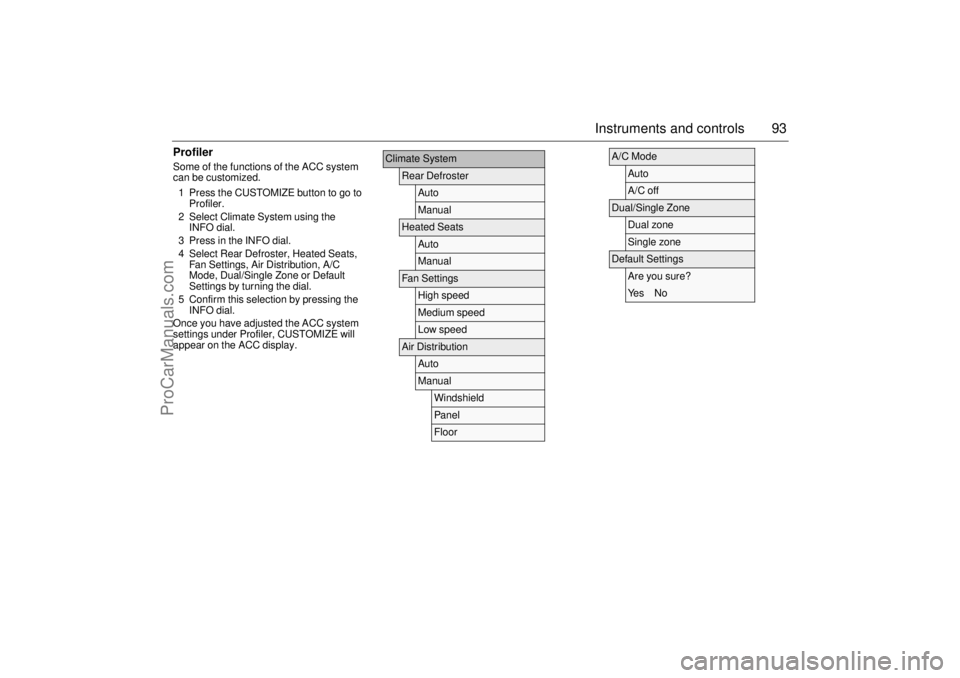
can be customized.
1 Press the CUSTOMIZE button to go to
Profiler.
2 Select Climate System using the
INFO dial.
3 Press in the INFO dial.
4 Select Rear Defroster, Heated Seats,
Fan Settings, Air Distribution, A/C
Mode, Dual/Single Zone or Default
Settings by turning the dial.
5 Confirm this selection by pressing the
INFO dial.
Once you have adjusted the ACC system
settings under Profiler, CUSTOMIZE will
appear on the ACC display.
Climate System
Rear Defroster
AutoManual
Heated Seats
AutoManual
Fan Settings
High speedMedium speedLow speed
Air Distribution
AutoManual
WindshieldPanelFloor
A/C Mode
AutoA/C off
Dual/Single Zone
Dual zoneSingle zone
Default Settings
Are you sure?Ye s N o
ProCarManuals.com
Page 94 of 256

94 Instruments and controlsExplanation of how the ACC system can be
customized under Profiler.
Rear Defroster
Auto:
The rear window and door mirror
heating is controlled automatically.
This is one of the Default Settings.
Manual:
The rear window and door mirror
heating is switched on with
the button on ACC panel.
Heated Seats
Auto:
The front seat heating is controlled
automatically.
Select the level by repeatedly
pressing the appropriate button on
the ACC panel: 2 arrows on symbol
= standard; 3 arrows = high; 1 arrow
= low. The selected heating setting
is saved when the engine is
switched off. Note: The symbol on
the ACC panel goes out if the heat-
ing is turned off automatically by the
system.
Manual:
See Electric heating, front seats
(option) on page 92
.
This is one of the Default Settings.
Fan Settings
High speed:
This selection give a slightly higher
fan speed than Medium speed
though with continued automatic
regulation.
Medium speed:
Normal automatic fan speed. This is
one of the Default Settings.
Low speed:
This selection give a slightly lower
fan speed than Medium speed
though with continued automatic
regulation.
Air Distribution
Auto:
The ACC system adapts air tem-
perature and distribution to the pre-
vailing conditions. This is one of the
Default Settings
.
Manual:
Windshield:
The ACC system directs almost
all air to the windshield.
Panel:
The ACC system directs almost
all air to air vents in the fascia.
Floor:
The ACC system directs almost
all air to the floor.
ProCarManuals.com
Page 107 of 256
107 Interior equipment
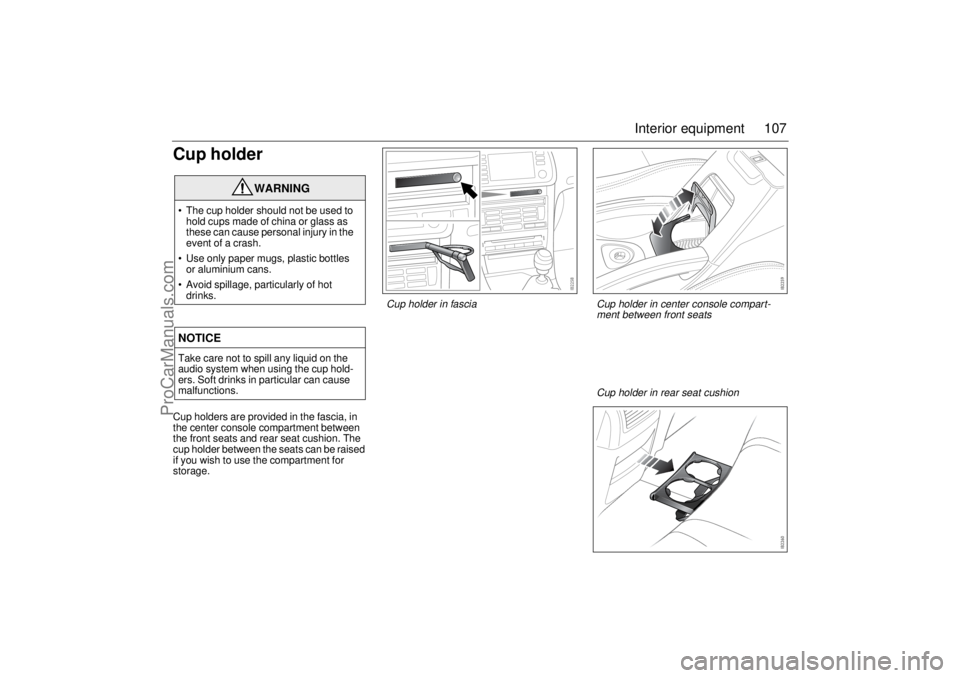
Cup holderCup holders are provided in the fascia, in
the center console compartment between
the front seats and rear seat cushion. The
cup holder between the seats can be raised
if you wish to use the compartment for
storage.
WARNING
The cup holder should not be used to
hold cups made of china or glass as
these can cause personal injury in the
event of a crash.
Use only paper mugs, plastic bottles
or aluminium cans.
Avoid spillage, particularly of hot
drinks.NOTICETake care not to spill any liquid on the
audio system when using the cup hold-
ers. Soft drinks in particular can cause
malfunctions.
Cup holder in fascia
Cup holder in center console compart-
ment between front seatsCup holder in rear seat cushion
ProCarManuals.com