battery SAAB 9-3 2003 Owner's Manual
[x] Cancel search | Manufacturer: SAAB, Model Year: 2003, Model line: 9-3, Model: SAAB 9-3 2003Pages: 256, PDF Size: 21.66 MB
Page 137 of 256

137 Starting and driving
Limp-homeIf the transmission malfunctions, the control
module will activate limp-home mode. In
this mode, only 2nd and 5th gears are avail-
able. Select 2nd gear when driving at low
speeds and 5th gear at higher speeds. 2nd
gear must be selected manually. Select 5th
gear manually or move the selector lever
to D (see page 139).
The following message is shown on the SID:Temporary override of Park Brake Shift
Lock
1 Apply the parking brake.
2 Lift up the rubber mat in the storage
compartment ahead of the selector
lever.
3 Under the floor of the storage compart-
ment is a yellow plastic lever. Use a thin
tool, such as a screwdriver, to press and
hold the plastic lever while moving the
selector lever from P to N.
4 Remove the tool.
5 Release the parking brake if the car is to
be moved immediately, otherwise it
should remain on.
Check fuse 6 in the engine bay fuse box.
If the fuse is OK the battery may be dead.
Contact a Saab dealer to have the problem
checked and rectified. Gearbox malfunction.
Limited performance.
Contact Saab dealer.
NOTICEDue to electrical problems it may not be
possible to move the selector lever out of
the park position, even if the ignition is
ON. If for some reason the selector lever
has to be moved out of the park position
(i.e. to tow the car a short distance) do as
described below.
Temporary override of Park Brake Shift
Lock
ProCarManuals.com
Page 150 of 256

150 Starting and drivingLong-term parkingIf the car is not going to be used for some
time, e.g. three to four months, the following
steps are recommended:
Drain the washer fluid reservoir and
hoses.
Wash and wax the car. Clean the rubber
seals on the hood, trunk lid and doors,
and lubricate them with glycerol
(glycerine).
After washing the car, dry the brake discs
to avoid corrosion by taking the car out on
the road and applying the brakes a few
times.
Fill the fuel tank to prevent condensation
forming in it.
Top up the coolant and check the anti-
freeze before the onset of winter. Park the car in a dry, covered and well-
ventilated building. Leave the parking
brake OFF!
If necessary, use wheel chocks.
Disconnect the negative (–) battery lead.
If frost is likely to occur during the storage
period, remove the battery and store it in
a frost-free place.
If it is not possible to stand the car on axle
stands, increase the tire pressure to
43 psi (3 bar).
Leave all the door windows open a crack
and cover the car with a non-plastic
tarpaulin – not one made of plastic which will
not breath.
ProCarManuals.com
Page 157 of 256
157 Starting and driving
Towing a trailerMake sure you are familiar with the legal
requirements regarding speed limits for
towing, maximum trailer weights, trailer
braking requirements, and also any spe-
cial driving licence provisions.
Trailer hitch attachmentTrailer hitch attachments are available as
accessories. These are designed for a max-
imum trailer weight of 3500 lbs (1588 kg),
with trailer brakes.
An electrical socket is provided for connect-
ing the trailer electrics. This is located under
the floor trim by the left-hand tail light.
The Saab genuine electrical socket enables
the battery in the trailer on tow to be charged
during while driving. Also, if the car has
SPA, this is deactivated automatically if a
trailer is hitched up and correctly connected
to the Saab genuine trailer socket.
Saab recommendations:
Use a genuine Saab towbar that is
designed and tested for your Saab.
Contact your Saab dealer for advice on
which towbar is designed for your car.
WARNING
Do not drive with a trailer on inclines
steeper than 15 %. The load on the
drive (front) wheels will be so low that
the wheels can start to spin and
prevent further progress.
In addition, the car’s parking brake
may not always be sufficient to hold
the car and trailer securely, as the
wheels may start to slide.
Always apply the trailer’s parking
brake when unhitching it. There is
otherwise a risk of personal injury or
damage to the bumper should the
trailer start to roll.
When you hitch up the trailer be sure
to attach its safety chains to the holes
by the hitch attachment.
NOTICE Use only a genuine Saab trailer hitch,
since other models can damage the
car’s bodywork and electrical system.
Consult a Saab dealer for guidance on
how to connect a trailer hitch.
Exercise care when driving on uneven
roads or against the curb if the car is
heavily laden. This particularly applies
to cars with 18" wheels.
ProCarManuals.com
Page 164 of 256
164 Starting and drivingTowing the car
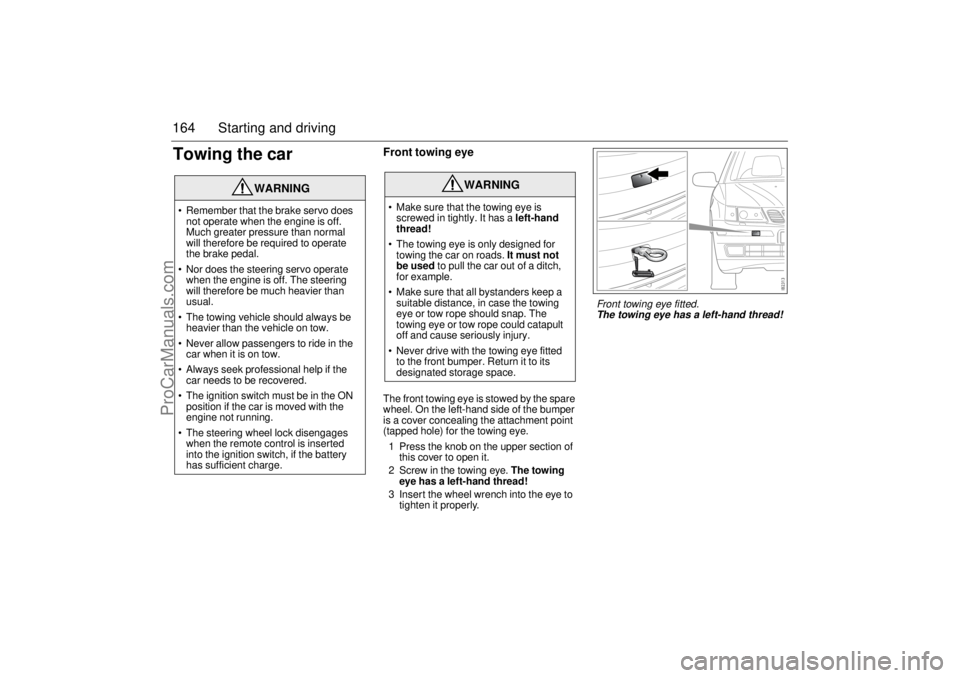
Front towing eyeThe front towing eye is stowed by the spare
wheel. On the left-hand side of the bumper
is a cover concealing the attachment point
(tapped hole) for the towing eye.
1 Press the knob on the upper section of
this cover to open it.
2 Screw in the towing eye. The towing
eye has a left-hand thread!
3 Insert the wheel wrench into the eye to
tighten it properly.
WARNING
Remember that the brake servo does
not operate when the engine is off.
Much greater pressure than normal
will therefore be required to operate
the brake pedal.
Nor does the steering servo operate
when the engine is off. The steering
will therefore be much heavier than
usual.
The towing vehicle should always be
heavier than the vehicle on tow.
Never allow passengers to ride in the
car when it is on tow.
Always seek professional help if the
car needs to be recovered.
The ignition switch must be in the ON
position if the car is moved with the
engine not running.
The steering wheel lock disengages
when the remote control is inserted
into the ignition switch, if the battery
has sufficient charge.
WARNING
Make sure that the towing eye is
screwed in tightly. It has a left-hand
thread!
The towing eye is only designed for
towing the car on roads. It must not
be used to pull the car out of a ditch,
for example.
Make sure that all bystanders keep a
suitable distance, in case the towing
eye or tow rope should snap. The
towing eye or tow rope could catapult
off and cause seriously injury.
Never drive with the towing eye fitted
to the front bumper. Return it to its
designated storage space.
Front towing eye fitted.
The towing eye has a left-hand thread!
ProCarManuals.com
Page 168 of 256
168 Starting and drivingJump starting
It is essential when a donor battery is to be
used to jump start the car that the jump
leads be connected correctly to prevent
arcing.
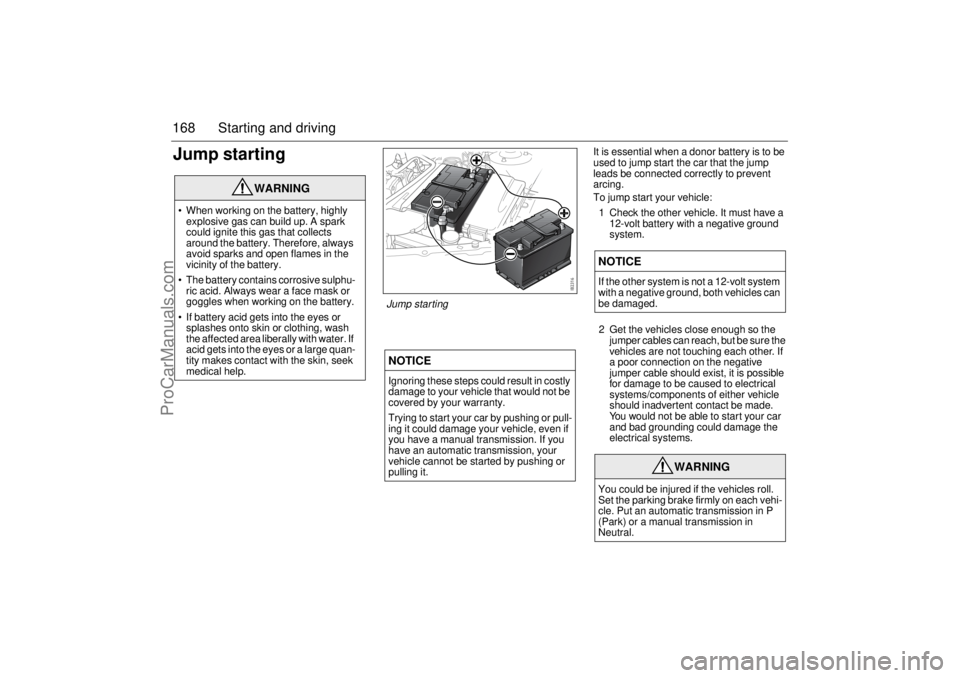
To jump start your vehicle:
1 Check the other vehicle. It must have a
12-volt battery with a negative ground
system.
2 Get the vehicles close enough so the
jumper cables can reach, but be sure the
vehicles are not touching each other. If
a poor connection on the negative
jumper cable should exist, it is possible
for damage to be caused to electrical
systems/components of either vehicle
should inadvertent contact be made.
You would not be able to start your car
and bad grounding could damage the
electrical systems.
WARNING
When working on the battery, highly
explosive gas can build up. A spark
could ignite this gas that collects
around the battery. Therefore, always
avoid sparks and open flames in the
vicinity of the battery.
The battery contains corrosive sulphu-
ric acid. Always wear a face mask or
goggles when working on the battery.
If battery acid gets into the eyes or
splashes onto skin or clothing, wash
the affected area liberally with water. If
acid gets into the eyes or a large quan-
tity makes contact with the skin, seek
medical help.
NOTICEIgnoring these steps could result in costly
damage to your vehicle that would not be
covered by your warranty.
Trying to start your car by pushing or pull-
ing it could damage your vehicle, even if
you have a manual transmission. If you
have an automatic transmission, your
vehicle cannot be started by pushing or
pulling it.
NOTICEIf the other system is not a 12-volt system
with a negative ground, both vehicles can
be damaged.
WARNING
You could be injured if the vehicles roll.
Set the parking brake firmly on each vehi-
cle. Put an automatic transmission in P
(Park) or a manual transmission in
Neutral.
Jump starting
ProCarManuals.com
Page 169 of 256
169 Starting and driving
3 Turn off the ignition on both vehicles.
Turn off all lights that are not needed,
and radios. This will avoid sparks and
help save both batteries and it could
save your radio.
4 Open the hood and locate the battery.
Find the positive (+) and negative (–) termi-
nals on the battery.
5 Check that the jumper cables do not
have loose or missing insulation. If they
do, you could get a shock and also the
vehicles could be damaged.
Before you connect the cables, here are
some basic things you should know.
Positive (+) will go to positive (+) and
negative (–) will go to negative (–). Do
not connect (+) to (–) or you will get a
short that could injure you or would
damage the battery and maybe other
parts as well.
6 Connect the red positive (+) cable to the
positive (+) terminal of the vehicle with
the discharged battery.7 Do not let the other end touch metal.
Connect it to the positive (+) terminal of
the good battery. Use a remote positive
(+) terminal if the vehicle has one.
8 Now connect the negative (–) cable to
the good battery’s negative terminal.
9 Attach the cable to the discharged
battery’s negative terminal.
10 Start the vehicle with the good battery
and run the engine for a while.
11 Try to start the vehicle with the
discharged battery. If it does not start
after a few tries, it probably needs
service.
12 Remove the cables in reverse order to
prevent electrical shorting. Take care
that they do not touch each other or any
other metal.NOTICEIf you leave your radio on, it could be
badly damaged. The repairs would not be
covered by your warranty.
WARNING
An electric fan can start up even when the
engine is not running and can injure you.
Keep hands, clothing and tools away from
any underhood electric fan.
WARNING
Using a match or flame of any kind near a
battery can cause battery gas to explode.
You can suffer burns or be blinded. Use a
flashlight if you need more light.
Be sure the electrolyte in the battery is not
frozen. Discharged batteries will freeze.
When connecting jumper cables to a
frozen battery, gas from the chemical
reaction inside the battery can build up
under the ice and cause an explosion.
Battery fluid contains acid that can burn
you. Do not get it on you. If you acciden-
tally get it in your eyes or on your skin,
flush the area with water and get medical
help immediately.
ProCarManuals.com
Page 170 of 256

170 Starting and drivingFor long tripsBefore starting off on a long journey, it is
advisable to have your car inspected by
your Saab dealer.
Obtain a few important items to take along
on your journey, such as spare bulbs, wiper
blades, fuses, a drive belt (poly-V-belt) and
the like.
You can check some points yourself before-
hand:
Check that no oil or fuel leaks out of the
engine or gearbox/transmission.
Check the coolant and power steering
fluid levels. Check also for leaks.
Inspect the drive belt (poly-V-belt) and
replace if it shows any signs of wear.
Check the battery charge.
Check the tires for tread pattern and air
pressure, including the compact spare
wheel.
Take an extra remote control and keep it
separate.
Check the brakes.
Check all bulbs.
Check for the presence of the tool kit and
jack in the car.
ProCarManuals.com
Page 171 of 256
171 Car care
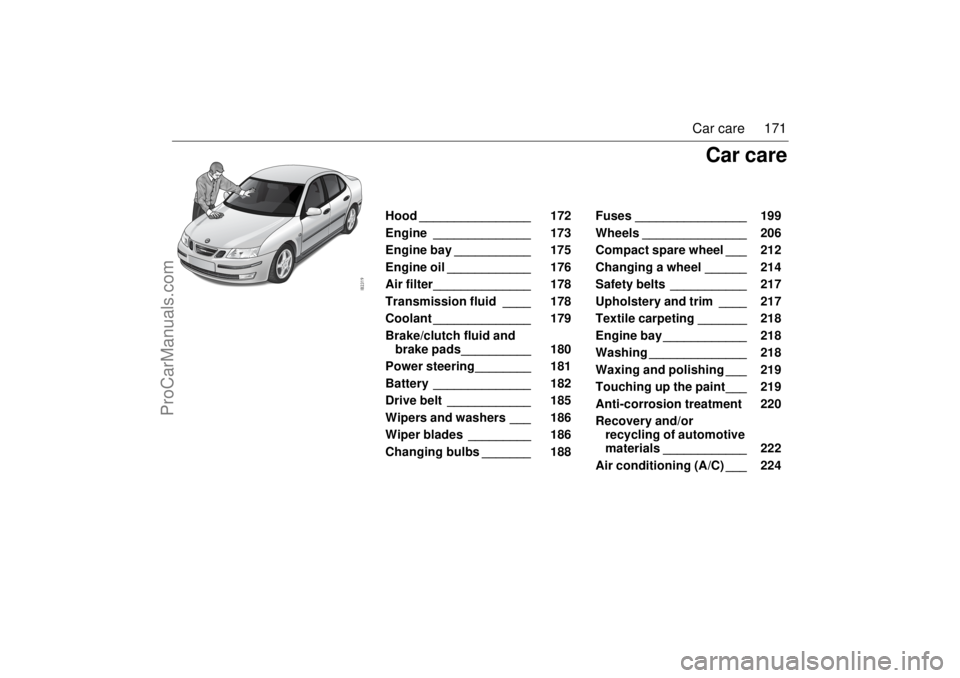
Hood ________________ 172
Engine ______________ 173
Engine bay ___________ 175
Engine oil ____________ 176
Air filter______________ 178
Transmission fluid ____ 178
Coolant ______________ 179
Brake/clutch fluid and
brake pads__________ 180
Power steering________ 181
Battery ______________ 182
Drive belt ____________ 185
Wipers and washers ___ 186
Wiper blades _________ 186
Changing bulbs _______ 188 Fuses ________________ 199
Wheels _______________ 206
Compact spare wheel ___ 212
Changing a wheel ______ 214
Safety belts ___________ 217
Upholstery and trim ____ 217
Textile carpeting _______ 218
Engine bay ____________ 218
Washing ______________ 218
Waxing and polishing ___ 219
Touching up the paint___ 219
Anti-corrosion treatment 220
Recovery and/or
recycling of automotive
materials ____________ 222
Air conditioning (A/C) ___ 224
Car care
ProCarManuals.com
Page 175 of 256
175 Car care
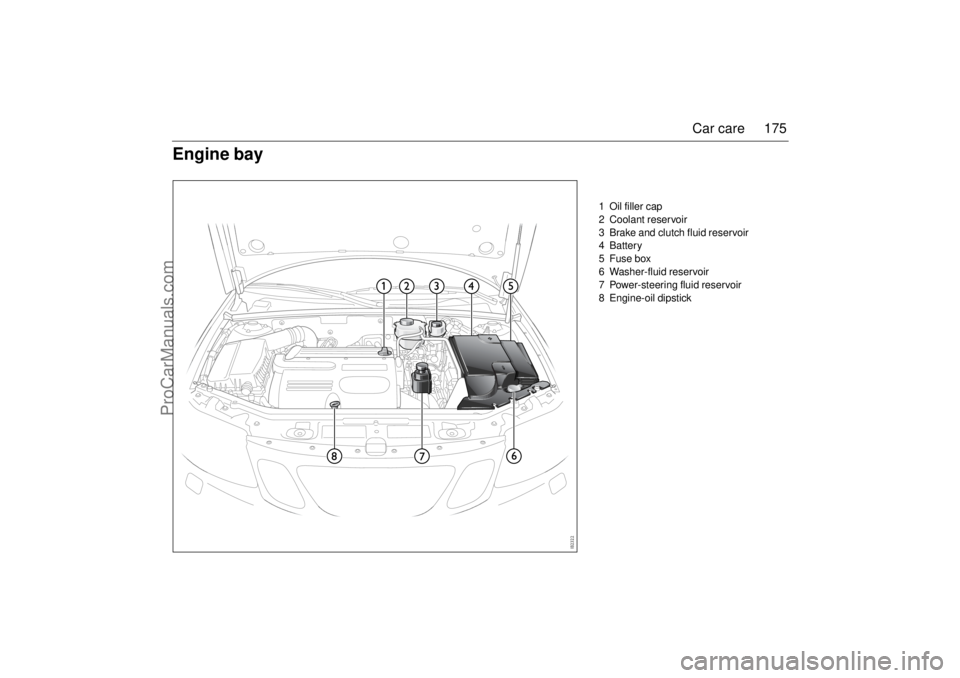
1 Oil filler cap
2 Coolant reservoir
3 Brake and clutch fluid reservoir
4Battery
5 Fuse box
6 Washer-fluid reservoir
7 Power-steering fluid reservoir
8 Engine-oil dipstick
Engine bay
ProCarManuals.com
Page 182 of 256
182 Car careBattery
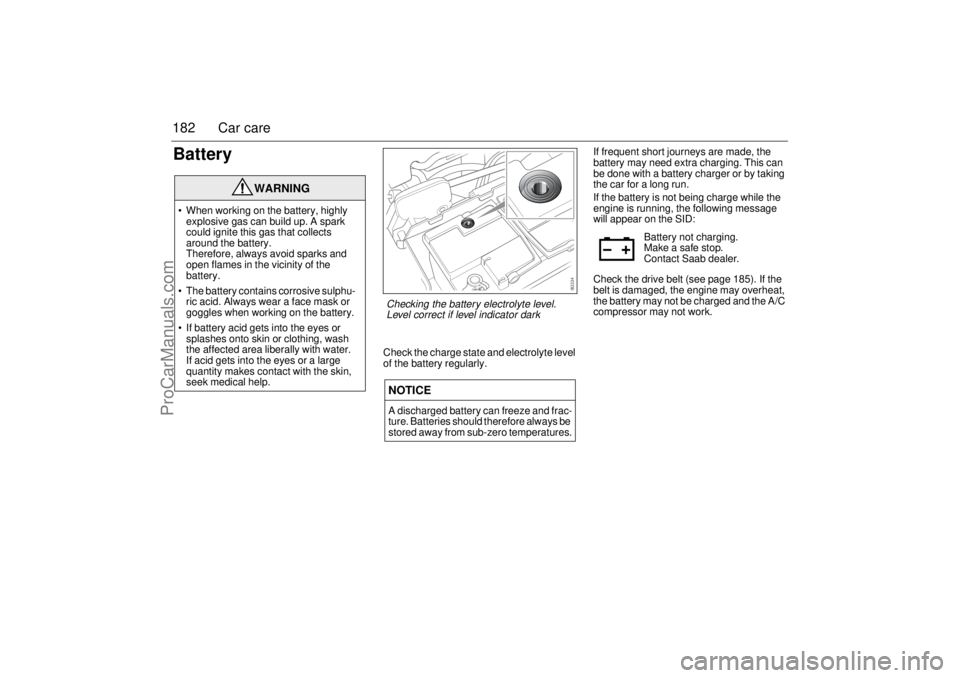
Check the charge state and electrolyte level
of the battery regularly.If frequent short journeys are made, the
battery may need extra charging. This can
be done with a battery charger or by taking
the car for a long run.
If the battery is not being charge while the
engine is running, the following message
will appear on the SID:
Check the drive belt (see page 185). If the
belt is damaged, the engine may overheat,
the battery may not be charged and the A/C
compressor may not work.
WARNING
When working on the battery, highly
explosive gas can build up. A spark
could ignite this gas that collects
around the battery.
Therefore, always avoid sparks and
open flames in the vicinity of the
battery.
The battery contains corrosive sulphu-
ric acid. Always wear a face mask or
goggles when working on the battery.
If battery acid gets into the eyes or
splashes onto skin or clothing, wash
the affected area liberally with water.
If acid gets into the eyes or a large
quantity makes contact with the skin,
seek medical help.
NOTICEA discharged battery can freeze and frac-
ture. Batteries should therefore always be
stored away from sub-zero temperatures.
Battery not charging.
Make a safe stop.
Contact Saab dealer.
Checking the battery electrolyte level.
Level correct if level indicator dark
ProCarManuals.com