instrument panel SAAB 9-3 2003 Owner's Manual
[x] Cancel search | Manufacturer: SAAB, Model Year: 2003, Model line: 9-3, Model: SAAB 9-3 2003Pages: 256, PDF Size: 21.66 MB
Page 80 of 256

80 Instruments and controlsAir distributionThe air distribution control is used to direct the flow of air to the
defroster, panel and floor vents.
The control also permits settings in between the three main settings
defroster, panel and floor:
defroster and floor
panel and floor
defroster, panel and floor (11 o’clock position)
To counter cold drafts from the front side windows when the control
has been set to defroster or floor, a small flow of air issues from
the outer vents on the fascia.
As the winter comfort setting, we recommend that the distribution
knob be turned to .
Recommended settings in severe coldOn starting with a cold engine, set the fan speed to 2 or 3 and select
maximum heat and defroster to heat the cabin and demist the wind-
shield as quickly as possible.
When the engine is warmer and the temperature gauge starts to
rise, fan setting 4 may be chosen. Once the windshield is clear, the
air distribution control should be turned to .
If the rear seat passengers desire more warmth to the feet, turn the
distribution knob one step clockwise.
How quickly the engine warms up will depend on how the car is
driven. It will take longer for the engine to warm up if the car is driven
in a high gear at low engine speeds, such as in town, than if it is
driven at high engine speeds on a motorway, for example.
Do not use fan speed 5. This is primarily intended for rapid cooling
during the summer.
ProCarManuals.com
Page 81 of 256
81 Instruments and controls
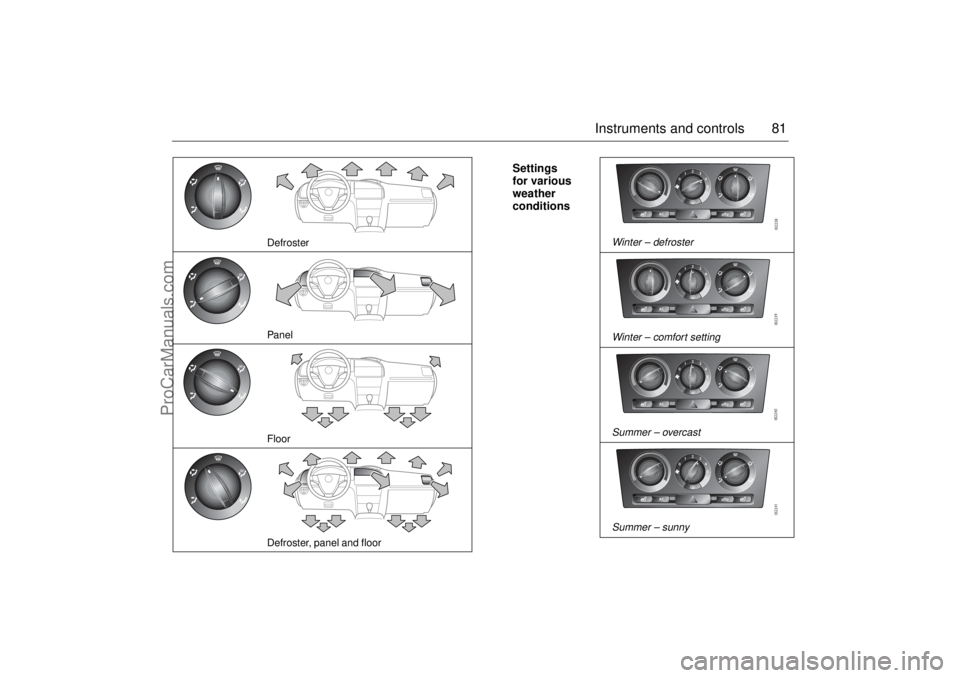
Defroster
Panel
Floor
Defroster, panel and floor
Winter – defroster
Winter – comfort setting
Summer – overcast
Summer – sunny
Settings
for various
weather
conditions
ProCarManuals.com
Page 82 of 256
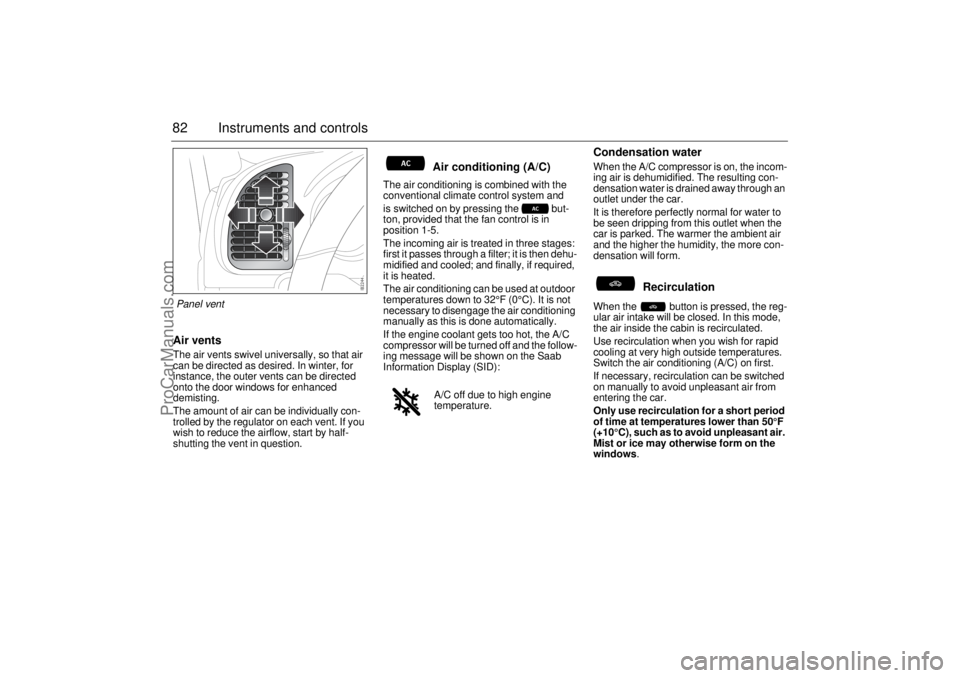
82 Instruments and controlsAir ventsThe air vents swivel universally, so that air
can be directed as desired. In winter, for
instance, the outer vents can be directed
onto the door windows for enhanced
demisting.
The amount of air can be individually con-
trolled by the regulator on each vent. If you
wish to reduce the airflow, start by half-
shutting the vent in question.The air conditioning is combined with the
conventional climate control system and
is switched on by pressing the but-
ton, provided that the fan control is in
position 1-5.
The incoming air is treated in three stages:
first it passes through a filter; it is then dehu-
midified and cooled; and finally, if required,
it is heated.
The air conditioning can be used at outdoor
temperatures down to 32°F (0°C). It is not
necessary to disengage the air conditioning
manually as this is done automatically.
If the engine coolant gets too hot, the A/C
compressor will be turned off and the follow-
ing message will be shown on the Saab
Information Display (SID):
Condensation waterWhen the A/C compressor is on, the incom-
ing air is dehumidified. The resulting con-
densation water is drained away through an
outlet under the car.
It is therefore perfectly normal for water to
be seen dripping from this outlet when the
car is parked. The warmer the ambient air
and the higher the humidity, the more con-
densation will form.
When the button is pressed, the reg-
ular air intake will be closed. In this mode,
the air inside the cabin is recirculated.
Use recirculation when you wish for rapid
cooling at very high outside temperatures.
Switch the air conditioning (A/C) on first.
If necessary, recirculation can be switched
on manually to avoid unpleasant air from
entering the car.
Only use recirculation for a short period
of time at temperatures lower than 50°F
(+10°C), such as to avoid unpleasant air.
Mist or ice may otherwise form on the
windows.
Air conditioning (A/C)A/C off due to high engine
temperature.
Recirculation
Panel vent
ProCarManuals.com
Page 84 of 256
84 Instruments and controlsAutomatic climate-
control system (ACC)Fresh air for the cabin is drawn in through an
inlet at the bottom edge of the windshield. It
passes through an effective filter before
reaching the climate control system and
delivery into the cabin. The air is evacuated
via openings in the parcel shelf. It is then led
through outlets on either side of the car
behind the rear bumper.
The Automatic Climate-Control syatem
(ACC) automatically maintains the desired
cabin temperature, regardless of the
weather outside.
The system will achieve the desired temper-
ature in the quickest possible way.
Note that heating or cooling is not
speeded up by setting the temperature
higher or lower than the final tempera-
ture you desire.
To optimize the performance of the air con-
ditioning system, all windows and the sun-
roof should be shut. The air vents in the
fascia must be open.
The incoming air is treated in three stages:
first it passes through a filter; it is then dehu-
midified and cooled; and finally, if required,
it is heated.To reduce potential misting on the insides of
the windows, the glass should be cleaned
with a quality glass cleaner. How often this
will need to be done depends on how clean
the air is - if there are smokers in the car, the
windows will need to be cleaned more
frequently.
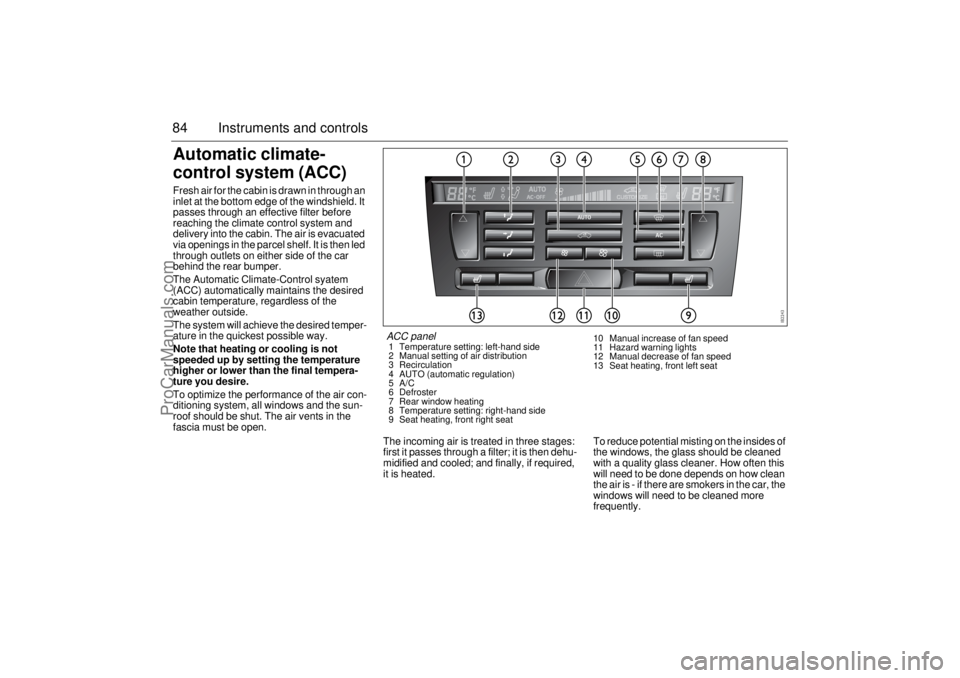
ACC panel1 Temperature setting: left-hand side
2 Manual setting of air distribution
3 Recirculation
4 AUTO (automatic regulation)
5A/C
6 Defroster
7 Rear window heating
8 Temperature setting: right-hand side
9 Seat heating, front right seat10 Manual increase of fan speed
11 Hazard warning lights
12 Manual decrease of fan speed
13 Seat heating, front left seat
ProCarManuals.com
Page 85 of 256
85 Instruments and controls
Temperature controlThe cabin is divided into two temperature
zones:
1 Driver’s zone.
2 Passenger zone.
The temperature in the rear seat will be a
mixture of the two zones.
If you choose the single zone setting, the
entire cabin is treated as one zone. If you
choose the dual zone setting, settings can
be made separately for the driver’s zone
and passenger zone.
Select between single and dual zone set-
tings under Profiler (see page 93).
The cabin temperature can be set to
between 58–82°F (15–27°C). In addition, HI
(maximum heating and high fan speed) and
LO (maximum cooling and maximum fan
speed) can be selected. HI and LO can only
be selected for the passenger zone if the
driver has selected the same setting.The displayed temperature is not the actual
air temperature but corresponds to the
comfort level normally experienced at that
temperature after allowance has been
made for the airflow, relative humidity, solar
radiation, and so on, currently prevailing
inside the car.
The most usual temperature setting is
between 66–74°F (19–23°C), depending
on personal preference and what clothing
is worn.
Change the temperature setting in 2°F
(1°C) steps.
Make sure the air vents are open when
cooling the cabin in warm weather.
Settings when HI is selected:
Maximum heat
Air distribution to windshield and floor
High fan speed (6 bars on the fan display).
Settings when LO is selected:
Maximum cooling
Air distribution to air vents in fascia
Maximum fan speed (8 bars on the fan
display).
Recirculation ON (depending on outside
temperature).
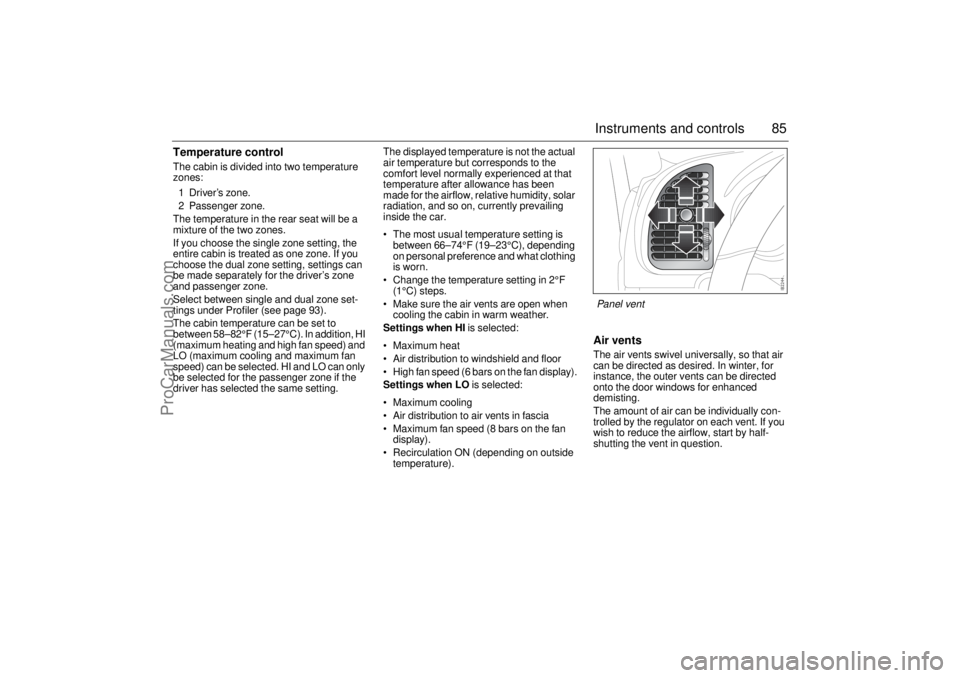
Air ventsThe air vents swivel universally, so that air
can be directed as desired. In winter, for
instance, the outer vents can be directed
onto the door windows for enhanced
demisting.
The amount of air can be individually con-
trolled by the regulator on each vent. If you
wish to reduce the airflow, start by half-
shutting the vent in question.Panel vent
ProCarManuals.com
Page 86 of 256
86 Instruments and controlsThe system uses four sensors:
Outside air temperature sensor
Cabin air temperature sensor
Sun sensor
Blended air temperature sensors (located
in the heater unit and the outer panel vent
duct).
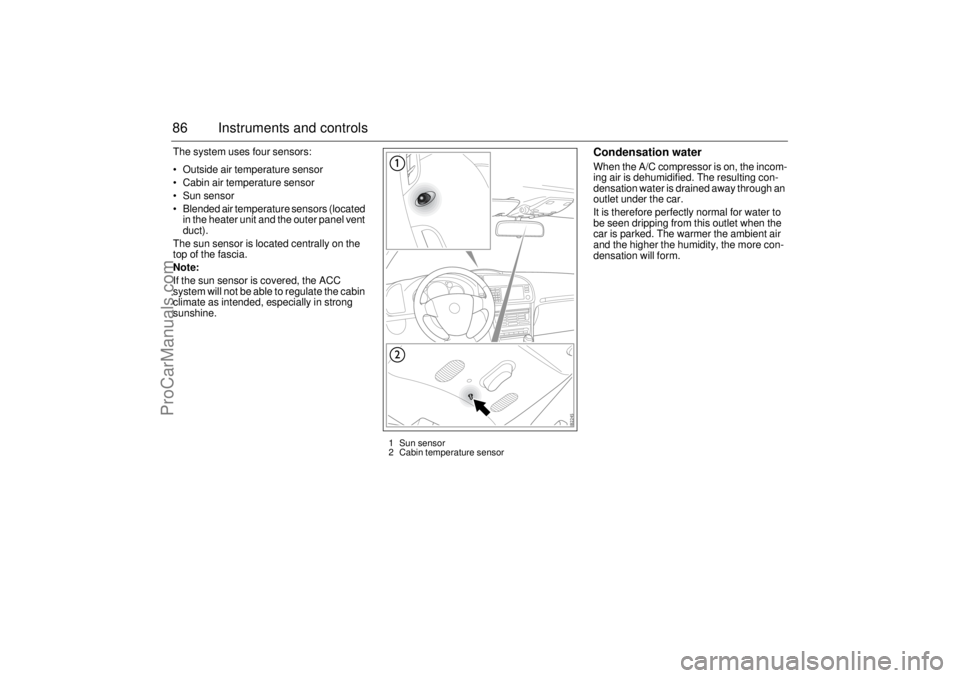
The sun sensor is located centrally on the
top of the fascia.
Note:
If the sun sensor is covered, the ACC
system will not be able to regulate the cabin
climate as intended, especially in strong
sunshine.
Condensation waterWhen the A/C compressor is on, the incom-
ing air is dehumidified. The resulting con-
densation water is drained away through an
outlet under the car.
It is therefore perfectly normal for water to
be seen dripping from this outlet when the
car is parked. The warmer the ambient air
and the higher the humidity, the more con-
densation will form.
1 Sun sensor
2 Cabin temperature sensor
ProCarManuals.com
Page 90 of 256
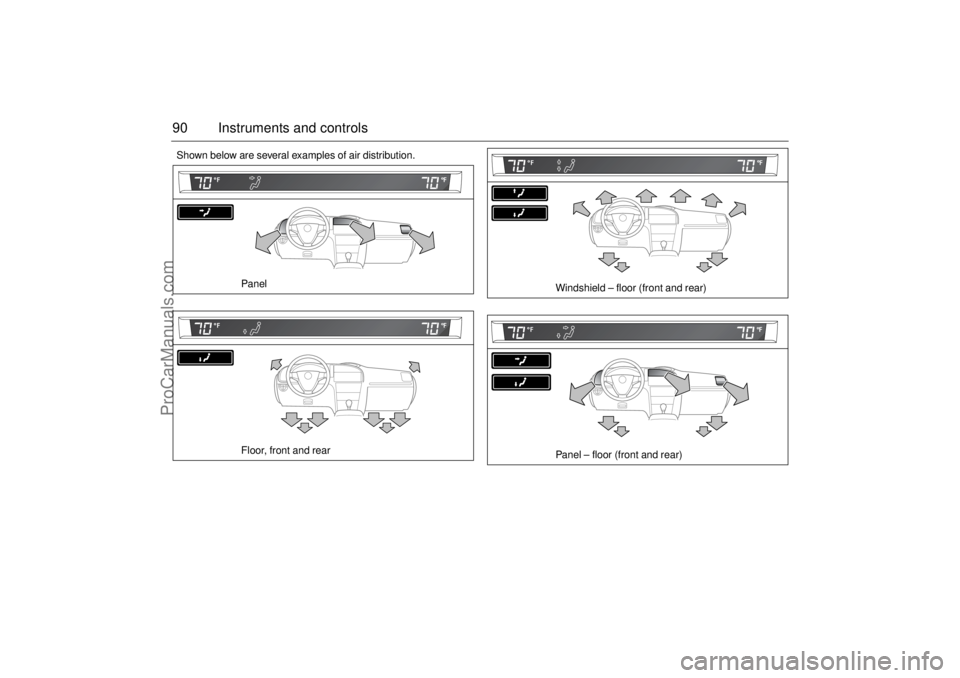
90 Instruments and controlsShown below are several examples of air distribution.
Panel
Floor, front and rear
Windshield – floor (front and rear)
Panel – floor (front and rear)
ProCarManuals.com
Page 91 of 256
91 Instruments and controls
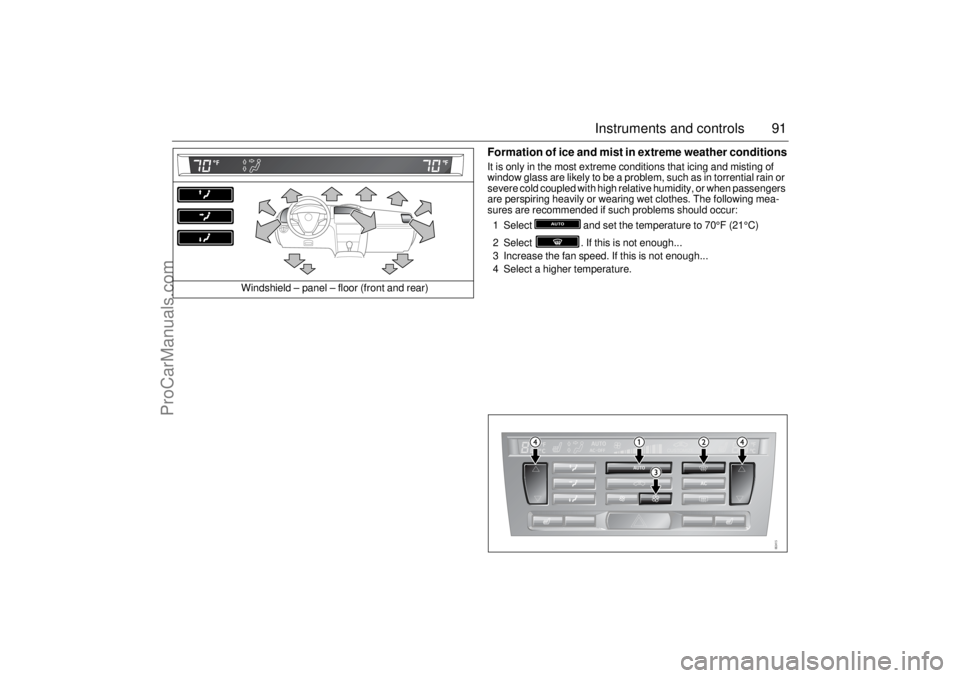
Formation of ice and mist in extreme weather conditionsIt is only in the most extreme conditions that icing and misting of
window glass are likely to be a problem, such as in torrential rain or
severe cold coupled with high relative humidity, or when passengers
are perspiring heavily or wearing wet clothes. The following mea-
sures are recommended if such problems should occur:
1 Select and set the temperature to 70°F (21°C)
2 Select . If this is not enough...
3 Increase the fan speed. If this is not enough...
4 Select a higher temperature.
Windshield – panel – floor (front and rear)
ProCarManuals.com
Page 93 of 256
93 Instruments and controls
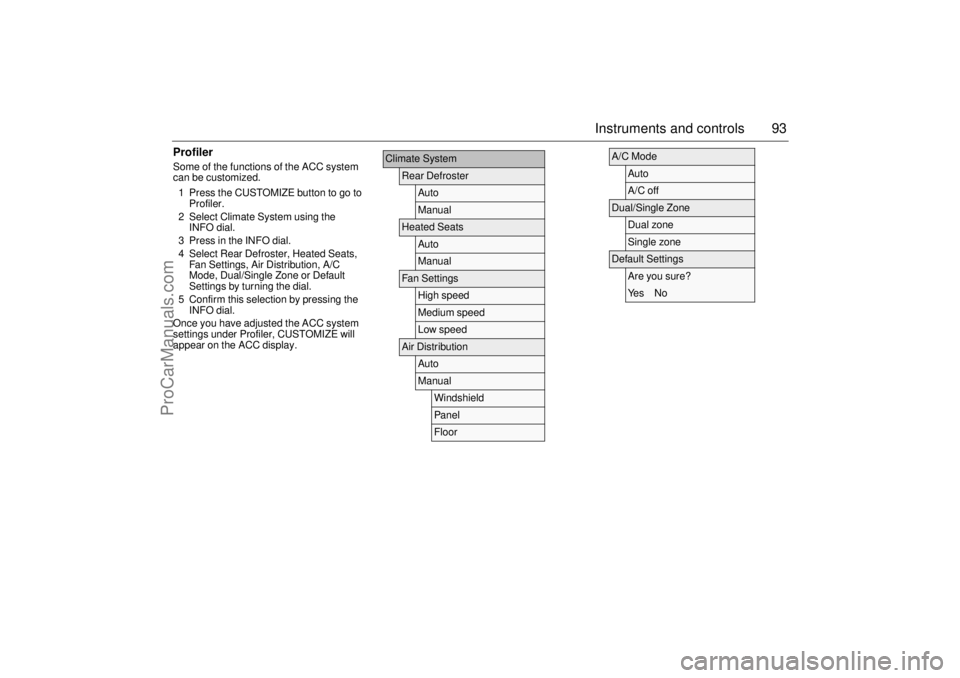
ProfilerSome of the functions of the ACC system
can be customized.
1 Press the CUSTOMIZE button to go to
Profiler.
2 Select Climate System using the
INFO dial.
3 Press in the INFO dial.
4 Select Rear Defroster, Heated Seats,
Fan Settings, Air Distribution, A/C
Mode, Dual/Single Zone or Default
Settings by turning the dial.
5 Confirm this selection by pressing the
INFO dial.
Once you have adjusted the ACC system
settings under Profiler, CUSTOMIZE will
appear on the ACC display.
Climate System
Rear Defroster
AutoManual
Heated Seats
AutoManual
Fan Settings
High speedMedium speedLow speed
Air Distribution
AutoManual
WindshieldPanelFloor
A/C Mode
AutoA/C off
Dual/Single Zone
Dual zoneSingle zone
Default Settings
Are you sure?Ye s N o
ProCarManuals.com
Page 94 of 256

94 Instruments and controlsExplanation of how the ACC system can be
customized under Profiler.
Rear Defroster
Auto:
The rear window and door mirror
heating is controlled automatically.
This is one of the Default Settings.
Manual:
The rear window and door mirror
heating is switched on with
the button on ACC panel.
Heated Seats
Auto:
The front seat heating is controlled
automatically.
Select the level by repeatedly
pressing the appropriate button on
the ACC panel: 2 arrows on symbol
= standard; 3 arrows = high; 1 arrow
= low. The selected heating setting
is saved when the engine is
switched off. Note: The symbol on
the ACC panel goes out if the heat-
ing is turned off automatically by the
system.
Manual:
See Electric heating, front seats
(option) on page 92
.
This is one of the Default Settings.
Fan Settings
High speed:
This selection give a slightly higher
fan speed than Medium speed
though with continued automatic
regulation.
Medium speed:
Normal automatic fan speed. This is
one of the Default Settings.
Low speed:
This selection give a slightly lower
fan speed than Medium speed
though with continued automatic
regulation.
Air Distribution
Auto:
The ACC system adapts air tem-
perature and distribution to the pre-
vailing conditions. This is one of the
Default Settings
.
Manual:
Windshield:
The ACC system directs almost
all air to the windshield.
Panel:
The ACC system directs almost
all air to air vents in the fascia.
Floor:
The ACC system directs almost
all air to the floor.
ProCarManuals.com