wheel SAAB 9-3 2003 Repair Manual
[x] Cancel search | Manufacturer: SAAB, Model Year: 2003, Model line: 9-3, Model: SAAB 9-3 2003Pages: 256, PDF Size: 21.66 MB
Page 215 of 256
215 Car care
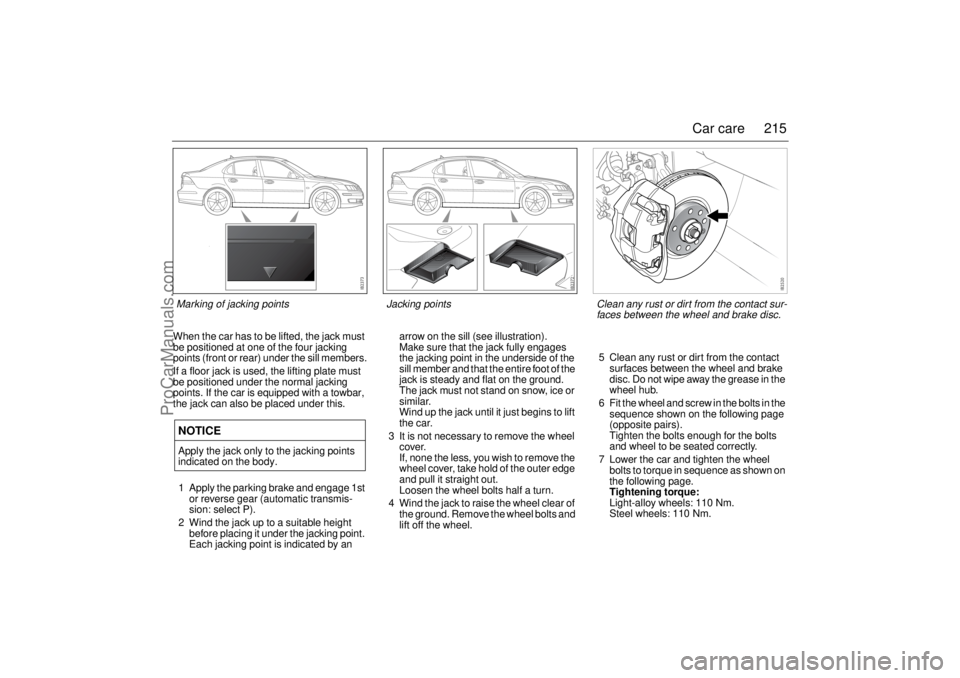
When the car has to be lifted, the jack must
be positioned at one of the four jacking
points (front or rear) under the sill members.
If a floor jack is used, the lifting plate must
be positioned under the normal jacking
points. If the car is equipped with a towbar,
the jack can also be placed under this.
1 Apply the parking brake and engage 1st
or reverse gear (automatic transmis-
sion: select P).
2 Wind the jack up to a suitable height
before placing it under the jacking point.
Each jacking point is indicated by an arrow on the sill (see illustration).
Make sure that the jack fully engages
the jacking point in the underside of the
sill member and that the entire foot of the
jack is steady and flat on the ground.
The jack must not stand on snow, ice or
similar.
Wind up the jack until it just begins to lift
the car.
3 It is not necessary to remove the wheel
cover.
If, none the less, you wish to remove the
wheel cover, take hold of the outer edge
and pull it straight out.
Loosen the wheel bolts half a turn.
4 Wind the jack to raise the wheel clear of
the ground. Remove the wheel bolts and
lift off the wheel.5 Clean any rust or dirt from the contact
surfaces between the wheel and brake
disc. Do not wipe away the grease in the
wheel hub.
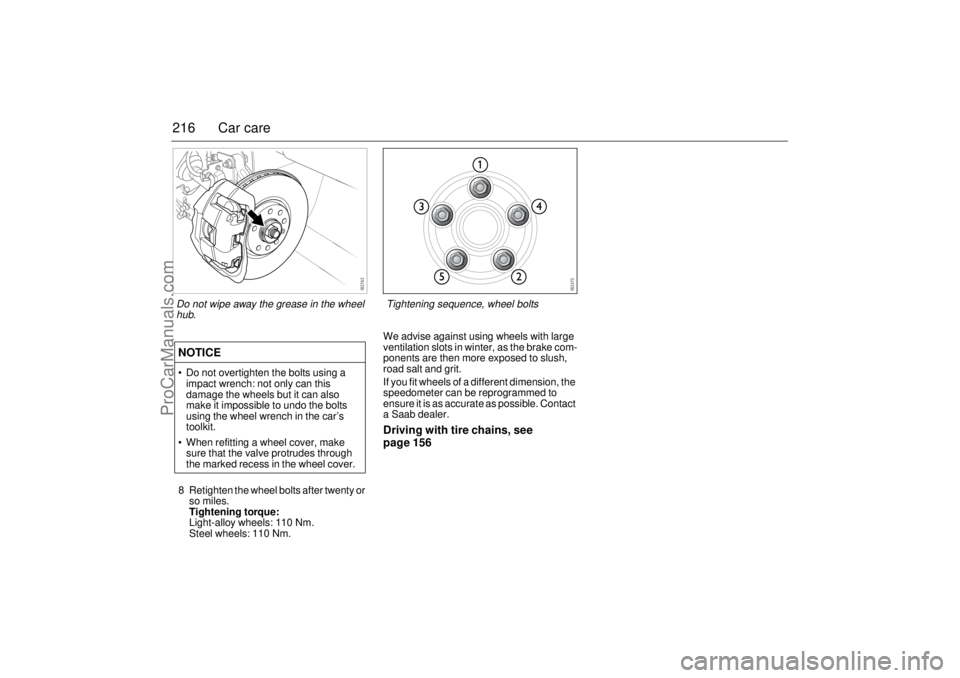
6 Fit the wheel and screw in the bolts in the
sequence shown on the following page
(opposite pairs).
Tighten the bolts enough for the bolts
and wheel to be seated correctly.
7 Lower the car and tighten the wheel
bolts to torque in sequence as shown on
the following page.
Tightening torque:
Light-alloy wheels: 110 Nm.
Steel wheels: 110 Nm.NOTICEApply the jack only to the jacking points
indicated on the body.
Jacking points
Marking of jacking points
Clean any rust or dirt from the contact sur-
faces between the wheel and brake disc.
ProCarManuals.com
Page 216 of 256
216 Car care8 Retighten the wheel bolts after twenty or
so miles.
Tightening torque:
Light-alloy wheels: 110 Nm.
Steel wheels: 110 Nm.We advise against using wheels with large
ventilation slots in winter, as the brake com-
ponents are then more exposed to slush,
road salt and grit.
If you fit wheels of a different dimension, the
speedometer can be reprogrammed to
ensure it is as accurate as possible. Contact
a Saab dealer.
Driving with tire chains, see
page 156 NOTICE
Do not overtighten the bolts using a
impact wrench: not only can this
damage the wheels but it can also
make it impossible to undo the bolts
using the wheel wrench in the car’s
toolkit.
When refitting a wheel cover, make
sure that the valve protrudes through
the marked recess in the wheel cover.
Tightening sequence, wheel bolts
Do not wipe away the grease in the wheel
hub.
ProCarManuals.com
Page 217 of 256

217 Car care
Flat spottingAll tires get hot, especially on long journeys
or when the car is driven hard. After the car
has been parked with hot tires and the tires
have cooled down, a flat spot can form in the
tire, where it is in contact with the ground.
The same can occur if the car has not been
moved for a long time.
Flat spots can cause vibration that can be
felt through the steering wheel, similar to
that experienced when the wheels need bal-
ancing.
Flat spots of this type disappear once the
tires get hot again, usually after 10–15 miles
(20–25 km) of driving at cruising speed.
Safety beltsCheck the function of the safety belts regu-
larly as follows:
Hold the diagonal strap and pull it sharply.
The safety belt should lock and it should
not be possible to withdraw it further.
Check the anchorage points in the floor.
They must not have suffered rust damage.
If a belt is worn or has any fraying edges, it
should be replaced.
Safety belts must not come into contact with
substances such as polishes, oil or chemi-
cals. If the belts get dirty, wash them with
warm water and a detergent or have them
replaced.
Upholstery and trimTo remove fluff and hairs from the seats,
door armrests and headlining, use a
vacuum cleaner, a moist lint-free cloth, or a
clothes brush. Remove spots and dirt using
a cloth moistened with lukewarm soapy
water.
When using a stain remover, always work
from the outside towards the centre to avoid
leaving a ring. If a soiled ring or spot should
remain, it can usually be removed using
lukewarm soapy water or water alone.
Spots left by liquids, such as soft drinks or
thin oil, must be removed at once with an
absorbent material, such as kitchen towel-
ling. Then clean with a stain remover.
White spirit is recommended for removing
grease and oil stains. A medium stiff brush
may also be used.
WARNING
If the car is involved in a crash, the safety
belts, belt pretensioners and other asso-
ciated components must be inspected at
a Saab dealer.
Never make any alterations or repairs to
the safetybelts yourself but visit a Saab
dealer.
ProCarManuals.com
Page 220 of 256
220 Car careTwo-coat enamelAs the name implies, two-coat enamel is
applied in two operations. The first coat, the
base color, contains the pigment, metal
flakes and binder. The second coat consists
of a clear enamel, which provides the final
gloss for the paintwork and protects the
base from moisture and environmental con-
taminants.
Touch-up stone-chip damage as follows:
1 Thoroughly clean the damaged area.
2 Then apply the primer, base colour and
finally, the clear enamel. To achieve the
best finish, apply two or three coats of
primer.
Anti-corrosion
treatmentThe entire car undergoes a series of anti-
corrosion processes during production.
These include electrophoretic priming,
polyester-based coating to protect against
stone chip damage and corrosion, and
treatment of body cavities and members
with thin, penetrating rustproofing oil.
In addition, most body panels, such as the
hood, doors and floor pan are galvanized.
The anti-corrosion treatment on some parts
of the car is constantly exposed to wear and
prone to damage. This applies particularly
to the underside of the car and inside the
wheel arches, where grit, road salt and the
like that are thrown up can give rise to cor-
rosion where the underseal has worn away.
The extent of this obviously depends on the
conditions in which the car is used.
Accordingly, make it a habit to hose the
underside of the car often and to inspect the
condition of the underseal. The anti-corro-
sion warranty does not relieve the car owner
of the need to carry out normal maintenance
to the rustproofing and to make good any
damage.
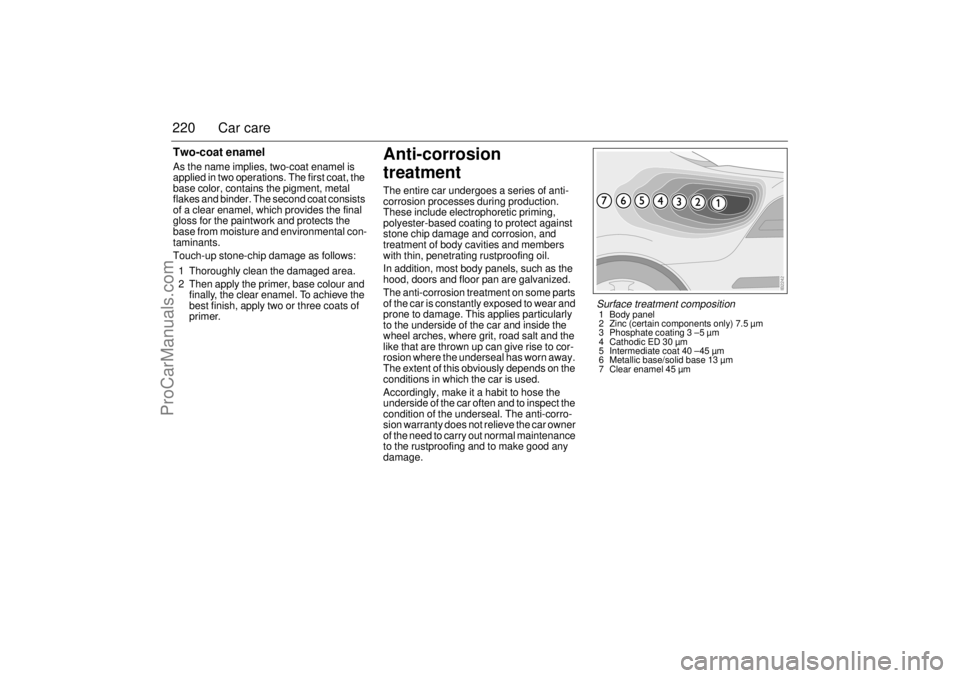
Surface treatment composition1 Body panel
2 Zinc (certain components only) 7.5 µm
3 Phosphate coating 3 –5 µm
4 Cathodic ED 30 µm
5 Intermediate coat 40 –45 µm
6 Metallic base/solid base 13 µm
7 Clear enamel 45 µm
ProCarManuals.com
Page 222 of 256

222 Car care2Clean the underside of the car during
the winter. Use high pressure water to
clean the car’s underside (floor panels,
wheel wells) at least at mid-winter and in
the spring.
3Inspect the car frequently for leaks or
damage, and arrange for needed
repairs promptly. After washing or after
heavy rain, check for leaks. When wash-
ing the car inspect body surfaces for
paint damage. While checking for leaks,
lift the floor mats and check underneath
them. Water can collect in these areas
and remain for prolonged periods. Dry
any wet areas including the floor mats.
Have leaks repaired as soon as possi-
ble.
Use touch-up paint to repair small
scratches or minor finish damage. Areas
where metal is exposed will rust quickly
and MUST be repaired immediately by
touch-up or professional repainting.
Rust must be removed, the bare metal
primed and painted. Major body
damage should be repaired immediately
and new panels or exposed areas
should be undercoated with anti- corro-
sion material.
Repairs of this type are the owner’s
responsibility and are not covered under
warranty.Inspect the undercoating and touch up if
necessary. Pay particular attention to the
fenders and wheel housings, which are
exposed to abrasion by flying gravel, etc. If
the composition has worn or flaked off, the
steel must be thoroughly cleaned and dried
before a fresh coat is applied. The cleaning
is best done with a scraper and a steel wire
brush, followed by washing with solvent.
Apply the new coating thinly, otherwise it
may run off or fall off when dry.
Recovery and/or
recycling of automotive
materialsA typical car consists of metals (65–75 %),
plastics (10–15 %), rubber (5 %) and small
quantities of glass, wood, paper and tex-
tiles. The recycling of metals has been com-
monplace for a long time now.
To facilitate the sorting of other materials,
plastic parts, for instance, have been
marked to identify the precise nature of the
plastic.
ProCarManuals.com
Page 223 of 256
223 Car care
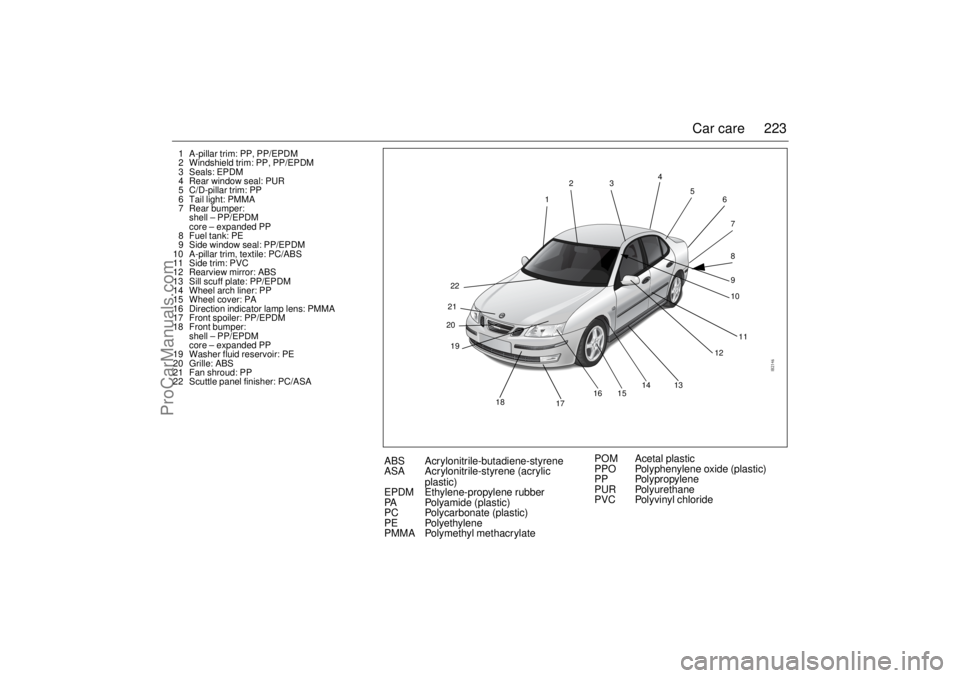
1 A-pillar trim: PP, PP/EPDM
2 Windshield trim: PP, PP/EPDM
3 Seals: EPDM
4 Rear window seal: PUR
5 C/D-pillar trim: PP
6 Tail light: PMMA
7 Rear bumper:
shell – PP/EPDM
core – expanded PP
8 Fuel tank: PE
9 Side window seal: PP/EPDM
10 A-pillar trim, textile: PC/ABS
11 Side trim: PVC
12 Rearview mirror: ABS
13 Sill scuff plate: PP/EPDM
14 Wheel arch liner: PP
15 Wheel cover: PA
16 Direction indicator lamp lens: PMMA
17 Front spoiler: PP/EPDM
18 Front bumper:
shell – PP/EPDM
core – expanded PP
19 Washer fluid reservoir: PE
20 Grille: ABS
21 Fan shroud: PP
22 Scuttle panel finisher: PC/ASA
19 2022
211234
18
1716 151412
1311 7
10 9 8 6 5
ABS Acr ylonitrile-butadiene-styrene
ASA Acrylonitrile-styrene (acrylic
plastic)
EPDM Ethylene-propylene rubber
PA Polyamide (plastic)
PC Polycarbonate (plastic)
PE Polyethylene
PMMA Polymethyl methacrylatePOM Acetal plastic
PPO Polyphenylene oxide (plastic)
PP Polypropylene
PUR Polyurethane
PVC Polyvinyl chloride
ProCarManuals.com
Page 226 of 256

226 Car careHeadlight aimingThe vehicle has a visual optical headlight
aiming system equipped with vertical
aiming device. The aim has been preset at
the factory and should normally not need
further adjustments.
If your headlights are damaged in a crash,
the headlight aim may be affected. If you
believe your headlights need to be re-
aimed, we recommend that you take it to
your Saab dealer for service. However, it is
possible for you to re-aim your headlights as
described in the following procedure.To check the aim, the vehicle should be
properly prepared as follows:
The vehicle shall be placed so that the
headlights are 25 ft (7.6 m) from a light
colored wall or other flat surface. The
aiming area should be darkened, this will
improve your ability to see the beam of the
low beam headlight being aimed.
An optical headlamp aimer can also be
used and will than replace the wall.
The vehicle must have all four wheels on
a perfectly level surface which is level all
the way to the wall or other flat surface.
The vehicle should be placed so it is per-
pendicular to the wall or other flat surface.
The vehicle should be unloaded and fuel
tank full, and one person or 160 lbs.
(75 kg) on the drivers seat. The vehicle should be fully assembled
and all other work stopped while headlight
aiming is being done.
The vehicle should not have any snow, ice
or mud attached to it.
Tires should be inflated to the prescribed
pressure.
Close all doors.
Rock the vehicle to stabilize the suspen-
sion.
Headlight aiming is done with the vehicle
low beam lamps. The high beam lamps will
be correctly aimed if the low beam lamps
are aimed properly.
WARNING
Before checking/adjusting the headlight
aiming, switch off the engine to avoid
danger of fingers and hands being injured
by moving parts.
The radiator fan can start up even when
the engine is switched off.NOTICETo make sure that your headlights are
aimed properly read all instructions
before beginning. Failure to follow these
instructions could cause damage to
headlight parts or a not correctly aimed
headlight.
ProCarManuals.com
Page 235 of 256
235 Technical data
General particulars _____ 236
Engine _______________ 238
Engine oil _____________ 238
Fuel__________________ 240
Engines ______________ 240
Electrical system_______ 240
Drive belt _____________ 240
Manual transmission ___ 241
Automatic transmission _ 241
Suspension ___________ 242
Steering ______________ 242
Brake system__________ 242
Wheels and tires _______ 243
Plates and labels _______ 246
Technical data
ProCarManuals.com
Page 236 of 256
236 Technical dataGeneral particularsOverall length, including bumpers: ______ 182.3'' (4630 mm)
Overall width, including door mirrors _____ 80.2'' (2038 mm)
Maximum height ____________________ 56.9'' (1445 mm)
Wheelbase ________________________ 105.3'' (2675 mm)
Tr a c k :
Front ____________________________ 59.8'' (1520 mm)
Rear ____________________________ 59.3'' (1506 mm)
Ground clearance at GVW ____________ approx. 120 mm
Number of seats (incl. driver) __________ 5
Turning circle:
Measured at vehicle extremities _______ 37.4 ft. (11.4 m)
Curb to curb ______________________ 35.4 ft. (10.8 m)
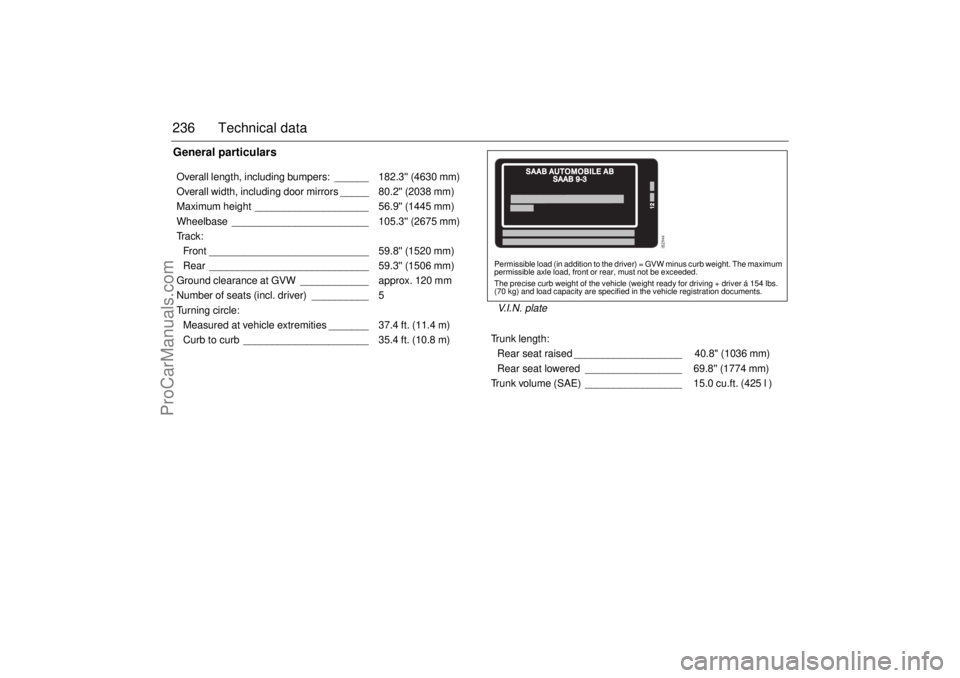
Permissible load (in addition to the driver) = GVW minus curb weight. The maximum
permissible axle load, front or rear, must not be exceeded.
The precise curb weight of the vehicle (weight ready for driving + driver á 154 lbs.
(70 kg) and load capacity are specified in the vehicle registration documents.V.I.N. plateTrunk length:
Rear seat raised ___________________ 40.8'' (1036 mm)
Rear seat lowered _________________ 69.8'' (1774 mm)
Trunk volume (SAE) _________________ 15.0 cu.ft. (425 l )
ProCarManuals.com
Page 237 of 256

237 Technical data
Curb weight
(i.e. with full fuel tank, full washer fluid res-
ervoir, standard tools and spare wheel) _3174–3461 lbs.
(1440–1570 kg)
Gross vehicle weight (GVW) ___________ 4343–4453 lbs.
(1970–2020 kg)
Maximum axle load:
Front ____________________________ 248 lbs. (1125 kg)
Rear ____________________________ 2226 lbs. (1010 kg)
Weight distribution:
Curb weight + driver (154 lbs. (70 kg)),
front/rear _________________________ approx. 60/40 %
GVW, front/rear ____________________ approx. 50/50 %
Maximum roof load _________________ 220 lbs. (100 kg)
Maximun load in trunk ______________ 175 lbs. (80 kg)
WARNING
The GVW and maximum axle loads must not be exceeded.
Note that if some accessories (e.g. towbar, CD changer) are
fitted, the available load capacity is reduced by the weight of
these.
When carrying a load in the trunk, make sure that it is lashed
down securely, particularly when part or all of the rear seat is
folded down.
Trailer:
Trailer with brakes ___________________ Max. 3500 lbs.
(1588 kg)
Trailer without brakes ________________ Max. 1000 lbs.
(450 kg)
Recommended towball load ___________ 110–165 lbs.
(50–75 kg)
Maximum theoretical towing speed, trailer
with brakes _______________________ 60 mph (100 km/h)
When towing a trailer, increase the pressure
of the rear tires by 0.2 bar (3 psi).
The above speed and weight restrictions are those specified by
Saab Automobile AB.
Note that national restrictions may apply to trailer speeds and
weights (see page 157).
ProCarManuals.com