tow SAAB 9-3 2003 Owners Manual
[x] Cancel search | Manufacturer: SAAB, Model Year: 2003, Model line: 9-3, Model: SAAB 9-3 2003Pages: 256, PDF Size: 21.66 MB
Page 4 of 256
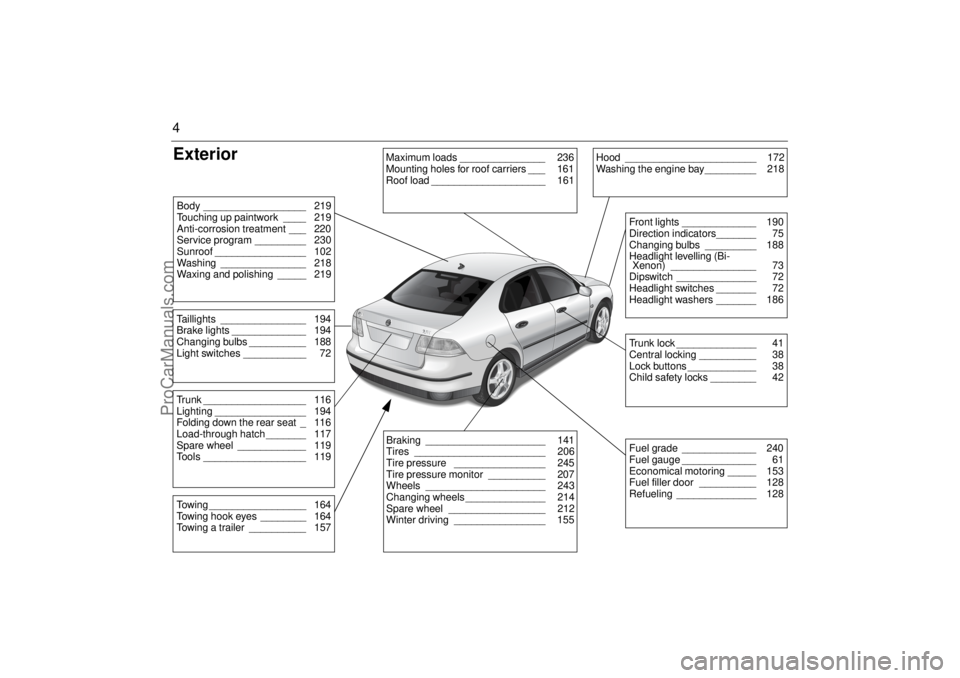
4ExteriorBody __________________ 219
Touching up paintwork ____ 219
Anti-corrosion treatment ___ 220
Service program _________ 230
Sunroof ________________ 102
Washing _______________ 218
Waxing and polishing _____ 219Taillights _______________ 194
Brake lights _____________ 194
Changing bulbs __________ 188
Light switches ___________ 72Towing _________________ 164
Towing hook eyes ________ 164
Towing a trailer __________ 157Trunk __________________ 116
Lighting ________________ 194
Folding down the rear seat _ 116
Load-through hatch _______ 117
Spare wheel ____________ 119
Tools __________________ 119
Maximum loads _______________ 236
Mounting holes for roof carriers ___ 161
Roof load ____________________ 161
Hood _______________________ 172
Washing the engine bay_________ 218
Trunk lock ______________ 41
Central locking __________ 38
Lock buttons ____________ 38
Child safety locks ________ 42Front lights _____________ 190
Direction indicators_______ 75
Changing bulbs _________ 188
Headlight levelling (Bi-
Xenon) _______________ 73
Dipswitch ______________ 72
Headlight switches _______ 72
Headlight washers _______ 186Fuel grade _____________ 240
Fuel gauge _____________ 61
Economical motoring _____ 153
Fuel filler door __________ 128
Refueling ______________ 128
Braking _____________________ 141
Tires _______________________ 206
Tire pressure ________________ 245
Tire pressure monitor __________ 207
Wheels _____________________ 243
Changing wheels ______________ 214
Spare wheel _________________ 212
Winter driving ________________ 155
ProCarManuals.com
Page 13 of 256
13 Safety
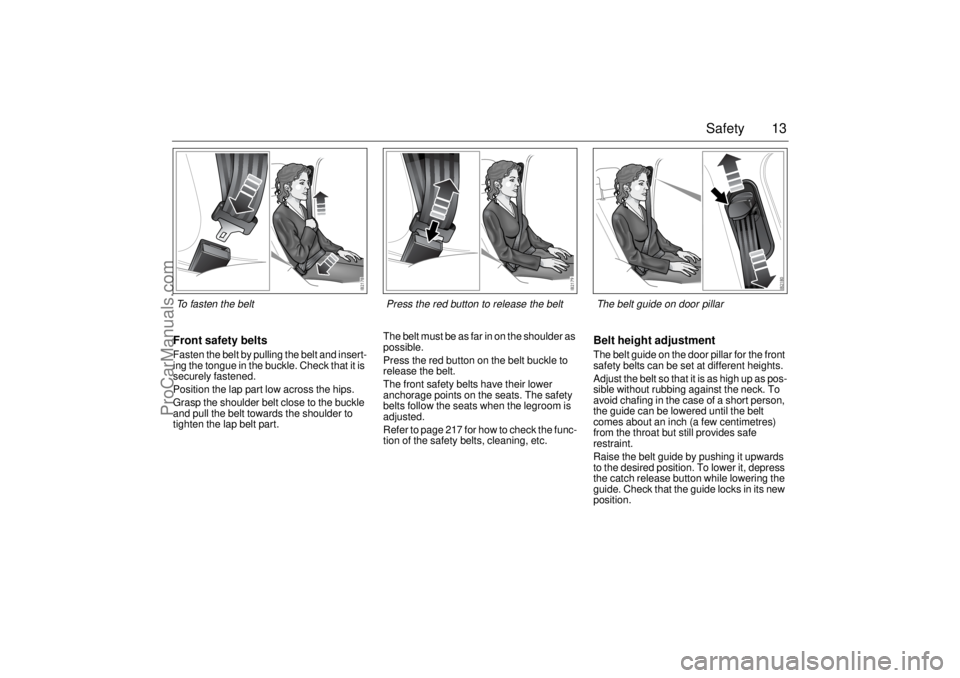
Front safety beltsFasten the belt by pulling the belt and insert-
ing the tongue in the buckle. Check that it is
securely fastened.
Position the lap part low across the hips.
Grasp the shoulder belt close to the buckle
and pull the belt towards the shoulder to
tighten the lap belt part.The belt must be as far in on the shoulder as
possible.
Press the red button on the belt buckle to
release the belt.
The front safety belts have their lower
anchorage points on the seats. The safety
belts follow the seats when the legroom is
adjusted.
Refer to page 217 for how to check the func-
tion of the safety belts, cleaning, etc.
Belt height adjustmentThe belt guide on the door pillar for the front
safety belts can be set at different heights.
Adjust the belt so that it is as high up as pos-
sible without rubbing against the neck. To
avoid chafing in the case of a short person,
the guide can be lowered until the belt
comes about an inch (a few centimetres)
from the throat but still provides safe
restraint.
Raise the belt guide by pushing it upwards
to the desired position. To lower it, depress
the catch release button while lowering the
guide. Check that the guide locks in its new
position.
To fasten the belt Press the red button to release the belt
The belt guide on door pillar
ProCarManuals.com
Page 15 of 256
15 Safety
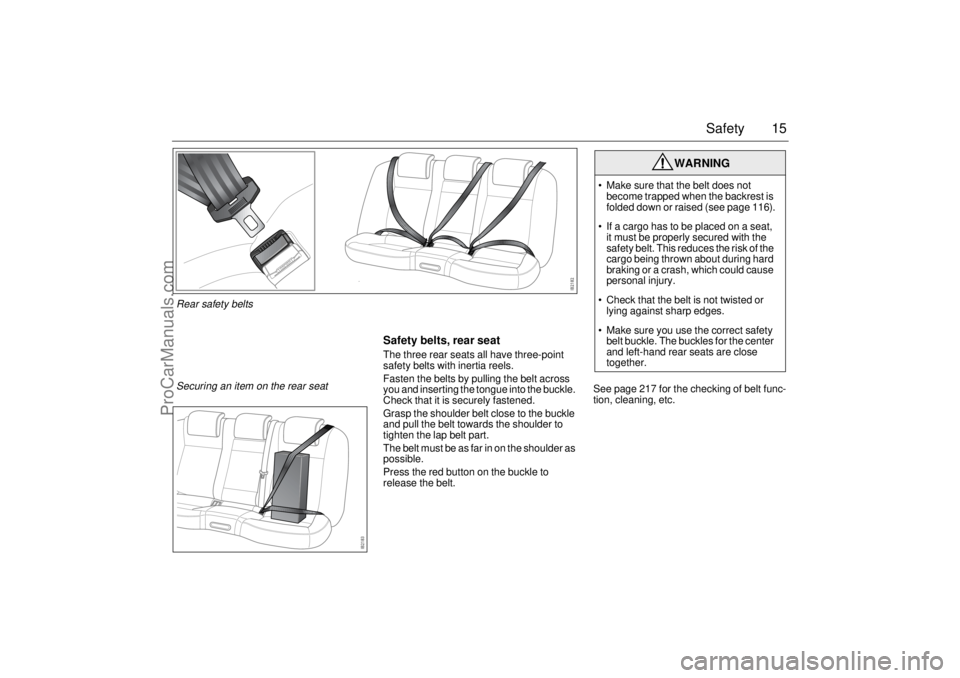
Safety belts, rear seatThe three rear seats all have three-point
safety belts with inertia reels.
Fasten the belts by pulling the belt across
you and inserting the tongue into the buckle.
Check that it is securely fastened.
Grasp the shoulder belt close to the buckle
and pull the belt towards the shoulder to
tighten the lap belt part.
The belt must be as far in on the shoulder as
possible.
Press the red button on the buckle to
release the belt.See page 217 for the checking of belt func-
tion, cleaning, etc.
WARNING
Make sure that the belt does not
become trapped when the backrest is
folded down or raised (see page 116).
If a cargo has to be placed on a seat,
it must be properly secured with the
safety belt. This reduces the risk of the
cargo being thrown about during hard
braking or a crash, which could cause
personal injury.
Check that the belt is not twisted or
lying against sharp edges.
Make sure you use the correct safety
belt buckle. The buckles for the center
and left-hand rear seats are close
together.
Rear safety belts
Securing an item on the rear seat
ProCarManuals.com
Page 61 of 256
61 Instruments and controls
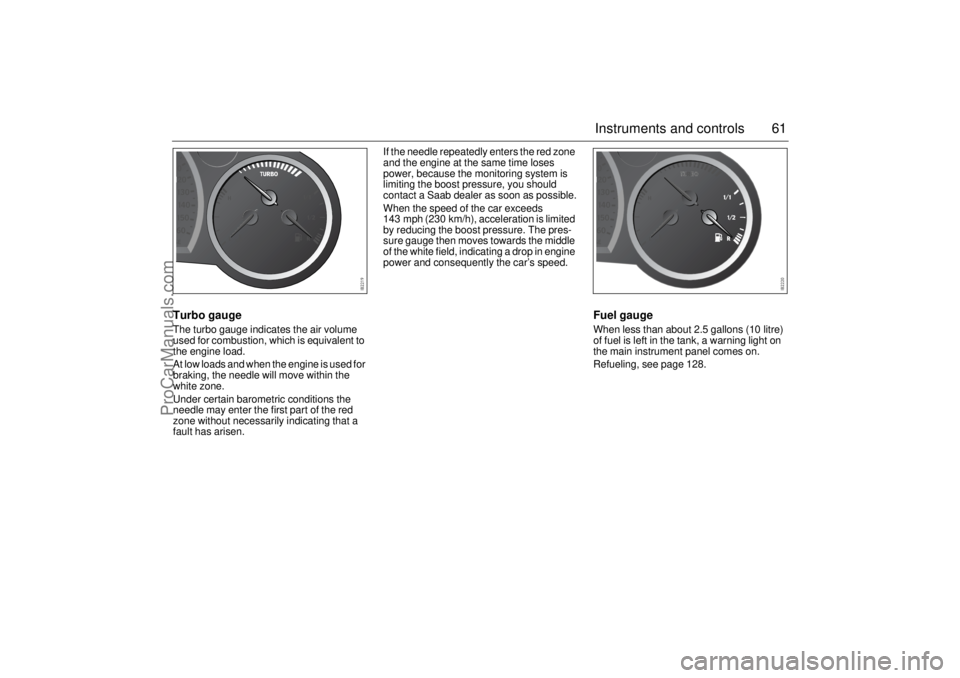
Turbo gaugeThe turbo gauge indicates the air volume
used for combustion, which is equivalent to
the engine load.
At low loads and when the engine is used for
braking, the needle will move within the
white zone.
Under certain barometric conditions the
needle may enter the first part of the red
zone without necessarily indicating that a
fault has arisen.If the needle repeatedly enters the red zone
and the engine at the same time loses
power, because the monitoring system is
limiting the boost pressure, you should
contact a Saab dealer as soon as possible.
When the speed of the car exceeds
143 mph (230 km/h), acceleration is limited
by reducing the boost pressure. The pres-
sure gauge then moves towards the middle
of the white field, indicating a drop in engine
power and consequently the car’s speed.
Fuel gaugeWhen less than about 2.5 gallons (10 litre)
of fuel is left in the tank, a warning light on
the main instrument panel comes on.
Refueling, see page 128.
ProCarManuals.com
Page 72 of 256
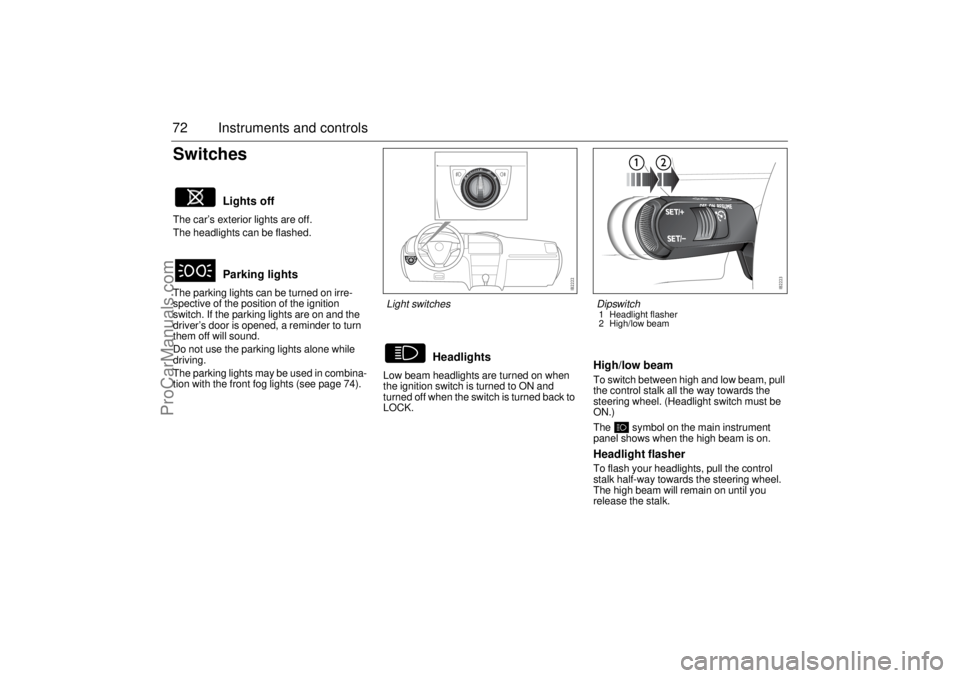
72 Instruments and controlsSwitchesThe car’s exterior lights are off.
The headlights can be flashed.
The parking lights can be turned on irre-
spective of the position of the ignition
switch. If the parking lights are on and the
driver’s door is opened, a reminder to turn
them off will sound.
Do not use the parking lights alone while
driving.
The parking lights may be used in combina-
tion with the front fog lights (see page 74).Low beam headlights are turned on when
the ignition switch is turned to ON and
turned off when the switch is turned back to
LOCK.
High/low beamTo switch between high and low beam, pull
the control stalk all the way towards the
steering wheel. (Headlight switch must be
ON.)
The symbol on the main instrument
panel shows when the high beam is on.Headlight flasherTo flash your headlights, pull the control
stalk half-way towards the steering wheel.
The high beam will remain on until you
release the stalk.
Lights off
Parking lights
Headlights
Light switches
Dipswitch1 Headlight flasher
2 High/low beam
ProCarManuals.com
Page 73 of 256
73 Instruments and controls
Courtesy Headlamp FeatureA delay function allows the low beam head-
lights and back-up lights to remain on for
about 30 seconds after the driver’s door has
been closed.
To activate this function:
1 After turning off the engine, remove the
remote control.
2 Open the driver’s door.
3 Pull the control stalk all the way towards
the steering wheel.
The low beam headlights and reversing
lights will come on and remain on for
30 seconds when the door is closed.
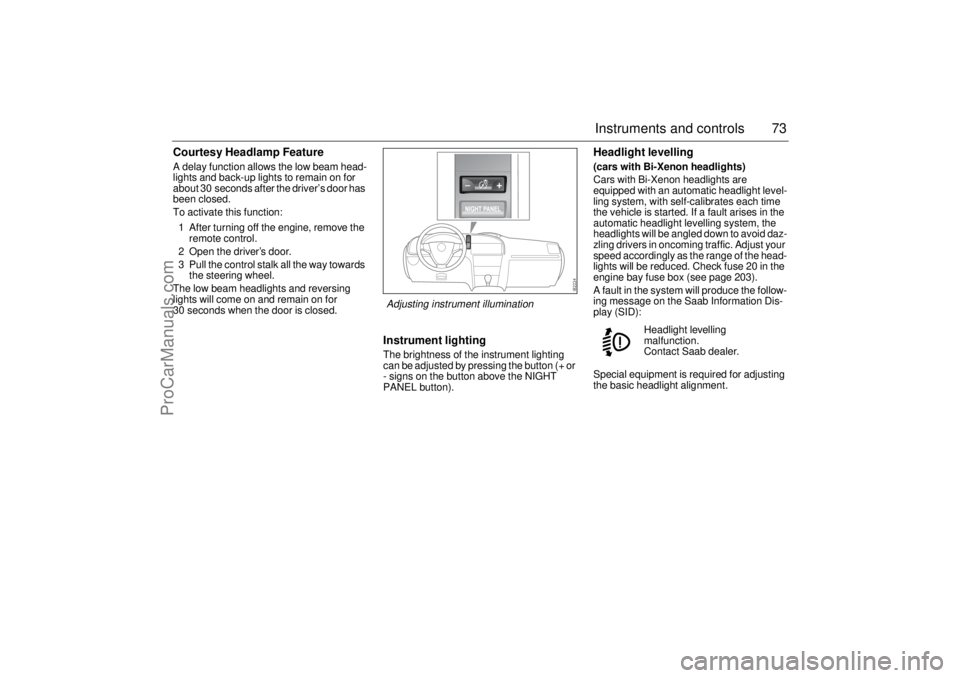
Instrument lightingThe brightness of the instrument lighting
can be adjusted by pressing the button (+ or
- signs on the button above the NIGHT
PANEL button).
Headlight levelling(cars with Bi-Xenon headlights)
Cars with Bi-Xenon headlights are
equipped with an automatic headlight level-
ling system, with self-calibrates each time
the vehicle is started. If a fault arises in the
automatic headlight levelling system, the
headlights will be angled down to avoid daz-
zling drivers in oncoming traffic. Adjust your
speed accordingly as the range of the head-
lights will be reduced. Check fuse 20 in the
engine bay fuse box (see page 203).
A fault in the system will produce the follow-
ing message on the Saab Information Dis-
play (SID):
Special equipment is required for adjusting
the basic headlight alignment.Headlight levelling
malfunction.
Contact Saab dealer.
Adjusting instrument illumination
ProCarManuals.com
Page 75 of 256
75 Instruments and controls
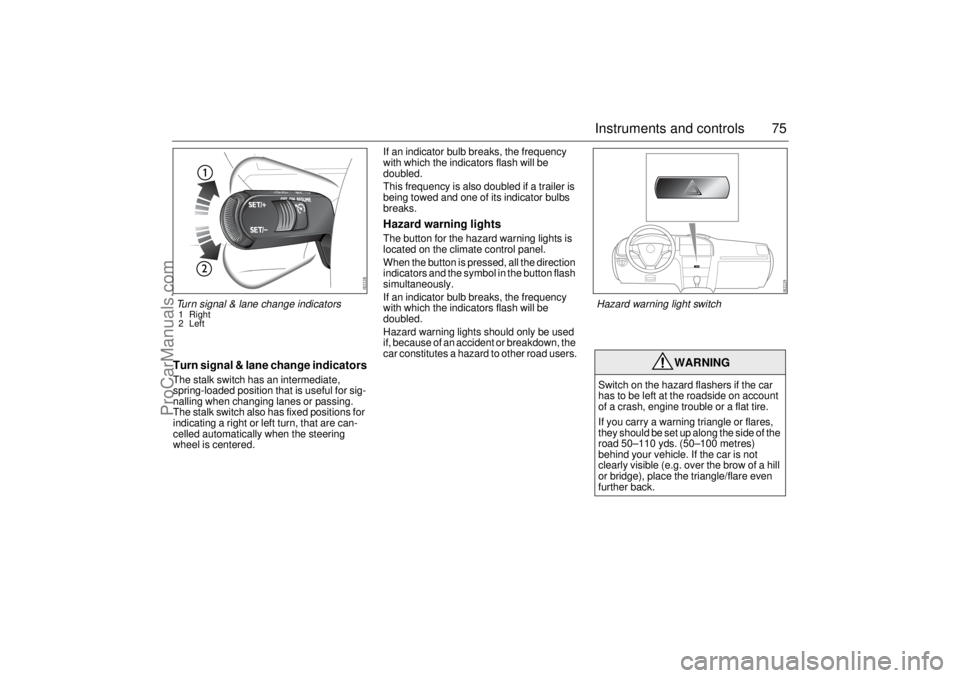
Turn signal & lane change indicatorsThe stalk switch has an intermediate,
spring-loaded position that is useful for sig-
nalling when changing lanes or passing.
The stalk switch also has fixed positions for
indicating a right or left turn, that are can-
celled automatically when the steering
wheel is centered.If an indicator bulb breaks, the frequency
with which the indicators flash will be
doubled.
This frequency is also doubled if a trailer is
being towed and one of its indicator bulbs
breaks.
Hazard warning lightsThe button for the hazard warning lights is
located on the climate control panel.
When the button is pressed, all the direction
indicators and the symbol in the button flash
simultaneously.
If an indicator bulb breaks, the frequency
with which the indicators flash will be
doubled.
Hazard warning lights should only be used
if, because of an accident or breakdown, the
car constitutes a hazard to other road users.
WARNING
Switch on the hazard flashers if the car
has to be left at the roadside on account
of a crash, engine trouble or a flat tire.
If you carry a warning triangle or flares,
they should be set up along the side of the
road 50–110 yds. (50–100 metres)
behind your vehicle. If the car is not
clearly visible (e.g. over the brow of a hill
or bridge), place the triangle/flare even
further back.
Turn signal & lane change indicators1 Right
2 Left
Hazard warning light switch
ProCarManuals.com
Page 76 of 256
76 Instruments and controlsBack-Up The back-up lights come on automatically
when reverse gear is engaged or selected
with the ignition switched on.
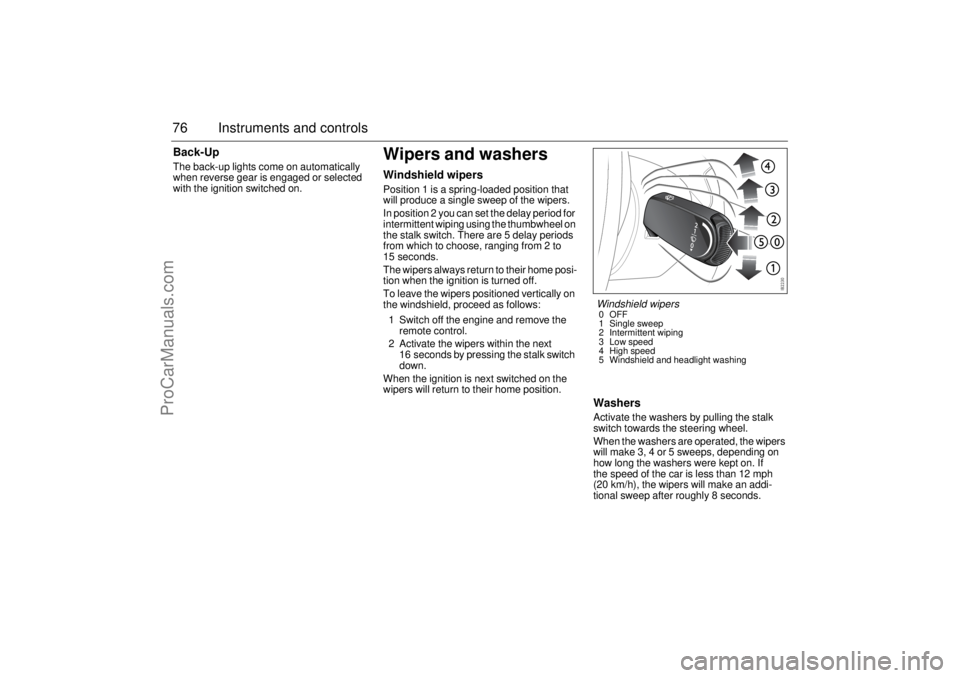
Wipers and washersWindshield wipersPosition 1 is a spring-loaded position that
will produce a single sweep of the wipers.
In position 2 you can set the delay period for
intermittent wiping using the thumbwheel on
the stalk switch. There are 5 delay periods
from which to choose, ranging from 2 to
15 seconds.
The wipers always return to their home posi-
tion when the ignition is turned off.
To leave the wipers positioned vertically on
the windshield, proceed as follows:
1 Switch off the engine and remove the
remote control.
2 Activate the wipers within the next
16 seconds by pressing the stalk switch
down.
When the ignition is next switched on the
wipers will return to their home position.
WashersActivate the washers by pulling the stalk
switch towards the steering wheel.
When the washers are operated, the wipers
will make 3, 4 or 5 sweeps, depending on
how long the washers were kept on. If
the speed of the car is less than 12 mph
(20 km/h), the wipers will make an addi-
tional sweep after roughly 8 seconds.Windshield wipers0OFF
1 Single sweep
2 Intermittent wiping
3 Low speed
4 High speed
5 Windshield and headlight washing
ProCarManuals.com
Page 80 of 256

80 Instruments and controlsAir distributionThe air distribution control is used to direct the flow of air to the
defroster, panel and floor vents.
The control also permits settings in between the three main settings
defroster, panel and floor:
defroster and floor
panel and floor
defroster, panel and floor (11 o’clock position)
To counter cold drafts from the front side windows when the control
has been set to defroster or floor, a small flow of air issues from
the outer vents on the fascia.
As the winter comfort setting, we recommend that the distribution
knob be turned to .
Recommended settings in severe coldOn starting with a cold engine, set the fan speed to 2 or 3 and select
maximum heat and defroster to heat the cabin and demist the wind-
shield as quickly as possible.
When the engine is warmer and the temperature gauge starts to
rise, fan setting 4 may be chosen. Once the windshield is clear, the
air distribution control should be turned to .
If the rear seat passengers desire more warmth to the feet, turn the
distribution knob one step clockwise.
How quickly the engine warms up will depend on how the car is
driven. It will take longer for the engine to warm up if the car is driven
in a high gear at low engine speeds, such as in town, than if it is
driven at high engine speeds on a motorway, for example.
Do not use fan speed 5. This is primarily intended for rapid cooling
during the summer.
ProCarManuals.com
Page 111 of 256
111 Interior equipment
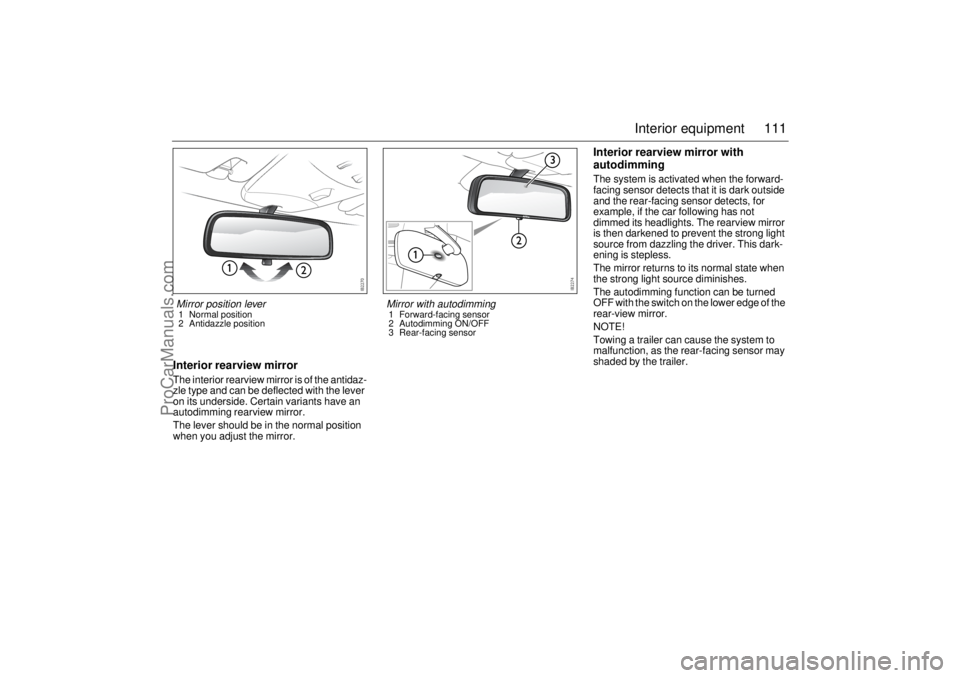
Interior rearview mirrorThe interior rearview mirror is of the antidaz-
zle type and can be deflected with the lever
on its underside. Certain variants have an
autodimming rearview mirror.
The lever should be in the normal position
when you adjust the mirror.
Interior rearview mirror with
autodimmingThe system is activated when the forward-
facing sensor detects that it is dark outside
and the rear-facing sensor detects, for
example, if the car following has not
dimmed its headlights. The rearview mirror
is then darkened to prevent the strong light
source from dazzling the driver. This dark-
ening is stepless.
The mirror returns to its normal state when
the strong light source diminishes.
The autodimming function can be turned
OFF with the switch on the lower edge of the
rear-view mirror.
NOTE!
Towing a trailer can cause the system to
malfunction, as the rear-facing sensor may
shaded by the trailer.
Mirror position lever1 Normal position
2 Antidazzle position
Mirror with autodimming1 Forward-facing sensor
2 Autodimming ON/OFF
3 Rear-facing sensor
ProCarManuals.com