park assist SAAB 9-3 2003 Owners Manual
[x] Cancel search | Manufacturer: SAAB, Model Year: 2003, Model line: 9-3, Model: SAAB 9-3 2003Pages: 256, PDF Size: 21.66 MB
Page 64 of 256

64 Instruments and controlsSaab Information
Display (SID)Various types of information are shown on
the SID: warnings, indications, trip com-
puter information and information from the
car’s Infotainment System.
The warnings and indications that can be
shown on the SID are listed on page 249.
When the engine is switched off, the current
warnings and indications are displayed.
If there is more than one message on the
SID, a plus sign will be displayed to the left
of the first message. Each message will be
displayed for 10 seconds.
Press the CLEAR button to acknowledge
a SID message. If you acknowledge a mes-
sage but do nothing about it, the message
will be displayed again the next time you
start the car.
You can adjust the settings of several of the
car’s systems, such as the clock, alarm and
climate control system. These are known as
Profiler.
ProfilerAdjustments can be made with the control
unit situated between the main instrument
panel and the audio system. This is called
Profiler.
1 Activate Profiler by pressing the
CUSTOMIZE button.
2 Turn the INFO dial until the appropriate
system is selected.
3 Confirm selection by pressing the
INFO dial.
Select Exit once you have made the desired
settings.The number of systems that are displayed
on the SID depends on the car’s equipment
level. The list shown below includes the
systems that can be found in your car.
Theft Alarm, page 46.
Full theft alarmDoor alarm only
Park Assistance, page 152.
SPA onSPA off
Clock / Alarm, page 69.
Set ClockSet Alarm
Rain Sensor, page 77.
HighMediumLow
SID, control unit and display
ProCarManuals.com
Page 142 of 256
142 Starting and driving
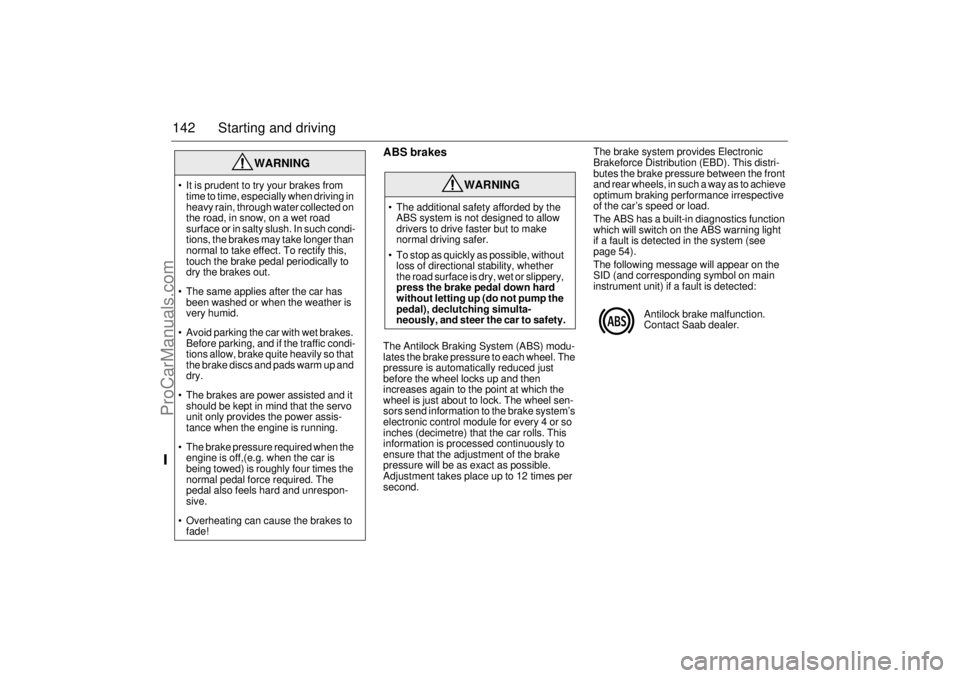
ABS brakesThe Antilock Braking System (ABS) modu-
lates the brake pressure to each wheel. The
pressure is automatically reduced just
before the wheel locks up and then
increases again to the point at which the
wheel is just about to lock. The wheel sen-
sors send information to the brake system’s
electronic control module for every 4 or so
inches (decimetre) that the car rolls. This
information is processed continuously to
ensure that the adjustment of the brake
pressure will be as exact as possible.
Adjustment takes place up to 12 times per
second.The brake system provides Electronic
Brakeforce Distribution (EBD). This distri-
butes the brake pressure between the front
and rear wheels, in such a way as to achieve
optimum braking performance irrespective
of the car’s speed or load.
The ABS has a built-in diagnostics function
which will switch on the ABS warning light
if a fault is detected in the system (see
page 54).
The following message will appear on the
SID (and corresponding symbol on main
instrument unit) if a fault is detected:
WARNING
It is prudent to try your brakes from
time to time, especially when driving in
heavy rain, through water collected on
the road, in snow, on a wet road
surface or in salty slush. In such condi-
tions, the brakes may take longer than
normal to take effect. To rectify this,
touch the brake pedal periodically to
dry the brakes out.
The same applies after the car has
been washed or when the weather is
very humid.
Avoid parking the car with wet brakes.
Before parking, and if the traffic condi-
tions allow, brake quite heavily so that
the brake discs and pads warm up and
dry.
The brakes are power assisted and it
should be kept in mind that the servo
unit only provides the power assis-
tance when the engine is running.
The brake pressure required when the
engine is off,(e.g. when the car is
being towed) is roughly four times the
normal pedal force required. The
pedal also feels hard and unrespon-
sive.
Overheating can cause the brakes to
fade!
WARNING
The additional safety afforded by the
ABS system is not designed to allow
drivers to drive faster but to make
normal driving safer.
To stop as quickly as possible, without
loss of directional stability, whether
the road surface is dry, wet or slippery,
press the brake pedal down hard
without letting up (do not pump the
pedal), declutching simulta-
neously, and steer the car to safety.
Antilock brake malfunction.
Contact Saab dealer.
ProCarManuals.com
Page 151 of 256
151 Starting and driving
Saab Parking
AssistanceSaab Parking Assistance
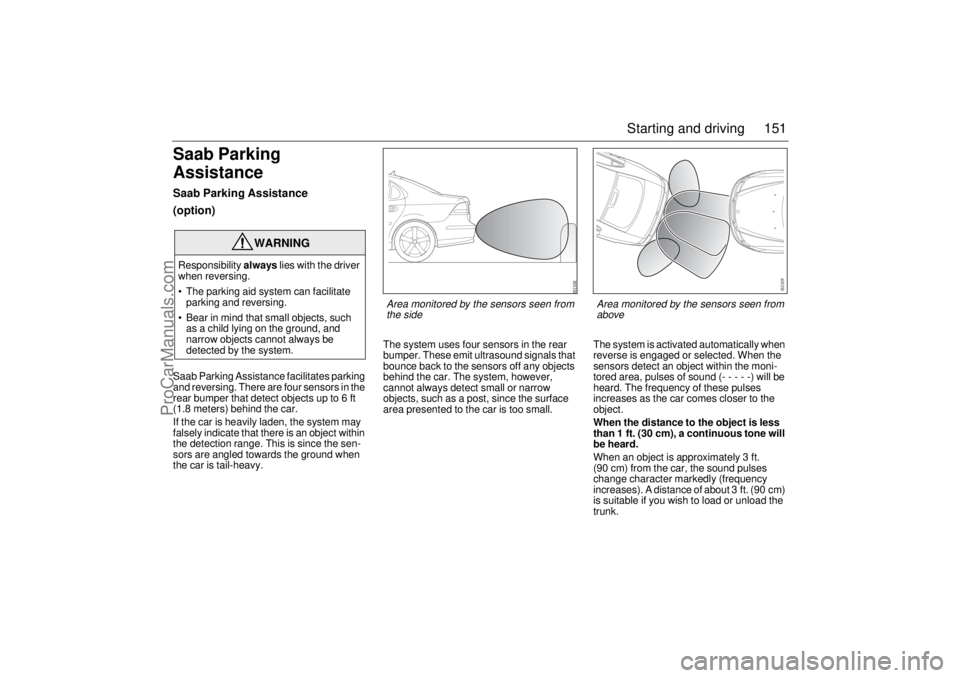
(option)Saab Parking Assistance facilitates parking
and reversing. There are four sensors in the
rear bumper that detect objects up to 6 ft
(1.8 meters) behind the car.
If the car is heavily laden, the system may
falsely indicate that there is an object within
the detection range. This is since the sen-
sors are angled towards the ground when
the car is tail-heavy.The system uses four sensors in the rear
bumper. These emit ultrasound signals that
bounce back to the sensors off any objects
behind the car. The system, however,
cannot always detect small or narrow
objects, such as a post, since the surface
area presented to the car is too small.The system is activated automatically when
reverse is engaged or selected. When the
sensors detect an object within the moni-
tored area, pulses of sound (- - - - -) will be
heard. The frequency of these pulses
increases as the car comes closer to the
object.
When the distance to the object is less
than 1 ft. (30 cm), a continuous tone will
be heard.
When an object is approximately 3 ft.
(90 cm) from the car, the sound pulses
change character markedly (frequency
increases). A distance of about 3 ft. (90 cm)
is suitable if you wish to load or unload the
trunk.
WARNING
Responsibility always lies with the driver
when reversing.
The parking aid system can facilitate
parking and reversing.
Bear in mind that small objects, such
as a child lying on the ground, and
narrow objects cannot always be
detected by the system.
Area monitored by the sensors seen from
the side
Area monitored by the sensors seen from
above
ProCarManuals.com
Page 152 of 256
152 Starting and drivingIf the distance between an object and a
corner sensor does not change for
3 seconds, for example if you are reversing
alongside a wall, the system will switch to
monitoring straight back. The system indi-
cates if the distance to the wall decreases
again.
If a trailer is hitched up and correctly con-
nected to the trailer contact by the tow bar,
the system is automatically deactivated.
You can temporarily deactivate the Saab
Parking Assistance as follows:
Engage reverse and press the CLEAR
button on the SID control panel.
The system will be reactivated the next time
you engage reverse.Error messages
If the system malfunctions, the following
message will appear on the SID:
If the system is subject to interference, the
following message will be shown on the
SID:
If this message appears, clean the sensors.
The sensors are located in the black trim on
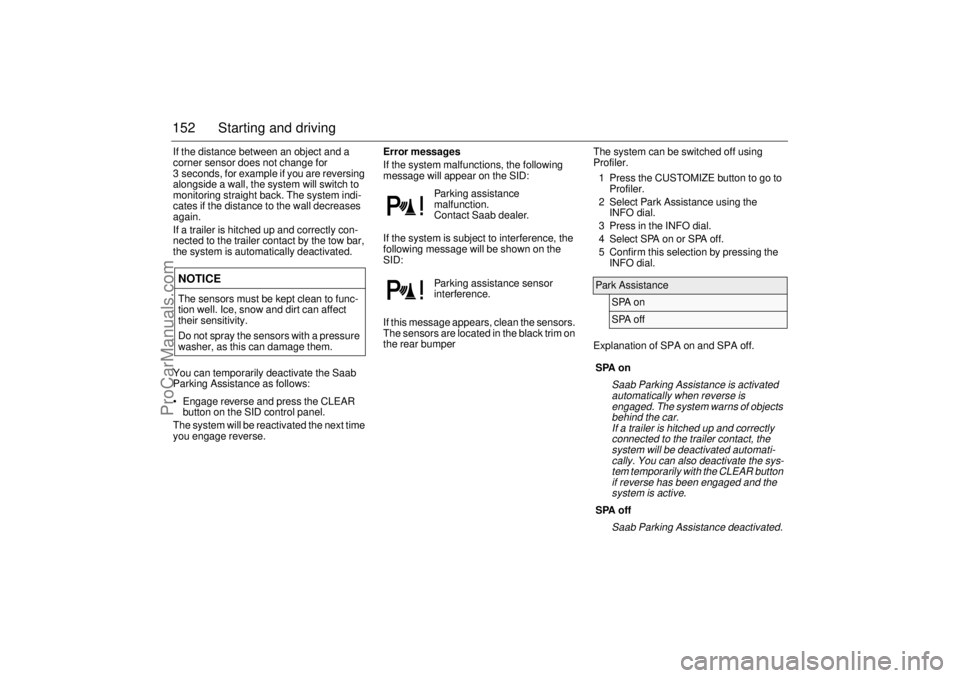
the rear bumper The system can be switched off using
Profiler.
1 Press the CUSTOMIZE button to go to
Profiler.
2 Select Park Assistance using the
INFO dial.
3 Press in the INFO dial.
4 Select SPA on or SPA off.
5 Confirm this selection by pressing the
INFO dial.
Explanation of SPA on and SPA off.NOTICEThe sensors must be kept clean to func-
tion well. Ice, snow and dirt can affect
their sensitivity.
Do not spray the sensors with a pressure
washer, as this can damage them.
Parking assistance
malfunction.
Contact Saab dealer.
Parking assistance sensor
interference.
Park Assistance
SPA onSPA off
SPA onSaab Parking Assistance is activated
automatically when reverse is
engaged. The system warns of objects
behind the car.
If a trailer is hitched up and correctly
connected to the trailer contact, the
system will be deactivated automati-
cally. You can also deactivate the sys-
tem temporarily with the CLEAR button
if reverse has been engaged and the
system is active.
SPA off
Saab Parking Assistance deactivated.
ProCarManuals.com
Page 202 of 256
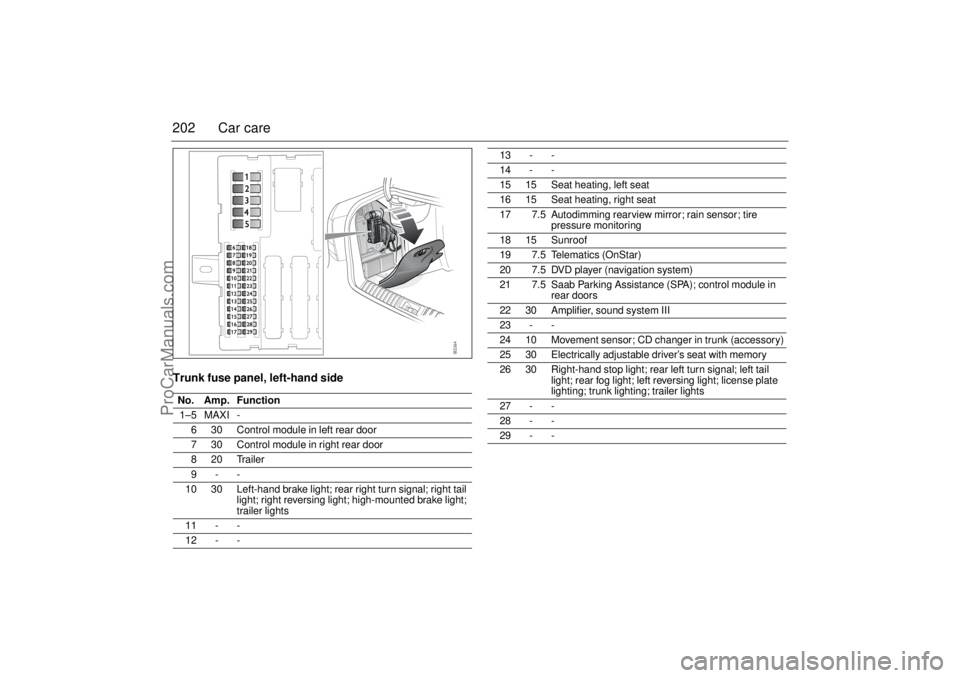
202 Car careTrunk fuse panel, left-hand sideNo. Amp. Function
1–5 MAXI -
6 30 Control module in left rear door
7 30 Control module in right rear door
820Trailer
9--
10 30 Left-hand brake light; rear right turn signal; right tail
light; right reversing light; high-mounted brake light;
trailer lights
11 - -
12 - -
13 - -
14 - -
15 15 Seat heating, left seat
16 15 Seat heating, right seat
17 7.5 Autodimming rearview mirror; rain sensor; tire
pressure monitoring
18 15 Sunroof
19 7.5 Telematics (OnStar)
20 7.5 DVD player (navigation system)
21 7.5 Saab Parking Assistance (SPA); control module in
rear doors
22 30 Amplifier, sound system III
23 - -
24 10 Movement sensor; CD changer in trunk (accessory)
25 30 Electrically adjustable driver’s seat with memory
26 30 Right-hand stop light; rear left turn signal; left tail
light; rear fog light; left reversing light; license plate
lighting; trunk lighting; trailer lights
27 - -
28 - -
29 - -
ProCarManuals.com
Page 219 of 256

219 Car care
thoroughly at the end of winter. Clean the
underside of the car by hand if the car is usu-
ally washed in an automatic car wash with-
out special facilities for underbody cleaning.
Never wash or leave the car to dry in the
sun, but wipe it dry with a chamois leather
immediately after washing to avoid smears
and streaks.
Clean the inside of window glass using a
proprietary window cleaner. This is particu-
larly important when the car is new, as
upholstery and trim have a tendency to
sweat a little at first.
Keep the glass well polished, as this helps
to prevent misting.
Clean the outside of the windows with Saab
washer fluid. This is especially important if
the car has been washed in an automatic
car wash, as sometimes a wax treatment is
used that can contaminate the windshield
and impair the performance of the wipers.
Waxing and polishingDo not wax a new car during the first three
or four months. In fact, there is no need to
polish the car before the paintwork has
started to go dull through oxidation. Other
than in exceptional cases, do not use abra-
sive polishes containing a cutting agent on
a new car. Always wash the car thoroughly
before waxing or polishing.
Touching up the paintDamaged paintwork should be treated as
soon as it is discovered: the longer it is left,
the greater the risk of corrosion. The anti-
corrosion warranty does not cover corrosion
resulting from untreated defects.
Paintwork damage sustained in a crash is
usually extensive and can only be properly
restored by professionals.
However, you can repair small scratches
and stone chip damage yourself. The nec-
essary tools and materials, such as primer,
touch-up paint and brushes, are available
from your Saab dealer.
In the case of minor flaws in the paintwork,
where the metal has not been exposed and
an undamaged layer of paint remains,
touch-up paint can usually be applied
directly, after any dirt has been scraped
away using a pointed knife.
If corrosion has already set in, such as the
result of stone-chip damage, use a pointed
knife to scrape off all surface rust. If possi-
ble, the damaged area should be taken
back to the bare metal. The metal should
then be primed with two thin coats of primer
applied by brush.
After the primer has dried, apply several thin
layers of topcoat until the surface of the
repaired area is flush with the surrounding
paintwork.
Stir both primer and touch-up paint thor-
oughly before use and allow each coat to
dry before applying the next.
NOTICE Try your brakes on leaving a car wash.
Wet brake discs reduce the perfor-
mance of the brakes.
Fixed antennae, such as for a mobile
phone, must be removed if the car
goes through an automatic car wash.
Cars with Saab Parking Assistance:
Do not spray the sensors or closer
than 8 in. (20 cm) to the sensors with
a pressure washer, as this can
damage them.
ProCarManuals.com
Page 230 of 256

230 Maintenance and owner assistanceMaintenance scheduleThe Maintenance Schedule prescribes a
service program to the purchaser/operator
of a Saab that is reasonable and necessary
to ensure the proper emission control sys-
tems function, safety and reliability of the
Saab automobile in normal use. Additional
maintenance is recommended for specific
components when the car is operated under
certain severe conditions. Proper mainte-
nance is always a good practice!
Authorized Saab dealers are equipped and
trained to meet your Saab’s service needs.
They regularly receive up-to-date Saab ser-
vice manuals and parts and technical ser-
vice bulletins from Saab and are able,
through their franchise agreement, to attend
Saab service schools, obtain Saab special
tools and technical assistance and pur-
chase original equipment service and
replacement parts.
Today’s complex automobiles should only
be entrusted to the most knowledgeable
service professionals. A Saab dealer is your
best choice.
SERVICE INTERVALSThe maintenance schedule begins with an
Inspection Service at 30 days. A time for
service message will illuminate on the Saab
Instrument Display (SID) when the car is
due for regular maintenance. There are twi
different messages that will appear:
TIME FOR INTERMEDIATE SERVICE
indicates that an oil/filter change is required
along with several inspections. This mes-
sage is set by the engine management
system which calculates service intervals
based on several factors including driving
habits, ambient temperature, number of
cold starts, mileage driven and elapsed time
since the last service. Based on this algo-
rithm, this message may appear at mileage
as low a 8,000 or as high as 15,000 miles.
If mileage accumulation does not occur, the
message will be set, and maintenance
required at a maximum of 2 years.
TIME FOR MAJOR SERVICE will be set
when additional maintenance is necessary,
such as air filter or spark plug replacement.
This message will appear at 30,000 mile
intervals. When either message is dis-
played, contact your Saab Dealer for a ser-
vice appointment.
Failure to perform scheduled maintenance
in a timely manner may result in serious
damage to key components or systems.
.NOTICEThe Check-up will be done by your Saab
dealer at no charge and should be done
as close as possible to the scheduled 30
days.
ProCarManuals.com
Page 250 of 256
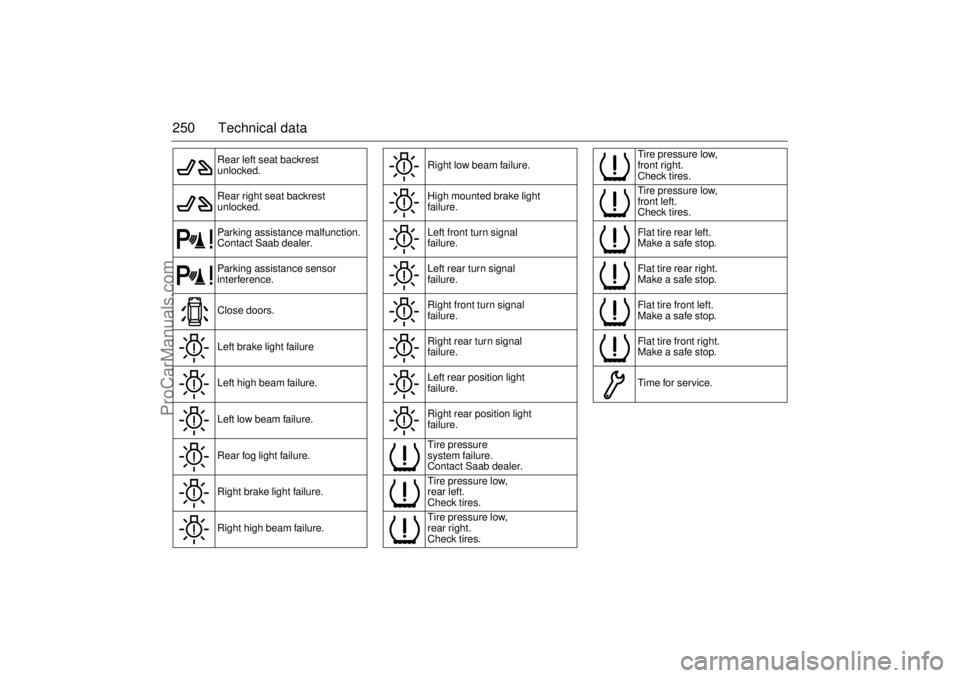
250 Technical data
Rear left seat backrest
unlocked.
Rear right seat backrest
unlocked.
Parking assistance malfunction.
Contact Saab dealer.
Parking assistance sensor
interference.
Close doors.
Left brake light failure
Left high beam failure.
Left low beam failure.
Rear fog light failure.
Right brake light failure.
Right high beam failure.
Right low beam failure.
High mounted brake light
failure.
Left front turn signal
failure.
Left rear turn signal
failure.
Right front turn signal
failure.
Right rear turn signal
failure.
Left rear position light
failure.
Right rear position light
failure.
Tire pressure
system failure.
Contact Saab dealer.
Tire pressure low,
rear left.
Check tires.
Tire pressure low,
rear right.
Check tires.
Tire pressure low,
front right.
Check tires.
Tire pressure low,
front left.
Check tires.
Flat tire rear left.
Make a safe stop.
Flat tire rear right.
Make a safe stop.
Flat tire front left.
Make a safe stop.
Flat tire front right.
Make a safe stop.
Time for service.
ProCarManuals.com
Page 253 of 256

253 Index
LLATCH (child safety)
_____________ 22
Labels and plates, location
_______ 246
Lashing eyes
__________________ 118
Laying the car up
______________ 150
Leather upholstery, cleaning
______ 218
Limp-home
___________________ 126
Limp-home, automatic transmission
137
Load carriers, roof
______________ 161
Load indices, tyres _____________ 209
Load-through hatch _____________ 117
Locking a car with flat battery
______ 41
Locks
________________________ 38
Long-term parking
______________ 150
Luggage compartment
__________ 116
Luggage compartment lighting
106
, 119
Luggage compartment lighting,
changing
____________________ 197
MMAXI fuses
___________________ 200
Main instrument panel
___________ 54
Main/dipped beam
______________ 72
Maintenance schedule __________ 230
Manual climate control ___________ 79
Manual gear selection ___________ 139
Manual gearbox
_______________ 133
Manual tripping of car alarm
_______ 49
Materials used in the car, reclamation
222Memory, driver’s seat
____________ 19
Milometer
_____________________ 59
Movement sensor, car alarm
______ 48
Mug holder
___________________ 107
NNight driving
__________________ 163
Number plate lighting, changing
___ 196
OORVR
_______________________ 174
Oil capacity, engine
_____________ 239
Opening handles
________________ 38
Opening the fuel filler flap manually
_52
Owner assistance
______________ 232
PPanic function, car alarm
_________ 49
Park Brake Shift Lock
___________ 135
Park Brake Shift Lock,
temporary override
____________ 137
Parking
______________________ 148
Parking aid ___________________ 151
Parking brake _________________ 148
Parking on a hill _______________ 149
Pinch protection, electric windows
_100
Pinch protection, sunroof
________ 104Plates and labels, location
________ 246
Polishing and waxing
____________ 219
Poly-V-belt
____________________ 185
Position lights __________________ 72
Power steering fluid, checking
_____ 181
Power steering fluid, grade
_______ 242
Pressure gauge
_________________ 61
Profiles, customized settings
_______ 64
Puncture, changing wheels _______ 214
QQuick guide, remote control
_______ 39
RRain sensor
____________________ 77
Rear fog light ___________________ 74
Rear seats, folding down
_________ 116
Rear towing eye
_______________ 165
Rear window heating
_____________ 83
Rearview mirrors
_______________ 110
Recirculation
___________________ 82
Recommendations for automatic
transmission, towing a trailer
____ 158
Recommendations for manual
gearbox, towing a trailer
________ 159
Recommended fuel grades _______ 128
Recommended snow chains ______ 243
Refueling
_____________________ 128
ProCarManuals.com
Page 254 of 256

254 IndexRemote control
_________________ 38
Remote locking malfunction
_______ 40
Reporting safety defects
_________ 233
Rev counter
___________________ 59
Reversing lights ________________ 76
Roof lighting
__________________ 105
Roof lighting, changing
__________ 196
Running-in
___________________ 132
SSAHR, head restraint
____________ 20
SID
__________________________ 64
SPA _________________________ 151
Saab Information Display
_________ 64
Saab Parking Assistance ________ 151
Saab Trionic engine
management system
__________ 174
Safety belts
____________________ 11
Seatbelts
______________________ 11
Seatbelts, care
________________ 217
Seatbelts, checking
_____________ 217
Seats
_________________________ 16
Securing a load
________________ 118
Sentronic, manual gear selection
__ 139
Service costs
_________________ 232
Service information
_____________ 232
Service intervals
_______________ 230
Service record retention
_________ 231
Shifting the wheels
_____________ 209
Signalling, horn
_________________ 98Ski hatch
_____________________ 117
Spare wheel __________________ 212
Speed ratings, tyres
____________ 209
Speedometer
__________________ 60
Starting the engine
_____________ 123
Steering wheel adjustment
________ 98
Steering wheel lock
_____________ 123
Storage compartments __________ 109
Sun visor
_____________________ 106
Sunroof
______________________ 102
Switches ______________________ 72
TTCS
_________________________ 144
Technical data
_________________ 236
Textile carpeting, cleaning
_______ 218
Tightening torque, wheels ________ 216
Tools and spare wheel
__________ 212
Touching up paintwork __________ 219
Towbar
______________________ 157
Towbar load
__________________ 159
Towing
______________________ 164
Towing a trailer
________________ 157
Towing the car ________________ 165
Traction Control System (TCS)
____ 144
Transmission oil, checking
_______ 178
Transmission oil, grade
__________ 241
Transmission, automatic _________ 134
Transmission, manual
___________ 133
Transporting the car
____________ 166Trip computer
__________________ 65
Trip meter
_____________________ 59
Trolley jack ___________________ 215
Troubleshooting, A/C and ACC
____ 224
Turbo gauge
___________________ 61
Tyre date code ________________ 212
Tyre markings
_________________ 209
Tyre pressure _________________ 207
Tyre pressure monitoring, automatic
207
Tyre sizes
____________________ 243
Tyres
________________________ 206
UUpholstery care
________________ 217
Upholstery, cleaning
____________ 217
Useful tips on night driving
_______ 163
Useful tips on starting petrol engines
125
VVanity mirror
__________________ 106
Vehicle identification number
_____ 246
Vehicle recovery
_______________ 166
WWarning labels
___________________ 7
Warning lights __________________ 54
Warning triangle ________________ 76
ProCarManuals.com