roof SAAB 9-3 2003 Owners Manual
[x] Cancel search | Manufacturer: SAAB, Model Year: 2003, Model line: 9-3, Model: SAAB 9-3 2003Pages: 256, PDF Size: 21.66 MB
Page 4 of 256
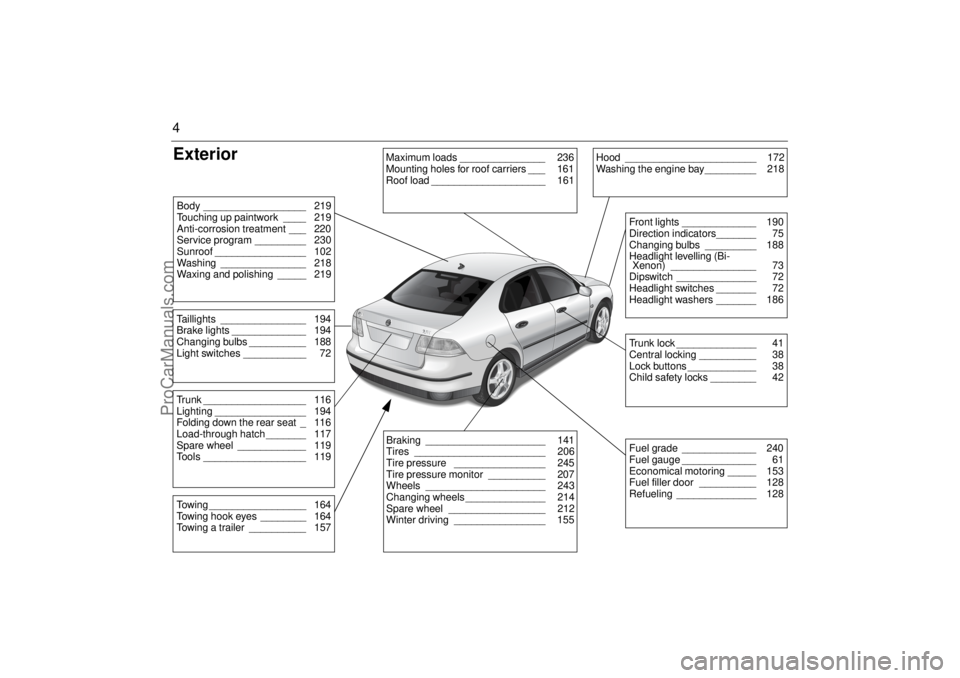
4ExteriorBody __________________ 219
Touching up paintwork ____ 219
Anti-corrosion treatment ___ 220
Service program _________ 230
Sunroof ________________ 102
Washing _______________ 218
Waxing and polishing _____ 219Taillights _______________ 194
Brake lights _____________ 194
Changing bulbs __________ 188
Light switches ___________ 72Towing _________________ 164
Towing hook eyes ________ 164
Towing a trailer __________ 157Trunk __________________ 116
Lighting ________________ 194
Folding down the rear seat _ 116
Load-through hatch _______ 117
Spare wheel ____________ 119
Tools __________________ 119
Maximum loads _______________ 236
Mounting holes for roof carriers ___ 161
Roof load ____________________ 161
Hood _______________________ 172
Washing the engine bay_________ 218
Trunk lock ______________ 41
Central locking __________ 38
Lock buttons ____________ 38
Child safety locks ________ 42Front lights _____________ 190
Direction indicators_______ 75
Changing bulbs _________ 188
Headlight levelling (Bi-
Xenon) _______________ 73
Dipswitch ______________ 72
Headlight switches _______ 72
Headlight washers _______ 186Fuel grade _____________ 240
Fuel gauge _____________ 61
Economical motoring _____ 153
Fuel filler door __________ 128
Refueling ______________ 128
Braking _____________________ 141
Tires _______________________ 206
Tire pressure ________________ 245
Tire pressure monitor __________ 207
Wheels _____________________ 243
Changing wheels ______________ 214
Spare wheel _________________ 212
Winter driving ________________ 155
ProCarManuals.com
Page 5 of 256
5
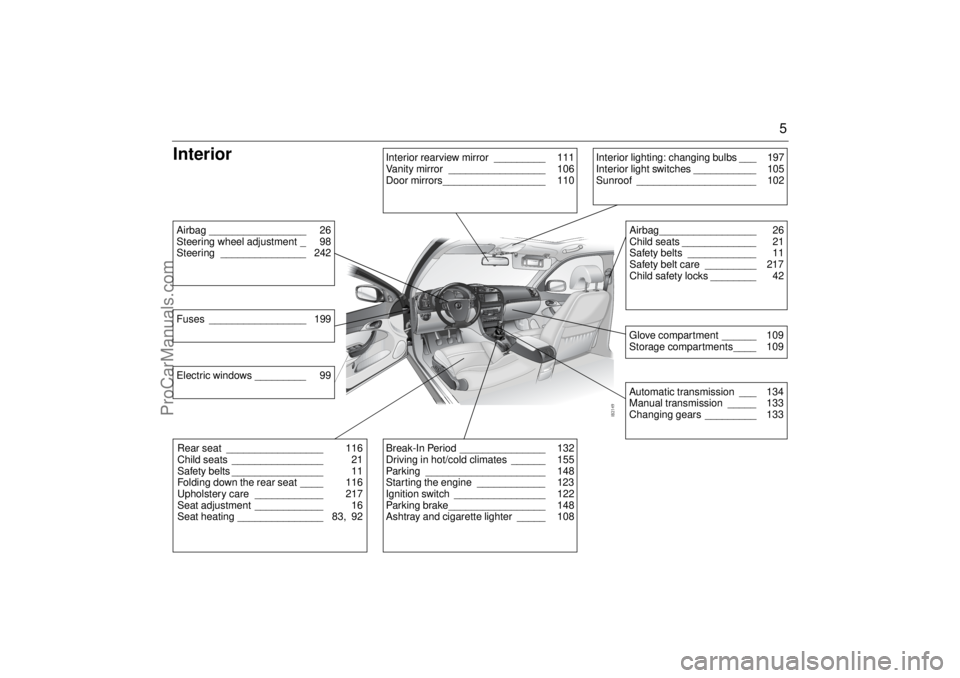
InteriorAirbag _________________ 26
Steering wheel adjustment _ 98
Steering _______________ 242
Interior rearview mirror _________ 111
Vanity mirror _________________ 106
Door mirrors__________________ 110
Airbag_________________ 26
Child seats _____________ 21
Safety belts ____________ 11
Safety belt care _________ 217
Child safety locks ________ 42Glove compartment ______ 109
Storage compartments____ 109Automatic transmission ___ 134
Manual transmission _____ 133
Changing gears _________ 133
Rear seat _________________ 116
Child seats ________________ 21
Safety belts ________________ 11
Folding down the rear seat ____ 116
Upholstery care ____________ 217
Seat adjustment ____________ 16
Seat heating _______________ 83, 92
Interior lighting: changing bulbs ___ 197
Interior light switches ___________ 105
Sunroof _____________________ 102
Break-In Period _______________ 132
Driving in hot/cold climates ______ 155
Parking _____________________ 148
Starting the engine ____________ 123
Ignition switch ________________ 122
Parking brake_________________ 148
Ashtray and cigarette lighter _____ 108
Fuses _________________ 199Electric windows _________ 99
ProCarManuals.com
Page 18 of 256
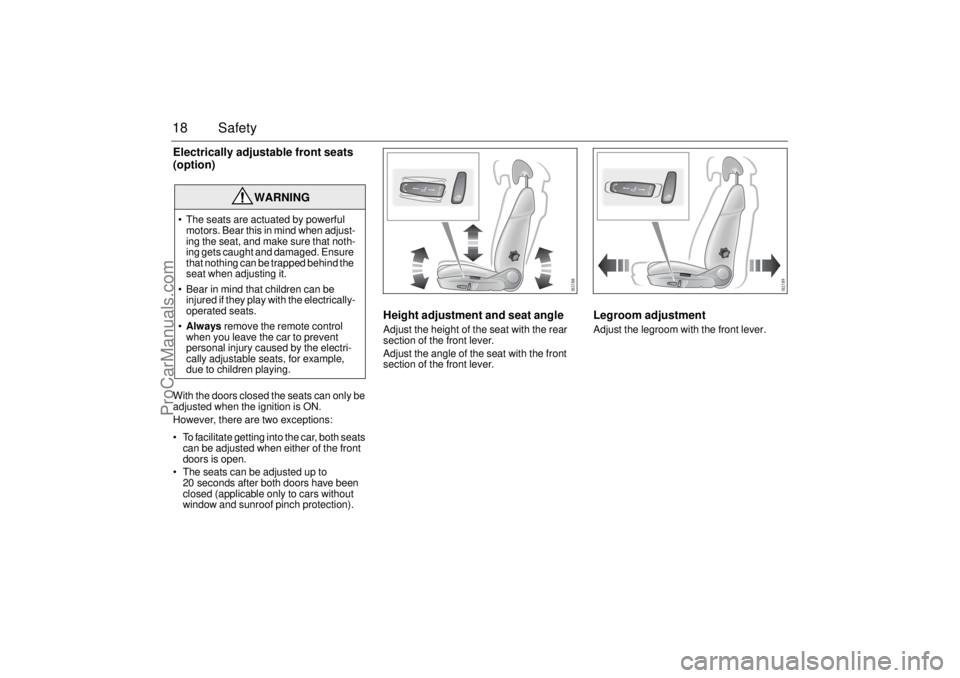
18 SafetyElectrically adjustable front seats
(option)With the doors closed the seats can only be
adjusted when the ignition is ON.
However, there are two exceptions:
To facilitate getting into the car, both seats
can be adjusted when either of the front
doors is open.
The seats can be adjusted up to
20 seconds after both doors have been
closed (applicable only to cars without
window and sunroof pinch protection).
Height adjustment and seat angleAdjust the height of the seat with the rear
section of the front lever.
Adjust the angle of the seat with the front
section of the front lever.
Legroom adjustmentAdjust the legroom with the front lever.
WARNING
The seats are actuated by powerful
motors. Bear this in mind when adjust-
ing the seat, and make sure that noth-
ing gets caught and damaged. Ensure
that nothing can be trapped behind the
seat when adjusting it.
Bear in mind that children can be
injured if they play with the electrically-
operated seats.
Always remove the remote control
when you leave the car to prevent
personal injury caused by the electri-
cally adjustable seats, for example,
due to children playing.
ProCarManuals.com
Page 26 of 256

26 SafetyAirbag
Airbag system components Airbag in steering wheel
Airbag in instrument panel in front of
passenger seat
Side airbags in front seat backrests
Inflatable curtains along length of headlin-
ing (from front to rear roof pillars)
Safety belt pretensioners for front seats.
The airbag system supplements the protec-
tion provided by the safety belts to further
enhance the safety of occupants taller than
55 in. (140 cm).
When the system is activated at the moment
of impact, the airbag inflates and then
deflates through holes in the back. The
whole operation takes roughly 0.1 second,
quicker than the blink of an eye.
The steering wheel and passenger airbags
are so-called smart airbags. The driver and
passenger airbag system compensates for
safety belt usage, the force of the crash and
the position of the seats at the moment of
impact.
Stage I is activated if the force of the
impact is low or if the seat is close to the
steering wheel or fascia.
Stage II is activated in all other cases.
Note:
The sensor reacts differently depending on
whether or not the front safety belts on the
driver’s and passenger sides are used. Sit-
uations can therefore arise where only one
of the airbags inflates.If the force of the impact is small, the airbag
needs only to inflate to Stage I to provide
optimum protection. If the seat is positioned
far forward (the person occupying the seat
is fairly short), only Stage I is activated to
prevent injury caused by the airbag being
inflated with full force.
If only Stage I is activated at the moment of
impact, Stage II will be activated later. This
occurs when the airbag is already fully
inflated and thus does not affect the person
occupying the seat. Stage II is activated
here to render the gas generator harmless
(its activation is not noticeable to the occu-
pant).
WARNING
To reduce risk of death or serious injury:
Always wear your safety belt.
Always adjust your seat so that you
are as far back as possible but still
able to operate the pedals and reach
the steering wheel and controls
comfortably.
Passengers 12 and under or shorter
than 55 inches (140 cm) must always
travel in the rear seat as the car is fitted
with a passenger airbag.
Never fit a child seat in front of the
passenger airbag.
ProCarManuals.com
Page 32 of 256
32 Safety
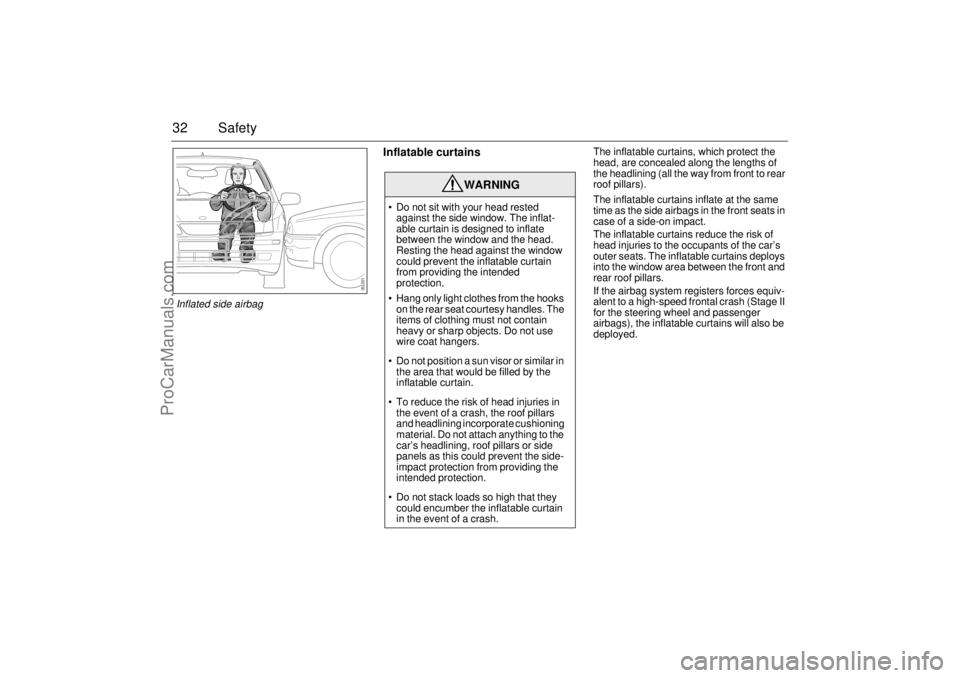
Inflatable curtains
The inflatable curtains, which protect the
head, are concealed along the lengths of
the headlining (all the way from front to rear
roof pillars).
The inflatable curtains inflate at the same
time as the side airbags in the front seats in
case of a side-on impact.
The inflatable curtains reduce the risk of
head injuries to the occupants of the car’s
outer seats. The inflatable curtains deploys
into the window area between the front and
rear roof pillars.
If the airbag system registers forces equiv-
alent to a high-speed frontal crash (Stage II
for the steering wheel and passenger
airbags), the inflatable curtains will also be
deployed.
WARNING
Do not sit with your head rested
against the side window. The inflat-
able curtain is designed to inflate
between the window and the head.
Resting the head against the window
could prevent the inflatable curtain
from providing the intended
protection.
Hang only light clothes from the hooks
on the rear seat courtesy handles. The
items of clothing must not contain
heavy or sharp objects. Do not use
wire coat hangers.
Do not position a sun visor or similar in
the area that would be filled by the
inflatable curtain.
To reduce the risk of head injuries in
the event of a crash, the roof pillars
and headlining incorporate cushioning
material. Do not attach anything to the
car’s headlining, roof pillars or side
panels as this could prevent the side-
impact protection from providing the
intended protection.
Do not stack loads so high that they
could encumber the inflatable curtain
in the event of a crash.
Inflated side airbag
ProCarManuals.com
Page 49 of 256

49 Security
The functions of Full theft alarm and Door
alarm only modes are explained below.
Panic functionThe car alarm includes a panic function.
This function allows the alarm to be started
manually, for example, to attract attention.
The panic alarm can only be activated while
the car is stationary. The alarm is silenced if
the car is driven off.
When the alarm is tripped, the lights and
horn come on for 3 minutes or until you
press one of the remote control buttons.
To start the alarm manually proceed as
follows:
Press and hold the button on the
remote control for more than 2 seconds,
or if you are sitting in the car...
Press and hold the or button on
one of the front doors for more than
2 seconds.
To switch off the alarm:
Press one of the remote control buttons
or, if you are sitting in the car, the or
buttons on one of the front doors. Full theft alarm:
The alarm will be triggered if a window
is smashed and someone sticks in their
arm to take something from the car. All
windows and the sunroof should be
shut when the car is locked in Full theft
alarm mode.
Door alarm only:
In this mode, the movement and tilt
sensors are disabled. This can be use-
ful if you wish to leave a dog in the car
or are travelling by ferry, for example.
ProCarManuals.com
Page 79 of 256
79 Instruments and controls
Manual climate-control
systemFresh air for the cabin is drawn in through an
inlet grille at the bottom edge of the wind-
shield. It passes through a filter before
reaching the climate control system and
delivery into the cabin. The air is evacuated
via openings in the parcel shelf. It is then led
through outlets on either side of the car
behind the rear bumper.
The incoming air is treated in three stages:
first it passes through a filter; it is then dehu-
midified and cooled; and finally, if required,
it is heated.
To optimize the performance of the A/C sys-
tem, all windows and the sunroof should be
shut.
To reduce potential misting on the insides of
the windows, the glass should be cleaned
with a quality glass cleaner. How often this
will need to be done depends on how clean
the air is - if there are smokers in the car, the
windows will need to be cleaned more fre-
quently.
The output of air is controlled by the fan
speed.
Temperature controlThe temperature of the incoming air can
be infinitely varied using the temperature
control.
Fan
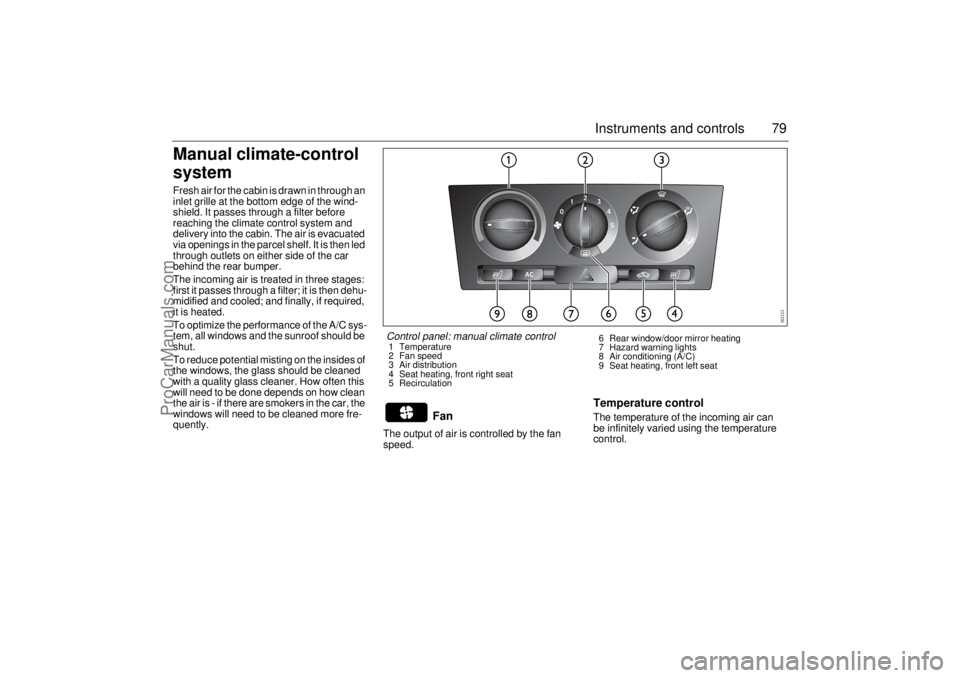
Control panel: manual climate control1 Temperature
2 Fan speed
3 Air distribution
4 Seat heating, front right seat
5 Recirculation6 Rear window/door mirror heating
7 Hazard warning lights
8 Air conditioning (A/C)
9 Seat heating, front left seat
ProCarManuals.com
Page 84 of 256
84 Instruments and controlsAutomatic climate-
control system (ACC)Fresh air for the cabin is drawn in through an
inlet at the bottom edge of the windshield. It
passes through an effective filter before
reaching the climate control system and
delivery into the cabin. The air is evacuated
via openings in the parcel shelf. It is then led
through outlets on either side of the car
behind the rear bumper.
The Automatic Climate-Control syatem
(ACC) automatically maintains the desired
cabin temperature, regardless of the
weather outside.
The system will achieve the desired temper-
ature in the quickest possible way.
Note that heating or cooling is not
speeded up by setting the temperature
higher or lower than the final tempera-
ture you desire.
To optimize the performance of the air con-
ditioning system, all windows and the sun-
roof should be shut. The air vents in the
fascia must be open.
The incoming air is treated in three stages:
first it passes through a filter; it is then dehu-
midified and cooled; and finally, if required,
it is heated.To reduce potential misting on the insides of
the windows, the glass should be cleaned
with a quality glass cleaner. How often this
will need to be done depends on how clean
the air is - if there are smokers in the car, the
windows will need to be cleaned more
frequently.
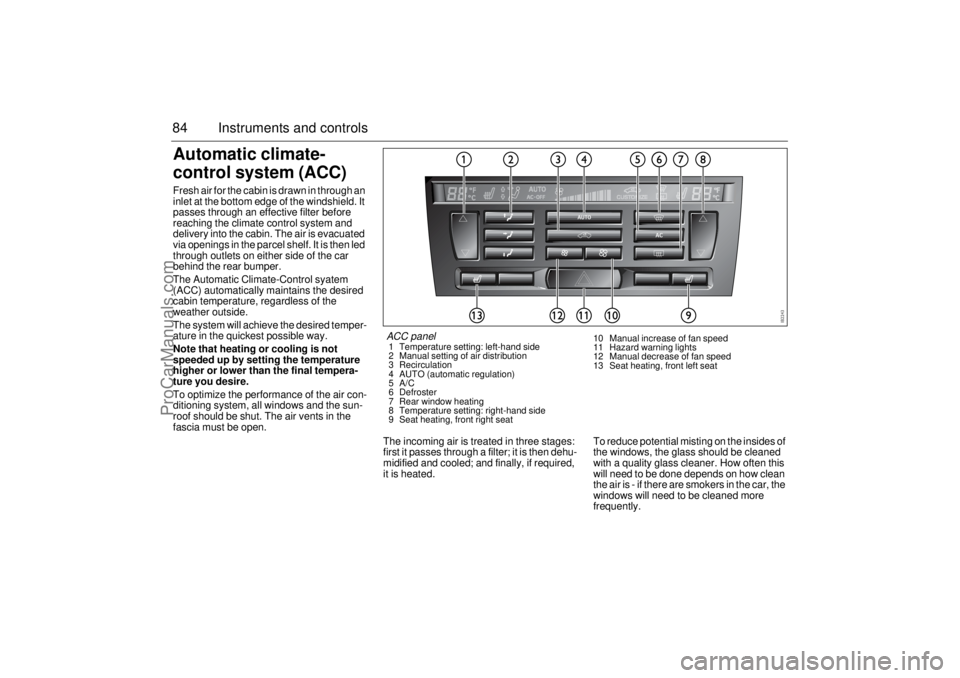
ACC panel1 Temperature setting: left-hand side
2 Manual setting of air distribution
3 Recirculation
4 AUTO (automatic regulation)
5A/C
6 Defroster
7 Rear window heating
8 Temperature setting: right-hand side
9 Seat heating, front right seat10 Manual increase of fan speed
11 Hazard warning lights
12 Manual decrease of fan speed
13 Seat heating, front left seat
ProCarManuals.com
Page 97 of 256
97 Interior equipment
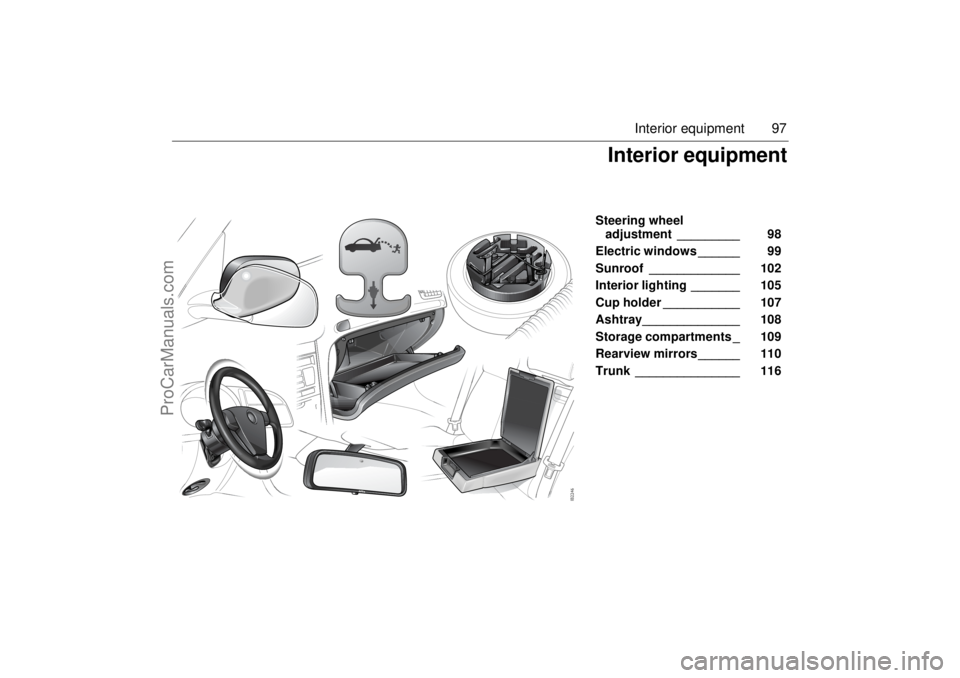
Steering wheel
adjustment _________ 98
Electric windows ______ 99
Sunroof _____________ 102
Interior lighting _______ 105
Cup holder ___________ 107
Ashtray______________ 108
Storage compartments _ 109
Rearview mirrors______ 110
Trunk _______________ 116
Interior equipment
ProCarManuals.com
Page 99 of 256
99 Interior equipment
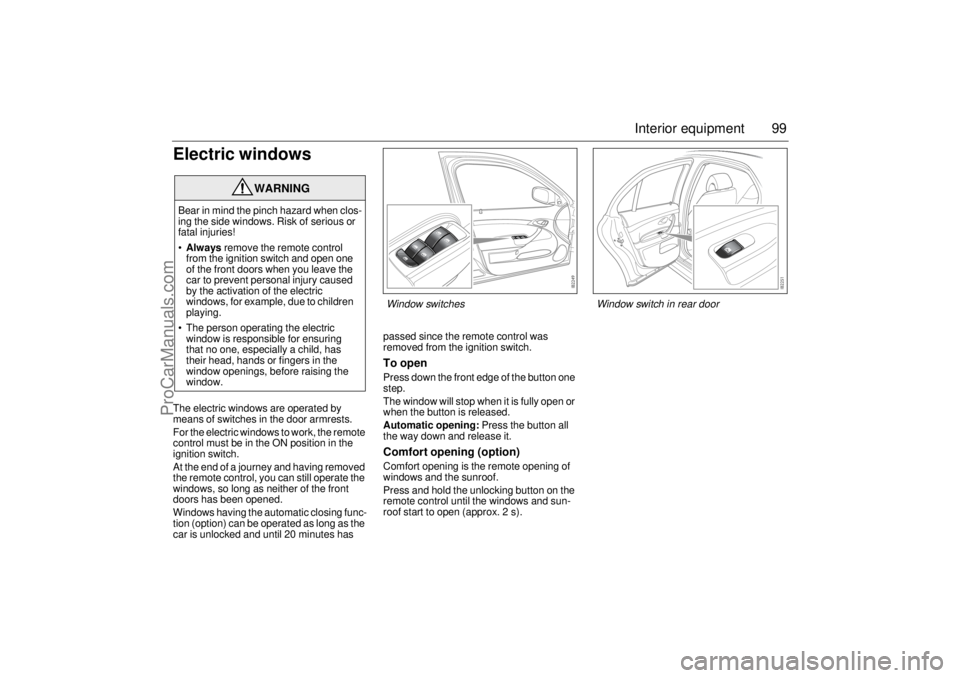
Electric windowsThe electric windows are operated by
means of switches in the door armrests.
For the electric windows to work, the remote
control must be in the ON position in the
ignition switch.
At the end of a journey and having removed
the remote control, you can still operate the
windows, so long as neither of the front
doors has been opened.
Windows having the automatic closing func-
tion (option) can be operated as long as the
car is unlocked and until 20 minutes has passed since the remote control was
removed from the ignition switch.
To openPress down the front edge of the button one
step.
The window will stop when it is fully open or
when the button is released.
Automatic opening: Press the button all
the way down and release it.Comfort opening (option)Comfort opening is the remote opening of
windows and the sunroof.
Press and hold the unlocking button on the
remote control until the windows and sun-
roof start to open (approx. 2 s).
WARNING
Bear in mind the pinch hazard when clos-
ing the side windows. Risk of serious or
fatal injuries!
•Always remove the remote control
from the ignition switch and open one
of the front doors when you leave the
car to prevent personal injury caused
by the activation of the electric
windows, for example, due to children
playing.
The person operating the electric
window is responsible for ensuring
that no one, especially a child, has
their head, hands or fingers in the
window openings, before raising the
window.
Window switches
Window switch in rear door
ProCarManuals.com