seats SAAB 9-3 2004 User Guide
[x] Cancel search | Manufacturer: SAAB, Model Year: 2004, Model line: 9-3, Model: SAAB 9-3 2004Pages: 288, PDF Size: 23.54 MB
Page 28 of 288
28 SafetyAirbag
Airbag system components Airbag in steering wheel
Airbag in instrument panel in front of
passenger seat
Side airbags in front seat backrests
Convertible: The side airbags help
protect the head also.
Inflatable curtains along length of headlin-
ing (from front to rear roof pillars)
(Sport Sedan only)
Safety belt pretensioners for front seats
and outer rear seats.
The airbag system supplements the protec-
tion provided by the safety belts to further
enhance the safety of occupants taller than
55 in. (140 cm).
When the system is activated at the moment
of impact, the airbag inflates and then
deflates through holes in the back. The
whole operation takes roughly 0.1 second,
quicker than the blink of an eye.
The steering wheel and passenger airbags
are so-called smart airbags. The driver and
passenger airbag system compensates for
safety belt usage and the force of the crash
at the moment of impact.Note:
The sensor reacts differently depending on
whether or not the front safety belts on the
driver’s and passenger sides are used. Sit-
uations can therefore arise where only one
of the airbags inflates. It is also possible for
only the safety belt pretensioners to be acti-
vated and for the airbags to remain unin-
flated.
If only Stage I is activated at the moment of
impact, Stage II will automatically be acti-
vated later to neutralize the gas generator in
the airbag.
WARNING
To reduce risk of death or serious injury:
Always wear your safety belt.
Always adjust your seat so that you
are as far back as possible but still
able to operate the pedals and reach
the steering wheel and controls
comfortably.
Passengers 12 and under or shorter
than 55 inches (140 cm) must always
travel in the rear seat as the car is fitted
with a passenger airbag.
Never fit a child seat in front of the
passenger airbag.
ProCarManuals.com
Page 33 of 288
33 Safety
Head protectionThe pillar trim and headlining (not Converti-
ble soft top) are designed to absorb energy,
softening possible blows to the head. After
a crash, these items must be changed in the
seat positions that were occupied. Never fit
accessories to the pillar trim or headlining
as these could reduce the effectiveness of
the head protection and inflatable curtain
(Sport Sedan).
Side-impact protection
The side airbags, which help protect the
upper body (head also in Convertible), are
integrated in the outside edges of the front
seat backrests. The side impact protection
of the Sport Sedan also includes inflatable
curtains (see page 34.
The front seats and outer rear seats have
safety belt pretensioners.
There are two sensors on each side of the
car, one at the rear of each door sill and one
in the lower part of each C-pillar. The side-
impact protection is only activated on the
side of impact, while the safety belt preten-
sioners on both sides are deployed.
Convertible: The Convertible has two side
impact protection sensors, one on each side
of the car. These are located at rear of the
sills. Never place anything on the dash or in
front of the seat as, in addition to being
a hazard to passengers, this could
interfere with the function of the airbag
in the event of a crash. The same
applies to the mounting of accessories
on the dash.
Keep feet on the floor – never put feet
up on the dash, on the seat or out of
the window.
Do not carry anything in your lap.
WARNING
This car is equipped with side airbags
and no extra seat cover should be
fitted. Failure to observe this warning
could result in the side airbags not
inflating as intended and thus not
providing the intended protection
either.
Never place any object in the area that
would be occupied by the inflated air-
bag.
For optimum protection, sit upright in
the seat, with your safety belt correctly
fastened.
The side-impact protection will only be
activated in the event of a side-on
crash and not in the event of a rear-
end crash or the car rolling over. For
the Convertible’s Roll-over protection
see page 68.
Damage or wear to the seat cover, or
the seat seam, in the area of the side
airbag must immediately be repaired
by an authorized Saab dealer.
ProCarManuals.com
Page 35 of 288
35 Safety
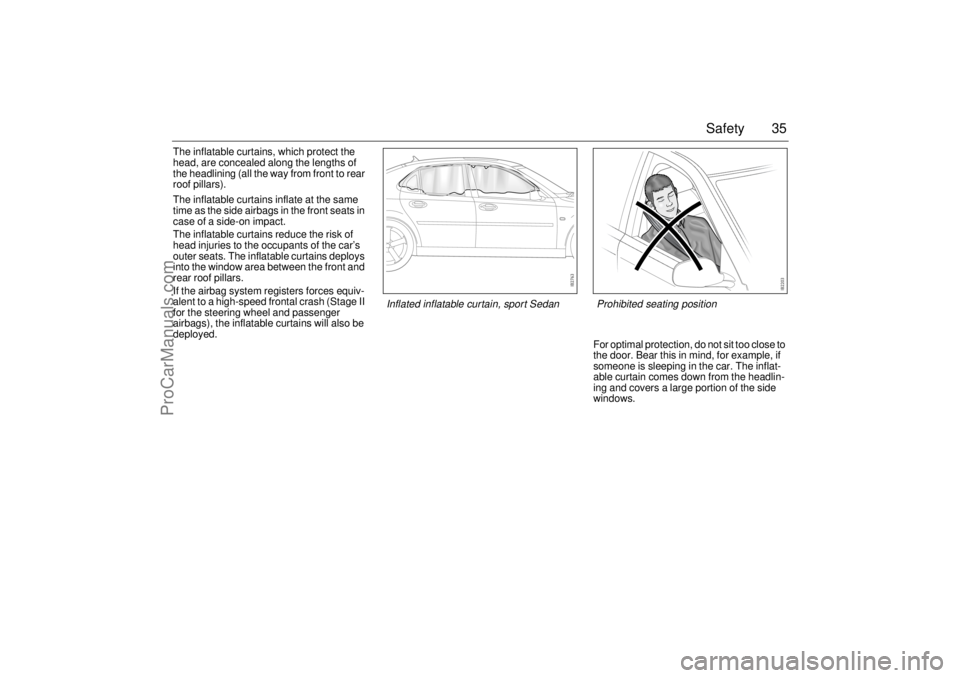
The inflatable curtains, which protect the
head, are concealed along the lengths of
the headlining (all the way from front to rear
roof pillars).
The inflatable curtains inflate at the same
time as the side airbags in the front seats in
case of a side-on impact.
The inflatable curtains reduce the risk of
head injuries to the occupants of the car’s
outer seats. The inflatable curtains deploys
into the window area between the front and
rear roof pillars.
If the airbag system registers forces equiv-
alent to a high-speed frontal crash (Stage II
for the steering wheel and passenger
airbags), the inflatable curtains will also be
deployed.
For optimal protection, do not sit too close to
the door. Bear this in mind, for example, if
someone is sleeping in the car. The inflat-
able curtain comes down from the headlin-
ing and covers a large portion of the side
windows.
Prohibited seating position
Inflated inflatable curtain, sport Sedan
ProCarManuals.com
Page 44 of 288
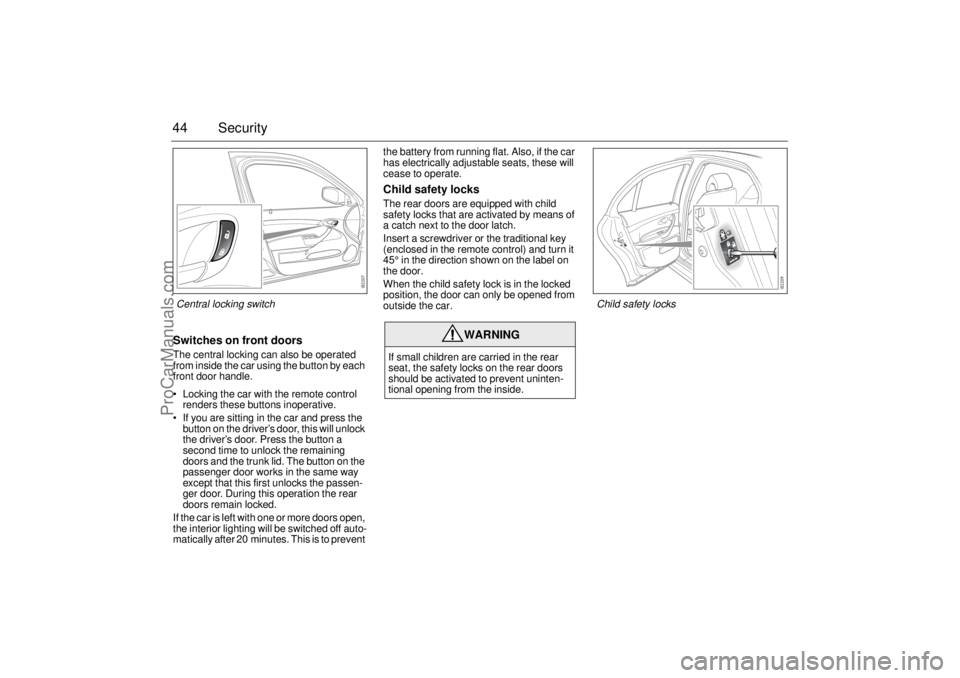
44 SecuritySwitches on front doorsThe central locking can also be operated
from inside the car using the button by each
front door handle.
Locking the car with the remote control
renders these buttons inoperative.
If you are sitting in the car and press the
button on the driver’s door, this will unlock
the driver’s door. Press the button a
second time to unlock the remaining
doors and the trunk lid. The button on the
passenger door works in the same way
except that this first unlocks the passen-
ger door. During this operation the rear
doors remain locked.
If the car is left with one or more doors open,
the interior lighting will be switched off auto-
matically after 20 minutes. This is to prevent the battery from running flat. Also, if the car
has electrically adjustable seats, these will
cease to operate.
Child safety locksThe rear doors are equipped with child
safety locks that are activated by means of
a catch next to the door latch.
Insert a screwdriver or the traditional key
(enclosed in the remote control) and turn it
45° in the direction shown on the label on
the door.
When the child safety lock is in the locked
position, the door can only be opened from
outside the car.
WARNING
If small children are carried in the rear
seat, the safety locks on the rear doors
should be activated to prevent uninten-
tional opening from the inside.
Child safety locks
Central locking switch
ProCarManuals.com
Page 62 of 288
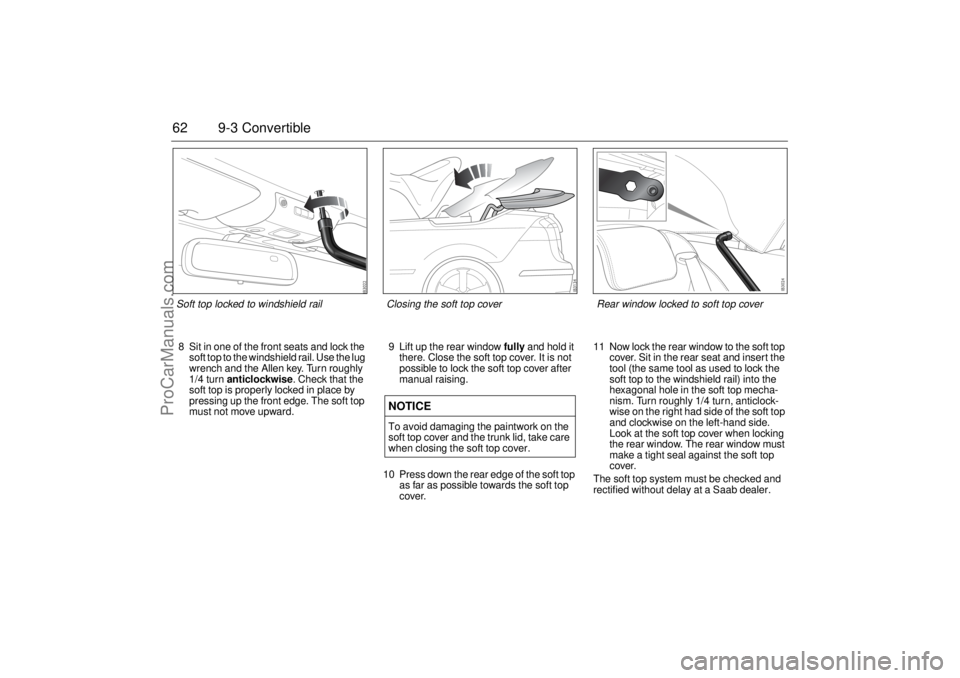
62 9-3 Convertible8 Sit in one of the front seats and lock the
soft top to the windshield rail. Use the lug
wrench and the Allen key. Turn roughly
1/4 turn anticlockwise. Check that the
soft top is properly locked in place by
pressing up the front edge. The soft top
must not move upward.9 Lift up the rear window fully and hold it
there. Close the soft top cover. It is not
possible to lock the soft top cover after
manual raising.
10 Press down the rear edge of the soft top
as far as possible towards the soft top
cover.11 Now lock the rear window to the soft top
cover. Sit in the rear seat and insert the
tool (the same tool as used to lock the
soft top to the windshield rail) into the
hexagonal hole in the soft top mecha-
nism. Turn roughly 1/4 turn, anticlock-
wise on the right had side of the soft top
and clockwise on the left-hand side.
Look at the soft top cover when locking
the rear window. The rear window must
make a tight seal against the soft top
cover.
The soft top system must be checked and
rectified without delay at a Saab dealer.
NOTICETo avoid damaging the paintwork on the
soft top cover and the trunk lid, take care
when closing the soft top cover.Closing the soft top cover
Rear window locked to soft top cover
Soft top locked to windshield rail
ProCarManuals.com
Page 65 of 288
65 9-3 Convertible
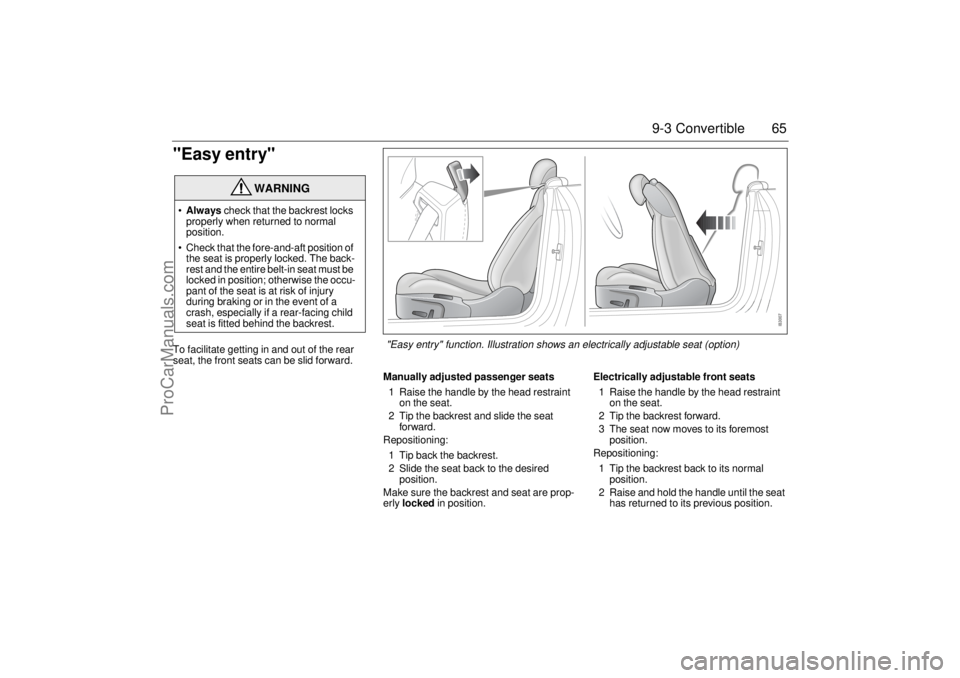
"Easy entry"To facilitate getting in and out of the rear
seat, the front seats can be slid forward.
Manually adjusted passenger seats
1 Raise the handle by the head restraint
on the seat.
2 Tip the backrest and slide the seat
forward.
Repositioning:
1 Tip back the backrest.
2 Slide the seat back to the desired
position.
Make sure the backrest and seat are prop-
erly locked in position.Electrically adjustable front seats
1 Raise the handle by the head restraint
on the seat.
2 Tip the backrest forward.
3 The seat now moves to its foremost
position.
Repositioning:
1 Tip the backrest back to its normal
position.
2 Raise and hold the handle until the seat
has returned to its previous position.
WARNING
Always check that the backrest locks
properly when returned to normal
position.
Check that the fore-and-aft position of
the seat is properly locked. The back-
rest and the entire belt-in seat must be
locked in position; otherwise the occu-
pant of the seat is at risk of injury
during braking or in the event of a
crash, especially if a rear-facing child
seat is fitted behind the backrest.
"Easy entry" function. Illustration shows an electrically adjustable seat (option)
ProCarManuals.com
Page 66 of 288
66 9-3 ConvertibleHead restraintsThe front seats are equipped with Saab
Active Head Restraints (SAHRs). These
r e du ce t h e ri s k o f n ec k i n ju r y i f t h e c a r is h it
from behind.
The SAHR is a mechanical system, actu-
ated by body weight. The mechanism is built
into the top of the backrest, where it is con-
nected to the head restraint.
In the event of a rear-end crash, the body is
forced back against the backrest. This, in
turn, causes the mechanism to press the
head restraint forward and upward, thus lim-
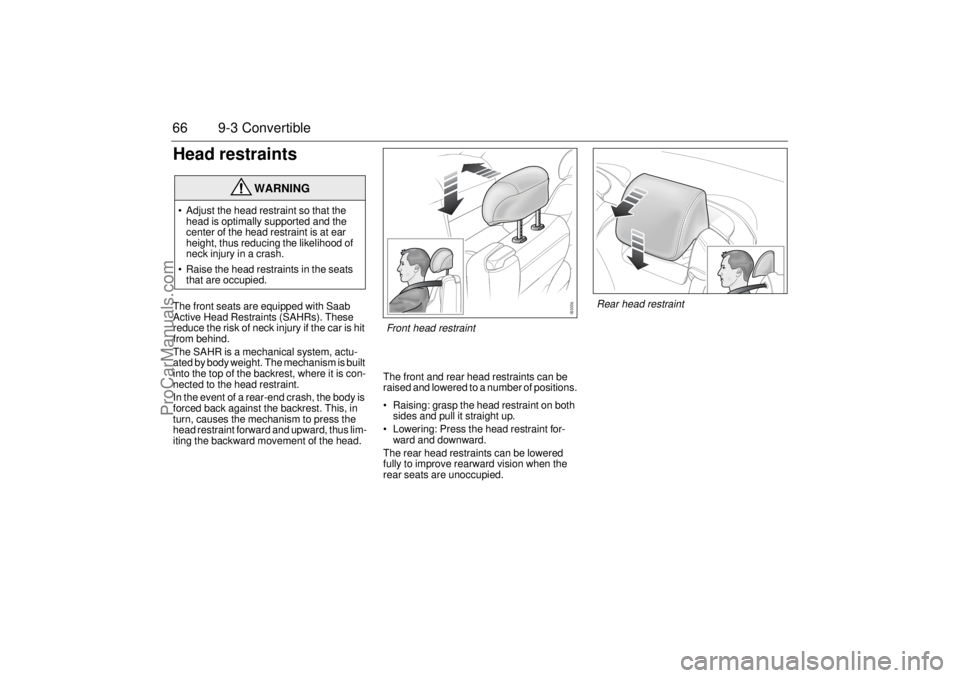
iting the backward movement of the head.The front and rear head restraints can be
raised and lowered to a number of positions.
Raising: grasp the head restraint on both
sides and pull it straight up.
Lowering: Press the head restraint for-
ward and downward.
The rear head restraints can be lowered
fully to improve rearward vision when the
rear seats are unoccupied.
WARNING
Adjust the head restraint so that the
head is optimally supported and the
center of the head restraint is at ear
height, thus reducing the likelihood of
neck injury in a crash.
Raise the head restraints in the seats
that are occupied.
Rear head restraint
Front head restraint
ProCarManuals.com
Page 67 of 288
67 9-3 Convertible
Safety belts, rear seat,
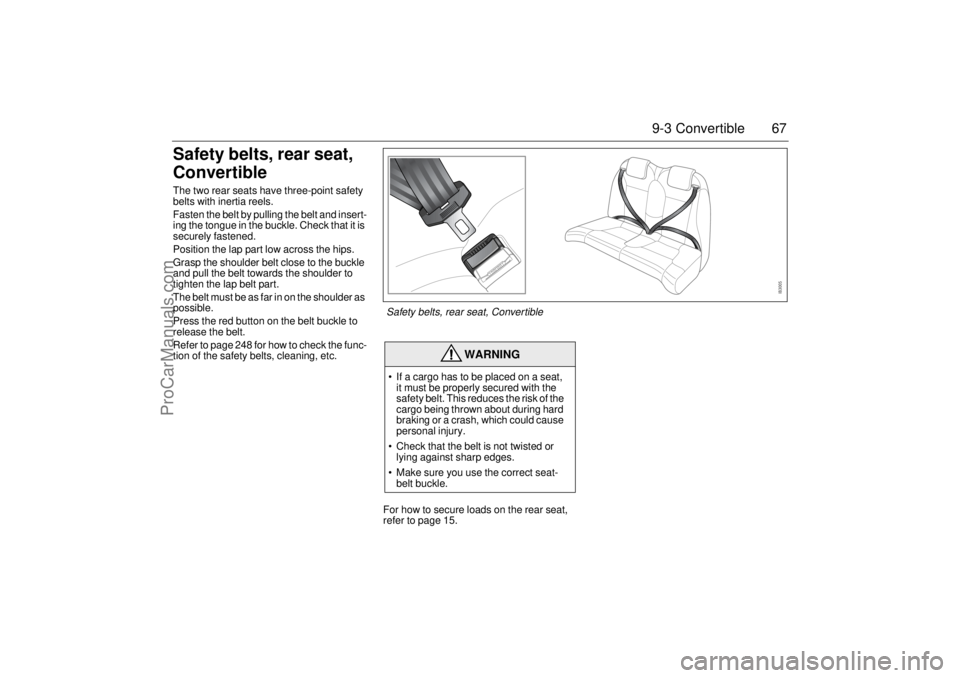
ConvertibleThe two rear seats have three-point safety
belts with inertia reels.
Fasten the belt by pulling the belt and insert-
ing the tongue in the buckle. Check that it is
securely fastened.
Position the lap part low across the hips.
Grasp the shoulder belt close to the buckle
and pull the belt towards the shoulder to
tighten the lap belt part.
The belt must be as far in on the shoulder as
possible.
Press the red button on the belt buckle to
release the belt.
Refer to page 248 for how to check the func-
tion of the safety belts, cleaning, etc.
For how to secure loads on the rear seat,
refer to page 15.
WARNING
If a cargo has to be placed on a seat,
it must be properly secured with the
safety belt. This reduces the risk of the
cargo being thrown about during hard
braking or a crash, which could cause
personal injury.
Check that the belt is not twisted or
lying against sharp edges.
Make sure you use the correct seat-
belt buckle.Safety belts, rear seat, Convertible
ProCarManuals.com
Page 84 of 288
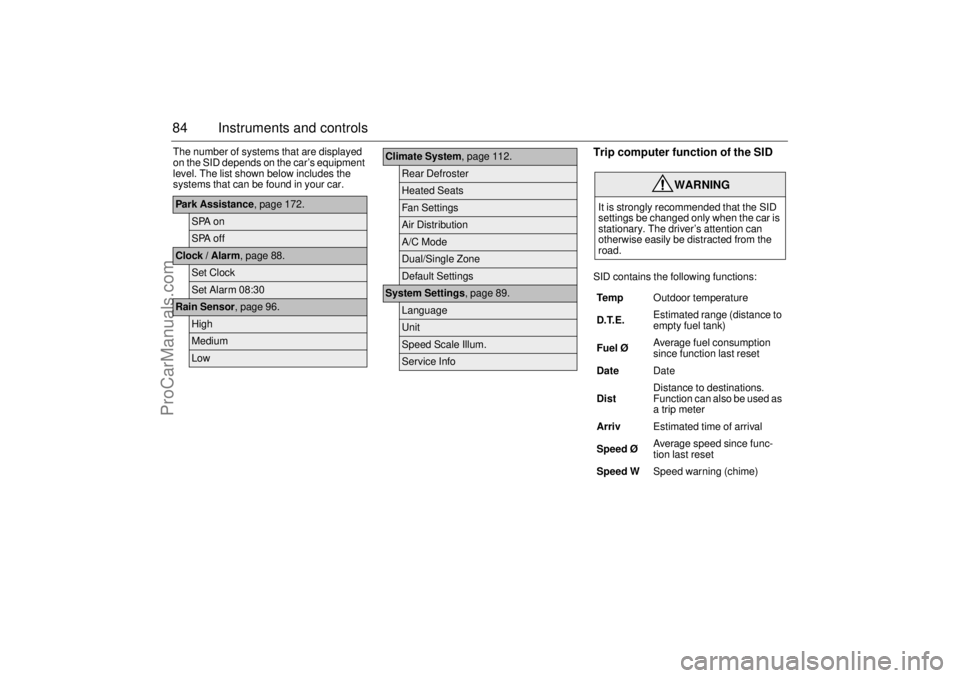
84 Instruments and controlsThe number of systems that are displayed
on the SID depends on the car’s equipment
level. The list shown below includes the
systems that can be found in your car.
Trip computer function of the SIDSID contains the following functions:
Park Assistance, page 172.
SPA onSPA off
Clock / Alarm, page 88.
Set ClockSet Alarm 08:30
Rain Sensor, page 96.
HighMediumLow
Climate System, page 112.
Rear DefrosterHeated SeatsFan SettingsAir DistributionA/C ModeDual/Single ZoneDefault Settings
System Settings, page 89.
LanguageUnitSpeed Scale Illum.Service Info
WARNING
It is strongly recommended that the SID
settings be changed only when the car is
stationary. The driver’s attention can
otherwise easily be distracted from the
road.
Te m pOutdoor temperature
D.T.E. Estimated range (distance to
empty fuel tank)
Fuel ØAverage fuel consumption
since function last reset
DateDate
DistDistance to destinations.
Function can also be used as
a trip meter
ArrivEstimated time of arrival
Speed Ø Average speed since func-
tion last reset
Speed WSpeed warning (chime)
ProCarManuals.com
Page 102 of 288
102 Instruments and controlsThis button is located under the fan speed
control.
Always switch off the heating as soon as the
rear window is free from ice and mist. It will
be turned off automatically after 12 minutes.
Refrain from placing sharp objects on the
parcel shelf, to avoid damaging the heating
element.
Convertible: The rear window heating is
not turned on if the soft top is folded down.The seat cushions and backrests of the front
seats are heated.
The heating is thermostatically controlled
and set at approx. 104°F (40°C).
Switch off the seat heating once the seat is
warm.
Electrically heated rear
window/external mirrors
Electric heating, front
seats (option)
ProCarManuals.com