service SAAB 9-3 2004 User Guide
[x] Cancel search | Manufacturer: SAAB, Model Year: 2004, Model line: 9-3, Model: SAAB 9-3 2004Pages: 288, PDF Size: 23.54 MB
Page 90 of 288
90 Instruments and controls
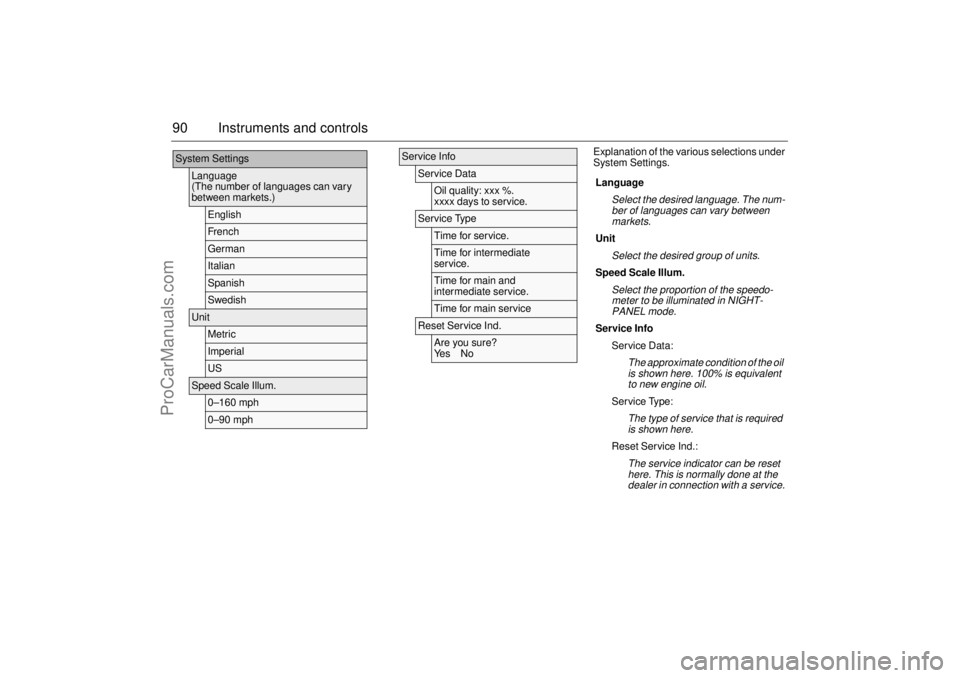
Explanation of the various selections under
System Settings.
System Settings
Language
(The number of languages can vary
between markets.)
EnglishFr e nc hGermanItalianSpanishSwedish
Unit
MetricImperialUS
Speed Scale Illum.
0–160 mph0–90 mph
Service Info
Service Data
Oil quality: xxx %.
xxxx days to service.
Service Type
Time for service.Time for intermediate
service.Time for main and
intermediate service.Time for main service
Reset Service Ind.
Are you sure?
Ye s N o
Language
Select the desired language. The num-
ber of languages can vary between
markets.
Unit
Select the desired group of units.
Speed Scale Illum.
Select the proportion of the speedo-
meter to be illuminated in NIGHT-
PANEL mode.
Service Info
Service Data:
The approximate condition of the oil
is shown here. 100% is equivalent
to new engine oil.
Service Type:
The type of service that is required
is shown here.
Reset Service Ind.:
The service indicator can be reset
here. This is normally done at the
dealer in connection with a service.
ProCarManuals.com
Page 145 of 288

145 Starting and driving
If the diagnosis function detects a fault in the
engine management system, the light
"Engine malfunction (CHECK ENGINE)" in
the instrument panel will come on (see page
75). Have the car checked at a Saab dealer
as soon as possible.
The following message is shown on the SID:
Important considerations with
catalytic convertersThe catalytic converter is an emission con-
trol device incorporated in the car’s exhaust
system. It consists of a metal canister with a
honeycomb insert, the cells of which have
walls coated in a catalytic layer (precious
metal alloy).
To ensure that the catalytic converter con-
tinues to function properly, and also to avoid
damage to the converter and its associated
components, the following points must be
observed: Have the car serviced regularly in accord-
ance with the service program.
Always be alert to any misfiring of the
engine (not running on all cylinders) and
any loss of power or performance. At the
first sign of a malfunction, reduce speed
and take the car to a Saab dealer.
If the engine fails to start (in severe cold
or if the battery is flat), the car can be
bump started (manual transmission only)
or started using jump leads to a donor
battery. However, as soon as you have
started the engine, it is important that it
runs on all cylinders. If it is misfiring, allow
it to idle for up to 5 minutes to give it time
to settle and run smoothly. If, after this
time, the engine still fails to run properly,
switch off the engine to avoid serious
damage to the catalytic converter.
Contact a Saab dealer for advice. Reduced engine power.
Contact Saab dealer.
NOTICEIf "Engine malfunction (CHECK
ENGINE)" warning light starts to flash
(indicating that the engine is misfiring and
the catalytic converter can be damaged),
ease off the accelerator slightly. The light
should go out or start to shine constantly.
If the light continues to flash despite
easing off the accelerator, you may
continue to drive the car but at the mini-
mum throttle permitted by the current traf-
fic situation. Have the car checked as
soon as possible at a Saab dealer.
NOTICEUse only unleaded gasoline. Leaded
gasoline is detrimental to the catalyst and
oxygen sensor and will seriously impair
the function of the catalytic converter.
ProCarManuals.com
Page 149 of 288

149 Starting and driving
Recommended fuel:For optimum performance we recommend
90 AON for 175 hp engines and 93 AON for
210 hp engines.
Octane rating is determined according to
the formula:
where MON is the Motor Octane Number,
and RON is the Research Octane Number.
The average of these two values is the
octane rating of the gasoline as it appears
on the pump at a retail gas station. This
value is sometimes referred to as the "Anti-
Knock Index" (AKI) or the "Average Octane
Number" (AON).To avoid deposit formation on the fuel injec-
tors which can cause poor driveability, use
only quality gasolines that contain deter-
gents and corrosion inhibitors. Because
gasolines sold at retail gas stations vary in
their composition and quality, you should
switch to a different brand if you begin expe-
riencing driveability and/or hard starting
problems shortly after refueling your car. In
recent years, a variety of fuel additives and
alcohols or oxygenates have been blended
with gasoline. These types of gasolines may
be found in all parts of the United States and
Canada, but particularly in geographic
areas and cities that have high carbon
monoxide levels. Saab approves the use of
such "reformulated" gasolines in its prod-
ucts, which help in reducing pollution from
all motor vehicles, provided that the follow-
ing blending percentages are met by such
fuels:
Up to 10 % ethanol by volume, with corro-
sion inhibitors.
Up to 15 % MTBE by volume (methyl
tertiary butyl ether).
Up to 5 % methanol by volume, with an
equal amount of a suitable co-solvent and
added corrosion inhibitors.Other, less common, fuel additives used by
some gasoline dealers are also acceptable,
provided that the resultant gasoline is not
more than 2.7 % oxygen by weight. In many
cases, you may not be able to determine the
exact type or percentage by volume of fuel
additive in the gasoline you purchase for
your car.
Some Canadian and U.S. gasolines contain
an octane enhancing additive called meth-
lycyclopentadienyl manganese tricarbonyl
(MMT). If such fuel is used, your emission
control system performance may deterio-
rate and the malfunction indicator lamp on
your instrument panel may turn on. If this
occurs, return to your authorized Saab
dealer for service.
However, these blended gasolines are reg-
ulated and should never exceed these rec-
ommended blend percentages and service
station operators should know if their gaso-
lines contain detergents and oxygenates,
and have been reformulated to reduce vehi-
cle emissions. Nevertheless, if you begin to
notice a problem with the way your car starts
or runs shortly after it has been refueled, try
a different brand of gasoline. MON + RON
2
ProCarManuals.com
Page 150 of 288
150 Starting and driving
Fuel (Gasoline Engine)Use regular unleaded gasoline rated at 87
octane or higher. Use of gasoline with an
octane rating lower than 87 can result in
severe engine damage. Damage caused by
incorrect fuel being used is not covered
under the terms of the New Car Warranty
and will be the responsibility of the owner. It
is recommended that the gasoline meet
specifications which were developed by the
American Automobile Manufacturers Asso-
ciation (AAMA) and endorsed by the Cana-
dian Motor Vehicle Manufacturers Associa-
tion for better vehicle performance and
engine protection. Gasolines meeting the
AAMA specification could provide improved
driveability and emission control system
performance compared to other gasolines.
Be sure the posted octane is at least 87. If
the octane is less than 87, you may get a
heavy knocking noise when you drive. If it’s
bad enough, it can damage your engine. If
you’re using fuel rated at 87 octane or
higher and you hear heavy knocking, your
engine needs service. But don’t worry if you
hear a little pinging noise when you’re accel-
erating or driving up a hill. That’s normal,
and you don’t have to buy a higher octane
fuel to get rid of pinging. It’s the heavy, con-
stant knock that means you have a problem.
NOTICEHigher concentrations of methanol than
listed above, or the use of methanol-
blended gasoline without suitable co-
solvents and corrosion inhibitors, can
damage your car’s fuel system, leading to
the need for repairs which are not
covered by Saab’s product warranty.
NOTICEThe engine control module (ECM) moni-
toring the engine parameters also stores
fault codes.
Under certain circumstances, this may
cause constant illumination of the Engine
malfunction (CHECK ENGINE) lamp
, thus indicating a fault that must be
checked by your Saab dealer, see page
75.
NOTE: always observe the following two
measures:
Make sure that the fuel filler cap is
screwed on correctly before the
engine is started. Screw on the fuel
filler cap until you hear a distinct click.
Avoid driving with the fuel low level indi-
cator illuminated. The symbol illuminates
when less than approximately 2.5 gallons
(10 litres) of fuel remains in the tank.
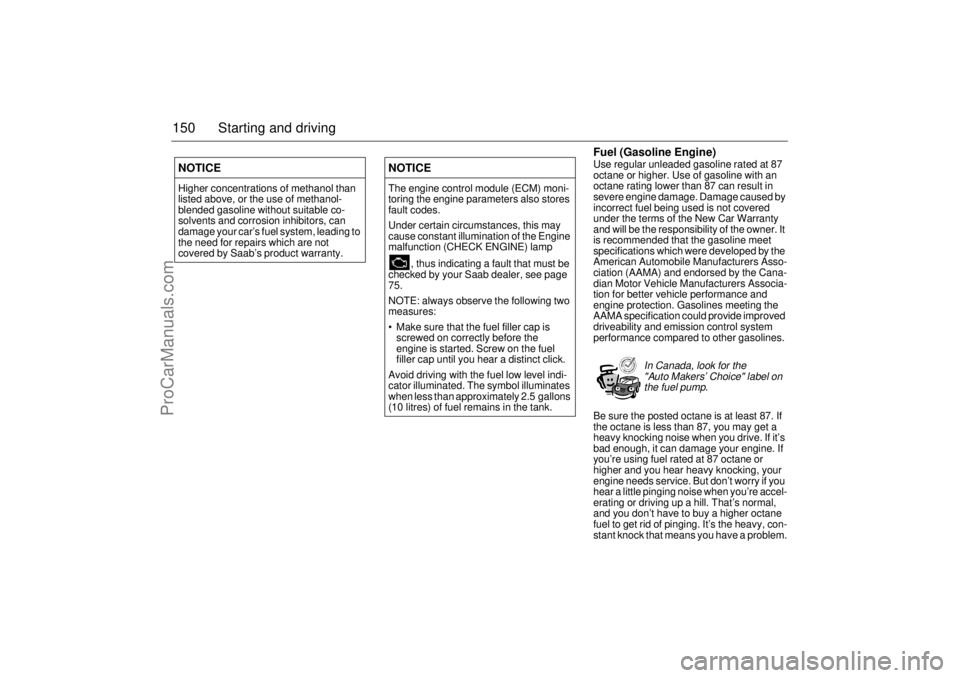
In Canada, look for the
"Auto Makers’ Choice" label on
the fuel pump
.
ProCarManuals.com
Page 151 of 288

151 Starting and driving
If your vehicle is certified to meet California
Emission Standards (indicated on the
underhood emission control label), it is
designed to operate on fuels that meet Cal-
ifornia specifications. If such fuels are not
available in states adopting California emis-
sions standards, your vehicle will operate
satisfactorily on fuels meeting federal spec-
ifications, but emission control system per-
formance may be affected. The malfunction
indicator lamp on your instrument panel
may turn on and/or your vehicle may fail a
smog-check test. See "Engine malfunction
(CHECK ENGINE)" on page 75. If this
occurs, return to your authorized Saab
dealer for diagnosis to determine the cause
of failure. In the event it is determined that
the cause of the condition is the type of fuels
used, repairs may not be covered by your
warranty.Some gasolines that are not reformulated
for low emissions may contain an octane-
enhancing additive called methylcyclopen-
tadienyl manganese tricarbonyl (MMT); ask
your service station operator whether or not
the fuel contains MMT. Saab does not
recommend the use of such gasolines. If
fuels containing MMT are used, spark plug
life may be reduced and your emission
control system performance may be
affected. The Engine malfunction (CHECK
ENGINE) light on your instrument panel
may turn on. If this occurs, return to your
authorized Saab dealer for service.
Engine Break-in PeriodPistons, cylinder bores and bearings need
time to obtain uniform, wear-resistant
surfaces.
If a new engine is driven too hard, this grad-
ual process of bedding-in will not be possi-
ble and the life of the engine will be short-
ened.
During the first 1,200 miles (2,000 km),
do not exceed 5,000 rpm.
In addition, refrain from driving the car at full
throttle, other than for brief instances,
during the first 1,800 miles (3,000 km).Wearing in new brake padsNew brake pads take time to bed in, about
90 miles (150 km) if the car is driven largely
under stop-and-go conditions or about
300 miles (500 km) of highway driving.
To extend the useful life of the pads, avoid
hard braking as much as possible.
ProCarManuals.com
Page 155 of 288
155 Starting and driving
Lock-upThe transmission’s torque converter has a
lock-up function. This can lock the torque
converter in 3rd, 4th and 5th gears, thus
reducing the engine speed and fuel con-
sumption.Kick-downWhen the accelerator is pressed down fully,
a down change is made to optimize acceler-
ation, e.g. for overtaking.
Following this, the next higher gear will be
selected at the optimum engine speed,
unless you ease off the accelerator before
reaching this. Kick-down works in manual
mode in 4th and 5th gears if the engine
speed is lower than 2,000 rpm.
Driving in hilly country with a heavy
loadThe transmission fluid can overheat when
the gearbox is strained, for example, when
driving with a trailer on hilly roads. To avoid
the transmission fluid overheating, always
drive with the selector lever in the D posi-
tion. The adaptive gear change patterns are
then active.
High air temperatures or a faulty oil cooler
can also cause the transmission fluid to
overheat. Overheating reduces the service
life of the fluid.TowingTowing of cars with automatic transmission,
see page 184.
Descending hillsIf the speed of the car increases while
descending a steep hill, despite the acceler-
ator being released, the control module will
change down to 4th gear. If you desire more
powerful engine braking, manually select a
lower gear (see page 158).
WARNING
Remember to use the braking effect of the
engine (1st, 2nd or 3rd gear) when you
are descending long or steep hills to
spare the brakes.
Overheating can cause the brakes to
fade!
ProCarManuals.com
Page 173 of 288
173 Starting and driving
Economical drivingFactors affecting fuel consumptionThe fuel consumption of a car is greatly
affected by driving conditions, climate, road
conditions, speed, driving technique, and
so on.Breaking-inFuel consumption may be somewhat
higher during the break-in period (the
first 3,000–4,000 miles (5,000–7,000 km)).Weather conditionsSummer temperatures give better fuel
economy than winter ones. The difference
can be as much as about 10%. Consump-
tion increases in cold weather because the
engine takes longer to reach its normal
operating temperature. The transmission
and wheel bearings also take longer to
warm up. Even distance affects consump-
tion: short journeys of 3–5 miles (5–8 km)
do not give the engine enough time to
reach its optimum temperature. Wind con-
ditions also have a marked effect on fuel
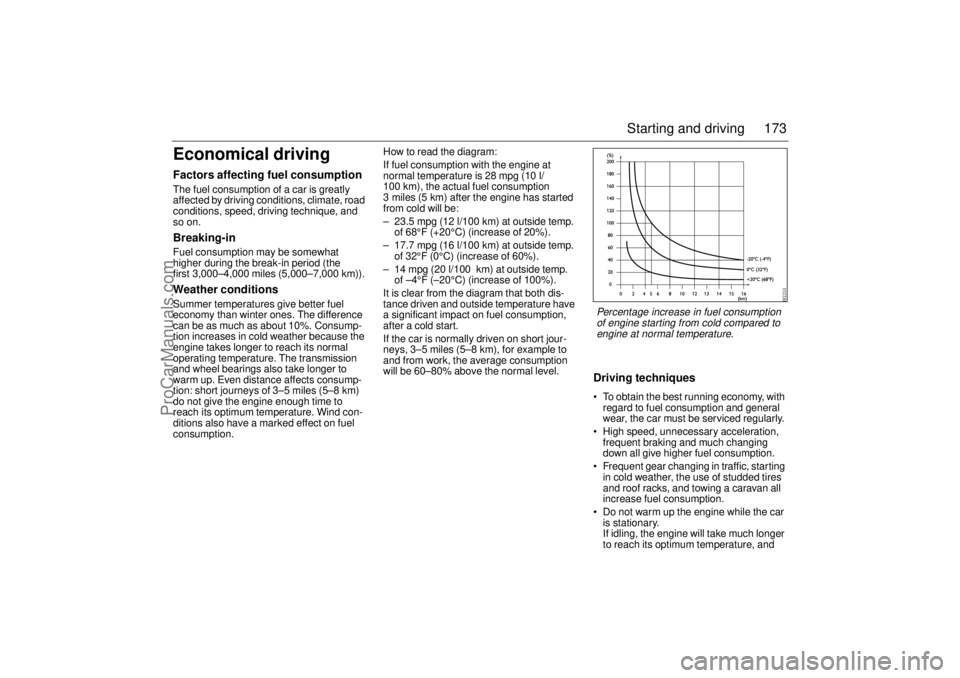
consumption.How to read the diagram:
If fuel consumption with the engine at
normal temperature is 28 mpg (10 l/
100 km), the actual fuel consumption
3 miles (5 km) after the engine has started
from cold will be:
– 23.5 mpg (12 l/100 km) at outside temp.
of 68°F (+20°C) (increase of 20%).
– 17.7 mpg (16 l/100 km) at outside temp.
of 32°F (0°C) (increase of 60%).
– 14 mpg (20 l/100 km) at outside temp.
of –4°F (–20°C) (increase of 100%).
It is clear from the diagram that both dis-
tance driven and outside temperature have
a significant impact on fuel consumption,
after a cold start.
If the car is normally driven on short jour-
neys, 3–5 miles (5–8 km), for example to
and from work, the average consumption
will be 60–80% above the normal level.
Driving techniques To obtain the best running economy, with
regard to fuel consumption and general
wear, the car must be serviced regularly.
High speed, unnecessary acceleration,
frequent braking and much changing
down all give higher fuel consumption.
Frequent gear changing in traffic, starting
in cold weather, the use of studded tires
and roof racks, and towing a caravan all
increase fuel consumption.
Do not warm up the engine while the car
is stationary.
If idling, the engine will take much longer
to reach its optimum temperature, and Percentage increase in fuel consumption
of engine starting from cold compared to
engine at normal temperature.
ProCarManuals.com
Page 189 of 288
189 Starting and driving
5 Check that the jumper cables do not
have loose or missing insulation. If they
do, you could get a shock and also the
vehicles could be damaged.
Before you connect the cables, here are
some basic things you should know.
Positive (+) will go to positive (+) and
negative (–) will go to negative (–). Do
not connect (+) to (–) or you will get a
short that could injure you or would
damage the battery and maybe other
parts as well.
6 Connect the red positive (+) cable to the
positive (+) terminal of the vehicle with
the discharged battery.7 Do not let the other end touch metal.
Connect it to the positive (+) terminal of
the good battery. Use a remote positive
(+) terminal if the vehicle has one.
8 Now connect the negative (–) cable to
the good battery’s negative terminal.
9 Attach the cable to the discharged
battery’s negative terminal.
10 Start the vehicle with the good battery
and run the engine for a while.
11 Try to start the vehicle with the
discharged battery. If it does not start
after a few tries, it probably needs
service.
12 Remove the cables in reverse order to
prevent electrical shorting. Take care
that they do not touch each other or any
other metal.
Using a battery charger/starter unitTo avoid damaging the car’s electrical
system and electronics, the following rules
must be followed when charging the battery
or jump starting the car.
If the charger or starter unit can be set to
different voltages (6V/12V/18V/24V), 12V
must be selected.
Follow the manufacturer’s instructions
supplied with the charger or starter unit.
No other apparatus that are grounded or
connected to the mains must be con-
nected to the car during charging or jump
starting.
The charger or starter unit must under no
conditions produce a voltage greater
than:
16V continuous
18V for 60 min.
If you are unsure about the charge rating of
the unit, disconnect the battery clamp from
the positive terminal before connecting the
unit to the battery.
WARNING
Using a match or flame of any kind near a
battery can cause battery gas to explode.
You can suffer burns or be blinded. Use a
flashlight if you need more light.
Be sure the electrolyte in the battery is not
frozen. Discharged batteries will freeze.
When connecting jumper cables to a
frozen battery, gas from the chemical
reaction inside the battery can build up
under the ice and cause an explosion.
Battery fluid contains acid that can burn
you. Do not get it on you. If you acciden-
tally get it in your eyes or on your skin,
flush the area with water and get medical
help immediately.
ProCarManuals.com
Page 193 of 288
193 Car care
EngineThe engine is a transverse four-cylinder in-
line engine with twin overhead camshafts
and 16 valves.
The engine is equipped with two balance-
shafts that reduce engine vibrations to a
minimum.
The balance shafts are chain-driven and
rotate at twice the speed of the crankshaft.
They produce forces and torques that are
opposed to those generated by the pistons
and connecting rods. The effect occurs
twice in each revolution of the engine, coun-
teracting the vibration from its moving parts,
and at the same time reducing unwanted
engine noise.
The gearbox, located on the right (viewed
from the front), is integrated with the engine.
Engine familiesSaab cars imported into the United States
and Canada meet all applicable emission
control standards. The engine family and
appropriate tune-up specifications are iden-
tified on a label affixed to the left front inner
fender.
These engine families meet applicable EPA
Federal Standards, California State Stan-
dards and Canadian Federal Standards and
are equipped with the following systems:
• sequential multiport fuel injection system
three way catalytic converter
crankcase emissions control system
evaporative emission system.
Emission control
systemsThe systems for controlling emissions to the
atmosphere require regular checking and
adjustment at the intervals specified in the
service program.
In addition to meeting the exhaust emission
regulations and thereby helping to keep the
environment clean, a correctly tuned engine
will also give maximum fuel economy.
WARNING
Engine exhaust, some of its constituents,
and certain vehicle components contain
or emit chemicals known to the State of
California to cause cancer and birth
defects and reproductive harm. In addi-
tion, certain fluids contained in vehicles
and certain products of component wear
contain or emit chemicals known to the
State of California to cause cancer and
birth defects or other reproductive harm.
ProCarManuals.com
Page 196 of 288
196 Car careEngine oilChecking the oil levelCheck the engine oil level regularly.
1 Park the car on a level ground.
2 Switch off the engine and wait for
2–5 minutes. The engine should be at
normal operating temperature.
3 Take the dipstick out and wipe it off with
a clean rag before carrying out the
check.
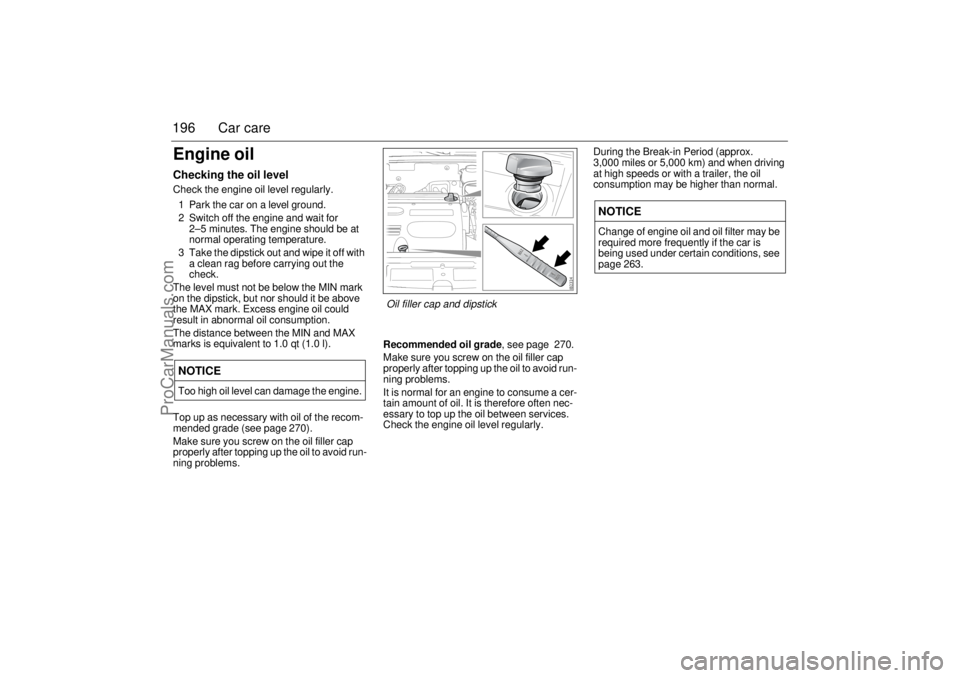
The level must not be below the MIN mark
on the dipstick, but nor should it be above
the MAX mark. Excess engine oil could
result in abnormal oil consumption.
The distance between the MIN and MAX
marks is equivalent to 1.0 qt (1.0 l).
Top up as necessary with oil of the recom-
mended grade (see page 270).
Make sure you screw on the oil filler cap
properly after topping up the oil to avoid run-
ning problems.Recommended oil grade, see page 270.
Make sure you screw on the oil filler cap
properly after topping up the oil to avoid run-
ning problems.
It is normal for an engine to consume a cer-
tain amount of oil. It is therefore often nec-
essary to top up the oil between services.
Check the engine oil level regularly.During the Break-in Period (approx.
3,000 miles or 5,000 km) and when driving
at high speeds or with a trailer, the oil
consumption may be higher than normal.NOTICEToo high oil level can damage the engine.
NOTICEChange of engine oil and oil filter may be
required more frequently if the car is
being used under certain conditions, see
page 263.
Oil filler cap and dipstick
ProCarManuals.com