belt SAAB 9-3 2004 Owner's Manual
[x] Cancel search | Manufacturer: SAAB, Model Year: 2004, Model line: 9-3, Model: SAAB 9-3 2004Pages: 288, PDF Size: 23.54 MB
Page 32 of 288
32 Safety
Front passenger seatThe system is the same as that used on the
driver’s side.
The airbag systems are interconnected and
have a common warning light . The pas-
senger airbag module is housed in the
fascia above the glove compartment and is
marked "AIRBAG".
Both airbags will be inflated in the event of a
moderate to severe frontal, or near-frontal
crash, even if the passenger seat is unoccu-
pied.
The car is equipped as standard with
a passenger airbag.
WARNING
Never secure a rear-facing child seat in
the right front seat of a car equipped with
a passenger airbag. Inflation of the airbag
in the event of a crash could seriously
injure or kill a child.
WARNING
DEATH or SERIOUS
INJURY can occur
Children 12 and under or
shorter than 55 inches
(140 cm) can be killed by the
airbag
The BACK SEAT is the SAFEST place
for children
NEVER put a rear-facing child seat in
the front
Sit as far back as possible from the
airbag
ALWAYS use SAFETY BELTS and
CHILD RESTRAINTS
Never allow a child to stand in front of
the seat or to sit on the lap of a front
seat passenger. Serious injury or
death could result if the airbag is
inflated in a crash.
The glove compartment must be
closed while travelling. An open glove
compartment door could cause leg
injuries in the event of a crash.
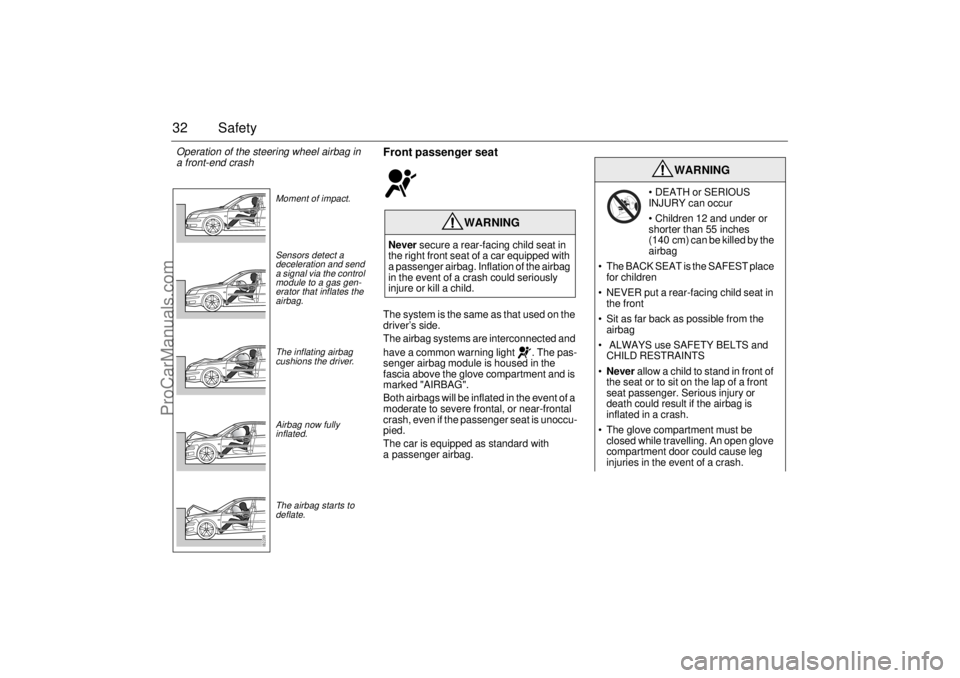
Operation of the steering wheel airbag in
a front-end crash
Moment of impact.
Sensors detect a
deceleration and send
a signal via the control
module to a gas gen-
erator that inflates the
airbag.
The inflating airbag
cushions the driver.
Airbag now fully
inflated.
The airbag starts to
deflate.
ProCarManuals.com
Page 33 of 288
33 Safety
Head protectionThe pillar trim and headlining (not Converti-
ble soft top) are designed to absorb energy,
softening possible blows to the head. After
a crash, these items must be changed in the
seat positions that were occupied. Never fit
accessories to the pillar trim or headlining
as these could reduce the effectiveness of
the head protection and inflatable curtain
(Sport Sedan).
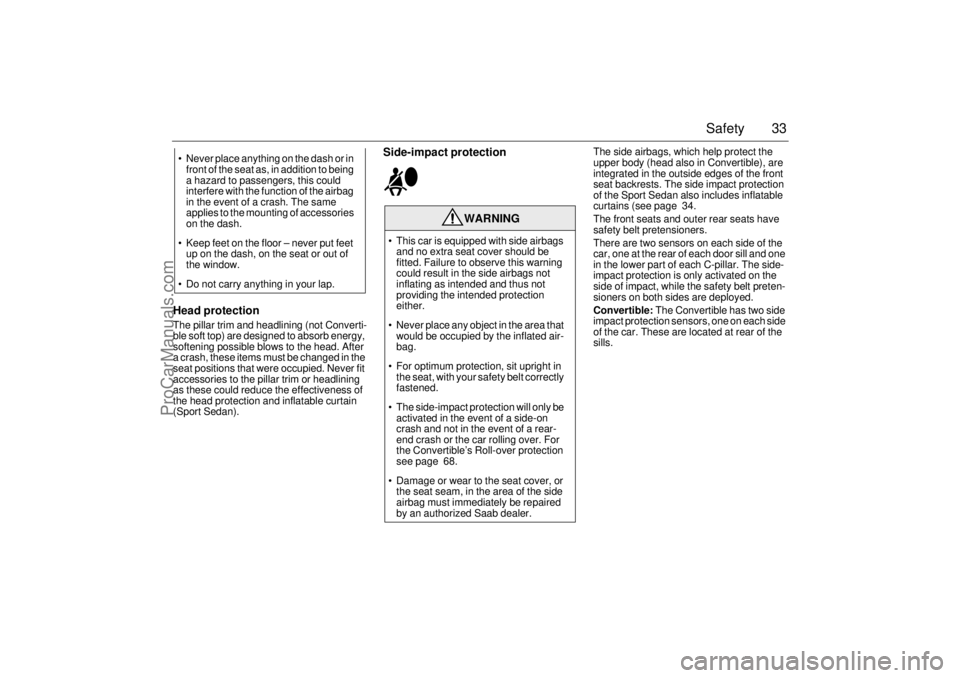
Side-impact protection
The side airbags, which help protect the
upper body (head also in Convertible), are
integrated in the outside edges of the front
seat backrests. The side impact protection
of the Sport Sedan also includes inflatable
curtains (see page 34.
The front seats and outer rear seats have
safety belt pretensioners.
There are two sensors on each side of the
car, one at the rear of each door sill and one
in the lower part of each C-pillar. The side-
impact protection is only activated on the
side of impact, while the safety belt preten-
sioners on both sides are deployed.
Convertible: The Convertible has two side
impact protection sensors, one on each side
of the car. These are located at rear of the
sills. Never place anything on the dash or in
front of the seat as, in addition to being
a hazard to passengers, this could
interfere with the function of the airbag
in the event of a crash. The same
applies to the mounting of accessories
on the dash.
Keep feet on the floor – never put feet
up on the dash, on the seat or out of
the window.
Do not carry anything in your lap.
WARNING
This car is equipped with side airbags
and no extra seat cover should be
fitted. Failure to observe this warning
could result in the side airbags not
inflating as intended and thus not
providing the intended protection
either.
Never place any object in the area that
would be occupied by the inflated air-
bag.
For optimum protection, sit upright in
the seat, with your safety belt correctly
fastened.
The side-impact protection will only be
activated in the event of a side-on
crash and not in the event of a rear-
end crash or the car rolling over. For
the Convertible’s Roll-over protection
see page 68.
Damage or wear to the seat cover, or
the seat seam, in the area of the side
airbag must immediately be repaired
by an authorized Saab dealer.
ProCarManuals.com
Page 36 of 288
36 SafetyAirbag warning lamp Servicing the airbag system
The airbag system must be inspected as
part of the normal service program but oth-
erwise may be regarded as maintenance-
free.
Scrapping or working on airbag and
belt pretensioners
WARNING
If the airbag readiness light stays on
after you start your vehicle, it means
the airbag system may not be working
properly. See page 77.
The airbags in your vehicle may not
inflate in a crash, or they could even
inflate without a crash.
To help avoid injury to yourself or
others, have your vehicle serviced
right away if the airbag readiness light
stays on after you start your vehicle.
WARNING
Under no circumstances should any
modifications be made that affect the
steering wheel or the airbag’s electri-
cal circuitry.
During any welding, both battery
cables must be disconnected and
covered.
Before quick drying paint in the vicinity
of the electronic control module, the
module’s grounding points and wiring
must be covered.
Airbags and safety belt pretensioners
must be deployed under controlled
conditions before the car is scrapped
or any of the system’s components are
removed. Airbags or belt pretension-
ers that have been deployed as a
result of a crash must be replaced by
new ones.
Airbag-system components must
never be transferred for use in another
vehicle.
All work involving the scrapping or
replacement of airbags or belt preten-
sioners must be carried out by autho-
rized personnel only.
ProCarManuals.com
Page 37 of 288

37 Safety
Frequently asked questions on
function of the airbagDo you still need to wear a safety belt if air-
bags are fitted?Yes, always! The airbag system compo-
nents merely supplement the car’s normal
safety system. Moreover, the front airbags
will only be actuated in a moderate to severe
frontal, or near-frontal crash, which means,
of course, that they provide no protection in
minor frontal crashes, major rear- or side-
crashes or if the car rolls over.
The safety belts help to reduce the sideway
movement of the body in a crash.
But they also ensure that, if a crash occurs
in which the airbags are inflated, the airbag
will make the optimum contact with the
occupant, i.e. square on from the front. If the
occupant meets the airbag in an offset posi-
tion, the protection afforded will be reduced.In addition, airbags provide no protection
against a secondary impact occurring in the
same incident. So there is no doubt about
the benefit of wearing safety belts at all
times.
Do not sit too close to the airbag: it needs
room to inflate.
The airbag inflates very quickly and power-
fully in order to protect an adult, before they
are thrown forward, in a serious frontal
crash.
How do I position the seat to leave room for
the airbag to inflate?Don’t have your seat too far forward.
Recline the seat back to increase the dis-
tance between you and the airbag. For short
drivers, special accessory pedal extensions
are available through your Saab dealer.
Airbags inflate extremely rapidly and with
great force – to be fast enough to protect an
adult in the seat.
When do the airbags in the steering wheel
and passenger side of the dash board
inflate? The airbag will only be inflated under certain
predetermined conditions in a moderate to
severe frontal, or near-frontal crash,
depending on such factors as the force and
angle of the impact, the speed of the car on
impact, and the resistance to deformation of
the impacting object.
The airbag can only be activated once in the
same incident.
Do not attempt to drive the car after an
airbag has been inflated, even if it is possi-
ble.What won’t trigger the airbag? The airbag will not be activated in all frontal
crashes. For instance, if the car has hit
something relatively soft and yielding (e.g. a
snow drift or a hedge) or a solid object at a
low impact speed, the airbag will not neces-
sarily be triggered.
ProCarManuals.com
Page 38 of 288

38 SafetyHow loud is the inflation? The noise of the inflation is certainly loud,
but it is of an very short duration and will not
damage your hearing. For a short time after-
wards you could experience a buzzing
noise in your ears.
Most people who have experienced it
cannot remember the noise of the inflation
at all – all they remember is the noise of the
crash. Can you still use a child seat in the front if a
passenger airbag is installed? Definitely not!
Children 12 and under or shorter than
55 inches (140 cm) can be killed by the air-
bag.
The back seat is the safest place for chil-
dren.
Never put a rear-facing child seat in the
front.
Sit as far back as possible from the air bag.
Always use seat belts and child restraints.
What should I do if the AIR-BAG warning
light comes on? If the warning light is on, it means that a fault
has been detected in the system. The
airbag cannot be relied on to operate as
intended and it might even be activated
erroneously. You should therefore take the
car to an authorized Saab dealer as soon as
possible.
Are the dust and fumes given off when the
airbag operates at all harmful? Most people who have remained in a car
with little or no ventilation for several min-
utes complained only of minor irritation of
the throat and eyes. Avoid as much as pos-
sible getting dust on your skin as there is a
risk of skin irritation.
If you suffer from asthma, the incident may
bring on an attack, in which case you should
follow the normal procedure advised by
your doctor. It is advisable to consult a
doctor afterwards.
ProCarManuals.com
Page 53 of 288
53 9-3 Convertible
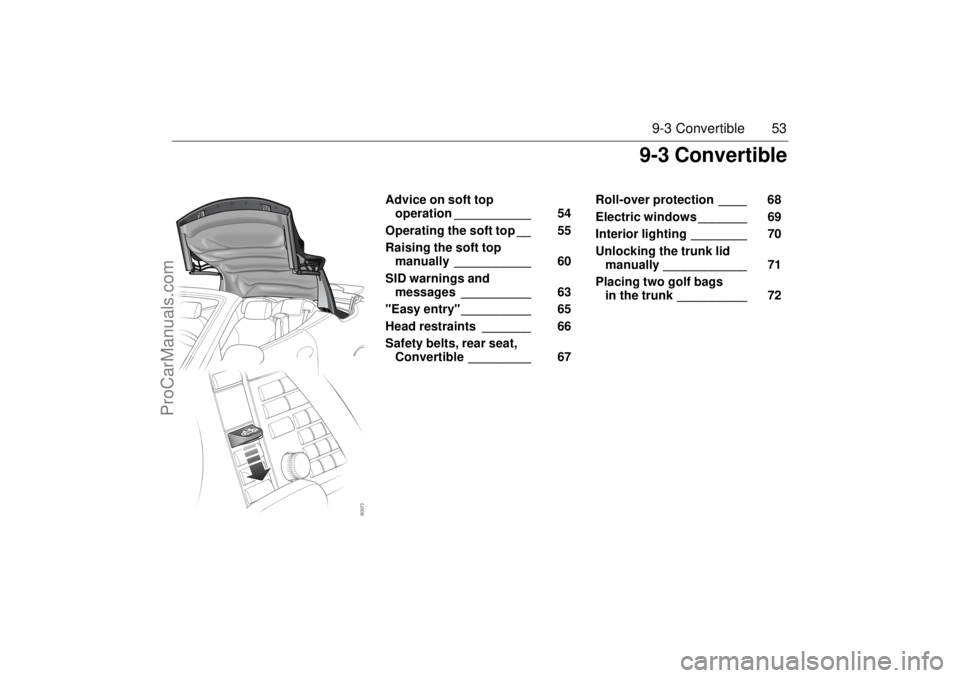
Advice on soft top
operation ___________ 54
Operating the soft top __ 55
Raising the soft top
manually ___________ 60
SID warnings and
messages __________ 63
"Easy entry" __________ 65
Head restraints _______ 66
Safety belts, rear seat,
Convertible _________ 67 Roll-over protection ____ 68
Electric windows _______ 69
Interior lighting ________ 70
Unlocking the trunk lid
manually ____________ 71
Placing two golf bags
in the trunk __________ 72
9-3 Convertible
ProCarManuals.com
Page 65 of 288
65 9-3 Convertible
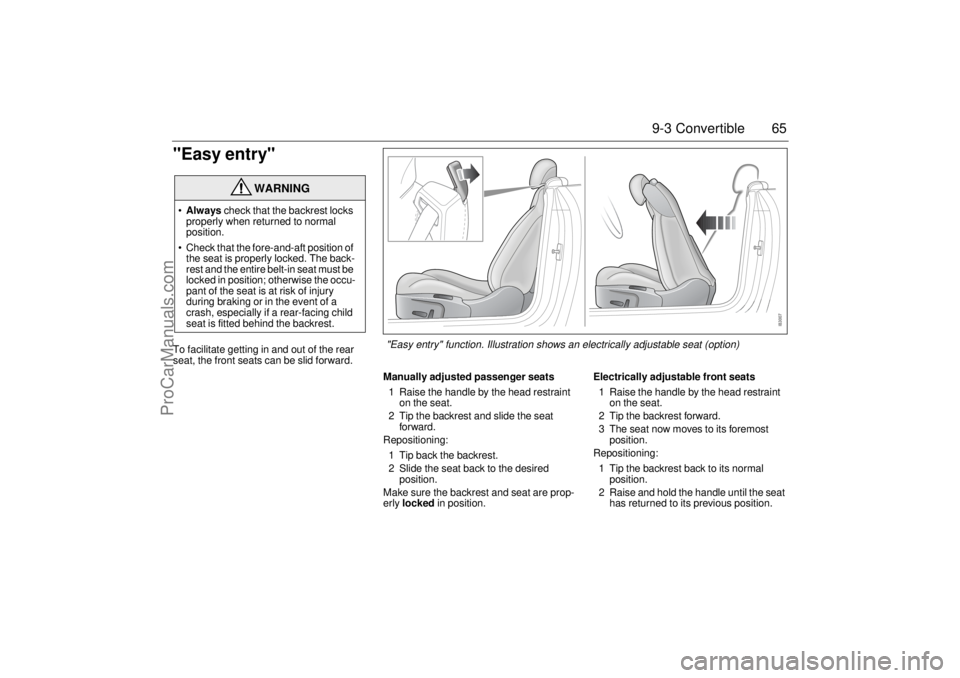
"Easy entry"To facilitate getting in and out of the rear
seat, the front seats can be slid forward.
Manually adjusted passenger seats
1 Raise the handle by the head restraint
on the seat.
2 Tip the backrest and slide the seat
forward.
Repositioning:
1 Tip back the backrest.
2 Slide the seat back to the desired
position.
Make sure the backrest and seat are prop-
erly locked in position.Electrically adjustable front seats
1 Raise the handle by the head restraint
on the seat.
2 Tip the backrest forward.
3 The seat now moves to its foremost
position.
Repositioning:
1 Tip the backrest back to its normal
position.
2 Raise and hold the handle until the seat
has returned to its previous position.
WARNING
Always check that the backrest locks
properly when returned to normal
position.
Check that the fore-and-aft position of
the seat is properly locked. The back-
rest and the entire belt-in seat must be
locked in position; otherwise the occu-
pant of the seat is at risk of injury
during braking or in the event of a
crash, especially if a rear-facing child
seat is fitted behind the backrest.
"Easy entry" function. Illustration shows an electrically adjustable seat (option)
ProCarManuals.com
Page 67 of 288
67 9-3 Convertible
Safety belts, rear seat,
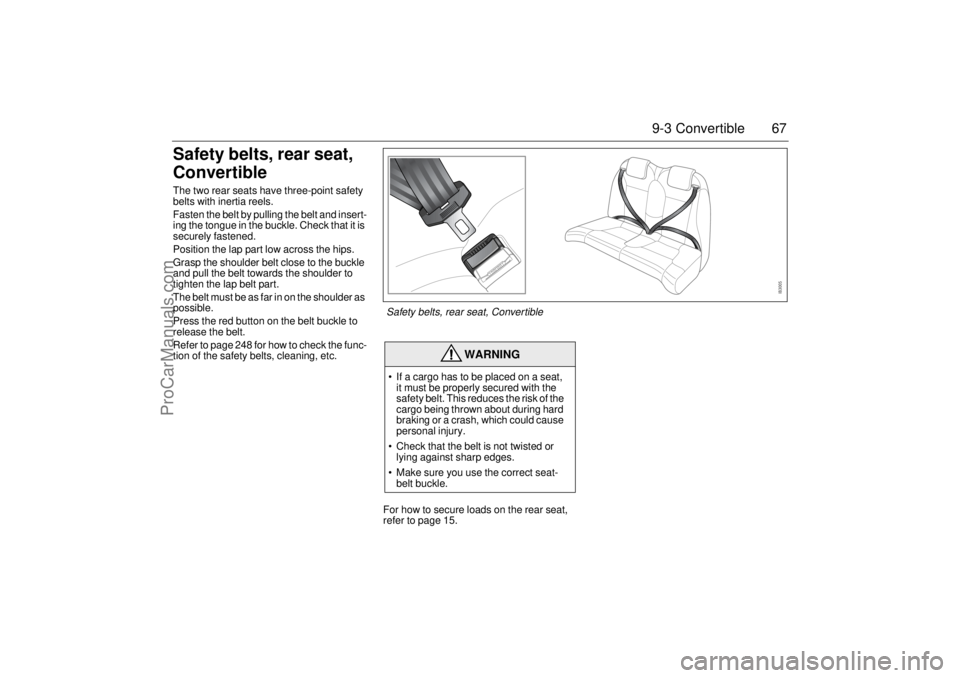
ConvertibleThe two rear seats have three-point safety
belts with inertia reels.
Fasten the belt by pulling the belt and insert-
ing the tongue in the buckle. Check that it is
securely fastened.
Position the lap part low across the hips.
Grasp the shoulder belt close to the buckle
and pull the belt towards the shoulder to
tighten the lap belt part.
The belt must be as far in on the shoulder as
possible.
Press the red button on the belt buckle to
release the belt.
Refer to page 248 for how to check the func-
tion of the safety belts, cleaning, etc.
For how to secure loads on the rear seat,
refer to page 15.
WARNING
If a cargo has to be placed on a seat,
it must be properly secured with the
safety belt. This reduces the risk of the
cargo being thrown about during hard
braking or a crash, which could cause
personal injury.
Check that the belt is not twisted or
lying against sharp edges.
Make sure you use the correct seat-
belt buckle.Safety belts, rear seat, Convertible
ProCarManuals.com
Page 68 of 288
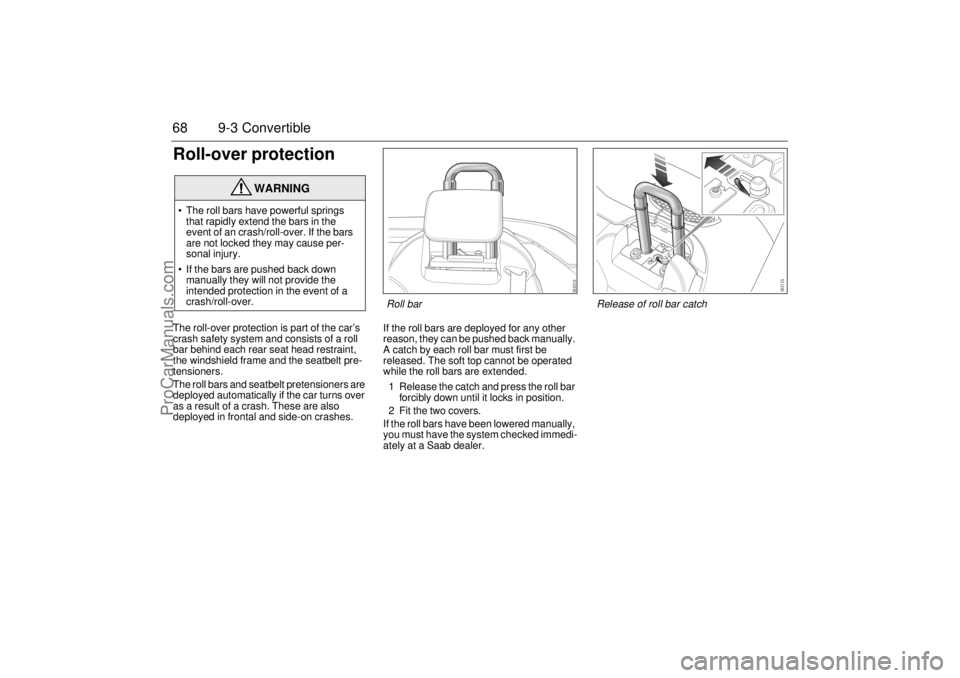
68 9-3 ConvertibleRoll-over protectionThe roll-over protection is part of the car’s
crash safety system and consists of a roll
bar behind each rear seat head restraint,
the windshield frame and the seatbelt pre-
tensioners.
The roll bars and seatbelt pretensioners are
deployed automatically if the car turns over
as a result of a crash. These are also
deployed in frontal and side-on crashes.If the roll bars are deployed for any other
reason, they can be pushed back manually.
A catch by each roll bar must first be
released. The soft top cannot be operated
while the roll bars are extended.
1 Release the catch and press the roll bar
forcibly down until it locks in position.
2 Fit the two covers.
If the roll bars have been lowered manually,
you must have the system checked immedi-
ately at a Saab dealer.
WARNING
The roll bars have powerful springs
that rapidly extend the bars in the
event of an crash/roll-over. If the bars
are not locked they may cause per-
sonal injury.
If the bars are pushed back down
manually they will not provide the
intended protection in the event of a
crash/roll-over.
Roll bar
Release of roll bar catch
ProCarManuals.com
Page 77 of 288
77 Instruments and controls
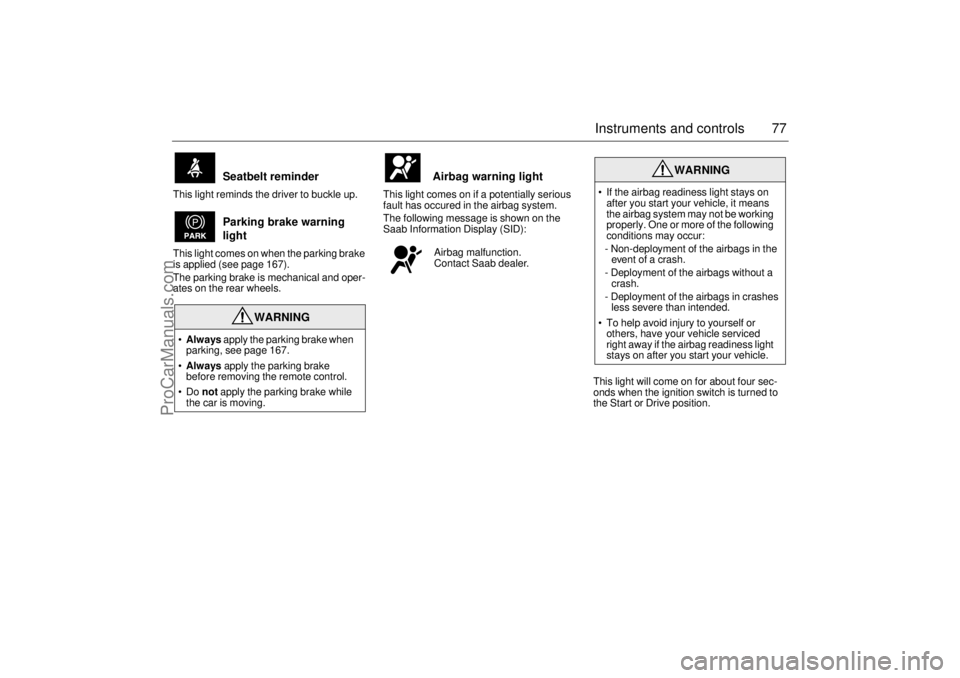
This light reminds the driver to buckle up.
This light comes on when the parking brake
is applied (see page 167).
The parking brake is mechanical and oper-
ates on the rear wheels.This light comes on if a potentially serious
fault has occured in the airbag system.
The following message is shown on the
Saab Information Display (SID):
This light will come on for about four sec-
onds when the ignition switch is turned to
the Start or Drive position.
Seatbelt reminder
Parking brake warning
light
WARNING
Always apply the parking brake when
parking, see page 167.
Always apply the parking brake
before removing the remote control.
Do not apply the parking brake while
the car is moving.
Airbag warning lightAirbag malfunction.
Contact Saab dealer.
WARNING
If the airbag readiness light stays on
after you start your vehicle, it means
the airbag system may not be working
properly. One or more of the following
conditions may occur:
- Non-deployment of the airbags in the
event of a crash.
- Deployment of the airbags without a
crash.
- Deployment of the airbags in crashes
less severe than intended.
To help avoid injury to yourself or
others, have your vehicle serviced
right away if the airbag readiness light
stays on after you start your vehicle.
ProCarManuals.com