belt SAAB 9-3 2004 Owner's Guide
[x] Cancel search | Manufacturer: SAAB, Model Year: 2004, Model line: 9-3, Model: SAAB 9-3 2004Pages: 288, PDF Size: 23.54 MB
Page 94 of 288
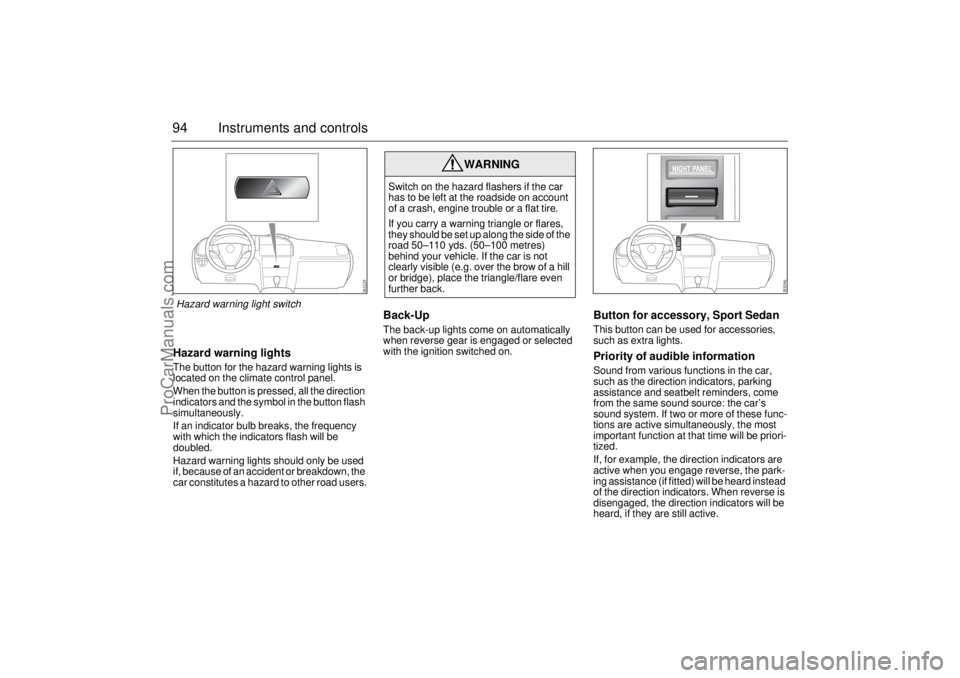
94 Instruments and controlsHazard warning lightsThe button for the hazard warning lights is
located on the climate control panel.
When the button is pressed, all the direction
indicators and the symbol in the button flash
simultaneously.
If an indicator bulb breaks, the frequency
with which the indicators flash will be
doubled.
Hazard warning lights should only be used
if, because of an accident or breakdown, the
car constitutes a hazard to other road users.
Back-Up The back-up lights come on automatically
when reverse gear is engaged or selected
with the ignition switched on.
Button for accessory, Sport SedanThis button can be used for accessories,
such as extra lights.Priority of audible informationSound from various functions in the car,
such as the direction indicators, parking
assistance and seatbelt reminders, come
from the same sound source: the car’s
sound system. If two or more of these func-
tions are active simultaneously, the most
important function at that time will be priori-
tized.
If, for example, the direction indicators are
active when you engage reverse, the park-
ing assistance (if fitted) will be heard instead
of the direction indicators. When reverse is
disengaged, the direction indicators will be
heard, if they are still active.
WARNING
Switch on the hazard flashers if the car
has to be left at the roadside on account
of a crash, engine trouble or a flat tire.
If you carry a warning triangle or flares,
they should be set up along the side of the
road 50–110 yds. (50–100 metres)
behind your vehicle. If the car is not
clearly visible (e.g. over the brow of a hill
or bridge), place the triangle/flare even
further back.
Hazard warning light switch
ProCarManuals.com
Page 134 of 288
134 Interior equipmentTrunkFolding down the rear seat, Sport SedanConvertible: The rear seat can not be folded.
WARNING
Never drive the car if the backrest is not correctly locked into
position as this increases the risk of personal injury in the
event of heavy braking or a crash.
Never leave a child or animal unattended in the car. During
sunny weather the temperature in the passenger and trunk
can climb to 160–180°F (70–80°C). Small children are very
susceptible to heat stroke.
Keep hands well clear of all moving parts.
Never place heavy objects on the parcel shelf. There is always
a danger of loose objects being thrown forward and causing
injury if the car should brake suddenly or be involved in a
crash. See also page 183.
When folding the backrest back upright, make sure that it is
locked correctly on both sides. This is imperative since the
center safety belt is mounted in the backrest.
When folding the backrest back upright, make sure that it is
locked correctly on both sides. This is imperative since other-
wise objects in the trunk could force their way into the cabin
during heavy breaking or a crash.
Adjust the head restraints for the rear seats to be occupied to
a suitable height before riding in the car.
ProCarManuals.com
Page 135 of 288

135 Interior equipment
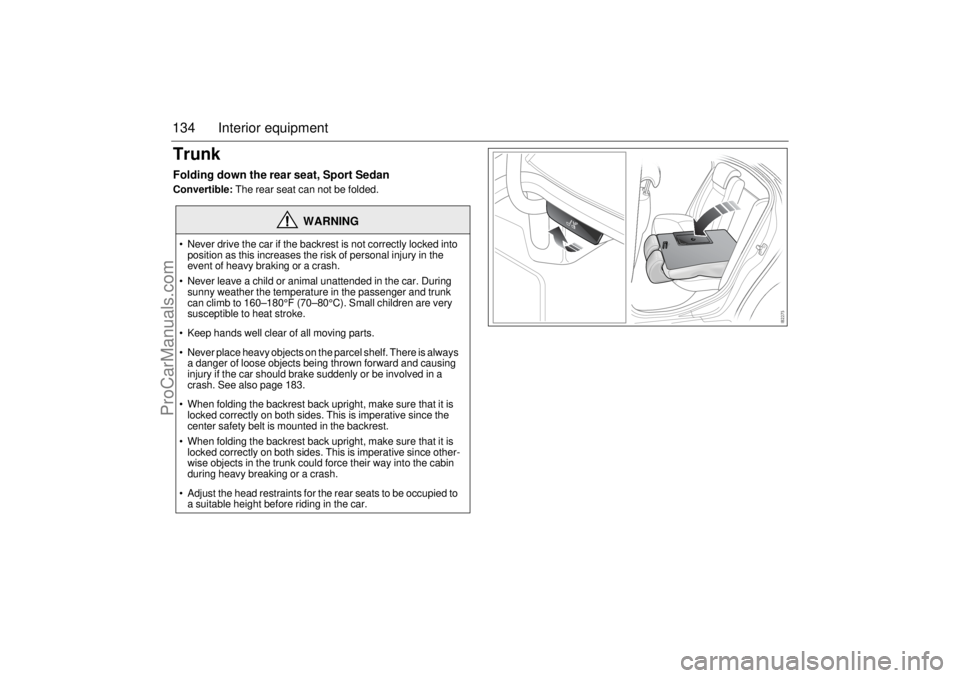
For greater flexibility, the rear seat is split so that the narrow and
the wide part can be folded down separately.
Next to the hinges in the trunk are handles for unlocking the rear seat
backrests.
The operation is easier if the front seats are not too far back and
the rear seat head restraints are fully lowered.
1 Unlock the backrest by pulling the appropriate handle in the
trunk.
2 Fold the backrest forward.
Note: When returning the backrest to its upright position, make
sure that it locks properly in place and that the safety belt does
not get caught.
If the left-hand backrest is not properly locked in position, the follow-
ing message is displayed on the SID (equivalent message displayed
for right-hand backrest):Trunk Release Handle, see page 137.
Emergency opening of the narrow backrest, see page
138.
Rear left seat backrest
unlocked.
ProCarManuals.com
Page 136 of 288
136 Interior equipmentLoad-through hatch, Sport SedanConvertible: There are no load-through hatch.
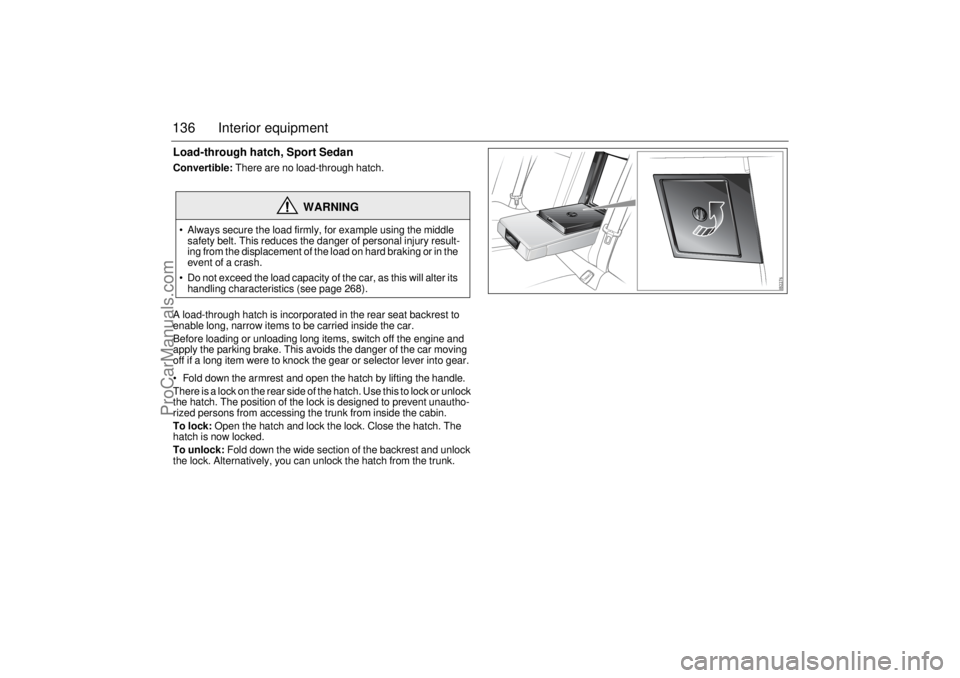
A load-through hatch is incorporated in the rear seat backrest to
enable long, narrow items to be carried inside the car.
Before loading or unloading long items, switch off the engine and
apply the parking brake. This avoids the danger of the car moving
off if a long item were to knock the gear or selector lever into gear.
Fold down the armrest and open the hatch by lifting the handle.
There is a lock on the rear side of the hatch. Use this to lock or unlock
the hatch. The position of the lock is designed to prevent unautho-
rized persons from accessing the trunk from inside the cabin.
To lock: Open the hatch and lock the lock. Close the hatch. The
hatch is now locked.
To unlock: Fold down the wide section of the backrest and unlock
the lock. Alternatively, you can unlock the hatch from the trunk.
WARNING
Always secure the load firmly, for example using the middle
safety belt. This reduces the danger of personal injury result-
ing from the displacement of the load on hard braking or in the
event of a crash.
Do not exceed the load capacity of the car, as this will alter its
handling characteristics (see page 268).
ProCarManuals.com
Page 170 of 288
170 Starting and drivingSaab Parking
AssistanceSaab Parking Assistance
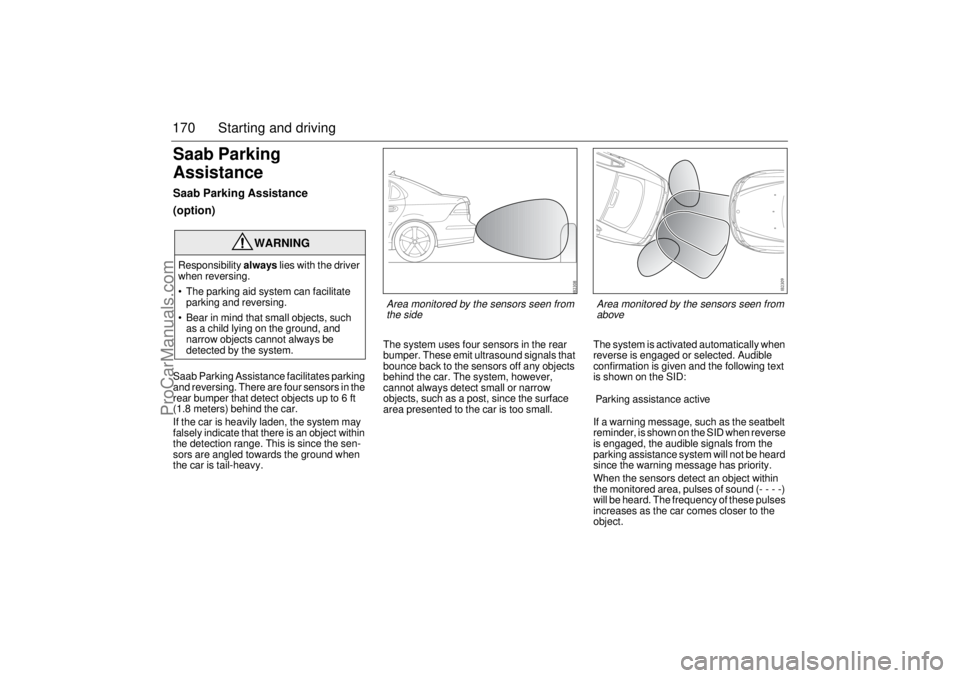
(option)Saab Parking Assistance facilitates parking
and reversing. There are four sensors in the
rear bumper that detect objects up to 6 ft
(1.8 meters) behind the car.
If the car is heavily laden, the system may
falsely indicate that there is an object within
the detection range. This is since the sen-
sors are angled towards the ground when
the car is tail-heavy.The system uses four sensors in the rear
bumper. These emit ultrasound signals that
bounce back to the sensors off any objects
behind the car. The system, however,
cannot always detect small or narrow
objects, such as a post, since the surface
area presented to the car is too small.The system is activated automatically when
reverse is engaged or selected. Audible
confirmation is given and the following text
is shown on the SID:
If a warning message, such as the seatbelt
reminder, is shown on the SID when reverse
is engaged, the audible signals from the
parking assistance system will not be heard
since the warning message has priority.
When the sensors detect an object within
the monitored area, pulses of sound (- - - -)
will be heard. The frequency of these pulses
increases as the car comes closer to the
object.
WARNING
Responsibility always lies with the driver
when reversing.
The parking aid system can facilitate
parking and reversing.
Bear in mind that small objects, such
as a child lying on the ground, and
narrow objects cannot always be
detected by the system.
Parking assistance active
Area monitored by the sensors seen from
the side
Area monitored by the sensors seen from
above
ProCarManuals.com
Page 190 of 288

190 Starting and drivingFor long tripsBefore starting off on a long journey, it is
advisable to have your car inspected by
your Saab dealer.
Obtain a few important items to take along
on your journey, such as spare bulbs, wiper
blades, fuses, a drive belt (poly-V-belt) and
the like.
You can check some points yourself before-
hand:
Check that no oil or fuel leaks out of the
engine or gearbox/transmission.
Check the coolant and power steering
fluid levels. Check also for leaks.
Inspect the drive belt (poly-V-belt) and
replace if it shows any signs of wear.
Check the battery charge.
Check the tires for tread pattern and air
pressure, including the compact spare
tire.
Take an extra remote control and keep it
separate.
Check the brakes.
Check all bulbs.
Check for the presence of the tool kit and
jack in the car.
ProCarManuals.com
Page 191 of 288
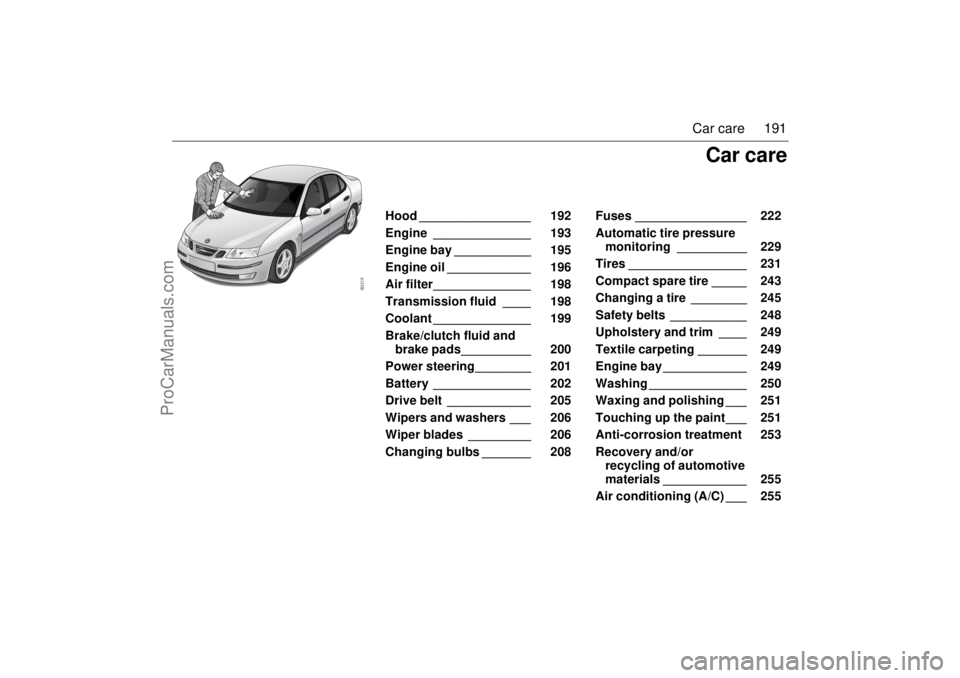
191 Car care
Hood ________________ 192
Engine ______________ 193
Engine bay ___________ 195
Engine oil ____________ 196
Air filter______________ 198
Transmission fluid ____ 198
Coolant ______________ 199
Brake/clutch fluid and
brake pads__________ 200
Power steering________ 201
Battery ______________ 202
Drive belt ____________ 205
Wipers and washers ___ 206
Wiper blades _________ 206
Changing bulbs _______ 208 Fuses ________________ 222
Automatic tire pressure
monitoring __________ 229
Tires _________________ 231
Compact spare tire _____ 243
Changing a tire ________ 245
Safety belts ___________ 248
Upholstery and trim ____ 249
Textile carpeting _______ 249
Engine bay ____________ 249
Washing ______________ 250
Waxing and polishing ___ 251
Touching up the paint___ 251
Anti-corrosion treatment 253
Recovery and/or
recycling of automotive
materials ____________ 255
Air conditioning (A/C) ___ 255
Car care
ProCarManuals.com
Page 202 of 288
202 Car careBattery
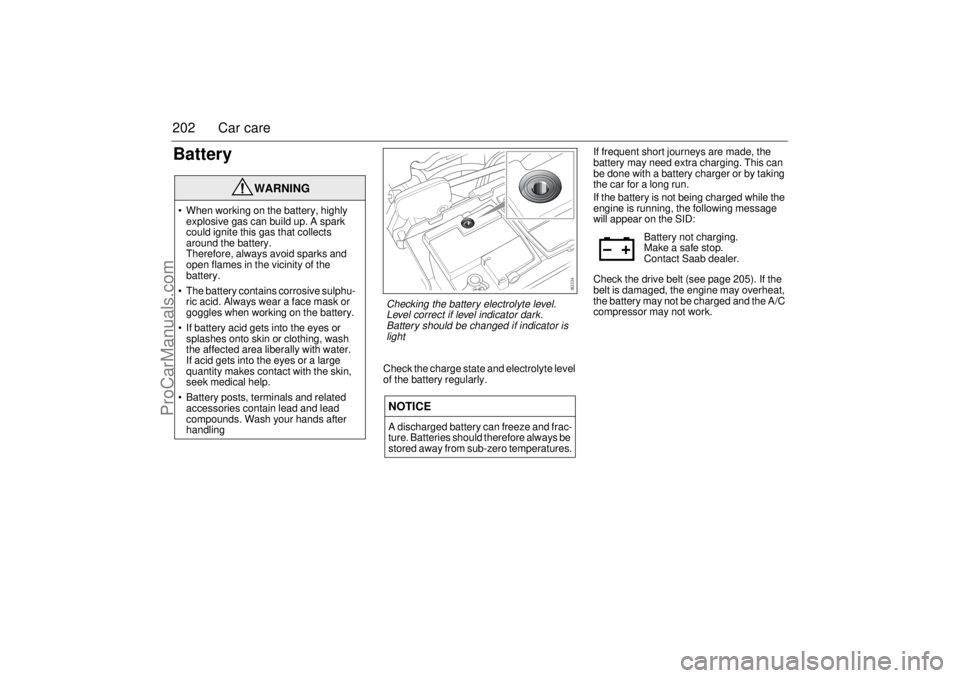
Check the charge state and electrolyte level
of the battery regularly.If frequent short journeys are made, the
battery may need extra charging. This can
be done with a battery charger or by taking
the car for a long run.
If the battery is not being charged while the
engine is running, the following message
will appear on the SID:
Check the drive belt (see page 205). If the
belt is damaged, the engine may overheat,
the battery may not be charged and the A/C
compressor may not work.
WARNING
When working on the battery, highly
explosive gas can build up. A spark
could ignite this gas that collects
around the battery.
Therefore, always avoid sparks and
open flames in the vicinity of the
battery.
The battery contains corrosive sulphu-
ric acid. Always wear a face mask or
goggles when working on the battery.
If battery acid gets into the eyes or
splashes onto skin or clothing, wash
the affected area liberally with water.
If acid gets into the eyes or a large
quantity makes contact with the skin,
seek medical help.
Battery posts, terminals and related
accessories contain lead and lead
compounds. Wash your hands after
handling
NOTICEA discharged battery can freeze and frac-
ture. Batteries should therefore always be
stored away from sub-zero temperatures.
Battery not charging.
Make a safe stop.
Contact Saab dealer.
Checking the battery electrolyte level.
Level correct if level indicator dark.
Battery should be changed if indicator is
light
ProCarManuals.com
Page 204 of 288
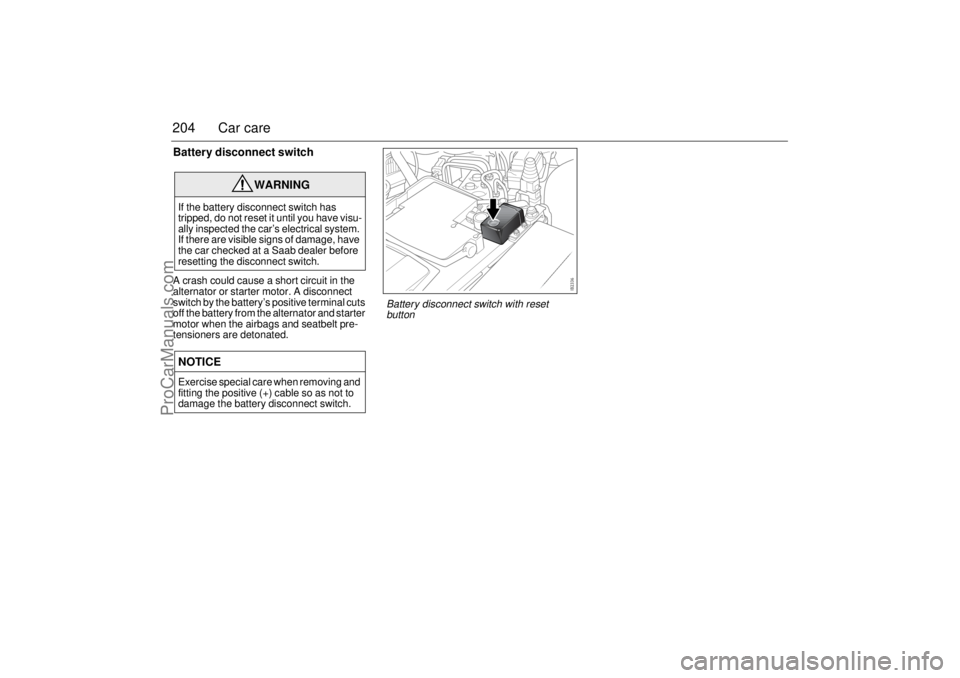
204 Car careBattery disconnect switchA crash could cause a short circuit in the
alternator or starter motor. A disconnect
switch by the battery’s positive terminal cuts
off the battery from the alternator and starter
motor when the airbags and seatbelt pre-
tensioners are detonated.
WARNING
If the battery disconnect switch has
tripped, do not reset it until you have visu-
ally inspected the car’s electrical system.
If there are visible signs of damage, have
the car checked at a Saab dealer before
resetting the disconnect switch.NOTICEExercise special care when removing and
fitting the positive (+) cable so as not to
damage the battery disconnect switch.
Battery disconnect switch with reset
button
ProCarManuals.com
Page 205 of 288
205 Car care
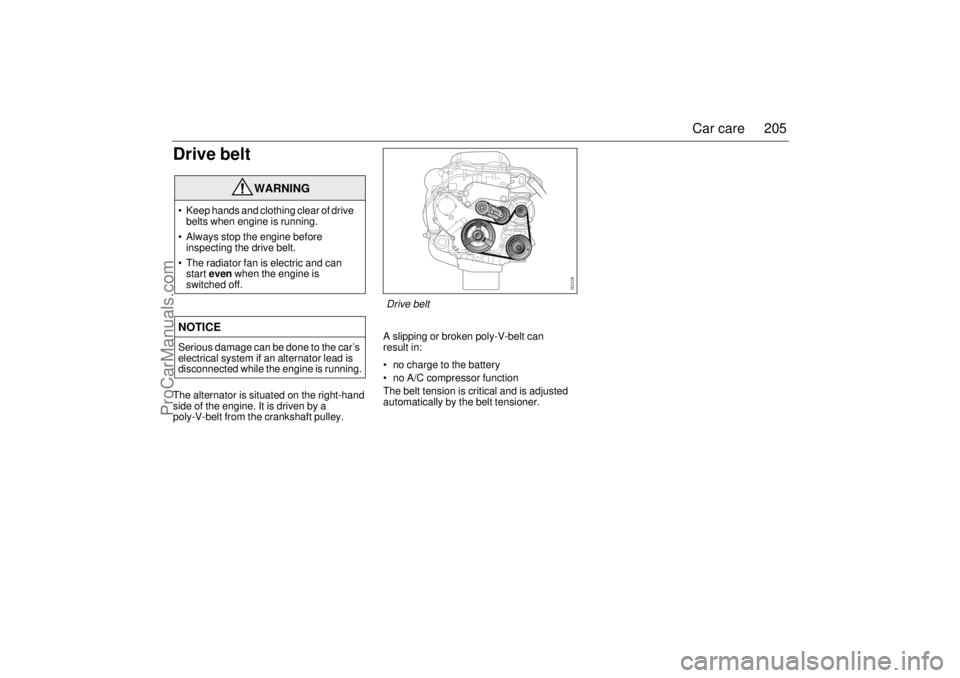
Drive beltThe alternator is situated on the right-hand
side of the engine. It is driven by a
poly-V-belt from the crankshaft pulley.A slipping or broken poly-V-belt can
result in:
no charge to the battery
no A/C compressor function
The belt tension is critical and is adjusted
automatically by the belt tensioner.
WARNING
Keep hands and clothing clear of drive
belts when engine is running.
Always stop the engine before
inspecting the drive belt.
The radiator fan is electric and can
start even when the engine is
switched off.NOTICESerious damage can be done to the car’s
electrical system if an alternator lead is
disconnected while the engine is running.
Drive belt
ProCarManuals.com