fuel SAAB 9-3 2004 Owner's Manual
[x] Cancel search | Manufacturer: SAAB, Model Year: 2004, Model line: 9-3, Model: SAAB 9-3 2004Pages: 288, PDF Size: 23.54 MB
Page 155 of 288

155 Starting and driving
Lock-upThe transmission’s torque converter has a
lock-up function. This can lock the torque
converter in 3rd, 4th and 5th gears, thus
reducing the engine speed and fuel con-
sumption.Kick-downWhen the accelerator is pressed down fully,
a down change is made to optimize acceler-
ation, e.g. for overtaking.
Following this, the next higher gear will be
selected at the optimum engine speed,
unless you ease off the accelerator before
reaching this. Kick-down works in manual
mode in 4th and 5th gears if the engine
speed is lower than 2,000 rpm.
Driving in hilly country with a heavy
loadThe transmission fluid can overheat when
the gearbox is strained, for example, when
driving with a trailer on hilly roads. To avoid
the transmission fluid overheating, always
drive with the selector lever in the D posi-
tion. The adaptive gear change patterns are
then active.
High air temperatures or a faulty oil cooler
can also cause the transmission fluid to
overheat. Overheating reduces the service
life of the fluid.TowingTowing of cars with automatic transmission,
see page 184.
Descending hillsIf the speed of the car increases while
descending a steep hill, despite the acceler-
ator being released, the control module will
change down to 4th gear. If you desire more
powerful engine braking, manually select a
lower gear (see page 158).
WARNING
Remember to use the braking effect of the
engine (1st, 2nd or 3rd gear) when you
are descending long or steep hills to
spare the brakes.
Overheating can cause the brakes to
fade!
ProCarManuals.com
Page 169 of 288

169 Starting and driving
Long-term parkingIf the car is not going to be used for some
time, e.g. three to four months, the following
steps are recommended:
Drain the washer fluid reservoir and
hoses.
Wash and wax the car. Clean the rubber
seals on the hood, trunk lid and doors,
and lubricate them with glycerol
(glycerine).
After washing the car, dry the brake discs
to avoid corrosion by taking the car out on
the road and applying the brakes a few
times.
Fill the fuel tank to prevent condensation
forming in it.
Top up the coolant and check the anti-
freeze before the onset of winter. Park the car in a dry, covered and well-
ventilated building. Leave the parking
brake OFF!
Convertible: If the car is stored, the soft
top should be closed.
If necessary, use wheel chocks and leave
the parking brake off.
Disconnect the negative (–) battery lead.
If frost is likely to occur during the storage
period, remove the battery and store it in
a frost-free place.
If it is not possible to stand the car on axle
stands, increase the tire pressure to
43 psi (3 bar).
Leave all the door windows open a crack
and cover the car with a non-plastic
tarpaulin – not one made of plastic which will
not breath.
ProCarManuals.com
Page 173 of 288
173 Starting and driving
Economical drivingFactors affecting fuel consumptionThe fuel consumption of a car is greatly
affected by driving conditions, climate, road
conditions, speed, driving technique, and
so on.Breaking-inFuel consumption may be somewhat
higher during the break-in period (the
first 3,000–4,000 miles (5,000–7,000 km)).Weather conditionsSummer temperatures give better fuel
economy than winter ones. The difference
can be as much as about 10%. Consump-
tion increases in cold weather because the
engine takes longer to reach its normal
operating temperature. The transmission
and wheel bearings also take longer to
warm up. Even distance affects consump-
tion: short journeys of 3–5 miles (5–8 km)
do not give the engine enough time to
reach its optimum temperature. Wind con-
ditions also have a marked effect on fuel
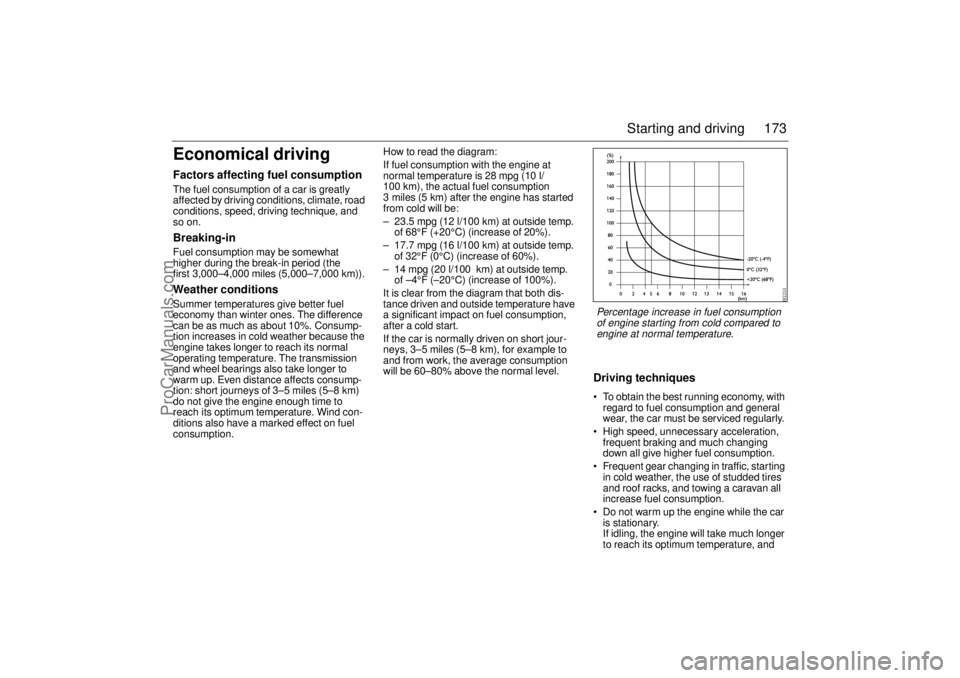
consumption.How to read the diagram:
If fuel consumption with the engine at
normal temperature is 28 mpg (10 l/
100 km), the actual fuel consumption
3 miles (5 km) after the engine has started
from cold will be:
– 23.5 mpg (12 l/100 km) at outside temp.
of 68°F (+20°C) (increase of 20%).
– 17.7 mpg (16 l/100 km) at outside temp.
of 32°F (0°C) (increase of 60%).
– 14 mpg (20 l/100 km) at outside temp.
of –4°F (–20°C) (increase of 100%).
It is clear from the diagram that both dis-
tance driven and outside temperature have
a significant impact on fuel consumption,
after a cold start.
If the car is normally driven on short jour-
neys, 3–5 miles (5–8 km), for example to
and from work, the average consumption
will be 60–80% above the normal level.
Driving techniques To obtain the best running economy, with
regard to fuel consumption and general
wear, the car must be serviced regularly.
High speed, unnecessary acceleration,
frequent braking and much changing
down all give higher fuel consumption.
Frequent gear changing in traffic, starting
in cold weather, the use of studded tires
and roof racks, and towing a caravan all
increase fuel consumption.
Do not warm up the engine while the car
is stationary.
If idling, the engine will take much longer
to reach its optimum temperature, and Percentage increase in fuel consumption
of engine starting from cold compared to
engine at normal temperature.
ProCarManuals.com
Page 174 of 288

174 Starting and drivingengine wear is at its greatest during this
period. Drive off as soon as possible after
starting the engine and avoid high engine
speeds.
Drive as smoothly and thoughtfully as
possible. Match your driving to the
prevailing traffic conditions.
Driving in a low gear gives rise to higher
fuel consumption than driving in a high
gear because of the higher engine speed
for any given road speed. Always shift up
as soon as traffic conditions allow and
drive in the highest gear as much as
possible.
Check the tire pressure once a month.
Incorrect tire pressure increases tire
wear. It is preferable for the tire pressure
to be slightly high than too low. Under-
pressure increases fuel consumption. Check the fuel consumption regularly.
Increased fuel consumption can indicate
that something is wrong and that the car
needs to be checked at a Saab dealer.
Practical road tests have demonstrated that
substantial savings in fuel consumption can
be made if the above advice is followed.
Road conditionsWet roads increase fuel consumption, as do
unpaved roads and driving in hilly country
(the amount of fuel saved driving downhill is
less than the additional amount required to
climb the hill).
Engine block heater (standard
equipment in Canada, accessory in
U.S.)The following are just some of the benefits
to the car and the environment of using an
engine block heater:
Lower fuel consumption.
Reduced wear on the engine.
Inside of car warms up faster.
Exhaust emissions substantially reduced
over short runs.
The engine heater is effective at outside
temperatures up to 60–70°F (+15–+20°C).
The warmer it is outside, the shorter the time
the engine heater needs to be connected.
Longer than 1.5 hours is unnecessary.
If the car is equipped with a removable,
electric cabin heater that is not in use, store
this in the trunk.
WARNING
Never switch off the engine while driving
as the effect of the brakes and power
steering will be greatly reduced.
ProCarManuals.com
Page 175 of 288

175 Starting and driving
Driving in cold weatherIn cold weather, special attention should be
paid to the following:
Before driving off, make sure that the
wiper blades have not frozen to the wind-
shield.
Remove any snow from the heating
system air intakes between the hood and
the windshield.
If necessary, inject oil into the locks to
prevent them from freezing. Use molyb-
denum-sulphide oil (MoS
2). If the locks
freeze, exercise care when unlocking the
car (manual unlocking) to avoid breaking
the key. Warm up the key or use a de-icer.
It is particularly important when the roads
are slippery that the brakes and tires are
in good condition.
For how to check the level of antifreeze in
the engine coolant, see page 199.
Add gasoline anti-freeze when refueling
several times before the onset of winter.
This will prevent condensation water in
the fuel tank from freezing and causing
interruptions in the fuel supply. The likeli-
hood of condensation is lowest when the
fuel tank is full.
If the car is parked outside and the
temperature is below zero, carburetor
spirit is of little use as it cannot remove
water that has already frozen. Park the
car in a warm place so that any ice that
may have built up melts, then add carbu-
retor spirit when refueling.Condensation is caused by temperature
fluctuations, either in the outside temper-
ature alone or when the car is alternately
parked outdoors and in a garage.
The car is equipped with tires designed to
provide optimum grip on both wet and dry
roads, although this has been achieved at
the expense of somewhat reduced grip on
snow and ice. For regular driving on snow
and ice, we therefore recommend that
winter (snow) tires be fitted.
Convertible: Avoid operating the soft top
at temperatures below 23°F (–5°C).The car is equipped with tires designed to
provide optimum grip on both wet and dry
roads, although this has been achieved at
the expense of somewhat reduced grip on
snow and ice. For regular driving on snow
and ice, we therefore recommend that
winter tires be fitted. However, winter tires
achieve this extra grip at the expense of grip
on bare road surfaces.
Winter tires, particularly studded tires, gen-
erally make driving safer on snow and ice.
Acquaint yourself with the legal provi-
sions governing the use of different
types of winter tires and snow chains.
Studded tires are not allowed in some
countries. If winter tires are fitted, the same
type must be fitted to all four wheels. Your
Saab dealer will be pleased to advise you on
the best tires for your car.
ProCarManuals.com
Page 182 of 288
182 Starting and drivingDriving with a roof rack
loadThe maximum permissible roof load is
220 lbs. (100 kg). Note that the roof load
must be included in the car’s maximum per-
missible payload and axle load.
Strong, sturdy roof carriers designed spe-
cially for your car are available from your
Saab dealer. Always secure roof loads
securely.
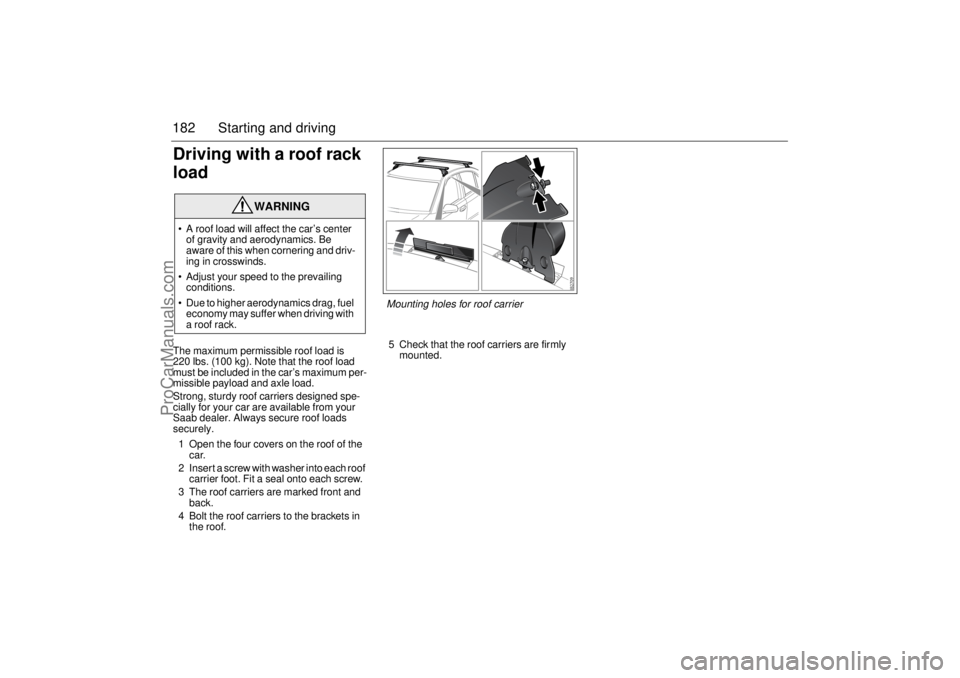
1 Open the four covers on the roof of the
car.
2 Insert a screw with washer into each roof
carrier foot. Fit a seal onto each screw.
3 The roof carriers are marked front and
back.
4 Bolt the roof carriers to the brackets in
the roof.5 Check that the roof carriers are firmly
mounted.
WARNING
A roof load will affect the car’s center
of gravity and aerodynamics. Be
aware of this when cornering and driv-
ing in crosswinds.
Adjust your speed to the prevailing
conditions.
Due to higher aerodynamics drag, fuel
economy may suffer when driving with
a roof rack.
Mounting holes for roof carrier
ProCarManuals.com
Page 190 of 288

190 Starting and drivingFor long tripsBefore starting off on a long journey, it is
advisable to have your car inspected by
your Saab dealer.
Obtain a few important items to take along
on your journey, such as spare bulbs, wiper
blades, fuses, a drive belt (poly-V-belt) and
the like.
You can check some points yourself before-
hand:
Check that no oil or fuel leaks out of the
engine or gearbox/transmission.
Check the coolant and power steering
fluid levels. Check also for leaks.
Inspect the drive belt (poly-V-belt) and
replace if it shows any signs of wear.
Check the battery charge.
Check the tires for tread pattern and air
pressure, including the compact spare
tire.
Take an extra remote control and keep it
separate.
Check the brakes.
Check all bulbs.
Check for the presence of the tool kit and
jack in the car.
ProCarManuals.com
Page 193 of 288

193 Car care
EngineThe engine is a transverse four-cylinder in-
line engine with twin overhead camshafts
and 16 valves.
The engine is equipped with two balance-
shafts that reduce engine vibrations to a
minimum.
The balance shafts are chain-driven and
rotate at twice the speed of the crankshaft.
They produce forces and torques that are
opposed to those generated by the pistons
and connecting rods. The effect occurs
twice in each revolution of the engine, coun-
teracting the vibration from its moving parts,
and at the same time reducing unwanted
engine noise.
The gearbox, located on the right (viewed
from the front), is integrated with the engine.
Engine familiesSaab cars imported into the United States
and Canada meet all applicable emission
control standards. The engine family and
appropriate tune-up specifications are iden-
tified on a label affixed to the left front inner
fender.
These engine families meet applicable EPA
Federal Standards, California State Stan-
dards and Canadian Federal Standards and
are equipped with the following systems:
• sequential multiport fuel injection system
three way catalytic converter
crankcase emissions control system
evaporative emission system.
Emission control
systemsThe systems for controlling emissions to the
atmosphere require regular checking and
adjustment at the intervals specified in the
service program.
In addition to meeting the exhaust emission
regulations and thereby helping to keep the
environment clean, a correctly tuned engine
will also give maximum fuel economy.
WARNING
Engine exhaust, some of its constituents,
and certain vehicle components contain
or emit chemicals known to the State of
California to cause cancer and birth
defects and reproductive harm. In addi-
tion, certain fluids contained in vehicles
and certain products of component wear
contain or emit chemicals known to the
State of California to cause cancer and
birth defects or other reproductive harm.
ProCarManuals.com
Page 194 of 288

194 Car careSaab Trionic engine management
systemThe Saab Trionic engine management
system is a unique Saab development that
combines sequential multiport fuel injection,
electronic distributorless ignition and turbo-
charger boost pressure control into one sys-
tem.
The Trionic engine control module (ECM)
monitors many different engine parameters
such as:
Intake manifold pressure.
Intake air temperature.
Crankshaft position.
Engine coolant temperature.
Throttle position.
The oxygen content of the exhaust gases.
The ECM receives information regarding
engine knocking from a sophisticated feed-
back function in the ignition discharge unit.
By processing all of this information, the Tri-
onic system can control fuel injector open-
ing duration, ignition timing and turbo-
charger boost pressure to provide excellent
engine performance while maintaining low
emissions and fuel consumption.
ORVR (Onboard Refueling Vapor
Recovery)All hydrocarbons formed when refueling will
be recovered by the car and not released
into the atmosphere. The hydrocarbons are
absorbed in an evaporative emission canis-
ter. When the engine is subsequently
started, the evaporative emission canister is
gradually purged as air is sucked into it
through a shut-off valve. The hydrocarbon/
air mixture passes through the evap canis-
ter purge valve and into the engine where it
is burned. “Refueling”, see page 147.
When refueling, make sure you screw the
filler cap on and keep turning until it has
clicked 3 times.
NOTICEThe Trionic engine management system
continuously monitors the operation of
these systems and has on-board diag-
nostic capabilities (OBD II). If the Engine
malfunction (CHECK ENGINE) light in
the main instrument illuminates, the
Trionic ECM has detected a problem. The
car will continue to operate, but perfor-
mance may be diminished. You should
have your car checked by a Saab dealer
as soon as possible.
ProCarManuals.com
Page 224 of 288
224 Car care
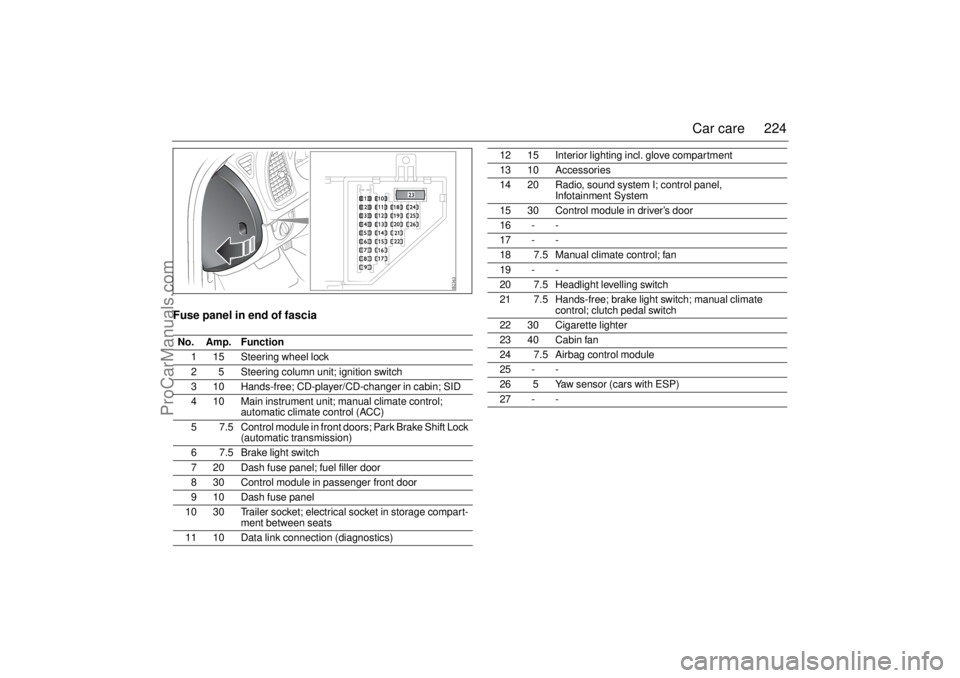
Fuse panel in end of fasciaNo. Amp. Function
1 15 Steering wheel lock
2 5 Steering column unit; ignition switch
3 10 Hands-free; CD-player/CD-changer in cabin; SID
4 10 Main instrument unit; manual climate control;
automatic climate control (ACC)
5 7.5 Control module in front doors; Park Brake Shift Lock
(automatic transmission)
6 7.5 Brake light switch
7 20 Dash fuse panel; fuel filler door
8 30 Control module in passenger front door
9 10 Dash fuse panel
10 30 Trailer socket; electrical socket in storage compart-
ment between seats
11 10 Data link connection (diagnostics)
12 15 Interior lighting incl. glove compartment
13 10 Accessories
14 20 Radio, sound system I; control panel,
Infotainment System
15 30 Control module in driver’s door
16 - -
17 - -
18 7.5 Manual climate control; fan
19 - -
20 7.5 Headlight levelling switch
21 7.5 Hands-free; brake light switch; manual climate
control; clutch pedal switch
22 30 Cigarette lighter
23 40 Cabin fan
24 7.5 Airbag control module
25 - -
26 5 Yaw sensor (cars with ESP)
27 - -
ProCarManuals.com