trunk SAAB 9-3 2004 Owner's Guide
[x] Cancel search | Manufacturer: SAAB, Model Year: 2004, Model line: 9-3, Model: SAAB 9-3 2004Pages: 288, PDF Size: 23.54 MB
Page 139 of 288
139 Starting and driving
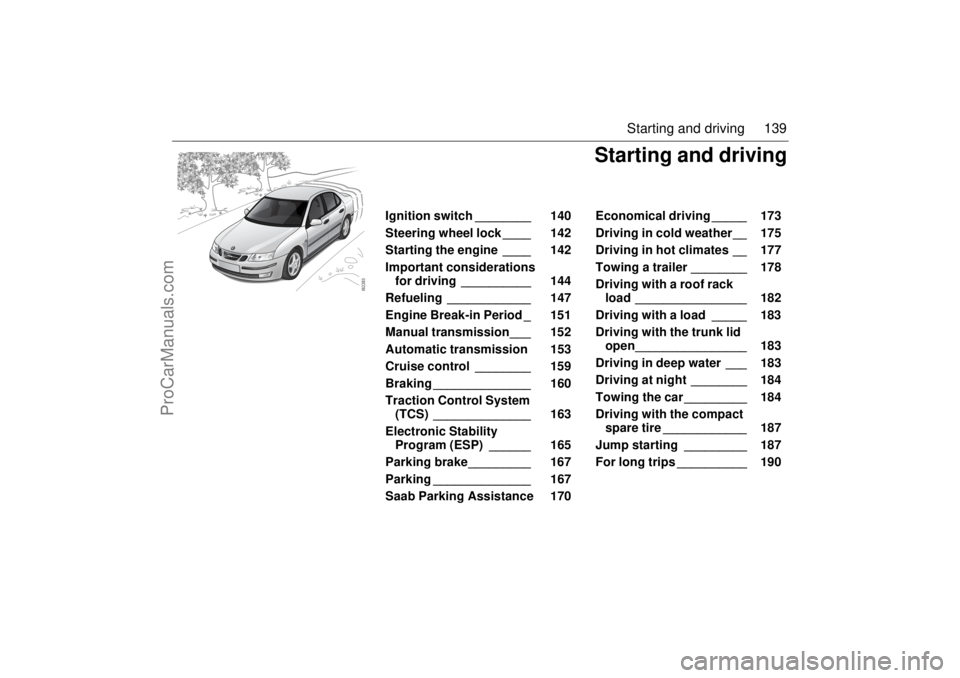
Ignition switch ________ 140
Steering wheel lock ____ 142
Starting the engine ____ 142
Important considerations
for driving __________ 144
Refueling ____________ 147
Engine Break-in Period _ 151
Manual transmission___ 152
Automatic transmission 153
Cruise control ________ 159
Braking ______________ 160
Traction Control System
(TCS) ______________ 163
Electronic Stability
Program (ESP) ______ 165
Parking brake_________ 167
Parking ______________ 167
Saab Parking Assistance 170 Economical driving _____ 173
Driving in cold weather__ 175
Driving in hot climates __ 177
Towing a trailer ________ 178
Driving with a roof rack
load ________________ 182
Driving with a load _____ 183
Driving with the trunk lid
open________________ 183
Driving in deep water ___ 183
Driving at night ________ 184
Towing the car _________ 184
Driving with the compact
spare tire ____________ 187
Jump starting _________ 187
For long trips __________ 190
Starting and driving
ProCarManuals.com
Page 169 of 288

169 Starting and driving
Long-term parkingIf the car is not going to be used for some
time, e.g. three to four months, the following
steps are recommended:
Drain the washer fluid reservoir and
hoses.
Wash and wax the car. Clean the rubber
seals on the hood, trunk lid and doors,
and lubricate them with glycerol
(glycerine).
After washing the car, dry the brake discs
to avoid corrosion by taking the car out on
the road and applying the brakes a few
times.
Fill the fuel tank to prevent condensation
forming in it.
Top up the coolant and check the anti-
freeze before the onset of winter. Park the car in a dry, covered and well-
ventilated building. Leave the parking
brake OFF!
Convertible: If the car is stored, the soft
top should be closed.
If necessary, use wheel chocks and leave
the parking brake off.
Disconnect the negative (–) battery lead.
If frost is likely to occur during the storage
period, remove the battery and store it in
a frost-free place.
If it is not possible to stand the car on axle
stands, increase the tire pressure to
43 psi (3 bar).
Leave all the door windows open a crack
and cover the car with a non-plastic
tarpaulin – not one made of plastic which will
not breath.
ProCarManuals.com
Page 171 of 288

171 Starting and driving
If you stop the car with reverse gear
engaged, the sound pulse will stop after
2 seconds. The sound pulses will return if
you continue to reverse. If the car rolls for-
ward while reverse is engaged, the system
is silenced.
When the distance to the object is less
than 1 ft. (30 cm), a continuous tone will
be heard.
When an object is approximately 3 ft.
(90 cm) from the car, the sound pulses
change character markedly (frequency
increases). A distance of about 3 ft. (90 cm)
is suitable if you wish to load or unload the
trunk.
If the distance between an object and a
corner sensor does not change for
3 seconds, for example if you are reversing
alongside a wall, the system will switch to
monitoring straight back. The system indi-
cates if the distance to the wall decreases
again.
If a trailer is hitched up and correctly con-
nected to the trailer contact by the tow bar,
the system is automatically deactivated.Reversing alongside a wall
If the distance between an object and a
corner sensor does not change for
2 seconds, for example if you are reversing
alongside a wall, the system will switch to
monitoring straight back. The system indi-
cates if the distance to the wall decreases
again.
Cars with trailer hitch
If the car has a ttrailer hitch and its wiring is
correctly connected to the car’s electrics,
the Saab Parking Assistance automatically
compensates for the protrusion of the tow
bar.
If a camper or trailer is hitched up and the
trailer hitch wiring is correctly connected to
the car’s electrics, the system is automati-
cally deactivated.You can temporarily deactivate the Saab
Parking Assistance as follows:
Engage reverse and press the CLEAR
button on the SID control panel.
The system will be reactivated the next time
you engage reverse.
Error messages
If the system malfunctions, the following
message will appear on the SID:
If the system is subject to interference, the
following message will be shown on the
SID:
If this message appears, clean the sensors.
The sensors are located in the black trim on
the rear bumper
NOTICEThe sensors must be kept clean to func-
tion well. Ice, snow and dirt can affect
their sensitivity.
Large quantities of snow or dirt covering
the sensors can prevent the parking
assistance system from detecting any
objects.
Do not spray the sensors with a pressure
washer, as this can damage them.
Parking assistance
malfunction.
Contact Saab dealer.
Parking assistance sensor
interference.
ProCarManuals.com
Page 174 of 288

174 Starting and drivingengine wear is at its greatest during this
period. Drive off as soon as possible after
starting the engine and avoid high engine
speeds.
Drive as smoothly and thoughtfully as
possible. Match your driving to the
prevailing traffic conditions.
Driving in a low gear gives rise to higher
fuel consumption than driving in a high
gear because of the higher engine speed
for any given road speed. Always shift up
as soon as traffic conditions allow and
drive in the highest gear as much as
possible.
Check the tire pressure once a month.
Incorrect tire pressure increases tire
wear. It is preferable for the tire pressure
to be slightly high than too low. Under-
pressure increases fuel consumption. Check the fuel consumption regularly.
Increased fuel consumption can indicate
that something is wrong and that the car
needs to be checked at a Saab dealer.
Practical road tests have demonstrated that
substantial savings in fuel consumption can
be made if the above advice is followed.
Road conditionsWet roads increase fuel consumption, as do
unpaved roads and driving in hilly country
(the amount of fuel saved driving downhill is
less than the additional amount required to
climb the hill).
Engine block heater (standard
equipment in Canada, accessory in
U.S.)The following are just some of the benefits
to the car and the environment of using an
engine block heater:
Lower fuel consumption.
Reduced wear on the engine.
Inside of car warms up faster.
Exhaust emissions substantially reduced
over short runs.
The engine heater is effective at outside
temperatures up to 60–70°F (+15–+20°C).
The warmer it is outside, the shorter the time
the engine heater needs to be connected.
Longer than 1.5 hours is unnecessary.
If the car is equipped with a removable,
electric cabin heater that is not in use, store
this in the trunk.
WARNING
Never switch off the engine while driving
as the effect of the brakes and power
steering will be greatly reduced.
ProCarManuals.com
Page 180 of 288
180 Starting and drivingRecommendations for cars with
manual transmissionRises in coolant temperature are indicated
by the temperature gauge in the main instru-
ment panel.
When the needle is just outside the red
zone, the A/C compressor will be switched
off and, on certain engine variants, the max-
imum engine torque will be limited.
When continuing your journey, select a low
gear in which the engine speed is about
3,500 rpm until the incline eases.
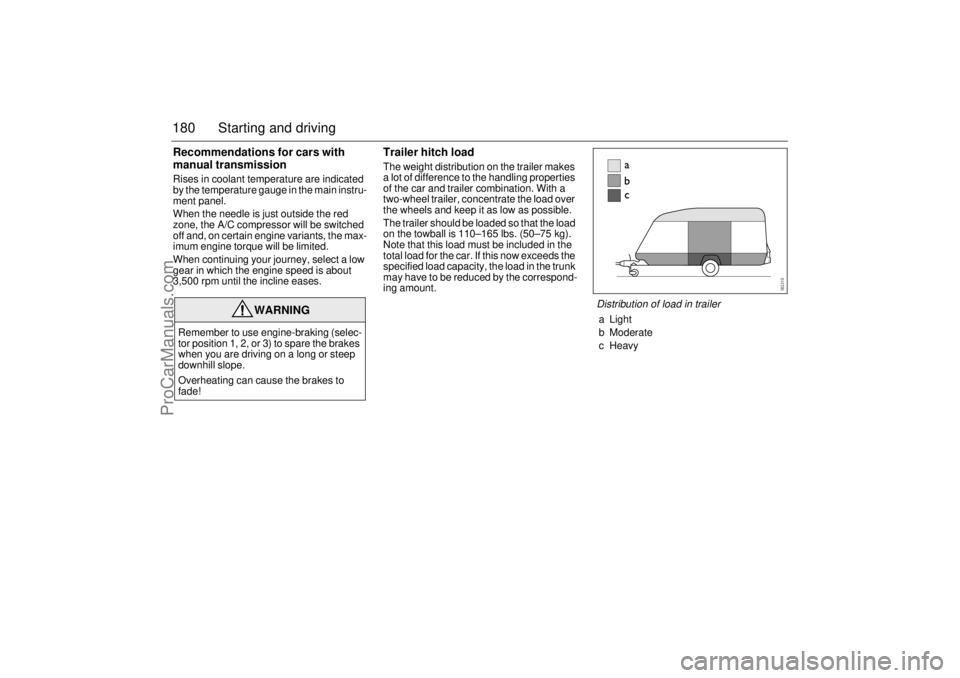
Trailer hitch loadThe weight distribution on the trailer makes
a lot of difference to the handling properties
of the car and trailer combination. With a
two-wheel trailer, concentrate the load over
the wheels and keep it as low as possible.
The trailer should be loaded so that the load
on the towball is 110–165 lbs. (50–75 kg).
Note that this load must be included in the
total load for the car. If this now exceeds the
specified load capacity, the load in the trunk
may have to be reduced by the correspond-
ing amount.
WARNING
Remember to use engine-braking (selec-
tor position 1, 2, or 3) to spare the brakes
when you are driving on a long or steep
downhill slope.
Overheating can cause the brakes to
fade!
Distribution of load in trailera Light
b Moderate
cHeavy
ProCarManuals.com
Page 183 of 288

183 Starting and driving
Driving with a loadThe handling characteristics are affected by
how the car is loaded.
Place the heaviest load as far forward and
as low as possible in the trunk.
Secure the load to the lashing eyes (see
page 137).
Heavy loads mean that the car’s center of
gravity is further back. As a result, the car
will sway more during evasive steering.
Never exceed the permissible load of the
roof box, even if there is room for more.
Ensure that the tire pressure is correct –
slight overinflation is preferable to under-
inflation.
The braking distance of a loaded car is
always greater. Keep your distance from
the vehicle in front.
Do not exceed the car’s permissible
gross vehicle weight or axle load (see
page 268).
Roof loads can negatively affect telecom-
munication.
For further information on tires see page
231.
Driving with the trunk lid
openAvoid driving with the trunk lid partly or fully
open, since exhaust fumes can be drawn
into the cabin.
If you must drive with the trunk lid open,
close all windows and the sunroof (if fitted)
and set the cabin fan to its highest speed
setting.
Driving in deep waterNOTICEDo not drive in puddles or water deeper
than 7 in. (20 cm) and do not drive faster
than 3–4 mph. Water can otherwise be
sucked into the engine. The engine will be
seriously damaged if water enters the
intake system.
ProCarManuals.com
Page 187 of 288

187 Starting and driving
Driving with the
compact spare tireObserve the following when the compact
spare tire is fitted:
The compact spare is light and easy to
handle when changing a tire.
Do not drive further than necessary with
the compact spare fitted - the maximum
life of the tire is only just over 2,000 miles
(approx. 3,500 km).
Refit the standard tire as soon as possi-
ble.Important considerations when driving with
a compact spare tire:
The car’s ground clearance is reduced.
The car must not be driven with more than
one compact spare tire at a time.
Avoid driving against the curb.
Do not use snow chains.
Do not fit the wheel cover - this would
conceal the warning text.
Jump starting
WARNING
Do not exceed 50 mph (80 km/h). The
tire can overheat affecting the car’s
roadholding.
Tire pressure: refer to page 275.
The spare tire or punctured tire must
be stowed under the trunk floor, and
secured in place with the retaining nut.
NOTICETo avoid damaging a alloy wheel of a
punctured tire, this can be temporarily
placed outside up in the spare wheel well
but only while driving to the closest work-
shop.
As a general rule, all heavy loads must be
well secured in the trunk (see page 137).
WARNING
When working on the battery, highly
explosive gas can build up. A spark
could ignite this gas that collects
around the battery. Therefore, always
avoid sparks and open flames in the
vicinity of the battery.
The battery contains corrosive sulphu-
ric acid. Always wear a face mask or
goggles when working on the battery.
If battery acid gets into the eyes or
splashes onto skin or clothing, wash
the affected area liberally with water. If
acid gets into the eyes or a large quan-
tity makes contact with the skin, seek
medical help.
ProCarManuals.com
Page 216 of 288
216 Car careReversing lights and rear fog light,
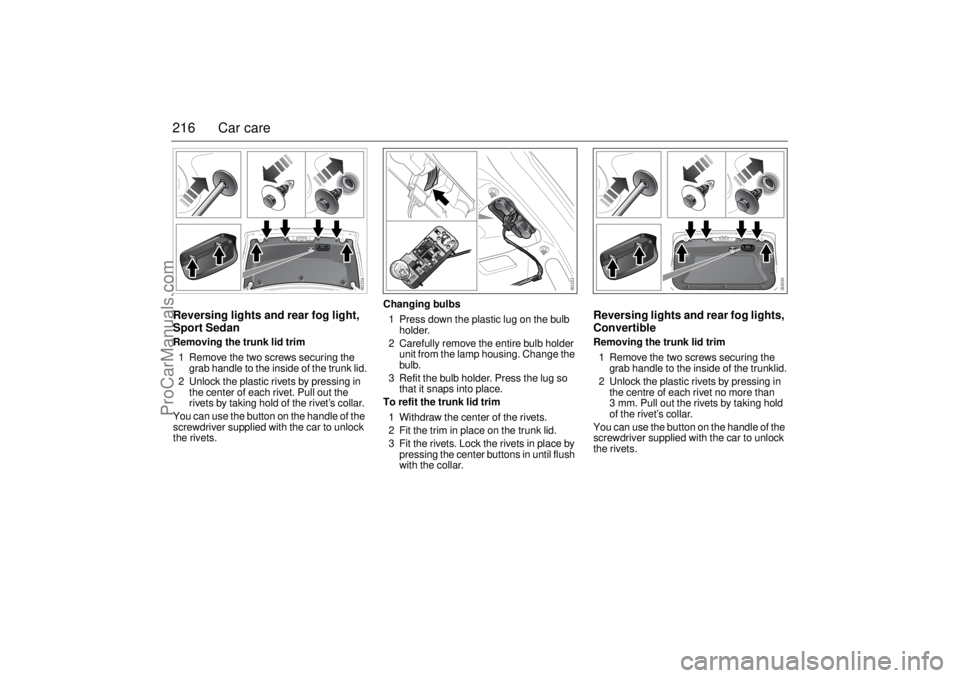
Sport SedanRemoving the trunk lid trim
1 Remove the two screws securing the
grab handle to the inside of the trunk lid.
2 Unlock the plastic rivets by pressing in
the center of each rivet. Pull out the
rivets by taking hold of the rivet’s collar.
You can use the button on the handle of the
screwdriver supplied with the car to unlock
the rivets.Changing bulbs
1 Press down the plastic lug on the bulb
holder.
2 Carefully remove the entire bulb holder
unit from the lamp housing. Change the
bulb.
3 Refit the bulb holder. Press the lug so
that it snaps into place.
To refit the trunk lid trim
1 Withdraw the center of the rivets.
2 Fit the trim in place on the trunk lid.
3 Fit the rivets. Lock the rivets in place by
pressing the center buttons in until flush
with the collar.
Reversing lights and rear fog lights,
ConvertibleRemoving the trunk lid trim
1 Remove the two screws securing the
grab handle to the inside of the trunklid.
2 Unlock the plastic rivets by pressing in
the centre of each rivet no more than
3 mm. Pull out the rivets by taking hold
of the rivet’s collar.
You can use the button on the handle of the
screwdriver supplied with the car to unlock
the rivets.
ProCarManuals.com
Page 217 of 288
217 Car care
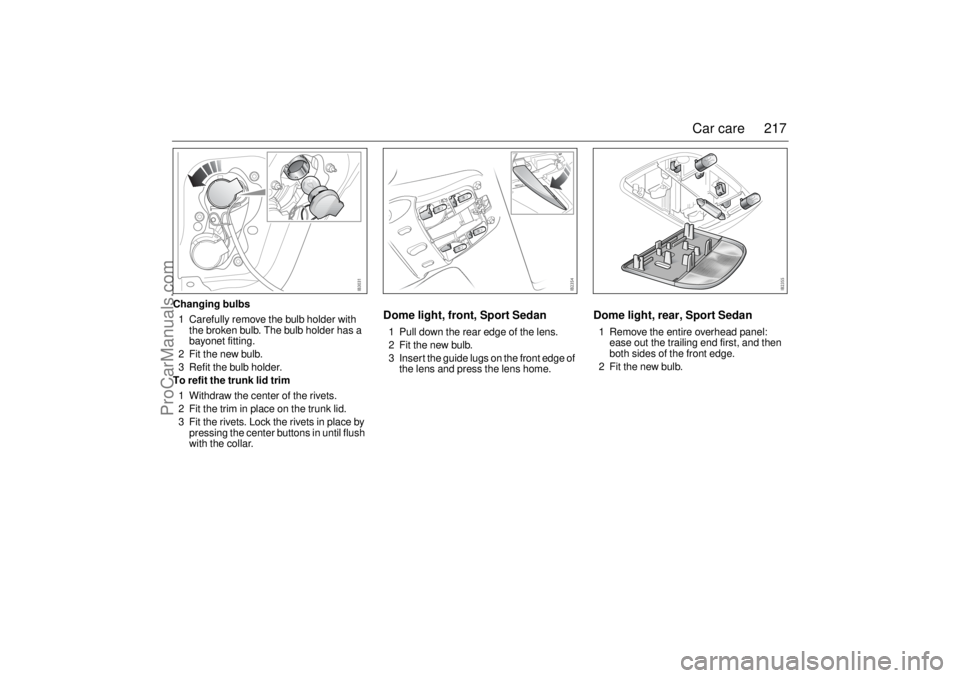
Changing bulbs
1 Carefully remove the bulb holder with
the broken bulb. The bulb holder has a
bayonet fitting.
2 Fit the new bulb.
3 Refit the bulb holder.
To refit the trunk lid trim
1 Withdraw the center of the rivets.
2 Fit the trim in place on the trunk lid.
3 Fit the rivets. Lock the rivets in place by
pressing the center buttons in until flush
with the collar.
Dome light, front, Sport Sedan1 Pull down the rear edge of the lens.
2 Fit the new bulb.
3 Insert the guide lugs on the front edge of
the lens and press the lens home.
Dome light, rear, Sport Sedan1 Remove the entire overhead panel:
ease out the trailing end first, and then
both sides of the front edge.
2 Fit the new bulb.
ProCarManuals.com
Page 219 of 288
219 Car care
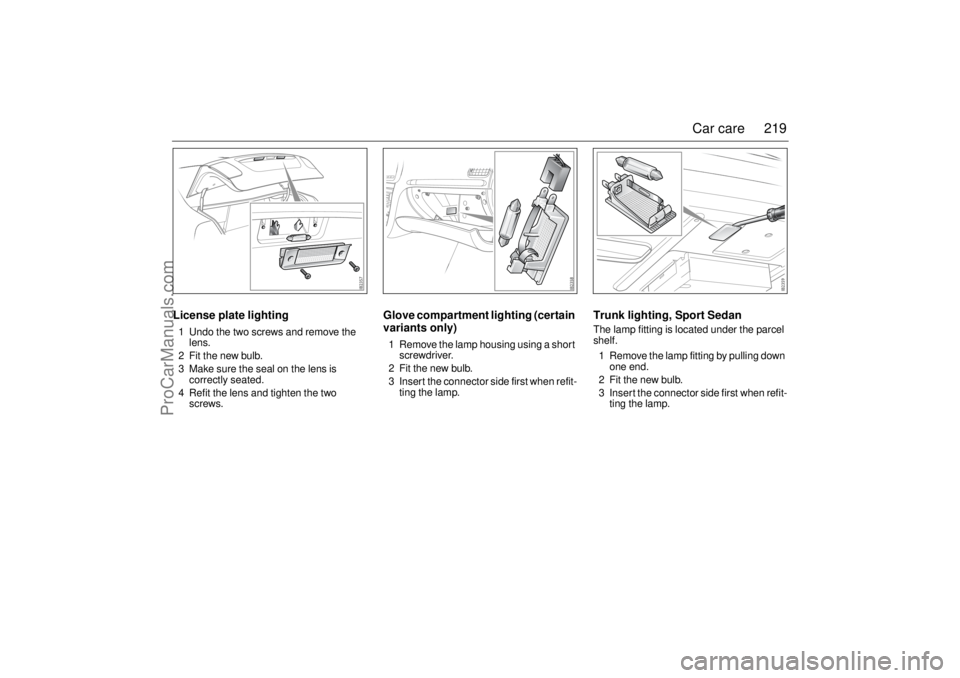
License plate lighting1 Undo the two screws and remove the
lens.
2 Fit the new bulb.
3 Make sure the seal on the lens is
correctly seated.
4 Refit the lens and tighten the two
screws.
Glove compartment lighting (certain
variants only)1 Remove the lamp housing using a short
screwdriver.
2 Fit the new bulb.
3 Insert the connector side first when refit-
ting the lamp.
Trunk lighting, Sport SedanThe lamp fitting is located under the parcel
shelf.
1 Remove the lamp fitting by pulling down
one end.
2 Fit the new bulb.
3 Insert the connector side first when refit-
ting the lamp.
ProCarManuals.com