trunk SAAB 9-3 2004 Service Manual
[x] Cancel search | Manufacturer: SAAB, Model Year: 2004, Model line: 9-3, Model: SAAB 9-3 2004Pages: 288, PDF Size: 23.54 MB
Page 220 of 288
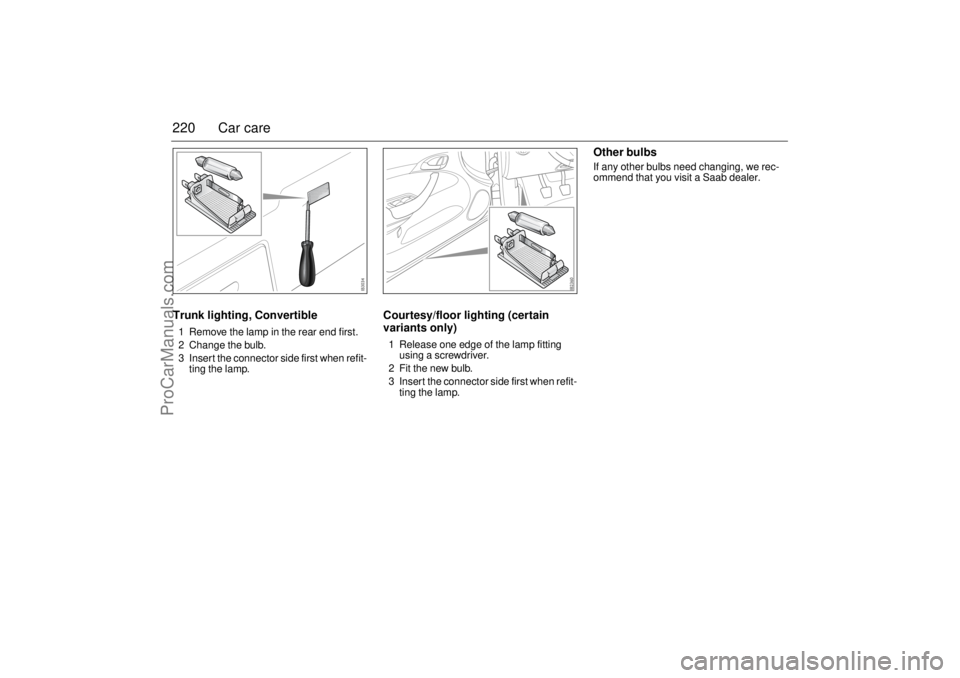
220 Car careTrunk lighting, Convertible1 Remove the lamp in the rear end first.
2 Change the bulb.
3 Insert the connector side first when refit-
ting the lamp.
Courtesy/floor lighting (certain
variants only)1 Release one edge of the lamp fitting
using a screwdriver.
2 Fit the new bulb.
3 Insert the connector side first when refit-
ting the lamp.
Other bulbsIf any other bulbs need changing, we rec-
ommend that you visit a Saab dealer.
ProCarManuals.com
Page 221 of 288
221 Car care
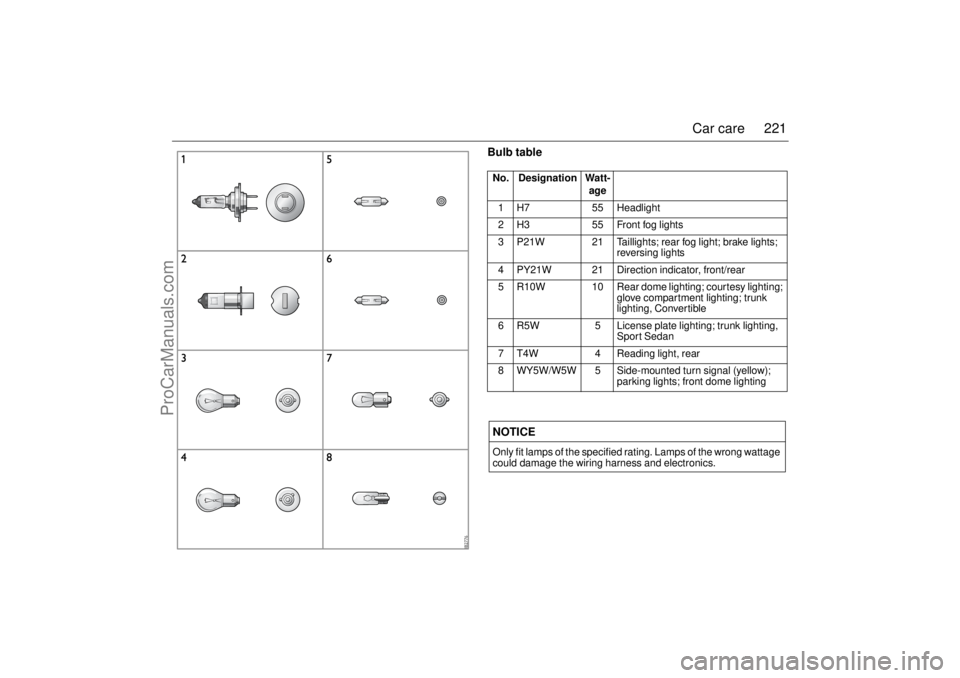
Bulb tableNo. Designation Watt-
age
1 H7 55 Headlight
2 H3 55 Front fog lights
3 P21W 21 Taillights; rear fog light; brake lights;
reversing lights
4 PY21W 21 Direction indicator, front/rear
5 R10W 10 Rear dome lighting; courtesy lighting;
glove compartment lighting; trunk
lighting, Convertible
6 R5W 5 License plate lighting; trunk lighting,
Sport Sedan
7 T4W 4 Reading light, rear
8 WY5W/W5W 5 Side-mounted turn signal (yellow);
parking lights; front dome lightingNOTICEOnly fit lamps of the specified rating. Lamps of the wrong wattage
could damage the wiring harness and electronics.
ProCarManuals.com
Page 222 of 288
222 Car careFuses
The fuses are housed in three fuse panels:
one behind a hatch on the left-hand end of
the dash, one in the engine bay (additional
small unit in front of battery) and one on the
left-hand side of the trunk. There is space
for spare fuses in the hatch on the left-hand
end of the dash.
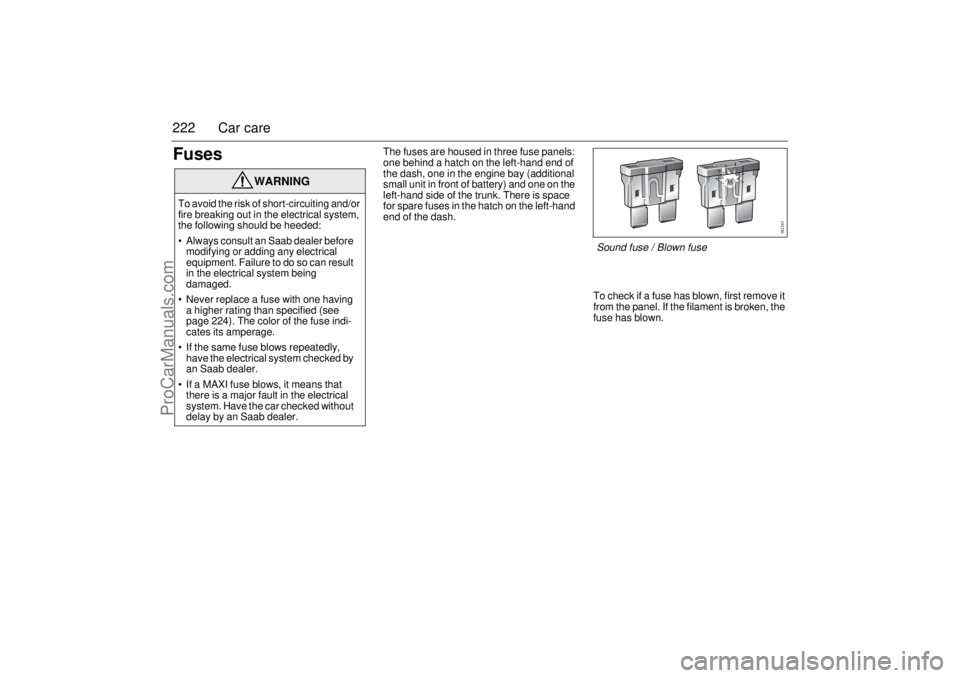
To check if a fuse has blown, first remove it
from the panel. If the filament is broken, the
fuse has blown.
WARNING
To avoid the risk of short-circuiting and/or
fire breaking out in the electrical system,
the following should be heeded:
Always consult an Saab dealer before
modifying or adding any electrical
equipment. Failure to do so can result
in the electrical system being
damaged.
Never replace a fuse with one having
a higher rating than specified (see
page 224). The color of the fuse indi-
cates its amperage.
If the same fuse blows repeatedly,
have the electrical system checked by
an Saab dealer.
If a MAXI fuse blows, it means that
there is a major fault in the electrical
system. Have the car checked without
delay by an Saab dealer.
Sound fuse / Blown fuse
ProCarManuals.com
Page 225 of 288
225 Car care
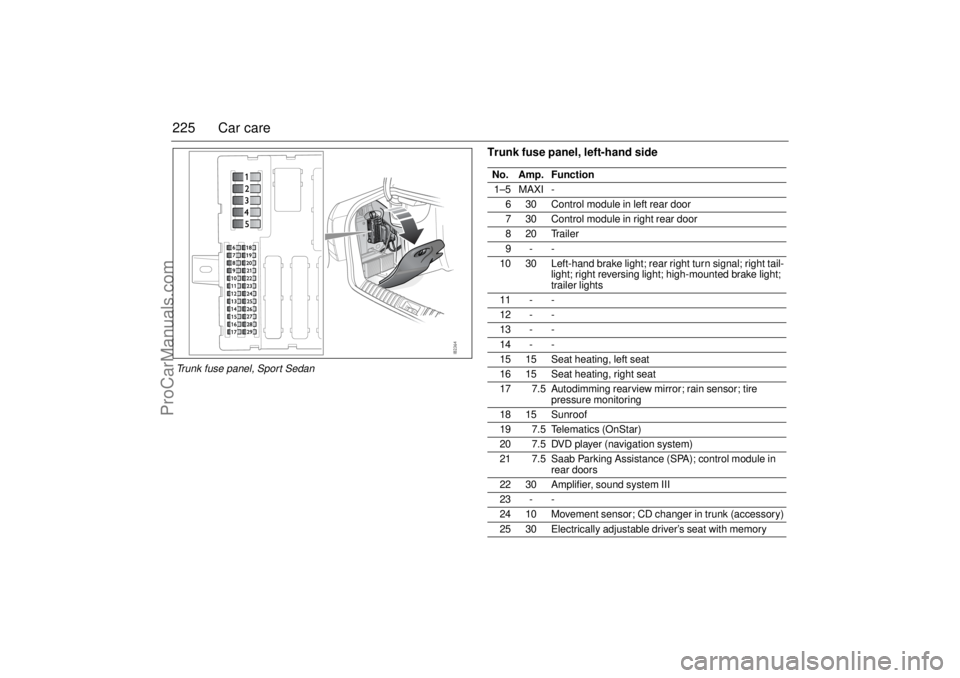
Trunk fuse panel, left-hand sideNo. Amp. Function
1–5 MAXI -
6 30 Control module in left rear door
7 30 Control module in right rear door
820Trailer
9--
10 30 Left-hand brake light; rear right turn signal; right tail-
light; right reversing light; high-mounted brake light;
trailer lights
11 - -
12 - -
13 - -
14 - -
15 15 Seat heating, left seat
16 15 Seat heating, right seat
17 7.5 Autodimming rearview mirror; rain sensor; tire
pressure monitoring
18 15 Sunroof
19 7.5 Telematics (OnStar)
20 7.5 DVD player (navigation system)
21 7.5 Saab Parking Assistance (SPA); control module in
rear doors
22 30 Amplifier, sound system III
23 - -
24 10 Movement sensor; CD changer in trunk (accessory)
25 30 Electrically adjustable driver’s seat with memory
Trunk fuse panel, Sport Sedan
ProCarManuals.com
Page 226 of 288
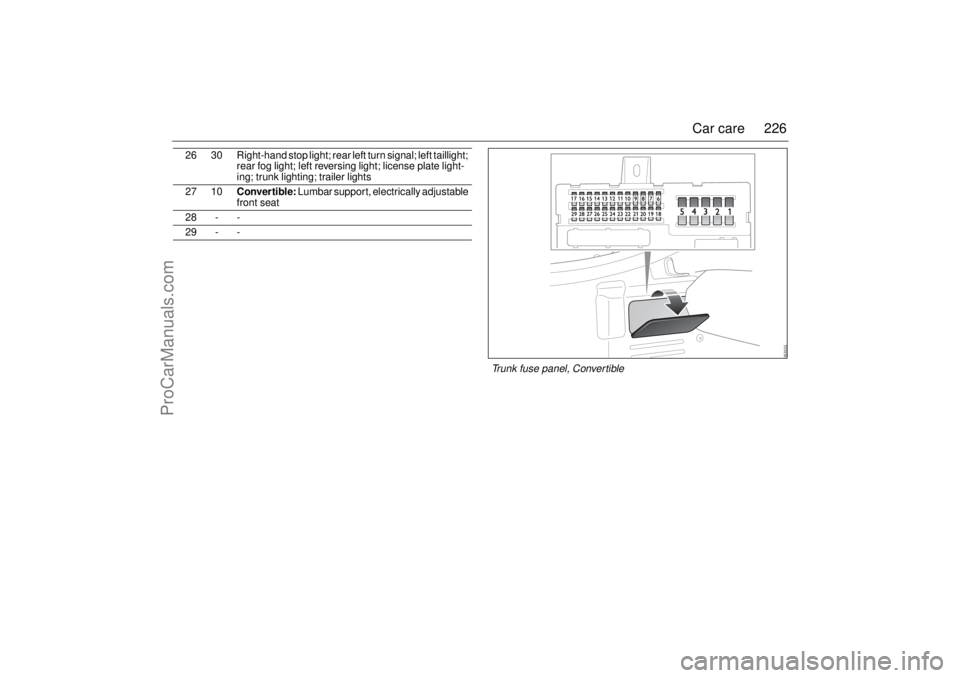
226 Car care
26 30 Right-hand stop light; rear left turn signal; left taillight;
rear fog light; left reversing light; license plate light-
ing; trunk lighting; trailer lights
27 10Convertible: Lumbar support, electrically adjustable
front seat
28 - -
29 - -
Trunk fuse panel, Convertible
ProCarManuals.com
Page 231 of 288

231 Car care
TiresYour new vehicle comes with high-quality
tires made by a leading tire manufacturer. If
you ever have qestions about your tire war-
ranty and where to obtain service, see your
Saab Warranty and Service Record Booklet
for details.
Inflation - Tire PressureThe Tire-Loading Information label, which is
on the inside of the trunk lid, shows the cor-
rect inflation pressures for your tires when
they’re cold. “Cold” means your vehicle has
been sitting for at least three hours or driven
no more than 1 mile (1.6 km).Notice:
Don’t let anyone tell you that
underinflation or overinflation is all
right. It’s not. If your tires don’t have
enough air (underinflation), you can get
the following:
Too much flexing
Too much heat
Tire overloading
Bad wear
Bad handling
Bad fuel economy
If your tires have too much air (overinfla-
tion), you can get the following:
Unusual wear
Bad handling
Rough ride
Needless damage from road hazardsAdjust the tire pressure to match the current
load and speed of the car (see page 277).
The stated tire pressures apply to cold tires,
i.e. tires that are the same temperature as
the outside air temperature. Tire pressure
increases as the tires become warm (e.g.
during highway driving) by approximately
0.3 bar (4 psi). When the temperature of the
tires changes by 50°F (10°C), the tire pres-
sure will change 0.1 bar (2 psi).
Never reduce the pressure of a hot tire. If the
tires are hot when you check them, only
increase the pressure, if necessary.
WARNING
Poor maintained and improperly uswed
tires are dangerous.
Overloading your tires can cause
overheating as a result of too much
friction. You could have an air-out and
a serious accident. See “Loading Your
Vehicle” on page 240.
Underinflated tires pose the same
danger as overloaded tires. The
resulting accident could cause serious
injury. Check all tires frequently to
maintain the recommended pressure.
Tire pressure should be checked
when your tires are cold.
Overinflated tires are more likely to be
cut, punctured or broken by a sudden
impact – such as when you hit a
pothole. Keep tires at the recom-
mended pressure.
Worn, old tires can cause accidents. If
your tread is badly worn, or if your tires
have been damaged, replace them.
ProCarManuals.com
Page 243 of 288
243 Car care
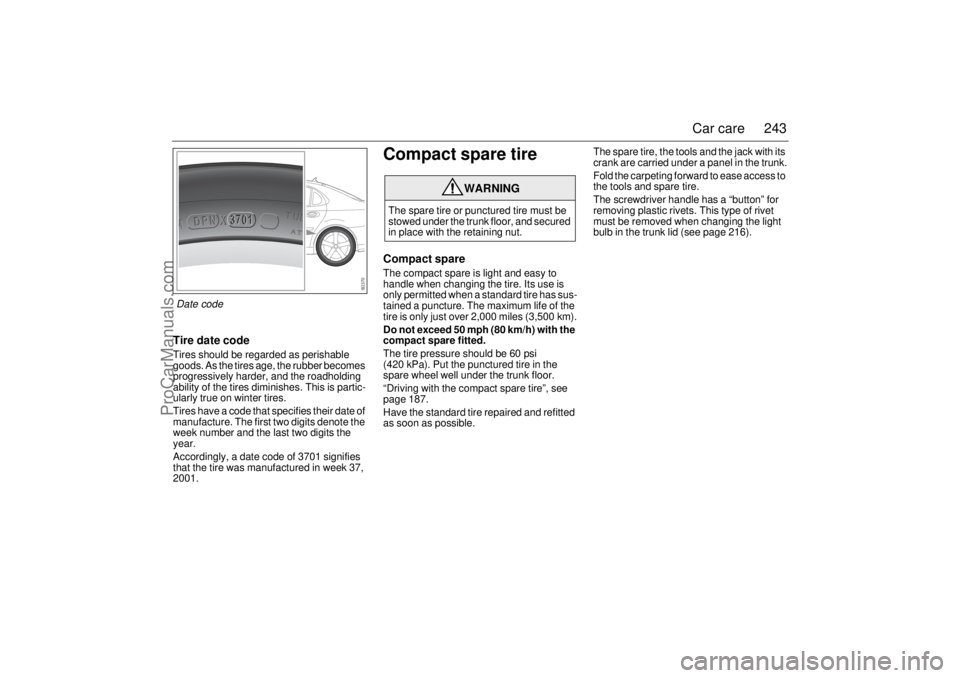
Tire date codeTires should be regarded as perishable
goods. As the tires age, the rubber becomes
progressively harder, and the roadholding
ability of the tires diminishes. This is partic-
ularly true on winter tires.
Tires have a code that specifies their date of
manufacture. The first two digits denote the
week number and the last two digits the
year.
Accordingly, a date code of 3701 signifies
that the tire was manufactured in week 37,
2001.
Compact spare tireCompact spareThe compact spare is light and easy to
handle when changing the tire. Its use is
only permitted when a standard tire has sus-
tained a puncture. The maximum life of the
tire is only just over 2,000 miles (3,500 km).
Do not exceed 50 mph (80 km/h) with the
compact spare fitted.
The tire pressure should be 60 psi
(420 kPa). Put the punctured tire in the
spare wheel well under the trunk floor.
“Driving with the compact spare tire”, see
page 187.
Have the standard tire repaired and refitted
as soon as possible.The spare tire, the tools and the jack with its
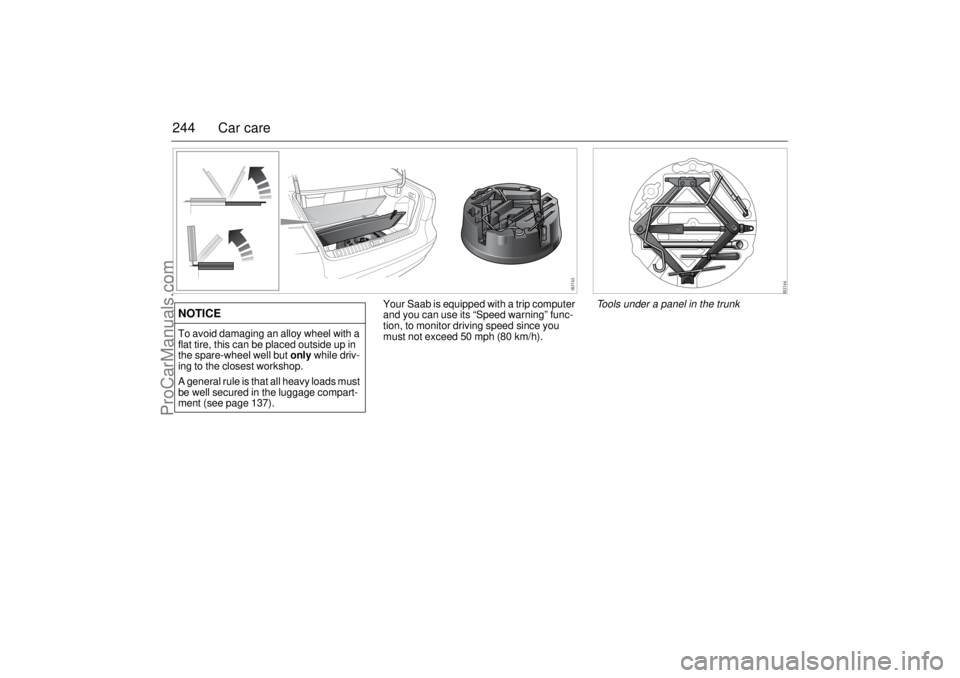
crank are carried under a panel in the trunk.
Fold the carpeting forward to ease access to
the tools and spare tire.
The screwdriver handle has a “button” for
removing plastic rivets. This type of rivet
must be removed when changing the light
bulb in the trunk lid (see page 216).
WARNING
The spare tire or punctured tire must be
stowed under the trunk floor, and secured
in place with the retaining nut.
Date code
ProCarManuals.com
Page 244 of 288
244 Car care
Your Saab is equipped with a trip computer
and you can use its “Speed warning” func-
tion, to monitor driving speed since you
must not exceed 50 mph (80 km/h).
NOTICETo avoid damaging an alloy wheel with a
flat tire, this can be placed outside up in
the spare-wheel well but only while driv-
ing to the closest workshop.
A general rule is that all heavy loads must
be well secured in the luggage compart-
ment (see page 137).
Tools under a panel in the trunk
ProCarManuals.com
Page 245 of 288

245 Car care
Changing a tire
WARNING
The car jack is designed solely for use
in changing a tire or fitting snow
chains. It must not be used to
support the car during repair work
or servicing.
Never crawl under a car that is
supported only by a jack.
Special care must be taken if the car is
on a slope - use wedge-shaped wheel
chocks!
Position chocks, one ahead and one
behind, the wheel that is diagonally
opposite to the one to be changed.
Switch on the hazard warning lights if
the car is on a road.
Apply the parking brake and leave the
car in gear (1st or reverse). Automatic
transmission: move the selector lever
to the P position.
Ensure that everybody is out of the car
before jacking it up.
Never start the engine while the car is
jacked up.
If possible, make sure the jack is
standing on a firm, level surface.
The jack should be stored correctly
under the carpeting in the trunk. If it
lies loose in the car, it could thrown
forward and cause personal injury in
the event of a crash or if the car rolls
over.
Do not use the jack on a car other than
your Saab 9-3.
Grit, salt and rust can clog the inner
threads of the wheel bolts if the car has
been driven for several years exclu-
sively with alloy wheels.
If steel wheels are being installed, the
bolt hole threads in the brake hubs
should be cleaned before the thinner
steel wheels are fitted. It may other-
wise not be possible to achieve the
correct clamping force, despite tight-
ening the wheel bolts to the correct
torque.
WARNING
Changing a tire can cause an injury. The
vehicle can slip off the jack and roll over
you or other people. You and they could
be badly injured. Find a level place to
change your tire. To help prevent the
vehicle from moving:
1 Set the parking brake firmly.
2 Put the shift lever in PARK (P) (auto-
matic transmission;
engage 1st gear (manual transmis-
sion).
3 Turn off the engine.
To be even more certain the vehicle won’t
move, you can put blocks at the front and
rear of the tire farthest away from the one
being changed. That would be the tire on
the other side of the vehicle, at the oppo-
site end.
ProCarManuals.com
Page 253 of 288

253 Car care
Anti-corrosion
treatmentThe entire car undergoes a series of anti-
corrosion processes during production.
These include electrophoretic priming,
PVC-based coating to protect against stone
chip damage and corrosion, and treatment
of body cavities and members with thin,
penetrating rustproofing oil.
In addition, most body panels, such as the
hood, doors and floor pan are galvanized.
The anti-corrosion treatment on some parts
of the car is constantly exposed to wear and
prone to damage. This applies particularly
to the underside of the car and inside the
wheel arches, where grit, road salt and the
like that are thrown up can give rise to cor-
rosion where the underseal has worn away.
The extent of this obviously depends on the
conditions in which the car is used.
Accordingly, make it a habit to hose the
underside of the car often and to inspect the
condition of the underseal. The anti-corro-
sion warranty does not relieve the car owner
of the need to carry out normal maintenance
to the rustproofing and to make good any
damage.Use a hose to clean the underside of the car
thoroughly. After it has dried, use a brush or
spray to apply a viscous anti-corrosion
agent to any worn or damaged areas, to
prevent the onset of corrosion.
Even after the anti-corrosion warranty has
expired, it makes good sense to continue to
maintain the rustproofing.
Seams in the body, especially those in the
doors and trunk lid, are particularly vulnera-
ble to corrosion from the outside, caused by
grit and salt thrown up from the road, and to
corrosion from the inside, largely as a result
of condensation. Keep the seams clean and
at the first sign of any rust, apply a thin, pen-
etrating, anti-corrosion oil. Your Saab
dealer will be pleased to give you further
advice.
What causes rust?Steel body panels of automobiles are sub-
ject to rusting whenever air and moisture
manage to penetrate the protective finish.
Body panels may rust through if the process
is unchecked. Rusting can occur wherever
water is trapped or where the car’s panels
are continuously damp.
Damage to paint and undercoating by
stones, gravel and minor crashes immedi-
ately exposes metal to air and moisture.
Road salts used for de-icing will collect on
the bottom of the car and promote rusting.
Areas of the country with high humidity have
a greater potential for rust problems, espe-
cially where salt is used on roads or there is
moist sea air. Industrial pollution (fallout)
may also damage paint and promote rust-
ing.
ProCarManuals.com