engine oil SAAB 9-3 2005 User Guide
[x] Cancel search | Manufacturer: SAAB, Model Year: 2005, Model line: 9-3, Model: SAAB 9-3 2005Pages: 292, PDF Size: 23 MB
Page 198 of 292

196 Starting and drivingFor long tripsBefore starting off on a long journey, it is
advisable to have your car inspected by
your Saab dealer.
Obtain a few important items to take along
on your journey, such as spare bulbs, wiper
blades, fuses, a drive belt (poly-V-belt) and
the like.
You can check some points yourself before-
hand:
Check that no oil or fuel leaks out of the
engine or gearbox/transmission.
Check the coolant and power steering
fluid levels. Check also for leaks.
Inspect the drive belt (poly-V-belt) and
replace if it shows any signs of wear.
Check the battery charge.
Check the tires for tread pattern and air
pressure, including the compact spare
tire.
Take an extra remote control and keep it
separate.
Check the brakes.
Check all bulbs.
Check for the presence of the tool kit and
jack in the car.
ProCarManuals.com
Page 199 of 292
197 Car care
Hood ________________ 198
Engine ______________ 199
Engine bay ___________ 201
Engine oil ____________ 202
Air filter______________ 204
Transmission fluid ____ 204
Coolant ______________ 205
Brake/clutch fluid and
brake pads__________ 206
Power steering________ 207
Battery ______________ 208
Drive belt ____________ 210
Wipers and washers ___ 211
Wiper blades _________ 211
Changing bulbs _______ 213 Fuses ________________ 227
Tires _________________ 234
Compact spare ________ 246
Changing a tire ________ 248
Safety belts ___________ 251
Upholstery and trim ____ 251
Textile carpeting _______ 252
Engine bay ____________ 252
Washing ______________ 252
Waxing and polishing ___ 253
Touching up the paint___ 253
Anti-corrosion treatment 254
Recovery and/or
recycling of automotive
materials ____________ 256
Air conditioning (A/C) ___ 257
Car care
ProCarManuals.com
Page 203 of 292
201 Car care
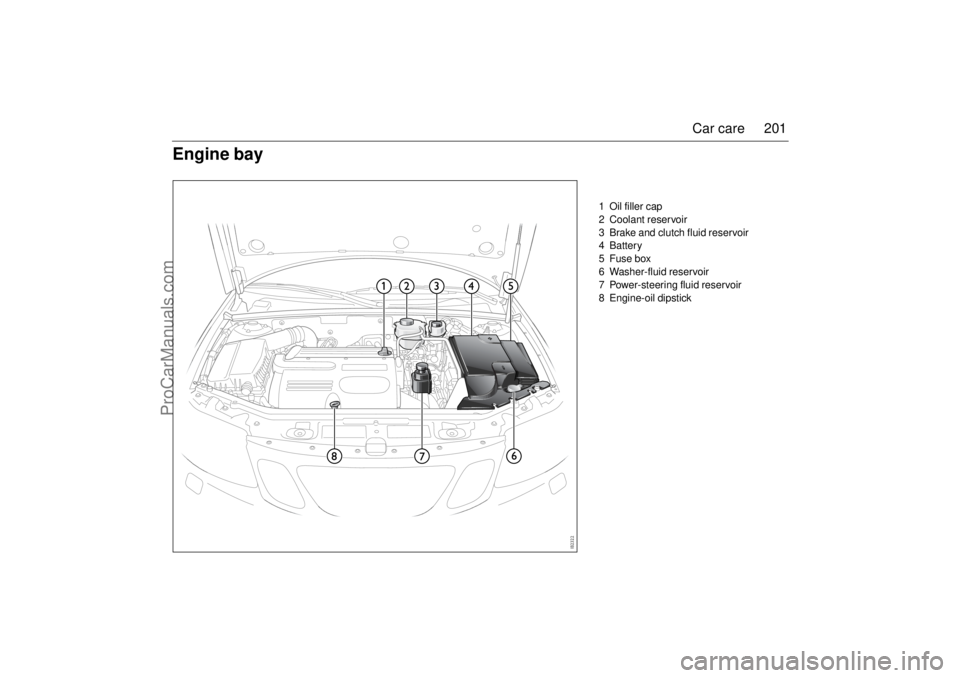
1 Oil filler cap
2 Coolant reservoir
3 Brake and clutch fluid reservoir
4Battery
5 Fuse box
6 Washer-fluid reservoir
7 Power-steering fluid reservoir
8 Engine-oil dipstick
Engine bay
ProCarManuals.com
Page 204 of 292
202 Car careEngine oilChecking the oil levelCheck the engine oil level regularly.
1 Park the car on a level ground.
2 Switch off the engine and wait for
2–5 minutes. The engine should be at
normal operating temperature.
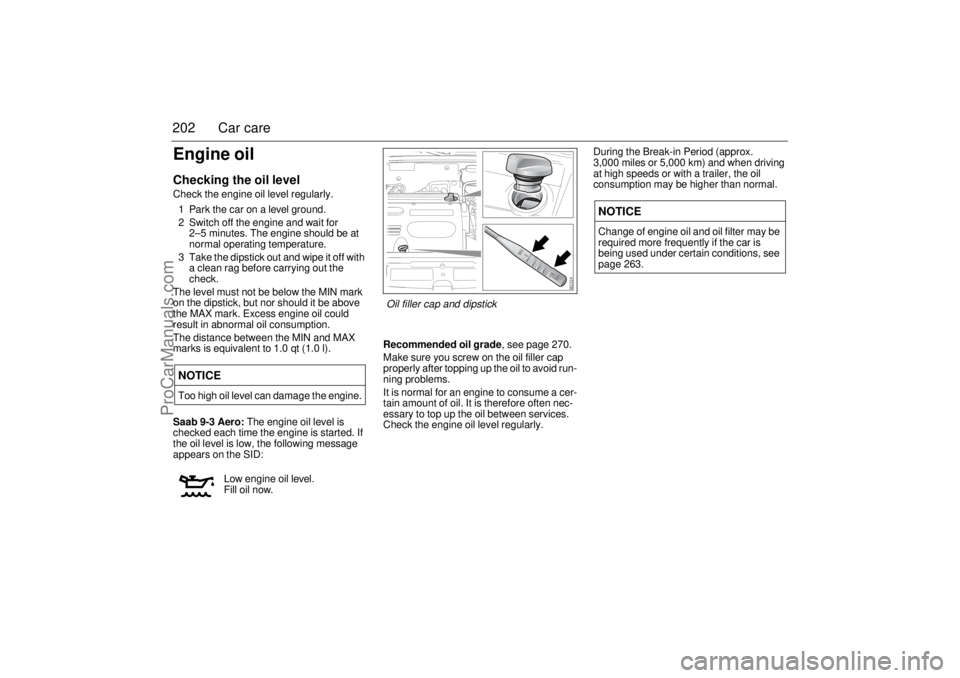
3 Take the dipstick out and wipe it off with
a clean rag before carrying out the
check.
The level must not be below the MIN mark
on the dipstick, but nor should it be above
the MAX mark. Excess engine oil could
result in abnormal oil consumption.
The distance between the MIN and MAX
marks is equivalent to 1.0 qt (1.0 l).
Saab 9-3 Aero: The engine oil level is
checked each time the engine is started. If
the oil level is low, the following message
appears on the SID:Recommended oil grade, see page 270.
Make sure you screw on the oil filler cap
properly after topping up the oil to avoid run-
ning problems.
It is normal for an engine to consume a cer-
tain amount of oil. It is therefore often nec-
essary to top up the oil between services.
Check the engine oil level regularly.During the Break-in Period (approx.
3,000 miles or 5,000 km) and when driving
at high speeds or with a trailer, the oil
consumption may be higher than normal.NOTICEToo high oil level can damage the engine.
Low engine oil level.
Fill oil now.
NOTICEChange of engine oil and oil filter may be
required more frequently if the car is
being used under certain conditions, see
page 263.
Oil filler cap and dipstick
ProCarManuals.com
Page 205 of 292
203 Car care
Changing engine oil
Engine oil and oil filter should be changed
according to the service program.
For oil volumes and grades, refer to “Tech-
nical data”.
The oil should be drained when the engine
is warm. The car must stand on level
ground.
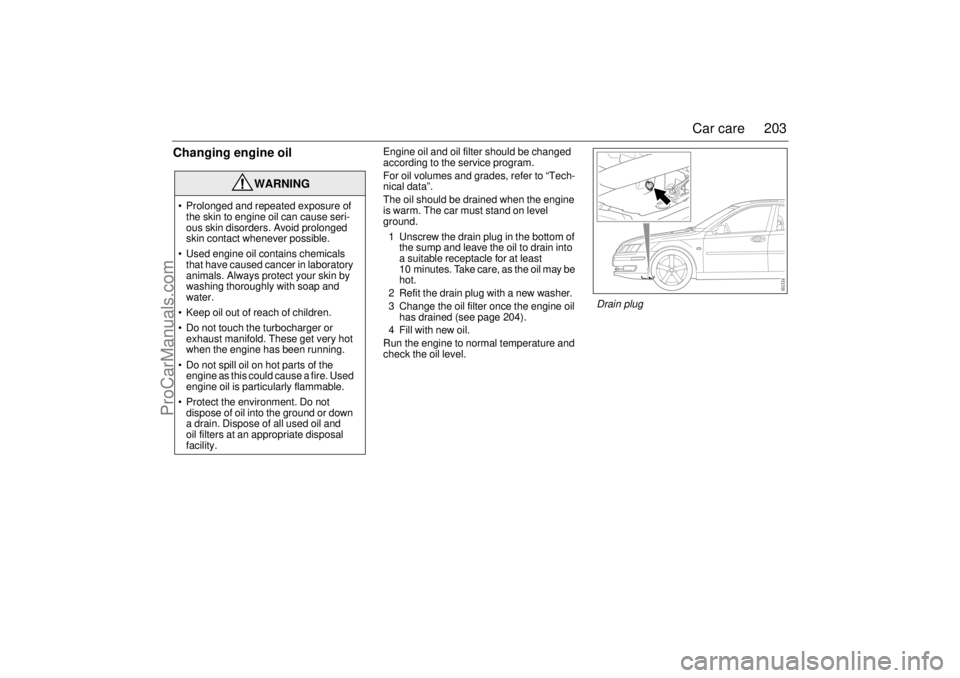
1 Unscrew the drain plug in the bottom of
the sump and leave the oil to drain into
a suitable receptacle for at least
10 minutes. Take care, as the oil may be
hot.
2 Refit the drain plug with a new washer.
3 Change the oil filter once the engine oil
has drained (see page 204).
4 Fill with new oil.
Run the engine to normal temperature and
check the oil level.
WARNING
Prolonged and repeated exposure of
the skin to engine oil can cause seri-
ous skin disorders. Avoid prolonged
skin contact whenever possible.
Used engine oil contains chemicals
that have caused cancer in laboratory
animals. Always protect your skin by
washing thoroughly with soap and
water.
Keep oil out of reach of children.
Do not touch the turbocharger or
exhaust manifold. These get very hot
when the engine has been running.
Do not spill oil on hot parts of the
engine as this could cause a fire. Used
engine oil is particularly flammable.
Protect the environment. Do not
dispose of oil into the ground or down
a drain. Dispose of all used oil and
oil filters at an appropriate disposal
facility.
Drain plug
ProCarManuals.com
Page 206 of 292
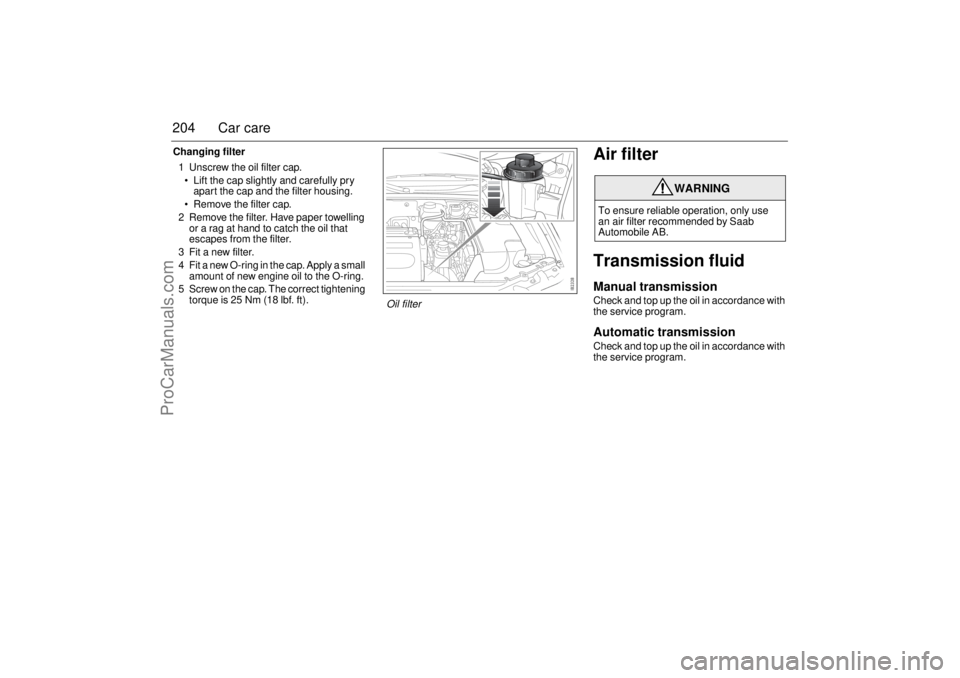
204 Car careChanging filter
1 Unscrew the oil filter cap.
Lift the cap slightly and carefully pry
apart the cap and the filter housing.
Remove the filter cap.
2 Remove the filter. Have paper towelling
or a rag at hand to catch the oil that
escapes from the filter.
3 Fit a new filter.
4 Fit a new O-ring in the cap. Apply a small
amount of new engine oil to the O-ring.
5 Screw on the cap. The correct tightening
torque is 25 Nm (18 lbf. ft).
Air filter
Transmission fluidManual transmissionCheck and top up the oil in accordance with
the service program.Automatic transmissionCheck and top up the oil in accordance with
the service program.
WARNING
To ensure reliable operation, only use
an air filter recommended by Saab
Automobile AB.
Oil filter
ProCarManuals.com
Page 207 of 292
205 Car care
CoolantIf the coolant level drops too low, the follow-
ing message appears on the SID:The properties of the coolant are retained
for the entire service life of the car. There-
fore, it is not necessary to change the cool-
ant.
The coolant contains 45 % antifreeze and
anti-corrosion fluid. This ratio gives the best
cooling effect. Lower concentrations should
be avoided, in view of the corrosion risk.
Other brands of antifreeze can damage the
engine and cooling system.The expansion tank is transparent to facili-
tate checking the coolant level.
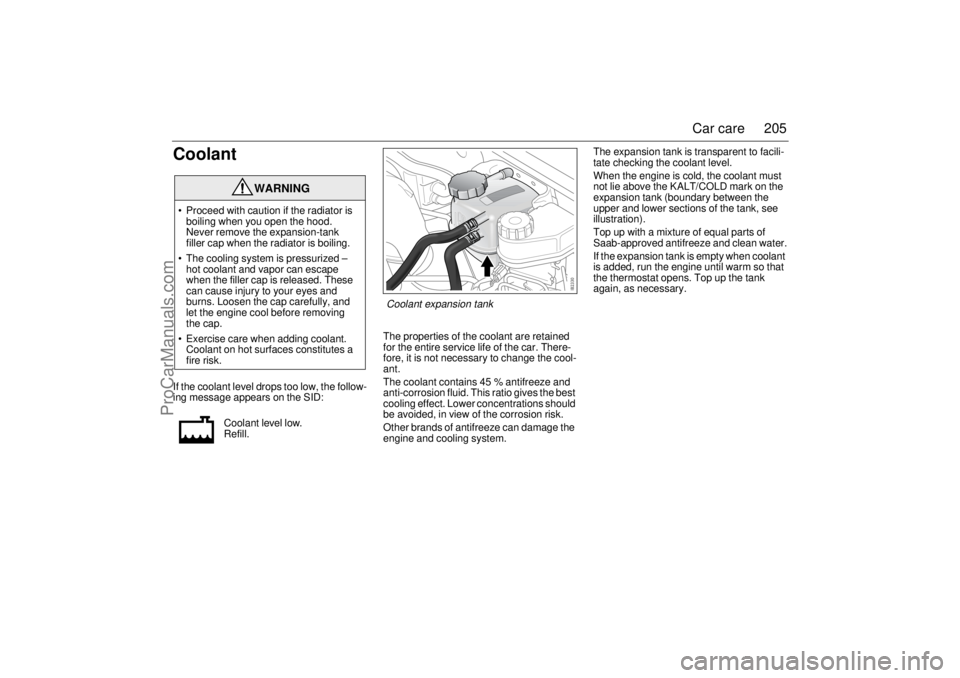
When the engine is cold, the coolant must
not lie above the KALT/COLD mark on the
expansion tank (boundary between the
upper and lower sections of the tank, see
illustration).
Top up with a mixture of equal parts of
Saab-approved antifreeze and clean water.
If the expansion tank is empty when coolant
is added, run the engine until warm so that
the thermostat opens. Top up the tank
again, as necessary.
WARNING
Proceed with caution if the radiator is
boiling when you open the hood.
Never remove the expansion-tank
filler cap when the radiator is boiling.
The cooling system is pressurized –
hot coolant and vapor can escape
when the filler cap is released. These
can cause injury to your eyes and
burns. Loosen the cap carefully, and
let the engine cool before removing
the cap.
Exercise care when adding coolant.
Coolant on hot surfaces constitutes a
fire risk.
Coolant level low.
Refill.
Coolant expansion tank
ProCarManuals.com
Page 209 of 292
207 Car care
The foot brake and parking brake are self-
adjusting.
It is not possible to detect, through abnormal
pedal or parking brake lever travel, whether
the brake pads are worn and need replac-
ing. It is therefore essential that brake pads
be checked regularly, as specified in the
service program.
Brake pads should only be changed at a
Saab dealer. To ensure optimum brake
performance, use only Saab genuine
brake pads.
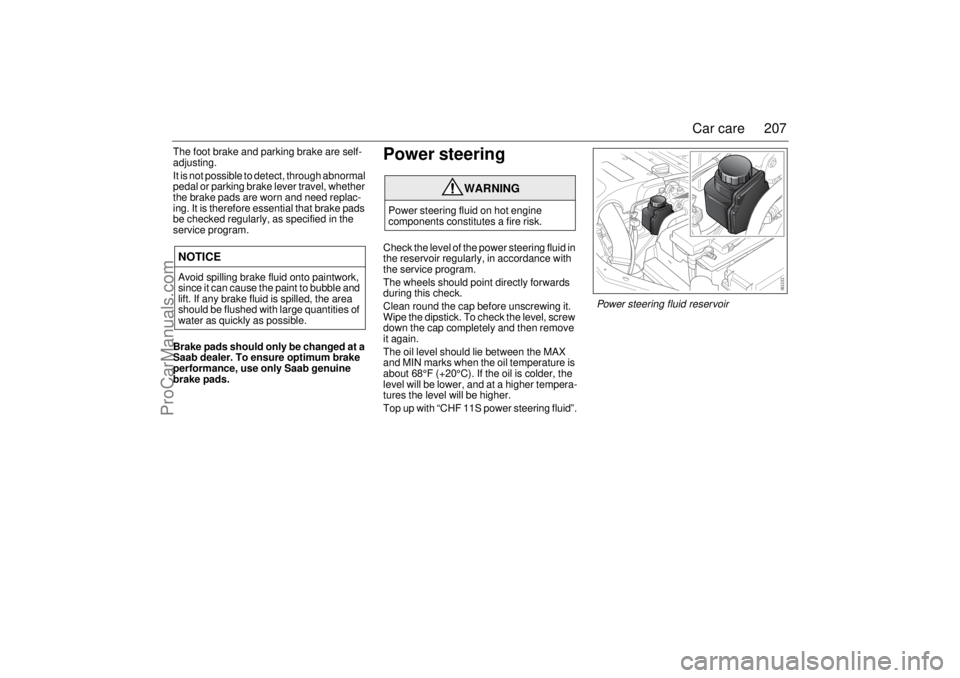
Power steeringCheck the level of the power steering fluid in
the reservoir regularly, in accordance with
the service program.
The wheels should point directly forwards
during this check.
Clean round the cap before unscrewing it.
Wipe the dipstick. To check the level, screw
down the cap completely and then remove
it again.
The oil level should lie between the MAX
and MIN marks when the oil temperature is
about 68°F (+20°C). If the oil is colder, the
level will be lower, and at a higher tempera-
tures the level will be higher.
Top up with “CHF 11S power steering fluid”.
NOTICEAvoid spilling brake fluid onto paintwork,
since it can cause the paint to bubble and
lift. If any brake fluid is spilled, the area
should be flushed with large quantities of
water as quickly as possible.
WARNING
Power steering fluid on hot engine
components constitutes a fire risk.
Power steering fluid reservoir
ProCarManuals.com
Page 259 of 292
257 Car care
Air conditioning (A/C)
TroubleshootingIf a fault occurs in the A/C system, there are
a number of checks you can perform your-
self. If the fault persists, however, have the
system checked at a Saab dealer.
Note:
When the A/C system is running, the intake
air is dehumidified. The resultant condensa-
tion that forms on the evaporator is drained
off under the car. When the car is parked,
this may result in a small puddle forming on
the ground. The warmer the air and the
higher the relative humidity, the more con-
densation will be produced.Inadequate coolinga Check that the controls for temperature
and air distribution are correctly set; see
“Manual climate-control system” on
page 103.
b Check that the condenser (in front of the
radiator) has not become clogged with
dirt and insects.
c Make sure that the compressor drive
belt does not slip (see page 210).
d Check the fuses for the ventilation fans
and compressor (see page 229).
Maintenance The compressor drive belt should be
inspected under the regular service
program.
Clean away dirt and insects from the
condenser and radiator to prevent clog-
ging. When washing the car, use the hose
to spray the radiator and condenser
(located in front of the radiator) from both
sides (both from the front of the car and
from inside the engine bay). Do not use a
pressure washer.
Caution: Do not hose down the radia-
tor and condenser while the engine is
hot.
Other than in extremely cold weather, do not
screen the radiator, e.g. with netting, as this
will greatly diminish its cooling capacity.
Applicable to the manual climate control
system - During cold months the air condi-
tioning should be switched on once or
twice a month and run for 5–10 minutes
during highway driving once the engine is
warm.
This action saves the gaskets in the
compressor from being spoiled. The
compressor uses a lubricant that circu-
lates with the coolant.
WARNING
All repairs and adjustments to the A/C
system must be carried out at a Saab
dealer authorized for this kind of work.
The A/C system is pressurized. Do not
break any connections or undo A/C
system components.
Escaping gas can cause eye injury or
other personal injury.NOTICE The A/C system is designed for use
with R134a refrigerant.
Refrigerant handling requires special
equipment and special procedures for
charging and draining the system.
Never mix R 134a with other refriger-
ants.
NOTICEDo not use a pressure washer when
cleaning the condenser or radiator due to
the risk of damage.
ProCarManuals.com
Page 264 of 292

262 Customer Assistance and InformationMaintenance scheduleThe Maintenance Schedule prescribes a
service program to the purchaser/operator
of a Saab that is reasonable and necessary
to ensure the proper emission control sys-
tems function, safety and reliability of the
Saab automobile in normal use. Additional
maintenance is recommended for specific
components when the car is operated under
certain severe conditions. Proper mainte-
nance is always a good practice!
Authorized Saab dealers are equipped and
trained to meet your Saab’s service needs.
They regularly receive up-to-date Saab ser-
vice manuals and parts and technical ser-
vice bulletins from Saab and are able,
through their franchise agreement, to attend
Saab service schools, obtain Saab special
tools and technical assistance and pur-
chase original equipment service and
replacement parts.
Today’s complex automobiles should only
be entrusted to the most knowledgeable
service professionals. A Saab dealer is your
best choice.
SERVICE INTERVALSA time for service message will illuminate on
the Saab Instrument Display (SID) when the
car is due for regular maintenance. There
are three different messages that will
appear:
TIME FOR INTERMEDIATE SERVICE
indicates that an oil/filter change is required
along with several inspections. This mes-
sage is set by the engine management
system which calculates service intervals
based on several factors including driving
habits, ambient temperature, number of
cold starts, mileage driven and elapsed time
since the last service. If mileage accumula-
tion does not occur, the message will be set,
and maintenance required at a maximum of
2 years.
TIME FOR MAIN AND INTERMEDIATE
SERVICE
indicates that an oil/filter change is required
along with several inspections and addi-
tional maintenance such as air filter or spark
plug replacement.TIME FOR MAIN SERVICE will be set when
additional maintenance is necessary, such
as air filter or spark plug replacement. When
the message Time for service. is displayed,
contact your Saab Dealer for a service
appointment.
Failure to perform scheduled maintenance
in a timely manner may result in serious
damage to key components or systems.
ProCarManuals.com