engine oil SAAB 9-3 2005 Owners Manual
[x] Cancel search | Manufacturer: SAAB, Model Year: 2005, Model line: 9-3, Model: SAAB 9-3 2005Pages: 292, PDF Size: 23 MB
Page 8 of 292
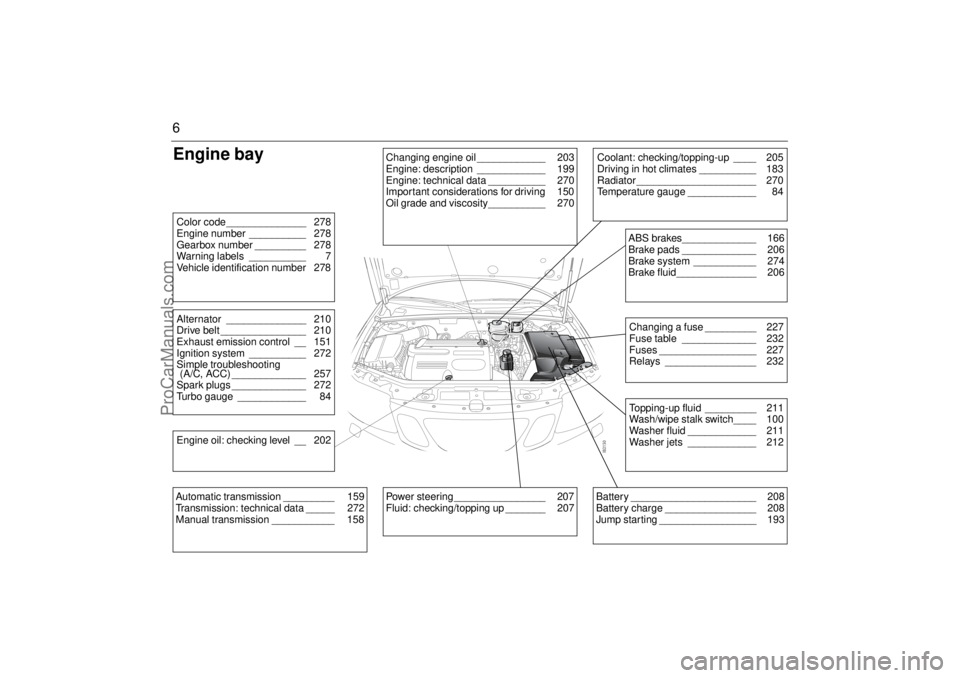
6Engine bayColor code______________ 278
Engine number __________ 278
Gearbox number _________ 278
Warning labels __________ 7
Vehicle identification number 278Alternator ______________ 210
Drive belt _______________ 210
Exhaust emission control __ 151
Ignition system __________ 272
Simple troubleshooting
(A/C, ACC) _____________ 257
Spark plugs _____________ 272
Turbo gauge ____________ 84Engine oil: checking level __ 202Automatic transmission _________ 159
Transmission: technical data _____ 272
Manual transmission ___________ 158
Battery ______________________ 208
Battery charge ________________ 208
Jump starting _________________ 193
Changing engine oil ____________ 203
Engine: description ____________ 199
Engine: technical data __________ 270
Important considerations for driving 150
Oil grade and viscosity__________ 270
Topping-up fluid _________ 211
Wash/wipe stalk switch____ 100
Washer fluid ____________ 211
Washer jets ____________ 212
Power steering ________________ 207
Fluid: checking/topping up _______ 207
Coolant: checking/topping-up ____ 205
Driving in hot climates __________ 183
Radiator _____________________ 270
Temperature gauge ____________ 84
Changing a fuse _________ 227
Fuse table _____________ 232
Fuses _________________ 227
Relays ________________ 232ABS brakes_____________ 166
Brake pads _____________ 206
Brake system ___________ 274
Brake fluid______________ 206
ProCarManuals.com
Page 9 of 292
7
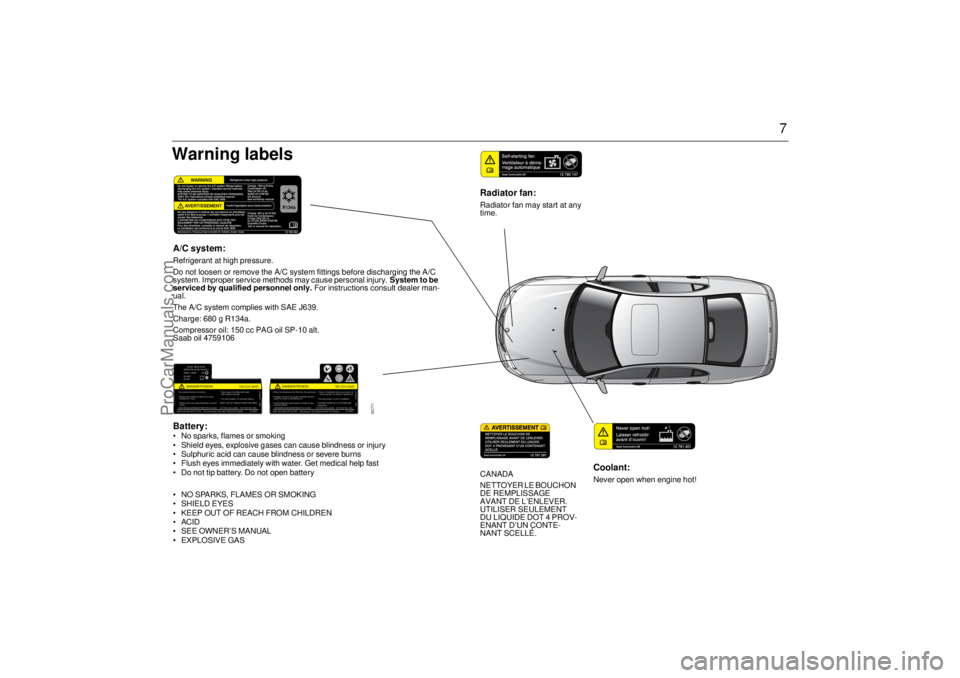
Coolant:Never open when engine hot!
Radiator fan:Radiator fan may start at any
time.
Battery: No sparks, flames or smoking
Shield eyes, explosive gases can cause blindness or injury
Sulphuric acid can cause blindness or severe burns
Flush eyes immediately with water. Get medical help fast
Do not tip battery. Do not open battery
NO SPARKS, FLAMES OR SMOKING
SHIELD EYES
KEEP OUT OF REACH FROM CHILDREN
ACID
SEE OWNER’S MANUAL
EXPLOSIVE GASWarning labelsA/C system:Refrigerant at high pressure.
Do not loosen or remove the A/C system fittings before discharging the A/C
system. Improper service methods may cause personal injury.
System to be
serviced by qualified personnel only. For instructions consult dealer man-
ual.
The A/C system complies with SAE J639.
Charge: 680 g R134a.
Compressor oil: 150 cc PAG oil SP-10 alt.
Saab oil 4759106
DANGER/POISON
700 CCA (SAE)
LEVEL INDICATOR
INDICATEUR DE NIVEAU
DARK / NOIR No sparks, flames or smoking. Flush eyes immediatly with water
Do not tip battery. Do not open battery
KEEP OUT OF REACH FROM CHILDREN.
000 12102-EP
Shield eyes, explosive gases can cause
blindness or injury.Get medical help fast.
Sulfuric acid can cause blindness or severeMAINTENANCE-FREE BATTERY-P/N 53 52 000 12V/700A/125min(SAE) 12V/700A/70Ah (EN)
Saab Automobile AB 53 53 057 Manufactured by Tudor Spain (Exide Technologies) 12102-EPburns.
OK
CLEAR
CLAIRLOW
BAS
DANGER/POISON
700 CCA (SAE)
Éviter les étincelles et les flammes. Ne pas fumer. Rincer immédiatement les yeux avec de
Ne pas pencher ni ouvrir la batterie.
GARDER HORS DE LA PORTÉE DES
ENFANTS
000 12103-EP
Protéger les yeux car les gaz explosife peuvent
causer la cécité ou des blessures.l'oau Consulter un médecin rapidement.
L'acide sulfurique peut causer la cécité ou desBATTERIE SANS ENTRETIEN-P/N 53 52 000 12V/700A/125min(SAE) 12V/700A/70Ah (EN)
Saab Automobile AB 53 53 085 Fabriquée par Tudor Espagne (Exide Technologies) 12103-EPbrûlures graves.
CANADA
NETTOYER LE BOUCHON
DE REMPLISSAGE
AVANT DE L’ENLEVER.
UTILISER SEULEMENT
DU LIQUIDE DOT 4 PROV-
ENANT D’UN CONTE-
NANT SCELLÉ.
ProCarManuals.com
Page 11 of 292
9
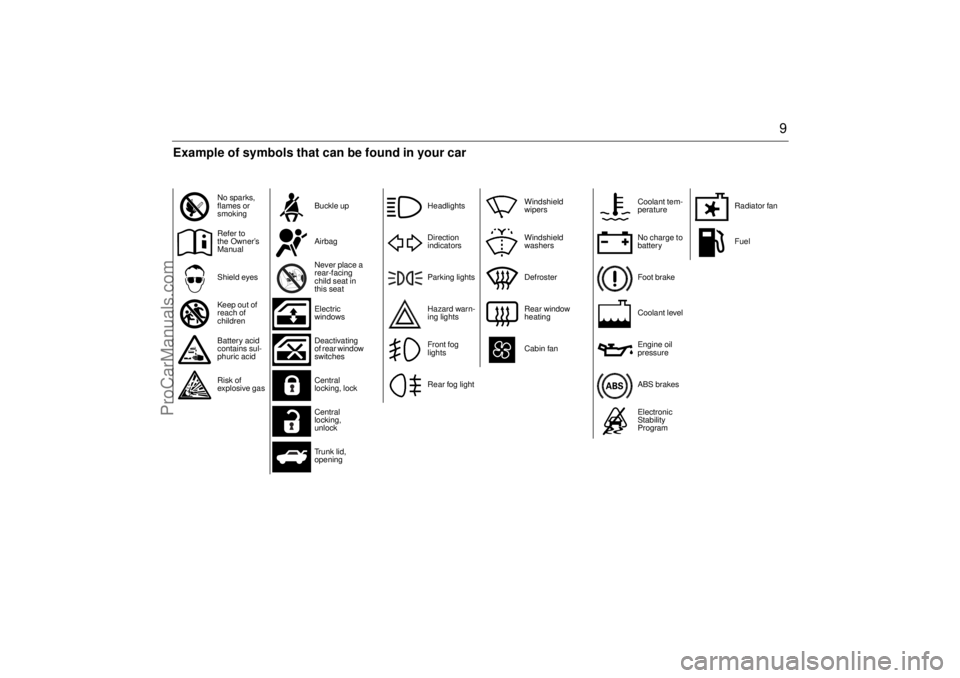
No sparks,
flames or
smokingBuckle up
Refer to
the Owner’s
ManualAirbag
Shield eyesNever place a
rear-facing
child seat in
this seat
Keep out of
reach of
childrenElectric
windows
Battery acid
contains sul-
phuric acidDeactivating
of rear window
switches
Risk of
explosive gasCentral
locking, lock
Central
locking,
unlock
Trunk lid,
opening
HeadlightsWindshield
wipers
Direction
indicatorsWindshield
washers
Parking lights Defroster
Hazard warn-
ing lightsRear window
heating
Front fog
lightsCabin fan
Rear fog light
Coolant tem-
peratureRadiator fan
No charge to
batteryFuel
Foot brake
Coolant level
Engine oil
pressure
ABS brakes
Electronic
Stability
Program
Example of symbols that can be found in your car
ProCarManuals.com
Page 81 of 292
79 Instruments and controls
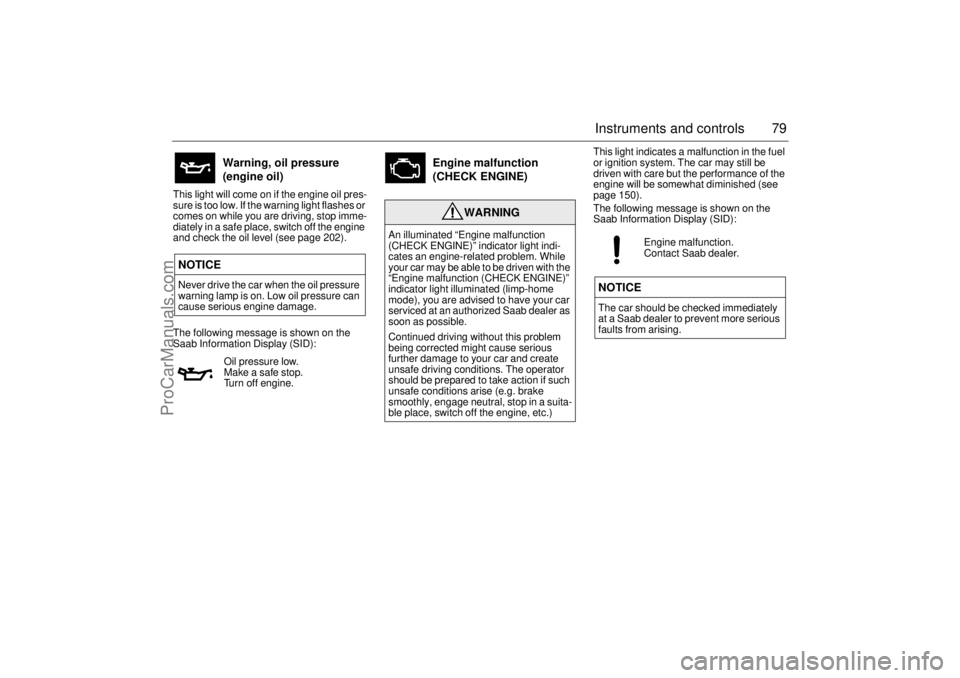
This light will come on if the engine oil pres-
sure is too low. If the warning light flashes or
comes on while you are driving, stop imme-
diately in a safe place, switch off the engine
and check the oil level (see page 202).
The following message is shown on the
Saab Information Display (SID):This light indicates a malfunction in the fuel
or ignition system. The car may still be
driven with care but the performance of the
engine will be somewhat diminished (see
page 150).
The following message is shown on the
Saab Information Display (SID):
Warning, oil pressure
(engine oil)
NOTICE
Never drive the car when the oil pressure
warning lamp is on. Low oil pressure can
cause serious engine damage.
Oil pressure low.
Make a safe stop.
Turn off engine.
Engine malfunction
(CHECK ENGINE)
WARNING
An illuminated “Engine malfunction
(CHECK ENGINE)” indicator light indi-
cates an engine-related problem. While
your car may be able to be driven with the
“Engine malfunction (CHECK ENGINE)”
indicator light illuminated (limp-home
mode), you are advised to have your car
serviced at an authorized Saab dealer as
soon as possible.
Continued driving without this problem
being corrected might cause serious
further damage to your car and create
unsafe driving conditions. The operator
should be prepared to take action if such
unsafe conditions arise (e.g. brake
smoothly, engage neutral, stop in a suita-
ble place, switch off the engine, etc.)
Engine malfunction.
Contact Saab dealer.
NOTICEThe car should be checked immediately
at a Saab dealer to prevent more serious
faults from arising.
ProCarManuals.com
Page 97 of 292

95 Instruments and controls
Explanation of the various selections under
System Settings.
Language
Select the desired language. The num-
ber of languages can vary between
markets.
Unit
Select the desired group of units.
Speed Scale Illum.
Select the proportion of the speedo-
meter to be illuminated in NIGHT-
PANEL mode.
Service Info
Service Data:
The approximate condition of the oil
is shown here. 100% is equivalent
to new engine oil.
Service Type:
The type of service that is required
is shown here.
Reset Service Ind.:
The service indicator can be reset
here. This is normally done at the
dealer in connection with a service.
ProCarManuals.com
Page 156 of 292
154 Starting and drivingRefueling1 Switch off the engine.
2 Open the filler cap, located in the right-
hand rear fender.
3 Insert the fuel pump nozzle beyond the
flange on the filler pipe and let the first
mark (a ring, a pimple or the first spring-
coil) rest on the flange. Do not withdraw
the nozzle while filling is in progress.
4 Cease refueling the first time the pump
stops, and wait a few seconds after
you´ve finished pumping before you
remove the nozzle.
Manually opening the fuel filler door, Con-
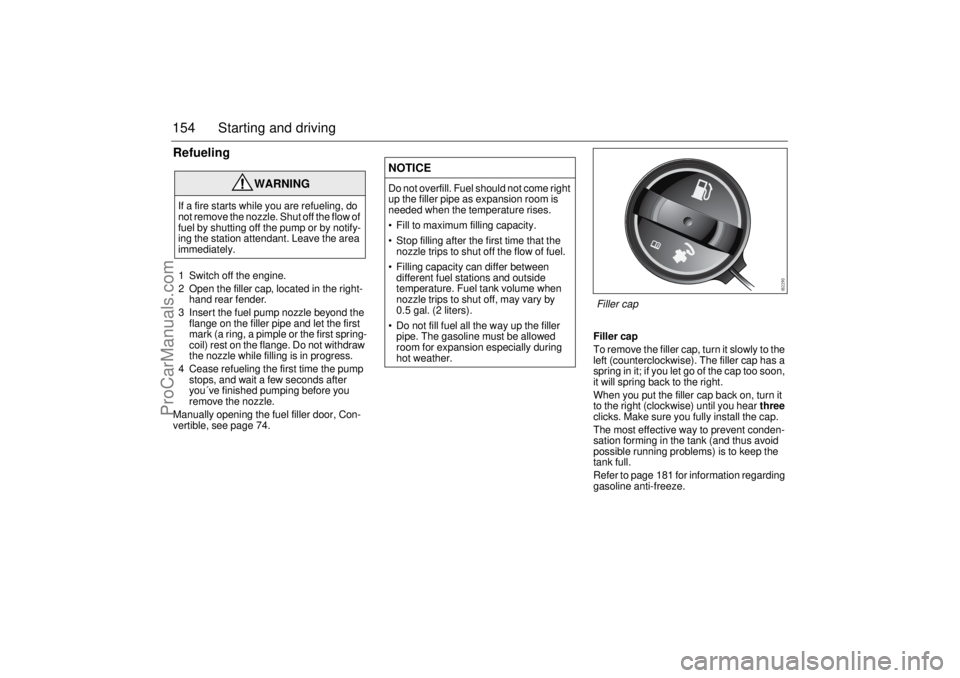
vertible, see page 74.Filler cap
To remove the filler cap, turn it slowly to the
left (counterclockwise). The filler cap has a
spring in it; if you let go of the cap too soon,
it will spring back to the right.
When you put the filler cap back on, turn it
to the right (clockwise) until you hear three
clicks. Make sure you fully install the cap.
The most effective way to prevent conden-
sation forming in the tank (and thus avoid
possible running problems) is to keep the
tank full.
Refer to page 181 for information regarding
gasoline anti-freeze.
WARNING
If a fire starts while you are refueling, do
not remove the nozzle. Shut off the flow of
fuel by shutting off the pump or by notify-
ing the station attendant. Leave the area
immediately.
NOTICEDo not overfill. Fuel should not come right
up the filler pipe as expansion room is
needed when the temperature rises.
Fill to maximum filling capacity.
Stop filling after the first time that the
nozzle trips to shut off the flow of fuel.
Filling capacity can differ between
different fuel stations and outside
temperature. Fuel tank volume when
nozzle trips to shut off, may vary by
0.5 gal. (2 liters).
Do not fill fuel all the way up the filler
pipe. The gasoline must be allowed
room for expansion especially during
hot weather.
Filler cap
ProCarManuals.com
Page 159 of 292

157 Starting and driving
whether the fuel contains MMT. Saab does
not recommend the use of such gasolines.
Fuels containing MMT can reduce the life of
spark plugs and the performance of the
emission control system may be affected.
The malfunction indicator lamp may turn on.
If this occurs, return to your authorized Saab
dealer for service.
Fuels in Foreign Countries
If you plan on driving in another country out-
side the United States or Canada, the
proper fuel may be hard to find. Never use
leaded gasoline or any other fuel not recom-
mended in the previous text on fuel. Costly
repairs caused by use of improper fuel
would not be covered by your warranty.
To check the fuel availability, ask an auto
club, or contact a major oil company that
does business in the country where you will
be driving.
Engine Break-in PeriodPistons, cylinder bores and bearings need
time to obtain uniform, wear-resistant
surfaces.
If a new engine is driven too hard, this grad-
ual process of bedding-in will not be possi-
ble and the life of the engine will be short-
ened.
During the first 1,200 miles (2,000 km),
do not exceed 5,000 rpm.
In addition, refrain from driving the car at full
throttle, other than for brief instances,
during the first 1,800 miles (3,000 km).
Wearing in new brake padsNew brake pads take time to bed in, about
90 miles (150 km) if the car is driven largely
under stop-and-go conditions or about
300 miles (500 km) of highway driving.
To extend the useful life of the pads, avoid
hard braking as much as possible.
ProCarManuals.com
Page 163 of 292
161 Starting and driving
Lock-upThe transmission’s torque converter has a
lock-up function. This can lock the torque
converter, thus reducing the engine speed
and fuel consumption.Kick-downWhen the accelerator is pressed down fully,
a down change is made to optimize acceler-
ation, e.g. for overtaking.
Following this, the next higher gear will be
selected at the optimum engine speed,
unless you ease off the accelerator before
reaching this.
Driving in hilly country with a
heavy loadThe transmission fluid can overheat when
the gearbox is strained, for example, when
driving with a trailer on hilly roads. To avoid
the transmission fluid overheating, always
drive with the selector lever in the D posi-
tion. The adaptive gear change patterns are
then active.
High air temperatures or a faulty oil cooler
can also cause the transmission fluid to
overheat. Overheating reduces the service
life of the fluid.
TowingTowing of cars with automatic transmission,
see page 190.Descending hillsIf the speed of the car increases while
descending a steep hill, despite the acceler-
ator being released, the control module will
change down. If you desire more powerful
engine braking, manually select a lower
gear (see page 164).
WARNING
Remember to use the braking effect of the
engine (1st, 2nd or 3rd gear) when you
are descending long or steep hills to
spare the brakes.
Overheating can cause the brakes to
fade!
ProCarManuals.com
Page 183 of 292

181 Starting and driving
Driving in cold weatherIn cold weather, special attention should be
paid to the following:
Before driving off, make sure that the
wiper blades have not frozen to the wind-
shield.
Remove any snow from the heating
system air intakes between the hood and
the windshield.
If necessary, inject oil into the locks to
prevent them from freezing. Use molyb-
denum-sulphide oil (MoS
2). If the locks
freeze, exercise care when unlocking the
car (manual unlocking) to avoid breaking
the key. Warm up the key or use a de-icer.
It is particularly important when the roads
are slippery that the brakes and tires are
in good condition.
For how to check the level of antifreeze in
the engine coolant, see page 205.
Add gasoline anti-freeze when refueling
several times before the onset of winter.
This will prevent condensation water in
the fuel tank from freezing and causing
interruptions in the fuel supply. The likeli-
hood of condensation is lowest when the
fuel tank is full.
If the car is parked outside and the
temperature is below zero, gasoline anti-
freeze is of little use as it cannot remove
water that has already frozen. Park the
car in a warm place so that any ice that
may have built up melts, then add gaso-
line anti-freeze when refueling.Condensation is caused by temperature
fluctuations, either in the outside temper-
ature alone or when the car is alternately
parked outdoors and in a garage.
Convertible: Avoid operating the soft top
at temperatures below 23°F (–5°C).
The car is equipped with tires designed to
provide optimum grip on both wet and dry
roads, although this has been achieved at
the expense of somewhat reduced grip on
snow and ice. For regular driving on snow
and ice, we therefore recommend that
winter tires be fitted. However, winter tires
achieve this extra grip at the expense of
grip on bare road surfaces.
Winter tires, particularly studded tires, gen-
erally make driving safer on snow and ice.
Acquaint yourself with the legal provi-
sions governing the use of different
types of winter tires and snow chains.
Studded tires are not allowed in some
countries. If winter tires are fitted, the same
type must be fitted to all four wheels. Your
Saab dealer will be pleased to advise you on
the best tires for your car.
ProCarManuals.com
Page 194 of 292
192 Starting and drivingAlways try to keep the towrope taut by
gently applying the brake of the car on tow,
as necessary. This will avoid the towrope
being jerked violently.
Cars with automatic transmission:
Always observe the speed limit for vehicles
on tow. Whatever the speed limit, the car
must not be towed at speeds exceeding
30 mph (50 km/h) nor for a distance of more
than 30 miles (50 km). If the car needs to be
transported over a longer distance, a tow
truck or flatbed truck must be called out.
The engine cannot be started by towing or
pushing the car. In an emergency, the
engine can be started as described under
"Jump starting" on page 193.
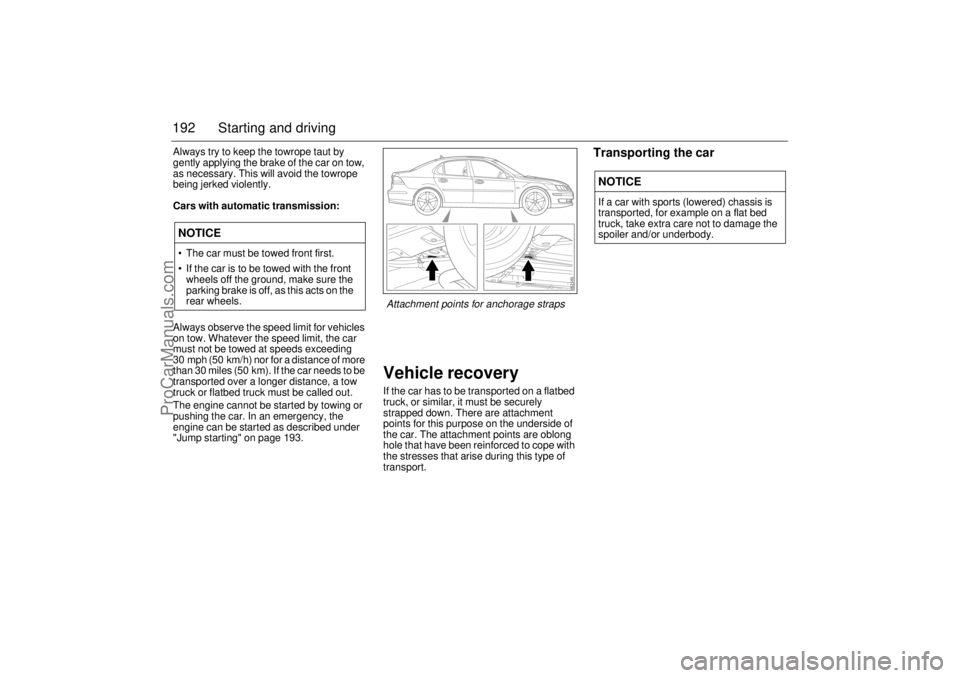
Vehicle recoveryIf the car has to be transported on a flatbed
truck, or similar, it must be securely
strapped down. There are attachment
points for this purpose on the underside of
the car. The attachment points are oblong
hole that have been reinforced to cope with
the stresses that arise during this type of
transport.
Transporting the car
NOTICE The car must be towed front first.
If the car is to be towed with the front
wheels off the ground, make sure the
parking brake is off, as this acts on the
rear wheels.
NOTICEIf a car with sports (lowered) chassis is
transported, for example on a flat bed
truck, take extra care not to damage the
spoiler and/or underbody.
Attachment points for anchorage straps
ProCarManuals.com