wheel SAAB 9-3 2005 User Guide
[x] Cancel search | Manufacturer: SAAB, Model Year: 2005, Model line: 9-3, Model: SAAB 9-3 2005Pages: 292, PDF Size: 23 MB
Page 40 of 292
38 Safety Let only qualified technicians work on
your airbag system. Improper service can
mean that your airbag system will not
work properly. See your dealer for
service.Notice:
If you damage the covering for
the driver's or the right front passenger's
airbag, or the side impact airbag cover-
ing on the ceiling near the side windows,
the bag may not work properly. You may
have to replace the airbag module in the
steering wheel, both the airbag module
and the instrument panel for the right
front passenger's airbag, or side impact
airbag module and ceiling covering for
the roof-mounted side impact airbag. Do
not open or break the airbag coverings.
Servicing the airbag systemThe airbag system must be inspected as
part of the normal service program but oth-
erwise may be regarded as maintenance-
free.
Scrapping or working on airbag
and belt pretensioners
WARNING
Under no circumstances should any
modifications be made that affect the
steering wheel or the airbag’s electri-
cal circuitry.
During any welding, both battery
cables must be disconnected and
covered.
Before quick drying paint in the vicinity
of the electronic control module, the
module’s grounding points and wiring
must be covered.
Airbags and safety belt pretensioners
must be deployed under controlled
conditions before the car is scrapped
or any of the system’s components are
removed. Airbags or belt pretension-
ers that have been deployed as a
result of a crash must be replaced by
new ones.
Airbag-system components must
never be transferred for use in another
vehicle.
All work involving the scrapping or
replacement of airbags or belt preten-
sioners must be carried out by autho-
rized personnel only.
ProCarManuals.com
Page 41 of 292

39 Safety
Frequently asked questions on
function of the airbagDo you still need to wear a safety belt if air-
bags are fitted?Yes, always! The airbag system compo-
nents merely supplement the car’s normal
safety system. Moreover, the front airbags
will only be actuated in a moderate to severe
frontal, or near-frontal crash, which means,
of course, that they provide no protection in
minor frontal crashes, major rear- or side-
crashes or if the car rolls over.
The safety belts help to reduce the sideway
movement of the body in a crash.
But they also ensure that, if a crash occurs
in which the airbags are inflated, the airbag
will make the optimum contact with the
occupant, i.e. square on from the front. If the
occupant meets the airbag in an offset posi-
tion, the protection afforded will be reduced.In addition, airbags provide no protection
against a secondary impact occurring in the
same incident. So there is no doubt about
the benefit of wearing safety belts at all
times.
Do not sit too close to the airbag: it needs
room to inflate.
The airbag inflates very quickly and power-
fully in order to protect an adult, before they
are thrown forward, in a serious frontal
crash.
How do I position the seat to leave room for
the airbag to inflate?Don’t have your seat too far forward.
Recline the seat back to increase the dis-
tance between you and the airbag. For short
drivers, special accessory pedal extensions
are available through your Saab dealer.
Airbags inflate extremely rapidly and with
great force – to be fast enough to protect an
adult in the seat.
When do the airbags in the steering wheel
and passenger side of the dash board
inflate? The airbag will only be inflated under certain
predetermined conditions in a moderate to
severe frontal, or near-frontal crash,
depending on such factors as the force and
angle of the impact, the speed of the car on
impact, and the resistance to deformation of
the impacting object.
The airbag can only be activated once in the
same incident.
Do not attempt to drive the car after an
airbag has been inflated, even if it is possi-
ble.What won’t trigger the airbag? The airbag will not be activated in all frontal
crashes. For instance, if the car has hit
something relatively soft and yielding (e.g. a
snow drift or a hedge) or a solid object at a
low impact speed, the airbag will not neces-
sarily be triggered.
ProCarManuals.com
Page 46 of 292
44 SecurityLocking/unlocking the carRemote locking and unlocking also control
the car alarm.
Remote locking
Press the button once: all doors and
the trunk lid locked (Convertible: also fuel
filler door).
The hazard warning lights will flash once to
confirm.Remote unlocking
Pressing the button once: the driver´s
door is unlocked (Convertible: also fuel filler
door). Press a second time to unlock the
rest of the doors and enable the trunk lid
switch.
The hazard warning lights will flash twice to
confirm.
If a fault arises in the locking system, the
Saab Information Display (SID) will display:
Saab Information Display (SID), see
page 87.
Intermittent malfunctioning
Equipment in the vicinity of the car that uses
the same frequency as the remote control
may cause interference to the remote con-
trol signal. In this case, retry from another
angle and aim at the receiver located by the
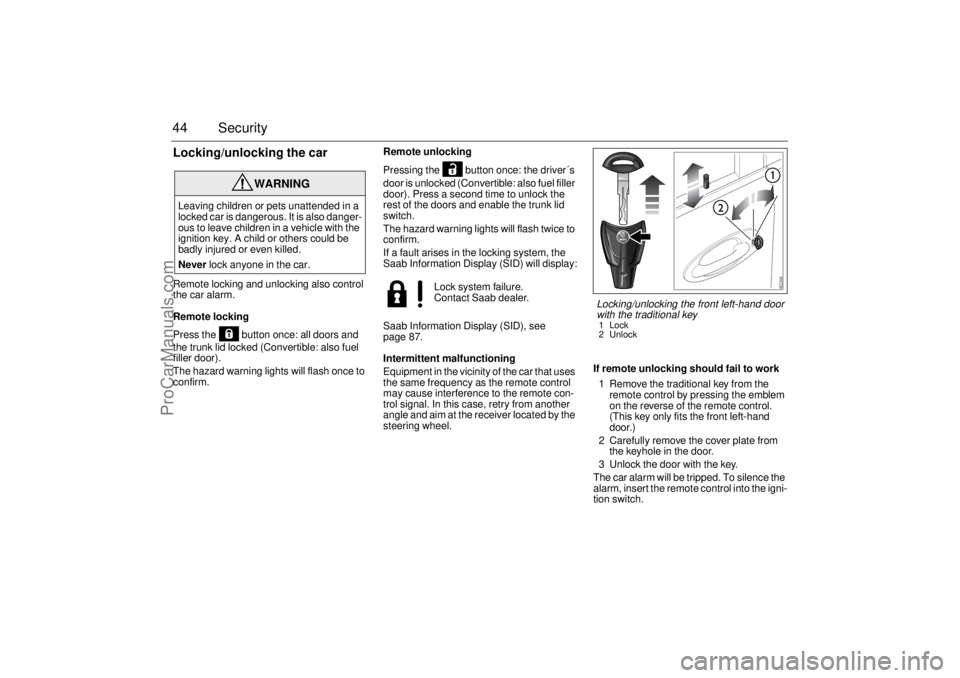
steering wheel.If remote unlocking should fail to work
1 Remove the traditional key from the
remote control by pressing the emblem
on the reverse of the remote control.
(This key only fits the front left-hand
door.)
2 Carefully remove the cover plate from
the keyhole in the door.
3 Unlock the door with the key.
The car alarm will be tripped. To silence the
alarm, insert the remote control into the igni-
tion switch.
WARNING
Leaving children or pets unattended in a
locked car is dangerous. It is also danger-
ous to leave children in a vehicle with the
ignition key. A child or others could be
badly injured or even killed.
Never lock anyone in the car.
Lock system failure.
Contact Saab dealer.
Locking/unlocking the front left-hand door
with the traditional key1 Lock
2 Unlock
ProCarManuals.com
Page 47 of 292
45 Security
Locking a car with dead batteryThe steering wheel lock requires sufficient
battery voltage to lock and unlock. If the bat-
tery voltage drops below a certain level
while the remote control is in the ignition
switch, you will not be able to remove the
remote control.
If you must leave the car, proceed as
follows:
1 Lock the car by pressing down the lock
buttons on the doors.
2 Lock the front left door from outside with
the traditional key (see page 44). The
car is now locked but the car alarm will
remain inactive.
Trunk lidOpening
The trunk lid is unlocked and slightly opened
when the button on the remote control
or on the inside of the driver’s door is
pressed once.
The hazard warning lights will flash three
times to confirm.
Closing
The trunk lid is locked when closed.
If the doors are locked when the trunk lid is
closed it is armed and the movement sensor
in the cabin will be armed.
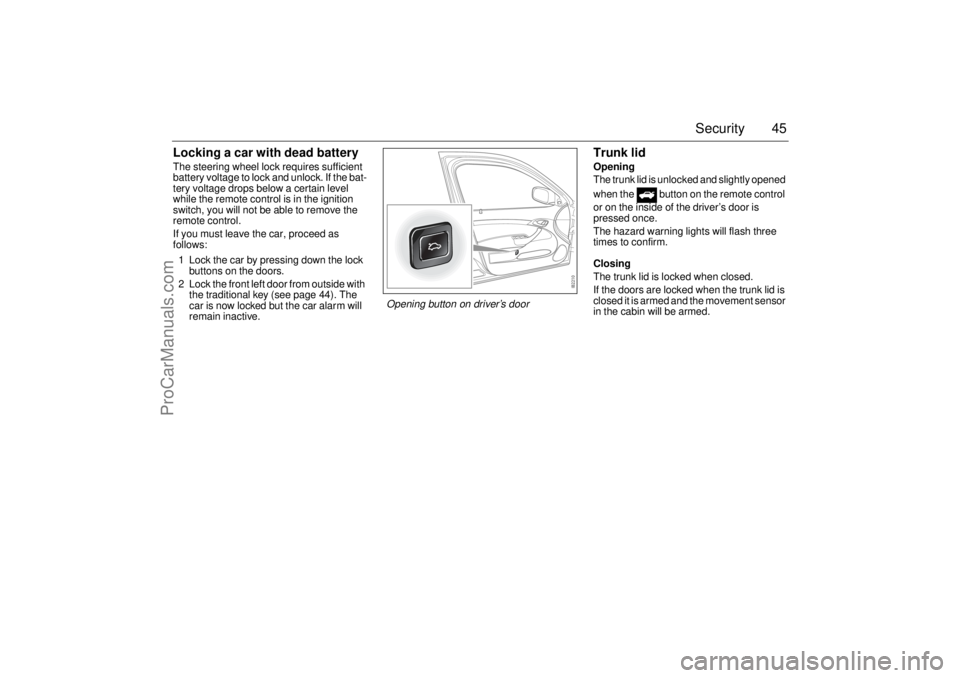
Opening button on driver’s door
ProCarManuals.com
Page 82 of 292
80 Instruments and controlsThis light shows when the high beam is on
(see page 97).
This light indicates when the front fog lights
are on (see page 98).
The front fog lights are switched off auto-
matically when the engine is switched off.
When the fog lights are next needed, they
will have to be switched on manually.This light should come on briefly when you
turn the ignition key to ON. If it doesn´t come
on, have it fixed so it will be ready to warn
you if there is a problem. This light indicates
when the brake fluid level is too low (see
page 206).
The following message is shown on the
Saab Information Display (SID):For safety reasons, stop the car and check
the level of the brake fluid (see page 206).
If the level is normal, depress the brake
pedal firmly two or three times. Now check
the level again. If the level is still normal, you
may drive the car, with considerable cau-
tion, to the nearest Saab dealer to have the
brake system checked.
The brake system provides Electronic
Brakeforce Distribution (EBD). This distrib-
utes the brake pressure between the front
and rear wheels, in such a way as to achieve
optimum braking performance irrespective
of the car’s load.
If a fault arises in the EBD function, the ,
and lights will come on. Also, the fol-
lowing message will appear on the Saab
Information Display (SID):
If this is the case, drive carefully and contact
a Saab dealer as soon as possible. Refer to
Brake warning light on page 80, Antilock
braking warning on page 78 and TCS OFF
or ESP OFF indicator on page 86.
High beam Indicator
Front fog lights (option)
Brake warning lightBrake fluid level low.
Make a safe stop.
Contact Saab dealer.
WARNING
Never drive the car if these two lights
are on at the same time. Danger of
brake failure!
If the level of brake fluid in the reser-
voir is below the MIN mark, the vehicle
should be transported on a recovery
vehicle.
Have the brake system checked
immediately at a Saab dealer.
Brake malfunction.
Make a safe stop.
Contact Saab dealer.
ProCarManuals.com
Page 83 of 292
81 Instruments and controls
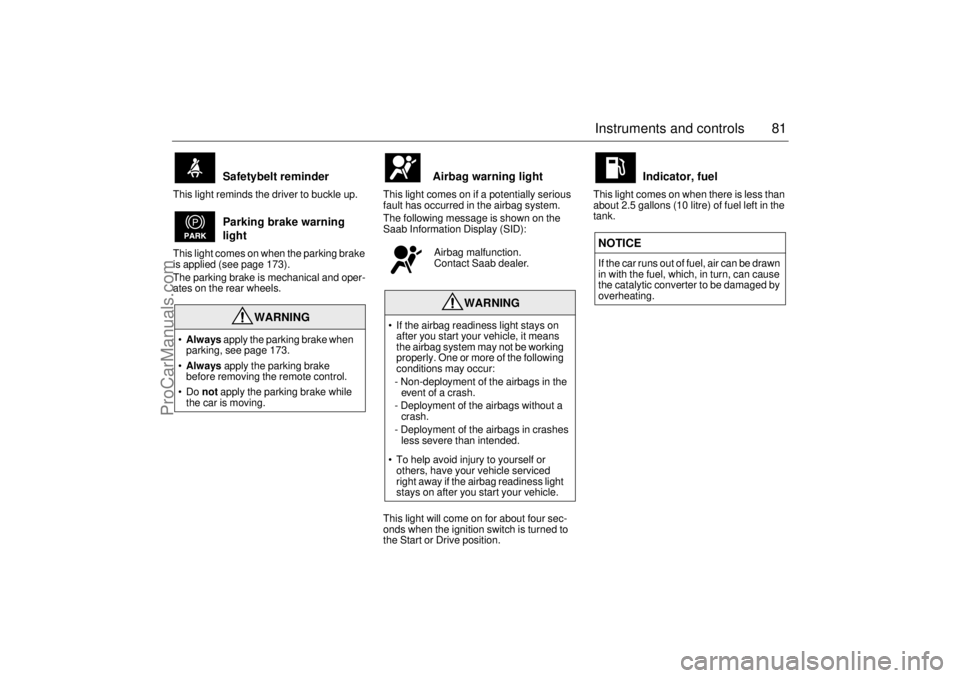
This light reminds the driver to buckle up.
This light comes on when the parking brake
is applied (see page 173).
The parking brake is mechanical and oper-
ates on the rear wheels.This light comes on if a potentially serious
fault has occurred in the airbag system.
The following message is shown on the
Saab Information Display (SID):
This light will come on for about four sec-
onds when the ignition switch is turned to
the Start or Drive position.This light comes on when there is less than
about 2.5 gallons (10 litre) of fuel left in the
tank.
Safetybelt reminder
Parking brake warning
light
WARNING
Always apply the parking brake when
parking, see page 173.
Always apply the parking brake
before removing the remote control.
Do not apply the parking brake while
the car is moving.
Airbag warning lightAirbag malfunction.
Contact Saab dealer.
WARNING
If the airbag readiness light stays on
after you start your vehicle, it means
the airbag system may not be working
properly. One or more of the following
conditions may occur:
- Non-deployment of the airbags in the
event of a crash.
- Deployment of the airbags without a
crash.
- Deployment of the airbags in crashes
less severe than intended.
To help avoid injury to yourself or
others, have your vehicle serviced
right away if the airbag readiness light
stays on after you start your vehicle.
Indicator, fuel
NOTICE
If the car runs out of fuel, air can be drawn
in with the fuel, which, in turn, can cause
the catalytic converter to be damaged by
overheating.
ProCarManuals.com
Page 85 of 292
83 Instruments and controls
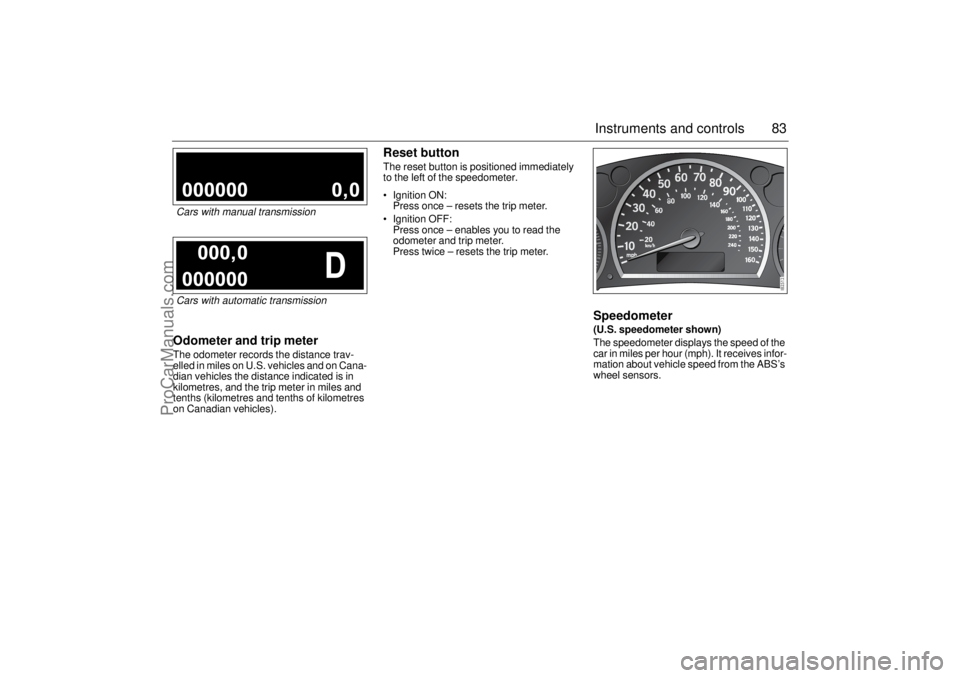
Odometer and trip meterThe odometer records the distance trav-
elled in miles on U.S. vehicles and on Cana-
dian vehicles the distance indicated is in
kilometres, and the trip meter in miles and
tenths (kilometres and tenths of kilometres
on Canadian vehicles).
Reset buttonThe reset button is positioned immediately
to the left of the speedometer.
Ignition ON:
Press once – resets the trip meter.
Ignition OFF:
Press once – enables you to read the
odometer and trip meter.
Press twice – resets the trip meter.
Speedometer (U.S. speedometer shown)
The speedometer displays the speed of the
car in miles per hour (mph). It receives infor-
mation about vehicle speed from the ABS’s
wheel sensors.
Cars with manual transmissionCars with automatic transmission
ProCarManuals.com
Page 99 of 292
97 Instruments and controls
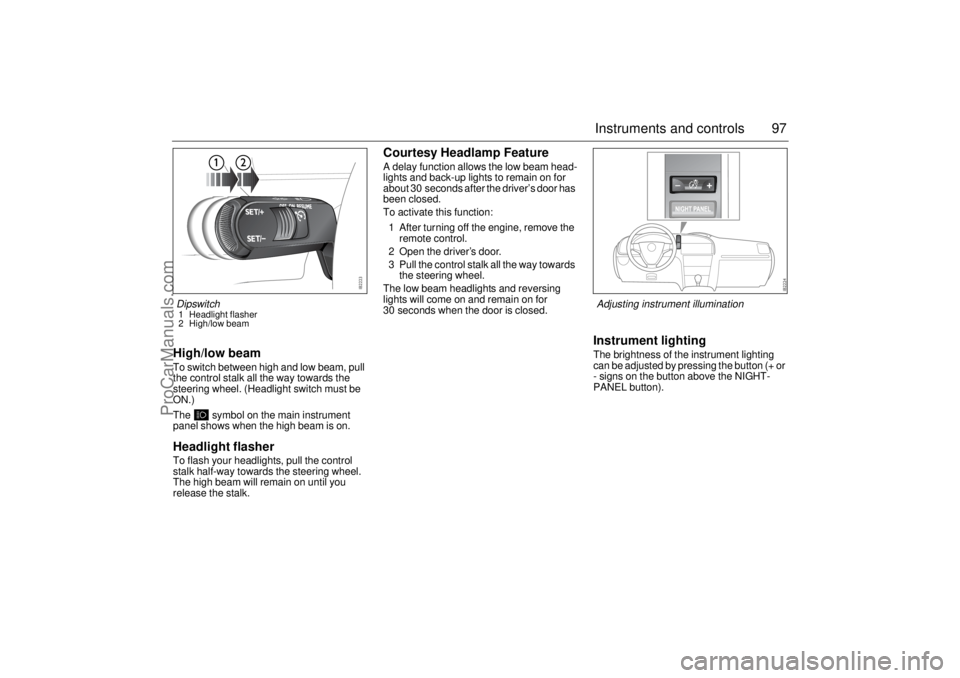
High/low beamTo switch between high and low beam, pull
the control stalk all the way towards the
steering wheel. (Headlight switch must be
ON.)
The symbol on the main instrument
panel shows when the high beam is on.Headlight flasherTo flash your headlights, pull the control
stalk half-way towards the steering wheel.
The high beam will remain on until you
release the stalk.
Courtesy Headlamp FeatureA delay function allows the low beam head-
lights and back-up lights to remain on for
about 30 seconds after the driver’s door has
been closed.
To activate this function:
1 After turning off the engine, remove the
remote control.
2 Open the driver’s door.
3 Pull the control stalk all the way towards
the steering wheel.
The low beam headlights and reversing
lights will come on and remain on for
30 seconds when the door is closed.
Instrument lightingThe brightness of the instrument lighting
can be adjusted by pressing the button (+ or
- signs on the button above the NIGHT-
PANEL button).
Dipswitch1 Headlight flasher
2 High/low beam
Adjusting instrument illumination
ProCarManuals.com
Page 100 of 292
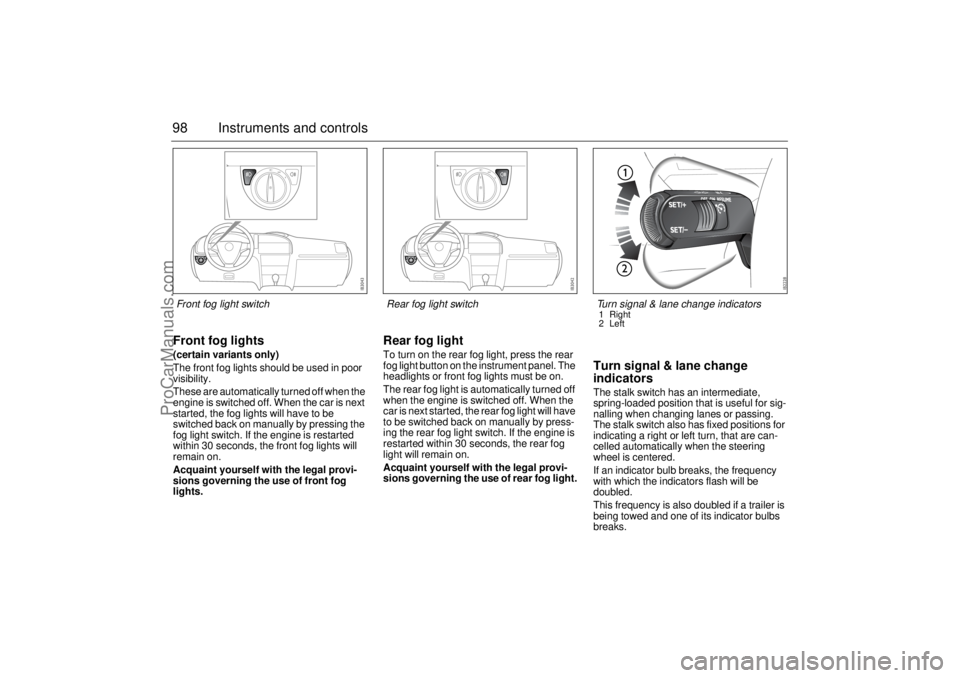
98 Instruments and controlsFront fog lights (certain variants only)
The front fog lights should be used in poor
visibility.
These are automatically turned off when the
engine is switched off. When the car is next
started, the fog lights will have to be
switched back on manually by pressing the
fog light switch. If the engine is restarted
within 30 seconds, the front fog lights will
remain on.
Acquaint yourself with the legal provi-
sions governing the use of front fog
lights.
Rear fog lightTo turn on the rear fog light, press the rear
fog light button on the instrument panel. The
headlights or front fog lights must be on.
The rear fog light is automatically turned off
when the engine is switched off. When the
car is next started, the rear fog light will have
to be switched back on manually by press-
ing the rear fog light switch. If the engine is
restarted within 30 seconds, the rear fog
light will remain on.
Acquaint yourself with the legal provi-
sions governing the use of rear fog light.
Turn signal & lane change
indicatorsThe stalk switch has an intermediate,
spring-loaded position that is useful for sig-
nalling when changing lanes or passing.
The stalk switch also has fixed positions for
indicating a right or left turn, that are can-
celled automatically when the steering
wheel is centered.
If an indicator bulb breaks, the frequency
with which the indicators flash will be
doubled.
This frequency is also doubled if a trailer is
being towed and one of its indicator bulbs
breaks.
Front fog light switch
Rear fog light switch
Turn signal & lane change indicators1 Right
2 Left
ProCarManuals.com
Page 102 of 292
100 Instruments and controlsPriority of audible informationSound from various functions in the car,
such as the direction indicators, parking
assistance and seatbelt reminders, come
from the same sound source: the car’s
sound system. If two or more of these func-
tions are active simultaneously, the most
important function at that time will be priori-
tized.
If, for example, the direction indicators are
active when you engage reverse, the park-
ing assistance (if fitted) will be heard instead
of the direction indicators. When reverse is
disengaged, the direction indicators will be
heard, if they are still active.
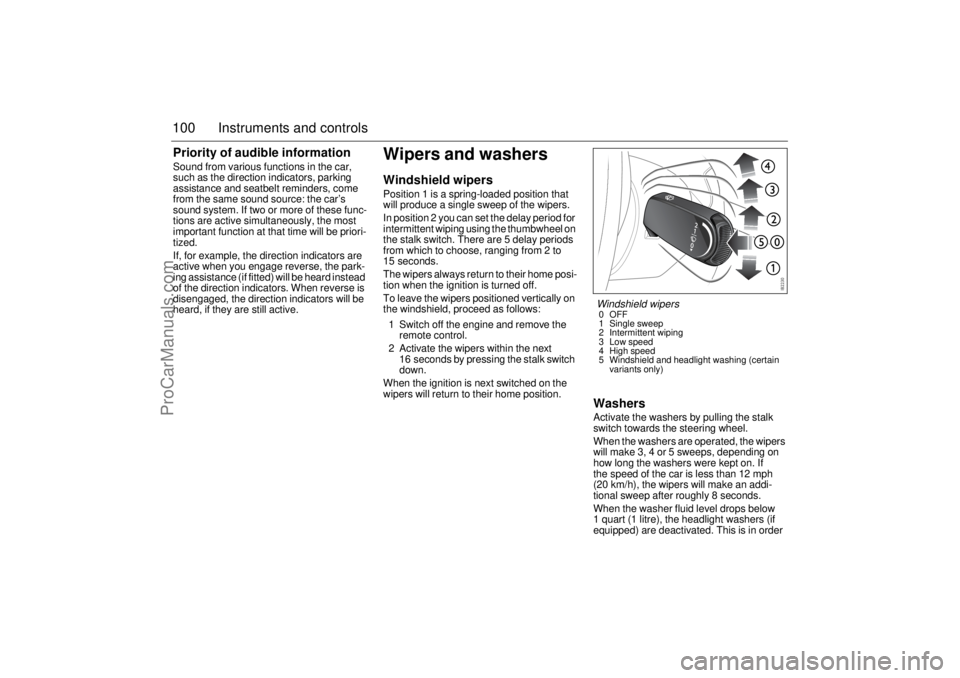
Wipers and washersWindshield wipersPosition 1 is a spring-loaded position that
will produce a single sweep of the wipers.
In position 2 you can set the delay period for
intermittent wiping using the thumbwheel on
the stalk switch. There are 5 delay periods
from which to choose, ranging from 2 to
15 seconds.
The wipers always return to their home posi-
tion when the ignition is turned off.
To leave the wipers positioned vertically on
the windshield, proceed as follows:
1 Switch off the engine and remove the
remote control.
2 Activate the wipers within the next
16 seconds by pressing the stalk switch
down.
When the ignition is next switched on the
wipers will return to their home position.
WashersActivate the washers by pulling the stalk
switch towards the steering wheel.
When the washers are operated, the wipers
will make 3, 4 or 5 sweeps, depending on
how long the washers were kept on. If
the speed of the car is less than 12 mph
(20 km/h), the wipers will make an addi-
tional sweep after roughly 8 seconds.
When the washer fluid level drops below
1 quart (1 litre), the headlight washers (if
equipped) are deactivated. This is in order Windshield wipers0OFF
1 Single sweep
2 Intermittent wiping
3 Low speed
4 High speed
5 Windshield and headlight washing (certain
variants only)
ProCarManuals.com