brake SAAB 9-3 2005 Owners Manual
[x] Cancel search | Manufacturer: SAAB, Model Year: 2005, Model line: 9-3, Model: SAAB 9-3 2005Pages: 292, PDF Size: 23 MB
Page 6 of 292
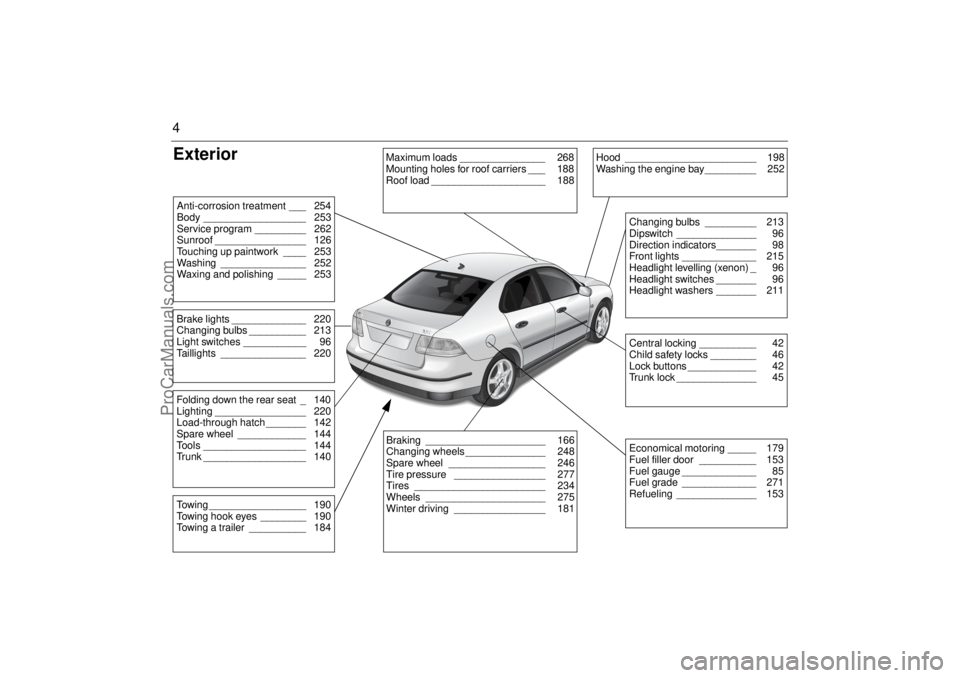
4ExteriorAnti-corrosion treatment ___ 254
Body __________________ 253
Service program _________ 262
Sunroof ________________ 126
Touching up paintwork ____ 253
Washing _______________ 252
Waxing and polishing _____ 253Brake lights _____________ 220
Changing bulbs __________ 213
Light switches ___________ 96
Taillights _______________ 220Towing _________________ 190
Towing hook eyes ________ 190
Towing a trailer __________ 184Folding down the rear seat _ 140
Lighting ________________ 220
Load-through hatch _______ 142
Spare wheel ____________ 144
Tools __________________ 144
Trunk __________________ 140
Maximum loads _______________ 268
Mounting holes for roof carriers ___ 188
Roof load ____________________ 188
Hood _______________________ 198
Washing the engine bay_________ 252
Central locking __________ 42
Child safety locks ________ 46
Lock buttons ____________ 42
Trunk lock ______________ 45Changing bulbs _________ 213
Dipswitch ______________ 96
Direction indicators_______ 98
Front lights _____________ 215
Headlight levelling (xenon) _ 96
Headlight switches _______ 96
Headlight washers _______ 211Economical motoring _____ 179
Fuel filler door __________ 153
Fuel gauge _____________ 85
Fuel grade _____________ 271
Refueling ______________ 153
Braking _____________________ 166
Changing wheels ______________ 248
Spare wheel _________________ 246
Tire pressure ________________ 277
Tires _______________________ 234
Wheels _____________________ 275
Winter driving ________________ 181
ProCarManuals.com
Page 7 of 292
5
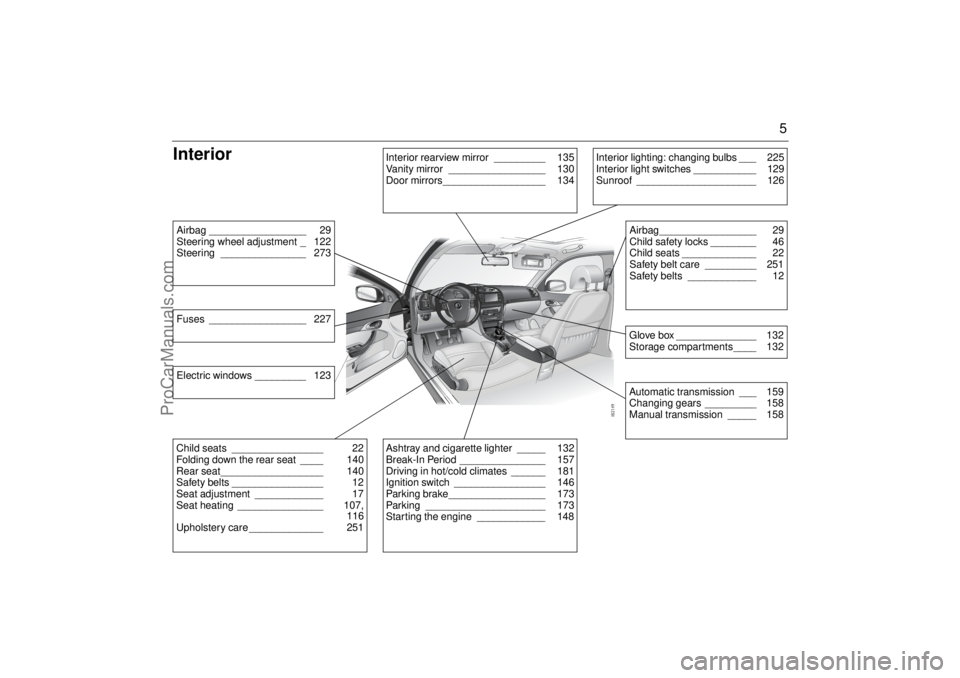
InteriorAirbag _________________ 29
Steering wheel adjustment _ 122
Steering _______________ 273
Interior rearview mirror _________ 135
Vanity mirror _________________ 130
Door mirrors__________________ 134
Airbag_________________ 29
Child safety locks ________ 46
Child seats _____________ 22
Safety belt care _________ 251
Safety belts ____________ 12Glove box ______________ 132
Storage compartments____ 132Automatic transmission ___ 159
Changing gears _________ 158
Manual transmission _____ 158
Child seats ________________ 22
Folding down the rear seat ____ 140
Rear seat__________________ 140
Safety belts ________________ 12
Seat adjustment ____________ 17
Seat heating _______________ 107,
116
Upholstery care _____________ 251
Interior lighting: changing bulbs ___ 225
Interior light switches ___________ 129
Sunroof _____________________ 126
Ashtray and cigarette lighter _____ 132
Break-In Period _______________ 157
Driving in hot/cold climates ______ 181
Ignition switch ________________ 146
Parking brake_________________ 173
Parking _____________________ 173
Starting the engine ____________ 148
Fuses _________________ 227Electric windows _________ 123
ProCarManuals.com
Page 8 of 292
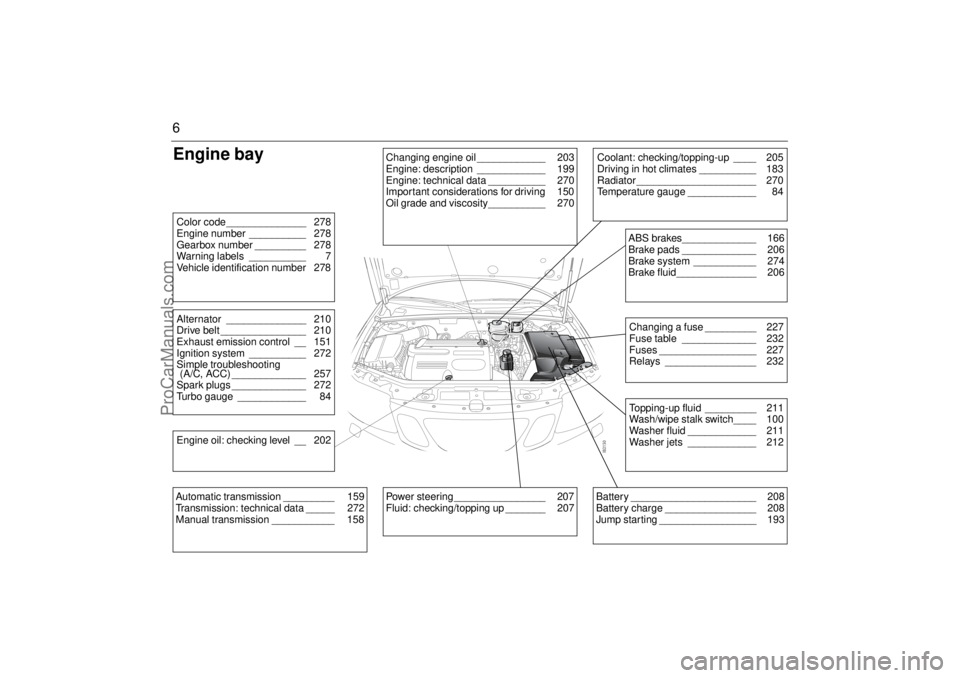
6Engine bayColor code______________ 278
Engine number __________ 278
Gearbox number _________ 278
Warning labels __________ 7
Vehicle identification number 278Alternator ______________ 210
Drive belt _______________ 210
Exhaust emission control __ 151
Ignition system __________ 272
Simple troubleshooting
(A/C, ACC) _____________ 257
Spark plugs _____________ 272
Turbo gauge ____________ 84Engine oil: checking level __ 202Automatic transmission _________ 159
Transmission: technical data _____ 272
Manual transmission ___________ 158
Battery ______________________ 208
Battery charge ________________ 208
Jump starting _________________ 193
Changing engine oil ____________ 203
Engine: description ____________ 199
Engine: technical data __________ 270
Important considerations for driving 150
Oil grade and viscosity__________ 270
Topping-up fluid _________ 211
Wash/wipe stalk switch____ 100
Washer fluid ____________ 211
Washer jets ____________ 212
Power steering ________________ 207
Fluid: checking/topping up _______ 207
Coolant: checking/topping-up ____ 205
Driving in hot climates __________ 183
Radiator _____________________ 270
Temperature gauge ____________ 84
Changing a fuse _________ 227
Fuse table _____________ 232
Fuses _________________ 227
Relays ________________ 232ABS brakes_____________ 166
Brake pads _____________ 206
Brake system ___________ 274
Brake fluid______________ 206
ProCarManuals.com
Page 10 of 292
8
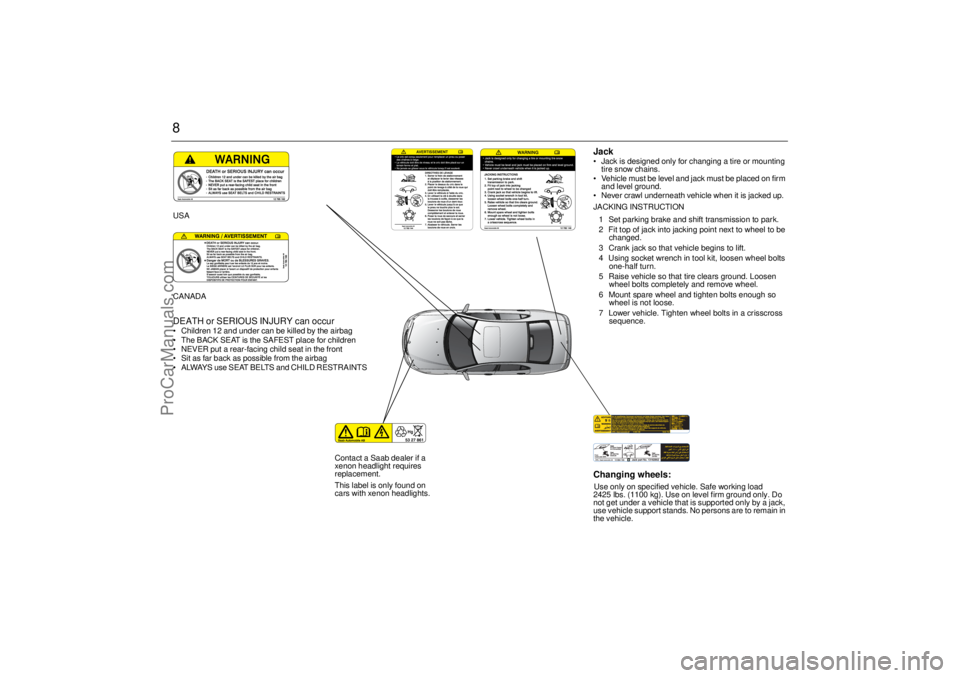
Changing wheels:Use only on specified vehicle. Safe working load
2425 lbs. (1100 kg). Use on level firm ground only. Do
not get under a vehicle that is supported only by a jack,
use vehicle support stands. No persons are to remain in
the vehicle.
Contact a Saab dealer if a
xenon headlight requires
replacement.
This label is only found on
cars with xenon headlights.
DEATH or SERIOUS INJURY can occur Children 12 and under can be killed by the airbag
The BACK SEAT is the SAFEST place for children
NEVER put a rear-facing child seat in the front
Sit as far back as possible from the airbag
ALWAYS use SEAT BELTS and CHILD RESTRAINTSUSA
CANADA
Jack Jack is designed only for changing a tire or mounting
tire snow chains.
Vehicle must be level and jack must be placed on firm
and level ground.
Never crawl underneath vehicle when it is jacked up.
JACKING INSTRUCTION
1 Set parking brake and shift transmission to park.
2 Fit top of jack into jacking point next to wheel to be
changed.
3 Crank jack so that vehicle begins to lift.
4 Using socket wrench in tool kit, loosen wheel bolts
one-half turn.
5 Raise vehicle so that tire clears ground. Loosen
wheel bolts completely and remove wheel.
6 Mount spare wheel and tighten bolts enough so
wheel is not loose.
7 Lower vehicle. Tighten wheel bolts in a crisscross
sequence.
ProCarManuals.com
Page 11 of 292
9
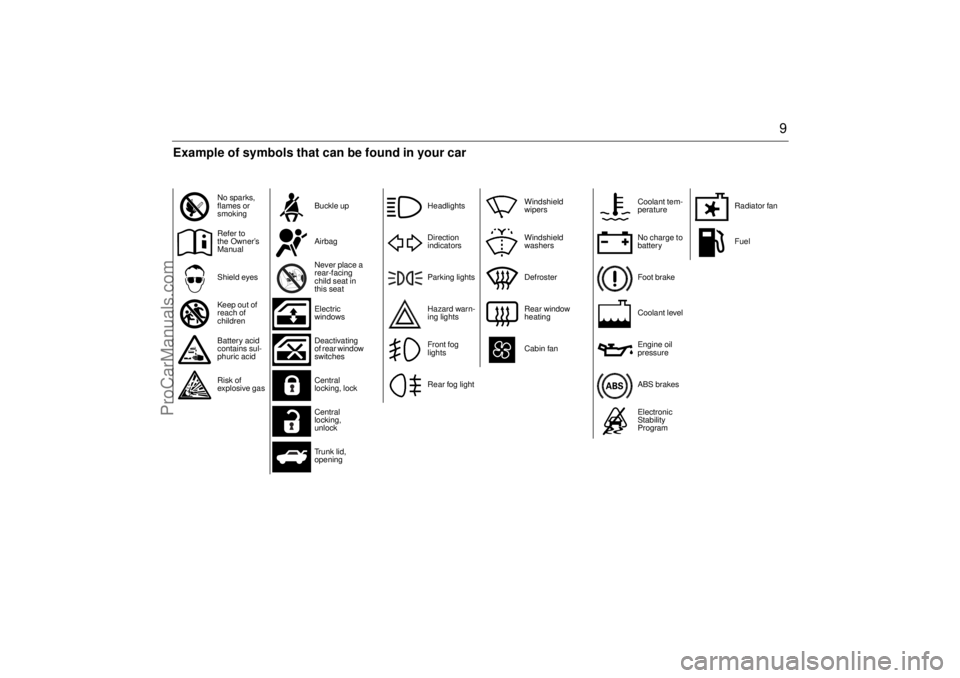
No sparks,
flames or
smokingBuckle up
Refer to
the Owner’s
ManualAirbag
Shield eyesNever place a
rear-facing
child seat in
this seat
Keep out of
reach of
childrenElectric
windows
Battery acid
contains sul-
phuric acidDeactivating
of rear window
switches
Risk of
explosive gasCentral
locking, lock
Central
locking,
unlock
Trunk lid,
opening
HeadlightsWindshield
wipers
Direction
indicatorsWindshield
washers
Parking lights Defroster
Hazard warn-
ing lightsRear window
heating
Front fog
lightsCabin fan
Rear fog light
Coolant tem-
peratureRadiator fan
No charge to
batteryFuel
Foot brake
Coolant level
Engine oil
pressure
ABS brakes
Electronic
Stability
Program
Example of symbols that can be found in your car
ProCarManuals.com
Page 15 of 292
13 Safety
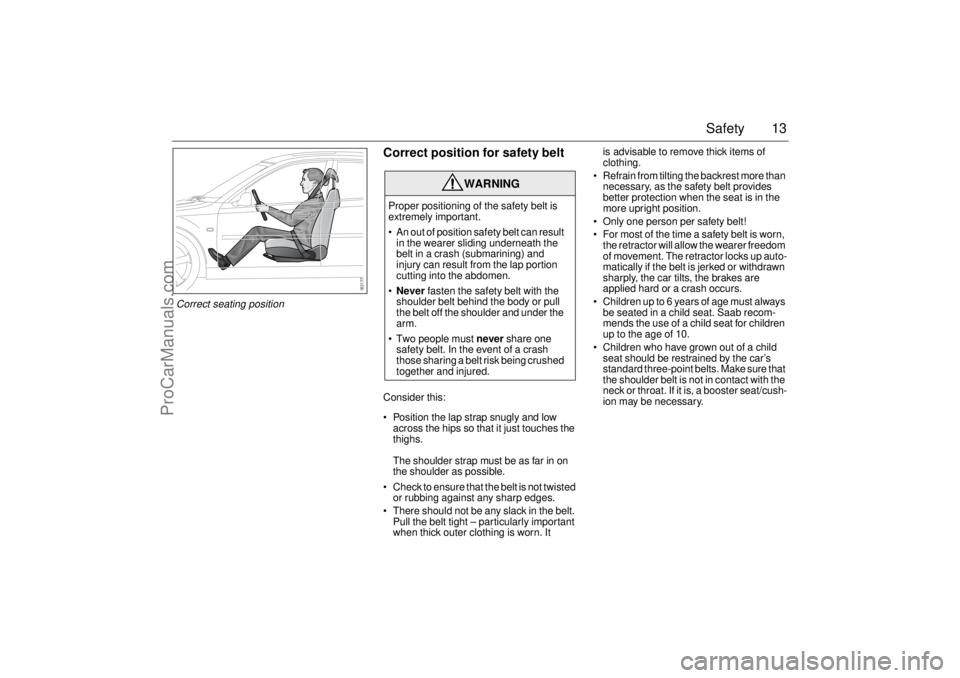
Correct position for safety beltConsider this:
Position the lap strap snugly and low
across the hips so that it just touches the
thighs.
The shoulder strap must be as far in on
the shoulder as possible.
Check to ensure that the belt is not twisted
or rubbing against any sharp edges.
There should not be any slack in the belt.
Pull the belt tight – particularly important
when thick outer clothing is worn. It is advisable to remove thick items of
clothing.
Refrain from tilting the backrest more than
necessary, as the safety belt provides
better protection when the seat is in the
more upright position.
Only one person per safety belt!
For most of the time a safety belt is worn,
the retractor will allow the wearer freedom
of movement. The retractor locks up auto-
matically if the belt is jerked or withdrawn
sharply, the car tilts, the brakes are
applied hard or a crash occurs.
Children up to 6 years of age must always
be seated in a child seat. Saab recom-
mends the use of a child seat for children
up to the age of 10.
Children who have grown out of a child
seat should be restrained by the car’s
standard three-point belts. Make sure that
the shoulder belt is not in contact with the
neck or throat. If it is, a booster seat/cush-
ion may be necessary.
WARNING
Proper positioning of the safety belt is
extremely important.
An out of position safety belt can result
in the wearer sliding underneath the
belt in a crash (submarining) and
injury can result from the lap portion
cutting into the abdomen.
Never fasten the safety belt with the
shoulder belt behind the body or pull
the belt off the shoulder and under the
arm.
Two people must never share one
safety belt. In the event of a crash
those sharing a belt risk being crushed
together and injured.
Correct seating position
ProCarManuals.com
Page 80 of 292
78 Instruments and controls
Warning and indicator
lightsThe following warning and indicator lights
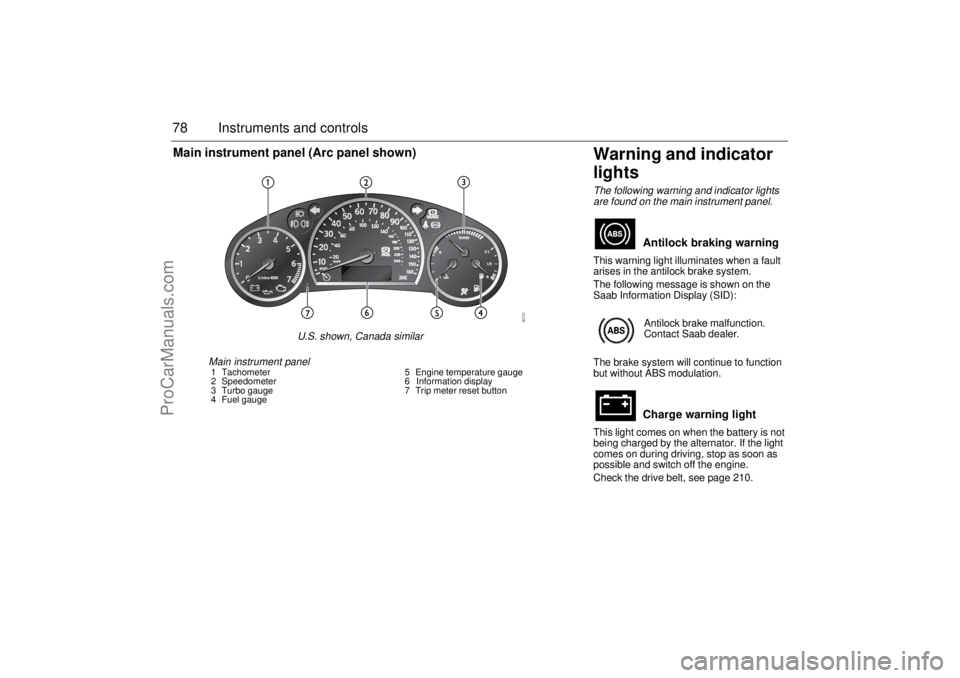
are found on the main instrument panel.This warning light illuminates when a fault
arises in the antilock brake system.
The following message is shown on the
Saab Information Display (SID):
The brake system will continue to function
but without ABS modulation.
This light comes on when the battery is not
being charged by the alternator. If the light
comes on during driving, stop as soon as
possible and switch off the engine.
Check the drive belt, see page 210.
Antilock braking warningAntilock brake malfunction.
Contact Saab dealer.Charge warning light
Main instrument panel1 Tachometer
2 Speedometer
3 Turbo gauge
4 Fuel gauge5 Engine temperature gauge
6 Information display
7 Trip meter reset button
Main instrument panel (Arc panel shown)
U.S. shown, Canada similar
ProCarManuals.com
Page 81 of 292
79 Instruments and controls
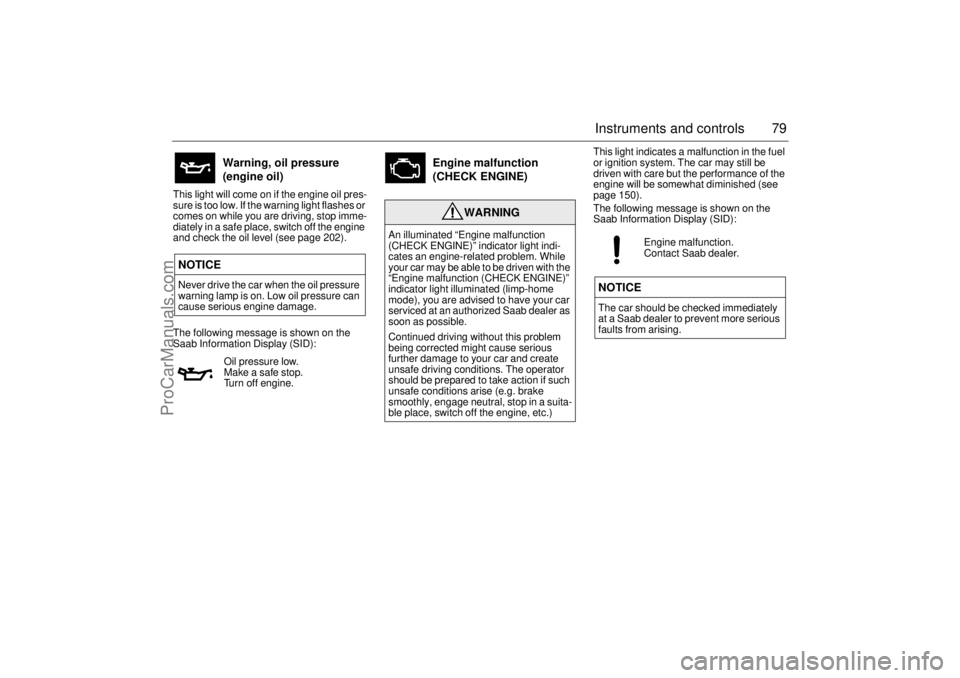
This light will come on if the engine oil pres-
sure is too low. If the warning light flashes or
comes on while you are driving, stop imme-
diately in a safe place, switch off the engine
and check the oil level (see page 202).
The following message is shown on the
Saab Information Display (SID):This light indicates a malfunction in the fuel
or ignition system. The car may still be
driven with care but the performance of the
engine will be somewhat diminished (see
page 150).
The following message is shown on the
Saab Information Display (SID):
Warning, oil pressure
(engine oil)
NOTICE
Never drive the car when the oil pressure
warning lamp is on. Low oil pressure can
cause serious engine damage.
Oil pressure low.
Make a safe stop.
Turn off engine.
Engine malfunction
(CHECK ENGINE)
WARNING
An illuminated “Engine malfunction
(CHECK ENGINE)” indicator light indi-
cates an engine-related problem. While
your car may be able to be driven with the
“Engine malfunction (CHECK ENGINE)”
indicator light illuminated (limp-home
mode), you are advised to have your car
serviced at an authorized Saab dealer as
soon as possible.
Continued driving without this problem
being corrected might cause serious
further damage to your car and create
unsafe driving conditions. The operator
should be prepared to take action if such
unsafe conditions arise (e.g. brake
smoothly, engage neutral, stop in a suita-
ble place, switch off the engine, etc.)
Engine malfunction.
Contact Saab dealer.
NOTICEThe car should be checked immediately
at a Saab dealer to prevent more serious
faults from arising.
ProCarManuals.com
Page 82 of 292
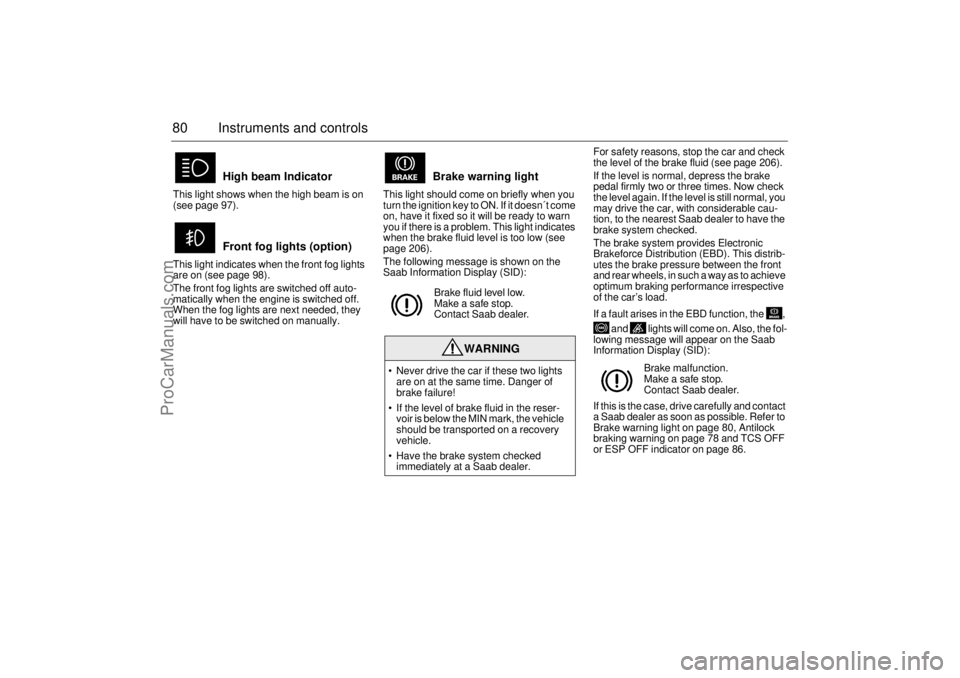
80 Instruments and controlsThis light shows when the high beam is on
(see page 97).
This light indicates when the front fog lights
are on (see page 98).
The front fog lights are switched off auto-
matically when the engine is switched off.
When the fog lights are next needed, they
will have to be switched on manually.This light should come on briefly when you
turn the ignition key to ON. If it doesn´t come
on, have it fixed so it will be ready to warn
you if there is a problem. This light indicates
when the brake fluid level is too low (see
page 206).
The following message is shown on the
Saab Information Display (SID):For safety reasons, stop the car and check
the level of the brake fluid (see page 206).
If the level is normal, depress the brake
pedal firmly two or three times. Now check
the level again. If the level is still normal, you
may drive the car, with considerable cau-
tion, to the nearest Saab dealer to have the
brake system checked.
The brake system provides Electronic
Brakeforce Distribution (EBD). This distrib-
utes the brake pressure between the front
and rear wheels, in such a way as to achieve
optimum braking performance irrespective
of the car’s load.
If a fault arises in the EBD function, the ,
and lights will come on. Also, the fol-
lowing message will appear on the Saab
Information Display (SID):
If this is the case, drive carefully and contact
a Saab dealer as soon as possible. Refer to
Brake warning light on page 80, Antilock
braking warning on page 78 and TCS OFF
or ESP OFF indicator on page 86.
High beam Indicator
Front fog lights (option)
Brake warning lightBrake fluid level low.
Make a safe stop.
Contact Saab dealer.
WARNING
Never drive the car if these two lights
are on at the same time. Danger of
brake failure!
If the level of brake fluid in the reser-
voir is below the MIN mark, the vehicle
should be transported on a recovery
vehicle.
Have the brake system checked
immediately at a Saab dealer.
Brake malfunction.
Make a safe stop.
Contact Saab dealer.
ProCarManuals.com
Page 83 of 292
81 Instruments and controls
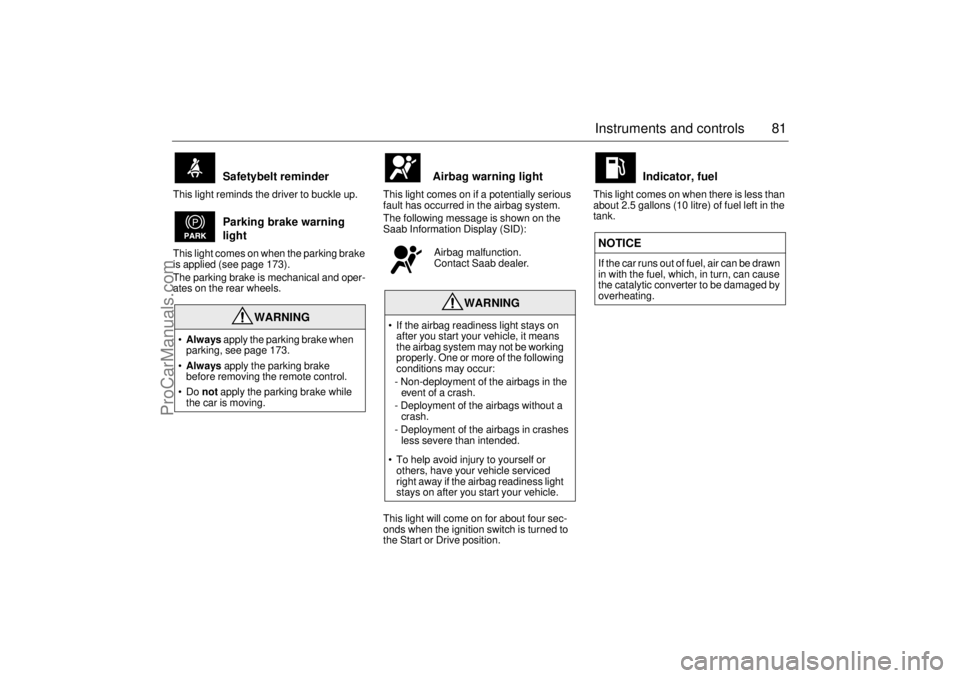
This light reminds the driver to buckle up.
This light comes on when the parking brake
is applied (see page 173).
The parking brake is mechanical and oper-
ates on the rear wheels.This light comes on if a potentially serious
fault has occurred in the airbag system.
The following message is shown on the
Saab Information Display (SID):
This light will come on for about four sec-
onds when the ignition switch is turned to
the Start or Drive position.This light comes on when there is less than
about 2.5 gallons (10 litre) of fuel left in the
tank.
Safetybelt reminder
Parking brake warning
light
WARNING
Always apply the parking brake when
parking, see page 173.
Always apply the parking brake
before removing the remote control.
Do not apply the parking brake while
the car is moving.
Airbag warning lightAirbag malfunction.
Contact Saab dealer.
WARNING
If the airbag readiness light stays on
after you start your vehicle, it means
the airbag system may not be working
properly. One or more of the following
conditions may occur:
- Non-deployment of the airbags in the
event of a crash.
- Deployment of the airbags without a
crash.
- Deployment of the airbags in crashes
less severe than intended.
To help avoid injury to yourself or
others, have your vehicle serviced
right away if the airbag readiness light
stays on after you start your vehicle.
Indicator, fuel
NOTICE
If the car runs out of fuel, air can be drawn
in with the fuel, which, in turn, can cause
the catalytic converter to be damaged by
overheating.
ProCarManuals.com