cruise control SAAB 9-3 2005 Owners Manual
[x] Cancel search | Manufacturer: SAAB, Model Year: 2005, Model line: 9-3, Model: SAAB 9-3 2005Pages: 292, PDF Size: 23 MB
Page 5 of 292
3
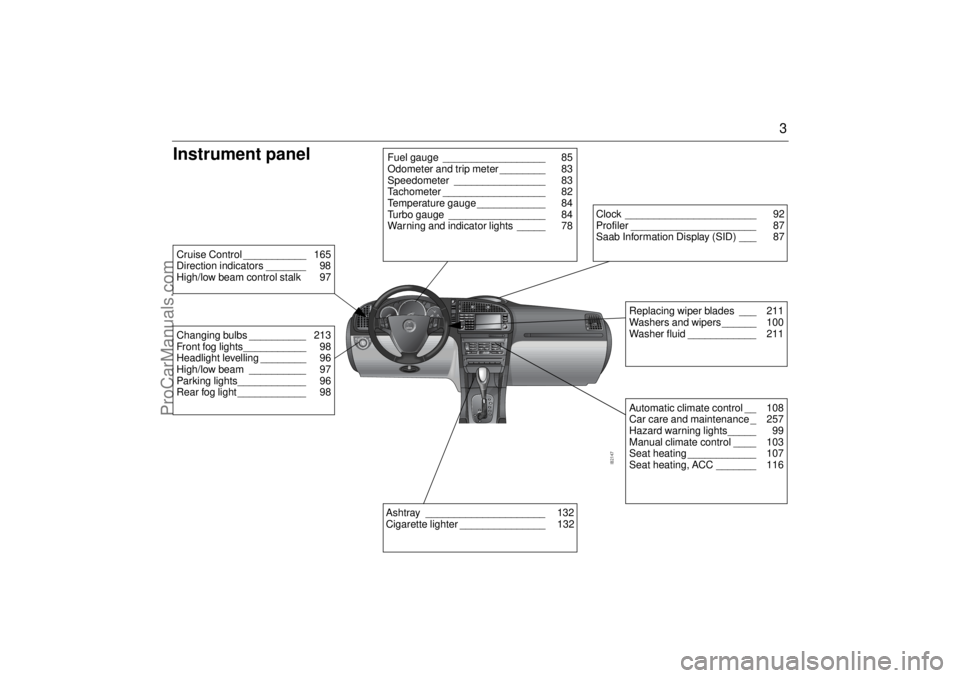
Instrument panelChanging bulbs __________ 213
Front fog lights___________ 98
Headlight levelling ________ 96
High/low beam __________ 97
Parking lights____________ 96
Rear fog light ____________ 98Cruise Control ___________ 165
Direction indicators _______ 98
High/low beam control stalk 97
Fuel gauge __________________ 85
Odometer and trip meter ________ 83
Speedometer ________________ 83
Tachometer __________________ 82
Temperature gauge ____________ 84
Turbo gauge _________________ 84
Warning and indicator lights _____ 78Ashtray _____________________ 132
Cigarette lighter _______________ 132
Clock _______________________ 92
Profiler ______________________ 87
Saab Information Display (SID) ___ 87
Replacing wiper blades ___ 211
Washers and wipers ______ 100
Washer fluid ____________ 211Automatic climate control __ 108
Car care and maintenance _ 257
Hazard warning lights_____ 99
Manual climate control ____ 103
Seat heating ____________ 107
Seat heating, ACC _______ 116
ProCarManuals.com
Page 84 of 292
82 Instruments and controlsThis light indicates that the headlights or
parking lights are on.
This light comes on when the system is
engaged.
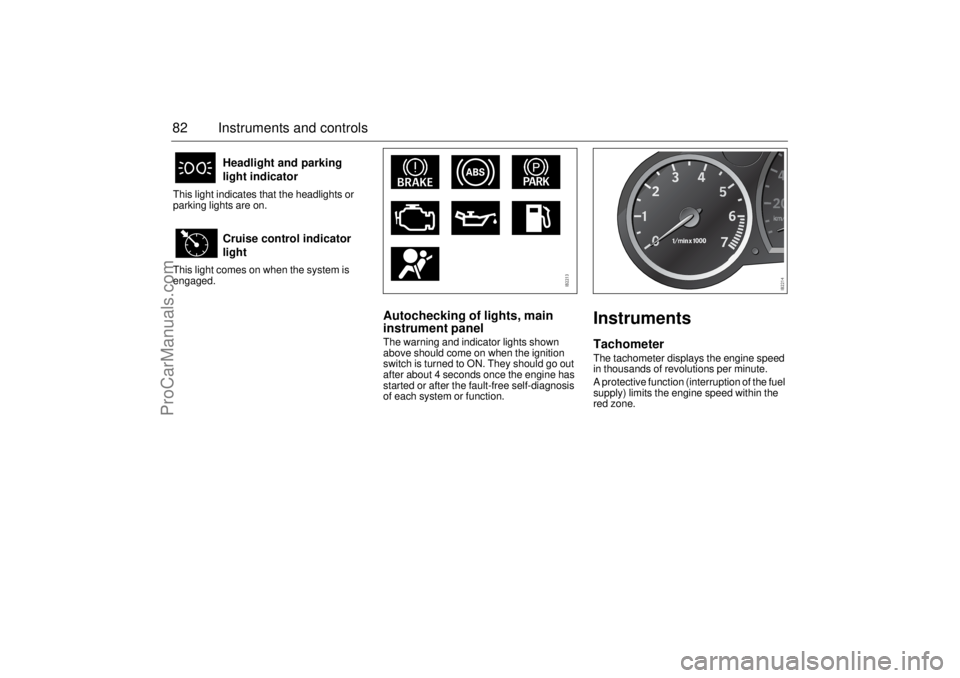
Autochecking of lights, main
instrument panelThe warning and indicator lights shown
above should come on when the ignition
switch is turned to ON. They should go out
after about 4 seconds once the engine has
started or after the fault-free self-diagnosis
of each system or function.
InstrumentsTachometerThe tachometer displays the engine speed
in thousands of revolutions per minute.
A protective function (interruption of the fuel
supply) limits the engine speed within the
red zone.
Headlight and parking
light indicator
Cruise control indicator
light
ProCarManuals.com
Page 147 of 292
145 Starting and driving
Ignition switch ________ 146
Steering wheel lock ____ 148
Starting the engine ____ 148
Important considerations
for driving __________ 150
Refueling ____________ 153
Engine Break-in Period _ 157
Manual transmission___ 158
Automatic transmission 159
Cruise control ________ 165
Braking ______________ 166
Traction Control System
(TCS) ______________ 169
Electronic Stability
Program (ESP) ______ 171
Parking brake_________ 173
Parking ______________ 173
Saab Parking Assistance 176 Economical driving _____ 179
Driving in cold weather__ 181
Driving in hot climates __ 183
Towing a trailer ________ 184
Driving with a roof rack
load ________________ 188
Driving with a load _____ 189
Driving with the trunk lid
open________________ 189
Driving in deep water ___ 189
Driving at night ________ 190
Towing the car _________ 190
Driving with the compact
spare tire ____________ 193
Jump starting _________ 193
For long trips __________ 196
Starting and driving
ProCarManuals.com
Page 152 of 292

150 Starting and drivingImportant
considerations for
driving1 Starting and driving
Do not use full throttle until the engine
is warm, so as to avoid unnecessary
wear. If the needle of the turbo gauge
repeatedly enters the red zone, the
engine may suddenly lose power, due
to the initiation of a monitoring system
that limits the boost pressure. Contact
a Saab dealer as soon as possible.
Under certain barometric conditions
(high outside temperature and/or high
altitude) the needle may enter the first
part of the red zone without necessarily
indicating that a fault has arisen.
A protective function (interruption of the
fuel supply) limits the engine speed.2 Stopping the engine
Do not rev the engine immediately
before switching it off - stop the engine
when it is idling.
3 Regulating the boost pressure
One of the advantages of boost pres-
sure regulation is that the engine can
also be run safely on gasoline with a
lower octane rating, although not lower
than AON 87. However, engine perfor-
mance will fall slightly and heavy load-
ing and laboring should be avoided. For
optimum performance, use the recom-
mended grade of fuel.
The maximum boost pressure is regu-
lated according to the tendency of the
engine to knock. Short-lived knocking
is perfectly normal. This can occur
when the engine is running at about
3,000 rpm under a heavy load. The
extent of this knocking will depend on
the grade of fuel in the tank.
Isolated instances of knocking can
occur with low-octane fuel. This
controlled form of knocking, followed
by a reduction in the boost pressure, is
a sign that the control system is work-
ing normally, and is perfectly safe for
the engine.
Limp-homeThe engine management system has a
diagnostic feature that checks a number of
internal functions. If a fault is detected in the
throttle valve, the engine management
system will set the throttle system to the
limp-home mode. This means:
idling control will be poor (uneven idling
since regulated by ignition and fuel
supply)
engine performance will be reduced
the cruise control will not function
the capacity of the A/C compressor will be
limited.NOTICE If the engine sounds strange there is a
malfunction. Contact a Saab dealer
immediately.
The use of fuel with too low an octane
rating can cause serious engine
damage.
ProCarManuals.com
Page 167 of 292
165 Starting and driving
Cruise control(Cruise control system)
For safety reasons (brake system func-
tion), the brakes must be applied once
when the engine has started, before the
cruise control system can be activated.
The following message is shown on the SID:
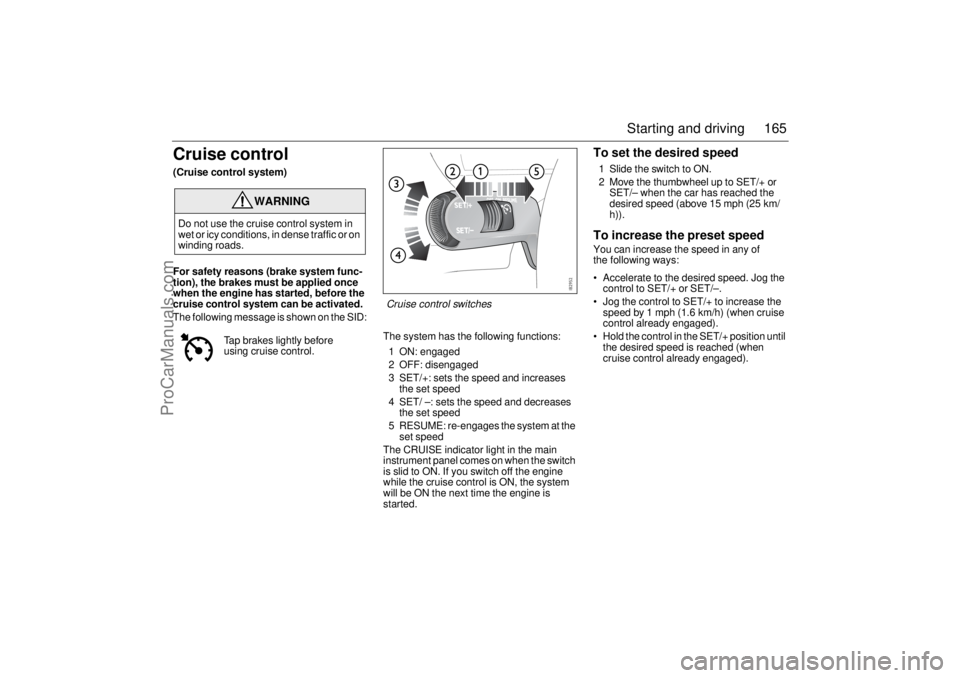
The system has the following functions:
1 ON: engaged
2 OFF: disengaged
3 SET/+: sets the speed and increases
the set speed
4 SET/ –: sets the speed and decreases
the set speed
5 RESUME: re-engages the system at the
set speed
The CRUISE indicator light in the main
instrument panel comes on when the switch
is slid to ON. If you switch off the engine
while the cruise control is ON, the system
will be ON the next time the engine is
started.
To set the desired speed1 Slide the switch to ON.
2 Move the thumbwheel up to SET/+ or
SET/– when the car has reached the
desired speed (above 15 mph (25 km/
h)).To increase the preset speedYou can increase the speed in any of
the following ways:
Accelerate to the desired speed. Jog the
control to SET/+ or SET/–.
Jog the control to SET/+ to increase the
speed by 1 mph (1.6 km/h) (when cruise
control already engaged).
Hold the control in the SET/+ position until
the desired speed is reached (when
cruise control already engaged).
WARNING
Do not use the cruise control system in
wet or icy conditions, in dense traffic or on
winding roads.
Tap brakes lightly before
using cruise control.
Cruise control switches
ProCarManuals.com
Page 168 of 292

166 Starting and drivingTo reduce the preset speedYou can reduce speed in any of the follow-
ing ways:
Brake to the desired speed. Jog the
control to SET/+ or SET/–.
Jog the control to SET/– to reduce the
speed by 1 mph (1.6 km/h).
Hold the control in the SET/– position until
the desired speed is reached.Temporary increase in speedAccelerate, without shifting down (manual
transmission), to exceed the set speed such
as for overtaking. When you release the
accelerator, the car will return to the set
speed.To disengage the system
temporarilySlide the switch to the left towards OFF, but
only as far as to disengage the cruise con-
trol. Allow the switch to spring back.
To re-engage the systemSlide the switch to RESUME. The car will
return to the previously set speed. Vehicle
speed must exceed 15 mph (25 km/h).To disengage the systemThe system will be disengaged:
As soon as the brake or clutch pedal is
depressed (cars with manual transmis-
sion).
When the switch is slid towards OFF. See
also heading "To disengage the system
temporarily".
When the switch is slid to OFF.
When the TCS/ESP system is operative.
When position N is selected (cars with
automatic transmission).
BrakingIt is good practice to try your brakes period-
ically while driving. This is particularly
important when driving in heavy rain, on
roads with a lot of surface water, in snow or
in salty slush. In such conditions a slight
delay in the braking effect may be noticed.
To minimize this delay, dry the brakes by
applying them lightly now and again. This
should also be done after the car has been
washed, and in extremely damp weather.
To avoid the brakes becoming overheated,
such as when negotiating long descents
with a drop of several hundred yards (hun-
dred metres), select a low gear to utilize the
braking effect of the engine. If the car has
automatic transmission, select 1st or 2nd
gear.
You can help to prolong the life of the brakes
by thinking ahead and braking harder over
short periods, rather than braking more
moderately over long stretches.
ProCarManuals.com
Page 172 of 292
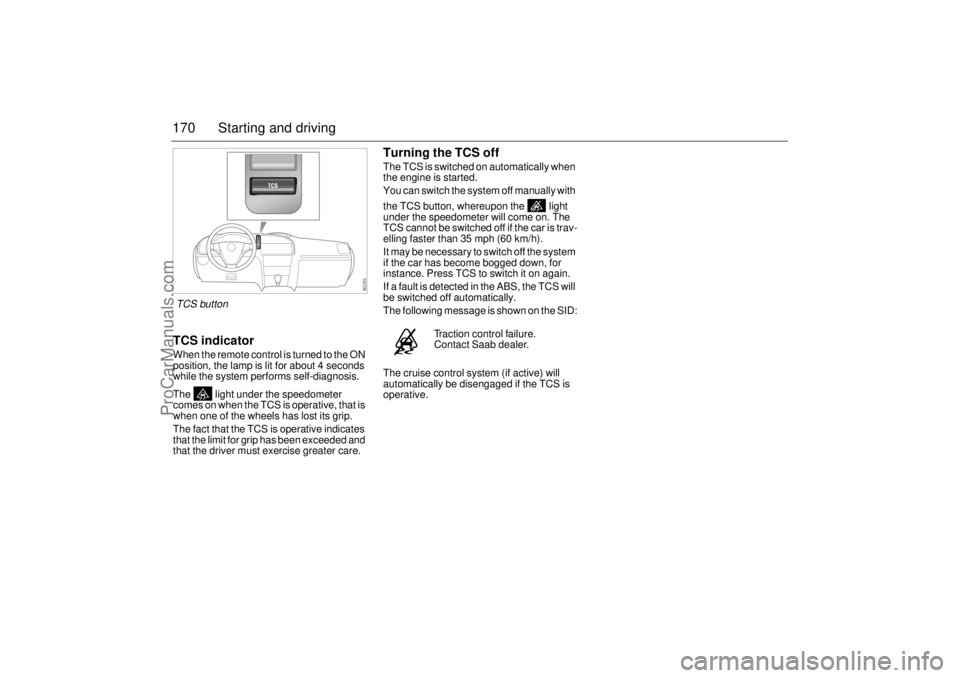
170 Starting and drivingTCS indicatorWhen the remote control is turned to the ON
position, the lamp is lit for about 4 seconds
while the system performs self-diagnosis.
The light under the speedometer
comes on when the TCS is operative, that is
when one of the wheels has lost its grip.
The fact that the TCS is operative indicates
that the limit for grip has been exceeded and
that the driver must exercise greater care.
Turning the TCS offThe TCS is switched on automatically when
the engine is started.
You can switch the system off manually with
the TCS button, whereupon the light
under the speedometer will come on. The
TCS cannot be switched off if the car is trav-
elling faster than 35 mph (60 km/h).
It may be necessary to switch off the system
if the car has become bogged down, for
instance. Press TCS to switch it on again.
If a fault is detected in the ABS, the TCS will
be switched off automatically.
The following message is shown on the SID:
The cruise control system (if active) will
automatically be disengaged if the TCS is
operative.
Traction control failure.
Contact Saab dealer.
TCS button
ProCarManuals.com
Page 174 of 292
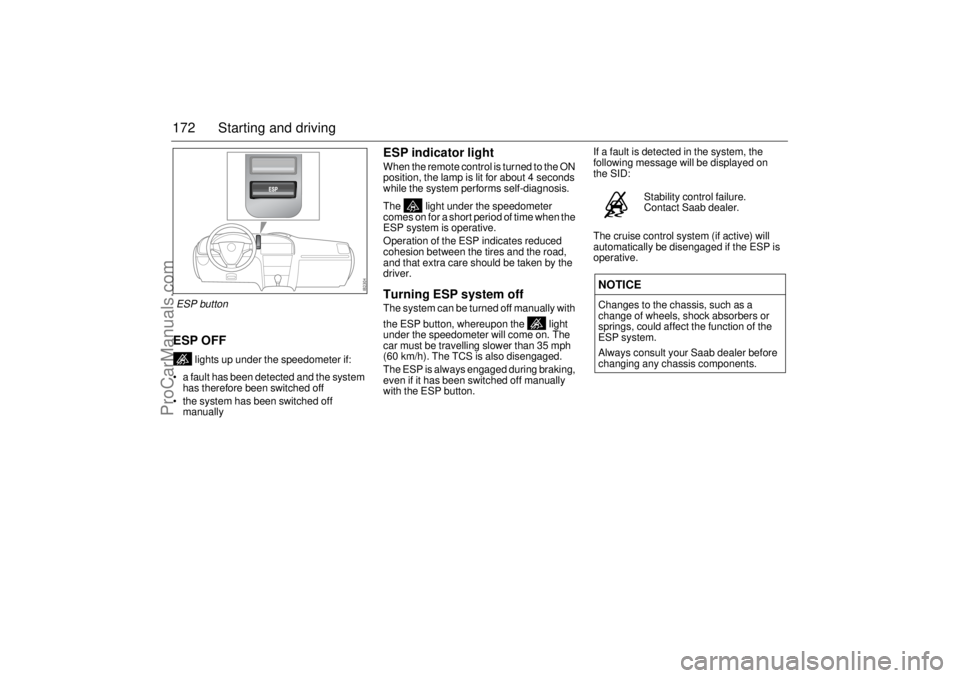
172 Starting and drivingESP OFF
lights up under the speedometer if:
a fault has been detected and the system
has therefore been switched off
the system has been switched off
manually
ESP indicator lightWhen the remote control is turned to the ON
position, the lamp is lit for about 4 seconds
while the system performs self-diagnosis.
The light under the speedometer
comes on for a short period of time when the
ESP system is operative.
Operation of the ESP indicates reduced
cohesion between the tires and the road,
and that extra care should be taken by the
driver.Turning ESP system offThe system can be turned off manually with
the ESP button, whereupon the light
under the speedometer will come on. The
car must be travelling slower than 35 mph
(60 km/h). The TCS is also disengaged.
The ESP is always engaged during braking,
even if it has been switched off manually
with the ESP button.If a fault is detected in the system, the
following message will be displayed on
the SID:
The cruise control system (if active) will
automatically be disengaged if the ESP is
operative.
Stability control failure.
Contact Saab dealer.
NOTICEChanges to the chassis, such as a
change of wheels, shock absorbers or
springs, could affect the function of the
ESP system.
Always consult your Saab dealer before
changing any chassis components.
ESP button
ProCarManuals.com
Page 283 of 292
281 Technical data
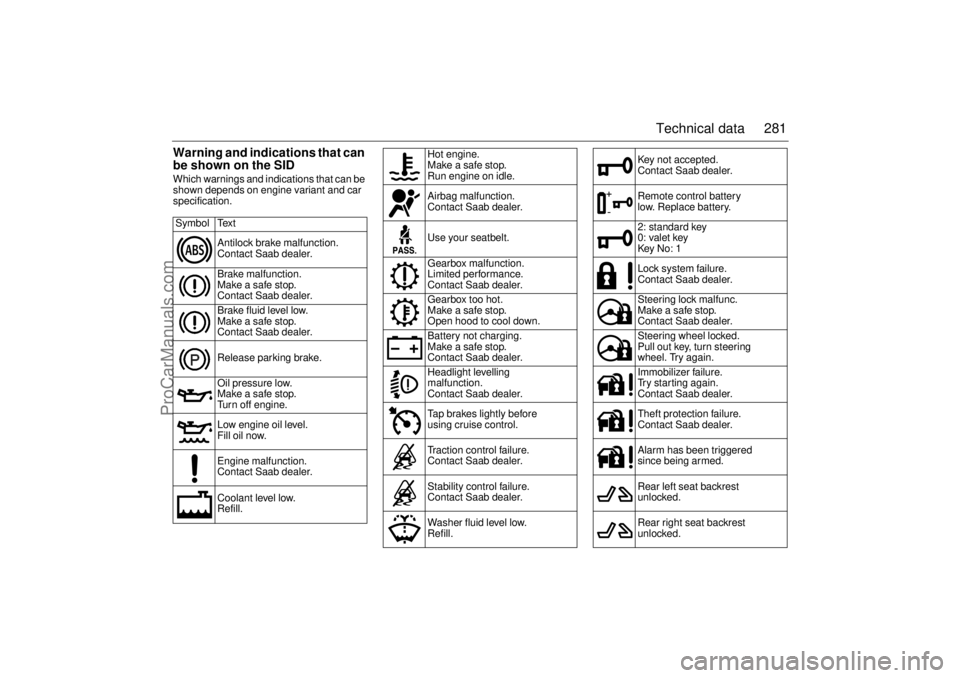
Warning and indications that can
be shown on the SIDWhich warnings and indications that can be
shown depends on engine variant and car
specification.
Symbol Text
Antilock brake malfunction.
Contact Saab dealer.
Brake malfunction.
Make a safe stop.
Contact Saab dealer.
Brake fluid level low.
Make a safe stop.
Contact Saab dealer.
Release parking brake.
Oil pressure low.
Make a safe stop.
Turn off engine.
Low engine oil level.
Fill oil now.
Engine malfunction.
Contact Saab dealer.
Coolant level low.
Refill.
Hot engine.
Make a safe stop.
Run engine on idle.
Airbag malfunction.
Contact Saab dealer.
Use your seatbelt.
Gearbox malfunction.
Limited performance.
Contact Saab dealer.
Gearbox too hot.
Make a safe stop.
Open hood to cool down.
Battery not charging.
Make a safe stop.
Contact Saab dealer.
Headlight levelling
malfunction.
Contact Saab dealer.
Tap brakes lightly before
using cruise control.
Traction control failure.
Contact Saab dealer.
Stability control failure.
Contact Saab dealer.
Washer fluid level low.
Refill.
Key not accepted.
Contact Saab dealer.
Remote control battery
low. Replace battery.
2: standard key
0: valet key
Key No: 1
Lock system failure.
Contact Saab dealer.
Steering lock malfunc.
Make a safe stop.
Contact Saab dealer.
Steering wheel locked.
Pull out key, turn steering
wheel. Try again.
Immobilizer failure.
Try starting again.
Contact Saab dealer.
Theft protection failure.
Contact Saab dealer.
Alarm has been triggered
since being armed.
Rear left seat backrest
unlocked.
Rear right seat backrest
unlocked.
ProCarManuals.com
Page 285 of 292

283 Index
Index
AA/C
__________________________ 106
ABS brakes
____________________ 167
ACC
_________________________ 108
Adjustment, steering wheel
________ 122
Air conditioning
_________________ 106
Air filter
_______________________ 204
Airbag
_________________________ 29
Anchorage eyes
________________ 143
Anti-corrosion treatment
__________ 254
Antilock braking system __________ 167
Anti-spin
______________________ 169
Ashtrays ______________________ 132
Autochecking of lights, warning and
indicator lights
__________________ 82
Autodimming
_______________ 135
, 136
Automatic climate control (ACC)
____ 108
Automatic transmission
___________ 159
BBattery
________________________ 208
Bedding-in of new brake pads
_____ 157
Before towing a trailer
____________ 187
Brake fluid, grade
_______________ 274
Brakes
________________________ 166Braking
_______________________ 166
Bulb changing
__________________ 213
Bulb table
_____________________ 226
Buying new tires
________________ 236
CCabin lighting
__________________ 129
Cabin lighting, Convertible
_________ 72
Car alarm
______________________ 50
Car transport ___________________ 192
Care of air conditioning
___________ 257
Change of address notification
_____ 264
Changing a tire
_________________ 248
Changing bulbs _________________ 213
Changing engine oil
_____________ 203
Changing the battery, remote control
_48
Changing wiper blades
___________ 211
Checking the number of remote
controls
_______________________ 47
Checks before towing a trailer
______ 187
Child safety
_____________________ 22
Child safety locks, rear doors
_______ 46
Child seats
_____________________ 22
Cigarette lighter
_________________ 132
Cleaning the engine bay
__________ 252
Cleaning upholstery
_____________ 251
Climate control system, manual
____ 103
Closing the soft top manually,
Convertible
____________________ 62
Closing the soft top, Convertible
_____ 58Clutch interlock
_________________ 158
Compact spare _________________ 246
Compass
______________________ 139
Condensation water, A/C
_________ 106
Convertible
_____________________ 55
Convertible, washing
_____________ 253
Coolant
_______________________ 205
Crash memory, see EDR
_________ 266
Cruise control
__________________ 165
Cup holder
_____________________ 130
DDate codes, tires
________________ 246
Deep water, driving through
_______ 189
Definitions and terminology, tire ____ 243
Determining correct load, tires
_____ 245
Direction indicator stalk switch ______ 98
Direction indicators
_______________ 98
Dome light, Convertible
___________ 223
Dome light, Sport Sedan __________ 222
Donor battery, boost starting
_______ 193
Door handles
____________________ 42
Door mirrors ___________________ 134
Drive belt
______________________ 210
Drive belt, length
________________ 272
Driver’s seat with memory
__________ 20
Driving at night
_________________ 190
Driving in cold climates
___________ 181
Driving in deep water
_____________ 189
Driving in hot climates ____________ 183
ProCarManuals.com