fuel cap SAAB 9-3 2005 Owners Manual
[x] Cancel search | Manufacturer: SAAB, Model Year: 2005, Model line: 9-3, Model: SAAB 9-3 2005Pages: 292, PDF Size: 23 MB
Page 152 of 292

150 Starting and drivingImportant
considerations for
driving1 Starting and driving
Do not use full throttle until the engine
is warm, so as to avoid unnecessary
wear. If the needle of the turbo gauge
repeatedly enters the red zone, the
engine may suddenly lose power, due
to the initiation of a monitoring system
that limits the boost pressure. Contact
a Saab dealer as soon as possible.
Under certain barometric conditions
(high outside temperature and/or high
altitude) the needle may enter the first
part of the red zone without necessarily
indicating that a fault has arisen.
A protective function (interruption of the
fuel supply) limits the engine speed.2 Stopping the engine
Do not rev the engine immediately
before switching it off - stop the engine
when it is idling.
3 Regulating the boost pressure
One of the advantages of boost pres-
sure regulation is that the engine can
also be run safely on gasoline with a
lower octane rating, although not lower
than AON 87. However, engine perfor-
mance will fall slightly and heavy load-
ing and laboring should be avoided. For
optimum performance, use the recom-
mended grade of fuel.
The maximum boost pressure is regu-
lated according to the tendency of the
engine to knock. Short-lived knocking
is perfectly normal. This can occur
when the engine is running at about
3,000 rpm under a heavy load. The
extent of this knocking will depend on
the grade of fuel in the tank.
Isolated instances of knocking can
occur with low-octane fuel. This
controlled form of knocking, followed
by a reduction in the boost pressure, is
a sign that the control system is work-
ing normally, and is perfectly safe for
the engine.
Limp-homeThe engine management system has a
diagnostic feature that checks a number of
internal functions. If a fault is detected in the
throttle valve, the engine management
system will set the throttle system to the
limp-home mode. This means:
idling control will be poor (uneven idling
since regulated by ignition and fuel
supply)
engine performance will be reduced
the cruise control will not function
the capacity of the A/C compressor will be
limited.NOTICE If the engine sounds strange there is a
malfunction. Contact a Saab dealer
immediately.
The use of fuel with too low an octane
rating can cause serious engine
damage.
ProCarManuals.com
Page 155 of 292

153 Starting and driving
Refueling
WARNING
If you spill fuel and then something ignites
it, you could be badly burned. Fuel can
spray out on you if you open the fuel cap
too quickly. This spray can happen if your
tank is nearly full, and is more likely in hot
weather. Open the fuel cap slowly and
wait for any “hiss” noise to stop. Then
unscrew the cap all the way.
Gasoline fumes are highly explosive.
Therefore:
never smoke while refueling
never use gasoline for any purpose
other than as engine fuel
gasoline is extremely flammable and
can cause severe burns. No open or
exposed flames near gasoline
do not use a mobile phone at the
same time as refueling
NOTICE Do not overfill. Fuel should not come
right up the filler pipe as room for
expansion is needed for when the
temperature rises.
The use of fuel with too low an octane
rating can cause serious engine
damage.
Clean fuel from painted surfaces as
soon as possible.
NOTICEThe engine control module (ECM) moni-
toring the engine parameters also stores
fault codes.
Under certain circumstances, this may
cause constant illumination of the Engine
malfunction (CHECK ENGINE) lamp
, thus indicating a fault that must be
checked by your Saab dealer, see
page 79.
NOTE: always observe the following two
measures:
Make sure that the fuel filler cap is
screwed on correctly before the
engine is started. Screw on the fuel
filler cap until you hear a distinct click.
Avoid driving with the fuel low level
indicator illuminated. The symbol illu-
minates when less than approximately
2.5 gallons (10 litres) of fuel remains
in the tank.
ProCarManuals.com
Page 156 of 292
154 Starting and drivingRefueling1 Switch off the engine.
2 Open the filler cap, located in the right-
hand rear fender.
3 Insert the fuel pump nozzle beyond the
flange on the filler pipe and let the first
mark (a ring, a pimple or the first spring-
coil) rest on the flange. Do not withdraw
the nozzle while filling is in progress.
4 Cease refueling the first time the pump
stops, and wait a few seconds after
you´ve finished pumping before you
remove the nozzle.
Manually opening the fuel filler door, Con-
vertible, see page 74.Filler cap
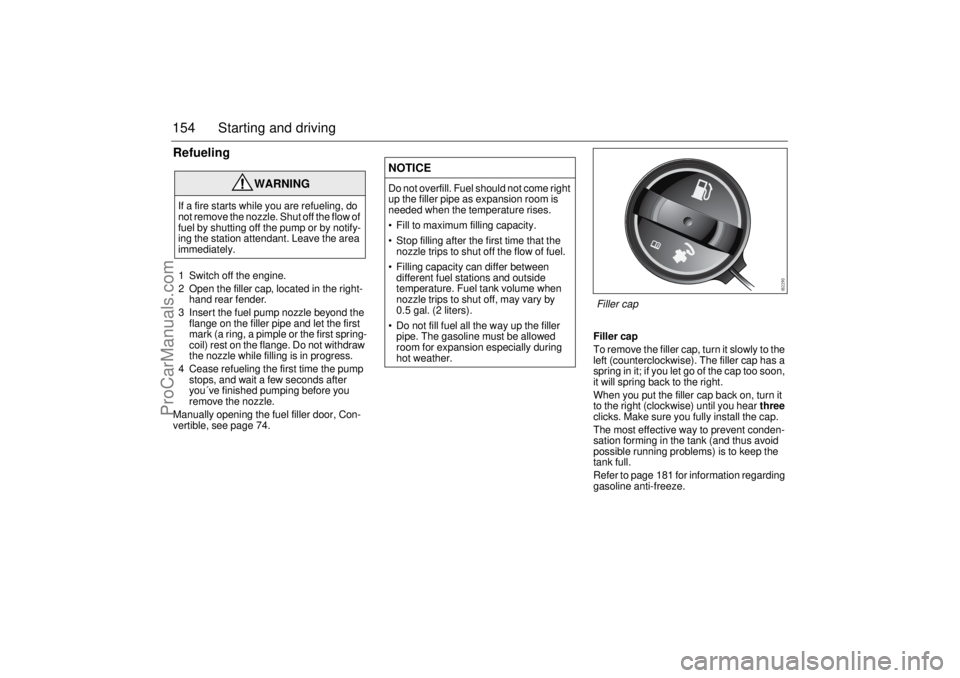
To remove the filler cap, turn it slowly to the
left (counterclockwise). The filler cap has a
spring in it; if you let go of the cap too soon,
it will spring back to the right.
When you put the filler cap back on, turn it
to the right (clockwise) until you hear three
clicks. Make sure you fully install the cap.
The most effective way to prevent conden-
sation forming in the tank (and thus avoid
possible running problems) is to keep the
tank full.
Refer to page 181 for information regarding
gasoline anti-freeze.
WARNING
If a fire starts while you are refueling, do
not remove the nozzle. Shut off the flow of
fuel by shutting off the pump or by notify-
ing the station attendant. Leave the area
immediately.
NOTICEDo not overfill. Fuel should not come right
up the filler pipe as expansion room is
needed when the temperature rises.
Fill to maximum filling capacity.
Stop filling after the first time that the
nozzle trips to shut off the flow of fuel.
Filling capacity can differ between
different fuel stations and outside
temperature. Fuel tank volume when
nozzle trips to shut off, may vary by
0.5 gal. (2 liters).
Do not fill fuel all the way up the filler
pipe. The gasoline must be allowed
room for expansion especially during
hot weather.
Filler cap
ProCarManuals.com
Page 157 of 292
155 Starting and driving
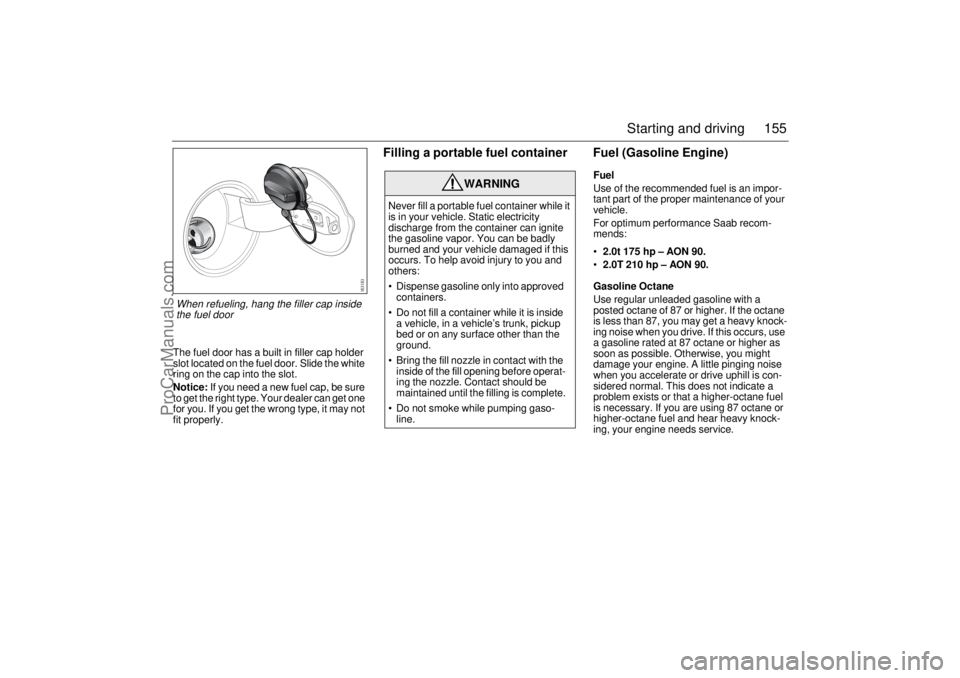
The fuel door has a built in filler cap holder
slot located on the fuel door. Slide the white
ring on the cap into the slot.
Notice: If you need a new fuel cap, be sure
to get the right type. Your dealer can get one
for you. If you get the wrong type, it may not
fit properly.
Filling a portable fuel container Fuel (Gasoline Engine)
Fuel
Use of the recommended fuel is an impor-
tant part of the proper maintenance of your
vehicle.
For optimum performance Saab recom-
mends:
2.0t 175 hp – AON 90.
2.0T 210 hp – AON 90.
Gasoline Octane
Use regular unleaded gasoline with a
posted octane of 87 or higher. If the octane
is less than 87, you may get a heavy knock-
ing noise when you drive. If this occurs, use
a gasoline rated at 87 octane or higher as
soon as possible. Otherwise, you might
damage your engine. A little pinging noise
when you accelerate or drive uphill is con-
sidered normal. This does not indicate a
problem exists or that a higher-octane fuel
is necessary. If you are using 87 octane or
higher-octane fuel and hear heavy knock-
ing, your engine needs service.
WARNING
Never fill a portable fuel container while it
is in your vehicle. Static electricity
discharge from the container can ignite
the gasoline vapor. You can be badly
burned and your vehicle damaged if this
occurs. To help avoid injury to you and
others:
Dispense gasoline only into approved
containers.
Do not fill a container while it is inside
a vehicle, in a vehicle’s trunk, pickup
bed or on any surface other than the
ground.
Bring the fill nozzle in contact with the
inside of the fill opening before operat-
ing the nozzle. Contact should be
maintained until the filling is complete.
Do not smoke while pumping gaso-
line.
When refueling, hang the filler cap inside
the fuel door
ProCarManuals.com
Page 202 of 292

200 Car careSaab Trionic engine
management systemThe Saab Trionic engine management
system is a unique Saab development that
combines sequential multiport fuel injection,
electronic distributorless ignition and turbo-
charger boost pressure control into one sys-
tem.
The Trionic engine control module (ECM)
monitors many different engine parameters
such as:
Intake manifold pressure.
Intake air temperature.
Crankshaft position.
Engine coolant temperature.
Throttle position.
The oxygen content of the exhaust gases.
The ECM receives information regarding
engine knocking from a sophisticated feed-
back function in the ignition discharge unit.
By processing all of this information, the Tri-
onic system can control fuel injector open-
ing duration, ignition timing and turbo-
charger boost pressure to provide excellent
engine performance while maintaining low
emissions and fuel consumption.
ORVR (Onboard Refueling Vapor
Recovery)All hydrocarbons formed when refueling will
be recovered by the car and not released
into the atmosphere. The hydrocarbons are
absorbed in an evaporative emission canis-
ter. When the engine is subsequently
started, the evaporative emission canister is
gradually purged as air is sucked into it
through a shut-off valve. The hydrocar-
bon/air mixture passes through the evap
canister purge valve and into the engine
where it is burned. “Refueling”, see
page 153.
When refueling, make sure you screw the
filler cap on and keep turning until it has
clicked 3 times.
NOTICEThe Trionic engine management system
continuously monitors the operation of
these systems and has on-board diag-
nostic capabilities (OBD II). If the Engine
malfunction (CHECK ENGINE) light in
the main instrument illuminates, the
Trionic ECM has detected a problem. The
car will continue to operate, but perfor-
mance may be diminished. You should
have your car checked by a Saab dealer
as soon as possible.
ProCarManuals.com
Page 245 of 292
243 Car care
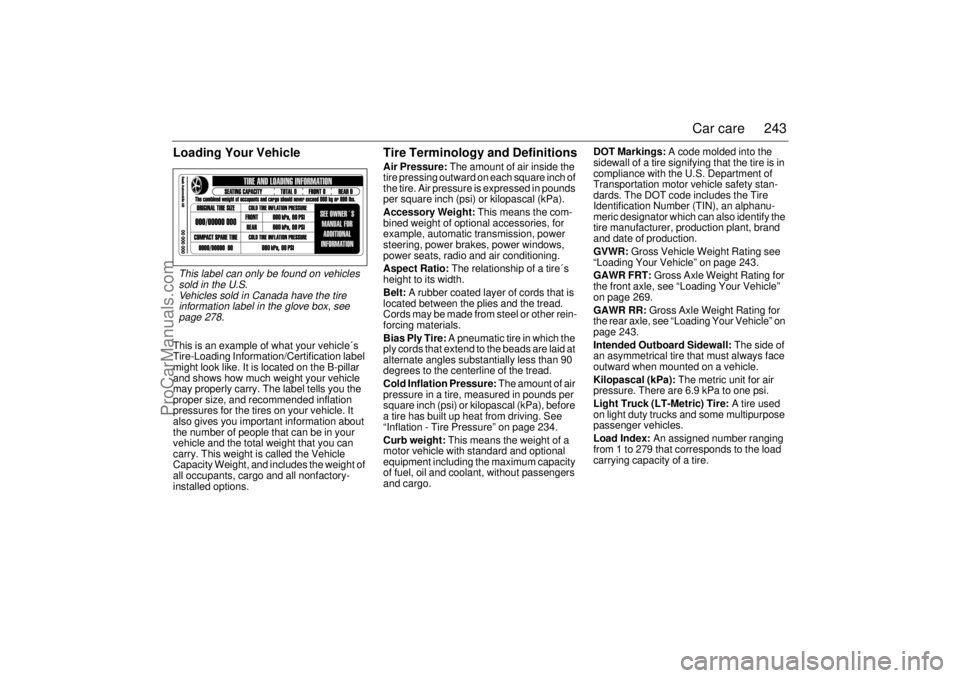
Loading Your VehicleThis is an example of what your vehicle´s
Tire-Loading Information/Certification label
might look like. It is located on the B-pillar
and shows how much weight your vehicle
may properly carry. The label tells you the
proper size, and recommended inflation
pressures for the tires on your vehicle. It
also gives you important information about
the number of people that can be in your
vehicle and the total weight that you can
carry. This weight is called the Vehicle
Capacity Weight, and includes the weight of
all occupants, cargo and all nonfactory-
installed options.
Tire Terminology and DefinitionsAir Pressure: The amount of air inside the
tire pressing outward on each square inch of
the tire. Air pressure is expressed in pounds
per square inch (psi) or kilopascal (kPa).
Accessory Weight: This means the com-
bined weight of optional accessories, for
example, automatic transmission, power
steering, power brakes, power windows,
power seats, radio and air conditioning.
Aspect Ratio: The relationship of a tire´s
height to its width.
Belt: A rubber coated layer of cords that is
located between the plies and the tread.
Cords may be made from steel or other rein-
forcing materials.
Bias Ply Tire: A pneumatic tire in which the
ply cords that extend to the beads are laid at
alternate angles substantially less than 90
degrees to the centerline of the tread.
Cold Inflation Pressure: The amount of air
pressure in a tire, measured in pounds per
square inch (psi) or kilopascal (kPa), before
a tire has built up heat from driving. See
“Inflation - Tire Pressure” on page 234.
Curb weight: This means the weight of a
motor vehicle with standard and optional
equipment including the maximum capacity
of fuel, oil and coolant, without passengers
and cargo.DOT Markings: A code molded into the
sidewall of a tire signifying that the tire is in
compliance with the U.S. Department of
Transportation motor vehicle safety stan-
dards. The DOT code includes the Tire
Identification Number (TIN), an alphanu-
meric designator which can also identify the
tire manufacturer, production plant, brand
and date of production.
GVWR: Gross Vehicle Weight Rating see
“Loading Your Vehicle” on page 243.
GAWR FRT: Gross Axle Weight Rating for
the front axle, see “Loading Your Vehicle”
on page 269.
GAWR RR: Gross Axle Weight Rating for
the rear axle, see “Loading Your Vehicle” on
page 243.
Intended Outboard Sidewall: The side of
an asymmetrical tire that must always face
outward when mounted on a vehicle.
Kilopascal (kPa): The metric unit for air
pressure. There are 6.9 kPa to one psi.
Light Truck (LT-Metric) Tire: A tire used
on light duty trucks and some multipurpose
passenger vehicles.
Load Index: An assigned number ranging
from 1 to 279 that corresponds to the load
carrying capacity of a tire.
This label can only be found on vehicles
sold in the U.S.
Vehicles sold in Canada have the tire
information label in the glove box, see
page 278.
ProCarManuals.com
Page 270 of 292

268 Technical dataGeneral dataOverall length, including bumpers: ___ 182.5'' (4635 mm)
Overall width, including door mirrors __ 80.2'' (2038 mm)
Maximum height _________________ 57.8'' (1468 mm)
Wheelbase _____________________ 105.3'' (2675 mm)
Tr a c k :
Front ____________________________ 59.8'' (1521 mm)
Rear ____________________________ 59.3'' (1506 mm)
Ground clearance at GVW _________ approx. 120 mm
Number of seats (incl. driver):
Sport Sedan ______________________ 5
Convertible _______________________ 4
Turning circle:
Measured at vehicle extremities _______ 37.4 ft. (11.4 m)
Curb to curb ______________________ 35.4 ft. (10.8 m)
Trunk length:
Rear seat raised ___________________ 40.8'' (1036 mm)
Rear seat lowered__________________ 69.8'' (1774 mm)
Convertible _______________________ 29.1" (740 mm)
Trunk volume (SAE):
Sport Sedan ______________________ 15.0 cu.ft. (425 l)
Convertible, soft top raised ___________ 12.4 cu.ft. (352 l)
Convertible, soft top folded ___________ 8.3 cu.ft. (235 l)
Permissible load (in addition to the driver) = GVW minus curb weight. The maximum
permissible axle load, front or rear, must not be exceeded.
The precise curb weight of the vehicle and load capacity are specified in the vehicle
registration documents.V.I.N. labelCurb weight
(i.e. with full fuel tank, full washer fluid res-
ervoir, standard tools and spare wheel):
Sport Sedan ______________________ 3200–3420 lbs.
(1450–1550 kg)
Convertible _______________________ 3570–3700 lbs.
(1620–1680 kg)
Gross vehicle weight (GVW):
Sport Sedan ______________________ 4120–4340 lbs.
(1870–1970 kg)
Convertible _______________________ 4460–4520 lbs.
(2025–2050 kg)
ProCarManuals.com
Page 272 of 292

270 Technical dataEngine Engine oilType: Four cylinders,
double overhead
camshafts,
16 valves, two
balancer shafts
Cylinder bore____________________ 3.386'' (86 mm)
Stroke _________________________ 3.386'' (86 mm)
Swept volume ___________________ 122 cu.in. (1.998 l)
Idling speed_____________________ 720 rpm.
When the engine
load increases, e.g.
the steering wheel is
turned, the idling
speed is raised to
900 rpm.
Antifreeze ______________________ Saab-approved
antifreeze
Coolant capacity _________________ 7.5 qts. (7.1 l)To meet demands in Saab's extended service intervals all en-
gines are filled with specially designed synthetic factory fill oils.
Long service intervals, fuel economy and environmental issues
are the base for our choice of oil. By using oils approved by
Saab you minimise the tendencies for oil sludge build, by that
protecting the engine from harmful, wear increasing, deposits.
Approved oils:
All gasoline engines - Fully Synthetic Engine Oil fulfilling GM-
LL-A-025 requirements.
To ensure being able to take advantage of the Saab specified
service intervals, be sure to select a fully synthetic engine oil
fulfilling GM-LL-A-025 requirements.
Servicing/Oil changes:
To be able to use recommended service intervals the need to
use only approved engine oils is vital. Use only engine oils ap-
proved for your engine. Service should be done according to
the recommended service intervals to optimize your engine's
function through out its entire life. Saab Automobile AB will not
take responsibility for any damage that might occur due to ne-
glecting to meet above mentioned requirements.
At your Saab dealers you can find Saab Genuine or Mobil en-
gine oils. Among those there are oils specially designed to meet
your engines specific needs. We recommend that you, with the
help of our skilled service personnel, choose your oil from that
selection.
Other oil companies also have engine oils approved according
to GM specifications. Oils meeting these standards may be
identified as synthetic. However, not all synthetic oils will meet
your engines requirements. You should only use oil that meets
your engines specific requirements (GM-LL-A-025).
ProCarManuals.com
Page 273 of 292

271 Technical data
Fuel
Engines
Recommended oil viscosities.
Viscosity is a measurement of the oils thickness. The thickness
influences, among other things, the fuel economy. For best
function Saab recommends:
For gasoline engines:
SAE 0W-30, SAE 5W-30 or SAE 0W-40 engine oil.
Extra engine oil additives.
Don't add anything to your oil. The recommended oils are all
you will need for good engine performance and protection.
When to change engine oil.
Your vehicle has a display (SID) where time for service will be
shown. Based not only on mileage but also on driving condi-
tions the mileage at which a service will be indicated can vary
considerably.
Under normal circumstances the service indication will come on
at or around 15 000 miles or 2 years.
For this service system to work it is of outmost importance that
the right engine oil is used.
When the message for service is displayed you need to have
the required service done as soon as possible.
After the service your service personnel will reset the service in-
dicator. It is important to reset the service indicator in order to
optimize the time to the next service.
Oil capacity, including filter (oil change) 6.3 qts. (6.0 l)Fuel tank capacity ________________ 16.05 U.S. gal. (61 l)
For optimum performance Saab recom-
mends: 2.0t 175 hp – AON 90.
2.0T 210 hp – AON 90.
Gasoline with a lower octane rating can be used, although not
lower than AON 87. However, engine performance will fall
slightly and heavy loading and laboring should be avoided. For
optimum performance, use the recommended grade of fuel.
For further information on fuel, see page 155.
2.0t EcopowerRating, EEC at 5500 rpm ____________ 175 hp (129 kW)
Maximum torque, EEC at 2500 rpm ____ 195 ft.lb. (265 Nm)
Compression ratio _________________ 9.5:12.0T EcopowerRating, EEC at 5300 rpm ____________ 210 hp (155 kW)
Maximum torque, EEC at 2500 rpm ____ 221 ft.lb. (300 Nm)
Compression ratio _________________ 9.5:1
ProCarManuals.com
Page 286 of 292

284 IndexDriving techniques
______________ 179
Driving with a heavy load on hilly
roads
________________________ 161
Driving with a load
_______________ 189
Driving with a roof load
___________ 188
Driving with the compact spare wheel
193
Driving with the trunk lid open
______ 189
EEDR (Event Data Recorders)
______ 266
ESP, anti-skid system
____________ 171
Easy entry, Convertible ____________ 67
Economical motoring
____________ 179
Electric engine heater ____________ 180
Electric heating, front seats
____ 107
, 116
Electric windows
________________ 123
Electric windows, Convertible
_______ 71
Electrical system, technical data ____ 272
Electrically adjustable seats
________ 19
Electronic Stability Program (ESP)
__ 171
Electronic steering wheel lock
______ 148
Emergency opening of the narrow
backrest
_____________________ 144
Emergency operation of the sunroof
_ 128
Engine bay, cleaning
_____________ 252
Engine heater
__________________ 180
Engine immobilizer
_______________ 49
Engine number
_________________ 278
Engine oil, checking
_____________ 202
Engine oil, grade
________________ 270Engine oil, volume
_______________ 271
Engine temperature gauge
_________ 84
Engine, description
______________ 199
Engine, technical data ____________ 270
Engines
_______________________ 271
Event Data Recorders (EDR)
______ 266
Extra electrical socket
____________ 132
FFacilitating entry to rear seat,
Convertible
____________________ 67
Factors affecting fuel consumption
__ 179
Filler cap
______________________ 154
Filling a portable fuel container
_____ 155
Filling up
______________________ 153
Flat spots, tires
_________________ 235
Floor jack
______________________ 249
Folding down the rear seat
________ 140
Front fog lights
__________________ 98
Front towing eye ________________ 190
Fuel container
__________________ 155
Fuel gauge
_____________________ 85
Fuel grade _____________________ 271
Fuel information
________________ 155
Functions, car alarm ______________ 53
Fuse panel in luggage compartment
_230
Fuse table
_____________________ 229
Fuses
________________________ 227
GGDO, garage door opener
_________ 136
Gear selector indicator, automatic trans-
mission
_______________________ 86
Gearbox number
________________ 278
General safety instructions, Convertible
56
Glovebox
______________________ 132
Glovebox lighting
________________ 224
HHandbrake
_____________________ 173
Hazard warning lights
_____________ 99
Head restraint, Convertible
_________ 68
Head restraints
__________________ 21
Headlight flasher _________________ 97
Headlight levelling ________________ 96
Headlights
______________________ 96
Heated door mirrors
_____________ 107
Hood
_________________________ 198
Horn __________________________ 122
Horn button
____________________ 122
IIf a tire goes flat
_________________ 240
Ignition switch
__________________ 146
Immobilizer
_____________________ 49
Important considerations for driving
_ 150
ProCarManuals.com