glove box SAAB 9-3 2005 Owners Manual
[x] Cancel search | Manufacturer: SAAB, Model Year: 2005, Model line: 9-3, Model: SAAB 9-3 2005Pages: 292, PDF Size: 23 MB
Page 7 of 292
5
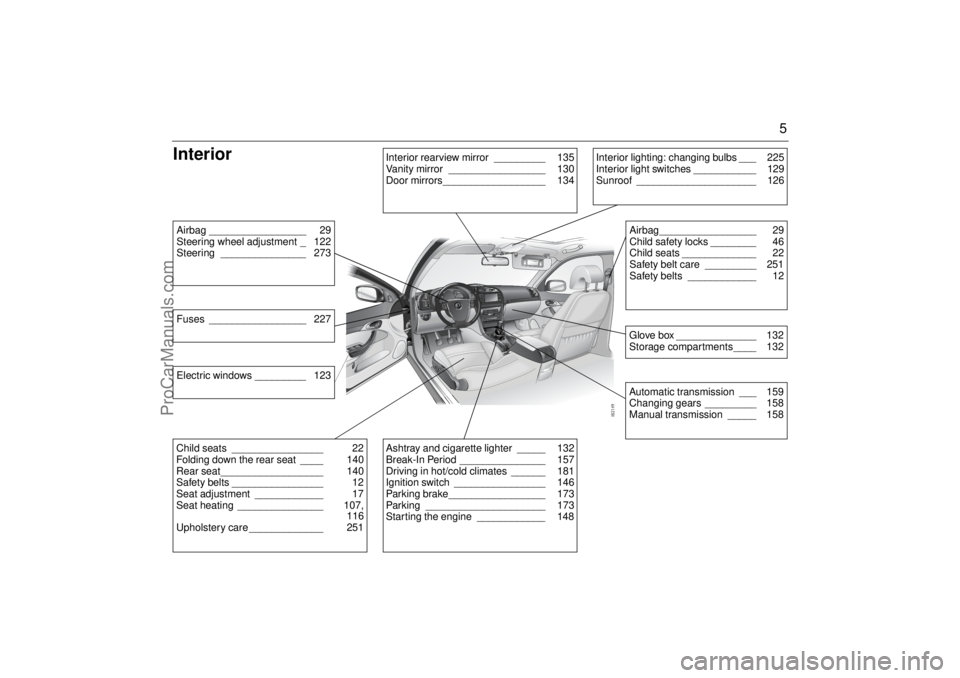
InteriorAirbag _________________ 29
Steering wheel adjustment _ 122
Steering _______________ 273
Interior rearview mirror _________ 135
Vanity mirror _________________ 130
Door mirrors__________________ 134
Airbag_________________ 29
Child safety locks ________ 46
Child seats _____________ 22
Safety belt care _________ 251
Safety belts ____________ 12Glove box ______________ 132
Storage compartments____ 132Automatic transmission ___ 159
Changing gears _________ 158
Manual transmission _____ 158
Child seats ________________ 22
Folding down the rear seat ____ 140
Rear seat__________________ 140
Safety belts ________________ 12
Seat adjustment ____________ 17
Seat heating _______________ 107,
116
Upholstery care _____________ 251
Interior lighting: changing bulbs ___ 225
Interior light switches ___________ 129
Sunroof _____________________ 126
Ashtray and cigarette lighter _____ 132
Break-In Period _______________ 157
Driving in hot/cold climates ______ 181
Ignition switch ________________ 146
Parking brake_________________ 173
Parking _____________________ 173
Starting the engine ____________ 148
Fuses _________________ 227Electric windows _________ 123
ProCarManuals.com
Page 35 of 292
33 Safety
Front passenger seatThe system is the same as that used on the
driver’s side.
The airbag systems are interconnected and
have a common warning light . The pas-
senger airbag module is housed in the
fascia above the glove box and is marked
"AIRBAG".
Both airbags will be inflated in the event of a
moderate to severe frontal, or near-frontal
crash, even if the passenger seat is unoccu-
pied.
The car is equipped as standard with
a passenger airbag.
WARNING
Never secure a rear-facing child seat in
the right front seat of a car equipped with
a passenger airbag. Inflation of the airbag
in the event of a crash could seriously
injure or kill a child.
WARNING
DEATH or SERIOUS
INJURY can occur
Children 12 and under or
shorter than 55 inches
(140 cm) can be killed by the
airbag
The BACK SEAT is the SAFEST place
for children
NEVER put a rear-facing child seat in
the front
Sit as far back as possible from the
airbag
ALWAYS use SAFETY BELTS and
CHILD RESTRAINTS
Never allow a child to stand in front of
the seat or to sit on the lap of a front
seat passenger. Serious injury or
death could result if the airbag is
inflated in a crash.
The glove box must be closed while
travelling. An open glove box door
could cause leg injuries in the event of
a crash.
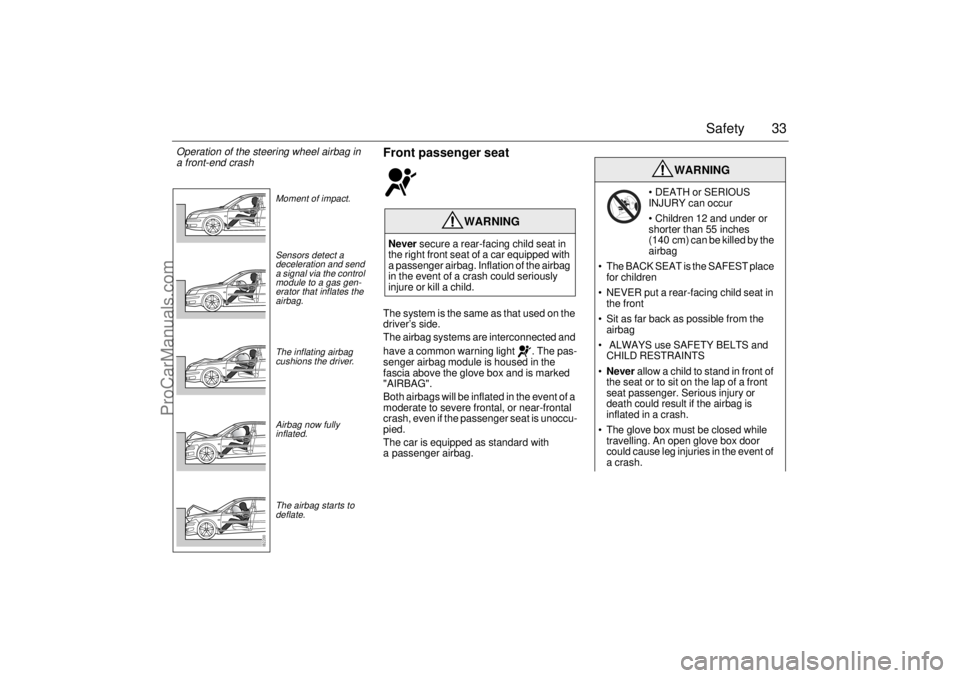
Operation of the steering wheel airbag in
a front-end crash
Moment of impact.
Sensors detect a
deceleration and send
a signal via the control
module to a gas gen-
erator that inflates the
airbag.
The inflating airbag
cushions the driver.
Airbag now fully
inflated.
The airbag starts to
deflate.
ProCarManuals.com
Page 75 of 292
73 9-3 Convertible
Glove boxThe glove box lighting comes on when the
compartment is opened and goes out when
it is closed.
For changing bulbs, refer to page 223.Sun visorAn illuminated vanity mirror is provided on
the inside of the sun visors. The lighting
comes on when the cover is raised and goes
out when it is closed.Trunk lightingThe trunk lighting comes on and goes out
when the trunk lid is opened and closed.
If the trunk lid is left open, the lighting will be
switched off automatically after 20 min to
prevent the battery from running flat.
For changing bulbs, refer to page 225.
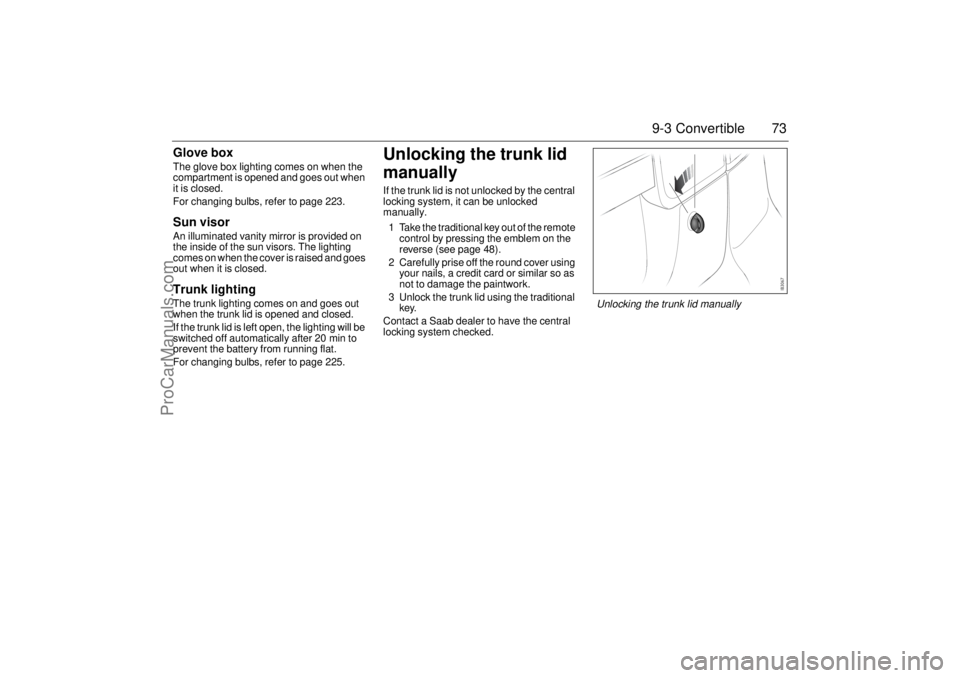
Unlocking the trunk lid
manuallyIf the trunk lid is not unlocked by the central
locking system, it can be unlocked
manually.
1 Take the traditional key out of the remote
control by pressing the emblem on the
reverse (see page 48).
2 Carefully prise off the round cover using
your nails, a credit card or similar so as
not to damage the paintwork.
3 Unlock the trunk lid using the traditional
key.
Contact a Saab dealer to have the central
locking system checked.
Unlocking the trunk lid manually
ProCarManuals.com
Page 131 of 292
129 Interior equipment
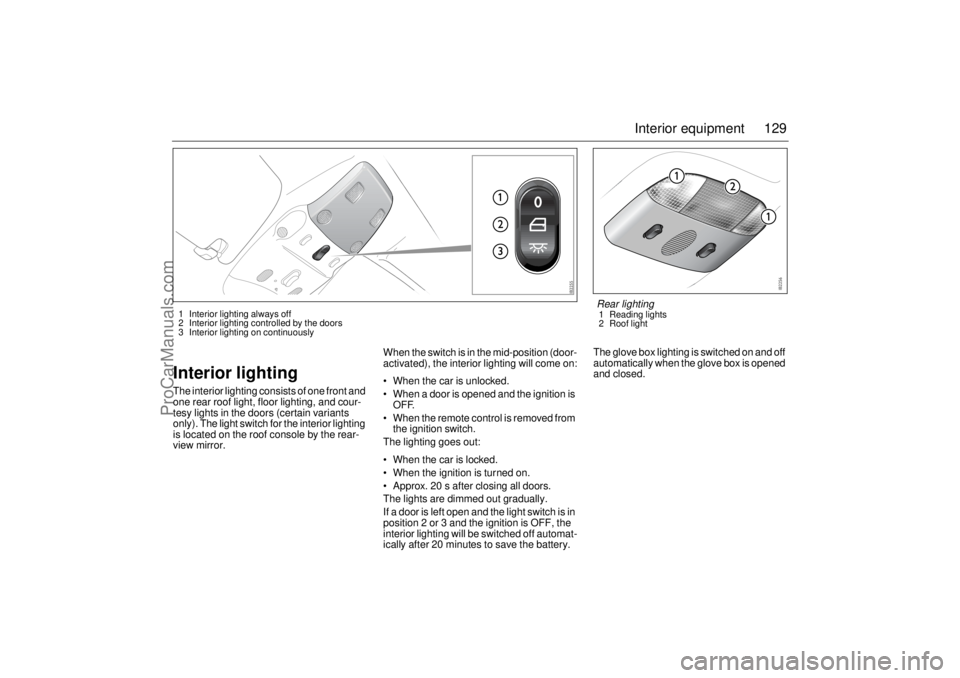
Interior lightingThe interior lighting consists of one front and
one rear roof light, floor lighting, and cour-
tesy lights in the doors (certain variants
only). The light switch for the interior lighting
is located on the roof console by the rear-
view mirror.When the switch is in the mid-position (door-
activated), the interior lighting will come on:
When the car is unlocked.
When a door is opened and the ignition is
OFF.
When the remote control is removed from
the ignition switch.
The lighting goes out:
When the car is locked.
When the ignition is turned on.
Approx. 20 s after closing all doors.
The lights are dimmed out gradually.
If a door is left open and the light switch is in
position 2 or 3 and the ignition is OFF, the
interior lighting will be switched off automat-
ically after 20 minutes to save the battery.The glove box lighting is switched on and off
automatically when the glove box is opened
and closed.1 Interior lighting always off
2 Interior lighting controlled by the doors
3 Interior lighting on continuously
Rear lighting1 Reading lights
2 Roof light
ProCarManuals.com
Page 134 of 292
132 Interior equipmentPower Outlet(if equipped)
You can use the electrical socket in the stor-
age compartment under the armrest
between the front seats to charge a mobile
phone, for example. There is a recess on
each side of the compartment which will
accept a lead so that you can close the lid
without damaging the charger lead.
Storage compartmentsThere are additional storage compartments
in the rear seat armrest, below the front ash-
tray and in the doors.
WARNING
The maximum output of the cigarette
lighter socket is 240 W (20 A). The rating
of the socket in the compartment between
the seats is the same. Overloading can
result in melting or even fire.
WARNING
The glove box must be closed while trav-
elling. An open glove box door could
cause personal injury in the event of a
crash.
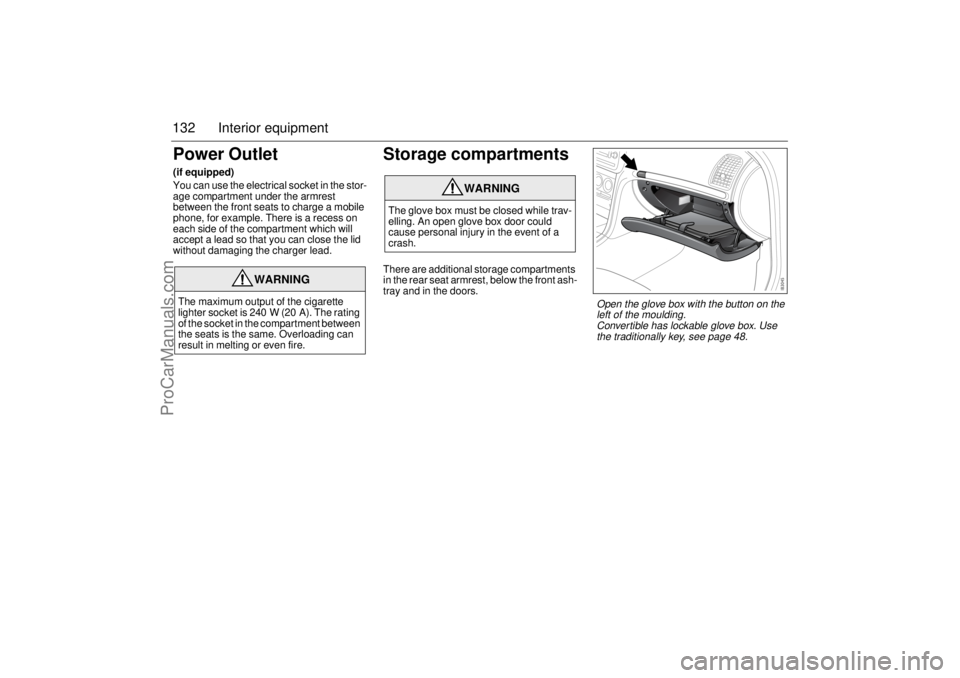
Open the glove box with the button on the
left of the moulding.
Convertible has lockable glove box. Use
the traditionally key, see page 48.
ProCarManuals.com
Page 135 of 292
133 Interior equipment
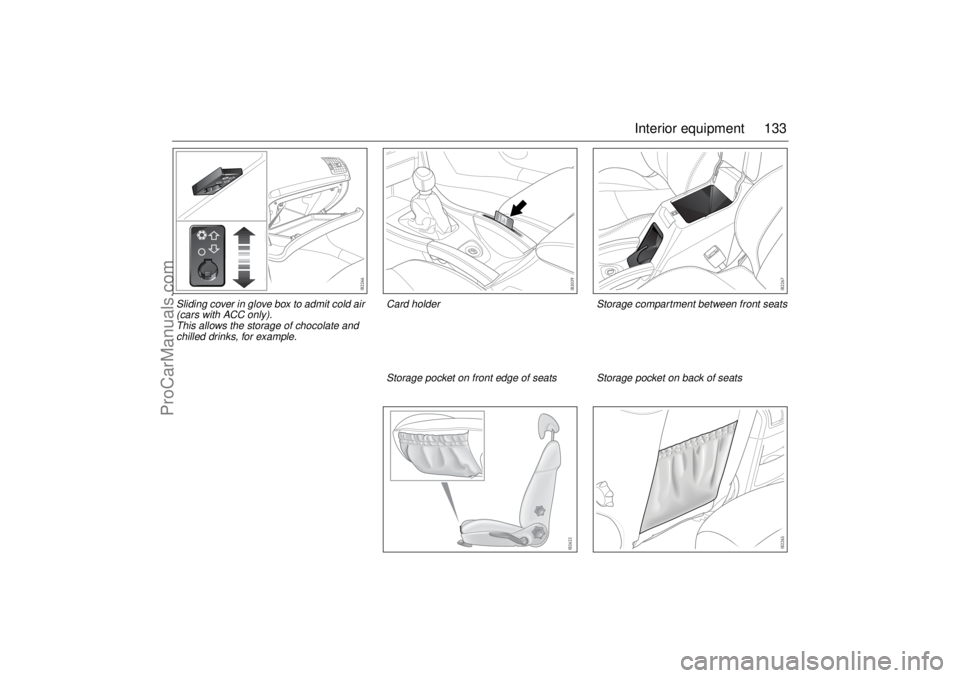
Sliding cover in glove box to admit cold air
(cars with ACC only).
This allows the storage of chocolate and
chilled drinks, for example.
Storage compartment between front seats
Storage pocket on front edge of seats
Storage pocket on back of seats
Card holder
ProCarManuals.com
Page 226 of 292
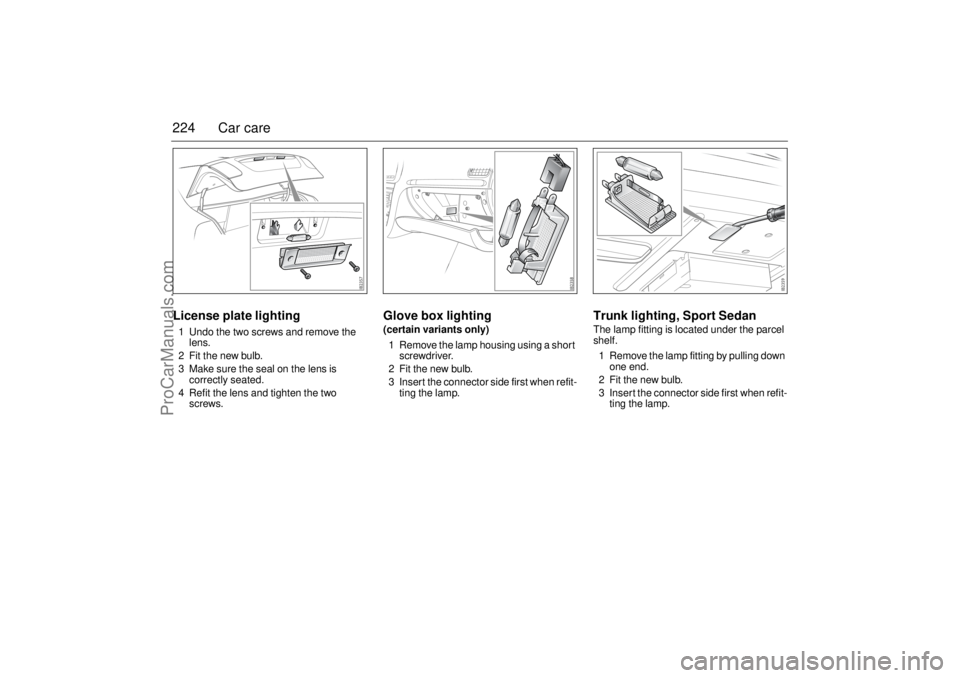
224 Car careLicense plate lighting1 Undo the two screws and remove the
lens.
2 Fit the new bulb.
3 Make sure the seal on the lens is
correctly seated.
4 Refit the lens and tighten the two
screws.
Glove box lighting(certain variants only)
1 Remove the lamp housing using a short
screwdriver.
2 Fit the new bulb.
3 Insert the connector side first when refit-
ting the lamp.
Trunk lighting, Sport SedanThe lamp fitting is located under the parcel
shelf.
1 Remove the lamp fitting by pulling down
one end.
2 Fit the new bulb.
3 Insert the connector side first when refit-
ting the lamp.
ProCarManuals.com
Page 228 of 292
226 Car care
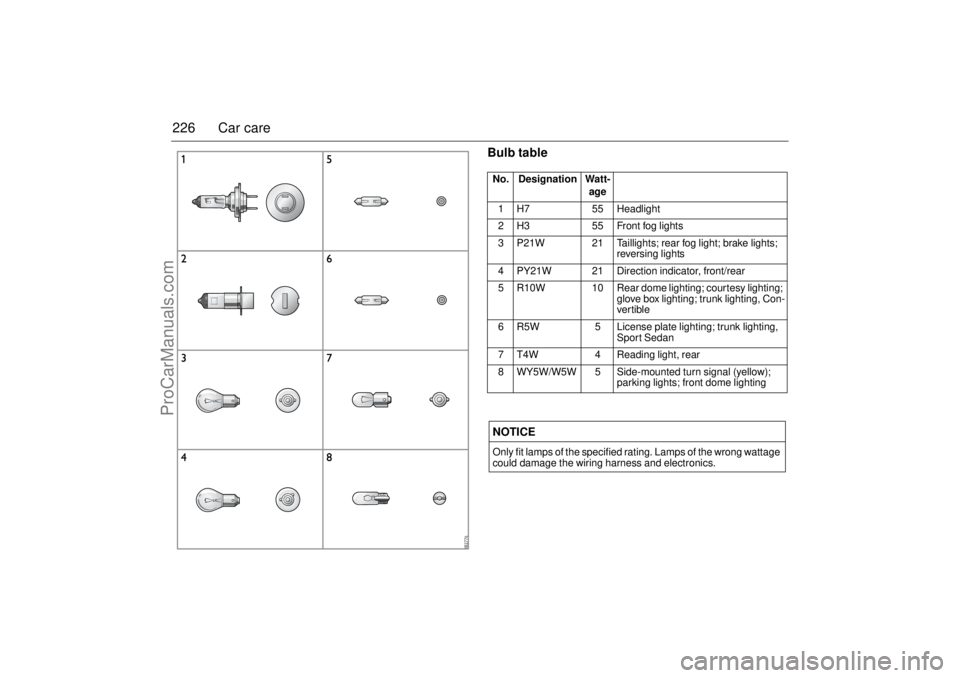
Bulb tableNo. Designation Watt-
age
1 H7 55 Headlight
2 H3 55 Front fog lights
3 P21W 21 Taillights; rear fog light; brake lights;
reversing lights
4 PY21W 21 Direction indicator, front/rear
5 R10W 10 Rear dome lighting; courtesy lighting;
glove box lighting; trunk lighting, Con-
vertible
6 R5W 5 License plate lighting; trunk lighting,
Sport Sedan
7 T4W 4 Reading light, rear
8 WY5W/W5W 5 Side-mounted turn signal (yellow);
parking lights; front dome lightingNOTICEOnly fit lamps of the specified rating. Lamps of the wrong wattage
could damage the wiring harness and electronics.
ProCarManuals.com
Page 231 of 292
229 Car care
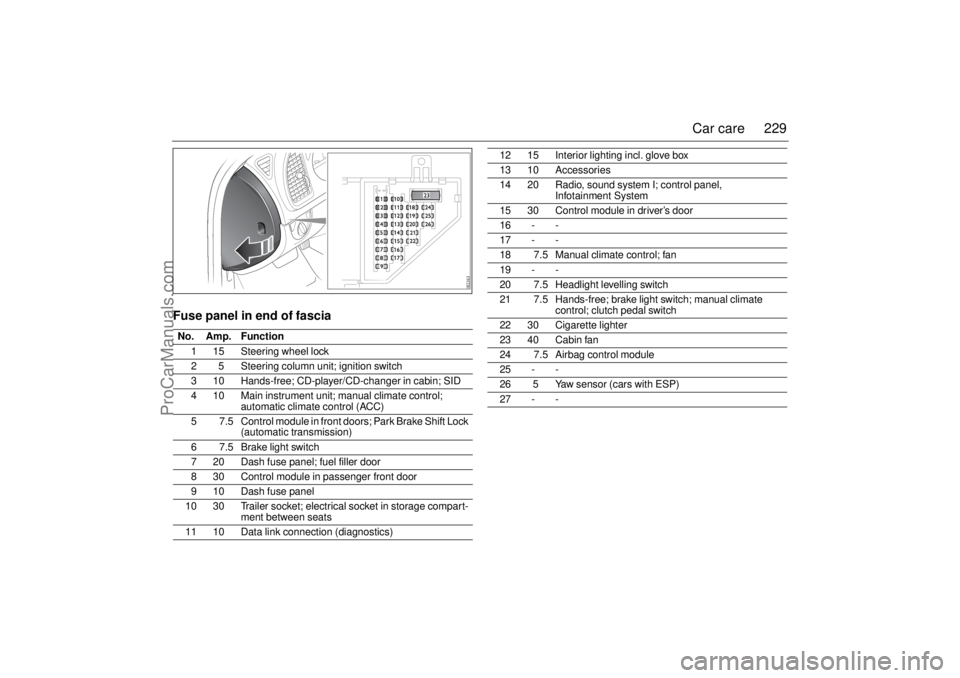
Fuse panel in end of fasciaNo. Amp. Function
1 15 Steering wheel lock
2 5 Steering column unit; ignition switch
3 10 Hands-free; CD-player/CD-changer in cabin; SID
4 10 Main instrument unit; manual climate control;
automatic climate control (ACC)
5 7.5 Control module in front doors; Park Brake Shift Lock
(automatic transmission)
6 7.5 Brake light switch
7 20 Dash fuse panel; fuel filler door
8 30 Control module in passenger front door
9 10 Dash fuse panel
10 30 Trailer socket; electrical socket in storage compart-
ment between seats
11 10 Data link connection (diagnostics)
12 15 Interior lighting incl. glove box
13 10 Accessories
14 20 Radio, sound system I; control panel,
Infotainment System
15 30 Control module in driver’s door
16 - -
17 - -
18 7.5 Manual climate control; fan
19 - -
20 7.5 Headlight levelling switch
21 7.5 Hands-free; brake light switch; manual climate
control; clutch pedal switch
22 30 Cigarette lighter
23 40 Cabin fan
24 7.5 Airbag control module
25 - -
26 5 Yaw sensor (cars with ESP)
27 - -
ProCarManuals.com
Page 245 of 292
243 Car care
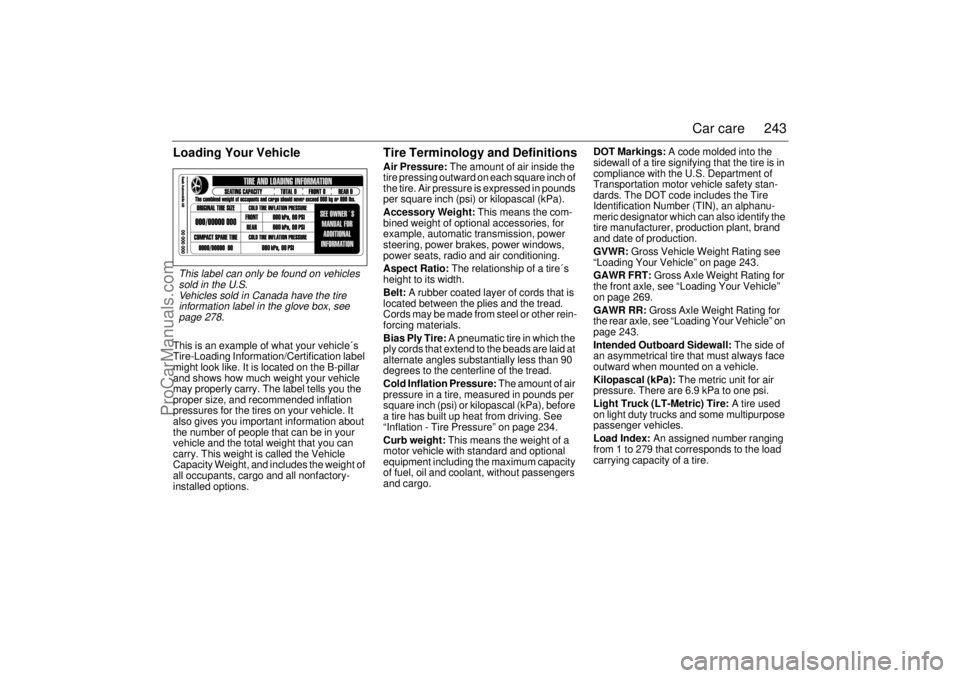
Loading Your VehicleThis is an example of what your vehicle´s
Tire-Loading Information/Certification label
might look like. It is located on the B-pillar
and shows how much weight your vehicle
may properly carry. The label tells you the
proper size, and recommended inflation
pressures for the tires on your vehicle. It
also gives you important information about
the number of people that can be in your
vehicle and the total weight that you can
carry. This weight is called the Vehicle
Capacity Weight, and includes the weight of
all occupants, cargo and all nonfactory-
installed options.
Tire Terminology and DefinitionsAir Pressure: The amount of air inside the
tire pressing outward on each square inch of
the tire. Air pressure is expressed in pounds
per square inch (psi) or kilopascal (kPa).
Accessory Weight: This means the com-
bined weight of optional accessories, for
example, automatic transmission, power
steering, power brakes, power windows,
power seats, radio and air conditioning.
Aspect Ratio: The relationship of a tire´s
height to its width.
Belt: A rubber coated layer of cords that is
located between the plies and the tread.
Cords may be made from steel or other rein-
forcing materials.
Bias Ply Tire: A pneumatic tire in which the
ply cords that extend to the beads are laid at
alternate angles substantially less than 90
degrees to the centerline of the tread.
Cold Inflation Pressure: The amount of air
pressure in a tire, measured in pounds per
square inch (psi) or kilopascal (kPa), before
a tire has built up heat from driving. See
“Inflation - Tire Pressure” on page 234.
Curb weight: This means the weight of a
motor vehicle with standard and optional
equipment including the maximum capacity
of fuel, oil and coolant, without passengers
and cargo.DOT Markings: A code molded into the
sidewall of a tire signifying that the tire is in
compliance with the U.S. Department of
Transportation motor vehicle safety stan-
dards. The DOT code includes the Tire
Identification Number (TIN), an alphanu-
meric designator which can also identify the
tire manufacturer, production plant, brand
and date of production.
GVWR: Gross Vehicle Weight Rating see
“Loading Your Vehicle” on page 243.
GAWR FRT: Gross Axle Weight Rating for
the front axle, see “Loading Your Vehicle”
on page 269.
GAWR RR: Gross Axle Weight Rating for
the rear axle, see “Loading Your Vehicle” on
page 243.
Intended Outboard Sidewall: The side of
an asymmetrical tire that must always face
outward when mounted on a vehicle.
Kilopascal (kPa): The metric unit for air
pressure. There are 6.9 kPa to one psi.
Light Truck (LT-Metric) Tire: A tire used
on light duty trucks and some multipurpose
passenger vehicles.
Load Index: An assigned number ranging
from 1 to 279 that corresponds to the load
carrying capacity of a tire.
This label can only be found on vehicles
sold in the U.S.
Vehicles sold in Canada have the tire
information label in the glove box, see
page 278.
ProCarManuals.com