power steering SAAB 9-3 2005 Owners Manual
[x] Cancel search | Manufacturer: SAAB, Model Year: 2005, Model line: 9-3, Model: SAAB 9-3 2005Pages: 292, PDF Size: 23 MB
Page 8 of 292
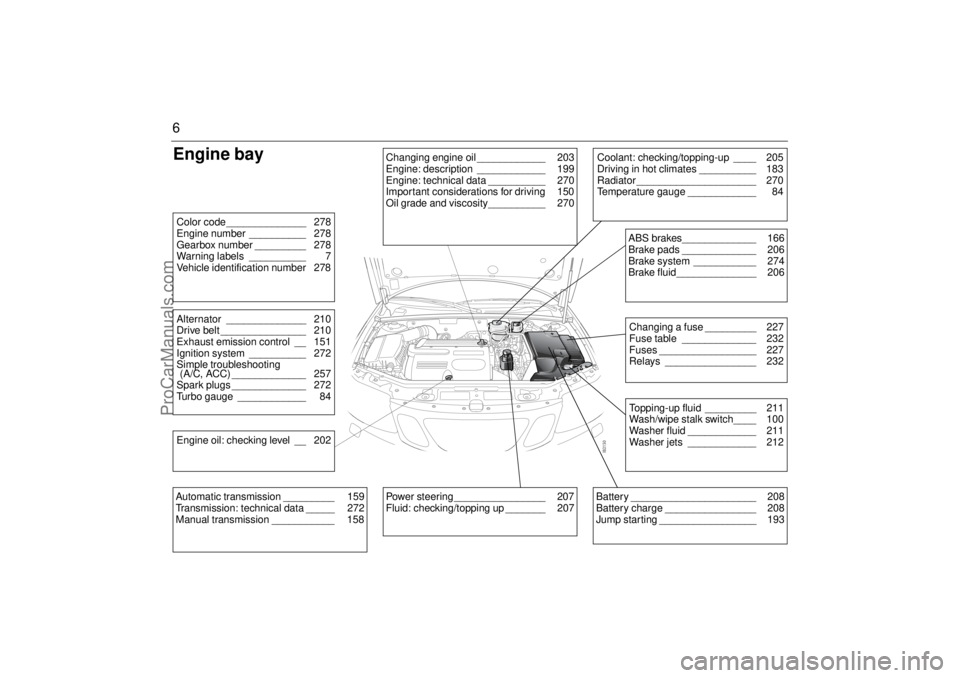
6Engine bayColor code______________ 278
Engine number __________ 278
Gearbox number _________ 278
Warning labels __________ 7
Vehicle identification number 278Alternator ______________ 210
Drive belt _______________ 210
Exhaust emission control __ 151
Ignition system __________ 272
Simple troubleshooting
(A/C, ACC) _____________ 257
Spark plugs _____________ 272
Turbo gauge ____________ 84Engine oil: checking level __ 202Automatic transmission _________ 159
Transmission: technical data _____ 272
Manual transmission ___________ 158
Battery ______________________ 208
Battery charge ________________ 208
Jump starting _________________ 193
Changing engine oil ____________ 203
Engine: description ____________ 199
Engine: technical data __________ 270
Important considerations for driving 150
Oil grade and viscosity__________ 270
Topping-up fluid _________ 211
Wash/wipe stalk switch____ 100
Washer fluid ____________ 211
Washer jets ____________ 212
Power steering ________________ 207
Fluid: checking/topping up _______ 207
Coolant: checking/topping-up ____ 205
Driving in hot climates __________ 183
Radiator _____________________ 270
Temperature gauge ____________ 84
Changing a fuse _________ 227
Fuse table _____________ 232
Fuses _________________ 227
Relays ________________ 232ABS brakes_____________ 166
Brake pads _____________ 206
Brake system ___________ 274
Brake fluid______________ 206
ProCarManuals.com
Page 41 of 292

39 Safety
Frequently asked questions on
function of the airbagDo you still need to wear a safety belt if air-
bags are fitted?Yes, always! The airbag system compo-
nents merely supplement the car’s normal
safety system. Moreover, the front airbags
will only be actuated in a moderate to severe
frontal, or near-frontal crash, which means,
of course, that they provide no protection in
minor frontal crashes, major rear- or side-
crashes or if the car rolls over.
The safety belts help to reduce the sideway
movement of the body in a crash.
But they also ensure that, if a crash occurs
in which the airbags are inflated, the airbag
will make the optimum contact with the
occupant, i.e. square on from the front. If the
occupant meets the airbag in an offset posi-
tion, the protection afforded will be reduced.In addition, airbags provide no protection
against a secondary impact occurring in the
same incident. So there is no doubt about
the benefit of wearing safety belts at all
times.
Do not sit too close to the airbag: it needs
room to inflate.
The airbag inflates very quickly and power-
fully in order to protect an adult, before they
are thrown forward, in a serious frontal
crash.
How do I position the seat to leave room for
the airbag to inflate?Don’t have your seat too far forward.
Recline the seat back to increase the dis-
tance between you and the airbag. For short
drivers, special accessory pedal extensions
are available through your Saab dealer.
Airbags inflate extremely rapidly and with
great force – to be fast enough to protect an
adult in the seat.
When do the airbags in the steering wheel
and passenger side of the dash board
inflate? The airbag will only be inflated under certain
predetermined conditions in a moderate to
severe frontal, or near-frontal crash,
depending on such factors as the force and
angle of the impact, the speed of the car on
impact, and the resistance to deformation of
the impacting object.
The airbag can only be activated once in the
same incident.
Do not attempt to drive the car after an
airbag has been inflated, even if it is possi-
ble.What won’t trigger the airbag? The airbag will not be activated in all frontal
crashes. For instance, if the car has hit
something relatively soft and yielding (e.g. a
snow drift or a hedge) or a solid object at a
low impact speed, the airbag will not neces-
sarily be triggered.
ProCarManuals.com
Page 123 of 292
121 Interior equipment
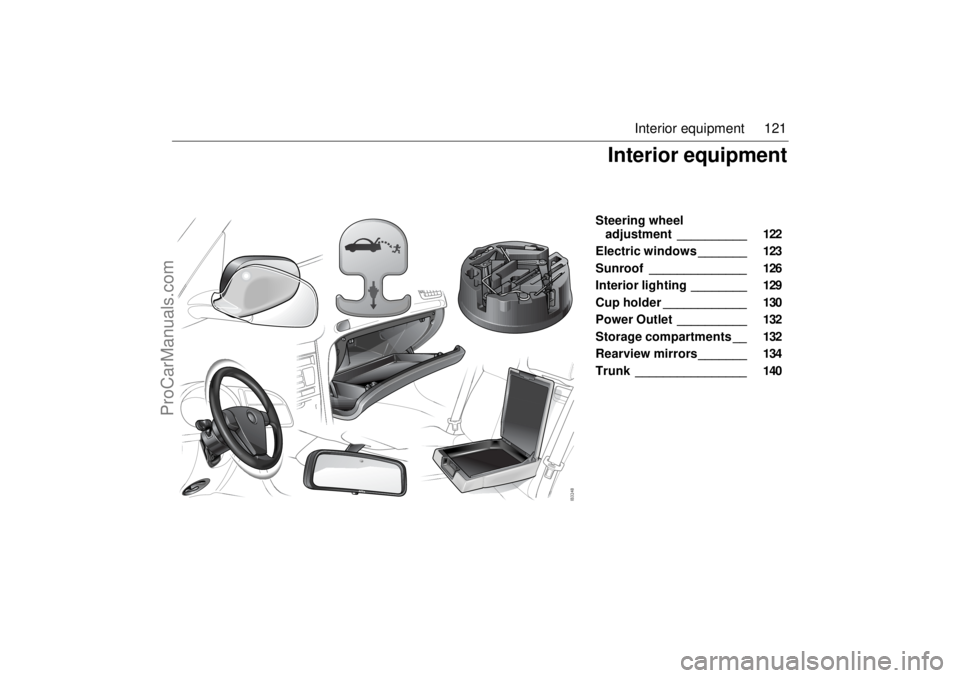
Steering wheel
adjustment __________ 122
Electric windows _______ 123
Sunroof ______________ 126
Interior lighting ________ 129
Cup holder ____________ 130
Power Outlet __________ 132
Storage compartments __ 132
Rearview mirrors_______ 134
Trunk ________________ 140
Interior equipment
ProCarManuals.com
Page 182 of 292

180 Starting and drivingengine wear is at its greatest during this
period. Drive off as soon as possible after
starting the engine and avoid high engine
speeds.
Drive as smoothly and thoughtfully as
possible. Match your driving to the
prevailing traffic conditions.
Driving in a low gear gives rise to higher
fuel consumption than driving in a high
gear because of the higher engine speed
for any given road speed. Always shift up
as soon as traffic conditions allow and
drive in the highest gear as much as
possible.
Check the tire pressure once a month.
Incorrect tire pressure increases tire
wear. It is preferable for the tire pressure
to be slightly high than too low. Under-
pressure increases fuel consumption. Check the fuel consumption regularly.
Increased fuel consumption can indicate
that something is wrong and that the car
needs to be checked at a Saab dealer.
Practical road tests have demonstrated that
substantial savings in fuel consumption can
be made if the above advice is followed.
Road conditionsWet roads increase fuel consumption, as do
unpaved roads and driving in hilly country
(the amount of fuel saved driving downhill is
less than the additional amount required to
climb the hill).
Engine block heater (standard equipment in Canada, acces-
sory in U.S.)
The following are just some of the benefits
to the car and the environment of using an
engine block heater:
Lower fuel consumption.
Reduced wear on the engine.
Inside of car warms up faster.
Exhaust emissions substantially reduced
over short runs.
The engine heater is effective at outside
temperatures up to 60–70°F (+15–+20°C).
The warmer it is outside, the shorter the time
the engine heater needs to be connected.
Longer than 1.5 hours is unnecessary.
If the car is equipped with a removable,
electric cabin heater that is not in use, store
this in the trunk.
WARNING
Never switch off the engine while driving
as the effect of the brakes and power
steering will be greatly reduced.
ProCarManuals.com
Page 198 of 292

196 Starting and drivingFor long tripsBefore starting off on a long journey, it is
advisable to have your car inspected by
your Saab dealer.
Obtain a few important items to take along
on your journey, such as spare bulbs, wiper
blades, fuses, a drive belt (poly-V-belt) and
the like.
You can check some points yourself before-
hand:
Check that no oil or fuel leaks out of the
engine or gearbox/transmission.
Check the coolant and power steering
fluid levels. Check also for leaks.
Inspect the drive belt (poly-V-belt) and
replace if it shows any signs of wear.
Check the battery charge.
Check the tires for tread pattern and air
pressure, including the compact spare
tire.
Take an extra remote control and keep it
separate.
Check the brakes.
Check all bulbs.
Check for the presence of the tool kit and
jack in the car.
ProCarManuals.com
Page 199 of 292
197 Car care
Hood ________________ 198
Engine ______________ 199
Engine bay ___________ 201
Engine oil ____________ 202
Air filter______________ 204
Transmission fluid ____ 204
Coolant ______________ 205
Brake/clutch fluid and
brake pads__________ 206
Power steering________ 207
Battery ______________ 208
Drive belt ____________ 210
Wipers and washers ___ 211
Wiper blades _________ 211
Changing bulbs _______ 213 Fuses ________________ 227
Tires _________________ 234
Compact spare ________ 246
Changing a tire ________ 248
Safety belts ___________ 251
Upholstery and trim ____ 251
Textile carpeting _______ 252
Engine bay ____________ 252
Washing ______________ 252
Waxing and polishing ___ 253
Touching up the paint___ 253
Anti-corrosion treatment 254
Recovery and/or
recycling of automotive
materials ____________ 256
Air conditioning (A/C) ___ 257
Car care
ProCarManuals.com
Page 203 of 292
201 Car care
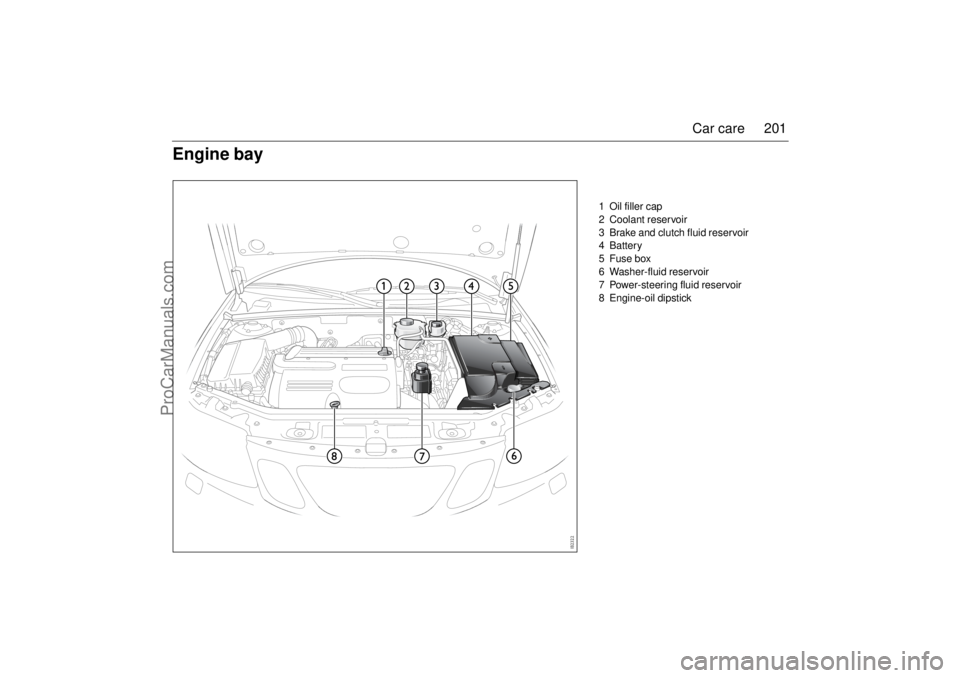
1 Oil filler cap
2 Coolant reservoir
3 Brake and clutch fluid reservoir
4Battery
5 Fuse box
6 Washer-fluid reservoir
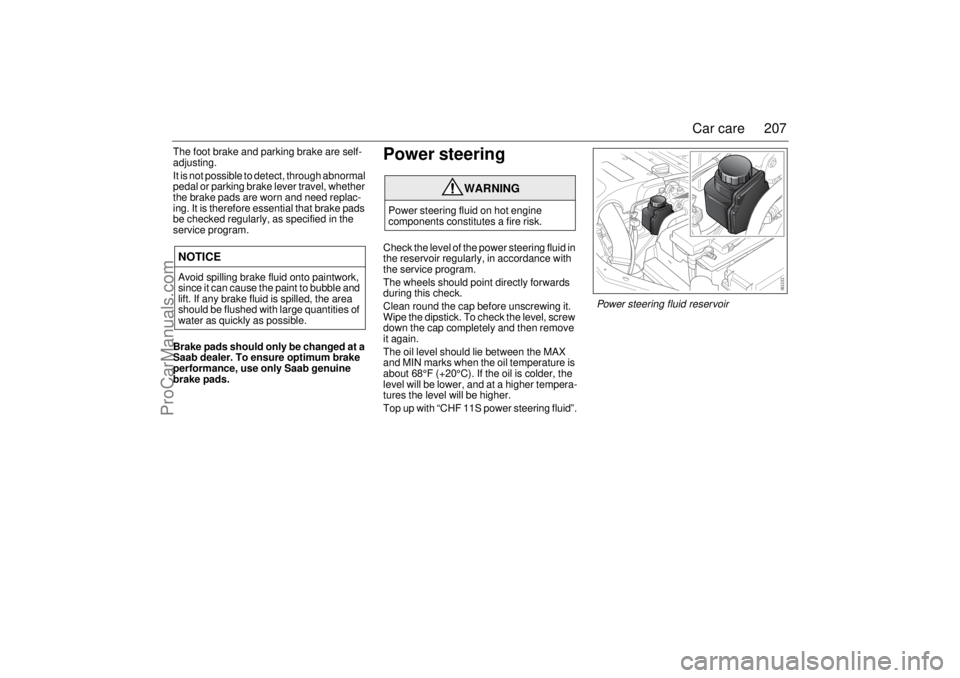
7 Power-steering fluid reservoir
8 Engine-oil dipstick
Engine bay
ProCarManuals.com
Page 209 of 292
207 Car care
The foot brake and parking brake are self-
adjusting.
It is not possible to detect, through abnormal
pedal or parking brake lever travel, whether
the brake pads are worn and need replac-
ing. It is therefore essential that brake pads
be checked regularly, as specified in the
service program.
Brake pads should only be changed at a
Saab dealer. To ensure optimum brake
performance, use only Saab genuine
brake pads.
Power steeringCheck the level of the power steering fluid in
the reservoir regularly, in accordance with
the service program.
The wheels should point directly forwards
during this check.
Clean round the cap before unscrewing it.
Wipe the dipstick. To check the level, screw
down the cap completely and then remove
it again.
The oil level should lie between the MAX
and MIN marks when the oil temperature is
about 68°F (+20°C). If the oil is colder, the
level will be lower, and at a higher tempera-
tures the level will be higher.
Top up with “CHF 11S power steering fluid”.
NOTICEAvoid spilling brake fluid onto paintwork,
since it can cause the paint to bubble and
lift. If any brake fluid is spilled, the area
should be flushed with large quantities of
water as quickly as possible.
WARNING
Power steering fluid on hot engine
components constitutes a fire risk.
Power steering fluid reservoir
ProCarManuals.com
Page 245 of 292

243 Car care
Loading Your VehicleThis is an example of what your vehicle´s
Tire-Loading Information/Certification label
might look like. It is located on the B-pillar
and shows how much weight your vehicle
may properly carry. The label tells you the
proper size, and recommended inflation
pressures for the tires on your vehicle. It
also gives you important information about
the number of people that can be in your
vehicle and the total weight that you can
carry. This weight is called the Vehicle
Capacity Weight, and includes the weight of
all occupants, cargo and all nonfactory-
installed options.
Tire Terminology and DefinitionsAir Pressure: The amount of air inside the
tire pressing outward on each square inch of
the tire. Air pressure is expressed in pounds
per square inch (psi) or kilopascal (kPa).
Accessory Weight: This means the com-
bined weight of optional accessories, for
example, automatic transmission, power
steering, power brakes, power windows,
power seats, radio and air conditioning.
Aspect Ratio: The relationship of a tire´s
height to its width.
Belt: A rubber coated layer of cords that is
located between the plies and the tread.
Cords may be made from steel or other rein-
forcing materials.
Bias Ply Tire: A pneumatic tire in which the
ply cords that extend to the beads are laid at
alternate angles substantially less than 90
degrees to the centerline of the tread.
Cold Inflation Pressure: The amount of air
pressure in a tire, measured in pounds per
square inch (psi) or kilopascal (kPa), before
a tire has built up heat from driving. See
“Inflation - Tire Pressure” on page 234.
Curb weight: This means the weight of a
motor vehicle with standard and optional
equipment including the maximum capacity
of fuel, oil and coolant, without passengers
and cargo.DOT Markings: A code molded into the
sidewall of a tire signifying that the tire is in
compliance with the U.S. Department of
Transportation motor vehicle safety stan-
dards. The DOT code includes the Tire
Identification Number (TIN), an alphanu-
meric designator which can also identify the
tire manufacturer, production plant, brand
and date of production.
GVWR: Gross Vehicle Weight Rating see
“Loading Your Vehicle” on page 243.
GAWR FRT: Gross Axle Weight Rating for
the front axle, see “Loading Your Vehicle”
on page 269.
GAWR RR: Gross Axle Weight Rating for
the rear axle, see “Loading Your Vehicle” on
page 243.
Intended Outboard Sidewall: The side of
an asymmetrical tire that must always face
outward when mounted on a vehicle.
Kilopascal (kPa): The metric unit for air
pressure. There are 6.9 kPa to one psi.
Light Truck (LT-Metric) Tire: A tire used
on light duty trucks and some multipurpose
passenger vehicles.
Load Index: An assigned number ranging
from 1 to 279 that corresponds to the load
carrying capacity of a tire.
This label can only be found on vehicles
sold in the U.S.
Vehicles sold in Canada have the tire
information label in the glove box, see
page 278.
ProCarManuals.com
Page 275 of 292

273 Technical data
Automatic transmission Suspension
SteeringType __________________________ Electronically con-
trolled, 5-speed,
fully-automatic with
hydraulic torque
converter, planetary
gears and integral
final drive.
Lock-up function in
selector positions 3,
4 and 5.
Selector lever positions ____________ P, R, N, D, M
Oil capacity, total _________________ 7.6 qts. (7.2 litres)
Oil type ________________________ Saab 3309
Clutch type _____________________ Hydraulic plate
clutches, brake
bands and one-way
couplings
Speed (mph/km/h) at 1000 rpm in top gear:
2.0t and 2.0T _____________________ 28–29/46–47Spring type, front and rear _________ Coil springs
Maximum deflection of springs:
Front ____________________________ 7.0'' (178 mm)
Rear ____________________________ 8.3'' (212 mm)
Dampers, front and rear ___________ Gas-filled dampers
Steering _______________________ Power-assisted
steering gear of
rack-pinion type and
telescopic jointed
steering column
Number of turns, lock to lock________ 2.97
Oil type ________________________ Power steering fluid
CHF 11S or
CHF 202
ProCarManuals.com