ECO mode SAAB 9-3 2006 User Guide
[x] Cancel search | Manufacturer: SAAB, Model Year: 2006, Model line: 9-3, Model: SAAB 9-3 2006Pages: 318, PDF Size: 28.05 MB
Page 113 of 318

113 Instruments and controls
Air ventsThe air vents swivel universally, so that air
can be directed as desired. In winter, for
instance, the outer vents can be directed
onto the door windows for enhanced
demisting.
The amount of air can be individually con-
trolled by the regulator on each vent. If you
wish to reduce the airflow, start by half-
shutting the vent in question.The air conditioning is combined with the
conventional climate control system and
is switched on by pressing the but-
ton, provided that the fan control is in
position 1-5.
The incoming air is treated in three stages:
first it passes through a filter; it is then dehu-
midified and cooled; and finally, if required,
it is heated.
If the engine coolant gets too hot, the A/C
compressor will be turned off.
Convertible: When the soft top or all the
windows are open in a hot, humid climate, it
is recommended to switch off the air condi-
tioning to save fuel. Also, if the air condition-
ing is on, condensation may form on cold
surfaces such as the floor air ducts.
Condensation waterWhen the A/C compressor is on, the incom-
ing air is dehumidified. The resulting con-
densation water is drained away through an
outlet under the car.
It is therefore perfectly normal for water to
be seen dripping from this outlet when the
car is parked. The warmer the ambient air
and the higher the humidity, the more con-
densation will form.
When the button is pressed, the reg-
ular air intake will be closed. In this mode,
the air inside the cabin is recirculated.
Use recirculation when you wish for rapid
cooling at very high outside temperatures.
Switch the air conditioning (A/C) on first.
If necessary, recirculation can be switched
on manually to avoid unpleasant air from
entering the car.
Only use recirculation for a short period
of time at temperatures lower than 50°F
(+10°C), such as to avoid unpleasant air.
Mist or ice may otherwise form on the
windows.
Air conditioning (A/C)
Recirculation
Panel vent93U S M 06.book Page 113 Friday, February 18, 2005 1:15 PM
ProCarManuals.com
Page 123 of 318

123 Instruments and controls
The seat cushions and backrests of the front
seats are heated.
Heating is thermostatically controlled.
Heating is controlled manually but can also
be automatic. Refer to Profiler on page 124.
Three heating levels are available. Pressing
the button once will turn the heating on at full
power. Pressing the button a total of 4 times
will turn the heating off.
= full.
= medium.
= low.
CalibrationCalibration is performed automatically
every fifth time the car is started after having
been switched off for more than 2 hours or
if the battery has been disconnected.ProgrammingA number of functions can be customized
under Profiler (see page 124). Further cus-
tomizations can be made at a workshop. We
recommend that you contact a Saab dealer.Tips(before contacting a workshop. We recom-
mend that you contact a Saab dealer)
If you feel that the ACC system is not func-
tioning satisfactorily, select "Default
Settings" under Profiler (see page 124.
To prevent the smell of washer fluid from
entering the car, recirculation can be acti-
vated automatically while the windshield
is washed. The recirculation symbol will
however not light up. This function is
optional; contact a workshop. We recom-
mend that you contact a Saab dealer. This
automatic recirculation is the factory
default setting as long as the system is
working in full "AUTO" model with no
customized settings.
Electric heating, front
seats3
93U S M 06.book Page 123 Friday, February 18, 2005 1:15 PM
ProCarManuals.com
Page 126 of 318

126 Instruments and controlsFan Settings
High speed:
This selection give a slightly higher
fan speed than Medium speed
though with continued automatic
regulation.
Medium speed:
Normal automatic fan speed. This is
one of the Default Settings.
Low speed:
This selection give a slightly lower
fan speed than Medium speed
though with continued automatic
regulation.
Convertible: Fan speed is not regulated
automatically when the soft top is open.
Air Distribution
Auto:
The ACC system adapts air tem-
perature and distribution to the pre-
vailing conditions. This is one of the
Default Settings
.
Manual:
Windshield:
The ACC system directs almost
all air to the windshield.
Panel:
The ACC system directs almost
all air to air vents in the fascia.
Floor:
The ACC system directs almost
all air to the floor.
A/C Mode
Auto:
Automatic engagement and disen-
gagement of the A/C. This is one of
the Default Settings.
A/C off:
A/C compressor OFF (see also
page 118). The A/C compressor
can be activated temporarily by
pressing the AC or AUTO button
while on the road and if the outside
temperature is above 41°F (+5°C).
The A/C will be off the next time the
engine is started, if the engine has
been switched off for more than
2hours.
Convertible: The A/C compressor is
switched off when the soft top is folded
down.
Further customizations to this function can
be made at a workshop. We recommend
taht you contact a Saab dealer.
The A/C compressor can be on even
when the soft top is folded down.
The A/C compressor can be set to
operate as when the soft top was last
folded down.Dual/Single Zone
Dual zone:
Individual temperature setting for
each zone (see page 116). The sys-
tem saves the settings when the
engine is switched off. This is one of
the Default Settings.
Single zone:
Common temperature setting when
the engine is started. If the temper-
ature setting for the passenger zone
is changed, the system will switch to
Dual zone control. Single zone con-
trol will return the next time the
engine is started having been
switched off for more than 2 hours.
93U S M 06.book Page 126 Friday, February 18, 2005 1:15 PM
ProCarManuals.com
Page 134 of 318
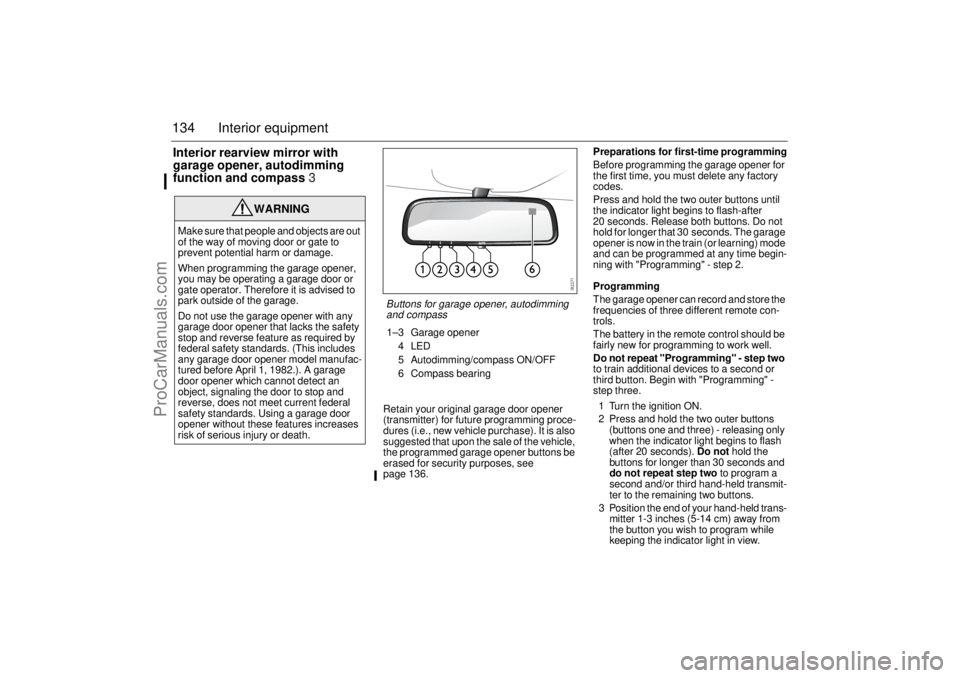
134 Interior equipmentInterior rearview mirror with
garage opener, autodimming
function and compass3
Retain your original garage door opener
(transmitter) for future programming proce-
dures (i.e., new vehicle purchase). It is also
suggested that upon the sale of the vehicle,
the programmed garage opener buttons be
erased for security purposes, see
page 136.Preparations for first-time programming
Before programming the garage opener for
the first time, you must delete any factory
codes.
Press and hold the two outer buttons until
the indicator light begins to flash-after
20 seconds. Release both buttons. Do not
hold for longer that 30 seconds. The garage
opener is now in the train (or learning) mode
and can be programmed at any time begin-
ning with "Programming" - step 2.
Programming
The garage opener can record and store the
frequencies of three different remote con-
trols.
The battery in the remote control should be
fairly new for programming to work well.
Do not repeat "Programming" - step two
to train additional devices to a second or
third button. Begin with "Programming" -
step three.
1 Turn the ignition ON.
2 Press and hold the two outer buttons
(buttons one and three) - releasing only
when the indicator light begins to flash
(after 20 seconds). Do not hold the
buttons for longer than 30 seconds and
do not repeat step two to program a
second and/or third hand-held transmit-
ter to the remaining two buttons.
3 Position the end of your hand-held trans-
mitter 1-3 inches (5-14 cm) away from
the button you wish to program while
keeping the indicator light in view.
WARNING
Make sure that people and objects are out
of the way of moving door or gate to
prevent potential harm or damage.
When programming the garage opener,
you may be operating a garage door or
gate operator. Therefore it is advised to
park outside of the garage.
Do not use the garage opener with any
garage door opener that lacks the safety
stop and reverse feature as required by
federal safety standards. (This includes
any garage door opener model manufac-
tured before April 1, 1982.). A garage
door opener which cannot detect an
object, signaling the door to stop and
reverse, does not meet current federal
safety standards. Using a garage door
opener without these features increases
risk of serious injury or death.
Buttons for garage opener, autodimming
and compass1–3 Garage opener
4LED
5 Autodimming/compass ON/OFF
6 Compass bearing
93U S M 06.book Page 134 Friday, February 18, 2005 1:15 PM
ProCarManuals.com
Page 136 of 318
136 Interior equipmentReprogramming a single button
To program a device to the garage opener
using a button previously trained, follow
these steps:
1 Press and hold the desired button. DO
NOT release the button.
2 The indicator light will begin to flash after
20 seconds. Without releasing the
button, proceed with "Programming" -
step 3.
Erasing the three buttons
To erase programming from the three but-
tons (individual buttons cannot be erased
but can be "reprogrammed" as outlined
below), follow the step noted:
Press and hold the two outer buttons until
the indicator light begins to flash-after
20 seconds. Release both buttons. Do
not hold for longer that 30 seconds. The
garage opener is now in the train (or
learning) mode and can be programmed
at any time beginning with "Programming"
- step 3.Opening a garage door
To operate, simply press and release the
programmed button. Activation will now
occur for the trained device (i.e. garage door
opener, gate operator, security system,
entry door lock, home/office lighting, etc.).
For convenience, the hand-held transmitter
of the device may also be used at any time.
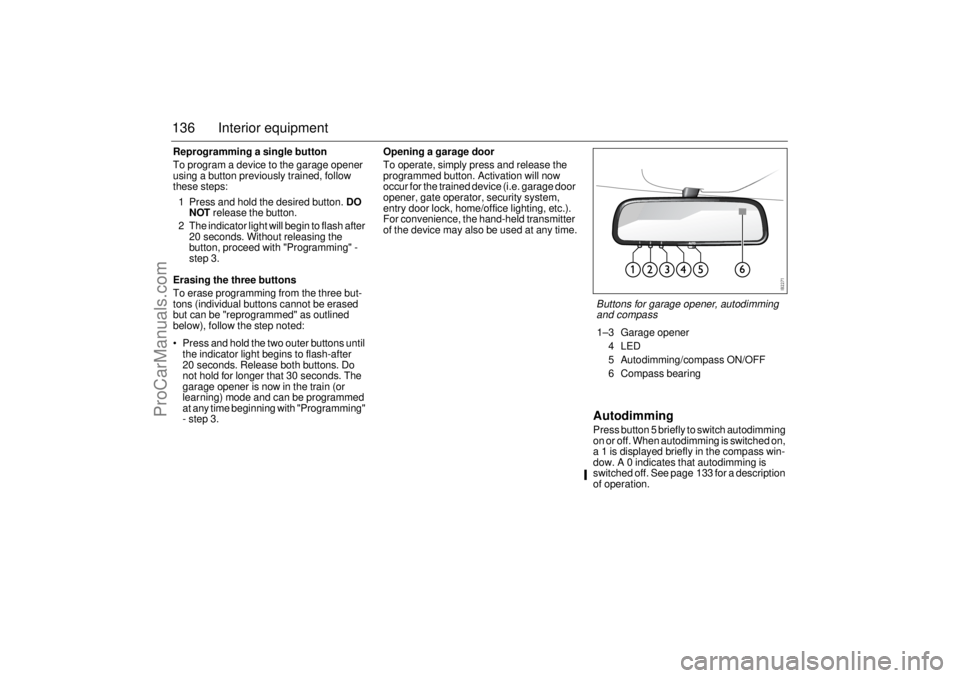
AutodimmingPress button 5 briefly to switch autodimming
on or off. When autodimming is switched on,
a 1 is displayed briefly in the compass win-
dow. A 0 indicates that autodimming is
switched off. See page 133 for a description
of operation.Buttons for garage opener, autodimming
and compass1–3 Garage opener
4LED
5 Autodimming/compass ON/OFF
6 Compass bearing
93U S M 06.book Page 136 Friday, February 18, 2005 1:15 PM
ProCarManuals.com
Page 159 of 318

159 Starting and driving
Ignition switch ________ 160
Steering wheel lock ____ 162
Starting the engine ____ 162
Important considerations
for driving __________ 164
Refueling ____________ 167
Engine Break-in Period _ 171
Manual transmission___ 172
Automatic
transmission 3 ______ 173
Cruise control ________ 179
Braking ______________ 180
Traction Control System
(TCS) ______________ 183
Electronic Stability
Program (ESP) 3 _____ 185
Parking brake_________ 187
Parking ______________ 187
Saab Parking
Assistance 3 ________ 190 Economical driving _____ 193
Driving in cold weather__ 195
Driving in hot climates __ 197
Towing a trailer 3_______ 198
Driving with a roof rack
load ________________ 202
Driving with a load _____ 204
Driving with the trunk lid
open________________ 204
Driving in deep water ___ 204
Driving at night ________ 205
Towing the car _________ 205
Driving with the compact
spare tire ____________ 208
Jump starting _________ 208
For long trips __________ 211
Starting and driving
3Asterisk means: equipment not fitted in all cars
(can depend on model variant, engine variant,
market specification, options or accessories).93U S M 06.book Page 159 Friday, February 18, 2005 1:15 PM
ProCarManuals.com
Page 164 of 318

164 Starting and drivingImportant
considerations for
driving1 Starting and driving
Do not use full throttle until the engine
is warm, so as to avoid unnecessary
wear. If the needle of the turbo gauge
repeatedly enters the red zone, the
engine may suddenly lose power, due
to the initiation of a monitoring system
that limits the boost pressure. We
recommend that you contact a Saab
dealer as soon as possible.
Under certain barometric conditions
(high outside temperature and/or high
altitude) the needle may enter the first
part of the red zone without necessarily
indicating that a fault has arisen.
A protective function (interruption of the
fuel supply) limits the engine speed.2 Stopping the engine
Do not rev the engine immediately
before switching it off - stop the engine
when it is idling.
3 Regulating the boost pressure
One of the advantages of boost pres-
sure regulation is that the engine can
also be run safely on gasoline with a
lower octane rating, although not lower
than AON 87. However, engine perfor-
mance will fall slightly and heavy load-
ing and laboring should be avoided. For
optimum performance, use the recom-
mended grade of fuel.
The maximum boost pressure is regu-
lated according to the tendency of the
engine to knock. Short-lived knocking
is perfectly normal. This can occur
when the engine is running at about
3,000 rpm under a heavy load. The
extent of this knocking will depend on
the grade of fuel in the tank.
Isolated instances of knocking can
occur with low-octane fuel. This
controlled form of knocking, followed by
a reduction in the boost pressure, is a
sign that the control system is working
normally, and is perfectly safe for the
engine.
Limp-homeThe engine management system has a
diagnostic feature that checks a number of
internal functions. If a fault is detected in the
throttle valve, the engine management
system will set the throttle system to the
limp-home mode. This means:
idling control will be poor (uneven idling
since regulated by ignition and fuel
supply)
engine performance will be reduced
the cruise control will not function
the capacity of the A/C compressor will be
limited.NOTICE If the engine sounds strange there is a
malfunction. We recommend that you
contact a Saab dealer immediately.
The use of fuel with too low an octane
rating can cause serious engine
damage.
93U S M 06.book Page 164 Friday, February 18, 2005 1:15 PM
ProCarManuals.com
Page 180 of 318

180 Starting and drivingTo reduce the preset speedYou can reduce speed in any of the follow-
ing ways:
Brake to the desired speed. Jog the
control to SET/+ or SET/–.
Jog the control to SET/– to reduce the
speed by 1 mph (1.6 km/h).
Hold the control in the SET/– position until
the desired speed is reached.Temporary increase in speedAccelerate, without shifting down (manual
transmission), to exceed the set speed such
as for overtaking. When you release the
accelerator, the car will return to the set
speed.To disengage the system
temporarilySlide the switch to the left towards OFF, but
only as far as to disengage the cruise con-
trol. Allow the switch to spring back.
To re-engage the systemSlide the switch to RESUME. The car will
return to the previously set speed. Vehicle
speed must exceed 15 mph (25 km/h).To disengage the systemThe system will be disengaged:
As soon as the brake or clutch pedal is
depressed (cars with manual transmis-
sion).
When the switch is slid towards OFF. See
also heading "To disengage the system
temporarily".
When the switch is slid to OFF.
When the TCS/ESP system is operative.
When position N is selected (cars with
automatic transmission).
BrakingIt is good practice to try your brakes period-
ically while driving. This is particularly
important when driving in heavy rain, on
roads with a lot of surface water, in snow or
in salty slush. In such conditions a slight
delay in the braking effect may be noticed.
To minimize this delay, dry the brakes by
applying them lightly now and again. This
should also be done after the car has been
washed, and in extremely damp weather.
To avoid the brakes becoming overheated,
such as when negotiating long descents
with a drop of several hundred yards (hun-
dred metres), select a low gear to utilize the
braking effect of the engine. If the car has
automatic transmission, select 1st or 2nd
gear.
You can help to prolong the life of the brakes
by thinking ahead and braking harder over
short periods, rather than braking more
moderately over long stretches.
93U S M 06.book Page 180 Friday, February 18, 2005 1:15 PM
ProCarManuals.com
Page 199 of 318
199 Starting and driving
Recommendations for cars with
automatic transmissionThe following driving time limits are based
on the capacity of the cooling system in hot
weather, i.e. approximately 86°F (+30°C).The following driving time limits are based
on the capacity of the cooling system in hot
weather, i.e. approximately 104°F (+40°C).
When negotiating long hills, bear the follow-
ing important considerations in mind.
Rises in coolant temperature are indicated
by the temperature gauge in the main instru-
ment panel.
The following steps are taken in order as the
temperature of the transmission increases:
Gear change pattern is altered
A/C compressor is switched off
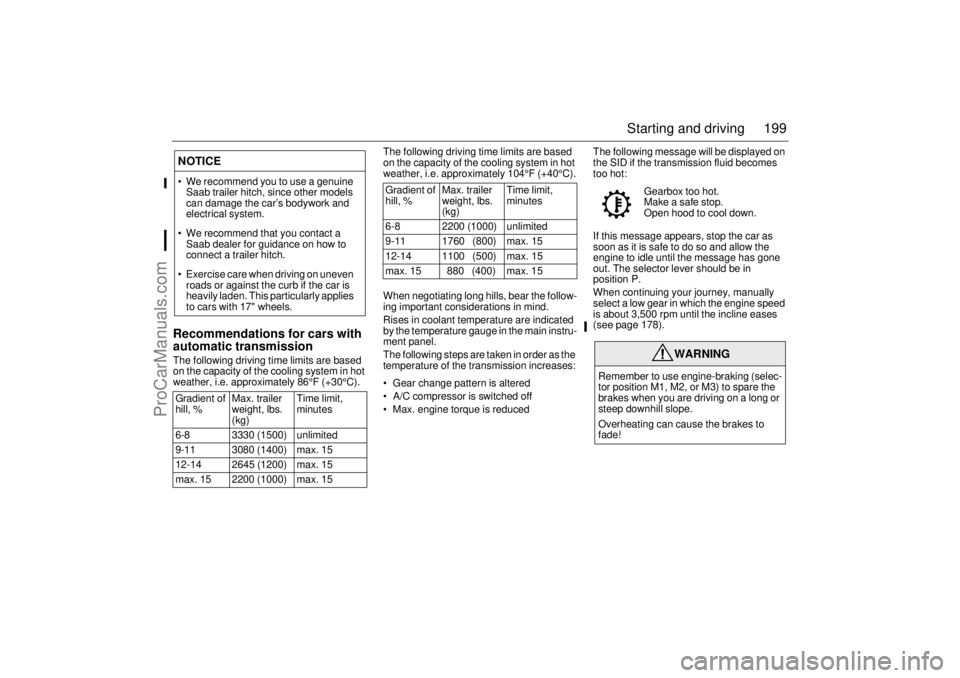
Max. engine torque is reducedThe following message will be displayed on
the SID if the transmission fluid becomes
too hot:
If this message appears, stop the car as
soon as it is safe to do so and allow the
engine to idle until the message has gone
out. The selector lever should be in
position P.
When continuing your journey, manually
select a low gear in which the engine speed
is about 3,500 rpm until the incline eases
(see page 178).NOTICE We recommend you to use a genuine
Saab trailer hitch, since other models
can damage the car’s bodywork and
electrical system.
We recommend that you contact a
Saab dealer for guidance on how to
connect a trailer hitch.
Exercise care when driving on uneven
roads or against the curb if the car is
heavily laden. This particularly applies
to cars with 17" wheels.
Gradient of
hill, %Max. trailer
weight, lbs.
(kg)Time limit,
minutes
6-8 3330 (1500) unlimited
9-11 3080 (1400) max. 15
12-14 2645 (1200) max. 15
max. 15 2200 (1000) max. 15
Gradient of
hill, %Max. trailer
weight, lbs.
(kg)Time limit,
minutes
6-8 2200 (1000) unlimited
9-11 1760 (800) max. 15
12-14 1100 (500) max. 15
max. 15 880 (400) max. 15
Gearbox too hot.
Make a safe stop.
Open hood to cool down.
WARNING
Remember to use engine-braking (selec-
tor position M1, M2, or M3) to spare the
brakes when you are driving on a long or
steep downhill slope.
Overheating can cause the brakes to
fade!
93U S M 06.book Page 199 Friday, February 18, 2005 1:15 PM
ProCarManuals.com
Page 200 of 318
200 Starting and drivingRecommendations for cars with
manual transmissionRises in coolant temperature are indicated
by the temperature gauge in the main instru-
ment panel.
When the needle is just outside the red
zone, the A/C compressor will be switched
off and, on certain engine variants, the max-
imum engine torque will be limited.
When continuing your journey, select a low
gear in which the engine speed is about
3,500 rpm until the incline eases.
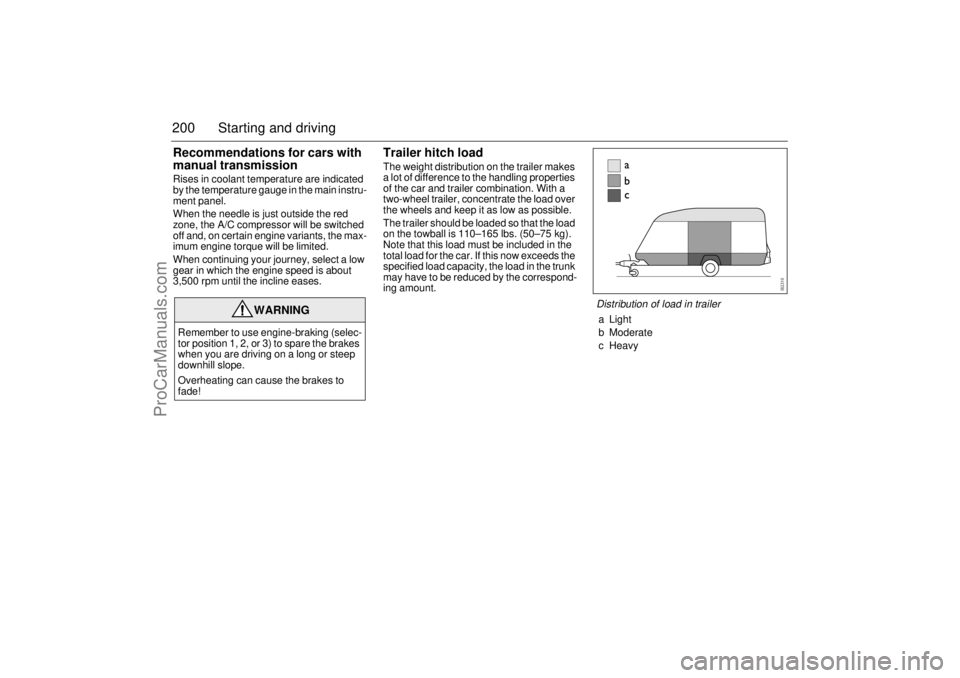
Trailer hitch loadThe weight distribution on the trailer makes
a lot of difference to the handling properties
of the car and trailer combination. With a
two-wheel trailer, concentrate the load over
the wheels and keep it as low as possible.
The trailer should be loaded so that the load
on the towball is 110–165 lbs. (50–75 kg).
Note that this load must be included in the
total load for the car. If this now exceeds the
specified load capacity, the load in the trunk
may have to be reduced by the correspond-
ing amount.
WARNING
Remember to use engine-braking (selec-
tor position 1, 2, or 3) to spare the brakes
when you are driving on a long or steep
downhill slope.
Overheating can cause the brakes to
fade!
Distribution of load in trailera Light
b Moderate
cHeavy
93U S M 06.book Page 200 Friday, February 18, 2005 1:15 PM
ProCarManuals.com