Cover SAAB 9-3 2006 Owner's Manual
[x] Cancel search | Manufacturer: SAAB, Model Year: 2006, Model line: 9-3, Model: SAAB 9-3 2006Pages: 318, PDF Size: 28.05 MB
Page 95 of 318
95 Instruments and controls
When the engine is started, the function that
was selected when the engine was
switched off is displayed, with the following
exceptions:
Te m p is displayed if the outside tempera-
ture is between 26 and 38°F (–3 and
+3°C).
D.T.E is displayed if less than or equal to
30 miles (50 km).
Outdoor temperature
The Temp function is always activated
(even in
NIGHTPANEL
mode) if the outdoor
temperature rises or falls to between 26 and
38°F (–3 and +3°C).
If the temperature sensor, located under the
front bumper, is covered by snow or ice,
temperature readings will be unreliable.
For how to set the year, month and day,
refer to Clock on page 98.Setting values
1 Select one of the functions using the
INFO dial.
Speed W (preset to 55 mph (90 km/h)
Dist (preset to 100 miles (100 km) if not
previously set)
Speed Ø
Arriv
2 Press and hold the INFO dial until given
audible confirmation.
3 Turn the INFO dial to change the value.
(Press CLEAR to reset the value.)
4 Press the INFO dial to finish setup.
Using DIST as a trip meter
1 Select Dist using the INFO dial.
2 Press and hold the CLEAR button for
approx. 1 second.
An arrow will now appear on the right-hand
side of the display, indicating that the trip
meter is running.Resetting a single function
1 Select the function you wish to reset with
the INFO dial.
Fuel Ø
SpeedØ
Tr i p (Dist used as trip meter)
2 Press and hold the CLEAR button for
approx. 1 second.
The selected function will now be reset.
Resetting the trip computer
1 Select one of the functions using the
INFO dial.
Fuel Ø
SpeedØ
D.T.E.
Arriv
Tr i p (Dist used as trip meter)
2 Press and hold the CLEAR button
(approx. 3 seconds) until audible confir-
mation is given.
WARNING
Remember that roads can be icy even at
temperatures of above 38°F (+3°C),
especially on bridges and stretches of
road that are sheltered from the sun.93U S M 06.book Page 95 Friday, February 18, 2005 1:15 PM
ProCarManuals.com
Page 117 of 318
117 Instruments and controls
The system uses four sensors:
Outside air temperature sensor
Cabin air temperature sensor
Sun sensor
Blended air temperature sensors (located
in the heater unit and the outer panel vent
duct).
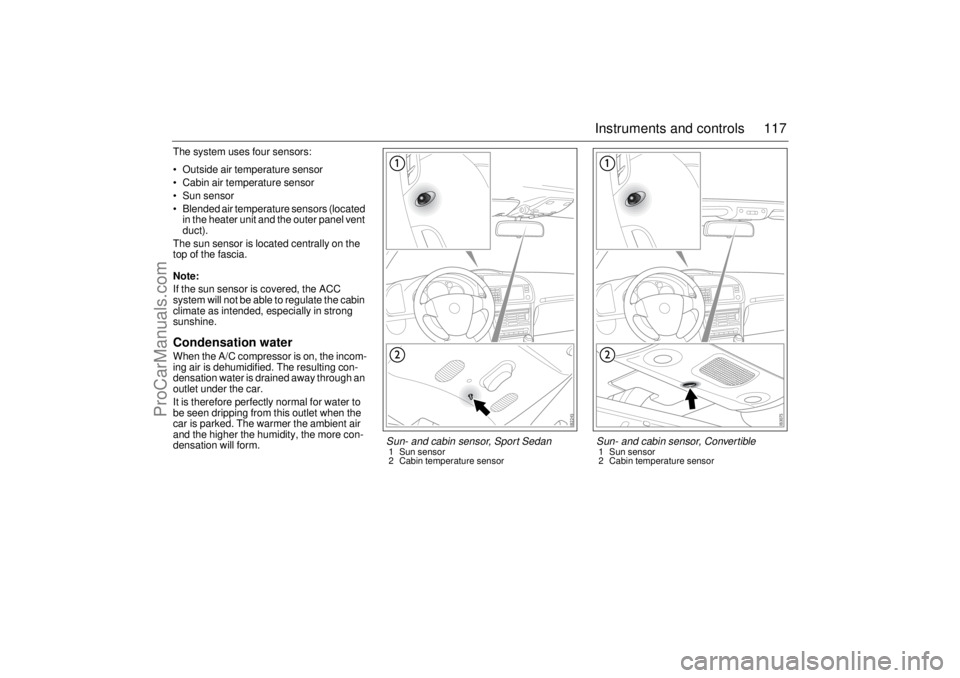
The sun sensor is located centrally on the
top of the fascia.
Note:
If the sun sensor is covered, the ACC
system will not be able to regulate the cabin
climate as intended, especially in strong
sunshine.Condensation waterWhen the A/C compressor is on, the incom-
ing air is dehumidified. The resulting con-
densation water is drained away through an
outlet under the car.
It is therefore perfectly normal for water to
be seen dripping from this outlet when the
car is parked. The warmer the ambient air
and the higher the humidity, the more con-
densation will form.
Sun- and cabin sensor, Sport Sedan1 Sun sensor
2 Cabin temperature sensor
Sun- and cabin sensor, Convertible1 Sun sensor
2 Cabin temperature sensor
93U S M 06.book Page 117 Friday, February 18, 2005 1:15 PM
ProCarManuals.com
Page 142 of 318
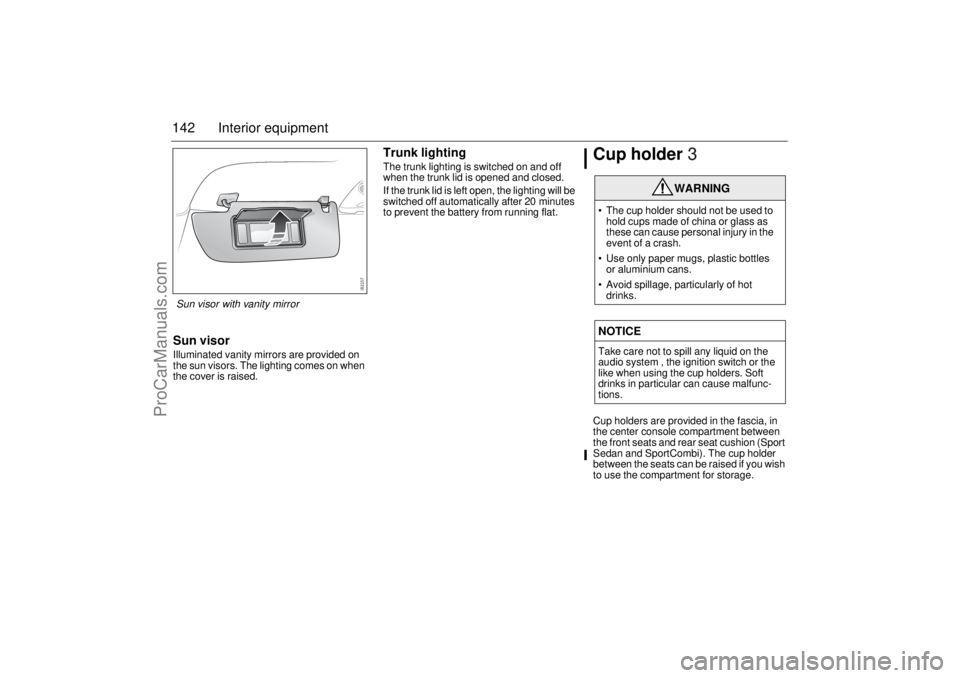
142 Interior equipmentSun visorIlluminated vanity mirrors are provided on
the sun visors. The lighting comes on when
the cover is raised.
Trunk lightingThe trunk lighting is switched on and off
when the trunk lid is opened and closed.
If the trunk lid is left open, the lighting will be
switched off automatically after 20 minutes
to prevent the battery from running flat.
Cup holder3Cup holders are provided in the fascia, in
the center console compartment between
the front seats and rear seat cushion (Sport
Sedan and SportCombi). The cup holder
between the seats can be raised if you wish
to use the compartment for storage.
WARNING
The cup holder should not be used to
hold cups made of china or glass as
these can cause personal injury in the
event of a crash.
Use only paper mugs, plastic bottles
or aluminium cans.
Avoid spillage, particularly of hot
drinks.NOTICETake care not to spill any liquid on the
audio system , the ignition switch or the
like when using the cup holders. Soft
drinks in particular can cause malfunc-
tions.
Sun visor with vanity mirror93U S M 06.book Page 142 Friday, February 18, 2005 1:15 PM
ProCarManuals.com
Page 145 of 318
145 Interior equipment
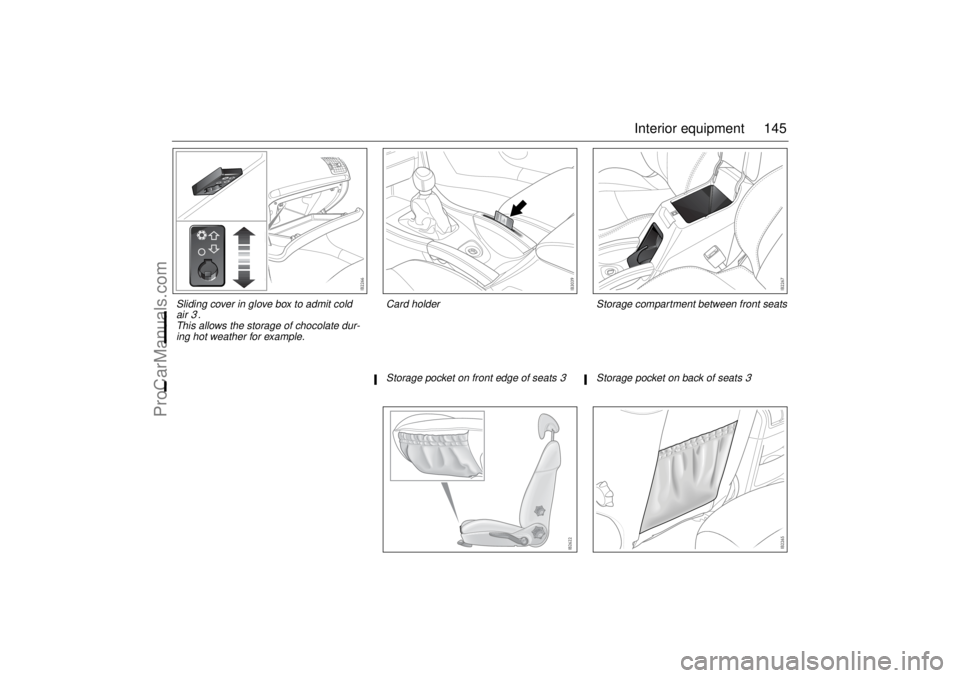
Sliding cover in glove box to admit cold
air
3.
This allows the storage of chocolate dur-
ing hot weather for example.
Storage compartment between front seats
Storage pocket on front edge of seats
3
Storage pocket on back of seats
3
Card holder
93U S M 06.book Page 145 Friday, February 18, 2005 1:15 PM
ProCarManuals.com
Page 150 of 318
150 Interior equipment
Trunk lightingOn the underside of the parcel shelf is a light
that is switched on and off when the trunk is
opened and closed.
If the trunk lid is left open, the lighting will be
switched off automatically after 20 minutes
to prevent the battery from running flat.
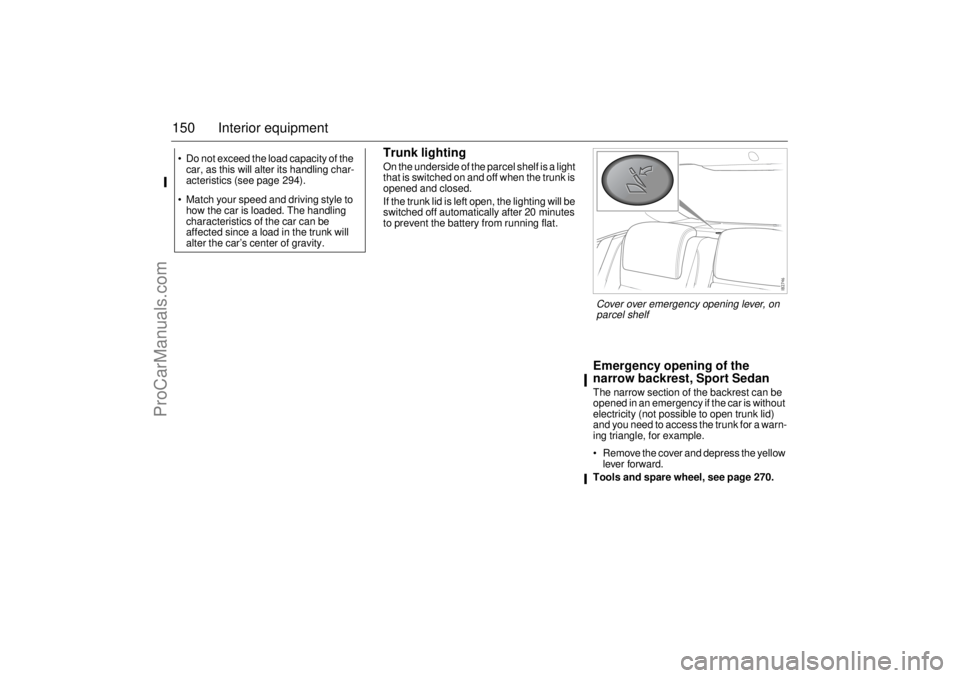
Emergency opening of the
narrow backrest, Sport SedanThe narrow section of the backrest can be
opened in an emergency if the car is without
electricity (not possible to open trunk lid)
and you need to access the trunk for a warn-
ing triangle, for example.
Remove the cover and depress the yellow
lever forward.
Tools and spare wheel, see page 270. Do not exceed the load capacity of the
car, as this will alter its handling char-
acteristics (see page 294).
Match your speed and driving style to
how the car is loaded. The handling
characteristics of the car can be
affected since a load in the trunk will
alter the car’s center of gravity.Cover over emergency opening lever, on
parcel shelf
93U S M 06.book Page 150 Friday, February 18, 2005 1:15 PM
ProCarManuals.com
Page 156 of 318
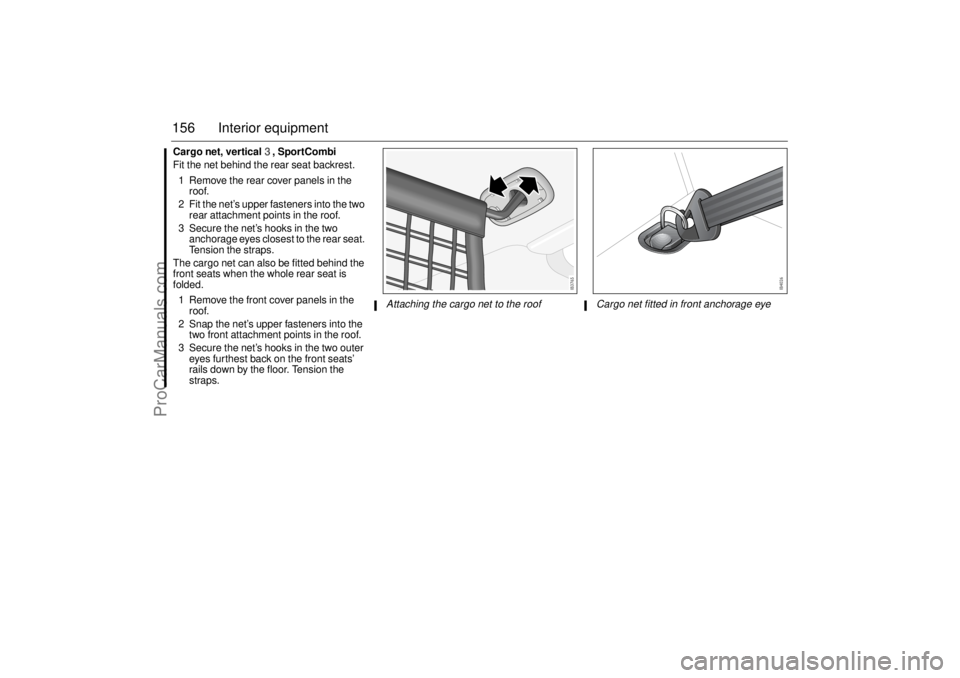
156 Interior equipmentCargo net, vertical3, SportCombi
Fit the net behind the rear seat backrest.
1 Remove the rear cover panels in the
roof.
2 Fit the net’s upper fasteners into the two
rear attachment points in the roof.
3 Secure the net’s hooks in the two
anchorage eyes closest to the rear seat.
Tension the straps.
The cargo net can also be fitted behind the
front seats when the whole rear seat is
folded.
1 Remove the front cover panels in the
roof.
2 Snap the net’s upper fasteners into the
two front attachment points in the roof.
3 Secure the net’s hooks in the two outer
eyes furthest back on the front seats’
rails down by the floor. Tension the
straps.
Attaching the cargo net to the roof
Cargo net fitted in front anchorage eye
93U S M 06.book Page 156 Friday, February 18, 2005 1:15 PM
ProCarManuals.com
Page 170 of 318

170 Starting and drivingGasoline Specifications
It is recommended that gasoline meet spec-
ifications which were developed by automo-
bile manufacturers around the world and
contained in the World-Wide Fuel Charter
which is available from the Alliance of Auto-
mobile Manufacturers at www.autoalli-
ance.org/fuel_charter.htm. Gasoline meet-
ing these specifications could provide
improved driveability and emission control
system performance compared to other
gasoline.California Fuel
If your vehicle is certified to meet California
Emission Standards (see the underhood
emission control label), it is designed to
operate on fuels that meet California speci-
fications. If this fuel is not available in states
adopting California emissions standards,
your vehicle will operate satisfactorily on
fuels meeting federal specifications, but
emission control system performance may
be affected. The malfunction indicator lamp
may turn on and your vehicle may fail a
smog-check test. See Engine malfunction
(CHECK ENGINE) on page 85. If this
occurs, return to your authorized Saab
dealer for diagnosis. If it is determined that
the condition is caused by the type of fuel
used, repairs may not be covered by your
warranty.Additives
To provide cleaner air, all gasolines in the
United States are now required to contain
additives that will help prevent engine and
fuel system deposits from forming, allowing
your emission control system to work prop-
erly. You should not have to add anything to
your fuel. However, some gasolines contain
only the minimum amount of additive
required to meet U.S. Environmental Pro-
tection Agency regulations. Saab recom-
mends that you buy gasolines that are
advertised to help keep fuel injectors and
intake valves clean. If your vehicle experi-
ences problems due to dirty injectors or
valves, try a different brand of gasoline.
Gasolines containing oxygenates, such as
ethers and ethanol, and reformulated gaso-
lines may be available in your area to con-
tribute to clean air. Saab recommends that
you use these gasolines, particularly if they
comply with the specifications described
earlier.
Notice: Your vehicle was not designed
for fuel that contains methanol. Do not
use fuel containing methanol. It can cor-
rode metal parts in your fuel system and
also damage the plastic and rubber
parts. That damage would not be cov-
ered under your warranty.
Some gasolines that are not reformulated
for low emissions may contain an octane-
enhancing additive called methylcyclopen-
tadienyl manganese tricarbonyl (MMT); ask
the attendant where you buy gasoline 93U S M 06.book Page 170 Friday, February 18, 2005 1:15 PM
ProCarManuals.com
Page 171 of 318

171 Starting and driving
whether the fuel contains MMT. Saab does
not recommend the use of such gasolines.
Fuels containing MMT can reduce the life of
spark plugs and the performance of the
emission control system may be affected.
The malfunction indicator lamp may turn on.
If this occurs, return to your authorized Saab
dealer for service.
Fuels in Foreign Countries
If you plan on driving in another country out-
side the United States or Canada, the
proper fuel may be hard to find. Never use
leaded gasoline or any other fuel not recom-
mended in the previous text on fuel. Costly
repairs caused by use of improper fuel
would not be covered by your warranty.
To check the fuel availability, ask an auto
club, or contact a major oil company that
does business in the country where you will
be driving.
Engine Break-in PeriodPistons, cylinder bores and bearings need
time to obtain uniform, wear-resistant
surfaces.
If a new engine is driven too hard, this grad-
ual process of bedding-in will not be possi-
ble and the life of the engine will be short-
ened.
During the first 1,200 miles (2,000 km),
do not exceed 5,000 rpm.
In addition, refrain from driving the car at full
throttle, other than for brief instances,
during the first 1,800 miles (3,000 km).
Wearing in new brake padsNew brake pads take time to bed in, about
90 miles (150 km) if the car is driven largely
under stop-and-go conditions or about
300 miles (500 km) of highway driving.
To extend the useful life of the pads, avoid
hard braking as much as possible.
93U S M 06.book Page 171 Friday, February 18, 2005 1:15 PM
ProCarManuals.com
Page 189 of 318

189 Starting and driving
Long-term parkingIf the car is not going to be used for some
time, e.g. three to four months, the following
steps are recommended:
Drain the washer fluid reservoir and
hoses.
Wash and wax the car. Clean the rubber
seals on the hood, trunk lid and doors,
and lubricate them with glycerol
(glycerine).
After washing the car, dry the brake discs
to avoid corrosion by taking the car out on
the road and applying the brakes a few
times.
Fill the fuel tank to prevent condensation
forming in it.
Top up the coolant and check the anti-
freeze before the onset of winter. Park the car in a dry, covered and well-
ventilated building. Leave the parking
brake OFF!
Convertible: If the car is stored, the soft
top should be closed.
If necessary, use wheel chocks and leave
the parking brake off.
Disconnect the negative (–) battery lead.
If frost is likely to occur during the storage
period, remove the battery and store it in
a frost-free place.
If it is not possible to stand the car on axle
stands, increase the tire pressure to
43 psi (3 bar).
Leave all the door windows open a crack
and cover the car with a non-plastic
tarpaulin – not one made of plastic which will
not breath.93U S M 06.book Page 189 Friday, February 18, 2005 1:15 PM
ProCarManuals.com
Page 191 of 318

191 Starting and driving
If you stop the car with reverse gear
engaged, the sound pulse will stop after
2 seconds. The sound pulses will return if
you continue to reverse. If the car rolls for-
ward while reverse is engaged, the system
is silenced.
When the distance to the object is less
than 1 ft. (30 cm), a continuous tone will
be heard.
When an object is approximately 3 ft.
(90 cm) from the car, the sound pulses
change character markedly (frequency
increases). A distance of about 3 ft. (90 cm)
is suitable if you wish to load or unload the
trunk.
If the distance between an object and a
corner sensor does not change for
3 seconds, for example if you are reversing
alongside a wall, the system will switch to
monitoring straight back. The system indi-
cates if the distance to the wall decreases
again.
If a trailer is hitched up and correctly con-
nected to the trailer contact by the tow bar,
the system is automatically deactivated.Reversing alongside a wall
If the distance between an object and a
corner sensor does not change for
2 seconds, for example if you are reversing
alongside a wall, the system will switch to
monitoring straight back. The system indi-
cates if the distance to the wall decreases
again.Cars with trailer hitch
If the car has a trailer hitch and its wiring is
correctly connected to the car’s electrical
system, the Saab Parking Assistance auto-
matically compensates for the protrusion of
the tow bar.
If a camper or trailer is hitched up and the
trailer hitch wiring is correctly connected to
the car’s electrics, the system is automati-
cally deactivated.
You can temporarily deactivate the Saab
Parking Assistance as follows:
Engage reverse and press the CLEAR
button on the SID control panel.
The system will be reactivated the next time
you engage reverse.
NOTICEThe sensors must be kept clean to func-
tion well. Ice, snow and dirt can affect
their sensitivity.
Large quantities of snow or dirt covering
the sensors can prevent the parking
assistance system from detecting any
objects.
Do not spray the sensors with a pressure
washer, as this can damage them.
93U S M 06.book Page 191 Friday, February 18, 2005 1:15 PM
ProCarManuals.com