Cover SAAB 9-3 2006 Service Manual
[x] Cancel search | Manufacturer: SAAB, Model Year: 2006, Model line: 9-3, Model: SAAB 9-3 2006Pages: 318, PDF Size: 28.05 MB
Page 235 of 318
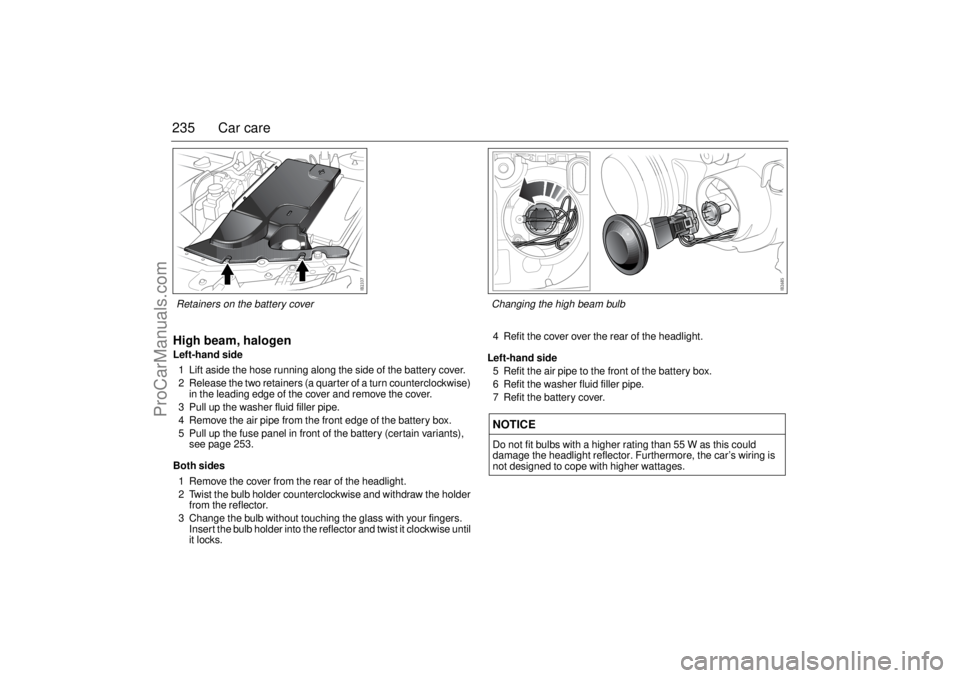
235 Car careHigh beam, halogenLeft-hand side
1 Lift aside the hose running along the side of the battery cover.
2 Release the two retainers (a quarter of a turn counterclockwise)
in the leading edge of the cover and remove the cover.
3 Pull up the washer fluid filler pipe.
4 Remove the air pipe from the front edge of the battery box.
5 Pull up the fuse panel in front of the battery (certain variants),
see page 253.
Both sides
1 Remove the cover from the rear of the headlight.
2 Twist the bulb holder counterclockwise and withdraw the holder
from the reflector.
3 Change the bulb without touching the glass with your fingers.
Insert the bulb holder into the reflector and twist it clockwise until
it locks.4 Refit the cover over the rear of the headlight.
Left-hand side
5 Refit the air pipe to the front of the battery box.
6 Refit the washer fluid filler pipe.
7 Refit the battery cover.
NOTICEDo not fit bulbs with a higher rating than 55 W as this could
damage the headlight reflector. Furthermore, the car’s wiring is
not designed to cope with higher wattages.
Retainers on the battery cover Changing the high beam bulb93U S M 06.book Page 235 Friday, February 18, 2005 1:15 PM
ProCarManuals.com
Page 236 of 318
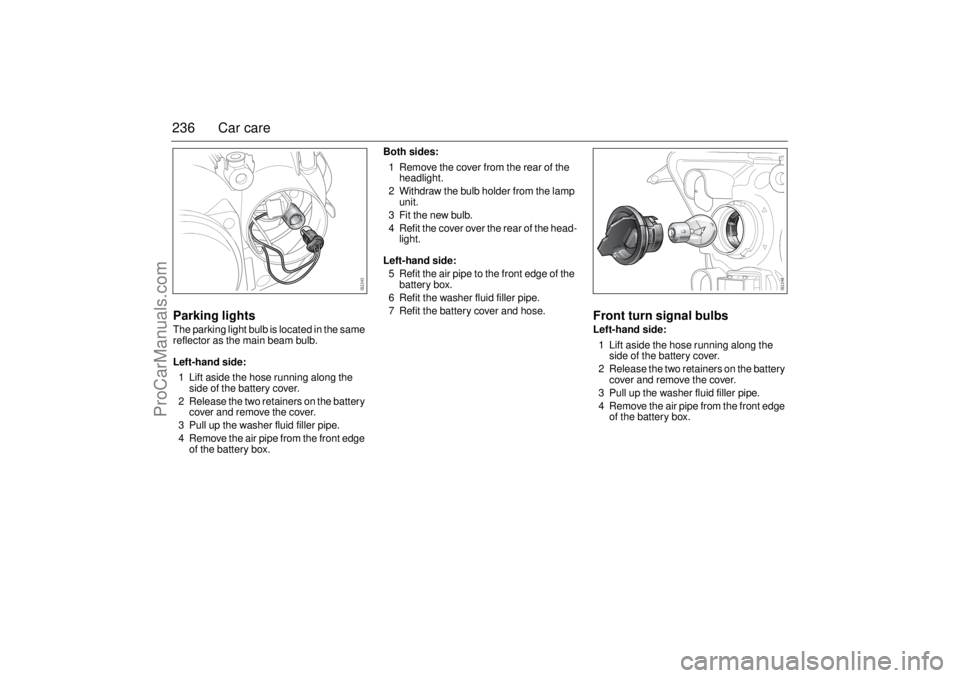
236 Car careParking lightsThe parking light bulb is located in the same
reflector as the main beam bulb.
Left-hand side:
1 Lift aside the hose running along the
side of the battery cover.
2 Release the two retainers on the battery
cover and remove the cover.
3 Pull up the washer fluid filler pipe.
4 Remove the air pipe from the front edge
of the battery box.Both sides:
1 Remove the cover from the rear of the
headlight.
2 Withdraw the bulb holder from the lamp
unit.
3 Fit the new bulb.
4 Refit the cover over the rear of the head-
light.
Left-hand side:
5 Refit the air pipe to the front edge of the
battery box.
6 Refit the washer fluid filler pipe.
7 Refit the battery cover and hose.
Front turn signal bulbsLeft-hand side:
1 Lift aside the hose running along the
side of the battery cover.
2 Release the two retainers on the battery
cover and remove the cover.
3 Pull up the washer fluid filler pipe.
4 Remove the air pipe from the front edge
of the battery box.
93U S M 06.book Page 236 Friday, February 18, 2005 1:15 PM
ProCarManuals.com
Page 237 of 318
237 Car care
Both sides:
1 The bulb holder has a bayonet fitting.
Turn the bulb holder counterclockwise
and withdraw it.
2 The bulb also has a bayonet fitting.
Press in the bulb and twist it counter-
clockwise.
3 Fit the new bulb.
4 To facilitate fitting, look in through the
headlight lens when fitting the bulb.
Check that the new bulb is firmly seated.
Left-hand side:
5 Refit the air pipe to the front edge of the
battery box.
6 Refit the washer fluid filler pipe.
7 Refit the battery cover and hose.
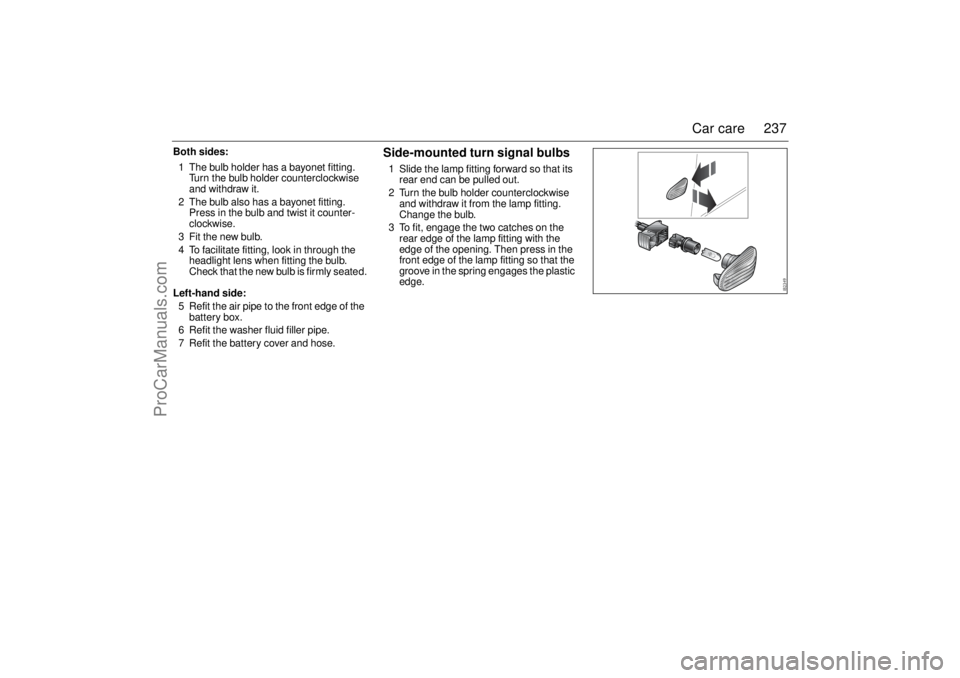
Side-mounted turn signal bulbs1 Slide the lamp fitting forward so that its
rear end can be pulled out.
2 Turn the bulb holder counterclockwise
and withdraw it from the lamp fitting.
Change the bulb.
3 To fit, engage the two catches on the
rear edge of the lamp fitting with the
edge of the opening. Then press in the
front edge of the lamp fitting so that the
groove in the spring engages the plastic
edge.
93U S M 06.book Page 237 Friday, February 18, 2005 1:15 PM
ProCarManuals.com
Page 238 of 318
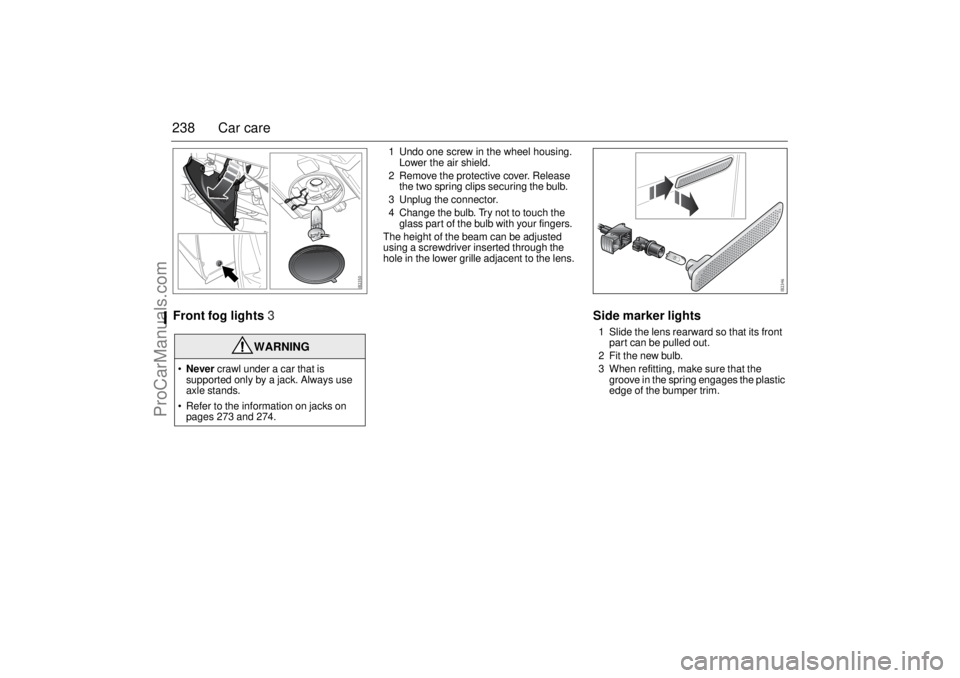
238 Car careFront fog lights3
1 Undo one screw in the wheel housing.
Lower the air shield.
2 Remove the protective cover. Release
the two spring clips securing the bulb.
3 Unplug the connector.
4 Change the bulb. Try not to touch the
glass part of the bulb with your fingers.
The height of the beam can be adjusted
using a screwdriver inserted through the
hole in the lower grille adjacent to the lens.
Side marker lights1 Slide the lens rearward so that its front
part can be pulled out.
2 Fit the new bulb.
3 When refitting, make sure that the
groove in the spring engages the plastic
edge of the bumper trim.
WARNING
Never crawl under a car that is
supported only by a jack. Always use
axle stands.
Refer to the information on jacks on
pages 273 and 274.93U S M 06.book Page 238 Friday, February 18, 2005 1:15 PM
ProCarManuals.com
Page 240 of 318
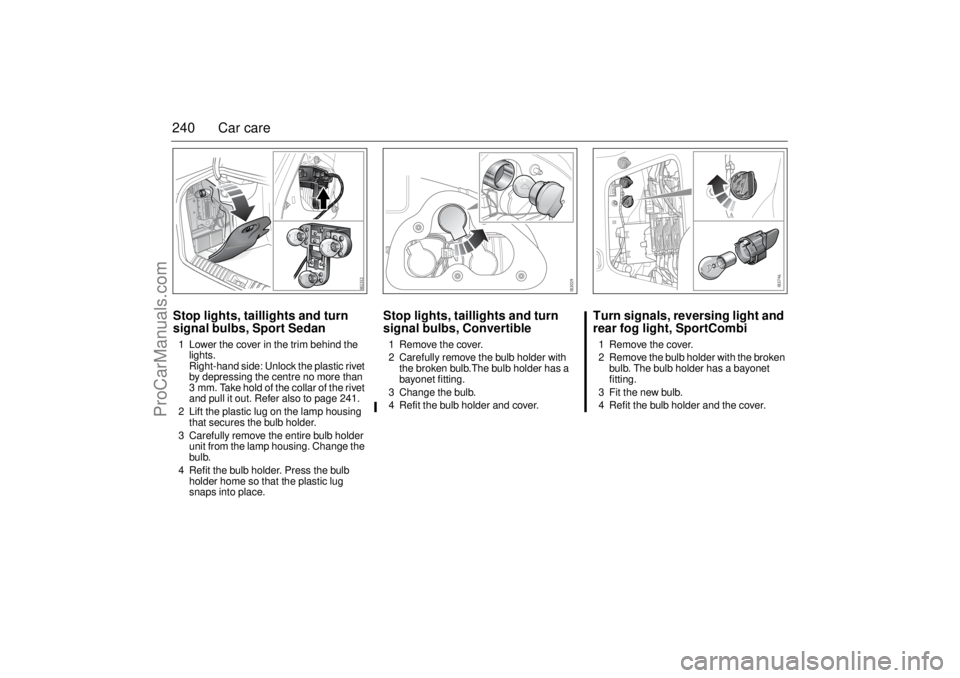
240 Car careStop lights, taillights and turn
signal bulbs, Sport Sedan1 Lower the cover in the trim behind the
lights.
Right-hand side: Unlock the plastic rivet
by depressing the centre no more than
3 mm. Take hold of the collar of the rivet
and pull it out. Refer also to page 241.
2 Lift the plastic lug on the lamp housing
that secures the bulb holder.
3 Carefully remove the entire bulb holder
unit from the lamp housing. Change the
bulb.
4 Refit the bulb holder. Press the bulb
holder home so that the plastic lug
snaps into place.
Stop lights, taillights and turn
signal bulbs, Convertible1 Remove the cover.
2 Carefully remove the bulb holder with
the broken bulb.The bulb holder has a
bayonet fitting.
3 Change the bulb.
4 Refit the bulb holder and cover.
Turn signals, reversing light and
rear fog light, SportCombi1 Remove the cover.
2 Remove the bulb holder with the broken
bulb. The bulb holder has a bayonet
fitting.
3 Fit the new bulb.
4 Refit the bulb holder and the cover.
93U S M 06.book Page 240 Friday, February 18, 2005 1:15 PM
ProCarManuals.com
Page 271 of 318
271 Car care
Driving with a compact wheel
fittedObserve the following when the compact
spare tire is fitted:
The compact spare is light and easy to
handle when changing a tire.
Do not drive further than necessary with
the compact spare fitted - the maximum life of the tire is only just over 2,000 miles
(approx. 3,500 km).
Refit the standard tire as soon as possi-
ble.
Important considerations when driving with
a compact spare tire:
The car’s ground clearance is reduced.
The car must not be driven with more than
one compact spare tire at a time.
Avoid driving against the curb.
Do not use snow chains.
Do not fit the wheel cover - this would
conceal the warning text.
WARNING
Do not exceed 50 mph (80 km/h). The
tire can overheat affecting the car’s
roadholding.
Tire pressure: refer to page 304.
The spare tire or punctured tire must
be stowed under the trunk floor, and
secured in place with the retaining nut.
NOTICETo avoid damaging a alloy wheel of a
punctured tire, this can be temporarily
placed outside up in the spare wheel well
but only while driving to the closest work-
shop.
As a general rule, all heavy loads must be
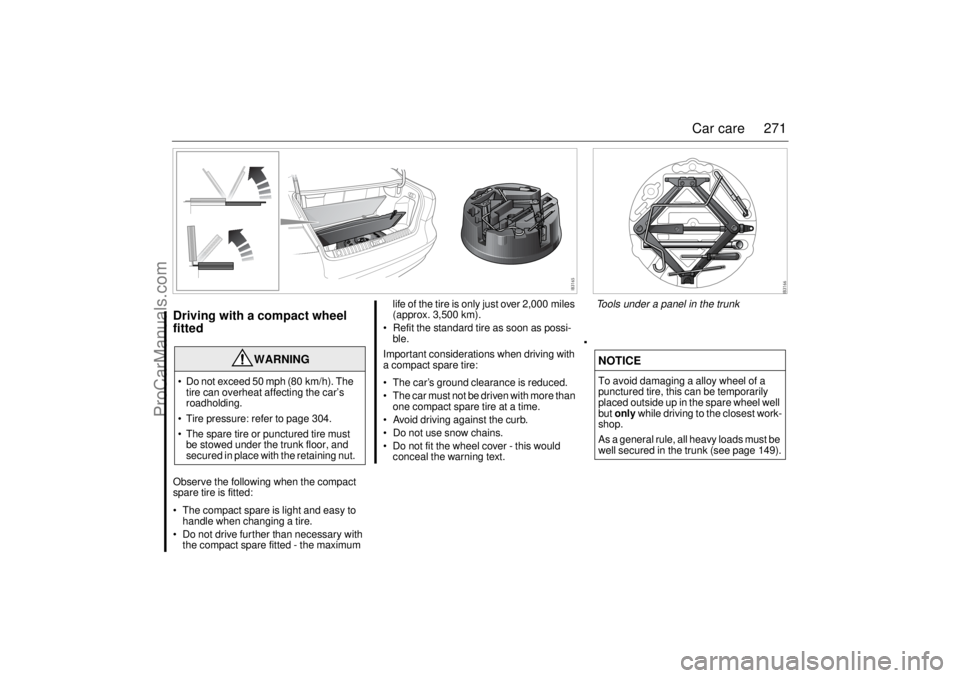
well secured in the trunk (see page 149).Tools under a panel in the trunk
93U S M 06.book Page 271 Friday, February 18, 2005 1:15 PM
ProCarManuals.com
Page 274 of 318
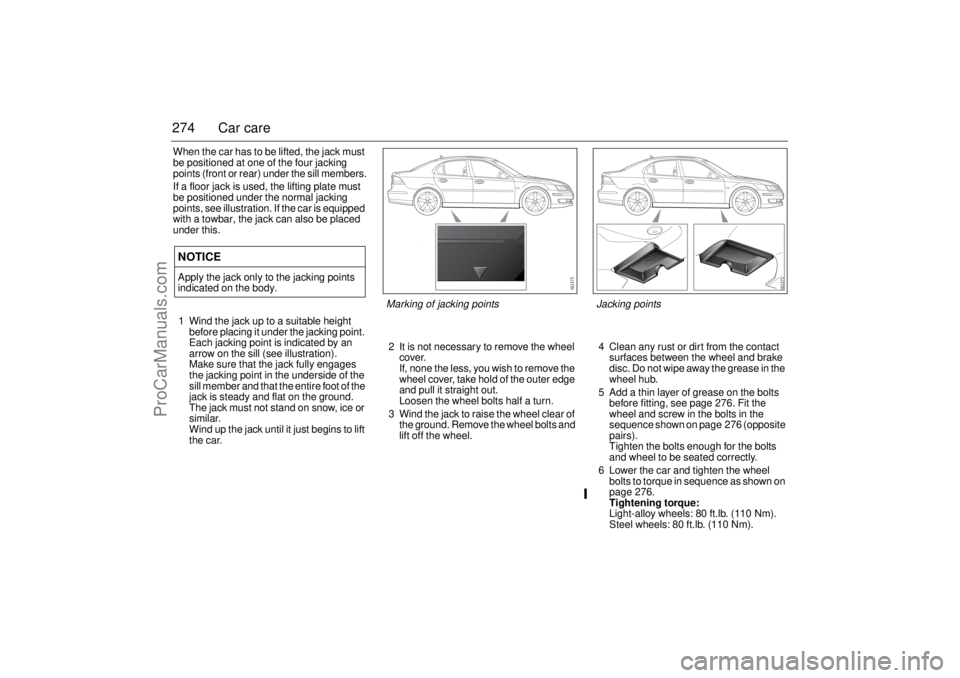
274 Car careWhen the car has to be lifted, the jack must
be positioned at one of the four jacking
points (front or rear) under the sill members.
If a floor jack is used, the lifting plate must
be positioned under the normal jacking
points, see illustration. If the car is equipped
with a towbar, the jack can also be placed
under this.
1 Wind the jack up to a suitable height
before placing it under the jacking point.
Each jacking point is indicated by an
arrow on the sill (see illustration).
Make sure that the jack fully engages
the jacking point in the underside of the
sill member and that the entire foot of the
jack is steady and flat on the ground.
The jack must not stand on snow, ice or
similar.
Wind up the jack until it just begins to lift
the car.2 It is not necessary to remove the wheel
cover.
If, none the less, you wish to remove the
wheel cover, take hold of the outer edge
and pull it straight out.
Loosen the wheel bolts half a turn.
3 Wind the jack to raise the wheel clear of
the ground. Remove the wheel bolts and
lift off the wheel.4 Clean any rust or dirt from the contact
surfaces between the wheel and brake
disc. Do not wipe away the grease in the
wheel hub.
5 Add a thin layer of grease on the bolts
before fitting, see page 276. Fit the
wheel and screw in the bolts in the
sequence shown on page 276 (opposite
pairs).
Tighten the bolts enough for the bolts
and wheel to be seated correctly.
6 Lower the car and tighten the wheel
bolts to torque in sequence as shown on
page 276.
Tightening torque:
Light-alloy wheels: 80 ft.lb. (110 Nm).
Steel wheels: 80 ft.lb. (110 Nm).NOTICEApply the jack only to the jacking points
indicated on the body.
Jacking points
Marking of jacking points
93U S M 06.book Page 274 Friday, February 18, 2005 1:15 PM
ProCarManuals.com
Page 275 of 318
275 Car care
7 Retouching the wheel bolts after twenty
or so miles.
Tightening torque:
Light-alloy wheels: 80 ft.lb. (110 Nm).
Steel wheels: 80 ft.lb. (110 Nm).
We advise against using wheels with large
ventilation slots in winter, as the brake com-
ponents are then more exposed to slush,
road salt and grit.
If you fit wheels of a different dimension, the
speedometer can be reprogrammed to
ensure it is as accurate as possible. We rec-
ommend that you contact a Saab dealer.
Driving with tire chains 3, see page 196
NOTICE Do not overtighten the bolts using a
impact wrench: not only can this
damage the wheels but it can also
make it impossible to undo the bolts
using the wheel wrench in the car’s
toolkit.
When refitting a wheel cover, make
sure that the valve protrudes through
the marked recess in the wheel cover.
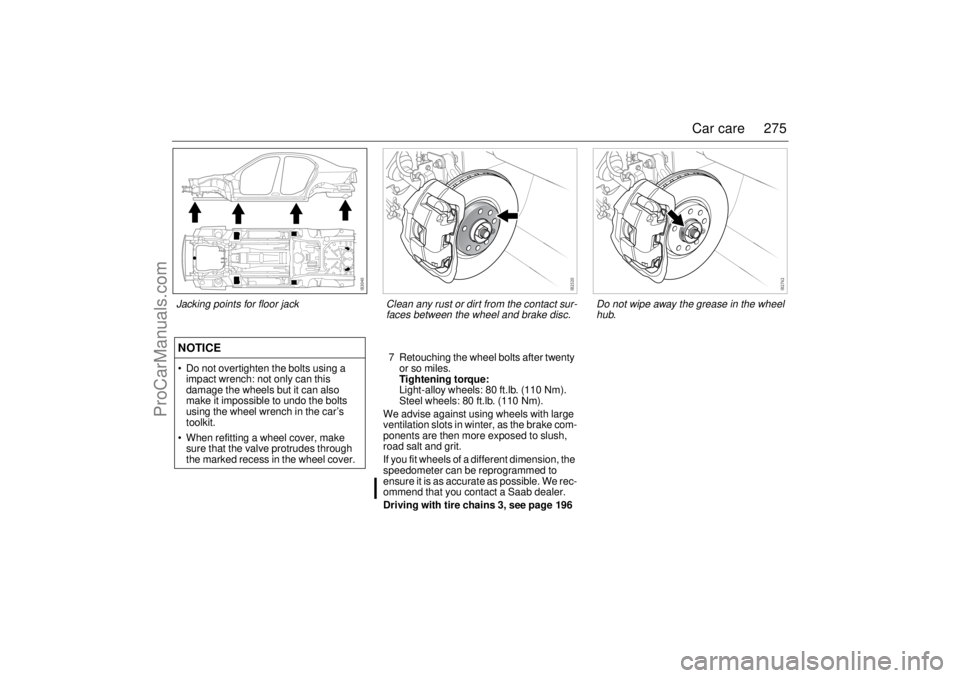
Do not wipe away the grease in the wheel
hub.
Clean any rust or dirt from the contact sur-
faces between the wheel and brake disc.
Jacking points for floor jack93U S M 06.book Page 275 Friday, February 18, 2005 1:15 PM
ProCarManuals.com
Page 277 of 318

277 Car care
Cleaning and caring for leather
upholsteryThe principal reason for treating leather
upholstery is to maintain its elegant appear-
ance and to provide it with a protective film.
Disco lour at ion caused by dust and wear
mainly affects the lighter shades, although
this is not detrimental to the leather, indeed,
the patina resulting from use is often consid-
ered desirable in leather. But if the leather is
allowed to become too grubby, it can start to
look shabby.
The leather upholstery should be cleaned
and reconditioned twice a year in conjunc-
tion with spring and autumn inspections. In
very warm, dry climates the leather may
need more regular reconditioning. Use con-
ventional leather care products. Follow the
instructions on the packaging.
Do not use unknown harsh polishing
agents, cleaning agents, sprays, coarse
soap or hot water.
Textile carpetingTextile carpeting should be vacuum
cleaned regularly. Carpeting can also be
cleaned using a brush or sponge and carpet
shampoo.
For safety reasons, vacuum cleaners that
are not earthed (grounded) must not be
used out of doors.Engine bayThe engine bay should be cleaned with an
engine decreasing and rinsed with hot
water. The headlights must be covered
over. Do not use a pressure washer. Avoid
spraying electrical components and con-
nectors.
Do not use petrol as a cleaning agent or sol-
vent when carrying out repairs or mainte-
nance. Saab recommends the use of envi-
ronmentally-friendly decrescendos.
WashingThe bodywork must be washed frequently.
When the car is new, the body should be
washed by hand using plain cold water and
a clean, soft brush through which the water
flows. Automatic caresses should be
avoided when the car is new.
After 5–6 months the paintwork will have
hardened. To facilitate cleaning, a suitable
detergent can be added to the water, which
should be lukewarm.
Remove any bird droppings without delay,
as these can discolor the paintwork and
prove difficult to polish out. Lay a wad of wet
paper on the patch of dirt and leave it for a
minute or so. It will then be easy to wash off
the dirt.
Use a soft cloth moistened with white spirit
to remove splashes of tar or asphalt. Do not
use strong cleaners, as these can dry out
the paintwork.
The underside of the car also needs wash-
ing regularly, and this should be done extra NOTICEDo not use alcohol-based cleaners on the
plastic lenses of the front or rear lights, as
these can cause a crackling effect on the
lenses.
The door mirrors should be folded in
before the car enters an automatic car
wash.
93U S M 06.book Page 277 Friday, February 18, 2005 1:15 PM
ProCarManuals.com
Page 279 of 318

279 Car care
Waxing and polishingDo not wax a new car during the first three
or four months. In fact, there is no need to
polish the car before the paintwork has
started to dull through oxidation. Other than
in exceptional cases, do not use abrasive
polishes containing a cutting agent on a new
car. Always wash the car thoroughly before
waxing or polishing.Touching up the paintDamaged paintwork should be treated as
soon as it is discovered: the longer it is left,
the greater the risk of corrosion. The anti-
corrosion warranty does not cover corrosion
resulting from untreated defects.
Paintwork damage sustained in a crash is
usually extensive and can only be properly
restored by professionals.
However, you can repair small scratches
and stone chip damage yourself. The nec-
essary tools and materials, such as primer,
touch-up paint and brushes, are available
from a workshop. We recommend that you
contact a Saab dealer.
In the case of minor flaws in the paintwork,
where the metal has not been exposed and
an undamaged layer of paint remains,
touch-up paint can usually be applied
directly, after any dirt has been scraped
away using a pointed knife.
If corrosion has already set in, such as the
result of stone-chip damage, use a pointed
knife to scrape off all surface rust. If possi-ble, the damaged area should be taken
back to the bare metal. The metal should
then be primed with two thin coats of primer
applied by brush.
After the primer has dried, apply several thin
layers of topcoat until the surface of the
repaired area is flush with the surrounding
paintwork.
Stir both primer and touch-up paint thor-
oughly before use and allow each coat to
dry before applying the next.
Two-coat enamelAs the name implies, two-coat enamel is
applied in two operations. The first coat, the
base color, contains the pigment, metal
flakes and binder. The second coat consists
of a clear enamel, which provides the final
gloss for the paintwork and protects the
base from moisture and environmental con-
taminants.
Touch-up stone-chip damage as follows:
1 Thoroughly clean the damaged area.
2 Then apply the primer, base color and
finally, the clear enamel. To achieve the
best finish, apply two or three coats of
primer.
Surface treatment composition1 Body panel
2 Zinc (certain components only) 7.5 µm
3 Phosphate coating 3 –5 µm
4 Cathodic ED 23 µm
5 Intermediate coat 35 µm
6 Metallic base/solid base 11 µm
7 Clear enamel 45 µm
93U S M 06.book Page 279 Friday, February 18, 2005 1:15 PM
ProCarManuals.com