door lock SAAB 9-3 2006 Owner's Manual
[x] Cancel search | Manufacturer: SAAB, Model Year: 2006, Model line: 9-3, Model: SAAB 9-3 2006Pages: 318, PDF Size: 28.05 MB
Page 140 of 318
140 Interior equipmentPinch protection3The sunroof is equipped with pinch protec-
tion. This is activated if something gets
trapped when the sunroof is being closed.
The sunroof will stop and open slightly.
Temporary overriding the pinch protec-
tion
If dirt, ice or similar create so much resis-
tance that the pinch protection cuts in (sun-
roof cannot be closed), the pinch protection
can be temporarily disengaged.
1 Make sure the ignition is ON.
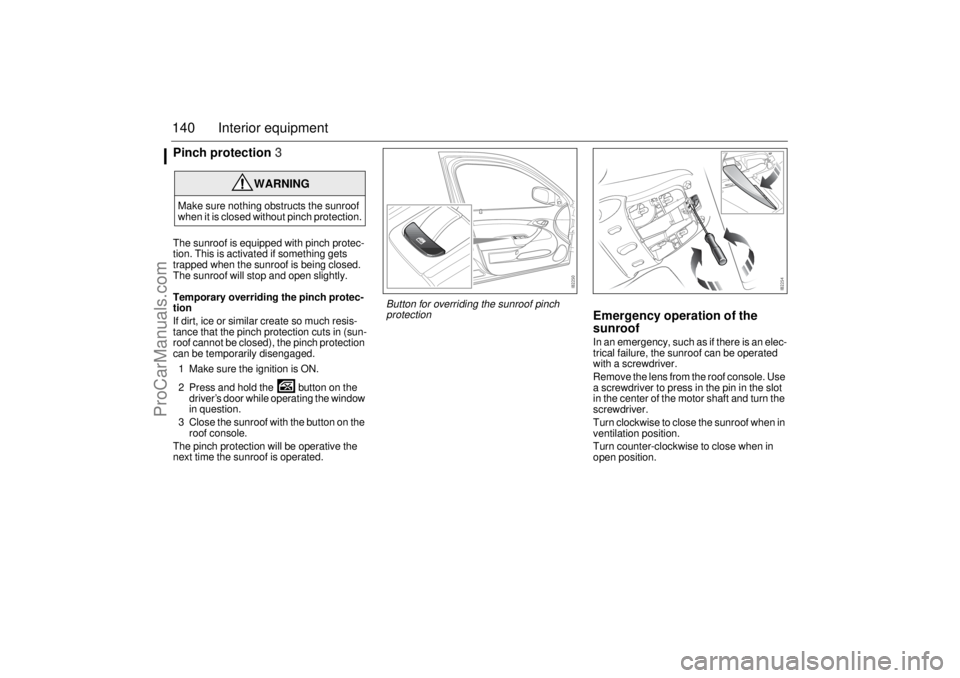
2 Press and hold the button on the
driver’s door while operating the window
in question.
3 Close the sunroof with the button on the
roof console.
The pinch protection will be operative the
next time the sunroof is operated.
Emergency operation of the
sunroofIn an emergency, such as if there is an elec-
trical failure, the sunroof can be operated
with a screwdriver.
Remove the lens from the roof console. Use
a screwdriver to press in the pin in the slot
in the center of the motor shaft and turn the
screwdriver.
Turn clockwise to close the sunroof when in
ventilation position.
Turn counter-clockwise to close when in
open position.
WARNING
Make sure nothing obstructs the sunroof
when it is closed without pinch protection.
Button for overriding the sunroof pinch
protection
93U S M 06.book Page 140 Friday, February 18, 2005 1:15 PM
ProCarManuals.com
Page 141 of 318
141 Interior equipment
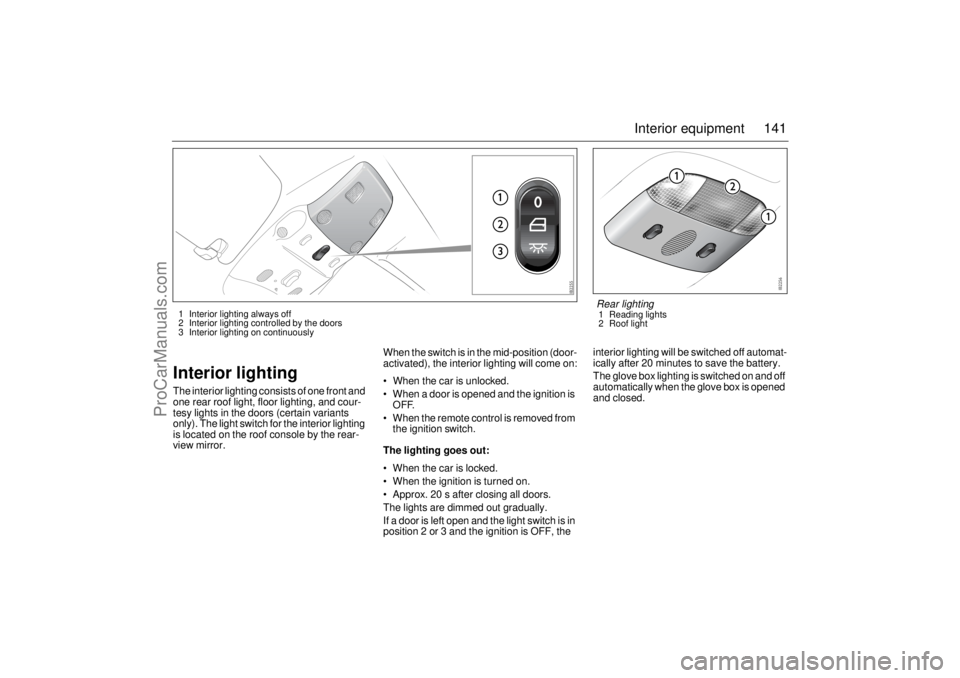
Interior lightingThe interior lighting consists of one front and
one rear roof light, floor lighting, and cour-
tesy lights in the doors (certain variants
only). The light switch for the interior lighting
is located on the roof console by the rear-
view mirror.When the switch is in the mid-position (door-
activated), the interior lighting will come on:
When the car is unlocked.
When a door is opened and the ignition is
OFF.
When the remote control is removed from
the ignition switch.
The lighting goes out:
When the car is locked.
When the ignition is turned on.
Approx. 20 s after closing all doors.
The lights are dimmed out gradually.
If a door is left open and the light switch is in
position 2 or 3 and the ignition is OFF, the interior lighting will be switched off automat-
ically after 20 minutes to save the battery.
The glove box lighting is switched on and off
automatically when the glove box is opened
and closed.1 Interior lighting always off
2 Interior lighting controlled by the doors
3 Interior lighting on continuously
Rear lighting1 Reading lights
2 Roof light
93U S M 06.book Page 141 Friday, February 18, 2005 1:15 PM
ProCarManuals.com
Page 144 of 318
144 Interior equipmentPower Outlet3You can use the electrical socket in the stor-
age compartment under the armrest
between the front seats to charge a mobile
phone, for example. There is a recess on
each side of the compartment which will
accept a lead so that you can close the lid
without damaging the charger lead.
Storage compartmentsThere are additional storage compartments
below the front ashtray and in the doors.
WARNING
The maximum output of the cigarette
lighter socket is 240 W (20 A). The rating
of the socket in the compartment between
the seats is the same. Overloading can
result in melting or even fire.
WARNING
The glove box must be closed while trav-
elling. An open glove box door could
cause personal injury in the event of a
crash.
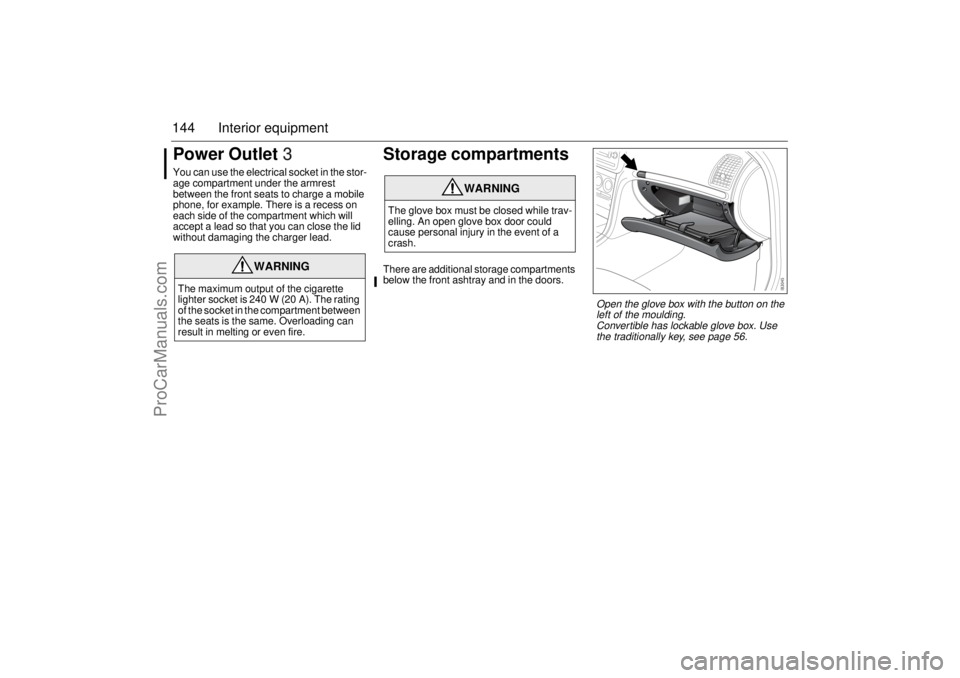
Open the glove box with the button on the
left of the moulding.
Convertible has lockable glove box. Use
the traditionally key, see page 56.
93U S M 06.book Page 144 Friday, February 18, 2005 1:15 PM
ProCarManuals.com
Page 162 of 318
162 Starting and drivingSteering wheel lockThe steering wheel lock is electronic. The
lock engages when the remote control is
removed from the ignition and unlocks when
the remote control is inserted. A click can be
heard when the steering wheel lock locks
and unlocks.
If the car is parked with one front wheel
touching the curb, for example, you may
need to turn the steering wheel slightly
when you insert the remote control to allow
the steering wheel lock to unlock. If you do
not succeed on first attempt you must
remove the remote control before trying
again. Turn the steering wheel and insert
the remote control into the ignition switch.
If the steering wheel lock does not disen-
gage it will not be possible to turn the remote
control in the ignition switch.
The following message is shown on the SID:If a fault arises affecting the steering wheel
lock, the following message will be
displayed on the SID:
If the steering wheel lock malfunctions while
the remote control is in the ignition switch,
this may prevent the removal of the remote
control or prevent the car from being
restarted once the engine has been
switched off.
If you have to leave the car, lock the car by
pressing down the lock buttons on the
doors. Lock the front left door from outside
with the traditional key (see page 52). The
car is now locked but the alarm is inactive.
Starting the engine
Steering wheel locked.
Pull out key, turn steering
wheel. Try again.
Steering lock malfunc.
Make a safe stop.
Contact Saab dealer.
WARNING
When starting the engine:
- Sit down in the driver’s seat.
- Depress the clutch pedal fully (M/T). If
the gear lever is not in the neutral posi-
tion, the clutch pedal must be fully
depressed or the car will jump
forwards or backwards, which may
cause a crash.
- Never start the car from outside the
vehicle, e.g. through a window that is
down. This could lead to serious
personal injury.
Cars with automatic transmission:
select position P to remove the ignition
key. The key can only be removed in
this gear position.
Carbon monoxide (CO) is a colorless,
odorless, poisonous gas. Be alert to
the danger of CO – always open the
garage doors before starting the
engine in the garage.
Do not rest or sleep in the car when
parked with the engine running. There
is a risk of depressing the accelerator
which could lead to engine damage.
There is also a danger of CO poison-
ing if the exhaust system is leaking.
93U S M 06.book Page 162 Friday, February 18, 2005 1:15 PM
ProCarManuals.com
Page 195 of 318

195 Starting and driving
Driving in cold weatherIn cold weather, special attention should be
paid to the following:
Before driving off, make sure that the
wiper blades have not frozen to the wind-
shield.
Remove any snow from the heating
system air intakes between the hood and
the windshield.
If necessary, inject oil into the locks to
prevent them from freezing. Use molyb-
denum-sulphide oil (MoS
2). If the locks
freeze, exercise care when unlocking the
car (manual unlocking) to avoid breaking
the key. Warm up the key or use a de-icer.
It is particularly important when the roads
are slippery that the brakes and tires are
in good condition.
For how to check the level of antifreeze in
the engine coolant, see page 222.
Add gasoline anti-freeze when refueling
several times before the onset of winter.
This will prevent condensation water in
the fuel tank from freezing and causing
interruptions in the fuel supply. The likeli-
hood of condensation is lowest when the
fuel tank is full.
If the car is parked outside and the
temperature is below zero, gasoline anti-
freeze is of little use as it cannot remove
water that has already frozen. Park the
car in a warm place so that any ice that
may have built up melts, then add gaso-
line anti-freeze when refueling.Condensation is caused by temperature
fluctuations, either in the outside temper-
ature alone or when the car is alternately
parked outdoors and in a garage.
Convertible: Avoid operating the soft top
at temperatures below 23°F (–5°C).
The car is equipped with tires designed to
provide optimum grip on both wet and dry
roads, although this has been achieved at
the expense of somewhat reduced grip on
snow and ice. For regular driving on snow
and ice, we therefore recommend that
winter tires be fitted. However, winter tires
achieve this extra grip at the expense of
grip on bare road surfaces.
Winter tires, particularly studded tires, gen-
erally make driving safer on snow and ice.
Acquaint yourself with the legal provi-
sions governing the use of different
types of winter tires and snow chains.
Studded tires are not allowed in some
countries. If winter tires are fitted, the same
type must be fitted to all four wheels. Your
Saab dealer will be pleased to advise you on
the best tires for your car.
93U S M 06.book Page 195 Friday, February 18, 2005 1:15 PM
ProCarManuals.com
Page 201 of 318

201 Starting and driving
Checks before drivingMake sure that the car and trailer are in
good working order. This is essential since
towing a trailer increases the strain on the
car.
Check and if necessary adjust the tire
pressure of the car and trailer.
Make sure all wheel bolts are properly
tightened.
Make sure that the equipment joining the
car and trailer is properly secured and
adjusted.
Make sure the trailer’s electrical cable is
properly connected and is not so long that
it drags along the ground. Also, make sure
the cable is not too short and risks break-
ing when turning a corner.
Check all bulbs.
Check the car and trailer brakes.
Make sure that all items on or in the
camper or trailer are properly secured.
Make sure that the trailer’s jockey wheel is
raised and locked.
Check the distribution of the load so that
the car and trailer are well balanced.
Check that the rearview mirrors provide
the best possible rearward vision.
Make sure the trailer’s safety cable is
correctly attached.
Driving considerationsAlways take extra care when towing a
trailer, as the car’s handling will be different
and its braking performance reduced. The
trailer’s braking system and suspension
also have a considerable effect on these
characteristics. See also "Driving with a
load" on page 204.
Drive carefully:
descending hills
on uneven roads
over railway crossings
when meeting large vehicles
If the car has automatic transmission, select
gear M1 when ascending or descending
steep hills.
ReversingGet someone to help you keep an eye out
behind the trailer as the door mirrors do not
always provide sufficient rearward vision
when reversing.
93U S M 06.book Page 201 Friday, February 18, 2005 1:15 PM
ProCarManuals.com
Page 249 of 318
249 Car care
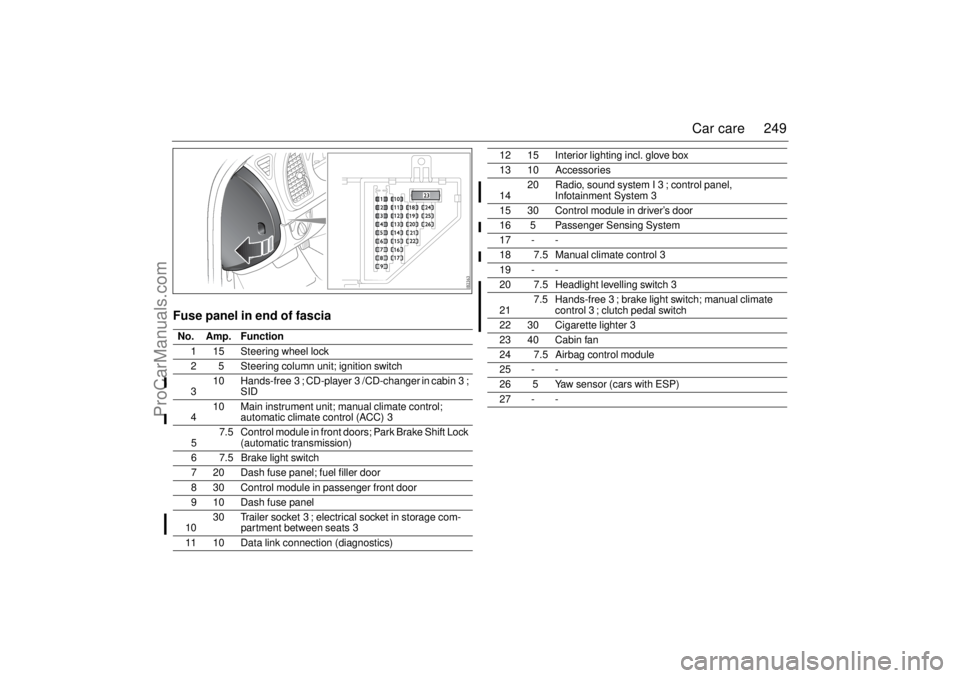
Fuse panel in end of fasciaNo. Amp. Function
1 15 Steering wheel lock
2 5 Steering column unit; ignition switch
310 Hands-free3; CD-player3/CD-changer in cabin3;
SID
410 Main instrument unit; manual climate control;
automatic climate control (ACC)3
57.5 Control module in front doors; Park Brake Shift Lock
(automatic transmission)
6 7.5 Brake light switch
7 20 Dash fuse panel; fuel filler door
8 30 Control module in passenger front door
9 10 Dash fuse panel
1030 Trailer socket3; electrical socket in storage com-
partment between seats3
11 10 Data link connection (diagnostics)
12 15 Interior lighting incl. glove box
13 10 Accessories
1420 Radio, sound system I3; control panel,
Infotainment System3
15 30 Control module in driver’s door
16 5 Passenger Sensing System
17 - -
18 7.5 Manual climate control3
19 - -
20 7.5 Headlight levelling switch3
217.5 Hands-free3; brake light switch; manual climate
control3; clutch pedal switch
22 30 Cigarette lighter3
23 40 Cabin fan
24 7.5 Airbag control module
25 - -
26 5 Yaw sensor (cars with ESP)
27 - -
93U S M 06.book Page 249 Friday, February 18, 2005 1:15 PM
ProCarManuals.com
Page 276 of 318
276 Car care
Safety beltsCheck the function of the safety belts regu-
larly as follows:
Hold the diagonal strap and pull it sharply.
The safety belt should lock and it should
not be possible to withdraw it further.
Check the anchorage points in the floor.
They must not have suffered rust damage.
If a belt is worn or has any fraying edges, it
should be replaced.
Safety belts must not come into contact with
substances such as polishes, oil or chemi-
cals. If the belts get dirty, wash them with
warm water and a detergent or have them
replaced.
Upholstery and trimTo remove fluff and hairs from the seats,
door armrests and headlining, use a
vacuum cleaner, a moist lint-free cloth, or a
clothes brush. Remove spots and dirt using
a cloth moistened with lukewarm soapy
water.
When using a stain remover, always work
from the outside towards the centre to avoid
leaving a ring. If a soiled ring or spot should
remain, it can usually be removed using
lukewarm soapy water or water alone.
Spots left by liquids, such as soft drinks or
thin oil, must be removed at once with an
absorbent material, such as kitchen towel-
ling. Then clean with a stain remover.
White spirit is recommended for removing
grease and oil stains. A medium stiff brush
may also be used.
WARNING
If the car is involved in a crash, the safety
belts, belt pretensioners and other asso-
ciated components must be inspected.
We recommend that you contact a Saab
dealer.
Never make any alterations or repairs to
the safety belts yourself. We recommend
that you contact a Saab dealer dealer.
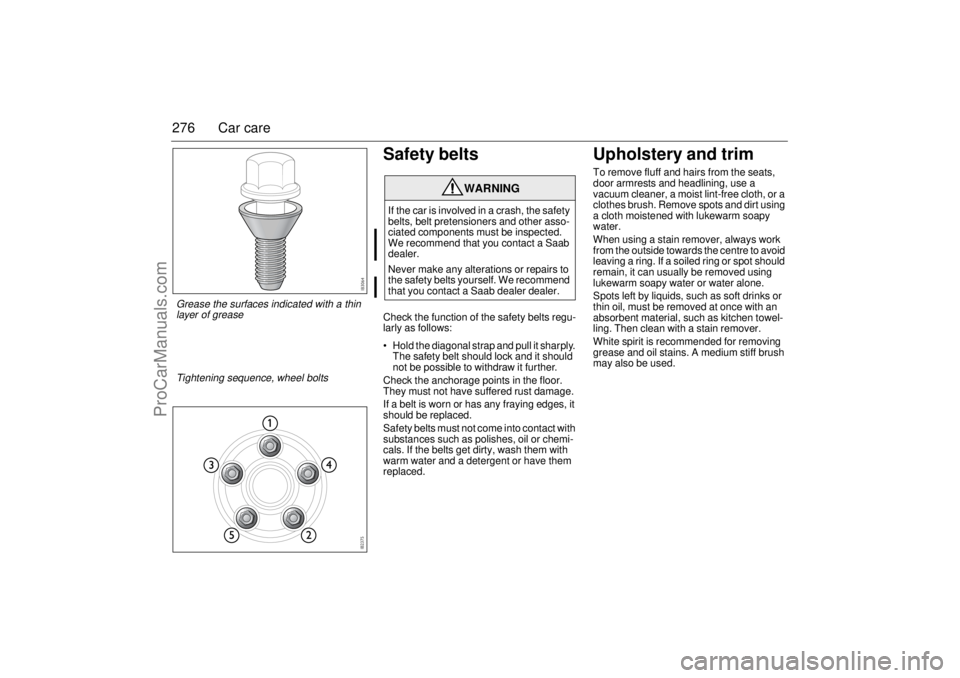
Tightening sequence, wheel boltsGrease the surfaces indicated with a thin
layer of grease93U S M 06.book Page 276 Friday, February 18, 2005 1:15 PM
ProCarManuals.com
Page 313 of 318

313 Index
Index
AA/C
__________________________ 113
Adjustment, steering wheel
________ 128
Air conditioning
_________________ 113
Air filter
_______________________ 222
Airbag
_________________________ 32
Anchorage eyes
________________ 149
Anti-corrosion treatment
__________ 280
Antilock braking system __________ 181
Anti-spin
______________________ 183
Ashtrays ______________________ 144
Autochecking of lights, warning and
indicator lights
__________________ 88
Autodimming
_______________ 133
, 134
Automatic climate control (ACC)
____ 115
Automatic tire pressure monitoring __ 254
Automatic transmission
___________ 173
ABS brakes
____________________ 181
ACC
_________________________ 115
BBattery
_______________________ 226
Bedding-in of new brake pads
_____ 171
Before towing a trailer
____________ 201
Brake fluid, grade
_______________ 303Brakes
________________________ 180
Braking _______________________ 180
Bulb changing
__________________ 232
Bulb table
_____________________ 246
Buying new tires
________________ 260
CCabin lighting
__________________ 141
Cabin lighting, Convertible
_________ 80
Car alarm
______________________ 58
Car transport ___________________ 207
Care of air conditioning
___________ 283
Change of address notification
_____ 290
Changing a tire
_________________ 273
Changing bulbs _________________ 232
Changing engine oil
_____________ 220
Changing the battery, remote control
_56
Changing wiper blades
___________ 230
Checking the number of remote
controls
_______________________ 55
Checks before towing a trailer
_____ 201
Child safety
_____________________ 24
Child safety locks, rear doors
_______ 54
Child seats
_____________________ 24
Cigarette lighter
_________________ 144
Cleaning the engine bay
__________ 277
Cleaning upholstery
_____________ 276
Climate control system, manual
____ 110
Closing the soft top manually,
Convertible
____________________ 70Closing the soft top, Convertible
_____ 66
Clutch interlock
_________________ 172
Compact spare _________________ 270
Compass
______________________ 137
Condensation water, A/C
_________ 113
Convertible
_____________________ 63
Convertible, washing
_____________ 278
Coolant
_______________________ 222
Crash memory, see EDR
_________ 292
Cruise control
__________________ 179
Cup holder
_____________________ 142
DDate codes, tires
________________ 270
Deep water, driving through
_______ 204
Definitions and terminology, tire ____ 267
Determining correct load, tires
_____ 269
Direction indicator stalk switch _____ 104
Direction indicators
______________ 104
Dome light, Convertible
___________ 243
Dome light, Sport Sedan __________ 242
Donor battery, boost starting
_______ 208
Door handles
____________________ 50
Door mirrors ___________________ 132
Drive belt
______________________ 229
Drive belt, length
________________ 301
Driver’s seat with memory
__________ 21
Driving at night
_________________ 205
Driving in cold climates
___________ 195
Driving in deep water
_____________ 204
93U S M 06.book Page 313 Friday, February 18, 2005 1:15 PM
ProCarManuals.com
Page 314 of 318

314 IndexDriving in hot climates
____________ 197
Driving techniques
______________ 193
Driving with a heavy load on hilly
roads
________________________ 175
Driving with a load
______________ 204
Driving with a roof load ___________ 202
Driving with the compact spare wheel
208
Driving with the trunk lid open
______ 204
EEasy entry, Convertible
____________ 75
Economical motoring
____________ 193
Electric engine heater ____________ 194
Electric heating, front seats
___ 114
, 123
Electric windows
________________ 129
Electric windows, Convertible
_______ 79
Electrical system, technical data ____ 300
Electrically adjustable seats
________ 20
Electronic steering wheel lock _____ 162
Electronic Stability Program (ESP)
__ 185
Emergency opening of the narrow
backrest
_____________________ 150
Emergency operation of the sunroof
_ 140
Engine bay, cleaning
____________ 277
Engine heater
__________________ 194
Engine immobilizer
_______________ 57
Engine number
_________________ 307
Engine oil, checking
_____________ 219
Engine oil, grade
________________ 298
Engine oil, volume ______________ 299Engine temperature gauge
_________ 90
Engine, description
______________ 215
Engine, technical data ____________ 297
Engines
_______________________ 300
Event Data Recorders (EDR)
______ 292
Extra electrical socket
____________ 144
EDR (Event Data Recorders)
______ 292
ESP, anti-skid system
____________ 185
FFacilitating entry to rear seat,
Convertible
____________________ 75
Factors affecting fuel consumption
__ 193
Filler cap
______________________ 168
Filling a portable fuel container
_____ 169
Filling up
______________________ 167
Flat spots, tires
_________________ 259
Floor jack
_____________________ 274
Folding down the rear seat
________ 146
Front fog lights
_________________ 104
Front towing eye ________________ 205
Fuel container
__________________ 169
Fuel gauge
_____________________ 91
Fuel grade _____________________ 299
Fuel information
________________ 169
Functions, car alarm ______________ 61
Fuse panel in luggage compartment
_250
Fuse table
_____________________ 249
Fuses
________________________ 247
GGear selector indicator, automatic
transmission
___________________ 92
Gearbox number ________________ 307
General safety instructions,
Convertible
____________________ 64
Glove box
_____________________ 144
Glovebox lighting
________________ 244
GDO, garage door opener
_________ 134
HHandbrake
_____________________ 187
Hazard warning lights
____________ 105
Head restraint, Convertible
_________ 76
Head restraints
__________________ 23
Headlight flasher ________________ 103
Headlight levelling _______________ 102
Headlights
_____________________ 102
Heated door mirrors
_____________ 114
Hood
_________________________ 214
Horn __________________________ 128
Horn button
____________________ 128
IIf a tire goes flat
_________________ 264
Ignition switch
__________________ 160
Immobilizer
_____________________ 57
93U S M 06.book Page 314 Friday, February 18, 2005 1:15 PM
ProCarManuals.com