ignition SAAB 9-3 2006 Service Manual
[x] Cancel search | Manufacturer: SAAB, Model Year: 2006, Model line: 9-3, Model: SAAB 9-3 2006Pages: 318, PDF Size: 28.05 MB
Page 163 of 318

163 Starting and driving
Starting the engineAvoid racing the engine or loading it heavily
before it has warmed up. Do not drive away
before the warning and indicator lights have
gone out.
The engine has an automatic choke and
should be started as follows:
Cars with manual transmission
To start the engine the clutch pedal must
be fully depressed.
1 Make sure the parking brake is applied.
2 Depress the clutch pedal but do not
touch the accelerator.
3 Start the engine. Let the remote control
spring back as soon as the engine has
started and is running smoothly.
Allow the engine to idle for about
10 seconds. Do not apply full throttle for at
least 3 minutes after starting.Cars with automatic transmission
The selector lever must be in the P or N
position.
1 The selector lever must be in the P or N
position.
2 Keep your foot on the brake pedal.
Note! Once the engine has started, the
brake pedal will sink. This is perfectly
normal.
3 Start the engine. Let the remote control
spring back as soon as the engine has
started and is running smoothly.
Allow the engine to idle for about
10 seconds. Do not apply full throttle for at
least 3 minutes after starting.
Useful tips on starting the engineIf the engine has failed to start after several
attempts in very cold weather, proceed as
follows:
1 Turn the ignition switch to ON (it is
essential that you turn the ignition to
ON before depressing the accelerator).
2 Press the accelerator to the floor and run
the starter motor for 5-10 seconds. This
will prevent the engine being flooded
(fully depressed accelerator cuts off the
fuel supply).
3 Now start the engine in the normal way
- do not touch the accelerator.
If the engine stalls immediately after starting
(e.g. if the clutch was released too quickly),
do not touch the accelerator when restarting
the engine.
93U S M 06.book Page 163 Friday, February 18, 2005 1:15 PM
ProCarManuals.com
Page 164 of 318

164 Starting and drivingImportant
considerations for
driving1 Starting and driving
Do not use full throttle until the engine
is warm, so as to avoid unnecessary
wear. If the needle of the turbo gauge
repeatedly enters the red zone, the
engine may suddenly lose power, due
to the initiation of a monitoring system
that limits the boost pressure. We
recommend that you contact a Saab
dealer as soon as possible.
Under certain barometric conditions
(high outside temperature and/or high
altitude) the needle may enter the first
part of the red zone without necessarily
indicating that a fault has arisen.
A protective function (interruption of the
fuel supply) limits the engine speed.2 Stopping the engine
Do not rev the engine immediately
before switching it off - stop the engine
when it is idling.
3 Regulating the boost pressure
One of the advantages of boost pres-
sure regulation is that the engine can
also be run safely on gasoline with a
lower octane rating, although not lower
than AON 87. However, engine perfor-
mance will fall slightly and heavy load-
ing and laboring should be avoided. For
optimum performance, use the recom-
mended grade of fuel.
The maximum boost pressure is regu-
lated according to the tendency of the
engine to knock. Short-lived knocking
is perfectly normal. This can occur
when the engine is running at about
3,000 rpm under a heavy load. The
extent of this knocking will depend on
the grade of fuel in the tank.
Isolated instances of knocking can
occur with low-octane fuel. This
controlled form of knocking, followed by
a reduction in the boost pressure, is a
sign that the control system is working
normally, and is perfectly safe for the
engine.
Limp-homeThe engine management system has a
diagnostic feature that checks a number of
internal functions. If a fault is detected in the
throttle valve, the engine management
system will set the throttle system to the
limp-home mode. This means:
idling control will be poor (uneven idling
since regulated by ignition and fuel
supply)
engine performance will be reduced
the cruise control will not function
the capacity of the A/C compressor will be
limited.NOTICE If the engine sounds strange there is a
malfunction. We recommend that you
contact a Saab dealer immediately.
The use of fuel with too low an octane
rating can cause serious engine
damage.
93U S M 06.book Page 164 Friday, February 18, 2005 1:15 PM
ProCarManuals.com
Page 176 of 318
176 Starting and driving The car may feel weak but can be driven
carefully to a workshop to have the prob-
lem rectified.
Drivability may barely be affected.
Irrespective of the drivability of the car, the
car must be taken to a workshop to have the
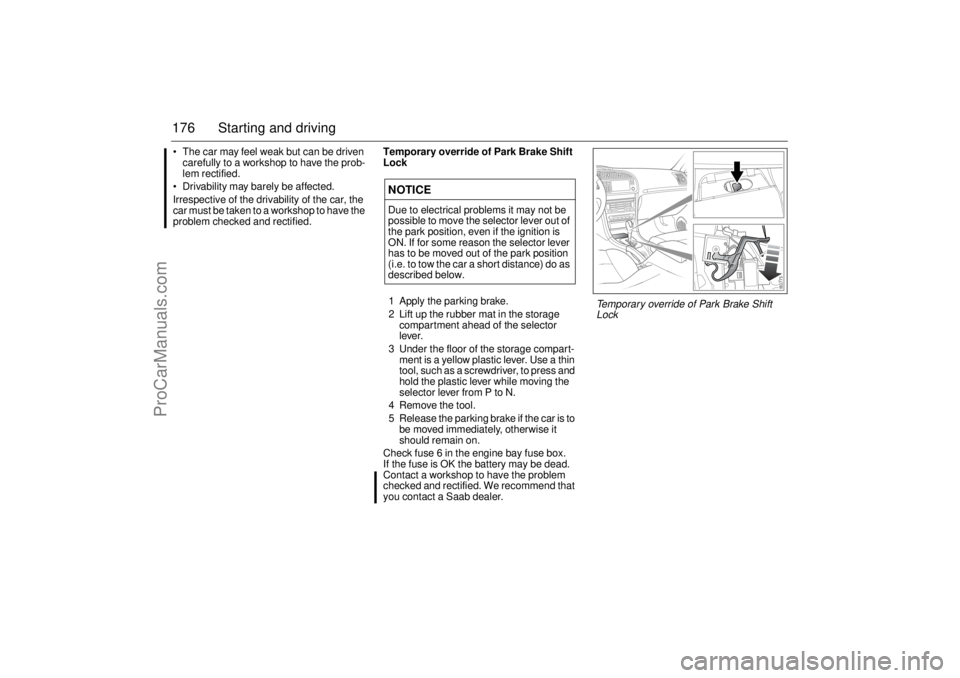
problem checked and rectified.Temporary override of Park Brake Shift
Lock
1 Apply the parking brake.
2 Lift up the rubber mat in the storage
compartment ahead of the selector
lever.
3 Under the floor of the storage compart-
ment is a yellow plastic lever. Use a thin
tool, such as a screwdriver, to press and
hold the plastic lever while moving the
selector lever from P to N.
4 Remove the tool.
5 Release the parking brake if the car is to
be moved immediately, otherwise it
should remain on.
Check fuse 6 in the engine bay fuse box.
If the fuse is OK the battery may be dead.
Contact a workshop to have the problem
checked and rectified. We recommend that
you contact a Saab dealer.
NOTICEDue to electrical problems it may not be
possible to move the selector lever out of
the park position, even if the ignition is
ON. If for some reason the selector lever
has to be moved out of the park position
(i.e. to tow the car a short distance) do as
described below.
Temporary override of Park Brake Shift
Lock
93U S M 06.book Page 176 Friday, February 18, 2005 1:15 PM
ProCarManuals.com
Page 205 of 318
205 Starting and driving
Driving at nightBear in mind the following points, especially
when driving at night:
Nighttime driving requires your full
concentration
Do not rush. Count on your journey taking
slightly longer.
The number of drivers under the influence
of drugs is likely to be greater at night than
during the day.
Do not stare at the headlights of oncom-
ing vehicles.
Avoid driving at night if you have poor
eyesight. Night vision deteriorates with
age.
Keep your car’s headlights, windows and
mirrors clean. Also, if you wear glasses,
make sure they are clean.
Make sure you are well rested before
starting a long journey. Take a break every
other hour.
Only eat light meals. Heavy meals have a
tendency to induce tiredness.
Wild animals prefer to move at dusk and
dawn.
Check the headlight levelling setting (see
page 102).
Towing the car
Front towing eye
WARNING
Remember that the brake servo does
not operate when the engine is off.
Much greater pressure than normal
will therefore be required to operate
the brake pedal.
Nor does the steering servo operate
when the engine is off. The steering
will therefore be much heavier than
usual.
The towing vehicle should always be
heavier than the vehicle on tow.
Never allow passengers to ride in the
car when it is on tow.
Always seek professional help if the
car needs to be recovered.
The ignition switch must be in the ON
position if the car is moved with the
engine not running.
The steering wheel lock must be
disengaged before towing the car.
The steering wheel lock disengages
when the remote control is inserted
into the ignition switch, if the battery
has sufficient charge.
WARNING
Make sure that the towing eye is
screwed in tightly. It has a left-hand
thread!
The towing eye is only designed for
towing the car on roads. It must not
be used to pull the car out of a ditch,
for example.
Make sure that all bystanders keep a
suitable distance, in case the towing
eye or tow rope should snap. The
towing eye or tow rope could catapult
off and cause seriously injury.
Never drive with the towing eye fitted
to the front bumper. Return it to its
designated storage space.
93U S M 06.book Page 205 Friday, February 18, 2005 1:15 PM
ProCarManuals.com
Page 209 of 318
209 Starting and driving
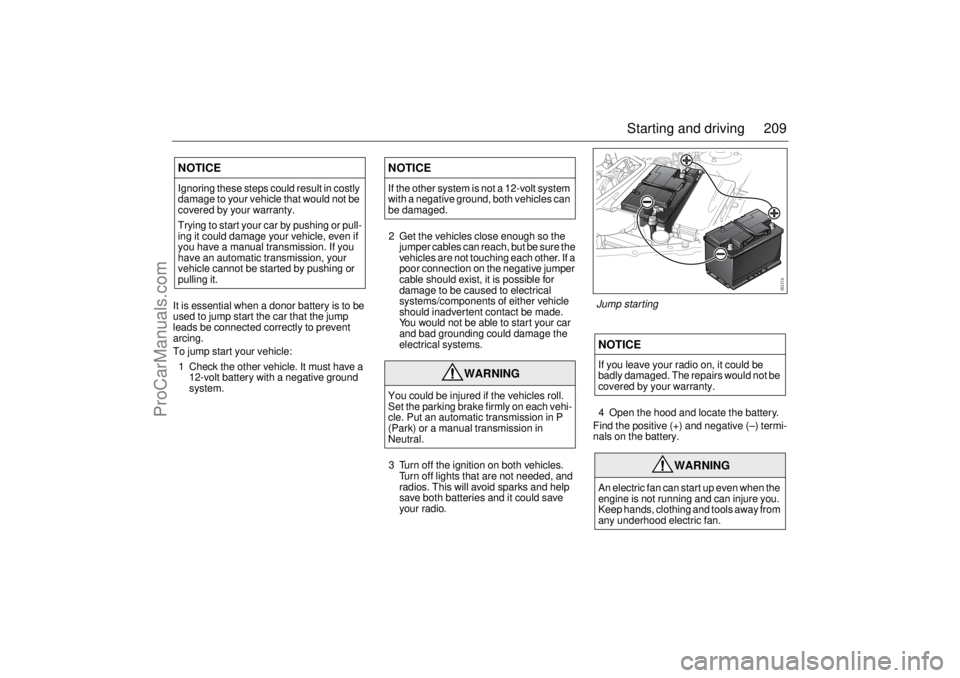
It is essential when a donor battery is to be
used to jump start the car that the jump
leads be connected correctly to prevent
arcing.
To jump start your vehicle:
1 Check the other vehicle. It must have a
12-volt battery with a negative ground
system.2 Get the vehicles close enough so the
jumper cables can reach, but be sure the
vehicles are not touching each other. If a
poor connection on the negative jumper
cable should exist, it is possible for
damage to be caused to electrical
systems/components of either vehicle
should inadvertent contact be made.
You would not be able to start your car
and bad grounding could damage the
electrical systems.
3 Turn off the ignition on both vehicles.
Turn off lights that are not needed, and
radios. This will avoid sparks and help
save both batteries and it could save
your radio.4 Open the hood and locate the battery.
Find the positive (+) and negative (–) termi-
nals on the battery.NOTICEIgnoring these steps could result in costly
damage to your vehicle that would not be
covered by your warranty.
Trying to start your car by pushing or pull-
ing it could damage your vehicle, even if
you have a manual transmission. If you
have an automatic transmission, your
vehicle cannot be started by pushing or
pulling it.
NOTICEIf the other system is not a 12-volt system
with a negative ground, both vehicles can
be damaged.
WARNING
You could be injured if the vehicles roll.
Set the parking brake firmly on each vehi-
cle. Put an automatic transmission in P
(Park) or a manual transmission in
Neutral.
NOTICEIf you leave your radio on, it could be
badly damaged. The repairs would not be
covered by your warranty.
WARNING
An electric fan can start up even when the
engine is not running and can injure you.
Keep hands, clothing and tools away from
any underhood electric fan.Jump starting
93U S M 06.book Page 209 Friday, February 18, 2005 1:15 PM
ProCarManuals.com
Page 216 of 318

216 Car careSaab Trionic engine
management systemThe Saab Trionic engine management
system is a unique Saab development that
combines sequential multiport fuel injection,
electronic distributorless ignition and turbo-
charger boost pressure control into one sys-
tem.
The Trionic engine control module (ECM)
monitors many different engine parameters
such as:
Intake manifold pressure.
Intake air temperature.
Crankshaft position.
Engine coolant temperature.
Throttle position.
The oxygen content of the exhaust gases.
The ECM receives information regarding
engine knocking from a sophisticated feed-
back function in the ignition discharge unit.
By processing all of this information, the Tri-
onic system can control fuel injector open-
ing duration, ignition timing and turbo-
charger boost pressure to provide excellent
engine performance while maintaining low
emissions and fuel consumption.
ORVR (Onboard Refueling Vapor
Recovery)All hydrocarbons formed when refueling will
be recovered by the car and not released
into the atmosphere. The hydrocarbons are
absorbed in an evaporative emission canis-
ter. When the engine is subsequently
started, the evaporative emission canister is
gradually purged as air is sucked into it
through a shut-off valve. The hydrocar-
bon/air mixture passes through the evap
canister purge valve and into the engine
where it is burned. “Refueling”, see
page 167.
When refueling, make sure you screw the
filler cap on and keep turning until it has
clicked 3 times.
NOTICEThe Trionic engine management system
continuously monitors the operation of
these systems and has on-board diag-
nostic capabilities (OBD II). If the Engine
malfunction (CHECK ENGINE) light in
the main instrument illuminates, the
Trionic ECM has detected a problem. The
car will continue to operate, but perfor-
mance may be diminished. You should
have your car checked by a Saab dealer
as soon as possible.
93U S M 06.book Page 216 Friday, February 18, 2005 1:15 PM
ProCarManuals.com
Page 232 of 318

232 Car care
Changing bulbsAutochecking of lightsThe bulbs that are most important from the point of view of traffic
safety are monitored by the car’s electrical system. If one of these
bulbs should fail, a message will be displayed on the SID.
Example of SID message:
The following bulbs are not checked: parking lights, front fog lights,
reversing lights, license plate lighting, side marker lights and side
direction indicators.
SportCombi
The tail lights and brake lights consist of LEDs. If approx. 3/4 of the
LEDs on one side are broken then this is indicated in the SID.If a stop light bulb fails
Sport Sedan: If a stop light bulb fails, the adjacent taillight will act
as a stop light to ensure traffic safety. Change the broken bulb when
possible.
All rear light bulbs are of the same type and rated 21 W, with the
exception of the license plate lighting which is rated 5 W.
Wrong bulb fitted
If a dipped or main beam bulb of too high a rating is fitted, a bulb
failure message will be shown on the SID (a too high wattage bulb
can damage the reflector).
If the following message is displayed but the bulb shines, it is most
likely that an incorrect bulb has been fitted.
Note:
When changing bulbs, fit the same type of bulb (e.g. Long-Life)
as that removed.
Headlight aiming, page 283.
WARNING
Before changing a bulb in the engine bay, switch off the engine
to avoid the danger of fingers and hands being injured by moving
parts.
The radiator fan can cut in even when the engine is switched off.NOTICESwitch off the ignition before changing a bulb, to avoid possible
short-circuiting.
Left low beam failure.
Right high beam failure.
93U S M 06.book Page 232 Friday, February 18, 2005 1:15 PM
ProCarManuals.com
Page 249 of 318
249 Car care
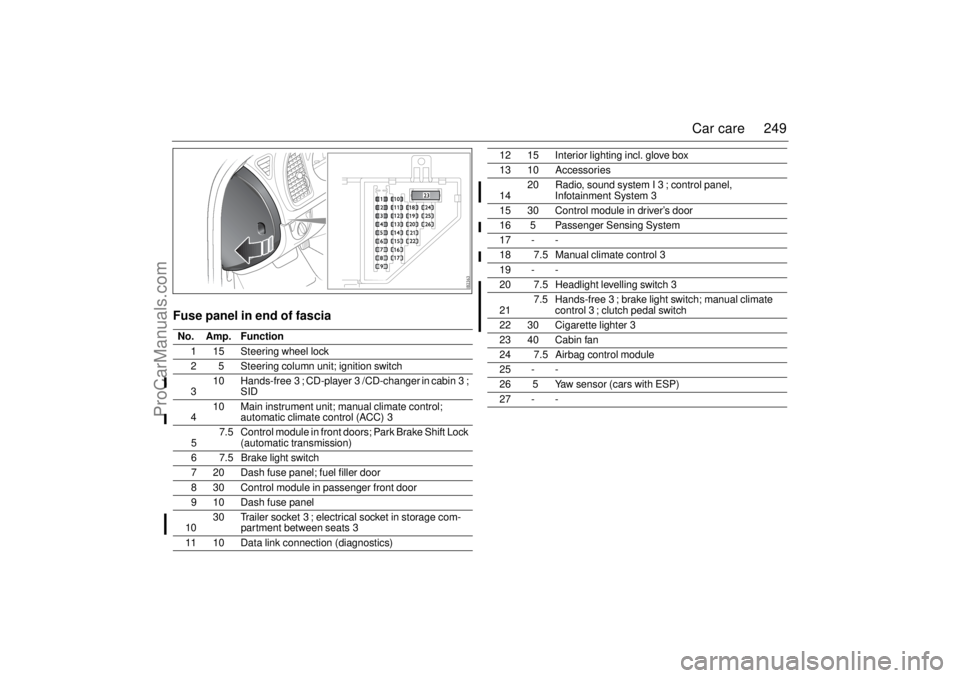
Fuse panel in end of fasciaNo. Amp. Function
1 15 Steering wheel lock
2 5 Steering column unit; ignition switch
310 Hands-free3; CD-player3/CD-changer in cabin3;
SID
410 Main instrument unit; manual climate control;
automatic climate control (ACC)3
57.5 Control module in front doors; Park Brake Shift Lock
(automatic transmission)
6 7.5 Brake light switch
7 20 Dash fuse panel; fuel filler door
8 30 Control module in passenger front door
9 10 Dash fuse panel
1030 Trailer socket3; electrical socket in storage com-
partment between seats3
11 10 Data link connection (diagnostics)
12 15 Interior lighting incl. glove box
13 10 Accessories
1420 Radio, sound system I3; control panel,
Infotainment System3
15 30 Control module in driver’s door
16 5 Passenger Sensing System
17 - -
18 7.5 Manual climate control3
19 - -
20 7.5 Headlight levelling switch3
217.5 Hands-free3; brake light switch; manual climate
control3; clutch pedal switch
22 30 Cigarette lighter3
23 40 Cabin fan
24 7.5 Airbag control module
25 - -
26 5 Yaw sensor (cars with ESP)
27 - -
93U S M 06.book Page 249 Friday, February 18, 2005 1:15 PM
ProCarManuals.com
Page 253 of 318
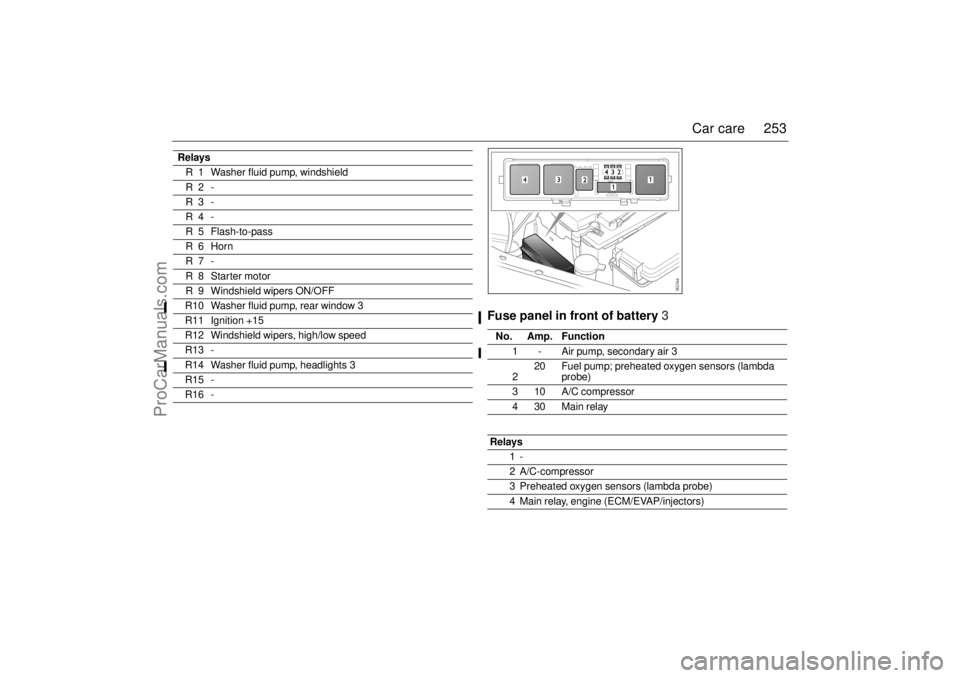
253 Car care
Fuse panel in front of battery3
Relays
R 1 Washer fluid pump, windshield
R2 -
R3 -
R4 -
R 5 Flash-to-pass
R6 Horn
R7 -
R8 Starter motor
R 9 Windshield wipers ON/OFF
R10 Washer fluid pump, rear window3
R11 Ignition +15
R12 Windshield wipers, high/low speed
R13 -
R14 Washer fluid pump, headlights3
R15 -
R16 -
No. Amp. Function
1 - Air pump, secondary air3
220 Fuel pump; preheated oxygen sensors (lambda
probe)
310A/C compressor
430Main relay
Relays
1-
2 A/C-compressor
3 Preheated oxygen sensors (lambda probe)
4 Main relay, engine (ECM/EVAP/injectors)
93U S M 06.book Page 253 Friday, February 18, 2005 1:15 PM
ProCarManuals.com
Page 314 of 318

314 IndexDriving in hot climates
____________ 197
Driving techniques
______________ 193
Driving with a heavy load on hilly
roads
________________________ 175
Driving with a load
______________ 204
Driving with a roof load ___________ 202
Driving with the compact spare wheel
208
Driving with the trunk lid open
______ 204
EEasy entry, Convertible
____________ 75
Economical motoring
____________ 193
Electric engine heater ____________ 194
Electric heating, front seats
___ 114
, 123
Electric windows
________________ 129
Electric windows, Convertible
_______ 79
Electrical system, technical data ____ 300
Electrically adjustable seats
________ 20
Electronic steering wheel lock _____ 162
Electronic Stability Program (ESP)
__ 185
Emergency opening of the narrow
backrest
_____________________ 150
Emergency operation of the sunroof
_ 140
Engine bay, cleaning
____________ 277
Engine heater
__________________ 194
Engine immobilizer
_______________ 57
Engine number
_________________ 307
Engine oil, checking
_____________ 219
Engine oil, grade
________________ 298
Engine oil, volume ______________ 299Engine temperature gauge
_________ 90
Engine, description
______________ 215
Engine, technical data ____________ 297
Engines
_______________________ 300
Event Data Recorders (EDR)
______ 292
Extra electrical socket
____________ 144
EDR (Event Data Recorders)
______ 292
ESP, anti-skid system
____________ 185
FFacilitating entry to rear seat,
Convertible
____________________ 75
Factors affecting fuel consumption
__ 193
Filler cap
______________________ 168
Filling a portable fuel container
_____ 169
Filling up
______________________ 167
Flat spots, tires
_________________ 259
Floor jack
_____________________ 274
Folding down the rear seat
________ 146
Front fog lights
_________________ 104
Front towing eye ________________ 205
Fuel container
__________________ 169
Fuel gauge
_____________________ 91
Fuel grade _____________________ 299
Fuel information
________________ 169
Functions, car alarm ______________ 61
Fuse panel in luggage compartment
_250
Fuse table
_____________________ 249
Fuses
________________________ 247
GGear selector indicator, automatic
transmission
___________________ 92
Gearbox number ________________ 307
General safety instructions,
Convertible
____________________ 64
Glove box
_____________________ 144
Glovebox lighting
________________ 244
GDO, garage door opener
_________ 134
HHandbrake
_____________________ 187
Hazard warning lights
____________ 105
Head restraint, Convertible
_________ 76
Head restraints
__________________ 23
Headlight flasher ________________ 103
Headlight levelling _______________ 102
Headlights
_____________________ 102
Heated door mirrors
_____________ 114
Hood
_________________________ 214
Horn __________________________ 128
Horn button
____________________ 128
IIf a tire goes flat
_________________ 264
Ignition switch
__________________ 160
Immobilizer
_____________________ 57
93U S M 06.book Page 314 Friday, February 18, 2005 1:15 PM
ProCarManuals.com