light SAAB 9-3 2006 Owners Manual
[x] Cancel search | Manufacturer: SAAB, Model Year: 2006, Model line: 9-3, Model: SAAB 9-3 2006Pages: 318, PDF Size: 28.05 MB
Page 3 of 318
3
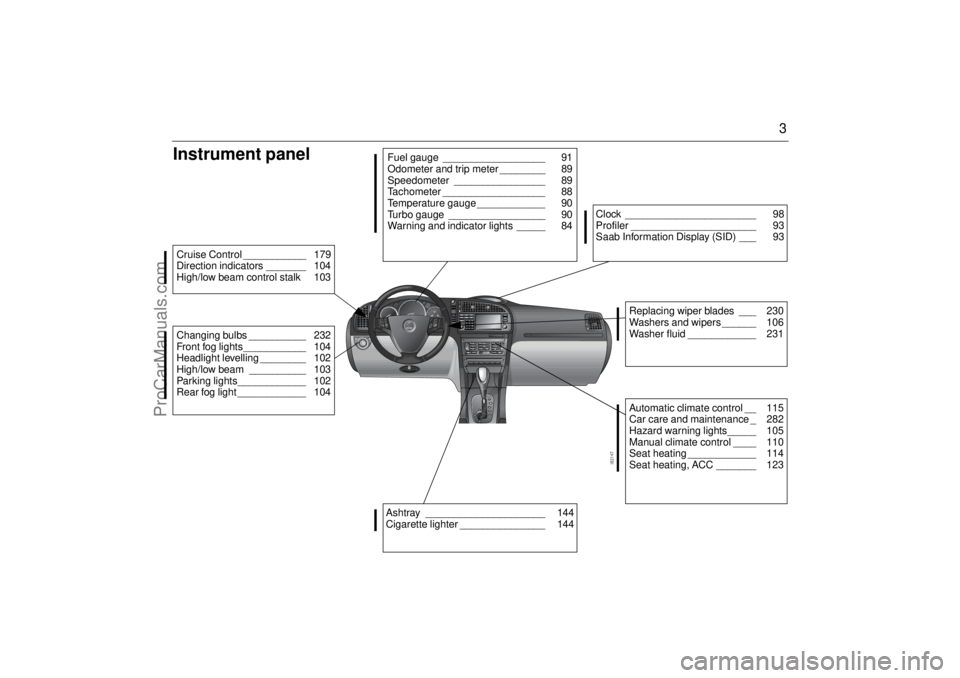
Instrument panelChanging bulbs __________ 232
Front fog lights___________ 104
Headlight levelling ________ 102
High/low beam __________ 103
Parking lights____________ 102
Rear fog light ____________ 104Cruise Control ___________ 179
Direction indicators _______ 104
High/low beam control stalk 103
Fuel gauge __________________ 91
Odometer and trip meter ________ 89
Speedometer ________________ 89
Tachometer __________________ 88
Temperature gauge ____________ 90
Turbo gauge _________________ 90
Warning and indicator lights _____ 84Ashtray _____________________ 144
Cigarette lighter _______________ 144
Clock _______________________ 98
Profiler ______________________ 93
Saab Information Display (SID) ___ 93
Replacing wiper blades ___ 230
Washers and wipers ______ 106
Washer fluid ____________ 231Automatic climate control __ 115
Car care and maintenance _ 282
Hazard warning lights_____ 105
Manual climate control ____ 110
Seat heating ____________ 114
Seat heating, ACC _______ 123
93U S M 06.book Page 3 Friday, February 18, 2005 1:15 PM
ProCarManuals.com
Page 4 of 318

4ExteriorAnti-corrosion treatment ___ 280
Body __________________ 279
Service program _________ 288
Sunroof ________________ 138
Touching up paintwork ____ 279
Washing _______________ 277
Waxing and polishing _____ 279Brake lights _____________ 240
Changing bulbs __________ 232
Light switches ___________ 102
Taillights _______________ 240Towing _________________ 205
Towing hook eyes ________ 205
Towing a trailer __________ 198Folding down the rear seat _ 146
Lighting ________________ 240
Load-through hatch _______ 148
Spare wheel ____________ 150
Tools __________________ 150
Trunk __________________ 146
Maximum loads _______________ 294
Mounting holes for roof carriers ___ 202
Roof load ____________________ 202
Hood _______________________ 214
Washing the engine bay_________ 277
Central locking __________ 50
Child safety locks ________ 54
Lock buttons ____________ 50
Trunk lock ______________ 53Changing bulbs _________ 232
Dipswitch ______________ 102
Direction indicators_______ 104
Front lights _____________ 234
Headlight levelling (xenon) _ 102
Headlight switches _______ 102
Headlight washers _______ 231Economical motoring _____ 193
Fuel filler door __________ 167
Fuel gauge _____________ 91
Fuel grade _____________ 299
Refueling ______________ 167
Braking _____________________ 180
Changing wheels ______________ 273
Spare wheel _________________ 270
Tire pressure ________________ 306
Tires _______________________ 256
Wheels _____________________ 304
Winter driving ________________ 195
93U S M 06.book Page 4 Friday, February 18, 2005 1:15 PM
ProCarManuals.com
Page 5 of 318

5
InteriorAirbag _________________ 32
Steering wheel adjustment _ 128
Steering _______________ 302
Interior rearview mirror _________ 133
Vanity mirror _________________ 142
Door mirrors__________________ 132
Airbag_________________ 32
Child safety locks ________ 54
Child seats _____________ 24
Safety belt care _________ 276
Safety belts ____________ 12Glove box ______________ 144
Storage compartments____ 144Automatic transmission ___ 173
Changing gears _________ 172
Manual transmission _____ 172
Child seats ________________ 24
Folding down the rear seat ____ 146
Rear seat__________________ 146
Safety belts ________________ 12
Seat adjustment ____________ 18
Seat heating _______________ 114,
123
Upholstery care _____________ 276
Interior lighting: changing bulbs ___ 245
Interior light switches ___________ 141
Sunroof _____________________ 138
Ashtray and cigarette lighter _____ 144
Break-In Period _______________ 171
Driving in hot/cold climates ______ 195
Ignition switch ________________ 160
Parking brake_________________ 187
Parking _____________________ 187
Starting the engine ____________ 162
Fuses _________________ 247Electric windows _________ 12993U S M 06.book Page 5 Friday, February 18, 2005 1:15 PM
ProCarManuals.com
Page 9 of 318
9
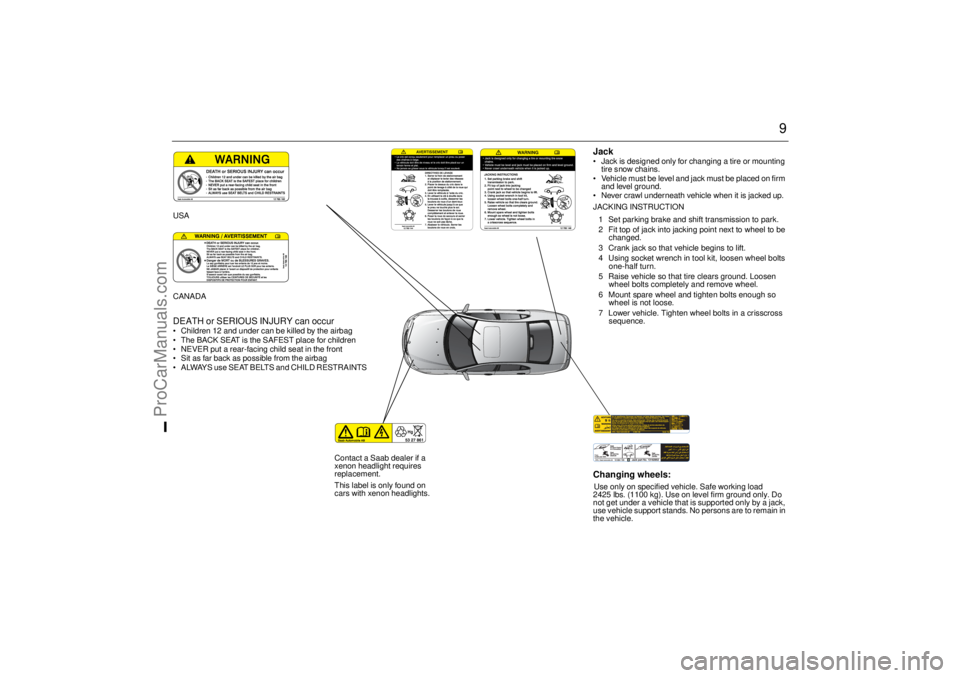
Changing wheels:Use only on specified vehicle. Safe working load
2425 lbs. (1100 kg). Use on level firm ground only. Do
not get under a vehicle that is supported only by a jack,
use vehicle support stands. No persons are to remain in
the vehicle.
Contact a Saab dealer if a
xenon headlight requires
replacement.
This label is only found on
cars with xenon headlights.
DEATH or SERIOUS INJURY can occur Children 12 and under can be killed by the airbag
The BACK SEAT is the SAFEST place for children
NEVER put a rear-facing child seat in the front
Sit as far back as possible from the airbag
ALWAYS use SEAT BELTS and CHILD RESTRAINTSUSA
CANADA
Jack Jack is designed only for changing a tire or mounting
tire snow chains.
Vehicle must be level and jack must be placed on firm
and level ground.
Never crawl underneath vehicle when it is jacked up.
JACKING INSTRUCTION
1 Set parking brake and shift transmission to park.
2 Fit top of jack into jacking point next to wheel to be
changed.
3 Crank jack so that vehicle begins to lift.
4 Using socket wrench in tool kit, loosen wheel bolts
one-half turn.
5 Raise vehicle so that tire clears ground. Loosen
wheel bolts completely and remove wheel.
6 Mount spare wheel and tighten bolts enough so
wheel is not loose.
7 Lower vehicle. Tighten wheel bolts in a crisscross
sequence.
93U S M 06.book Page 9 Friday, February 18, 2005 1:15 PM
ProCarManuals.com
Page 10 of 318
10
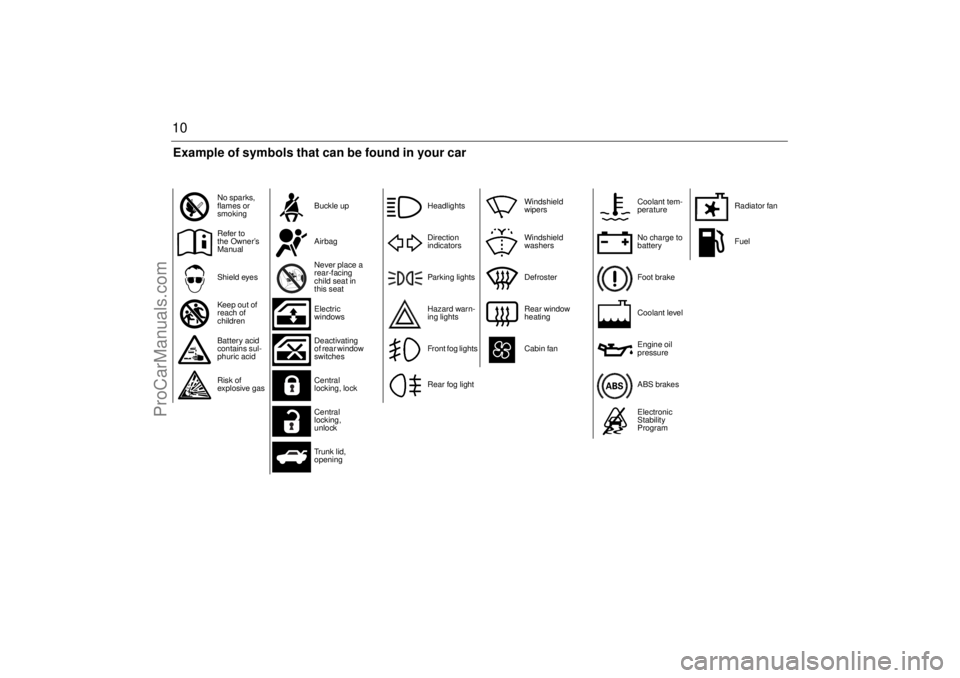
No sparks,
flames or
smokingBuckle up
Refer to
the Owner’s
ManualAirbag
Shield eyesNever place a
rear-facing
child seat in
this seat
Keep out of
reach of
childrenElectric
windows
Battery acid
contains sul-
phuric acidDeactivating
of rear window
switches
Risk of
explosive gasCentral
locking, lock
Central
locking,
unlock
Trunk lid,
opening
HeadlightsWindshield
wipers
Direction
indicatorsWindshield
washers
Parking lights Defroster
Hazard warn-
ing lightsRear window
heating
Front fog lights Cabin fan
Rear fog light
Coolant tem-
peratureRadiator fan
No charge to
batteryFuel
Foot brake
Coolant level
Engine oil
pressure
ABS brakes
Electronic
Stability
Program
Example of symbols that can be found in your car93U S M 06.book Page 10 Friday, February 18, 2005 1:15 PM
ProCarManuals.com
Page 16 of 318
16 SafetySafety belt pretensioners
Sport Sedan and SportCombi: The front
safety belts are equipped with pretension-
ers and force limiters. The pretensioners
are activated in the event of a violent frontal
or side-on crash. The safety belt pretension-
ers are only activated if the safety belt in
question is in use but not activated should
the car roll over.
The safety belt pretensioners serve to
reduce the forward movement of the body
by tensioning the belt. The force limiters
reduce belt loads on the body by "slacken-
ing" the safety belt slightly to absorb the
body’s kinetic energy as gradually as possi-
ble. Certain variants are equipped with two-
step pretensioners and they serve to reduce
the forward movement of the body in the
same way as the one-step pretensioners.Convertible: The front and rear safety belts
are equipped with pretensioners and force
limiters. The pretensioners are activated in
the event of a violent frontal or side-on
crash. The front safety belt pretensioners
are only activated if the safety belt in ques-
tion is in use.
The safety belt pretensioners serve to
reduce the movement of the body by ten-
sioning the belt, including in a roll over
crash. The force limiters reduce belt loads
on the body by "slackening" the safety belt
slightly to absorb the body’s kinetic energy
as gradually as possible. Certain variants
are equipped with two-step pretensioners
and they serve to reduce the forward move-
ment of the body in the same way as the
one-step pretensioners.
WARNING
If the car is involved in a crash, the safety
belts, belt pretensioners and other
components must be inspected and
replaced as necessary. We recommend
that you contact a Saab dealer.
Never make any alterations or repairs to
the safety belt yourself. We recommend
that you contact a Saab dealer for any
necessary repairs.93U S M 06.book Page 16 Friday, February 18, 2005 1:15 PM
ProCarManuals.com
Page 35 of 318
35 Safety
WARNING
Even if the car is equipped with
AIRBAGS, safety belts must still
always be worn by all occupants.
Note that because an airbag inflates
and deflates extremely rapidly, it will
not provide protection against a
second impact occurring in the same
incident. Always use your safety belt.
Always sit with the whole of your back
in contact with the backrest of the seat,
and with your seat as far back as is
practical.Otherwise you will be thrown
back against the backrest when the
airbag inflates which could cause you
injury or death. The airbag needs
room in which to inflate.
Never attach anything to the steering
wheel or passenger side of the instru-
ment panel, as this could result in
injury if the airbag should inflate. The
same applies to anything you might
have in your mouth, such as a pipe, for
instance.
Some components of the airbag will
be warm for a short time. In some
circumstances the airbag can cause
minor burns or abrasions to the body
when the airbag inflates/deflates.
Never rest your hands or forearms on
the steering-wheel center padding.
If the airbag warning light remains
on after the car has been started or
comes on while you are driving, have
the car checked immediately. We
recommend that you contact a Saab
dealer. The warning light could signify
that the airbags may not inflate in a
crash, or they could even inflate with-
out a crash. See page 87.
Fumes are generated by the chemical
reaction that inflates the airbag.
Skin surfaces that show signs of irrita-
tion should be washed with clean
water and a mild soap as soon as
possible.
In the event of eye irritation, flush the
eyes thoroughly with clean water for at
least 20 minutes.
In case of persistent irritation, consult
a doctor.
93U S M 06.book Page 35 Friday, February 18, 2005 1:15 PM
ProCarManuals.com
Page 36 of 318
36 Safety
Front passenger seatThe system is the same as that used on the
driver’s side.
The airbag systems are interconnected and
have a common warning light . The pas-
senger airbag module is housed in the
fascia above the glove box and is marked
"AIRBAG".
Both airbags will be inflated in the event of a
moderate to severe frontal, or near-frontal
crash, even if the passenger seat is unoccu-
pied.
The car is equipped as standard with
a passenger airbag.
WARNING
Never secure a rear-facing child seat in
the right front seat of a car equipped with
a passenger airbag. Inflation of the airbag
in the event of a crash could seriously
injure or kill a child.
WARNING
DEATH or SERIOUS
INJURY can occur
Children 12 and under or
shorter than 55 inches
(140 cm) can be killed by the
airbag
The BACK SEAT is the SAFEST place
for children
NEVER put a rear-facing child seat in
the front
Sit as far back as possible from the
airbag
ALWAYS use SAFETY BELTS and
CHILD RESTRAINTS
Never allow a child to stand in front of
the seat or to sit on the lap of a front
seat passenger. Serious injury or
death could result if the airbag is
inflated in a crash.
The glove box must be closed while
travelling. An open glove box door
could cause leg injuries in the event of
a crash.
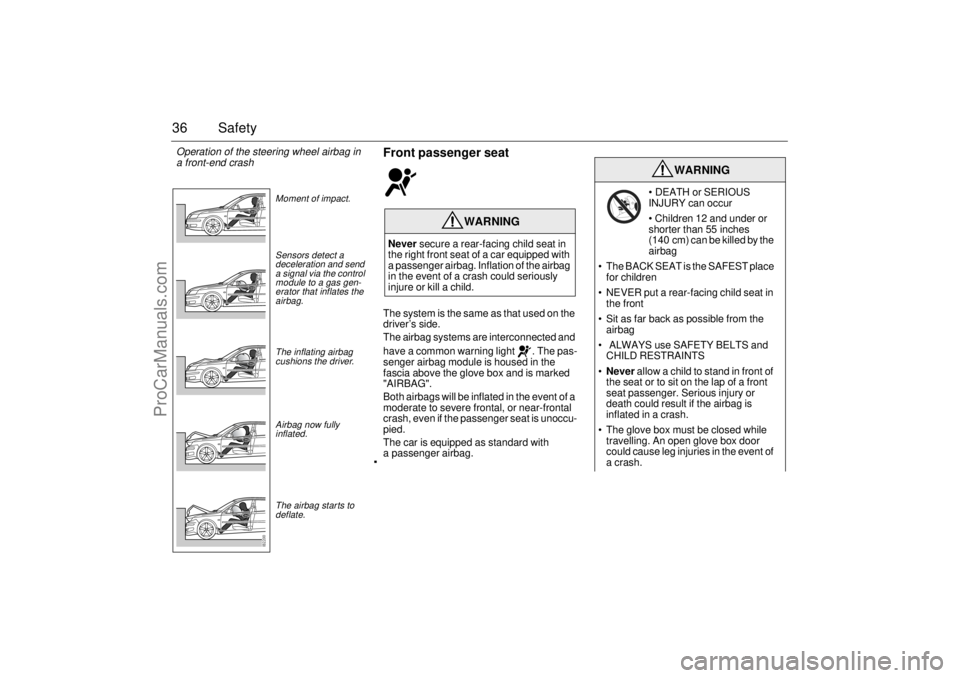
Operation of the steering wheel airbag in
a front-end crash
Moment of impact.
Sensors detect a
deceleration and send
a signal via the control
module to a gas gen-
erator that inflates the
airbag.
The inflating airbag
cushions the driver.
Airbag now fully
inflated.
The airbag starts to
deflate.
93U S M 06.book Page 36 Friday, February 18, 2005 1:15 PM
ProCarManuals.com
Page 37 of 318

37 Safety
Passenger Sensing SystemVehicles with a passenger sensing system
have indicator LEDs on the facia. The indi-
cators will be lit during the system check.
When the system check is complete, either
the ON or the OFF LED, will be lit. See
Airbag warning light on page 87. If your
vehicle does not have the indicators pic-
tured, then your vehicle does not have the
passenger sensing system.
The passenger sensing system will turn off
the right front passenger’s frontal airbag
under certain conditions.
The driver’s airbag and the side airbags are
not part of the passenger sensing system.
The passenger sensing system works with
sensors that are part of the right front pas-
senger’s seat and safety belt. The sensors
are designed to detect the presence of a
properly-seated occupant and determine if
the passenger’s frontal airbag should be
enabled (may inflate) or not.
Accident statistics show that children are
safer if they are restrained in the rear rather
than the front seat.Saab recommends that child restraints be
secured in a rear seat, including an infant
riding in a rear-facing infant seat, a child
riding in a forward-facing child seat and an
older child riding in a booster seat.
Your vehicle has a rear seat that will accom-
modate a rear-facing child restraint. A label
on your sun visor says, “Never put a rear-
facing child seat in the front.” This is
because the risk to the rear-facing child is so
great, if the airbag deploys. Never place anything on the dash or in
front of the seat as, in addition to being
a hazard to passengers, this could
interfere with the function of the airbag
in the event of a crash. The same
applies to the mounting of accessories
on the dash.
Keep feet on the floor – never put feet
up on the dash, on the seat or out of
the window.
Do not carry anything in your lap.
Passenger Airbag Status Indicator
93U S M 06.book Page 37 Friday, February 18, 2005 1:15 PM
ProCarManuals.com
Page 38 of 318

38 Safety
The passenger sensing system is designed
to turn off the right front passenger’s frontal
airbag if:
the right front passenger seat is unoccu-
pied
the system determines that an infant is
present in a rear-facing infant seat
the system determines that a small child
is present in a forward-facing child
restraint
the system determines that a small child
is present in a booster seat
a right front passenger takes his/her
weight off of the seat for a period of time
the right front passenger seat is occupied
by a smaller person, such as a child who
has outgrown child restraints
or if there is a critical problem with the
airbag system or the passenger sensing
system.When the passenger sensing system has
turned off the passenger’s frontal air bag,
the off indicator will light and stay lit to
remind you that the airbag is off.
If a child restraint has been installed and the
on indicator is lit, turn the vehicle off.
Remove the child restraint from the vehicle
and reinstall the child restraint following the
child restraint manufacturer’s directions and
refer to Installation of child restraint using
the standard safety belt on page 31.
If after reinstalling the child restraint and
restarting the vehicle, the on indicator is still
lit, check to make sure that the vehicle’s
seatback is not pressing the child restraint
into the seat cushion. If this happens,
slightly recline the vehicle’s seatback and
adjust the seat cushion if possible. Also
make sure the child restraint is not trapped
under the vehicle head restraint. If this hap-
pens, adjust the head restraint.
If the on indicator is still lit, secure the child
in the child restraint in a rear seat position in
the vehicle and check with your dealer.
WARNING
A child in a rear-facing child restraint can
be seriously injured or killed if the right
front passenger’s airbag inflates. This is
because the back of the rear-facing child
restraint would be very close to the inflat-
ing airbag.
Even though the passenger sensing
system is designed to turn off the passen-
ger’s frontal airbag if the system detects a
rear-facing child restraint, no system is
fail-safe, and no one can guarantee that
an airbag will not deploy under some
unusual circumstance, even though it is
turned off. Saab recommends that rear-
facing child restraints be secured in the
rear seat, even if the airbag is off.93U S M 06.book Page 38 Friday, February 18, 2005 1:15 PM
ProCarManuals.com