oil temperature SAAB 9-3 2006 Owners Manual
[x] Cancel search | Manufacturer: SAAB, Model Year: 2006, Model line: 9-3, Model: SAAB 9-3 2006Pages: 318, PDF Size: 28.05 MB
Page 6 of 318
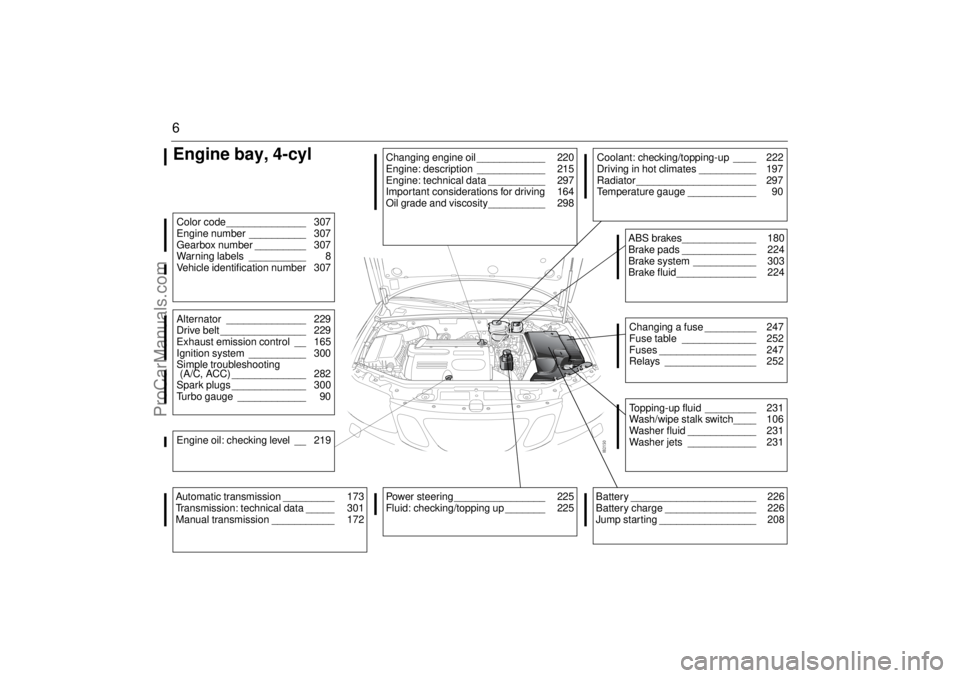
6Engine bay, 4-cylColor code______________ 307
Engine number __________ 307
Gearbox number _________ 307
Warning labels __________ 8
Vehicle identification number 307Alternator ______________ 229
Drive belt _______________ 229
Exhaust emission control __ 165
Ignition system __________ 300
Simple troubleshooting
(A/C, ACC) _____________ 282
Spark plugs _____________ 300
Turbo gauge ____________ 90Engine oil: checking level __ 219Automatic transmission _________ 173
Transmission: technical data _____ 301
Manual transmission ___________ 172
Battery ______________________ 226
Battery charge ________________ 226
Jump starting _________________ 208
Changing engine oil ____________ 220
Engine: description ____________ 215
Engine: technical data __________ 297
Important considerations for driving 164
Oil grade and viscosity__________ 298
Topping-up fluid _________ 231
Wash/wipe stalk switch____ 106
Washer fluid ____________ 231
Washer jets ____________ 231
Power steering ________________ 225
Fluid: checking/topping up _______ 225
Coolant: checking/topping-up ____ 222
Driving in hot climates __________ 197
Radiator _____________________ 297
Temperature gauge ____________ 90
Changing a fuse _________ 247
Fuse table _____________ 252
Fuses _________________ 247
Relays ________________ 252ABS brakes_____________ 180
Brake pads _____________ 224
Brake system ___________ 303
Brake fluid______________ 224
93U S M 06.book Page 6 Friday, February 18, 2005 1:15 PM
ProCarManuals.com
Page 7 of 318
7
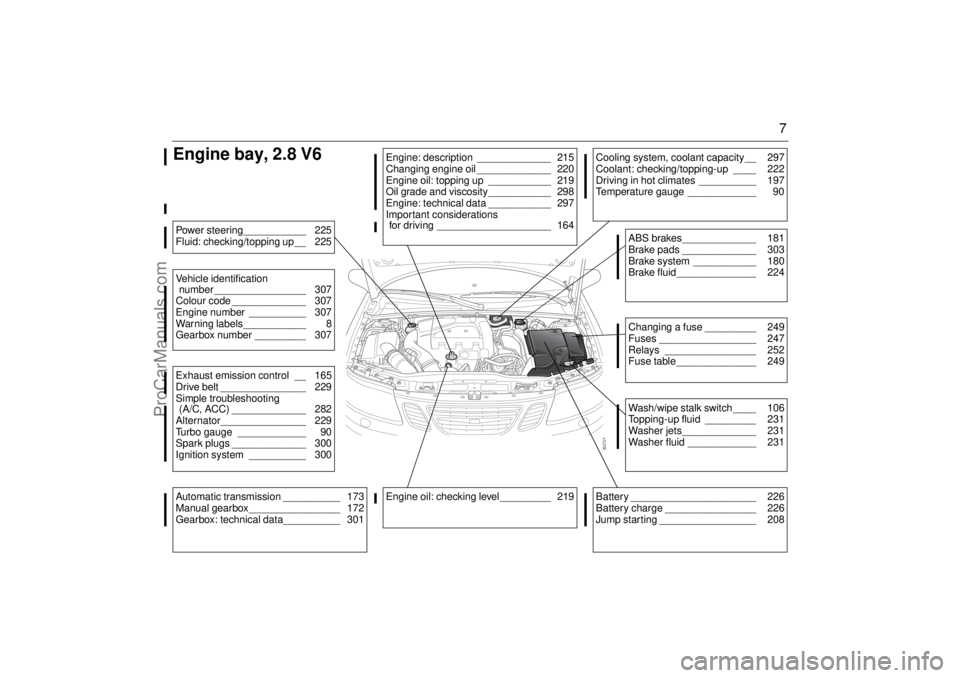
Engine bay, 2.8 V6Power steering___________ 225
Fluid: checking/topping up__ 225Vehicle identification
number ________________ 307
Colour code _____________ 307
Engine number __________ 307
Warning labels___________ 8
Gearbox number _________ 307Exhaust emission control __ 165
Drive belt _______________ 229
Simple troubleshooting
(A/C, ACC) _____________ 282
Alternator_______________ 229
Turbo gauge ____________ 90
Spark plugs _____________ 300
Ignition system __________ 300Automatic transmission __________ 173
Manual gearbox________________ 172
Gearbox: technical data__________ 301
Engine: description _____________ 215
Changing engine oil _____________ 220
Engine oil: topping up ___________ 219
Oil grade and viscosity___________ 298
Engine: technical data ___________ 297
Important considerations
for driving ____________________ 164Engine oil: checking level_________ 219
Battery ______________________ 226
Battery charge ________________ 226
Jump starting _________________ 208
Wash/wipe stalk switch ____ 106
Topping-up fluid _________ 231
Washer jets_____________ 231
Washer fluid ____________ 231Changing a fuse _________ 249
Fuses _________________ 247
Relays ________________ 252
Fuse table ______________ 249ABS brakes_____________ 181
Brake pads _____________ 303
Brake system ___________ 180
Brake fluid______________ 224
Cooling system, coolant capacity__ 297
Coolant: checking/topping-up ____ 222
Driving in hot climates __________ 197
Temperature gauge ____________ 90
93U S M 06.book Page 7 Friday, February 18, 2005 1:15 PM
ProCarManuals.com
Page 168 of 318
168 Starting and drivingRefueling1 Switch off the engine.
2 Open the filler cap, located in the right-
hand rear fender.
3 Insert the fuel pump nozzle beyond the
flange on the filler pipe and let the first
mark (a ring, a pimple or the first spring-
coil) rest on the flange. Do not withdraw
the nozzle while filling is in progress.
4 Cease refueling the first time the pump
stops, and wait a few seconds after
you´ve finished pumping before you
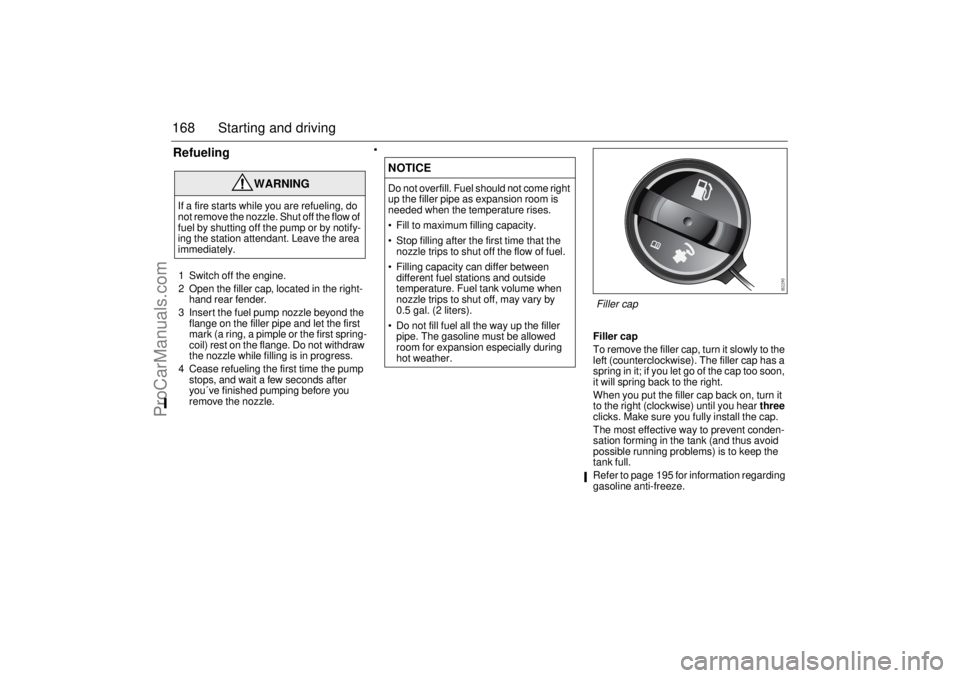
remove the nozzle.Filler cap
To remove the filler cap, turn it slowly to the
left (counterclockwise). The filler cap has a
spring in it; if you let go of the cap too soon,
it will spring back to the right.
When you put the filler cap back on, turn it
to the right (clockwise) until you hear three
clicks. Make sure you fully install the cap.
The most effective way to prevent conden-
sation forming in the tank (and thus avoid
possible running problems) is to keep the
tank full.
Refer to page 195 for information regarding
gasoline anti-freeze.
WARNING
If a fire starts while you are refueling, do
not remove the nozzle. Shut off the flow of
fuel by shutting off the pump or by notify-
ing the station attendant. Leave the area
immediately.
NOTICEDo not overfill. Fuel should not come right
up the filler pipe as expansion room is
needed when the temperature rises.
Fill to maximum filling capacity.
Stop filling after the first time that the
nozzle trips to shut off the flow of fuel.
Filling capacity can differ between
different fuel stations and outside
temperature. Fuel tank volume when
nozzle trips to shut off, may vary by
0.5 gal. (2 liters).
Do not fill fuel all the way up the filler
pipe. The gasoline must be allowed
room for expansion especially during
hot weather.
Filler cap
93U S M 06.book Page 168 Friday, February 18, 2005 1:15 PM
ProCarManuals.com
Page 175 of 318
175 Starting and driving
Lock-upThe transmission’s torque converter has a
lock-up function. This can lock the torque
converter, thus reducing the engine speed
and fuel consumption.Kick-downWhen the accelerator is pressed down fully,
a down change is made to optimize acceler-
ation, e.g. for overtaking.
Following this, the next higher gear will be
selected at the optimum engine speed,
unless you ease off the accelerator before
reaching this.Driving in hilly country with a
heavy loadThe transmission fluid can overheat when
the gearbox is strained, for example, when
driving with a trailer on hilly roads. To avoid
the transmission fluid overheating, always
drive with the selector lever in the D posi-
tion. The adaptive gear change patterns are
then active.
High air temperatures or a faulty oil cooler
can also cause the transmission fluid to
overheat. Overheating reduces the service
life of the fluid.
TowingTowing of cars with automatic transmission,
see page 205.Descending hillsIf the speed of the car increases while
descending a steep hill, despite the acceler-
ator being released, the control module will
change down. If you desire more powerful
engine braking, manually select a lower
gear (see page 178).
Limp-homeIf the transmission malfunctions, the control
module will activate limp-home mode. Driv-
ability will be affected to varying degrees.
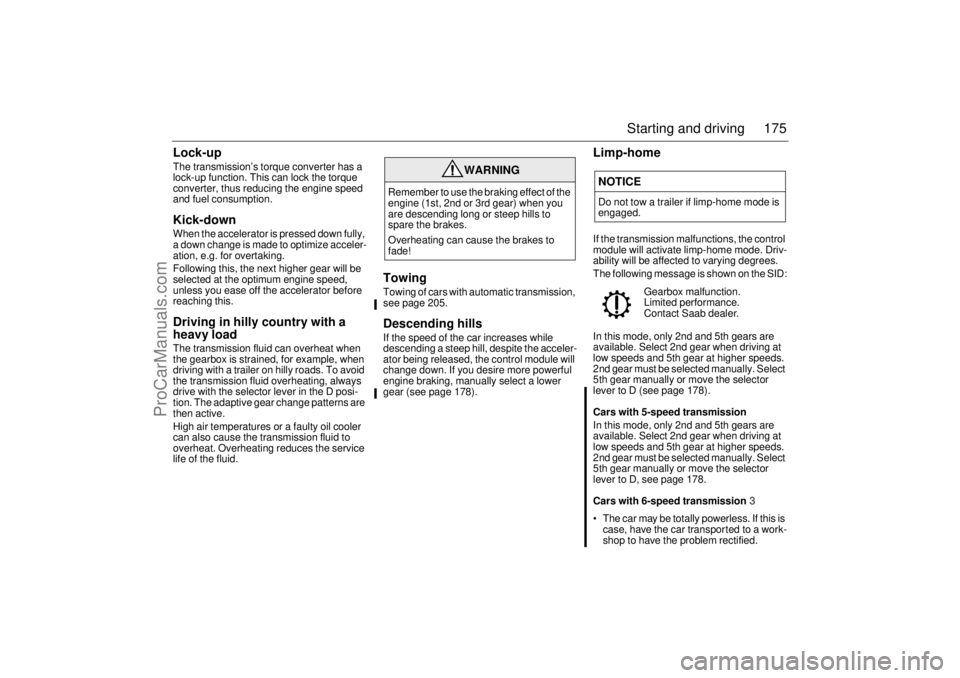
The following message is shown on the SID:
In this mode, only 2nd and 5th gears are
available. Select 2nd gear when driving at
low speeds and 5th gear at higher speeds.
2nd gear must be selected manually. Select
5th gear manually or move the selector
lever to D (see page 178).
Cars with 5-speed transmission
In this mode, only 2nd and 5th gears are
available. Select 2nd gear when driving at
low speeds and 5th gear at higher speeds.
2nd gear must be selected manually. Select
5th gear manually or move the selector
lever to D, see page 178.
Cars with 6-speed transmission3
The car may be totally powerless. If this is
case, have the car transported to a work-
shop to have the problem rectified.
WARNING
Remember to use the braking effect of the
engine (1st, 2nd or 3rd gear) when you
are descending long or steep hills to
spare the brakes.
Overheating can cause the brakes to
fade!
NOTICEDo not tow a trailer if limp-home mode is
engaged.
Gearbox malfunction.
Limited performance.
Contact Saab dealer.
93U S M 06.book Page 175 Friday, February 18, 2005 1:15 PM
ProCarManuals.com
Page 195 of 318

195 Starting and driving
Driving in cold weatherIn cold weather, special attention should be
paid to the following:
Before driving off, make sure that the
wiper blades have not frozen to the wind-
shield.
Remove any snow from the heating
system air intakes between the hood and
the windshield.
If necessary, inject oil into the locks to
prevent them from freezing. Use molyb-
denum-sulphide oil (MoS
2). If the locks
freeze, exercise care when unlocking the
car (manual unlocking) to avoid breaking
the key. Warm up the key or use a de-icer.
It is particularly important when the roads
are slippery that the brakes and tires are
in good condition.
For how to check the level of antifreeze in
the engine coolant, see page 222.
Add gasoline anti-freeze when refueling
several times before the onset of winter.
This will prevent condensation water in
the fuel tank from freezing and causing
interruptions in the fuel supply. The likeli-
hood of condensation is lowest when the
fuel tank is full.
If the car is parked outside and the
temperature is below zero, gasoline anti-
freeze is of little use as it cannot remove
water that has already frozen. Park the
car in a warm place so that any ice that
may have built up melts, then add gaso-
line anti-freeze when refueling.Condensation is caused by temperature
fluctuations, either in the outside temper-
ature alone or when the car is alternately
parked outdoors and in a garage.
Convertible: Avoid operating the soft top
at temperatures below 23°F (–5°C).
The car is equipped with tires designed to
provide optimum grip on both wet and dry
roads, although this has been achieved at
the expense of somewhat reduced grip on
snow and ice. For regular driving on snow
and ice, we therefore recommend that
winter tires be fitted. However, winter tires
achieve this extra grip at the expense of
grip on bare road surfaces.
Winter tires, particularly studded tires, gen-
erally make driving safer on snow and ice.
Acquaint yourself with the legal provi-
sions governing the use of different
types of winter tires and snow chains.
Studded tires are not allowed in some
countries. If winter tires are fitted, the same
type must be fitted to all four wheels. Your
Saab dealer will be pleased to advise you on
the best tires for your car.
93U S M 06.book Page 195 Friday, February 18, 2005 1:15 PM
ProCarManuals.com
Page 219 of 318

219 Car care
Engine oilChecking the oil levelCheck the engine oil level regularly.
1 Park the car on a level ground.
2 Switch off the engine and wait for
2–5 minutes. The engine should be at
normal operating temperature.
3 Take the dipstick out and wipe it off with
a clean rag before carrying out the
check.
The level must not be below the MIN mark
on the dipstick, but nor should it be above
the MAX mark. Excess engine oil could
result in abnormal oil consumption.
The distance between the MIN and MAX
marks is equivalent to 1.0 qt (1.0 l).2.0 Turbo (210 hk): The engine oil level is
checked each time the engine is started. If
the oil level is low, the following message
appears on the SID:
f this occurs the oil level must be checked
first. If the level is too low then it must be
topped up.V6: The engine has an oil level sensor that
checks the oil level when the engine is
running. If the oil level drops too low, the
following message appears on the SID:
f this occurs the oil level must be checked
first. If the level is too low then it must be
topped up.NOTICEToo high oil level can damage the engine.
Low engine oil level.
Fill oil now.
Low engine oil level.
Fill oil now.
Oil filler cap and dipstick, 4-cyl engine
Oil filler cap and dipstick, V6 engine
93U S M 06.book Page 219 Friday, February 18, 2005 1:15 PM
ProCarManuals.com
Page 220 of 318

220 Car careMake sure you screw on the oil filler cap
properly after topping up the oil to avoid
running problems.
It is normal for an engine to consume a cer-
tain amount of oil. It is therefore often nec-
essary to top up the oil between services.
Check the engine oil level regularly.
During the Break-in Period (approx.
3,000 miles or 5,000 km) and when driving
at high speeds or with a trailer, the oil con-
sumption may be higher than normal.
Changing engine oil
Engine oil and oil filter should be changed
according to the service program.
For oil volumes and grades, refer to
page 298.
The oil should be drained when the engine
is warm. The car must stand on level
ground.
1 Unscrew the drain plug in the bottom of
the sump and leave the oil to drain into a
suitable receptacle for at least
10 minutes. Take care, as the oil may be
hot.
2 Refit the drain plug with a new washer.
3 Change the oil filter once the engine oil
has drained (see page 221).
4 Fill with new oil.
Run the engine to normal temperature and
check the oil level.
NOTICEChange of engine oil and oil filter may be
required more frequently if the car is
being used under certain conditions, see
page 289.
WARNING
Prolonged and repeated exposure of
the skin to engine oil can cause seri-
ous skin disorders. Avoid prolonged
skin contact whenever possible.
Used engine oil contains chemicals
that have caused cancer in laboratory
animals. Always protect your skin by
washing thoroughly with soap and
water.
Keep oil out of reach of children.
Do not touch the turbocharger or
exhaust manifold. These get very hot
when the engine has been running.
Do not spill oil on hot parts of the
engine as this could cause a fire. Used
engine oil is particularly flammable.
Protect the environment. Do not
dispose of oil into the ground or down
a drain. Dispose of all used oil and
oil filters at an appropriate disposal
facility.
93U S M 06.book Page 220 Friday, February 18, 2005 1:15 PM
ProCarManuals.com
Page 225 of 318

225 Car care
Power steeringCheck the level of the power steering fluid in
the reservoir regularly, in accordance with
the service program.
The wheels should point directly forwards
during this check.
Clean round the cap before unscrewing it.
Wipe the dipstick. To check the level, screw
down the cap completely and then remove
it again.
The oil level should lie between the MAX
and MIN marks when the oil temperature is
about 68°F (+20°C). If the oil is colder, the
level will be lower, and at a higher tempera-
tures the level will be higher.
Top up with CHF 11S or CHF 202 power
steering fluid.
WARNING
Power steering fluid on hot engine
components constitutes a fire risk.
Power steering fluid reservoir, 4-cyl
engine
Power steering fluid reservoir, V6 engine
93U S M 06.book Page 225 Friday, February 18, 2005 1:15 PM
ProCarManuals.com
Page 283 of 318

283 Car care
Maintenance The compressor drive belt should be
inspected under the regular service
program.
Clean away dirt and insects from the
condenser and radiator to prevent clog-
ging. When washing the car, use the hose
to spray the radiator and condenser
(located in front of the radiator) from both
sides (both from the front of the car and
from inside the engine bay). Do not use a
pressure washer.
Caution: Do not hose down the radia-
tor and condenser while the engine is
hot.Other than in extremely cold weather, do not
screen the radiator, e.g. with netting, as this
will greatly diminish its cooling capacity.
Applicable to the manual climate control
system - During cold months the air condi-
tioning should be switched on once or
twice a month and run for 5–10 minutes
during highway driving once the engine is
warm.
This action saves the gaskets in the
compressor from being spoiled. The
compressor uses a lubricant that circu-
lates with the coolant.
Note:
The A/C system cannot be switched on
when the outside temperature is below 32°F
(0°C). Turn on the A/C system when the car
is standing in a warm place. Simplest is to
always have the A/C button pressed in. The
A/C system will then cut in automatically
when the outside temperature is high
enough.
Headlight aimingThe vehicle has a visual optical headlight
aiming system equipped with vertical
aiming device. The aim has been preset at
the factory and should normally not need
further adjustments.
If your headlights are damaged in a crash,
the headlight aim may be affected. If you
believe your headlights need to be re-
aimed, we recommend that you take it to
your Saab dealer for service. However, it is
possible for you to re-aim your headlights as
described in the following procedure.
NOTICEDo not use a pressure washer when
cleaning the condenser or radiator due to
the risk of damage.
WARNING
Before checking/adjusting the headlight
aiming, switch off the engine to avoid
danger of fingers and hands being injured
by moving parts.
The radiator fan can start up even when
the engine is switched off.NOTICETo make sure that your headlights are
aimed properly read all instructions
before beginning. Failure to follow these
instructions could cause damage to
headlight parts or a not correctly aimed
headlight.
93U S M 06.book Page 283 Friday, February 18, 2005 1:15 PM
ProCarManuals.com
Page 288 of 318

288 Customer Assistance and InformationMaintenance scheduleThe Maintenance Schedule prescribes a
service program to the purchaser/operator
of a Saab that is reasonable and necessary
to ensure the proper emission control sys-
tems function, safety and reliability of the
Saab automobile in normal use. Additional
maintenance is recommended for specific
components when the car is operated under
certain severe conditions. Proper mainte-
nance is always a good practice!
Authorized Saab dealers are equipped and
trained to meet your Saab’s service needs.
They regularly receive up-to-date Saab ser-
vice manuals and parts and technical ser-
vice bulletins from Saab and are able,
through their franchise agreement, to attend
Saab service schools, obtain Saab special
tools and technical assistance and pur-
chase original equipment service and
replacement parts.
Today’s complex automobiles should only
be entrusted to the most knowledgeable
service professionals. A Saab dealer is your
best choice.
SERVICE INTERVALSA time for service message will illuminate on
the Saab Instrument Display (SID) when the
car is due for regular maintenance. There
are three different messages that will
appear:
TIME FOR INTERMEDIATE SERVICE
indicates that an oil/filter change is required
along with several inspections. This mes-
sage is set by the engine management
system which calculates service intervals
based on several factors including driving
habits, ambient temperature, number of
cold starts, mileage driven and elapsed time
since the last service. If mileage accumula-
tion does not occur, the message will be set,
and maintenance required at a maximum of
2 years.
TIME FOR MAIN AND INTERMEDIATE
SERVICE
indicates that an oil/filter change is required
along with several inspections and addi-
tional maintenance such as air filter or spark
plug replacement.TIME FOR MAIN SERVICE will be set when
additional maintenance is necessary, such
as air filter or spark plug replacement. When
the message Time for service. is displayed,
contact your Saab Dealer for a service
appointment.
Failure to perform scheduled maintenance
in a timely manner may result in serious
damage to key components or systems.
93U S M 06.book Page 288 Friday, February 18, 2005 1:15 PM
ProCarManuals.com