engine oil SAAB 9-3 2007 User Guide
[x] Cancel search | Manufacturer: SAAB, Model Year: 2007, Model line: 9-3, Model: SAAB 9-3 2007Pages: 304, PDF Size: 26.16 MB
Page 197 of 304
197 Starting and driving
Always try to keep the towrope taut by
gently applying the brake of the car on tow,
as necessary. This will avoid the towrope
being jerked violently.
Cars with automatic transmission:
Always observe the speed limit for vehicles
on tow. Whatever the speed limit, the car
must not be towed at speeds exceeding
30 mph (50 km/h) nor for a distance of more
than 30 miles (50 km). If the car needs to be
transported over a longer distance, a tow
truck or flatbed truck must be called out.
The engine cannot be started by towing or
pushing the car. In an emergency, the
engine can be started as described under
"Jump starting" on page 198.
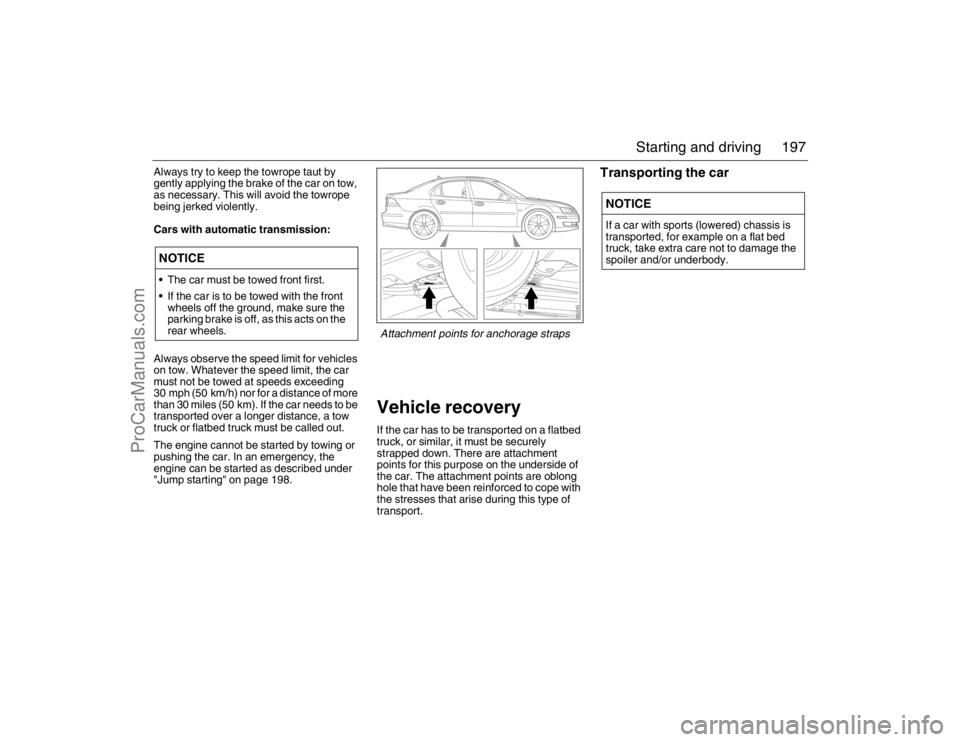
Vehicle recoveryIf the car has to be transported on a flatbed
truck, or similar, it must be securely
strapped down. There are attachment
points for this purpose on the underside of
the car. The attachment points are oblong
hole that have been reinforced to cope with
the stresses that arise during this type of
transport.
Transporting the car
NOTICE The car must be towed front first.
If the car is to be towed with the front
wheels off the ground, make sure the
parking brake is off, as this acts on the
rear wheels.
NOTICEIf a car with sports (lowered) chassis is
transported, for example on a flat bed
truck, take extra care not to damage the
spoiler and/or underbody.
Attachment points for anchorage straps
93_U S _M 07.book Page 197 W ednesday, April 12, 2006 9:30 AM
ProCarManuals.com
Page 200 of 304

200 Starting and drivingUsing a battery charger3/starter
unitTo avoid damaging the car’s electrical
system and electronics, the following rules
must be followed when charging the battery
or jump starting the car.
If the charger or starter unit can be set to
different voltages (6V/12V/18V/24V), 12V
must be selected.
Follow the manufacturer’s instructions
supplied with the charger or starter unit.
No other apparatus that are grounded or
connected to the mains must be
connected to the car during charging or
jump starting.
The charger or starter unit must under no
conditions produce a voltage greater
than:
16V continuous
18V for 60 min.
If you are unsure about the charge rating of
the unit, disconnect the battery clamp from
the positive terminal before connecting the
unit to the battery.
For long tripsBefore starting off on a long journey, it is
advisable to have your car inspected by
your Saab dealer.
Obtain a few important items to take along
on your journey, such as spare bulbs, wiper
blades, fuses, a drive belt (poly-V-belt) and
the like.
You can check some points yourself before-
hand:
Check that no oil or fuel leaks out of the
engine or gearbox/transmission.
Check the coolant and power steering
fluid levels. Check also for leaks.
Inspect the drive belt (poly-V-belt) and
replace if it shows any signs of wear.
Check the battery charge.
Check the tires for tread pattern and air
pressure, including the compact spare
tire.
Take an extra remote control and keep it
separate.
Check the brakes.
Check all bulbs.
Check for the presence of the tool kit and
jack in the car.
93_U S _M 07.book Page 200 W ednesday, April 12, 2006 9:30 AM
ProCarManuals.com
Page 201 of 304
201 Car care
Hood ________________ 202
Engine ______________ 202
Engine bay, 4-cyl engine 205
Engine bay, V6 engine _ 206
Engine oil ____________ 207
Air filter______________ 209
Transmission fluid ____ 209
Coolant ______________ 209
Brake/clutch fluid and
brake pads__________ 211
Power steering________ 212
Battery ______________ 213
Drive belt ____________ 216
Wipers and washers ___ 217
Wiper blades _________ 217
Changing bulbs _______ 219 Fuses ________________ 234
Tires _________________ 241
Compact spare ________ 254
Changing a tire ________ 257
Safety belts ___________ 260
Upholstery and trim ____ 260
Textile carpeting _______ 261
Engine bay ____________ 261
Washing ______________ 261
Waxing and polishing ___ 264
Touching up the paint___ 264
Anti-corrosion treatment 265
Recovery and/or
recycling of automotive
materials ____________ 267
Air conditioning (A/C) ___ 268
Car care
3Asterisk means: equipment not fitted in all cars
(can depend on model variant, engine variant,
market specification, options or accessories).93_U S _M 07.book Page 201 W ednesday, April 12, 2006 9:30 AM
ProCarManuals.com
Page 205 of 304
205 Car care
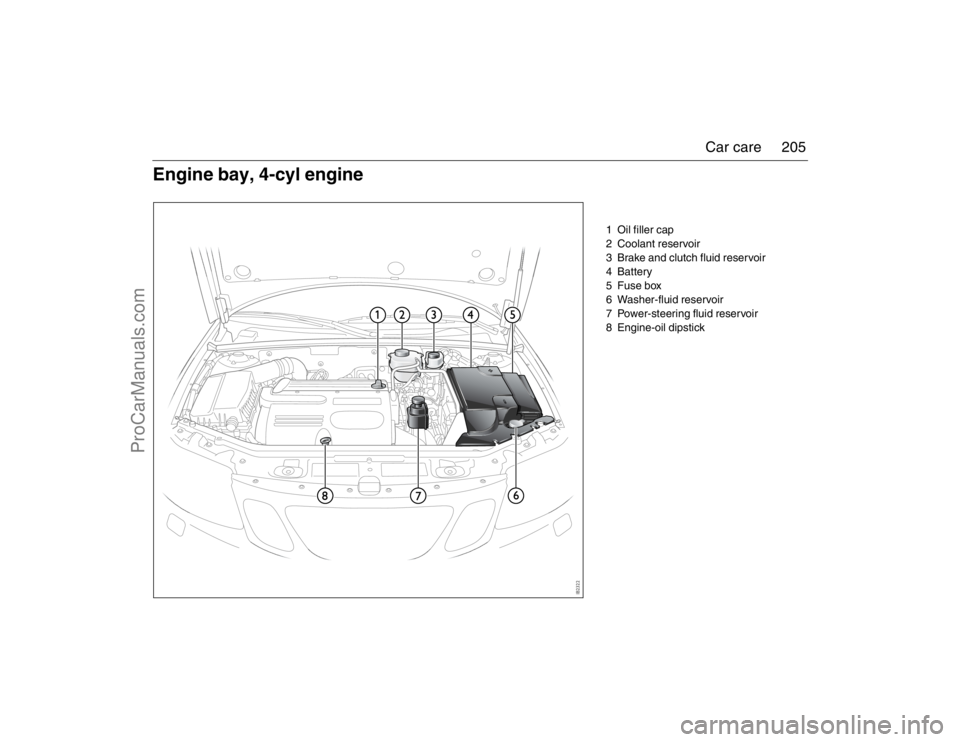
1 Oil filler cap
2 Coolant reservoir
3 Brake and clutch fluid reservoir
4Battery
5 Fuse box
6 Washer-fluid reservoir
7 Power-steering fluid reservoir
8 Engine-oil dipstick
Engine bay, 4-cyl engine93_U S _M 07.book Page 205 W ednesday, April 12, 2006 9:30 AM
ProCarManuals.com
Page 206 of 304
206 Car care
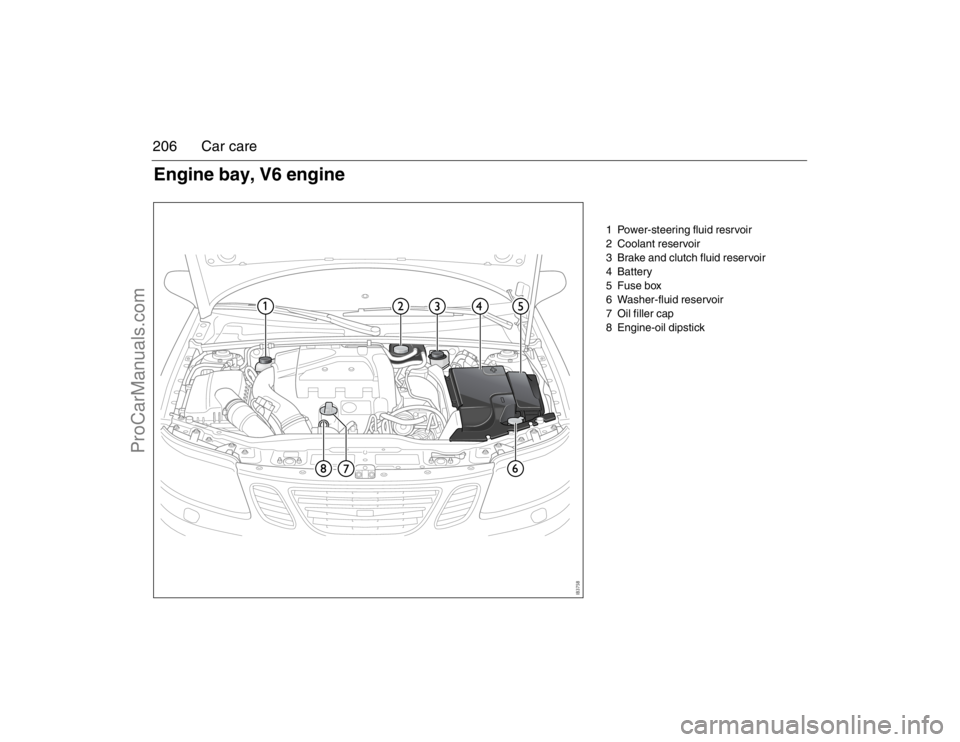
1 Power-steering fluid resrvoir
2 Coolant reservoir
3 Brake and clutch fluid reservoir
4Battery
5 Fuse box
6 Washer-fluid reservoir
7 Oil filler cap
8 Engine-oil dipstick
Engine bay, V6 engine93_U S _M 07.book Page 206 W ednesday, April 12, 2006 9:30 AM
ProCarManuals.com
Page 207 of 304
207 Car care
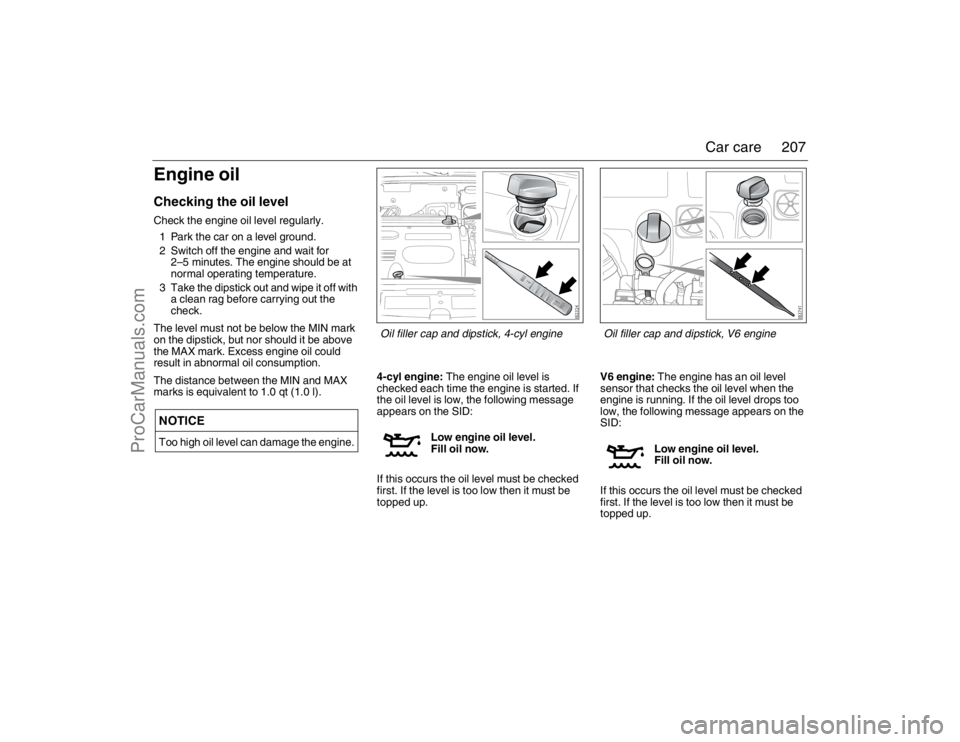
Engine oilChecking the oil levelCheck the engine oil level regularly.
1 Park the car on a level ground.
2 Switch off the engine and wait for
2–5 minutes. The engine should be at
normal operating temperature.
3 Take the dipstick out and wipe it off with
a clean rag before carrying out the
check.
The level must not be below the MIN mark
on the dipstick, but nor should it be above
the MAX mark. Excess engine oil could
result in abnormal oil consumption.
The distance between the MIN and MAX
marks is equivalent to 1.0 qt (1.0 l).4-cyl engine: The engine oil level is
checked each time the engine is started. If
the oil level is low, the following message
appears on the SID:
If this occurs the oil level must be checked
first. If the level is too low then it must be
topped up.V6 engine: The engine has an oil level
sensor that checks the oil level when the
engine is running. If the oil level drops too
low, the following message appears on the
SID:
If this occurs the oil level must be checked
first. If the level is too low then it must be
topped up.NOTICEToo high oil level can damage the engine.
Low engine oil level.
Fill oil now.
Low engine oil level.
Fill oil now.
Oil filler cap and dipstick, 4-cyl engine
Oil filler cap and dipstick, V6 engine
93_U S _M 07.book Page 207 W ednesday, April 12, 2006 9:30 AM
ProCarManuals.com
Page 208 of 304

208 Car careMake sure you screw on the oil filler cap
properly after topping up the oil to avoid
running problems.
It is normal for an engine to consume a cer-
tain amount of oil. It is therefore often nec-
essary to top up the oil between services.
Check the engine oil level regularly.
During the Break-in Period (approx.
3,000 miles or 5,000 km) and when driving
at high speeds or with a trailer, the oil con-
sumption may be higher than normal.NOTICEChange of engine oil and oil filter may be
required more frequently if the car is
being used under certain conditions, see
page 275.
WARNING
Prolonged and repeated exposure of
the skin to engine oil can cause seri-
ous skin disorders. Avoid prolonged
skin contact whenever possible.
Used engine oil contains chemicals
that have caused cancer in laboratory
animals. Always protect your skin by
washing thoroughly with soap and
water.
Keep oil out of reach of children.
Do not touch the turbocharger or
exhaust manifold. These get very hot
when the engine has been running.
Do not spill oil on hot parts of the
engine as this could cause a fire. Used
engine oil is particularly flammable.
Protect the environment. Do not
dispose of oil into the ground or down
a drain. Dispose of all used oil and
oil filters at an appropriate disposal
facility.
NOTICE Do not run the engine with the oil level
too low.
Change engine oil and oil filter in
accordance with the service
programme
Only use the recommended type of oil.
Observe the above three points to avoid
serious damage to the engine.
For oil volumes and grades, refer to
page 284.
93_U S _M 07.book Page 208 W ednesday, April 12, 2006 9:30 AM
ProCarManuals.com
Page 209 of 304
209 Car care
Air filter
Transmission fluidManual transmission
Check and top up the oil in accordance with
the service program.
Automatic transmission
Check and top up the oil in accordance with
the service program.
CoolantThere is an overpressure in the cooling sys-
tem. Coolant temperatures can sometimes
exceed 212° F (100° C).
If the coolant level drops too low, the follow-
ing message appears on the SID:
The properties of the coolant are retained
for the entire service life of the car. There-
fore, it is not necessary to change the cool-
ant.The coolant contains 45 % antifreeze and
anti-corrosion fluid. This ratio gives the best
cooling effect. Lower concentrations should
be avoided, in view of the corrosion risk.
Coolants of a different brand could damage
the engine or cooling system. We therefore
recommend strict use of coolants that have
been approved by Saab.
Note:
If incorrect coolant is used or added, the life-
time properties will be affected. Even if the
coolant is flushed from the system and
replaced with life-time coolant, life-time
properties are no longer retained and the
coolant must then be drained and replaced
at regular intervals.
WARNING
To ensure reliable operation, only use
an air filter recommended by Saab
Automobile AB.
WARNING
Proceed with caution if the radiator is
boiling when you open the hood.
Never remove the expansion-tank
filler cap when the radiator is boiling.
The cooling system is pressurized –
hot coolant and vapor can escape
when the filler cap is released. These
can cause injury to your eyes and
burns. Loosen the cap carefully, and
let the engine cool before removing
the cap.
Exercise care when adding coolant.
Coolant on hot surfaces constitutes a
fire risk.
Coolant level low.
Refill.
NOTICEIf the cooling system needs topping up,
mix the antifreeze with the appropriate
quantity of drinking water or distilled
water before adding it to the system.
If undiluted antifreeze is added, the
engine could still freeze and be damaged.
This is because the antifreeze will not mix
properly with the coolant before the ther-
mostat has opened to allow full circula-
tion.
93_U S _M 07.book Page 209 W ednesday, April 12, 2006 9:30 AM
ProCarManuals.com
Page 212 of 304
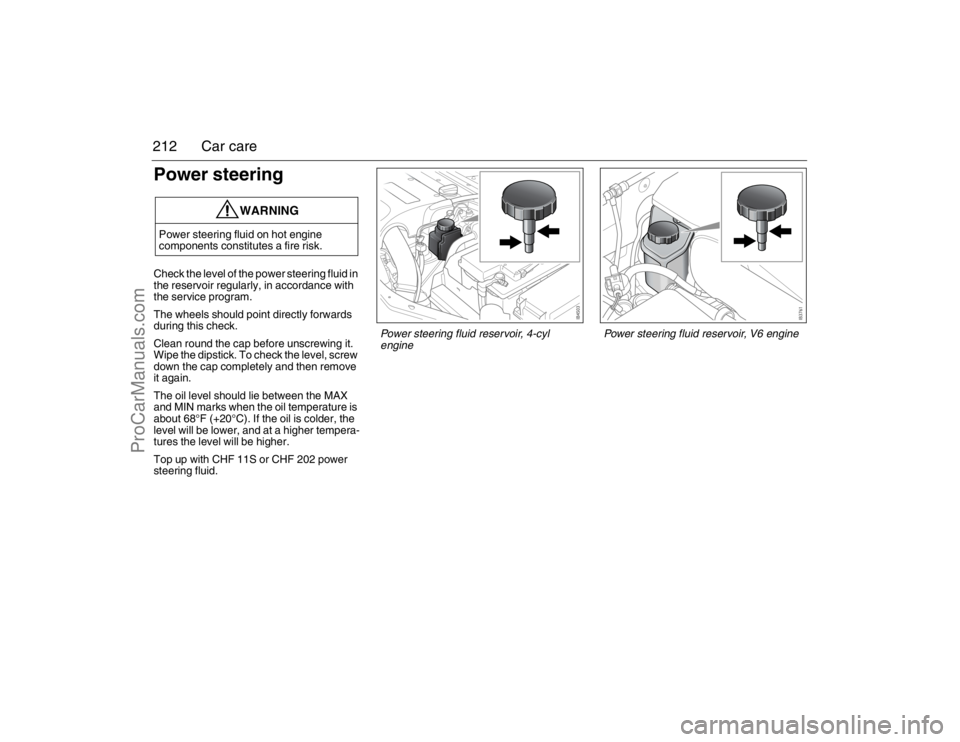
212 Car carePower steeringCheck the level of the power steering fluid in
the reservoir regularly, in accordance with
the service program.
The wheels should point directly forwards
during this check.
Clean round the cap before unscrewing it.
Wipe the dipstick. To check the level, screw
down the cap completely and then remove
it again.
The oil level should lie between the MAX
and MIN marks when the oil temperature is
about 68°F (+20°C). If the oil is colder, the
level will be lower, and at a higher tempera-
tures the level will be higher.
Top up with CHF 11S or CHF 202 power
steering fluid.
WARNING
Power steering fluid on hot engine
components constitutes a fire risk.
Power steering fluid reservoir, 4-cyl
engine
Power steering fluid reservoir, V6 engine
93_U S _M 07.book Page 212 W ednesday, April 12, 2006 9:30 AM
ProCarManuals.com
Page 269 of 304

269 Car care
Other than in extremely cold weather, do not
screen the radiator, e.g. with netting, as this
will greatly diminish its cooling capacity.
Applicable to the manual climate control
system - During cold months the air condi-
tioning should be switched on once or
twice a month and run for 5–10 minutes
during highway driving once the engine is
warm.
This action saves the gaskets in the
compressor from being spoiled. The
compressor uses a lubricant that circu-
lates with the coolant.
Note:
The A/C system cannot be switched on
when the outside temperature is below 32°F
(0°C). Turn on the A/C system when the car
is standing in a warm place. Simplest is to
always have the A/C button pressed in. The
A/C system will then cut in automatically
when the outside temperature is high
enough.
Headlight aimingThe vehicle has a visual optical headlight
aiming system equipped with vertical
aiming device. The aim has been preset at
the factory and should normally not need
further adjustments.
If your headlights are damaged in a crash,
the headlight aim may be affected. If you
believe your headlights need to be re-
aimed, we recommend that you take it to
your Saab dealer for service. However, it is
possible for you to re-aim your headlights as
described in the following procedure.To check the aim, the vehicle should be
properly prepared as follows:
The vehicle shall be placed so that the
headlights are 25 ft (7.6 m) from a light
colored wall or other flat surface. The
aiming area should be darkened, this will
improve your ability to see the beam of the
low beam headlight being aimed.
An optical headlamp aimer can also be
used and will than replace the wall.
The vehicle must have all four wheels on
a perfectly level surface which is level all
the way to the wall or other flat surface.
The vehicle should be placed so it is per-
pendicular to the wall or other flat surface.
The vehicle should be unloaded and fuel
tank full, and one person or 160 lbs.
(75 kg) on the drivers seat.
The vehicle should be fully assembled
and all other work stopped while headlight
aiming is being done.
The vehicle should not have any snow,
ice or mud attached to it.
Tires should be inflated to the prescribed
pressure.
Close all doors.
Rock the vehicle to stabilize the suspen-
sion.
Headlight aiming is done with the vehicle
low beam lamps. The high beam lamps will
be correctly aimed if the low beam lamps
are aimed properly.
WARNING
Before checking/adjusting the headlight
aiming, switch off the engine to avoid
danger of fingers and hands being injured
by moving parts.
The radiator fan can start up even when
the engine is switched off.NOTICETo make sure that your headlights are
aimed properly read all instructions
before beginning. Failure to follow these
instructions could cause damage to
headlight parts or a not correctly aimed
headlight.
93_U S _M 07.book Page 269 W ednesday, April 12, 2006 9:30 AM
ProCarManuals.com