open hood SAAB 9-3 2007 User Guide
[x] Cancel search | Manufacturer: SAAB, Model Year: 2007, Model line: 9-3, Model: SAAB 9-3 2007Pages: 304, PDF Size: 26.16 MB
Page 209 of 304
209 Car care
Air filter
Transmission fluidManual transmission
Check and top up the oil in accordance with
the service program.
Automatic transmission
Check and top up the oil in accordance with
the service program.
CoolantThere is an overpressure in the cooling sys-
tem. Coolant temperatures can sometimes
exceed 212° F (100° C).
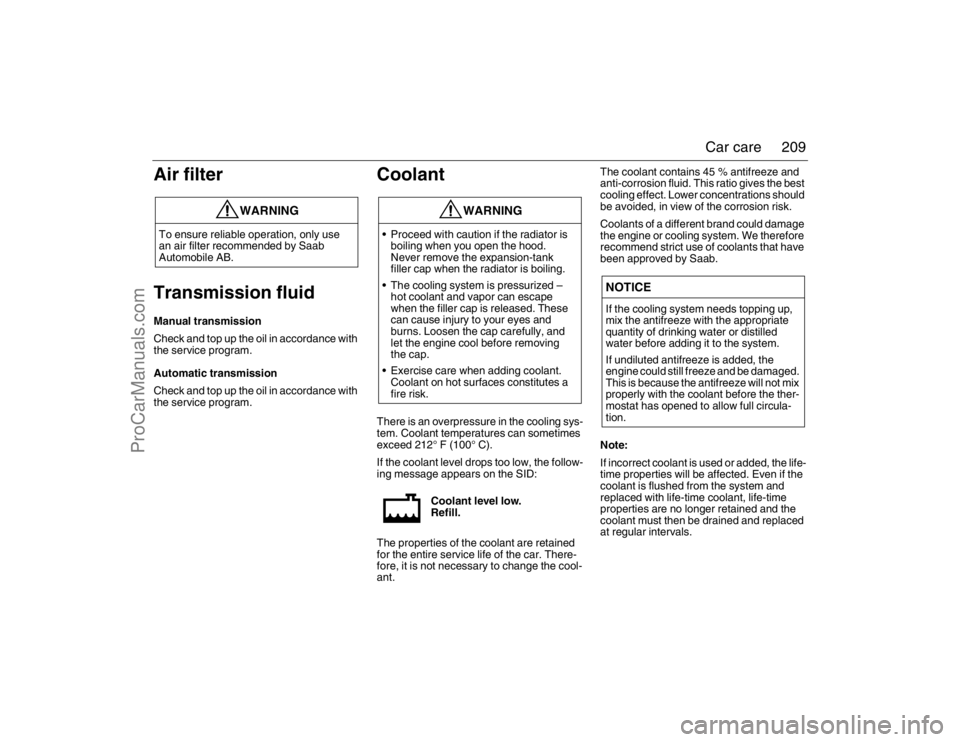
If the coolant level drops too low, the follow-
ing message appears on the SID:
The properties of the coolant are retained
for the entire service life of the car. There-
fore, it is not necessary to change the cool-
ant.The coolant contains 45 % antifreeze and
anti-corrosion fluid. This ratio gives the best
cooling effect. Lower concentrations should
be avoided, in view of the corrosion risk.
Coolants of a different brand could damage
the engine or cooling system. We therefore
recommend strict use of coolants that have
been approved by Saab.
Note:
If incorrect coolant is used or added, the life-
time properties will be affected. Even if the
coolant is flushed from the system and
replaced with life-time coolant, life-time
properties are no longer retained and the
coolant must then be drained and replaced
at regular intervals.
WARNING
To ensure reliable operation, only use
an air filter recommended by Saab
Automobile AB.
WARNING
Proceed with caution if the radiator is
boiling when you open the hood.
Never remove the expansion-tank
filler cap when the radiator is boiling.
The cooling system is pressurized –
hot coolant and vapor can escape
when the filler cap is released. These
can cause injury to your eyes and
burns. Loosen the cap carefully, and
let the engine cool before removing
the cap.
Exercise care when adding coolant.
Coolant on hot surfaces constitutes a
fire risk.
Coolant level low.
Refill.
NOTICEIf the cooling system needs topping up,
mix the antifreeze with the appropriate
quantity of drinking water or distilled
water before adding it to the system.
If undiluted antifreeze is added, the
engine could still freeze and be damaged.
This is because the antifreeze will not mix
properly with the coolant before the ther-
mostat has opened to allow full circula-
tion.
93_U S _M 07.book Page 209 W ednesday, April 12, 2006 9:30 AM
ProCarManuals.com
Page 270 of 304
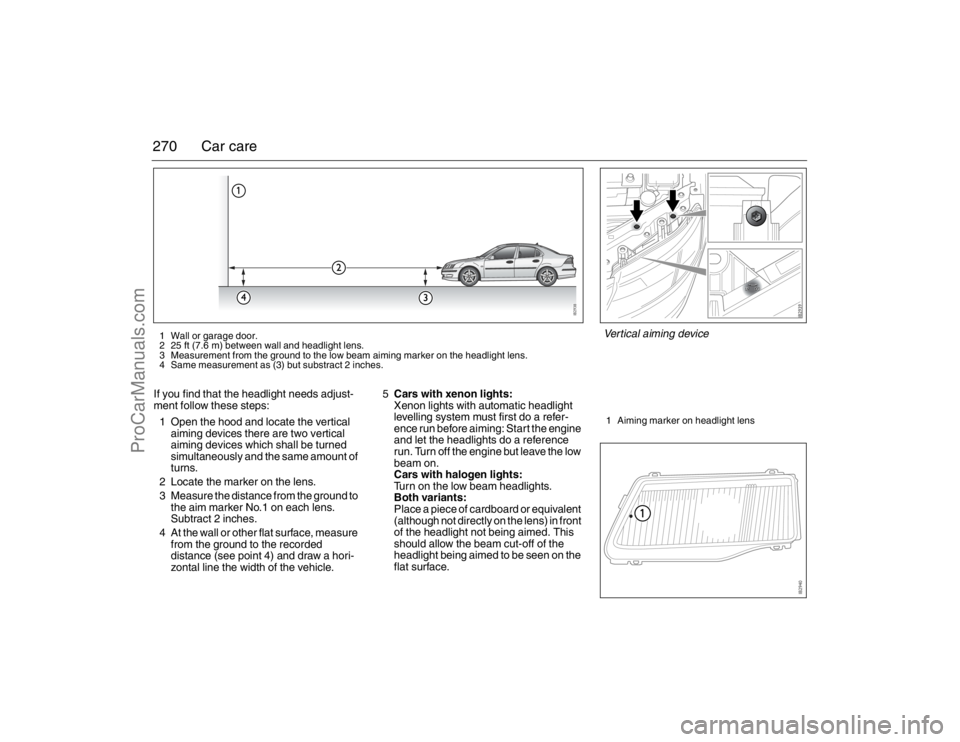
270 Car careIf you find that the headlight needs adjust-
ment follow these steps:
1 Open the hood and locate the vertical
aiming devices there are two vertical
aiming devices which shall be turned
simultaneously and the same amount of
turns.
2 Locate the marker on the lens.
3 Measure the distance from the ground to
the aim marker No.1 on each lens.
Subtract 2 inches.
4 At the wall or other flat surface, measure
from the ground to the recorded
distance (see point 4) and draw a hori-
zontal line the width of the vehicle.5Cars with xenon lights:
Xenon lights with automatic headlight
levelling system must first do a refer-
ence run before aiming: Start the engine
and let the headlights do a reference
run. Turn off the engine but leave the low
beam on.
Cars with halogen lights:
Turn on the low beam headlights.
Both variants:
Place a piece of cardboard or equivalent
(although not directly on the lens) in front
of the headlight not being aimed. This
should allow the beam cut-off of the
headlight being aimed to be seen on the
flat surface.1 Wall or garage door.
2 25 ft (7.6 m) between wall and headlight lens.
3 Measurement from the ground to the low beam aiming marker on the headlight lens.
4 Same measurement as (3) but substract 2 inches.
Vertical aiming device1 Aiming marker on headlight lens
93_U S _M 07.book Page 270 W ednesday, April 12, 2006 9:30 AM
ProCarManuals.com
Page 296 of 304
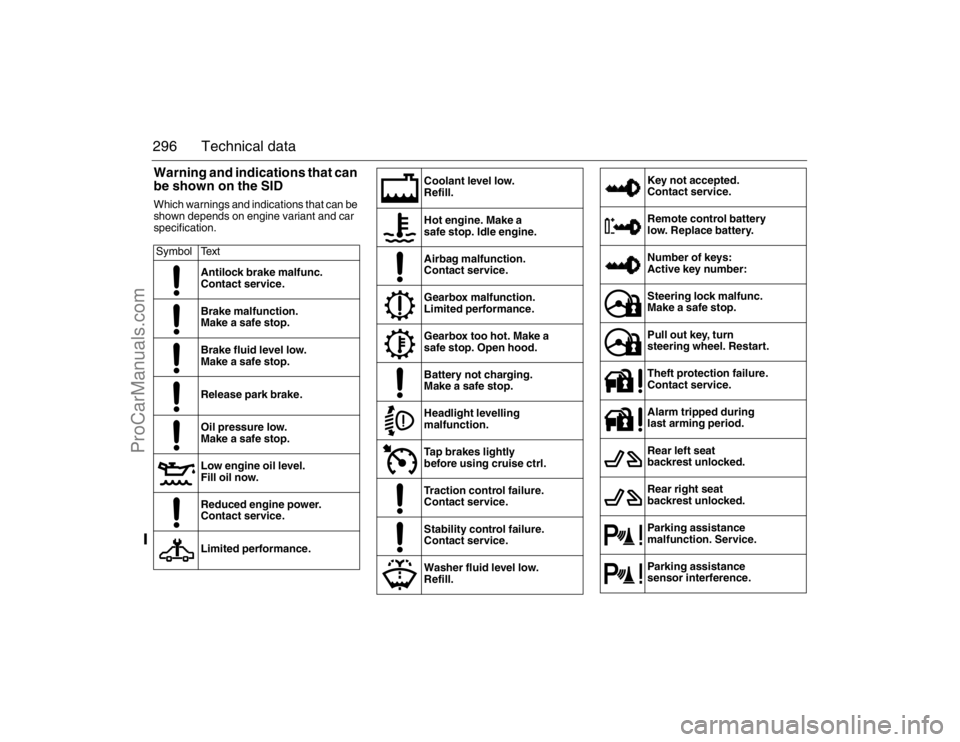
296 Technical dataWarning and indications that can
be shown on the SIDWhich warnings and indications that can be
shown depends on engine variant and car
specification.
Symbol Text
Antilock brake malfunc.
Contact service.
Brake malfunction.
Make a safe stop.
Brake fluid level low.
Make a safe stop.
Release park brake.
Oil pressure low.
Make a safe stop.
Low engine oil level.
Fill oil now.
Reduced engine power.
Contact service.
Limited performance.
Coolant level low.
Refill.
Hot engine. Make a
safe stop. Idle engine.
Airbag malfunction.
Contact service.
Gearbox malfunction.
Limited performance.
Gearbox too hot. Make a
safe stop. Open hood.
Battery not charging.
Make a safe stop.
Headlight levelling
malfunction.
Tap brakes lightly
before using cruise ctrl.
Traction control failure.
Contact service.
Stability control failure.
Contact service.
Washer fluid level low.
Refill.
Key not accepted.
Contact service.
Remote control battery
low. Replace battery.
Number of keys:
Active key number:
Steering lock malfunc.
Make a safe stop.
Pull out key, turn
steering wheel. Restart.
Theft protection failure.
Contact service.
Alarm tripped during
last arming period.
Rear left seat
backrest unlocked.
Rear right seat
backrest unlocked.
Parking assistance
malfunction. Service.
Parking assistance
sensor interference.
93_U S _M 07.book Page 296 W ednesday, April 12, 2006 9:30 AM
ProCarManuals.com
Page 301 of 304

301 Index
Headlight flasher
________________ 100
Headlight levelling ________________ 99
Headlights
______________________ 99
Hood
_________________________ 204
Horn _________________________ 120
Horn button
____________________ 120
IIf a tire goes flat
________________ 250
Ignition switch
__________________ 152
Immobilizer
_____________________ 57
Important considerations for driving
_ 156
Important information, petrol-engined
cars with catalytic converters
_____ 157
Indicator lights
___________________ 84
Inflation, tires __________________ 243
Information about fuel
____________ 161
Instrument illumination, adjusting
___ 100
Interior lighting, Convertible
________ 80
Interior lighting, Sport Sedan and
SportCombi
___________________ 133
Interior rearview mirror
___________ 125
Intermittent malfunctioning, central
locking
_______________________ 52
JJump starting
__________________ 200
KKey
___________________________ 50
Kick-down
_____________________ 166
LLATCH (child safety)
______________ 25
Labeling, tire sidewall ____________ 251
Labels and plates, location
________ 293
Lashing eyes, Sport Sedan ________ 141
Lashing eyes, SportCombi ________ 146
Laying the car up
_______________ 181
Leather upholstery, cleaning
_______ 263
Lighting in luggage compartment,
Convertible
____________________ 81
Limp-home
____________________ 157
Limp-home, automatic transmission
_167
Load carriers, roof
_______________ 194
Load indices, tires _______________ 252
Loading your vehicle _____________ 253
Load-through hatch, Sport Sedan
___ 140
Load-through hatch, SportCombi ___ 145
Locking a car with flat battery
_______ 53
Locks
__________________________ 50
Long-term parking
_______________ 181
Luggage compartment
___________ 138
Luggage compartment lighting,
Convertible
____________________ 81
Luggage compartment lighting,
Sport Sedan ______________ 134
, 142Luggage compartment lighting,
changing
_____________________ 233
MMAXI fuses
____________________ 237
Main instrument panel
_____________ 84
Main/dipped beam
_______________ 100
Maintenance schedule
___________ 274
Manual gear selection ____________ 170
Manual gearbox
_________________ 164
Manual tripping of car alarm
________ 60
Materials used in the car,
reclamation
___________________ 269
Memory, driver’s seat
_____________ 21
Messages on SID, Convertible
______ 73
Milometer
_______________________ 92
Moonroof ______________________ 130
Mug holder ____________________ 134
NNew tires, buying
________________ 246
Night driving
___________________ 197
Number plate lighting, changing
____ 233
OORVR
________________________ 206
Oil capacity, engine
______________ 285
Opening handles
_________________ 50
Opening the soft top, Convertible
____ 66
93_U S _M 07.book Page 301 W ednesday, April 12, 2006 9:30 AM
ProCarManuals.com