ESP SAAB 9-3 2007 Owner's Manual
[x] Cancel search | Manufacturer: SAAB, Model Year: 2007, Model line: 9-3, Model: SAAB 9-3 2007Pages: 304, PDF Size: 26.16 MB
Page 171 of 304
171 Starting and driving
ABS brakesThe Antilock Braking System (ABS) modu-
lates the brake pressure to each wheel. The
pressure is automatically reduced just
before the wheel locks up and then
increases again to the point at which the
wheel is just about to lock. The wheel sen-
sors send information to the brake system’s
electronic control module for every 4 or so
inches (decimetre) that the car rolls. This
information is processed continuously to
ensure that the adjustment of the brake
pressure will be as exact as possible.
Adjustment takes place up to 12 times per
second.The brake system provides Electronic
Brakeforce Distribution (EBD). This distri-
butes the brake pressure between the front
and rear wheels, in such a way as to achieve
optimum braking performance irrespective
of the car’s speed or load.
The ABS has a built-in diagnostics function
which will switch on the ABS warning light
if a fault is detected in the system (see
page 82).
The following message will appear on the
SID (and corresponding symbol on main
instrument unit) if a fault is detected:
WARNING
It is prudent to try your brakes from
time to time, especially when driving in
heavy rain, through water collected on
the road, in snow, on a wet road
surface or in salty slush. In such condi-
tions, the brakes may take longer than
normal to take effect. To rectify this,
touch the brake pedal periodically to
dry the brakes out.
The same applies after the car has
been washed or when the weather is
very humid.
Avoid parking the car with wet brakes.
Before parking, and if the traffic condi-
tions allow, brake quite heavily so that
the brake discs and pads warm up and
dry.
The brakes are power assisted and it
should be kept in mind that the servo
unit only provides the power assis-
tance when the engine is running.
The brake pressure required when the
engine is off, (e.g. when the car is
being towed) is roughly four times the
normal pedal force required. The
pedal also feels hard and unrespon-
sive.
Overheating can cause the brakes to
fade!
WARNING
The additional safety afforded by the
ABS system is not designed to allow
drivers to drive faster but to make
normal driving safer.
To stop as quickly as possible, without
loss of directional stability, whether
the road surface is dry, wet or slippery,
press the brake pedal down hard
without letting up (do not pump the
pedal), declutching simulta-
neously, and steer the car to safety.
Antilock brake malfunc.
Contact service.
93_U S _M 07.book Page 171 W ednesday, April 12, 2006 9:30 AM
ProCarManuals.com
Page 175 of 304
175 Starting and driving
Electronic Stability
Program (ESP
®)3
Anti-skid system
The Electronic Stability Program employs
both the antilock braking system (ABS) and
the traction control system (TCS). It is a
system that helps the driver to stabilize the
car in unusual circumstances that can oth-
erwise be more difficult to handle.
How the ESP
® system works
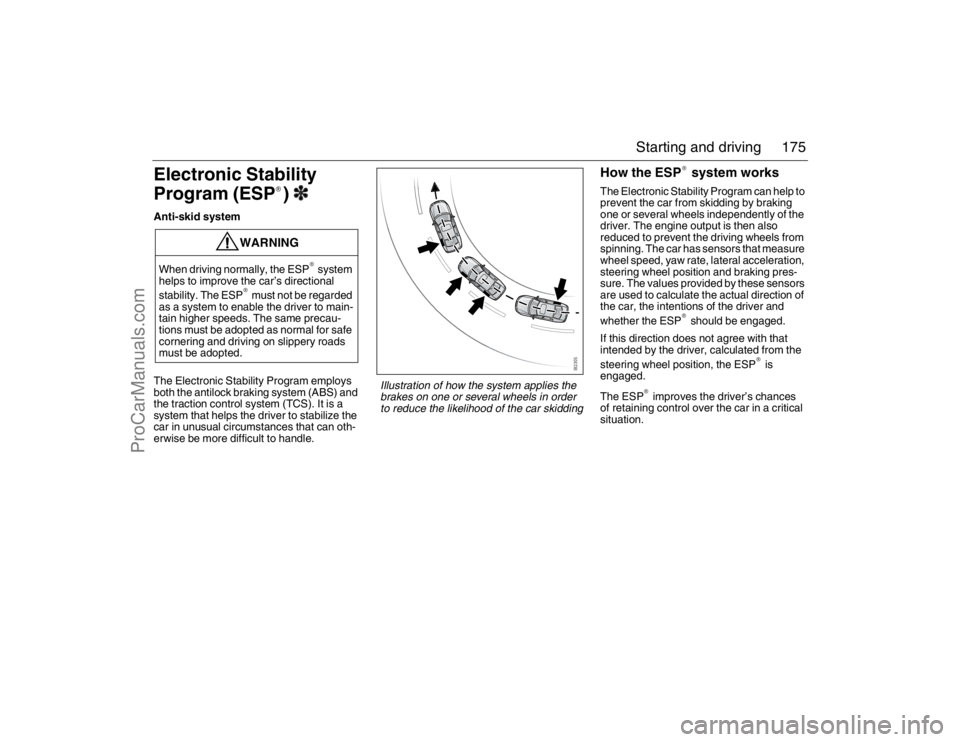
The Electronic Stability Program can help to
prevent the car from skidding by braking
one or several wheels independently of the
driver. The engine output is then also
reduced to prevent the driving wheels from
spinning. The car has sensors that measure
wheel speed, yaw rate, lateral acceleration,
steering wheel position and braking pres-
sure. The values provided by these sensors
are used to calculate the actual direction of
the car, the intentions of the driver and
whether the ESP
® should be engaged.
If this direction does not agree with that
intended by the driver, calculated from the
steering wheel position, the ESP
® is
engaged.
The ESP
® improves the driver’s chances
of retaining control over the car in a critical
situation.
WARNING
When driving normally, the ESP
® system
helps to improve the car’s directional
stability. The ESP
® must not be regarded
as a system to enable the driver to main-
tain higher speeds. The same precau-
tions must be adopted as normal for safe
cornering and driving on slippery roads
must be adopted.
Illustration of how the system applies the
brakes on one or several wheels in order
to reduce the likelihood of the car skidding
93_U S _M 07.book Page 175 W ednesday, April 12, 2006 9:30 AM
ProCarManuals.com
Page 176 of 304
176 Starting and drivingESP
® OFF
lights up if:
a fault has been detected and the system
has therefore been switched off
the system has been switched off
manually
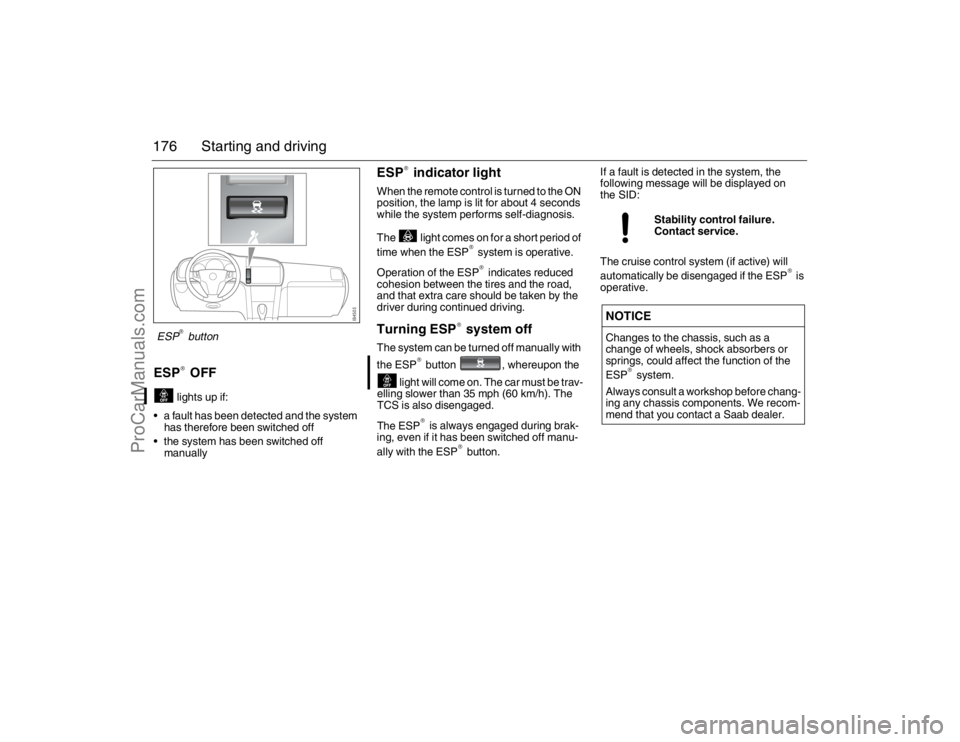
ESP
® indicator light
When the remote control is turned to the ON
position, the lamp is lit for about 4 seconds
while the system performs self-diagnosis.
The light comes on for a short period of
time when the ESP
® system is operative.
Operation of the ESP® indicates reduced
cohesion between the tires and the road,
and that extra care should be taken by the
driver during continued driving.
Turning ESP
® system off
The system can be turned off manually with
the ESP
® button , whereupon the
light will come on. The car must be trav-
elling slower than 35 mph (60 km/h). The
TCS is also disengaged.
The ESP® is always engaged during brak-
ing, even if it has been switched off manu-
ally with the ESP
® button.If a fault is detected in the system, the
following message will be displayed on
the SID:
The cruise control system (if active) will
automatically be disengaged if the ESP
® is
operative.
Stability control failure.
Contact service.
NOTICEChanges to the chassis, such as a
change of wheels, shock absorbers or
springs, could affect the function of the
ESP
® system.
Always consult a workshop before chang-
ing any chassis components. We recom-
mend that you contact a Saab dealer.
ESP
® button
93_U S _M 07.book Page 176 W ednesday, April 12, 2006 9:30 AM
ProCarManuals.com
Page 177 of 304
177 Starting and driving
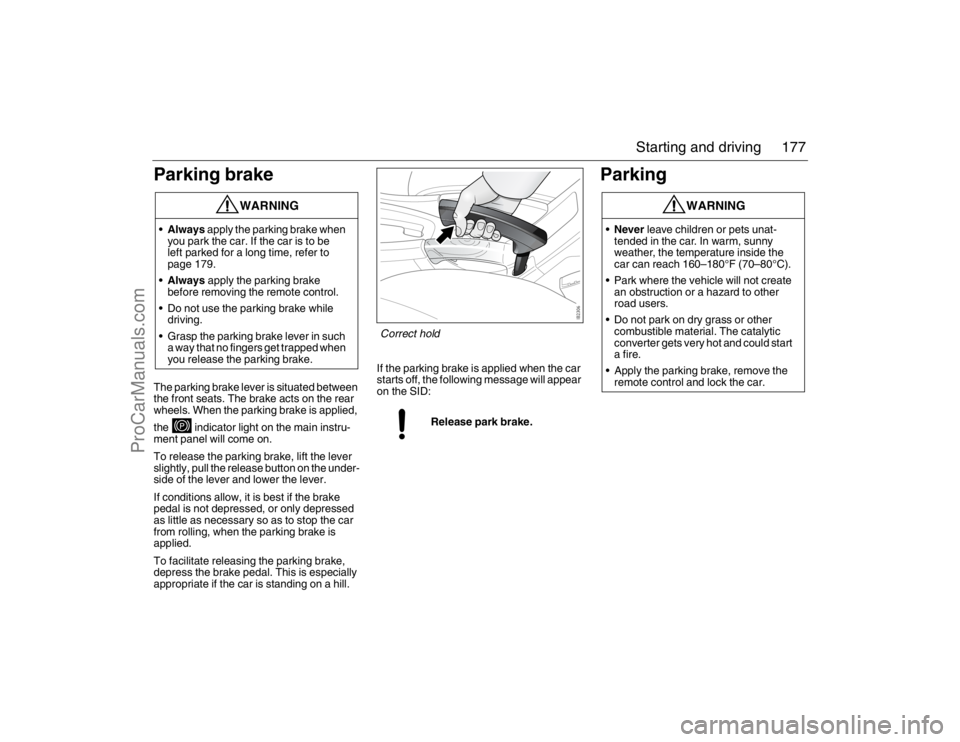
Parking brakeThe parking brake lever is situated between
the front seats. The brake acts on the rear
wheels. When the parking brake is applied,
the indicator light on the main instru-
ment panel will come on.
To release the parking brake, lift the lever
slightly, pull the release button on the under-
side of the lever and lower the lever.
If conditions allow, it is best if the brake
pedal is not depressed, or only depressed
as little as necessary so as to stop the car
from rolling, when the parking brake is
applied.
To facilitate releasing the parking brake,
depress the brake pedal. This is especially
appropriate if the car is standing on a hill.If the parking brake is applied when the car
starts off, the following message will appear
on the SID:
Parking
WARNING
Always apply the parking brake when
you park the car. If the car is to be
left parked for a long time, refer to
page 179.
Always apply the parking brake
before removing the remote control.
Do not use the parking brake while
driving.
Grasp the parking brake lever in such
a way that no fingers get trapped when
you release the parking brake.
Release park brake.
WARNING
Never leave children or pets unat-
tended in the car. In warm, sunny
weather, the temperature inside the
car can reach 160–180°F (70–80°C).
Park where the vehicle will not create
an obstruction or a hazard to other
road users.
Do not park on dry grass or other
combustible material. The catalytic
converter gets very hot and could start
a fire.
Apply the parking brake, remove the
remote control and lock the car.
Correct hold
93_U S _M 07.book Page 177 W ednesday, April 12, 2006 9:30 AM
ProCarManuals.com
Page 180 of 304
180 Starting and drivingSaab Parking
Assistance3Saab Parking Assistance
Saab Parking Assistance facilitates parking
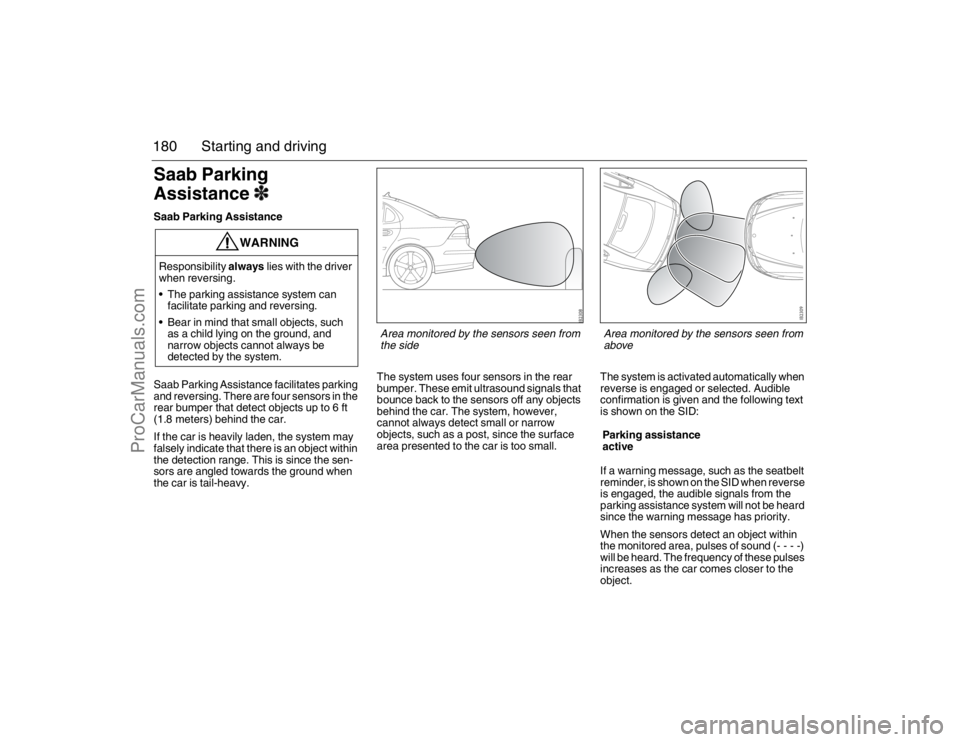
and reversing. There are four sensors in the
rear bumper that detect objects up to 6 ft
(1.8 meters) behind the car.
If the car is heavily laden, the system may
falsely indicate that there is an object within
the detection range. This is since the sen-
sors are angled towards the ground when
the car is tail-heavy.The system uses four sensors in the rear
bumper. These emit ultrasound signals that
bounce back to the sensors off any objects
behind the car. The system, however,
cannot always detect small or narrow
objects, such as a post, since the surface
area presented to the car is too small.The system is activated automatically when
reverse is engaged or selected. Audible
confirmation is given and the following text
is shown on the SID:
If a warning message, such as the seatbelt
reminder, is shown on the SID when reverse
is engaged, the audible signals from the
parking assistance system will not be heard
since the warning message has priority.
When the sensors detect an object within
the monitored area, pulses of sound (- - - -)
will be heard. The frequency of these pulses
increases as the car comes closer to the
object.
WARNING
Responsibility always lies with the driver
when reversing.
The parking assistance system can
facilitate parking and reversing.
Bear in mind that small objects, such
as a child lying on the ground, and
narrow objects cannot always be
detected by the system.
Parking assistance
active
Area monitored by the sensors seen from
the side
Area monitored by the sensors seen from
above
93_U S _M 07.book Page 180 W ednesday, April 12, 2006 9:30 AM
ProCarManuals.com
Page 186 of 304

186 Starting and drivingRemember that tires age: it may therefore
be necessary to change winter tires before
they reach the legal wear limit, as they grad-
ually lose their friction properties with age.
If you get into a front wheel skid and the car
has a manual transmission, the best
response is to freewheel, which means
declutching so that the wheels neither drive
nor brake, and to cautiously steer in the
desired direction.
If the car has automatic transmission, ease
off the accelerator slightly and steer cau-
tiously in the desired direction.
If you get into a rear wheel skid, steer in the
same direction as the movement of the rear
of the car.
Driving with tire chains3Snow chains must only be fitted to the wheel
and tire dimensions that Saab recommends
in "Technical data" on page 279.
We recommend that you contact a Saab
dealer regarding approved tire chains. See
also page 248.
WARNING
Do not drive at speeds above 30 mph
(50 km/h) when tire chains are fitted.
Tire chains can reduce directional
stability.
Do not fit tire chains to the car’s rear
wheels.
NOTICE Check the links frequently for wear.
Check that the chains do not foul the
wheel arch liner at full lock.
Refer to the "Technical data" section
on page 279, for information on wheel
and tire dimensions approved for the
fitting of tire chains.
93_U S _M 07.book Page 186 W ednesday, April 12, 2006 9:30 AM
ProCarManuals.com
Page 190 of 304
190 Starting and drivingWhen continuing your journey, manually
select a low gear in which the engine speed
is about 3,500 rpm until the incline eases
(see page 168).
Recommendations for cars with
manual transmissionRises in coolant temperature are indicated
by the temperature gauge in the main instru-
ment panel.
When the needle is just outside the red
zone, the A/C compressor will be switched
off and, on certain engine variants, the max-
imum engine torque will be limited.
When continuing your journey, select a low
gear in which the engine speed is about
3,500 rpm until the incline eases.
Trailer hitch loadThe weight distribution on the trailer makes
a lot of difference to the handling properties
of the car and trailer combination. With a
two-wheel trailer, concentrate the load over
the wheels and keep it as low as possible.
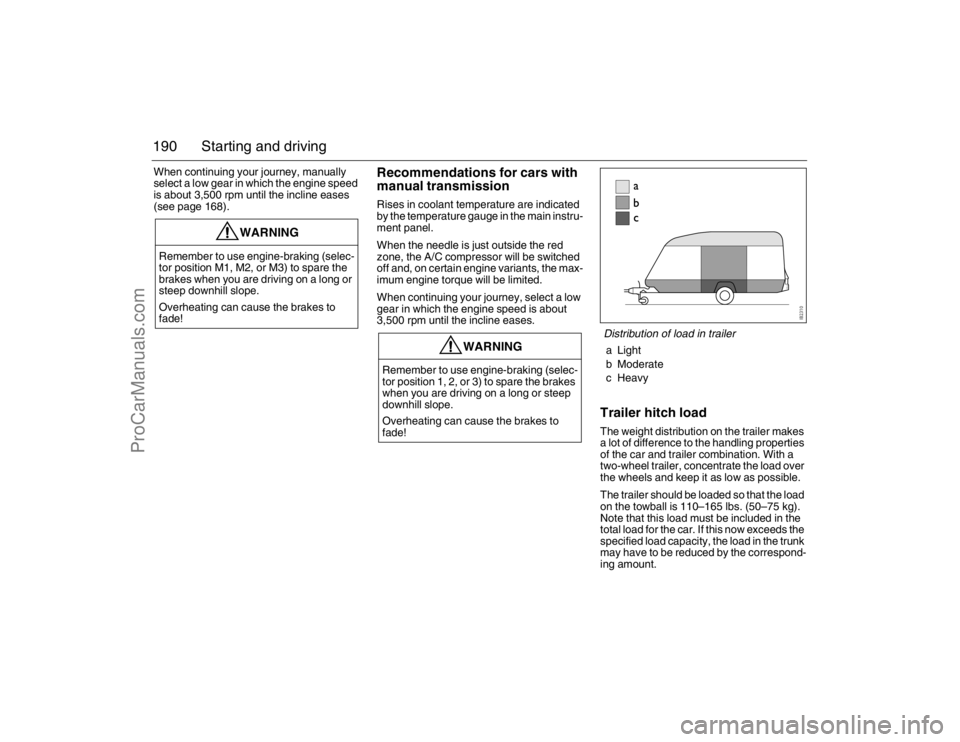
The trailer should be loaded so that the load
on the towball is 110–165 lbs. (50–75 kg).
Note that this load must be included in the
total load for the car. If this now exceeds the
specified load capacity, the load in the trunk
may have to be reduced by the correspond-
ing amount.
WARNING
Remember to use engine-braking (selec-
tor position M1, M2, or M3) to spare the
brakes when you are driving on a long or
steep downhill slope.
Overheating can cause the brakes to
fade!
WARNING
Remember to use engine-braking (selec-
tor position 1, 2, or 3) to spare the brakes
when you are driving on a long or steep
downhill slope.
Overheating can cause the brakes to
fade!
Distribution of load in trailera Light
b Moderate
cHeavy
93_U S _M 07.book Page 190 W ednesday, April 12, 2006 9:30 AM
ProCarManuals.com
Page 193 of 304
193 Starting and driving
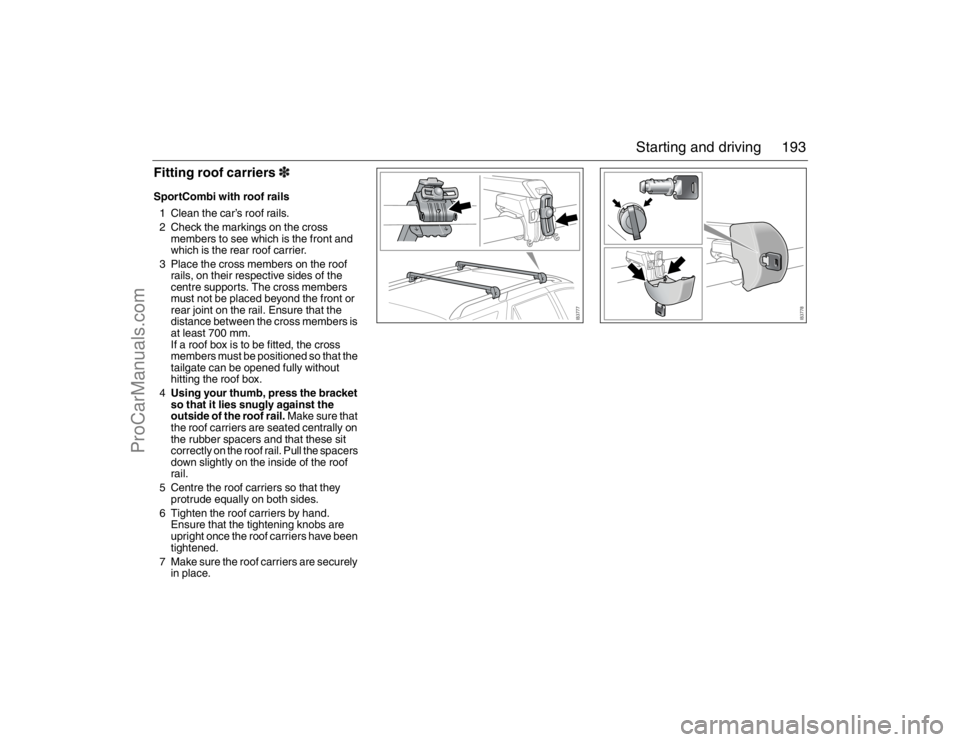
Fitting roof carriers3SportCombi with roof rails
1 Clean the car’s roof rails.
2 Check the markings on the cross
members to see which is the front and
which is the rear roof carrier.
3 Place the cross members on the roof
rails, on their respective sides of the
centre supports. The cross members
must not be placed beyond the front or
rear joint on the rail. Ensure that the
distance between the cross members is
at least 700 mm.
If a roof box is to be fitted, the cross
members must be positioned so that the
tailgate can be opened fully without
hitting the roof box.
4Using your thumb, press the bracket
so that it lies snugly against the
outside of the roof rail. M a k e s u r e t h a t
the roof carriers are seated centrally on
the rubber spacers and that these sit
correctly on the roof rail. Pull the spacers
down slightly on the inside of the roof
rail.
5 Centre the roof carriers so that they
protrude equally on both sides.
6 Tighten the roof carriers by hand.
Ensure that the tightening knobs are
upright once the roof carriers have been
tightened.
7 Make sure the roof carriers are securely
in place.93_U S _M 07.book Page 193 W ednesday, April 12, 2006 9:30 AM
ProCarManuals.com
Page 195 of 304
195 Starting and driving
Driving at nightBear in mind the following points, especially
when driving at night:
Nighttime driving requires your full
concentration
Do not rush. Count on your journey taking
slightly longer.
The number of drivers under the influence
of drugs is likely to be greater at night than
during the day.
Do not stare at the headlights of oncom-
ing vehicles.
Avoid driving at night if you have poor
eyesight. Night vision deteriorates with
age.
Keep your car’s headlights, windows and
mirrors clean. Also, if you wear glasses,
make sure they are clean.
Make sure you are well rested before
starting a long journey. Take a break
every other hour.
Only eat light meals. Heavy meals have a
tendency to induce tiredness.
Wild animals prefer to move at dusk and
dawn.
Check the headlight levelling setting (see
page 97).
Towing the car
Front towing eye
WARNING
Remember that the brake servo does
not operate when the engine is off.
Much greater pressure than normal
will therefore be required to operate
the brake pedal.
Nor does the steering servo operate
when the engine is off. The steering
will therefore be much heavier than
usual.
The towing vehicle should always be
heavier than the vehicle on tow.
Never allow passengers to ride in the
car when it is on tow.
Always seek professional help if the
car needs to be recovered.
The ignition switch must be in the ON
position if the car is moved with the
engine not running.
The steering wheel lock must be
disengaged before towing the car.
The steering wheel lock disengages
when the remote control is inserted
into the ignition switch, if the battery
has sufficient charge.
WARNING
Make sure that the towing eye is
screwed in tightly. It has a left-hand
thread!
The towing eye is only designed for
towing the car on roads. It must not
be used to pull the car out of a ditch,
for example.
Make sure that all bystanders keep a
suitable distance, in case the towing
eye or tow rope should snap. The
towing eye or tow rope could catapult
off and cause seriously injury.
Never drive with the towing eye fitted
to the front bumper. Return it to its
designated storage space.
93_U S _M 07.book Page 195 W ednesday, April 12, 2006 9:30 AM
ProCarManuals.com
Page 211 of 304
211 Car care
Brake/clutch fluid and
brake padsCheckingBrake fluid should be changed according to
the service program. Refer to the Warranty
and Service Book.
The brake and clutch fluid reservoir is trans-
parent to facilitate checking of the fluid level.
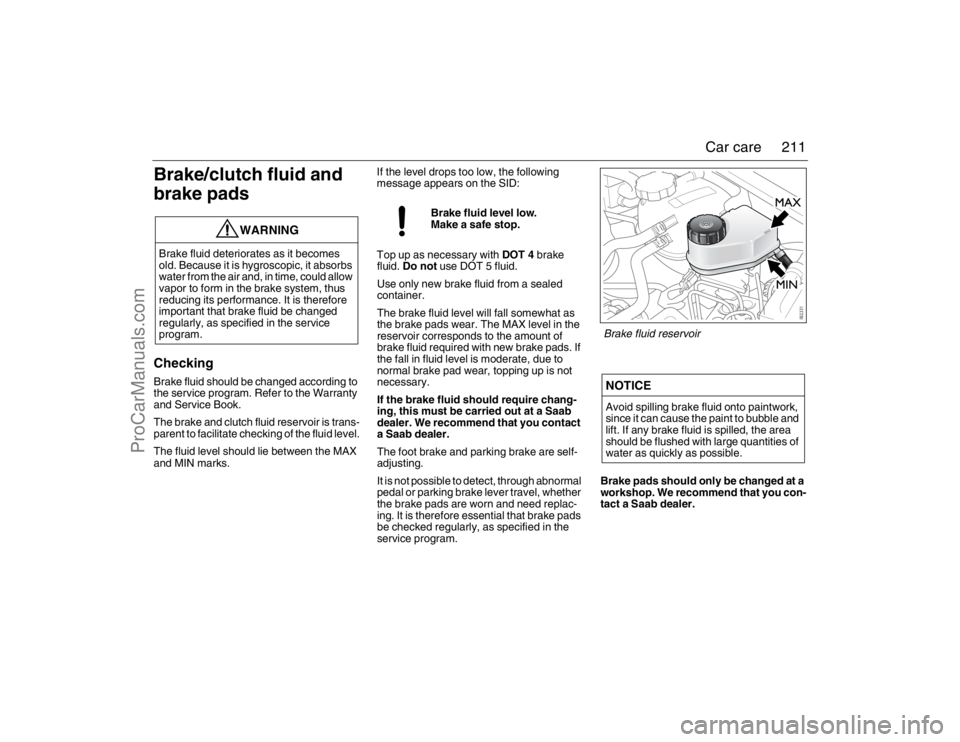
The fluid level should lie between the MAX
and MIN marks.If the level drops too low, the following
message appears on the SID:
Top up as necessary with DOT 4 brake
fluid. Do not use DOT 5 fluid.
Use only new brake fluid from a sealed
container.
The brake fluid level will fall somewhat as
the brake pads wear. The MAX level in the
reservoir corresponds to the amount of
brake fluid required with new brake pads. If
the fall in fluid level is moderate, due to
normal brake pad wear, topping up is not
necessary.
If the brake fluid should require chang-
ing, this must be carried out at a Saab
dealer. We recommend that you contact
a Saab dealer.
The foot brake and parking brake are self-
adjusting.
It is not possible to detect, through abnormal
pedal or parking brake lever travel, whether
the brake pads are worn and need replac-
ing. It is therefore essential that brake pads
be checked regularly, as specified in the
service program.Brake pads should only be changed at a
workshop. We recommend that you con-
tact a Saab dealer.
WARNING
Brake fluid deteriorates as it becomes
old. Because it is hygroscopic, it absorbs
water from the air and, in time, could allow
vapor to form in the brake system, thus
reducing its performance. It is therefore
important that brake fluid be changed
regularly, as specified in the service
program.
Brake fluid level low.
Make a safe stop.
NOTICEAvoid spilling brake fluid onto paintwork,
since it can cause the paint to bubble and
lift. If any brake fluid is spilled, the area
should be flushed with large quantities of
water as quickly as possible.Brake fluid reservoir
93_U S _M 07.book Page 211 W ednesday, April 12, 2006 9:30 AM
ProCarManuals.com