child seat SAAB 9-3 2007 Owner's Manual
[x] Cancel search | Manufacturer: SAAB, Model Year: 2007, Model line: 9-3, Model: SAAB 9-3 2007Pages: 304, PDF Size: 26.16 MB
Page 46 of 304

46 Safetylow impact speed, the airbag will not neces-
sarily be triggered. How loud is the inflation? The noise of the inflation is certainly loud,
but it is of an very short duration and will not
damage your hearing. For a short time after-
wards you could experience a buzzing
noise in your ears.
Most people who have experienced it
cannot remember the noise of the inflation
at all – all they remember is the noise of the
crash. Can you still use a child seat in the front if a
passenger airbag is installed? Definitely not!
Children 12 and under or shorter than
55 inches (140 cm) can be killed by the air-
bag.
The back seat is the safest place for chil-
dren.
Never put a rear-facing child seat in the
front.
Sit as far back as possible from the airbag.
Always use seat belts and child restraints.
What should I do if the AIR-BAG warning
light comes on? If the warning light is on, it means that a fault
has been detected in the system. The
airbag cannot be relied on to operate as
intended and it might even be activated
erroneously. You should therefore take the
car to a workshop. We recommend that you
contact a Saab dealer as soon as possible.Are the dust and fumes given off when the
airbag operates at all harmful? Most people who have remained in a car
with little or no ventilation for several min-
utes complained only of minor irritation of
the throat and eyes. Avoid as much as pos-
sible getting dust on your skin as there is a
risk of skin irritation.
If you suffer from asthma, the incident may
bring on an attack, in which case you should
follow the normal procedure advised by
your doctor. It is advisable to consult a
doctor afterwards.
Adding Equipment to Your
Airbag-Equipped VehicleIs there anything I might add to the front or
sides of the vehicle that could keep the air-
bags from working properly?Yes. If you add things that change your vehi-
cle’s frame, bumper system, front end or
side sheet metal or height, they may keep
the airbag system from working properly.
Also, the airbag system may not work prop-
erly if you relocate any of the airbag sen-
sors. If you have any questions about this,
you should contact Saab Customer Assis-
tance before you modify your vehicle. The
phone numbers and addresses for Cus-
tomer Assistance can be found on page
276.Because I have a disability, I have to get my
vehicle modified. How can I find out whether
this will affect my advanced airbag system?Changing or moving any parts of the front
seats, safety belts, the airbag sensing and
diagnostic module or the inside rearview
mirror can affect the operation of the
advanced airbag system. If you have ques-
tions, call Customer Assistance. The phone
numbers and addresses for Customer
Assistance can be found on page 276.
93_U S _M 07.book Page 46 W ednesday, April 12, 2006 9:30 AM
ProCarManuals.com
Page 52 of 304
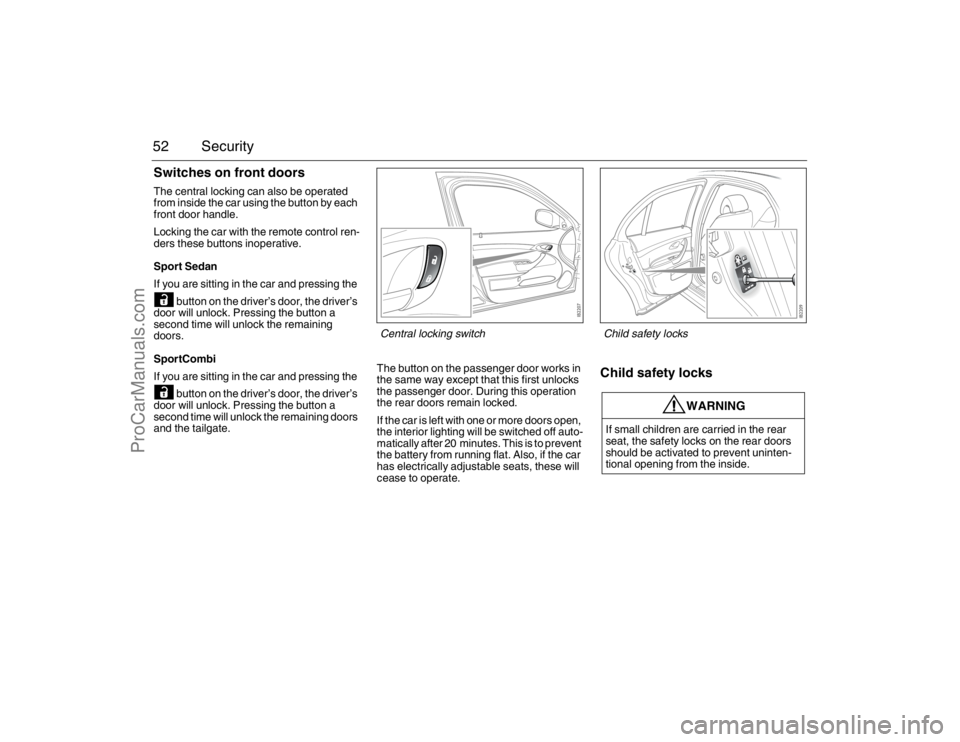
52 SecuritySwitches on front doorsThe central locking can also be operated
from inside the car using the button by each
front door handle.
Locking the car with the remote control ren-
ders these buttons inoperative.
Sport Sedan
If you are sitting in the car and pressing the
button on the driver’s door, the driver’s
door will unlock. Pressing the button a
second time will unlock the remaining
doors.
SportCombi
If you are sitting in the car and pressing the
button on the driver’s door, the driver’s
door will unlock. Pressing the button a
second time will unlock the remaining doors
and the tailgate.The button on the passenger door works in
the same way except that this first unlocks
the passenger door. During this operation
the rear doors remain locked.
If the car is left with one or more doors open,
the interior lighting will be switched off auto-
matically after 20 minutes. This is to prevent
the battery from running flat. Also, if the car
has electrically adjustable seats, these will
cease to operate.
Child safety locks
WARNING
If small children are carried in the rear
seat, the safety locks on the rear doors
should be activated to prevent uninten-
tional opening from the inside.
Central locking switch
Child safety locks
93_U S _M 07.book Page 52 W ednesday, April 12, 2006 9:30 AM
ProCarManuals.com
Page 73 of 304
73 9-3 Convertible
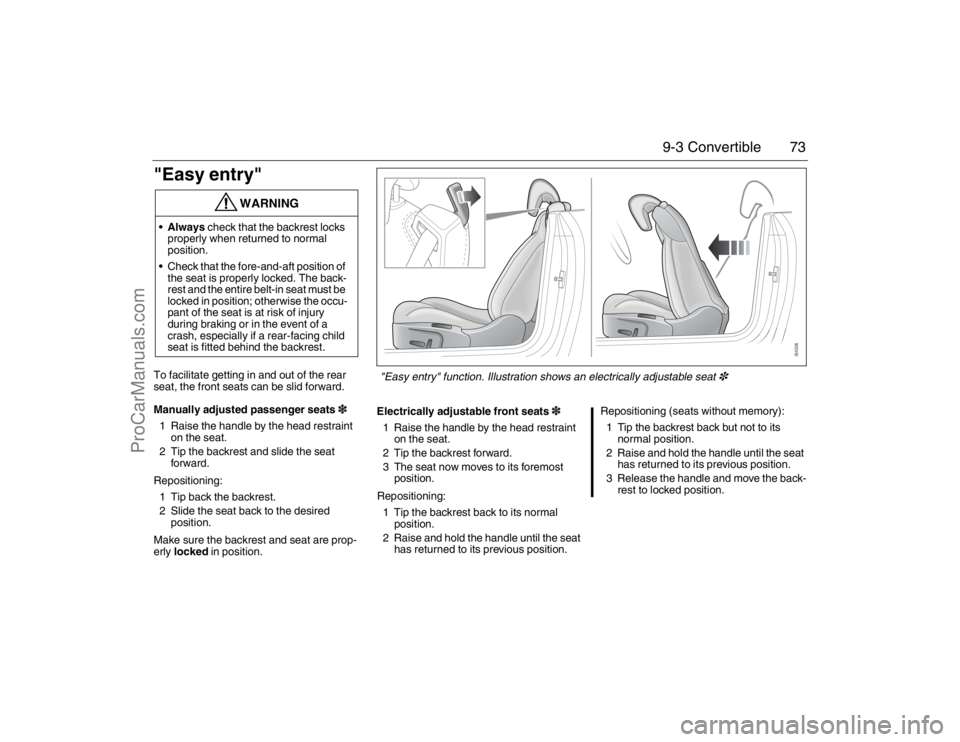
"Easy entry"To facilitate getting in and out of the rear
seat, the front seats can be slid forward.
Manually adjusted passenger seats3
1 Raise the handle by the head restraint
on the seat.
2 Tip the backrest and slide the seat
forward.
Repositioning:
1 Tip back the backrest.
2 Slide the seat back to the desired
position.
Make sure the backrest and seat are prop-
erly locked in position.Electrically adjustable front seats3
1 Raise the handle by the head restraint
on the seat.
2 Tip the backrest forward.
3 The seat now moves to its foremost
position.
Repositioning:
1 Tip the backrest back to its normal
position.
2 Raise and hold the handle until the seat
has returned to its previous position.Repositioning (seats without memory):
1 Tip the backrest back but not to its
normal position.
2 Raise and hold the handle until the seat
has returned to its previous position.
3 Release the handle and move the back-
rest to locked position.
WARNING
Always check that the backrest locks
properly when returned to normal
position.
Check that the fore-and-aft position of
the seat is properly locked. The back-
rest and the entire belt-in seat must be
locked in position; otherwise the occu-
pant of the seat is at risk of injury
during braking or in the event of a
crash, especially if a rear-facing child
seat is fitted behind the backrest.
"Easy entry" function. Illustration shows an electrically adjustable seat
3
93_U S _M 07.book Page 73 W ednesday, April 12, 2006 9:30 AM
ProCarManuals.com
Page 136 of 304
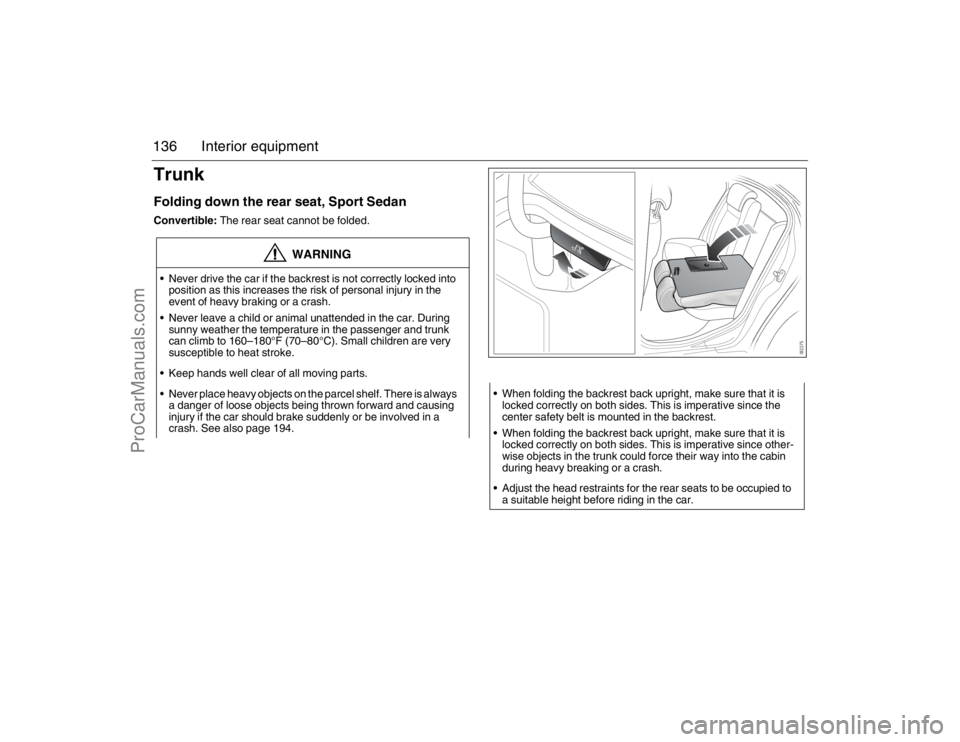
136 Interior equipmentTrunkFolding down the rear seat, Sport SedanConvertible: The rear seat cannot be folded.
WARNING
Never drive the car if the backrest is not correctly locked into
position as this increases the risk of personal injury in the
event of heavy braking or a crash.
Never leave a child or animal unattended in the car. During
sunny weather the temperature in the passenger and trunk
can climb to 160–180°F (70–80°C). Small children are very
susceptible to heat stroke.
Keep hands well clear of all moving parts.
Never place heavy objects on the parcel shelf. There is always
a danger of loose objects being thrown forward and causing
injury if the car should brake suddenly or be involved in a
crash. See also page 194.
When folding the backrest back upright, make sure that it is
locked correctly on both sides. This is imperative since the
center safety belt is mounted in the backrest.
When folding the backrest back upright, make sure that it is
locked correctly on both sides. This is imperative since other-
wise objects in the trunk could force their way into the cabin
during heavy breaking or a crash.
Adjust the head restraints for the rear seats to be occupied to
a suitable height before riding in the car.
93_U S _M 07.book Page 136 W ednesday, April 12, 2006 9:30 AM
ProCarManuals.com
Page 141 of 304
141 Interior equipment
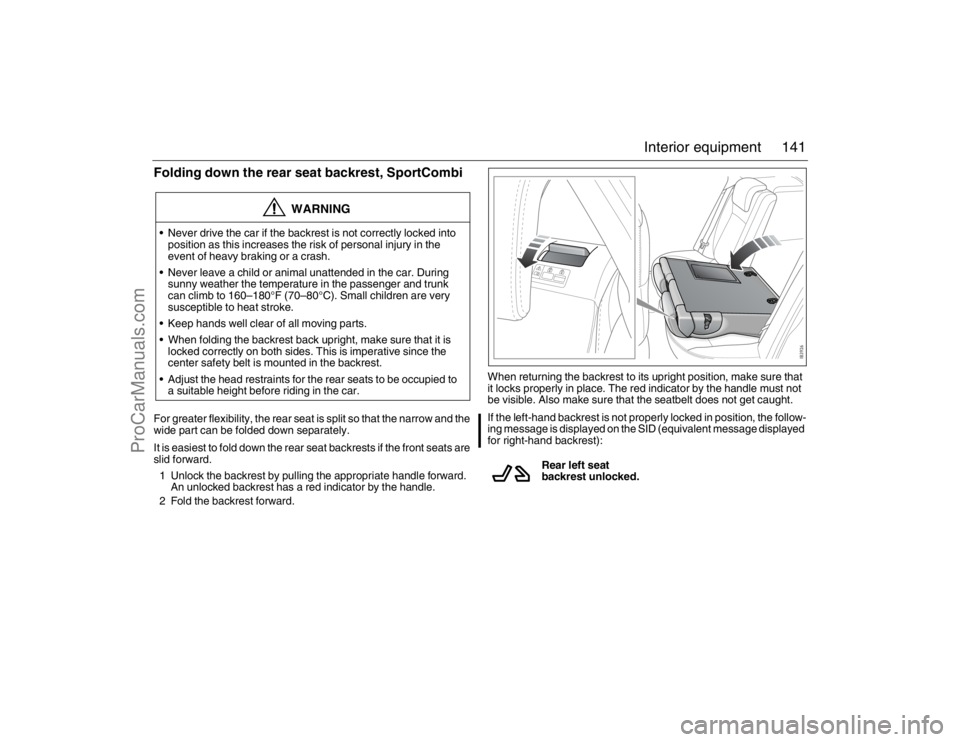
Folding down the rear seat backrest, SportCombiFor greater flexibility, the rear seat is split so that the narrow and the
wide part can be folded down separately.
It is easiest to fold down the rear seat backrests if the front seats are
slid forward.
1 Unlock the backrest by pulling the appropriate handle forward.
An unlocked backrest has a red indicator by the handle.
2 Fold the backrest forward.When returning the backrest to its upright position, make sure that
it locks properly in place. The red indicator by the handle must not
be visible. Also make sure that the seatbelt does not get caught.
If the left-hand backrest is not properly locked in position, the follow-
ing message is displayed on the SID (equivalent message displayed
for right-hand backrest):
WARNING
Never drive the car if the backrest is not correctly locked into
position as this increases the risk of personal injury in the
event of heavy braking or a crash.
Never leave a child or animal unattended in the car. During
sunny weather the temperature in the passenger and trunk
can climb to 160–180°F (70–80°C). Small children are very
susceptible to heat stroke.
Keep hands well clear of all moving parts.
When folding the backrest back upright, make sure that it is
locked correctly on both sides. This is imperative since the
center safety belt is mounted in the backrest.
Adjust the head restraints for the rear seats to be occupied to
a suitable height before riding in the car.
Rear left seat
backrest unlocked.
93_U S _M 07.book Page 141 W ednesday, April 12, 2006 9:30 AM
ProCarManuals.com
Page 150 of 304
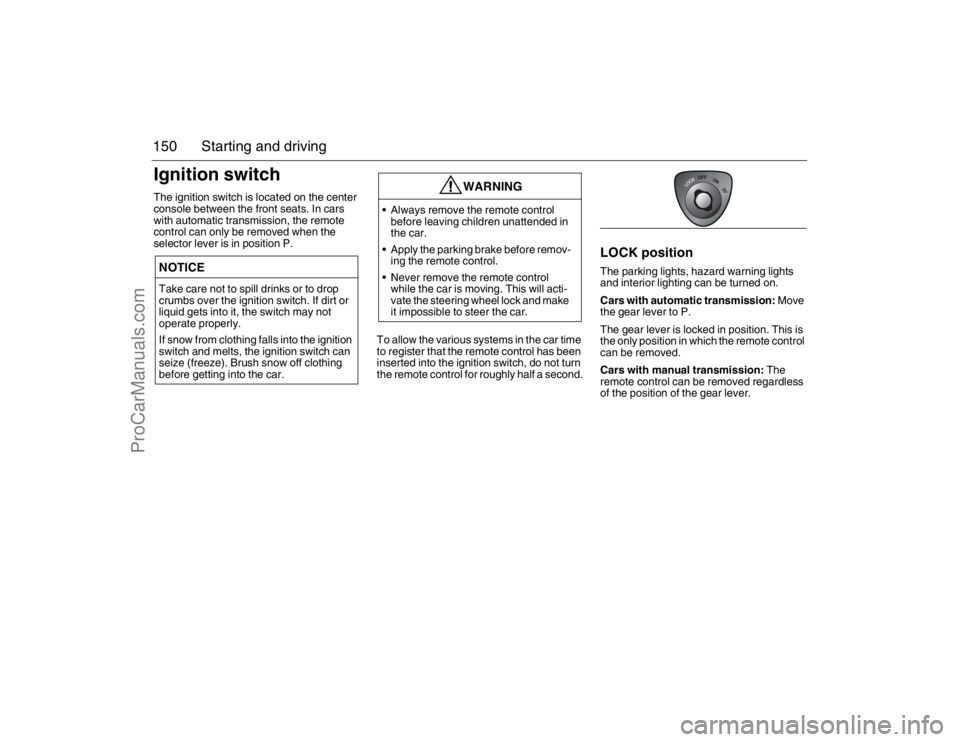
150 Starting and drivingIgnition switchThe ignition switch is located on the center
console between the front seats. In cars
with automatic transmission, the remote
control can only be removed when the
selector lever is in position P.
To allow the various systems in the car time
to register that the remote control has been
inserted into the ignition switch, do not turn
the remote control for roughly half a second.
LOCK positionThe parking lights, hazard warning lights
and interior lighting can be turned on.
Cars with automatic transmission: Move
the gear lever to P.
The gear lever is locked in position. This is
the only position in which the remote control
can be removed.
Cars with manual transmission: The
remote control can be removed regardless
of the position of the gear lever.
NOTICETake care not to spill drinks or to drop
crumbs over the ignition switch. If dirt or
liquid gets into it, the switch may not
operate properly.
If snow from clothing falls into the ignition
switch and melts, the ignition switch can
seize (freeze). Brush snow off clothing
before getting into the car.
WARNING
Always remove the remote control
before leaving children unattended in
the car.
Apply the parking brake before remov-
ing the remote control.
Never remove the remote control
while the car is moving. This will acti-
vate the steering wheel lock and make
it impossible to steer the car.
93_U S _M 07.book Page 150 W ednesday, April 12, 2006 9:30 AM
ProCarManuals.com
Page 177 of 304
177 Starting and driving
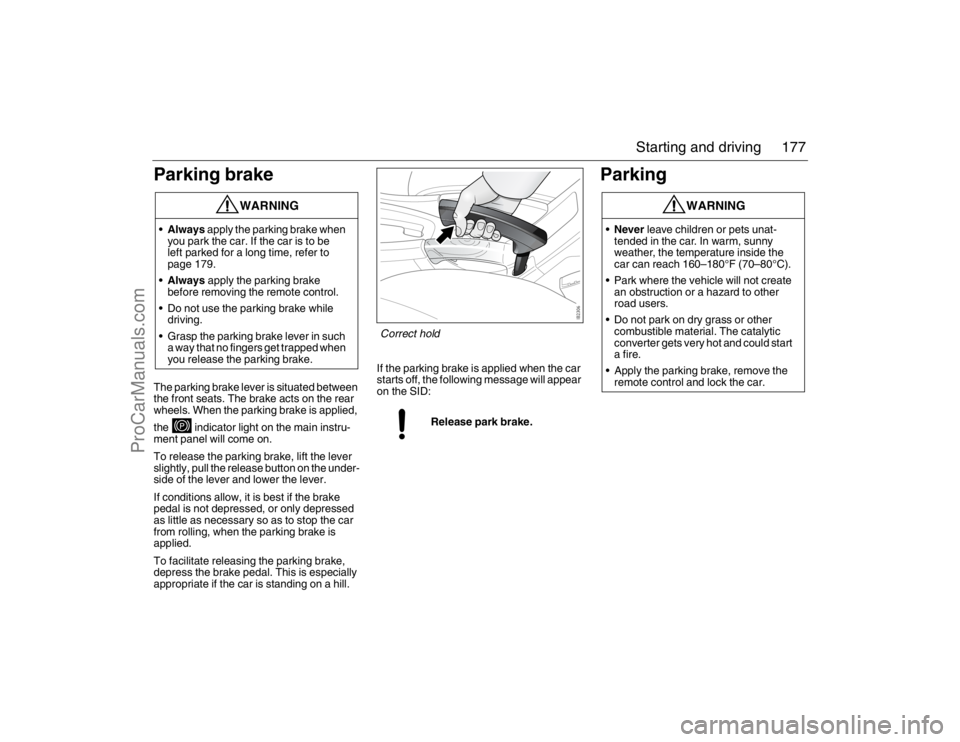
Parking brakeThe parking brake lever is situated between
the front seats. The brake acts on the rear
wheels. When the parking brake is applied,
the indicator light on the main instru-
ment panel will come on.
To release the parking brake, lift the lever
slightly, pull the release button on the under-
side of the lever and lower the lever.
If conditions allow, it is best if the brake
pedal is not depressed, or only depressed
as little as necessary so as to stop the car
from rolling, when the parking brake is
applied.
To facilitate releasing the parking brake,
depress the brake pedal. This is especially
appropriate if the car is standing on a hill.If the parking brake is applied when the car
starts off, the following message will appear
on the SID:
Parking
WARNING
Always apply the parking brake when
you park the car. If the car is to be
left parked for a long time, refer to
page 179.
Always apply the parking brake
before removing the remote control.
Do not use the parking brake while
driving.
Grasp the parking brake lever in such
a way that no fingers get trapped when
you release the parking brake.
Release park brake.
WARNING
Never leave children or pets unat-
tended in the car. In warm, sunny
weather, the temperature inside the
car can reach 160–180°F (70–80°C).
Park where the vehicle will not create
an obstruction or a hazard to other
road users.
Do not park on dry grass or other
combustible material. The catalytic
converter gets very hot and could start
a fire.
Apply the parking brake, remove the
remote control and lock the car.
Correct hold
93_U S _M 07.book Page 177 W ednesday, April 12, 2006 9:30 AM
ProCarManuals.com
Page 180 of 304
180 Starting and drivingSaab Parking
Assistance3Saab Parking Assistance
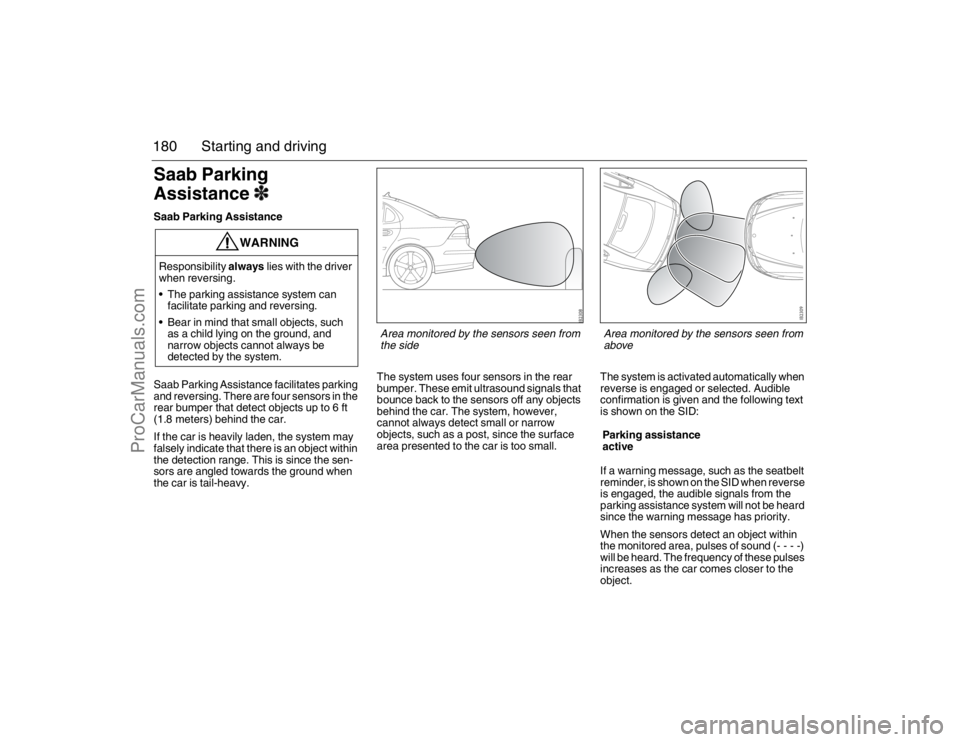
Saab Parking Assistance facilitates parking
and reversing. There are four sensors in the
rear bumper that detect objects up to 6 ft
(1.8 meters) behind the car.
If the car is heavily laden, the system may
falsely indicate that there is an object within
the detection range. This is since the sen-
sors are angled towards the ground when
the car is tail-heavy.The system uses four sensors in the rear
bumper. These emit ultrasound signals that
bounce back to the sensors off any objects
behind the car. The system, however,
cannot always detect small or narrow
objects, such as a post, since the surface
area presented to the car is too small.The system is activated automatically when
reverse is engaged or selected. Audible
confirmation is given and the following text
is shown on the SID:
If a warning message, such as the seatbelt
reminder, is shown on the SID when reverse
is engaged, the audible signals from the
parking assistance system will not be heard
since the warning message has priority.
When the sensors detect an object within
the monitored area, pulses of sound (- - - -)
will be heard. The frequency of these pulses
increases as the car comes closer to the
object.
WARNING
Responsibility always lies with the driver
when reversing.
The parking assistance system can
facilitate parking and reversing.
Bear in mind that small objects, such
as a child lying on the ground, and
narrow objects cannot always be
detected by the system.
Parking assistance
active
Area monitored by the sensors seen from
the side
Area monitored by the sensors seen from
above
93_U S _M 07.book Page 180 W ednesday, April 12, 2006 9:30 AM
ProCarManuals.com
Page 299 of 304

299 Index
Index
AABS brakes
____________________ 173
ACC
_________________________ 107
Adjustment, steering wheel
________ 120
Air filter
_______________________ 211
Airbag
_________________________ 32
Anchorage eyes, Sport Sedan
_____ 141
Anti-corrosion treatment
__________ 267
Antilock braking system __________ 173
Anti-spin
______________________ 175
Ashtrays ______________________ 136
Autochecking of lights, warning and
indicator lights
__________________ 89
Autodimming
_______________ 125
, 126
Automatic climate control (ACC)
____ 107
Automatic closing of moonroof
_____ 131
Automatic closing of windows,
Sport Sedan and SportCombi _____ 122
Automatic transmission
___________ 165
BBattery
_______________________ 215
Bedding-in of new brake pads
_____ 163
Before towing a trailer
____________ 193
Belt height, Sport Sedan and
SportCombi
____________________ 14
Brake fluid, grade
_______________ 289Brakes
________________________ 172
Braking _______________________ 172
Bulb changing
__________________ 221
Bulb table
_____________________ 235
Buying new tires
________________ 246
CCabin lighting, Convertible
_________ 80
Cabin lighting, Sport Sedan and
SportCombi
___________________ 133
Calibrating front electric windows
with pinch protection
_____________ 80
Calibration of windows, Sport Sedan
and SportCombi
_______________ 123
Car alarm
______________________ 58
Car transport ___________________ 199
Care of air conditioning
___________ 270
Cargo guard
___________________ 150
Cargo guard, SportWagon
________ 150
Cargo net, SportCombi
___________ 147
Change of address notification
_____ 276
Changing a tire
_________________ 259
Changing bulbs _________________ 221
Changing the battery, remote control
_56
Changing wiper blades
___________ 219
Checking the number of remote
controls
_______________________ 55
Checks before towing a trailer
_____ 193
Child safety
_____________________ 24
Child safety locks, rear doors
_______ 54
Child seats
_____________________ 24Cigarette lighter
_________________ 136
Cleaning the engine bay
__________ 263
Cleaning upholstery
______________ 262
Closing the soft top manually,
Convertible
____________________ 70
Closing the soft top, Convertible
_____ 66
Clutch interlock
_________________ 164
Comfort opening of moonroof
______ 131
Comfort opening of windows,
Sport Sedan and SportCombi _____ 121
Compact spare
_________________ 256
Compact spare wheel fitted, driving
with
_________________________ 257
Compass
______________________ 129
Convertible _____________________ 63
Convertible, washing
_____________ 264
Coolant
_______________________ 211
Crash memory, see EDR
_________ 278
Cruise control
__________________ 171
Cup holder
_____________________ 134
DDate codes, tires
________________ 256
Deactivating rear windows,
Sport Sedan and SportCombi
_____ 123
Deactivating the passenger door
window button, Convertible
________ 79
Deactivating the rear window
switches
_____________________ 123
Deep water, driving through
_______ 196
Definitions and terminology, tire ____ 253
93_U S _M 07.book Page 299 W ednesday, April 12, 2006 9:30 AM
ProCarManuals.com
Page 301 of 304

301 Index
Headlight flasher
________________ 100
Headlight levelling ________________ 99
Headlights
______________________ 99
Hood
_________________________ 204
Horn _________________________ 120
Horn button
____________________ 120
IIf a tire goes flat
________________ 250
Ignition switch
__________________ 152
Immobilizer
_____________________ 57
Important considerations for driving
_ 156
Important information, petrol-engined
cars with catalytic converters
_____ 157
Indicator lights
___________________ 84
Inflation, tires __________________ 243
Information about fuel
____________ 161
Instrument illumination, adjusting
___ 100
Interior lighting, Convertible
________ 80
Interior lighting, Sport Sedan and
SportCombi
___________________ 133
Interior rearview mirror
___________ 125
Intermittent malfunctioning, central
locking
_______________________ 52
JJump starting
__________________ 200
KKey
___________________________ 50
Kick-down
_____________________ 166
LLATCH (child safety)
______________ 25
Labeling, tire sidewall ____________ 251
Labels and plates, location
________ 293
Lashing eyes, Sport Sedan ________ 141
Lashing eyes, SportCombi ________ 146
Laying the car up
_______________ 181
Leather upholstery, cleaning
_______ 263
Lighting in luggage compartment,
Convertible
____________________ 81
Limp-home
____________________ 157
Limp-home, automatic transmission
_167
Load carriers, roof
_______________ 194
Load indices, tires _______________ 252
Loading your vehicle _____________ 253
Load-through hatch, Sport Sedan
___ 140
Load-through hatch, SportCombi ___ 145
Locking a car with flat battery
_______ 53
Locks
__________________________ 50
Long-term parking
_______________ 181
Luggage compartment
___________ 138
Luggage compartment lighting,
Convertible
____________________ 81
Luggage compartment lighting,
Sport Sedan ______________ 134
, 142Luggage compartment lighting,
changing
_____________________ 233
MMAXI fuses
____________________ 237
Main instrument panel
_____________ 84
Main/dipped beam
_______________ 100
Maintenance schedule
___________ 274
Manual gear selection ____________ 170
Manual gearbox
_________________ 164
Manual tripping of car alarm
________ 60
Materials used in the car,
reclamation
___________________ 269
Memory, driver’s seat
_____________ 21
Messages on SID, Convertible
______ 73
Milometer
_______________________ 92
Moonroof ______________________ 130
Mug holder ____________________ 134
NNew tires, buying
________________ 246
Night driving
___________________ 197
Number plate lighting, changing
____ 233
OORVR
________________________ 206
Oil capacity, engine
______________ 285
Opening handles
_________________ 50
Opening the soft top, Convertible
____ 66
93_U S _M 07.book Page 301 W ednesday, April 12, 2006 9:30 AM
ProCarManuals.com