service SAAB 9-3 2007 Owner's Manual
[x] Cancel search | Manufacturer: SAAB, Model Year: 2007, Model line: 9-3, Model: SAAB 9-3 2007Pages: 304, PDF Size: 26.16 MB
Page 161 of 304

161 Starting and driving
whether the fuel contains MMT. Saab does
not recommend the use of such gasolines.
Fuels containing MMT can reduce the life of
spark plugs and the performance of the
emission control system may be affected.
The malfunction indicator lamp may turn on.
If this occurs, return to your authorized Saab
dealer for service.
Fuels in Foreign Countries
If you plan on driving in another country out-
side the United States or Canada, the
proper fuel may be hard to find. Never use
leaded gasoline or any other fuel not recom-
mended in the previous text on fuel. Costly
repairs caused by use of improper fuel
would not be covered by your warranty.
To check the fuel availability, ask an auto
club, or contact a major oil company that
does business in the country where you will
be driving.
Engine Break-in PeriodPistons, cylinder bores and bearings need
time to obtain uniform, wear-resistant
surfaces.
If a new engine is driven too hard, this grad-
ual process of bedding-in will not be possi-
ble and the life of the engine will be short-
ened.
During the first 1,200 miles (2,000 km),
do not exceed 5,000 rpm.
In addition, refrain from driving the car at full
throttle, other than for brief instances,
during the first 1,800 miles (3,000 km).
Wearing in new brake padsNew brake pads take time to bed in, about
90 miles (150 km) if the car is driven largely
under stop-and-go conditions or about
300 miles (500 km) of highway driving.
To extend the useful life of the pads, avoid
hard braking as much as possible.
93_U S _M 07.book Page 161 W ednesday, April 12, 2006 9:30 AM
ProCarManuals.com
Page 165 of 304
165 Starting and driving
Driving in hilly country with a
heavy loadThe transmission fluid can overheat when
the gearbox is strained, for example, when
driving with a trailer on hilly roads. To avoid
the transmission fluid overheating, always
drive with the selector lever in the D posi-
tion. The adaptive gear change patterns are
then active.
High air temperatures or a faulty oil cooler
can also cause the transmission fluid to
overheat. Overheating reduces the service
life of the fluid.
TowingTowing of cars with automatic transmission,
see page 195.Descending hillsIf the speed of the car increases while
descending a steep hill, despite the acceler-
ator being released, the control module will
change down. If you desire more powerful
engine braking, manually select a lower
gear (see page 168).
Limp-homeIf the transmission malfunctions, the control
module will activate limp-home mode. Driv-
ability will be affected to varying degrees.
The following message is shown on the SID:
WARNING
Remember to use the braking effect of the
engine (1st, 2nd or 3rd gear) when you
are descending long or steep hills to
spare the brakes.
Overheating can cause the brakes to
fade!
NOTICEDo not tow a trailer if limp-home mode is
engaged.
Gearbox malfunction.
Limited performance.
93_U S _M 07.book Page 165 W ednesday, April 12, 2006 9:30 AM
ProCarManuals.com
Page 171 of 304
171 Starting and driving
ABS brakesThe Antilock Braking System (ABS) modu-
lates the brake pressure to each wheel. The
pressure is automatically reduced just
before the wheel locks up and then
increases again to the point at which the
wheel is just about to lock. The wheel sen-
sors send information to the brake system’s
electronic control module for every 4 or so
inches (decimetre) that the car rolls. This
information is processed continuously to
ensure that the adjustment of the brake
pressure will be as exact as possible.
Adjustment takes place up to 12 times per
second.The brake system provides Electronic
Brakeforce Distribution (EBD). This distri-
butes the brake pressure between the front
and rear wheels, in such a way as to achieve
optimum braking performance irrespective
of the car’s speed or load.
The ABS has a built-in diagnostics function
which will switch on the ABS warning light
if a fault is detected in the system (see
page 82).
The following message will appear on the
SID (and corresponding symbol on main
instrument unit) if a fault is detected:
WARNING
It is prudent to try your brakes from
time to time, especially when driving in
heavy rain, through water collected on
the road, in snow, on a wet road
surface or in salty slush. In such condi-
tions, the brakes may take longer than
normal to take effect. To rectify this,
touch the brake pedal periodically to
dry the brakes out.
The same applies after the car has
been washed or when the weather is
very humid.
Avoid parking the car with wet brakes.
Before parking, and if the traffic condi-
tions allow, brake quite heavily so that
the brake discs and pads warm up and
dry.
The brakes are power assisted and it
should be kept in mind that the servo
unit only provides the power assis-
tance when the engine is running.
The brake pressure required when the
engine is off, (e.g. when the car is
being towed) is roughly four times the
normal pedal force required. The
pedal also feels hard and unrespon-
sive.
Overheating can cause the brakes to
fade!
WARNING
The additional safety afforded by the
ABS system is not designed to allow
drivers to drive faster but to make
normal driving safer.
To stop as quickly as possible, without
loss of directional stability, whether
the road surface is dry, wet or slippery,
press the brake pedal down hard
without letting up (do not pump the
pedal), declutching simulta-
neously, and steer the car to safety.
Antilock brake malfunc.
Contact service.
93_U S _M 07.book Page 171 W ednesday, April 12, 2006 9:30 AM
ProCarManuals.com
Page 174 of 304
174 Starting and drivingTCS indicatorWhen the remote control is turned to the ON
position, the lamp is lit for about 4 seconds
while the system performs self-diagnosis.
The light comes on when the TCS is
operative, that is when one of the wheels
has lost its grip.
The fact that the TCS is operative indicates
that the limit for grip has been exceeded and
that the driver must exercise greater care.
Turning the TCS offThe TCS is switched on automatically when
the engine is started.
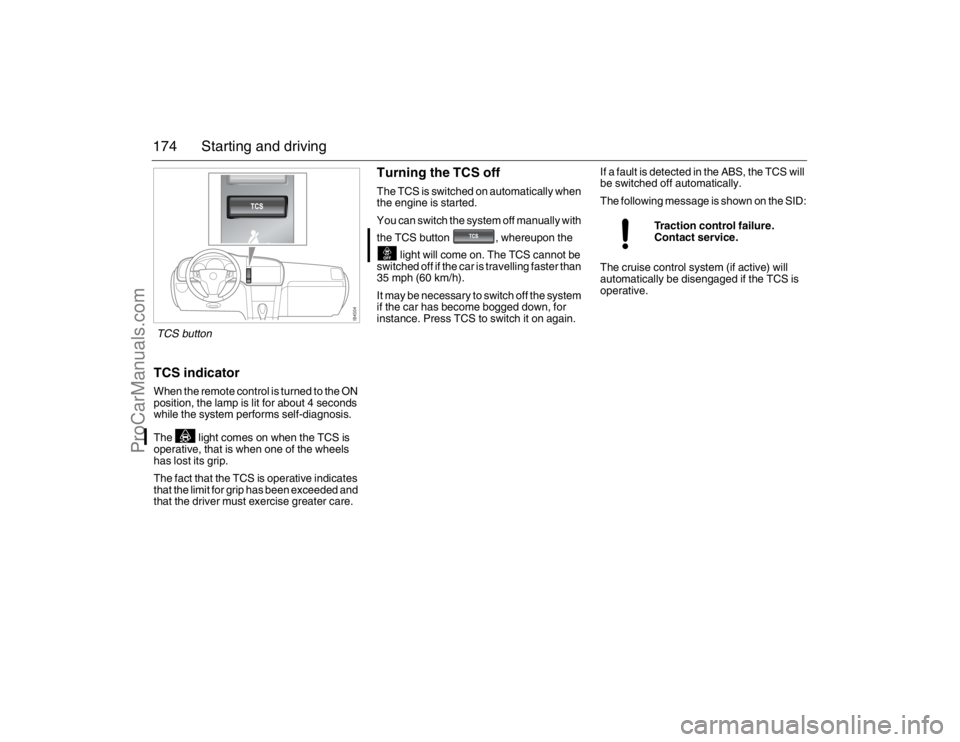
You can switch the system off manually with
the TCS button , whereupon the
light will come on. The TCS cannot be
switched off if the car is travelling faster than
35 mph (60 km/h).
It may be necessary to switch off the system
if the car has become bogged down, for
instance. Press TCS to switch it on again.If a fault is detected in the ABS, the TCS will
be switched off automatically.
The following message is shown on the SID:
The cruise control system (if active) will
automatically be disengaged if the TCS is
operative.
Traction control failure.
Contact service.
TCS button93_U S _M 07.book Page 174 W ednesday, April 12, 2006 9:30 AM
ProCarManuals.com
Page 176 of 304
176 Starting and drivingESP
® OFF
lights up if:
a fault has been detected and the system
has therefore been switched off
the system has been switched off
manually
ESP
® indicator light
When the remote control is turned to the ON
position, the lamp is lit for about 4 seconds
while the system performs self-diagnosis.
The light comes on for a short period of
time when the ESP
® system is operative.
Operation of the ESP® indicates reduced
cohesion between the tires and the road,
and that extra care should be taken by the
driver during continued driving.
Turning ESP
® system off
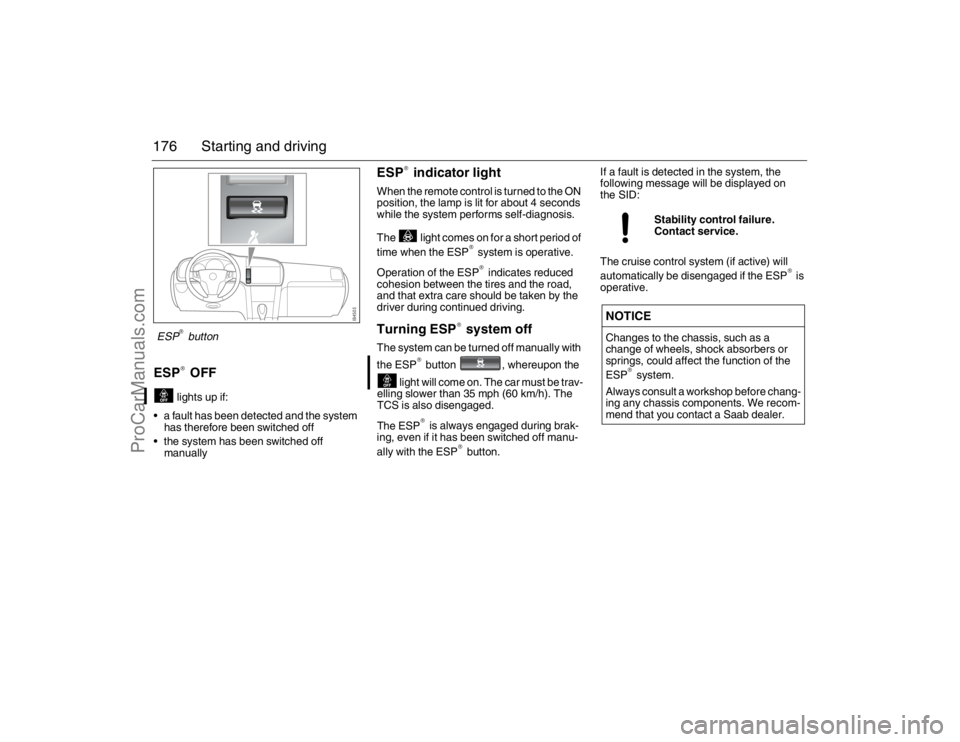
The system can be turned off manually with
the ESP
® button , whereupon the
light will come on. The car must be trav-
elling slower than 35 mph (60 km/h). The
TCS is also disengaged.
The ESP® is always engaged during brak-
ing, even if it has been switched off manu-
ally with the ESP
® button.If a fault is detected in the system, the
following message will be displayed on
the SID:
The cruise control system (if active) will
automatically be disengaged if the ESP
® is
operative.
Stability control failure.
Contact service.
NOTICEChanges to the chassis, such as a
change of wheels, shock absorbers or
springs, could affect the function of the
ESP
® system.
Always consult a workshop before chang-
ing any chassis components. We recom-
mend that you contact a Saab dealer.
ESP
® button
93_U S _M 07.book Page 176 W ednesday, April 12, 2006 9:30 AM
ProCarManuals.com
Page 182 of 304
182 Starting and drivingError messages
If the system malfunctions, the following
message will appear on the SID:
If the system is subject to interference, the
following message will be shown on the
SID:
If this message appears, clean the sensors.
The sensors are located in the black trim on
the rear bumper The system can be switched off using
Settings.
1 Select Settings using the steering
wheel controls, or .
2 Press and hold the SET button until
given audible confirmation.
3 Select Park Assistance.
4 Press the SET button.
5 Select ON or OFF.
6 Confirm the setting by pressing the SET
button.Explanation of ON and OFF.
Parking assistance
malfunction. Service.
Parking assistance
sensor interference.
Park Assistance
ONOFF
ON
Saab Parking Assistance is activated
automatically when reverse is
engaged. The system warns of objects
behind the car.
If a trailer is hitched up and correctly
connected to the trailer connector, the
system will be deactivated automati-
cally. You can also deactivate the sys-
tem temporarily with the CLR button if
reverse has been engaged and the
system is active.
OFF
Saab Parking Assistance deactivated.
93_U S _M 07.book Page 182 W ednesday, April 12, 2006 9:30 AM
ProCarManuals.com
Page 183 of 304
183 Starting and driving
Economical drivingFactors affecting fuel
consumptionThe fuel consumption of a car is greatly
affected by driving conditions, climate, road
conditions, speed, driving technique, etc.Breaking-inFuel consumption may be somewhat
higher during the break-in period (the
first 3,000–4,000 miles (5,000–7,000 km)).Weather conditionsSummer temperatures give better fuel
economy than winter ones. The difference
can be as much as about 10%. Consump-
tion increases in cold weather because the
engine takes longer to reach its normal
operating temperature. The transmission
and wheel bearings also take longer to
warm up. Even distance affects consump-
tion: short journeys of 3–5 miles (5–8 km)
do not give the engine enough time to
reach its optimum temperature. Wind con-
ditions also have a marked effect on fuel
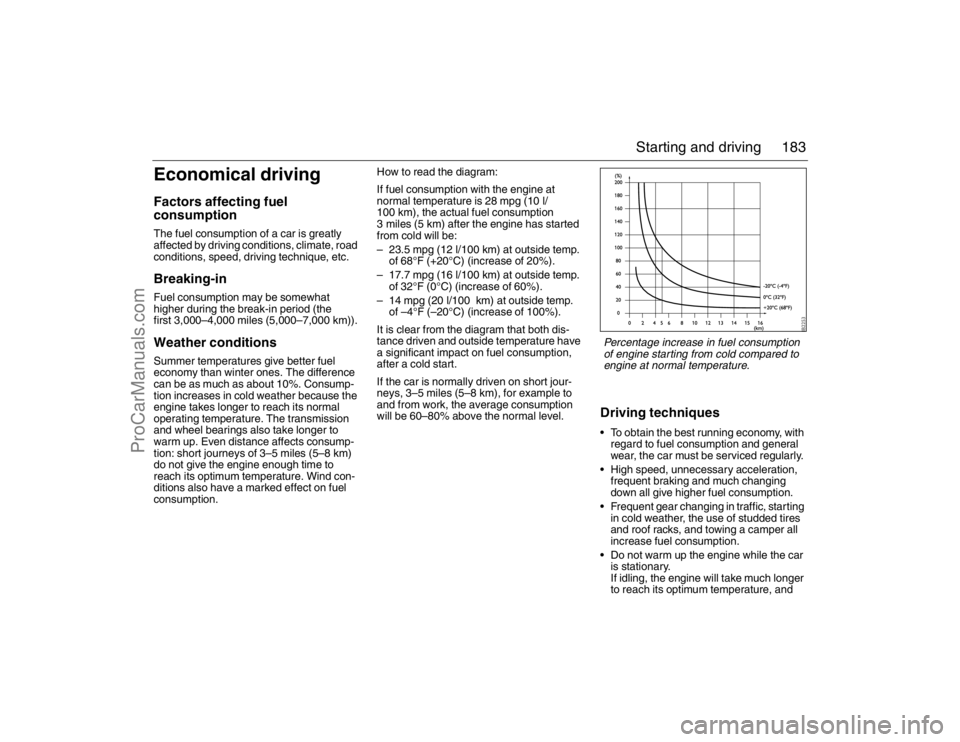
consumption.How to read the diagram:
If fuel consumption with the engine at
normal temperature is 28 mpg (10 l/
100 km), the actual fuel consumption
3 miles (5 km) after the engine has started
from cold will be:
– 23.5 mpg (12 l/100 km) at outside temp.
of 68°F (+20°C) (increase of 20%).
– 17.7 mpg (16 l/100 km) at outside temp.
of 32°F (0°C) (increase of 60%).
– 14 mpg (20 l/100 km) at outside temp.
of –4°F (–20°C) (increase of 100%).
It is clear from the diagram that both dis-
tance driven and outside temperature have
a significant impact on fuel consumption,
after a cold start.
If the car is normally driven on short jour-
neys, 3–5 miles (5–8 km), for example to
and from work, the average consumption
will be 60–80% above the normal level.
Driving techniques To obtain the best running economy, with
regard to fuel consumption and general
wear, the car must be serviced regularly.
High speed, unnecessary acceleration,
frequent braking and much changing
down all give higher fuel consumption.
Frequent gear changing in traffic, starting
in cold weather, the use of studded tires
and roof racks, and towing a camper all
increase fuel consumption.
Do not warm up the engine while the car
is stationary.
If idling, the engine will take much longer
to reach its optimum temperature, and Percentage increase in fuel consumption
of engine starting from cold compared to
engine at normal temperature.
93_U S _M 07.book Page 183 W ednesday, April 12, 2006 9:30 AM
ProCarManuals.com
Page 199 of 304
199 Starting and driving
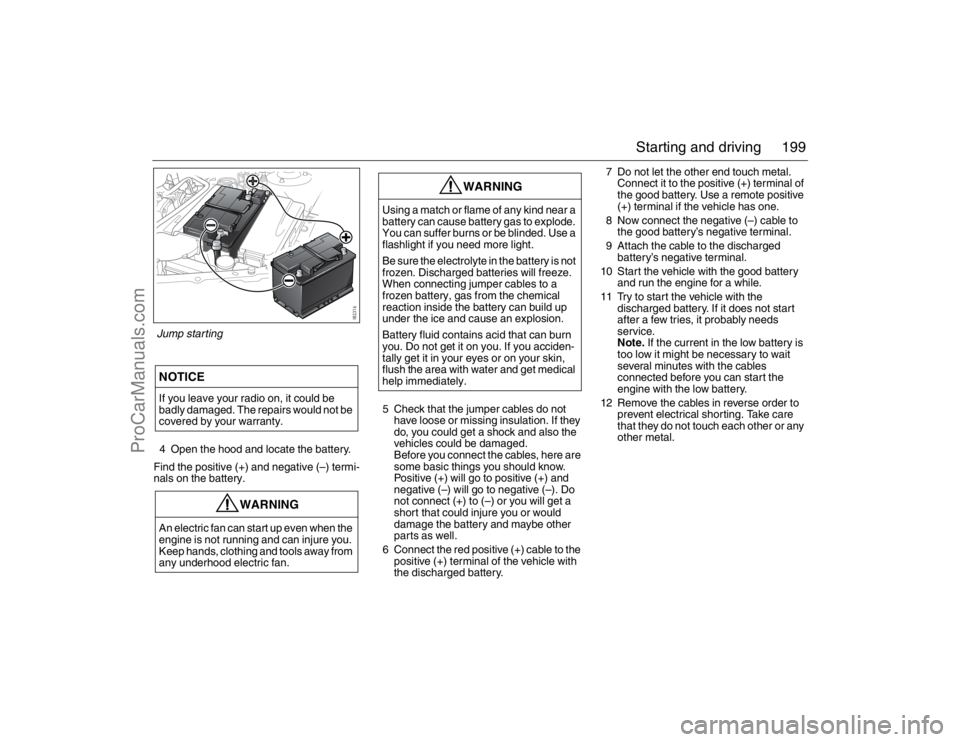
4 Open the hood and locate the battery.
Find the positive (+) and negative (–) termi-
nals on the battery.5 Check that the jumper cables do not
have loose or missing insulation. If they
do, you could get a shock and also the
vehicles could be damaged.
Before you connect the cables, here are
some basic things you should know.
Positive (+) will go to positive (+) and
negative (–) will go to negative (–). Do
not connect (+) to (–) or you will get a
short that could injure you or would
damage the battery and maybe other
parts as well.
6 Connect the red positive (+) cable to the
positive (+) terminal of the vehicle with
the discharged battery.7 Do not let the other end touch metal.
Connect it to the positive (+) terminal of
the good battery. Use a remote positive
(+) terminal if the vehicle has one.
8 Now connect the negative (–) cable to
the good battery’s negative terminal.
9 Attach the cable to the discharged
battery’s negative terminal.
10 Start the vehicle with the good battery
and run the engine for a while.
11 Try to start the vehicle with the
discharged battery. If it does not start
after a few tries, it probably needs
service.
Note. If the current in the low battery is
too low it might be necessary to wait
several minutes with the cables
connected before you can start the
engine with the low battery.
12 Remove the cables in reverse order to
prevent electrical shorting. Take care
that they do not touch each other or any
other metal.NOTICEIf you leave your radio on, it could be
badly damaged. The repairs would not be
covered by your warranty.
WARNING
An electric fan can start up even when the
engine is not running and can injure you.
Keep hands, clothing and tools away from
any underhood electric fan.
WARNING
Using a match or flame of any kind near a
battery can cause battery gas to explode.
You can suffer burns or be blinded. Use a
flashlight if you need more light.
Be sure the electrolyte in the battery is not
frozen. Discharged batteries will freeze.
When connecting jumper cables to a
frozen battery, gas from the chemical
reaction inside the battery can build up
under the ice and cause an explosion.
Battery fluid contains acid that can burn
you. Do not get it on you. If you acciden-
tally get it in your eyes or on your skin,
flush the area with water and get medical
help immediately.
Jump starting93_U S _M 07.book Page 199 W ednesday, April 12, 2006 9:30 AM
ProCarManuals.com
Page 203 of 304

203 Car care
engine is equipped with CVCP (Continuous
Variable Cam Phasing). This means that
the engine’s intake camshafts can be
adjusted to achieve optimum functionality.
The switches are hydraulic.Engine familiesSaab cars imported into the United States
and Canada meet all applicable emission
control standards. The engine family and
appropriate tune-up specifications are iden-
tified on a label in the engine bay.
These engine families meet applicable EPA
Federal Standards, California State Stan-
dards and Canadian Federal Standards and
are equipped with the following systems:
sequential multiport fuel injection system
three way catalytic converter
crankcase emissions control system
evaporative emission system.
Emission control
systemsThe systems for controlling emissions to the
atmosphere require regular checking and
adjustment at the intervals specified in the
service program.
In addition to meeting the exhaust emission
regulations and thereby helping to keep the
environment clean, a correctly tuned engine
will also give maximum fuel economy.
Saab Trionic engine
management system, 4-cyl
engineThe Saab Trionic engine management
system is a unique Saab development that
combines sequential multiport fuel injection,
electronic distributorless ignition and turbo-
charger boost pressure control into one sys-
tem.
The Trionic engine control module (ECM)
monitors many different engine parameters
such as:
Intake manifold pressure.
Intake air temperature.
Crankshaft position.
Engine coolant temperature.
Throttle position.
The oxygen content of the exhaust gases.
The ECM receives information regarding
engine knocking from a sophisticated feed-
back function in the ignition discharge unit.
By processing all of this information, the Tri-
onic system can control fuel injector open-
ing duration, ignition timing and turbo-
charger boost pressure to provide excellent
engine performance while maintaining low
emissions and fuel consumption.
WARNING
Engine exhaust, some of its constituents,
and certain vehicle components contain
or emit chemicals known to the State of
California to cause cancer and birth
defects and reproductive harm. In addi-
tion, certain fluids contained in vehicles
and certain products of component wear
contain or emit chemicals known to the
State of California to cause cancer and
birth defects or other reproductive harm.
93_U S _M 07.book Page 203 W ednesday, April 12, 2006 9:30 AM
ProCarManuals.com
Page 208 of 304

208 Car careMake sure you screw on the oil filler cap
properly after topping up the oil to avoid
running problems.
It is normal for an engine to consume a cer-
tain amount of oil. It is therefore often nec-
essary to top up the oil between services.
Check the engine oil level regularly.
During the Break-in Period (approx.
3,000 miles or 5,000 km) and when driving
at high speeds or with a trailer, the oil con-
sumption may be higher than normal.NOTICEChange of engine oil and oil filter may be
required more frequently if the car is
being used under certain conditions, see
page 275.
WARNING
Prolonged and repeated exposure of
the skin to engine oil can cause seri-
ous skin disorders. Avoid prolonged
skin contact whenever possible.
Used engine oil contains chemicals
that have caused cancer in laboratory
animals. Always protect your skin by
washing thoroughly with soap and
water.
Keep oil out of reach of children.
Do not touch the turbocharger or
exhaust manifold. These get very hot
when the engine has been running.
Do not spill oil on hot parts of the
engine as this could cause a fire. Used
engine oil is particularly flammable.
Protect the environment. Do not
dispose of oil into the ground or down
a drain. Dispose of all used oil and
oil filters at an appropriate disposal
facility.
NOTICE Do not run the engine with the oil level
too low.
Change engine oil and oil filter in
accordance with the service
programme
Only use the recommended type of oil.
Observe the above three points to avoid
serious damage to the engine.
For oil volumes and grades, refer to
page 284.
93_U S _M 07.book Page 208 W ednesday, April 12, 2006 9:30 AM
ProCarManuals.com