soft top SAAB 9-3 2007 Owner's Manual
[x] Cancel search | Manufacturer: SAAB, Model Year: 2007, Model line: 9-3, Model: SAAB 9-3 2007Pages: 304, PDF Size: 26.16 MB
Page 119 of 304
119 Interior equipment
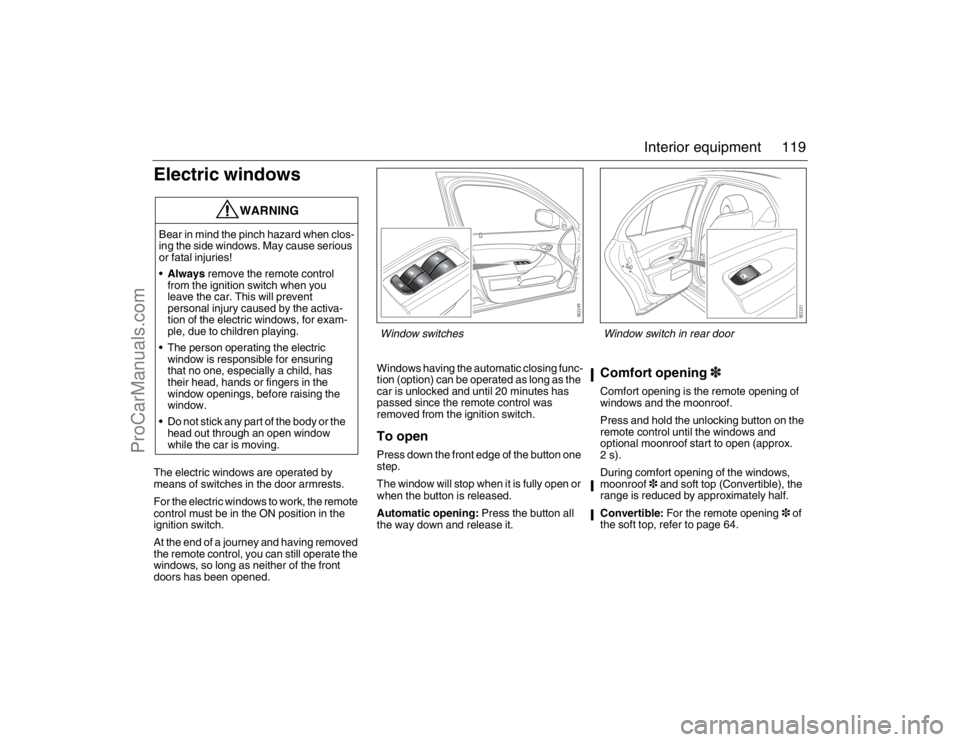
Electric windowsThe electric windows are operated by
means of switches in the door armrests.
For the electric windows to work, the remote
control must be in the ON position in the
ignition switch.
At the end of a journey and having removed
the remote control, you can still operate the
windows, so long as neither of the front
doors has been opened.Windows having the automatic closing func-
tion (option) can be operated as long as the
car is unlocked and until 20 minutes has
passed since the remote control was
removed from the ignition switch.
To openPress down the front edge of the button one
step.
The window will stop when it is fully open or
when the button is released.
Automatic opening: Press the button all
the way down and release it.
Comfort opening3Comfort opening is the remote opening of
windows and the moonroof.
Press and hold the unlocking button on the
remote control until the windows and
optional moonroof start to open (approx.
2s).
During comfort opening of the windows,
moonroof3 and soft top (Convertible), the
range is reduced by approximately half.
Convertible: For the remote opening3 of
the soft top, refer to page 64.
WARNING
Bear in mind the pinch hazard when clos-
ing the side windows. May cause serious
or fatal injuries!
Always remove the remote control
from the ignition switch when you
leave the car. This will prevent
personal injury caused by the activa-
tion of the electric windows, for exam-
ple, due to children playing.
The person operating the electric
window is responsible for ensuring
that no one, especially a child, has
their head, hands or fingers in the
window openings, before raising the
window.
Do not stick any part of the body or the
head out through an open window
while the car is moving.
Window switches
Window switch in rear door
93_U S _M 07.book Page 119 W ednesday, April 12, 2006 9:30 AM
ProCarManuals.com
Page 129 of 304

129 Interior equipment
To closeManually controlled closing
Slide the control forward to its first position.
The moonroof will halt when you release the
control.
Automatic closing3
Slide the control forward to its second posi-
tion and release it. The moonroof will close
fully.
The moonroof pinch protection halts closing
and opens the moonroof slightly if some-
thing obstructs closing.
Moonroof without automatic closing3
Slide the control forward to position 3 (see
illustration). The moonroof will stop when
you release the control or once it is fully
closed.Ventilation position (rear edge of moon-
roof open)
To open – press in the control.
To close – slide the control forward to the
second position.
It is also possible to select the ventilation
position when the moonroof is open by
pressing in the control. The moonroof will
then close automatically. Press the control
once more to open the moonroof to its ven-
tilation position.
If you wish to open the moonroof fully from
the ventilation position, you must first close
it (slide the control forward). You can then
slide the control rearward to open the moon-
roof.
The moonroof incorporates an interior,
manual, sliding sun blind.
Moonroof without automatic closing3
To open – press the control up.
To close – slide the control forward to
position 3.
Comfort opening3Comfort opening is the remote opening of
windows and the moonroof.
Press and hold the unlocking button on the
remote control until the windows and
optional moonroof start to open (approx.
2s).
During comfort opening of the windows,
moonroof (option) and soft top, the range is
reduced by approximately half.
If the moonroof is in the ventilation position,
it will not open.
Convertible: For the remote opening of the
soft top, refer to page 64.
WARNING
Exercise great care when closing the
moonroof to ensure that nothing gets
trapped.93_U S _M 07.book Page 129 W ednesday, April 12, 2006 9:30 AM
ProCarManuals.com
Page 179 of 304

179 Starting and driving
Long-term parkingIf the car is not going to be used for some
time, e.g. three to four months, the following
steps are recommended:
Drain the washer fluid reservoir and
hoses.
Wash and wax the car. Clean the rubber
seals on the hood, trunk lid and doors,
and lubricate them with glycerol
(glycerine).
After washing the car, dry the brake discs
to avoid corrosion by taking the car out on
the road and applying the brakes a few
times.
Fill the fuel tank to prevent condensation
forming in it.
Top up the coolant and check the anti-
freeze before the onset of winter. Park the car in a dry, covered and well-
ventilated building. Leave the parking
brake OFF!
Convertible: If the car is stored, the soft
top should be closed.
If necessary, use wheel chocks and leave
the parking brake off.
Disconnect the negative (–) battery lead.
If frost is likely to occur during the storage
period, remove the battery and store it in
a frost-free place.
If it is not possible to stand the car on axle
stands, increase the tire pressure to
43 psi (3 bar).
Leave all the door windows open a crack
and cover the car with a non-plastic
tarpaulin – not one made of plastic which will
not breath.93_U S _M 07.book Page 179 W ednesday, April 12, 2006 9:30 AM
ProCarManuals.com
Page 185 of 304

185 Starting and driving
Driving in cold weatherIn cold weather, special attention should be
paid to the following:
Before driving off, make sure that the
wiper blades have not frozen to the wind-
shield.
Remove any snow from the heating
system air intakes between the hood and
the windshield.
If necessary, inject oil into the locks to
prevent them from freezing. Use molyb-
denum-sulphide oil (MoS
2). If the locks
freeze, exercise care when unlocking the
car (manual unlocking) to avoid breaking
the key. Warm up the key or use a de-icer.
It is particularly important when the roads
are slippery that the brakes and tires are
in good condition.
For how to check the level of antifreeze in
the engine coolant, see page 209. Add gasoline anti-freeze when refueling
several times before the onset of winter.
This will prevent condensation water in
the fuel tank from freezing and causing
interruptions in the fuel supply. The likeli-
hood of condensation is lowest when the
fuel tank is full.
If the car is parked outside and the
temperature is below zero, gasoline anti-
freeze is of little use as it cannot remove
water that has already frozen. Park the
car in a warm place so that any ice that
may have built up melts, then add gaso-
line anti-freeze when refueling.
Condensation is caused by temperature
fluctuations, either in the outside temper-
ature alone or when the car is alternately
parked outdoors and in a garage.
Convertible: Avoid operating the soft top
at temperatures below 23°F (–5°C). The car is equipped with tires designed to
provide optimum grip on both wet and dry
roads, although this has been achieved at
the expense of somewhat reduced grip on
snow and ice. For regular driving on snow
and ice, we therefore recommend that
winter tires be fitted. However, winter tires
achieve this extra grip at the expense of
grip on bare road surfaces.
Winter tires, particularly studded tires, gen-
erally make driving safer on snow and ice.
Acquaint yourself with the legal provi-
sions governing the use of different
types of winter tires and snow chains.
Studded tires are not allowed in some
countries. If winter tires are fitted, the same
type must be fitted to all four wheels. Your
Saab dealer will be pleased to advise you on
the best tires for your car.
93_U S _M 07.book Page 185 W ednesday, April 12, 2006 9:30 AM
ProCarManuals.com
Page 262 of 304

262 Car care
The underside of the car also needs wash-
ing regularly, and this should be done extra
thoroughly at the end of winter. Clean the
underside of the car by hand if the car is
usually washed in an automatic car wash
without special facilities for underbody
cleaning.
Never wash or leave the car to dry in the
sun, but wipe it dry with a chamois leather
immediately after washing to avoid smears
and streaks.
Clean the inside of window glass using a
proprietary window cleaner. This is particu-
larly important when the car is new, as
upholstery and trim have a tendency to
sweat a little at first.
Keep the glass well polished, as this helps
to prevent misting.
Clean the outside of the windows with Saab
washer fluid. This is especially important if
the car has been washed in an automatic
car wash, as sometimes a wax treatment is
used that can contaminate the windshield
and impair the performance of the wipers.
In the U.S., Saab offers a full complement of
car care products. See your dealer or visit
us at www.saabcatalog.com.Convertible:
If a pressure washer is used be heedful of
the following recommendations:
on the lower part of the car (not higher
than the door handles): max pressure
of 100 bar and not closer than 8 in.
(20 cm).
on the upper part of the car: tax pres-
sure of 100 bar and not closer than
32 in. (80 cm).
Do not use any drying chemicals or water-
proofing agents.
Avoid automatic car washes.
NOTICEDo not use alcohol-based cleaners on the
plastic lenses of the front or rear lights, as
these can cause a crackling effect on the
lenses.
The door mirrors should be folded in
before the car enters an automatic car
wash.
Try your brakes on leaving a car wash.
Wet brake discs reduce the performance
of the brakes.
Fixed antennae, such as for a mobile
phone, must be removed if the car goes
through an automatic car wash.
Cars with Saab Parking Assistance: Do
not spray the sensors or closer than 8 in.
(20 cm) to the sensors with a pressure
washer, as this can damage them.
WARNING
Read and follow the instructions on
the packaging of the recommended
cleaning agents and waterproofing
agents. We recommend that you
contact an authorised Saab workshop
regarding recommended cleaning
agents and waterproofing agents.
Never treat the soft top with hot wax or
similar.
93_U S _M 07.book Page 262 W ednesday, April 12, 2006 9:30 AM
ProCarManuals.com
Page 263 of 304

263 Car care
When the soft top is only slightly soiled,
follow the directions on the cleaning agent
packaging. No brushing is necessary.
Check the soft top for water penetration
from time to time by spraying a small
amount of water on it. If water does not form
droplets but disappear into the material, it is
recommended to wash normally and then
waterproof.
If the soft top is heavily soiled and normal
recommended cleaning does not produce a
noticeable improvement, carry out the follo-
wing.
The following cleaning method must be only
used if the soft top is heavily soiled and must
not be carried out more than twice a year.
1 Stop normal cleaning.
2 Rinse off the thick dirt thoroughly with
water.
3 Spray the newly rinsed soft top with the
recommended cleaning agent and allow
it to work in for 15-20 minutes.4 Move the washing brush backwards and
forwards, not diagonally, from side to
side or in circles. Use a soft brush, like a
clothes brush or a micro fibre cloth so
that the cleaning agent foams. Never
use a wire brush.
5 Then rinse the soft top with warm water
and brush using a soft brush in the direc-
tion of the vehicle until all foam has
disappeared. Brush carefully to prevent
damaging the material.
6 Dry the soft top using a clean chamois
leather or a cloth that does not leave lint
on the soft top.
7 Allow the soft top to dry fully. Touch with
a hand after a while, if the material feels
damp, allow it to dry for longer. Never use petrochemical based
solvents for cleaning. Only use water
with a recommended cleaning agent.
Petrochemical based solvents can
cause irreparable damage to the soft
top.
Never use a pressure washer to clean
the soft top. Only use normal house-
hold water pressure.
NOTICE Only operate the soft top when it is
clean and dry.
Do not lower the soft top when it is
damp. This can cause folds and pres-
sure marks. If the soft top is heavily
soiled, the dirt may cause irreparable
visible chafe marks.
Only use water, recommended clea-
ning agents and a microfibre cloth if
the soft top is already damaged, other-
wise the damage can become worse.
At creases, seams and window edges
the cleaning motion should be away
from the crease, seam or window
edge in to the soft top.
WARNING
Water hotter than 37 °C can burn the skin,
cause skin irritation and/or cause injuries.
Use suitable protection.
93_U S _M 07.book Page 263 W ednesday, April 12, 2006 9:30 AM
ProCarManuals.com
Page 264 of 304

264 Car care8 If spots are still visible, repeat the treat-
ment on these spots as before. Press
lightly with the brush to prevent damag-
ing the material. Do not use the brush
excessively. This can irreparably
damage the material. Do not repeat the
treatment more than twice.
9 When the soft top has fully dried, it must
be waterproofed immediately. Only use
the recommended waterproofing agent.
Follow the instructions on the packa-
ging.
10 To obtain even and optimum water-
proofing, the car must be closed for
24 hours after treatment. Do not touch
the material and do not place any
objects on it.
Waxing and polishingDo not wax a new car during the first three
or four months. In fact, there is no need to
polish the car before the paintwork has
started to dull through oxidation. Other than
in exceptional cases, do not use abrasive
polishes containing a cutting agent on a new
car. Always wash the car thoroughly before
waxing or polishing.Touching up the paintDamaged paintwork should be treated as
soon as it is discovered: the longer it is left,
the greater the risk of corrosion. The anti-
corrosion warranty does not cover corrosion
resulting from untreated defects.
Paintwork damage sustained in a crash is
usually extensive and can only be properly
restored by professionals.
However, you can repair small scratches
and stone chip damage yourself. The nec-
essary tools and materials, such as primer,
touch-up paint and brushes, are available
from a workshop. We recommend that you
contact a Saab dealer.
In the case of minor flaws in the paintwork,
where the metal has not been exposed and
an undamaged layer of paint remains,
touch-up paint can usually be applied
directly, after any dirt has been scraped
away using a pointed knife.If corrosion has already set in, such as the
result of stone-chip damage, use a pointed
knife to scrape off all surface rust. If possi-
ble, the damaged area should be taken
back to the bare metal. The metal should
then be primed with two thin coats of primer
applied by brush.
After the primer has dried, apply several thin
layers of topcoat until the surface of the
repaired area is flush with the surrounding
paintwork.
Stir both primer and touch-up paint thor-
oughly before use and allow each coat to
dry before applying the next.
Two-coat enamelAs the name implies, two-coat enamel is
applied in two operations. The first coat, the
base color, contains the pigment, metal
flakes and binder. The second coat consists
of a clear enamel, which provides the final
gloss for the paintwork and protects the
base from moisture and environmental con-
taminants.
Touch-up stone-chip damage as follows:
1 Thoroughly clean the damaged area.
2 Then apply the primer, base color and
finally, the clear enamel. To achieve the
best finish, apply two or three coats of
primer.
93_U S _M 07.book Page 264 W ednesday, April 12, 2006 9:30 AM
ProCarManuals.com
Page 280 of 304
280 Technical dataGeneral dataOverall length, including bumpers: ______
Sport Sedan and Convertible _________ 182.5'' (4635 mm)
SportCombi_______________________ 183.2'' (4654 mm)
Overall width, including door mirrors _____ 80.2'' (2038 mm)
Maximum height ____________________ 60.6'' (1539 mm)
Wheelbase ________________________ 105.3'' (2675 mm)
Tr a c k :
Front ____________________________ 59.8'' (1524 mm)
Rear ____________________________ 59.3'' (1506 mm)
Ground clearance at GVW ____________ approx. 4.7''
(120 mm)
Number of seats (incl. driver):
Sport Sedan and SportCombi ________ 5
Convertible _______________________ 4
Turning circle:
Measured at vehicle extremities _______ 39.0 ft. (11.9 m)
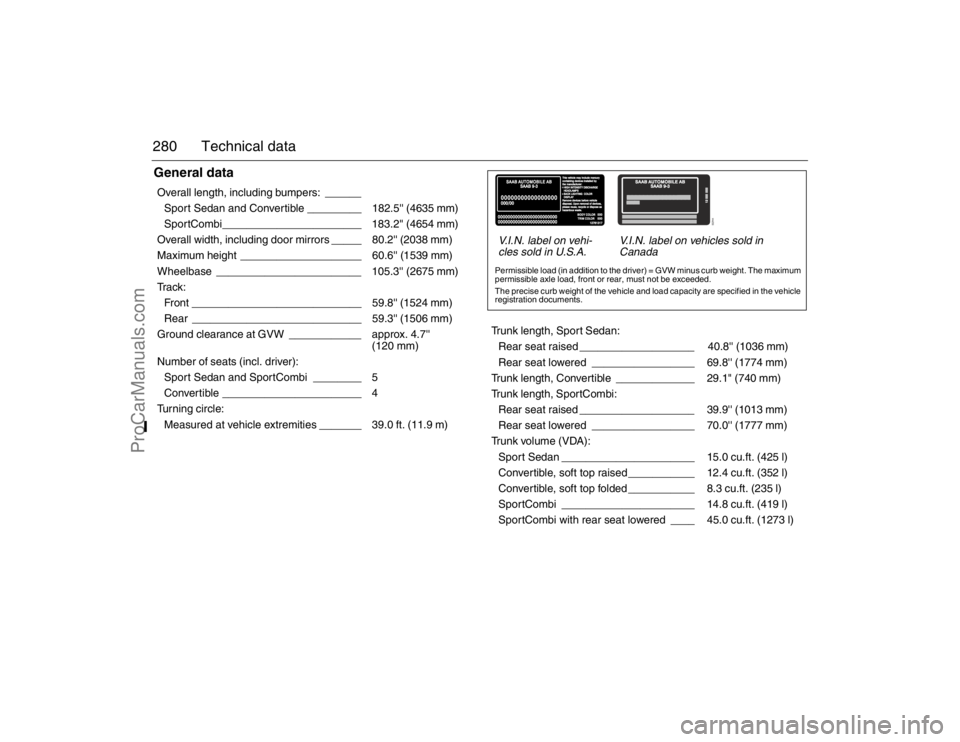
V.I.N. label on vehi-
cles sold in U.S.A.V.I.N. label on vehicles sold in
CanadaPermissible load (in addition to the driver) = GVW minus curb weight. The maximum
permissible axle load, front or rear, must not be exceeded.
The precise curb weight of the vehicle and load capacity are specified in the vehicle
registration documents.Trunk length, Sport Sedan:
Rear seat raised ___________________ 40.8'' (1036 mm)
Rear seat lowered _________________ 69.8'' (1774 mm)
Trunk length, Convertible _____________ 29.1" (740 mm)
Trunk length, SportCombi:
Rear seat raised ___________________ 39.9'' (1013 mm)
Rear seat lowered _________________ 70.0'' (1777 mm)
Trunk volume (VDA):
Sport Sedan ______________________ 15.0 cu.ft. (425 l)
Convertible, soft top raised ___________ 12.4 cu.ft. (352 l)
Convertible, soft top folded ___________ 8.3 cu.ft. (235 l)
SportCombi ______________________ 14.8 cu.ft. (419 l)
SportCombi with rear seat lowered ____ 45.0 cu.ft. (1273 l)
93_U S _M 07.book Page 280 W ednesday, April 12, 2006 9:30 AM
ProCarManuals.com
Page 289 of 304

289 Technical data
Brake system
Hydraulic unit for soft top, ConvertibleFoot brake (ABS)____________________ Hydraulic disc
brakes with vacuum
servo unit. Diago-
nally split circuits;
ventilated discs on
front wheels (some
variants also have
ventilated rear
discs). EBD function
(see page 171).
Park brake _________________________ Acts on rear wheels
Brake fluid _________________________ To DOT 4.
Do not use DOT 5.Disc diameter:
Front ____________________________ 11.22 in.
(285 mm) **)
Fr o nt3 *) ________________________ 11.81 in.
(300 mm) **)
Rear ____________________________ 10.94 in. (278 mm)
Rear3 *) ________________________ 11.42 in.
(290 mm) **)
Total friction area of brake pads:
Front ____________________________ 9.30 in.² (60 cm²)
Fr o nt3__________________________ 9.61 in.² (62 cm²)
Rear ____________________________ 4.96 in.² (32 cm²)
*)15" wheels and 16" aluminium wheels
must not be fitted to these variants since
the diameter of the brake discs does not
allow this.
**) ventilated
Oil capacity _______________________ 0.6 qt. (0.6 l)
Oil type __________________________ CHF 11S93_U S _M 07.book Page 289 W ednesday, April 12, 2006 9:30 AM
ProCarManuals.com
Page 295 of 304

295 Technical data
Several of the systems in your
Saab can be customized to better
suit your individual needs.
Contact your Saab dealerCentral locking system
Some functions are governed by legal
requirements and cannot therefore be
reprogrammed.
We recommend that you consult a Saab
dealer for further information.
Listed below are a number of examples of
programmable functions.
Audible confirmation of arming/disarming
the car alarm.
Automatic unlocking when car stopped
and remote control removed from the igni-
tion switch.
Trunk lid locked when car driven off or
30 s after being shut.Courtesy Headlamp Feature
The length of time the lights are on.
Whether the reversing light or tail lights
should come on as well as the dipped
beam.
Automatic Climate System (ACC)
Convertible: A/C compressor not
switched off when the soft top is open.93_U S _M 07.book Page 295 W ednesday, April 12, 2006 9:30 AM
ProCarManuals.com