warning light SAAB 9-3 2007 Repair Manual
[x] Cancel search | Manufacturer: SAAB, Model Year: 2007, Model line: 9-3, Model: SAAB 9-3 2007Pages: 304, PDF Size: 26.16 MB
Page 225 of 304
225 Car care
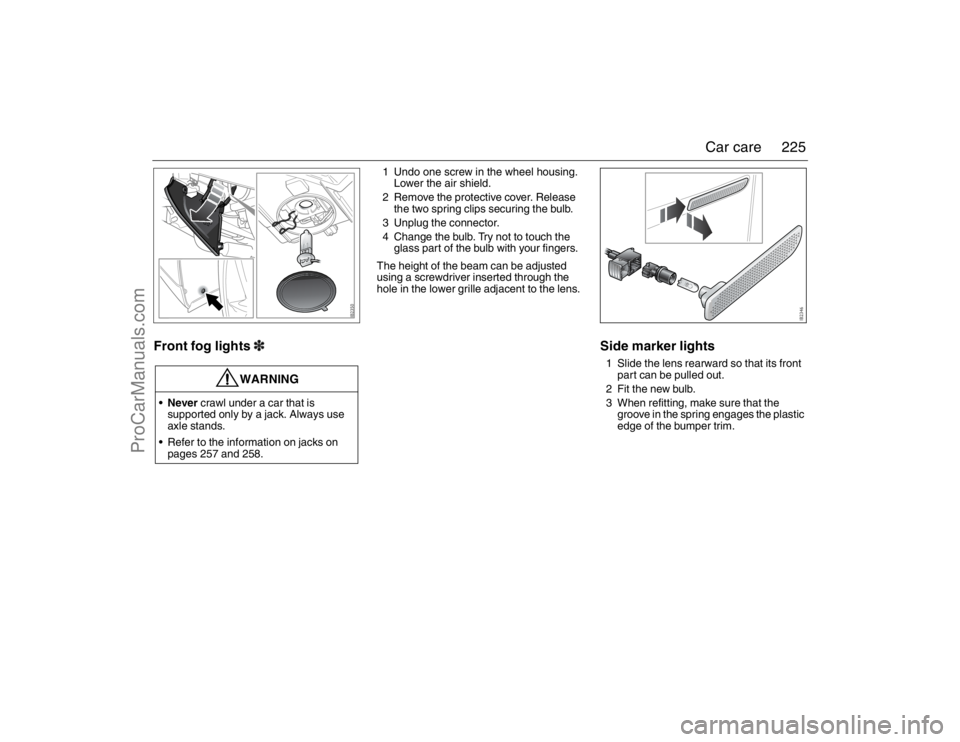
Front fog lights3
1 Undo one screw in the wheel housing.
Lower the air shield.
2 Remove the protective cover. Release
the two spring clips securing the bulb.
3 Unplug the connector.
4 Change the bulb. Try not to touch the
glass part of the bulb with your fingers.
The height of the beam can be adjusted
using a screwdriver inserted through the
hole in the lower grille adjacent to the lens.
Side marker lights1 Slide the lens rearward so that its front
part can be pulled out.
2 Fit the new bulb.
3 When refitting, make sure that the
groove in the spring engages the plastic
edge of the bumper trim.
WARNING
Never crawl under a car that is
supported only by a jack. Always use
axle stands.
Refer to the information on jacks on
pages 257 and 258.93_U S _M 07.book Page 225 W ednesday, April 12, 2006 9:30 AM
ProCarManuals.com
Page 245 of 304

245 Car care
Uniform Tire Quality GradingQuality grades can be found where applica-
ble on the tire sidewall between tread shoul-
der and maximum section width. For exam-
ple:
Treadwear 200 Traction AA
Temperature A
The following information relates to the
system developed by the United States
National Highway Traffic Safety Administra-
tion, which grades tires by treadwear, trac-
tion and temperature performance. (This
applies only to vehicles sold in the United
States.) The grades are molded on the side-
walls of most passenger car tires. The Uni-
form Tire Quality Grading system does not
apply to deep tread, winter-type snow tires,
space-saver or temporary use spare tires,
tires with nominal rim diameters of 10 to 12
inches (25 to 30 cm), or to some limited-pro-
duction tires.
While the tires available on General Motors
passenger cars and light trucks may vary
with respect to these grades, they must also
conform to federal safety requirements and
additional General Motors Tire Perfor-
mance Criteria (TPC) standards.
NOTICEWide wheels and tires with side walls that
are too low can:
be damaged in potholes, etc.
cause springs, shock absorbers and
wheel bearings and body mountings
to be overloaded.
affect the function of the Electronic
Stability Program (ESP
®).
The speed and load limits of the tires
must not be exceeded; see page 250.
Wheels larger than 17" must not be fitted
on the Saab 9-3 for reasons above. The
permissible offset is 1.61 inch (41 mm).
WARNING
Mixing tires could cause you to lose
control while driving. If you mix tires of
different sizes or types (radial and bias-
belted tires), the vehicle may not handle
properly, and you could have a crash.
Using tires of different sizes may also
cause damage to your vehicle. Be sure to
use the same size and type tires on all
wheels. It’s all right to drive with your
compact spare temporarily, it was devel-
oped for use on your vehicle. See
“Compact spare” on page 254.
WARNING
If you use bias-ply tires on your vehicle,
the wheel rim flanges could develop
cracks after many miles of driving. A tire
and/or wheel could fail suddenly, causing
a crash. Use only radial-ply tires with the
wheels on your vehicle.
93_U S _M 07.book Page 245 W ednesday, April 12, 2006 9:30 AM
ProCarManuals.com
Page 254 of 304

254 Car careWinter tiresWinter (snow) tires are recommended for
winter climates where the majority of your
driving will be done on snow and ice. Winter
tires should be fitted to all four wheels to
maintain a proper balance. Your Saab
dealer can advise you of to the correct size
tire for your car (if different from the original
size) and also supply Saab approved winter
tires pre-mounted on steel or alloy rims.
Winter tires normally use a different speed
rating compared to summer/all season tires.
Make sure not to exceed the stated speed
rating on the tires you use.Tire date codeTires should be regarded as perishable
goods. As the tires age, the rubber becomes
progressively harder, and the roadholding
ability of the tires diminishes. This is partic-
ularly true on winter tires.
Tires have a code that specifies their date of
manufacture. The first two digits denote the
week number and the last two digits the year
followed by a filled triangle.
Compact spareThe compact spare is light and easy to
handle when changing the tire. Its use is
only permitted when a standard tire has sus-
tained a puncture. The maximum life of the
tire is only just over 2,000 miles (3,500 km).
Do not exceed 50 mph (80 km/h) with the
compact spare fitted.
The tire pressure should be 60 psi
(420 kPa). Put the punctured tire in the
spare wheel well under the trunk floor.
Have the standard tire repaired and refitted
as soon as possible.The spare tire, the tools and the jack with its
crank are carried under a panel in the trunk.
Fold the carpeting forward to ease access to
the tools and spare tire.
The screwdriver handle has a “button” for
removing plastic rivets. This type of rivet
must be removed when changing the light
bulb in the trunk lid (see page 228).
Your Saab is equipped with a trip computer
and you can use its “Speed warning” func-
tion, to monitor driving speed since you
must not exceed 50 mph (80 km/h), see
page 90.
WARNING
The spare tire or punctured tire must be
stowed under the trunk floor, and secured
in place with the retaining nut.
93_U S _M 07.book Page 254 W ednesday, April 12, 2006 9:30 AM
ProCarManuals.com
Page 255 of 304
255 Car care
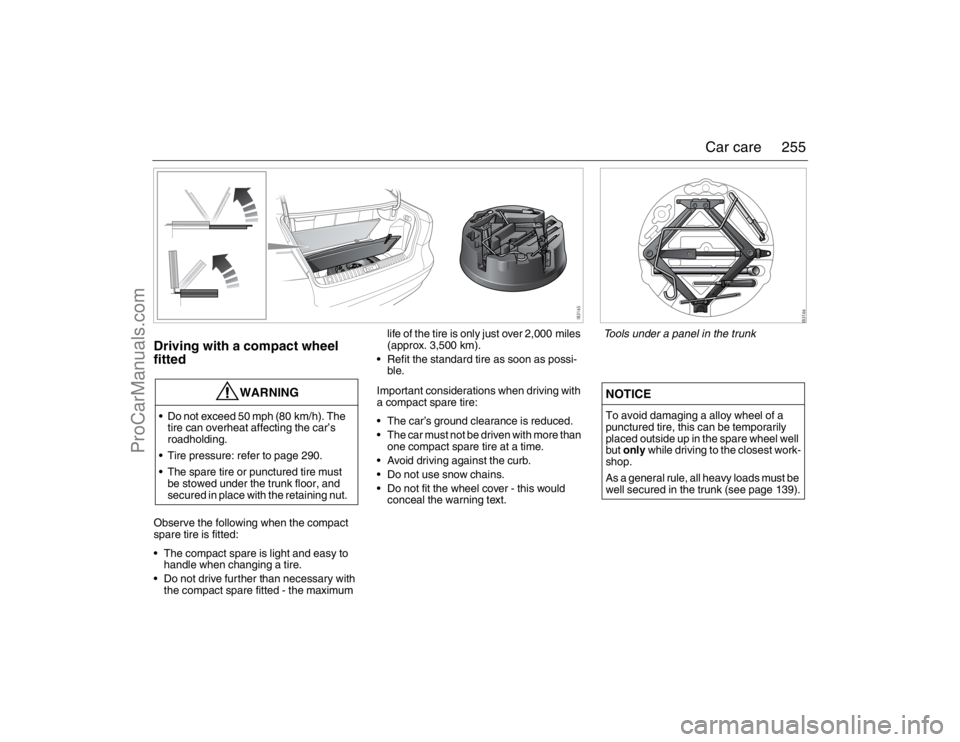
Driving with a compact wheel
fittedObserve the following when the compact
spare tire is fitted:
The compact spare is light and easy to
handle when changing a tire.
Do not drive further than necessary with
the compact spare fitted - the maximum life of the tire is only just over 2,000 miles
(approx. 3,500 km).
Refit the standard tire as soon as possi-
ble.
Important considerations when driving with
a compact spare tire:
The car’s ground clearance is reduced.
The car must not be driven with more than
one compact spare tire at a time.
Avoid driving against the curb.
Do not use snow chains.
Do not fit the wheel cover - this would
conceal the warning text.
WARNING
Do not exceed 50 mph (80 km/h). The
tire can overheat affecting the car’s
roadholding.
Tire pressure: refer to page 290.
The spare tire or punctured tire must
be stowed under the trunk floor, and
secured in place with the retaining nut.
NOTICETo avoid damaging a alloy wheel of a
punctured tire, this can be temporarily
placed outside up in the spare wheel well
but only while driving to the closest work-
shop.
As a general rule, all heavy loads must be
well secured in the trunk (see page 139).Tools under a panel in the trunk
93_U S _M 07.book Page 255 W ednesday, April 12, 2006 9:30 AM
ProCarManuals.com
Page 257 of 304

257 Car care
Changing a tire
WARNING
Lifting a vehicle and getting under it to do
maintenance or repairs is dangerous
without the appropriate safety equipment
and training. The jack provided with your
vehicle is designed only for changing a
flat tire. If it is used for anything else, you
or others could be badly injured or killed if
the vehicle slips off the jack. Use the jack
provided with your vehicle only for chang-
ing a flat tire.
Changing a tire can be dangerous. The
vehicle can slip off the jack and roll over
or fall on you or other people. You and
they could be badly injured or even killed.
Find a level place to change your tire. To
help prevent the vehicle from moving:
1 Set the parking brake firmly.
2 If you have an automatic transmis-
sion, put the shift lever in PARK (P).
For a manual transmission, leave the
car in gear (1st or REVERSE (R)).
3 Turn off the engine and do not restart
while the vehicle is raised.
4 Do not allow passengers to remain in
the vehicle.
To be even more certain the vehicle won't
move, you should put blocks at the front
and rear of the tire farthest away from the
one being changed. That would be the
tire, on the other side, at the opposite end
of the vehicle.
The car jack is designed solely for use
in changing a tire or fitting snow
chains. It must not be used to
support the car during repair work
or servicing.
Never crawl under a car that is
supported only by a jack. Always use
axle stands.
Raising your vehicle too high or with
the jack improperly positioned can
damage the vehicle and even make
the vehicle fall. To help avoid personal
injury and vehicle damage, be sure to
fit the jack lift head into the proper
location before raising the vehicle, and
raise the vehicle only far enough off
the ground so there is enough room for
the spare tire to fit (no more than
25 mm or 1 inch clearance between
the ground and the bottom of the tire).
Switch on the hazard warning lights if
the car is on a road.
The jack should be stored correctly
under the carpeting in the trunk. If it
lies loose in the car, it could thrown
forward and cause personal injury in
the event of a crash or if the car rolls
over.
Grit, salt and rust can clog the inner
threads of the wheel bolts if the car has
been driven for several years exclu-
sively with alloy wheels.
If steel wheels are being installed, the
bolt hole threads in the brake hubs
should be cleaned before the thinner
steel wheels are fitted. It may other-
wise not be possible to achieve the
correct clamping force, despite tight-
ening the wheel bolts to the correct
torque.
93_U S _M 07.book Page 257 W ednesday, April 12, 2006 9:30 AM
ProCarManuals.com
Page 262 of 304

262 Car care
The underside of the car also needs wash-
ing regularly, and this should be done extra
thoroughly at the end of winter. Clean the
underside of the car by hand if the car is
usually washed in an automatic car wash
without special facilities for underbody
cleaning.
Never wash or leave the car to dry in the
sun, but wipe it dry with a chamois leather
immediately after washing to avoid smears
and streaks.
Clean the inside of window glass using a
proprietary window cleaner. This is particu-
larly important when the car is new, as
upholstery and trim have a tendency to
sweat a little at first.
Keep the glass well polished, as this helps
to prevent misting.
Clean the outside of the windows with Saab
washer fluid. This is especially important if
the car has been washed in an automatic
car wash, as sometimes a wax treatment is
used that can contaminate the windshield
and impair the performance of the wipers.
In the U.S., Saab offers a full complement of
car care products. See your dealer or visit
us at www.saabcatalog.com.Convertible:
If a pressure washer is used be heedful of
the following recommendations:
on the lower part of the car (not higher
than the door handles): max pressure
of 100 bar and not closer than 8 in.
(20 cm).
on the upper part of the car: tax pres-
sure of 100 bar and not closer than
32 in. (80 cm).
Do not use any drying chemicals or water-
proofing agents.
Avoid automatic car washes.
NOTICEDo not use alcohol-based cleaners on the
plastic lenses of the front or rear lights, as
these can cause a crackling effect on the
lenses.
The door mirrors should be folded in
before the car enters an automatic car
wash.
Try your brakes on leaving a car wash.
Wet brake discs reduce the performance
of the brakes.
Fixed antennae, such as for a mobile
phone, must be removed if the car goes
through an automatic car wash.
Cars with Saab Parking Assistance: Do
not spray the sensors or closer than 8 in.
(20 cm) to the sensors with a pressure
washer, as this can damage them.
WARNING
Read and follow the instructions on
the packaging of the recommended
cleaning agents and waterproofing
agents. We recommend that you
contact an authorised Saab workshop
regarding recommended cleaning
agents and waterproofing agents.
Never treat the soft top with hot wax or
similar.
93_U S _M 07.book Page 262 W ednesday, April 12, 2006 9:30 AM
ProCarManuals.com
Page 263 of 304

263 Car care
When the soft top is only slightly soiled,
follow the directions on the cleaning agent
packaging. No brushing is necessary.
Check the soft top for water penetration
from time to time by spraying a small
amount of water on it. If water does not form
droplets but disappear into the material, it is
recommended to wash normally and then
waterproof.
If the soft top is heavily soiled and normal
recommended cleaning does not produce a
noticeable improvement, carry out the follo-
wing.
The following cleaning method must be only
used if the soft top is heavily soiled and must
not be carried out more than twice a year.
1 Stop normal cleaning.
2 Rinse off the thick dirt thoroughly with
water.
3 Spray the newly rinsed soft top with the
recommended cleaning agent and allow
it to work in for 15-20 minutes.4 Move the washing brush backwards and
forwards, not diagonally, from side to
side or in circles. Use a soft brush, like a
clothes brush or a micro fibre cloth so
that the cleaning agent foams. Never
use a wire brush.
5 Then rinse the soft top with warm water
and brush using a soft brush in the direc-
tion of the vehicle until all foam has
disappeared. Brush carefully to prevent
damaging the material.
6 Dry the soft top using a clean chamois
leather or a cloth that does not leave lint
on the soft top.
7 Allow the soft top to dry fully. Touch with
a hand after a while, if the material feels
damp, allow it to dry for longer. Never use petrochemical based
solvents for cleaning. Only use water
with a recommended cleaning agent.
Petrochemical based solvents can
cause irreparable damage to the soft
top.
Never use a pressure washer to clean
the soft top. Only use normal house-
hold water pressure.
NOTICE Only operate the soft top when it is
clean and dry.
Do not lower the soft top when it is
damp. This can cause folds and pres-
sure marks. If the soft top is heavily
soiled, the dirt may cause irreparable
visible chafe marks.
Only use water, recommended clea-
ning agents and a microfibre cloth if
the soft top is already damaged, other-
wise the damage can become worse.
At creases, seams and window edges
the cleaning motion should be away
from the crease, seam or window
edge in to the soft top.
WARNING
Water hotter than 37 °C can burn the skin,
cause skin irritation and/or cause injuries.
Use suitable protection.
93_U S _M 07.book Page 263 W ednesday, April 12, 2006 9:30 AM
ProCarManuals.com
Page 269 of 304

269 Car care
Other than in extremely cold weather, do not
screen the radiator, e.g. with netting, as this
will greatly diminish its cooling capacity.
Applicable to the manual climate control
system - During cold months the air condi-
tioning should be switched on once or
twice a month and run for 5–10 minutes
during highway driving once the engine is
warm.
This action saves the gaskets in the
compressor from being spoiled. The
compressor uses a lubricant that circu-
lates with the coolant.
Note:
The A/C system cannot be switched on
when the outside temperature is below 32°F
(0°C). Turn on the A/C system when the car
is standing in a warm place. Simplest is to
always have the A/C button pressed in. The
A/C system will then cut in automatically
when the outside temperature is high
enough.
Headlight aimingThe vehicle has a visual optical headlight
aiming system equipped with vertical
aiming device. The aim has been preset at
the factory and should normally not need
further adjustments.
If your headlights are damaged in a crash,
the headlight aim may be affected. If you
believe your headlights need to be re-
aimed, we recommend that you take it to
your Saab dealer for service. However, it is
possible for you to re-aim your headlights as
described in the following procedure.To check the aim, the vehicle should be
properly prepared as follows:
The vehicle shall be placed so that the
headlights are 25 ft (7.6 m) from a light
colored wall or other flat surface. The
aiming area should be darkened, this will
improve your ability to see the beam of the
low beam headlight being aimed.
An optical headlamp aimer can also be
used and will than replace the wall.
The vehicle must have all four wheels on
a perfectly level surface which is level all
the way to the wall or other flat surface.
The vehicle should be placed so it is per-
pendicular to the wall or other flat surface.
The vehicle should be unloaded and fuel
tank full, and one person or 160 lbs.
(75 kg) on the drivers seat.
The vehicle should be fully assembled
and all other work stopped while headlight
aiming is being done.
The vehicle should not have any snow,
ice or mud attached to it.
Tires should be inflated to the prescribed
pressure.
Close all doors.
Rock the vehicle to stabilize the suspen-
sion.
Headlight aiming is done with the vehicle
low beam lamps. The high beam lamps will
be correctly aimed if the low beam lamps
are aimed properly.
WARNING
Before checking/adjusting the headlight
aiming, switch off the engine to avoid
danger of fingers and hands being injured
by moving parts.
The radiator fan can start up even when
the engine is switched off.NOTICETo make sure that your headlights are
aimed properly read all instructions
before beginning. Failure to follow these
instructions could cause damage to
headlight parts or a not correctly aimed
headlight.
93_U S _M 07.book Page 269 W ednesday, April 12, 2006 9:30 AM
ProCarManuals.com
Page 296 of 304
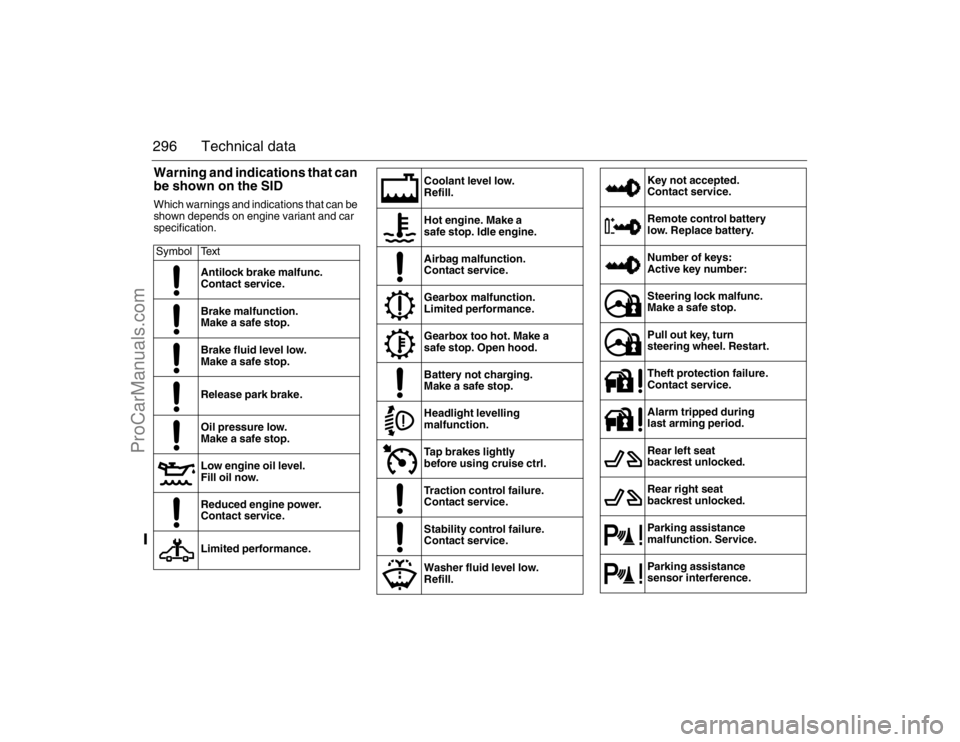
296 Technical dataWarning and indications that can
be shown on the SIDWhich warnings and indications that can be
shown depends on engine variant and car
specification.
Symbol Text
Antilock brake malfunc.
Contact service.
Brake malfunction.
Make a safe stop.
Brake fluid level low.
Make a safe stop.
Release park brake.
Oil pressure low.
Make a safe stop.
Low engine oil level.
Fill oil now.
Reduced engine power.
Contact service.
Limited performance.
Coolant level low.
Refill.
Hot engine. Make a
safe stop. Idle engine.
Airbag malfunction.
Contact service.
Gearbox malfunction.
Limited performance.
Gearbox too hot. Make a
safe stop. Open hood.
Battery not charging.
Make a safe stop.
Headlight levelling
malfunction.
Tap brakes lightly
before using cruise ctrl.
Traction control failure.
Contact service.
Stability control failure.
Contact service.
Washer fluid level low.
Refill.
Key not accepted.
Contact service.
Remote control battery
low. Replace battery.
Number of keys:
Active key number:
Steering lock malfunc.
Make a safe stop.
Pull out key, turn
steering wheel. Restart.
Theft protection failure.
Contact service.
Alarm tripped during
last arming period.
Rear left seat
backrest unlocked.
Rear right seat
backrest unlocked.
Parking assistance
malfunction. Service.
Parking assistance
sensor interference.
93_U S _M 07.book Page 296 W ednesday, April 12, 2006 9:30 AM
ProCarManuals.com
Page 299 of 304

299 Index
Index
AABS brakes
____________________ 173
ACC
_________________________ 107
Adjustment, steering wheel
________ 120
Air filter
_______________________ 211
Airbag
_________________________ 32
Anchorage eyes, Sport Sedan
_____ 141
Anti-corrosion treatment
__________ 267
Antilock braking system __________ 173
Anti-spin
______________________ 175
Ashtrays ______________________ 136
Autochecking of lights, warning and
indicator lights
__________________ 89
Autodimming
_______________ 125
, 126
Automatic climate control (ACC)
____ 107
Automatic closing of moonroof
_____ 131
Automatic closing of windows,
Sport Sedan and SportCombi _____ 122
Automatic transmission
___________ 165
BBattery
_______________________ 215
Bedding-in of new brake pads
_____ 163
Before towing a trailer
____________ 193
Belt height, Sport Sedan and
SportCombi
____________________ 14
Brake fluid, grade
_______________ 289Brakes
________________________ 172
Braking _______________________ 172
Bulb changing
__________________ 221
Bulb table
_____________________ 235
Buying new tires
________________ 246
CCabin lighting, Convertible
_________ 80
Cabin lighting, Sport Sedan and
SportCombi
___________________ 133
Calibrating front electric windows
with pinch protection
_____________ 80
Calibration of windows, Sport Sedan
and SportCombi
_______________ 123
Car alarm
______________________ 58
Car transport ___________________ 199
Care of air conditioning
___________ 270
Cargo guard
___________________ 150
Cargo guard, SportWagon
________ 150
Cargo net, SportCombi
___________ 147
Change of address notification
_____ 276
Changing a tire
_________________ 259
Changing bulbs _________________ 221
Changing the battery, remote control
_56
Changing wiper blades
___________ 219
Checking the number of remote
controls
_______________________ 55
Checks before towing a trailer
_____ 193
Child safety
_____________________ 24
Child safety locks, rear doors
_______ 54
Child seats
_____________________ 24Cigarette lighter
_________________ 136
Cleaning the engine bay
__________ 263
Cleaning upholstery
______________ 262
Closing the soft top manually,
Convertible
____________________ 70
Closing the soft top, Convertible
_____ 66
Clutch interlock
_________________ 164
Comfort opening of moonroof
______ 131
Comfort opening of windows,
Sport Sedan and SportCombi _____ 121
Compact spare
_________________ 256
Compact spare wheel fitted, driving
with
_________________________ 257
Compass
______________________ 129
Convertible _____________________ 63
Convertible, washing
_____________ 264
Coolant
_______________________ 211
Crash memory, see EDR
_________ 278
Cruise control
__________________ 171
Cup holder
_____________________ 134
DDate codes, tires
________________ 256
Deactivating rear windows,
Sport Sedan and SportCombi
_____ 123
Deactivating the passenger door
window button, Convertible
________ 79
Deactivating the rear window
switches
_____________________ 123
Deep water, driving through
_______ 196
Definitions and terminology, tire ____ 253
93_U S _M 07.book Page 299 W ednesday, April 12, 2006 9:30 AM
ProCarManuals.com