fuel cap SAAB 9-3 2007 Owners Manual
[x] Cancel search | Manufacturer: SAAB, Model Year: 2007, Model line: 9-3, Model: SAAB 9-3 2007Pages: 304, PDF Size: 26.16 MB
Page 155 of 304

155 Starting and driving
Limp-homeThe engine management system has a
diagnostic feature that checks a number of
internal functions. If a fault is detected in the
throttle valve, the engine management
system will set the throttle system to the
limp-home mode. This means:
idling control will be poor (uneven idling
since regulated by ignition and fuel
supply)
engine performance will be reduced
the cruise control will not function
the capacity of the A/C compressor will be
limited.
If the diagnosis function detects a fault in the
engine management system, the light
"Engine malfunction (CHECK ENGINE)" in
the instrument panel will come on (see
page 83). Have the car checked at a work-
shop as soon as possible. We recommend
that you contact a Saab dealer.
Important considerations with
catalytic convertersThe catalytic converter is an emission con-
trol device incorporated in the car’s exhaust
system. It consists of a metal canister with a
honeycomb insert, the cells of which have
walls coated in a catalytic layer (precious
metal alloy).
To ensure that the catalytic converter con-
tinues to function properly, and also to avoid
damage to the converter and its associated
components, the following points must be
observed:
NOTICEIf "Engine malfunction (CHECK
ENGINE)" warning light starts to flash
(indicating that the engine is misfiring and
the catalytic converter can be damaged),
ease off the accelerator slightly. The light
should go out or start to shine constantly.
If the light continues to flash despite
easing off the accelerator, you may
continue to drive the car but at the mini-
mum throttle permitted by the current traf-
fic situation. Have the car checked as
soon as possible. We recommend that
you contact a Saab dealer.
NOTICEUse only unleaded gasoline. Leaded
gasoline is detrimental to the catalyst and
oxygen sensor and will seriously impair
the function of the catalytic converter.
93_U S _M 07.book Page 155 W ednesday, April 12, 2006 9:30 AM
ProCarManuals.com
Page 157 of 304
157 Starting and driving
Refueling
WARNING
If you spill fuel and then something ignites
it, you could be badly burned. Fuel can
spray out on you if you open the fuel cap
too quickly. This spray can happen if your
tank is nearly full, and is more likely in hot
weather. Open the fuel cap slowly and
wait for any “hiss” noise to stop. Then
unscrew the cap all the way.
Gasoline fumes are highly explosive.
Therefore:
never smoke while refueling.
never use gasoline for any purpose
other than as engine fuel.
gasoline is extremely flammable and
can cause severe burns. No open or
exposed flames near gasoline.
do not use a mobile phone at the
same time as refueling.
If a fire starts while you are refueling, do
not remove the nozzle. Shut off the flow of
fuel by shutting off the pump or by notify-
ing the station attendant. Leave the area
immediately.
NOTICE Do not overfill. Fuel should not come
right up the filler pipe as room for
expansion is needed for when the
temperature rises.
The use of fuel with too low an octane
rating can cause serious engine
damage.
Clean fuel from painted surfaces as
soon as possible.
NOTICEThe engine control module (ECM) moni-
toring the engine parameters also stores
fault codes.
Under certain circumstances, this may
cause constant illumination of the Engine
malfunction (CHECK ENGINE) lamp
, thus indicating a fault that must be
checked by your Saab dealer, see
page 83.
NOTE: always observe the following two
measures:
Make sure that the fuel filler cap is
screwed on correctly before the
engine is started. Screw on the fuel
filler cap until you hear a distinct click.
Avoid driving with the fuel low level
indicator illuminated. The symbol illu-
minates when less than approximately
2.5 gallons (10 litres) of fuel remains
in the tank.
93_U S _M 07.book Page 157 W ednesday, April 12, 2006 9:30 AM
ProCarManuals.com
Page 158 of 304
158 Starting and drivingRefueling1 Switch off the engine.
2 Open the filler cap, located in the right-
hand rear fender.
3 Insert the fuel pump nozzle beyond the
flange on the filler pipe and let the first
mark (a ring, a pimple or the first spring-
coil) rest on the flange. Do not withdraw
the nozzle while filling is in progress.
4 Cease refueling the first time the pump
stops, and wait a few seconds after
you´ve finished pumping before you
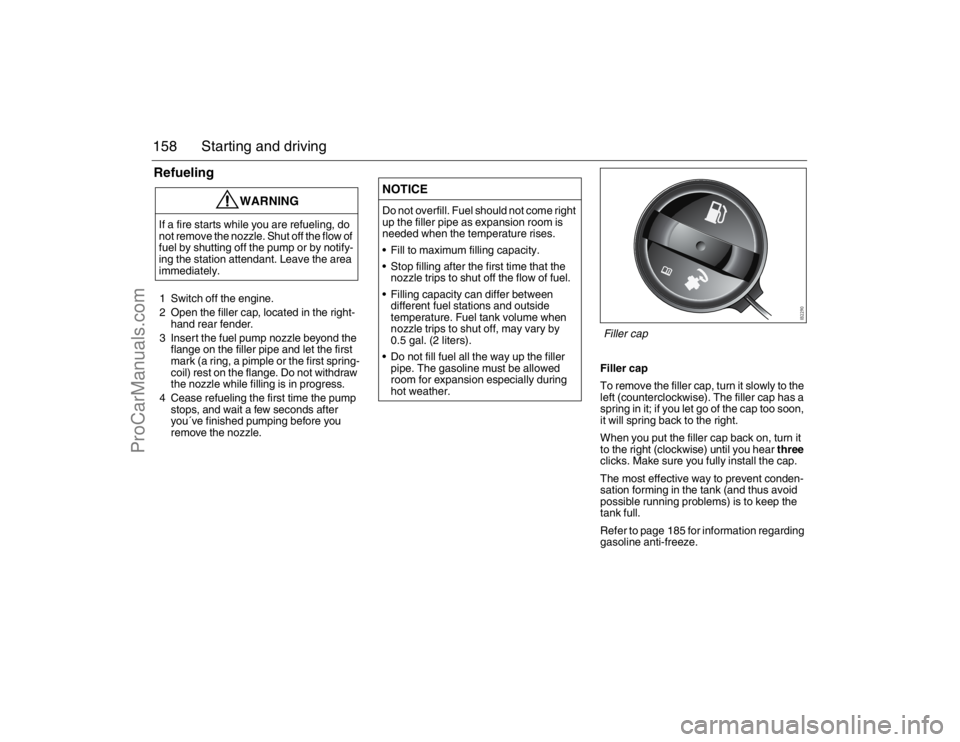
remove the nozzle.Filler cap
To remove the filler cap, turn it slowly to the
left (counterclockwise). The filler cap has a
spring in it; if you let go of the cap too soon,
it will spring back to the right.
When you put the filler cap back on, turn it
to the right (clockwise) until you hear three
clicks. Make sure you fully install the cap.
The most effective way to prevent conden-
sation forming in the tank (and thus avoid
possible running problems) is to keep the
tank full.
Refer to page 185 for information regarding
gasoline anti-freeze.
WARNING
If a fire starts while you are refueling, do
not remove the nozzle. Shut off the flow of
fuel by shutting off the pump or by notify-
ing the station attendant. Leave the area
immediately.
NOTICEDo not overfill. Fuel should not come right
up the filler pipe as expansion room is
needed when the temperature rises.
Fill to maximum filling capacity.
Stop filling after the first time that the
nozzle trips to shut off the flow of fuel.
Filling capacity can differ between
different fuel stations and outside
temperature. Fuel tank volume when
nozzle trips to shut off, may vary by
0.5 gal. (2 liters).
Do not fill fuel all the way up the filler
pipe. The gasoline must be allowed
room for expansion especially during
hot weather.
Filler cap
93_U S _M 07.book Page 158 W ednesday, April 12, 2006 9:30 AM
ProCarManuals.com
Page 159 of 304
159 Starting and driving
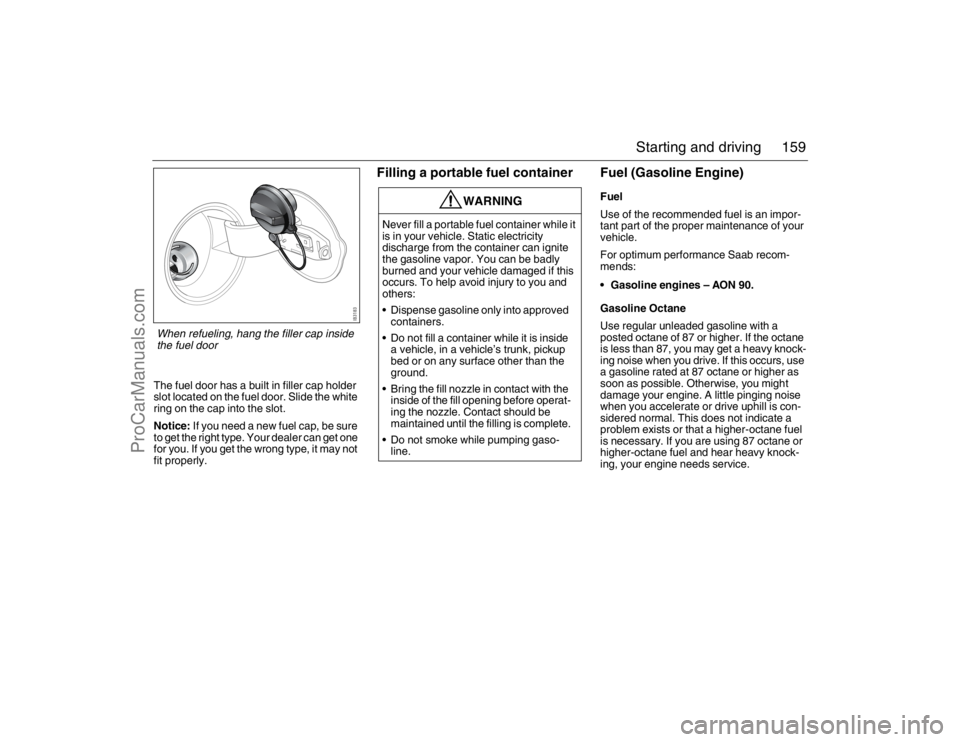
The fuel door has a built in filler cap holder
slot located on the fuel door. Slide the white
ring on the cap into the slot.
Notice: If you need a new fuel cap, be sure
to get the right type. Your dealer can get one
for you. If you get the wrong type, it may not
fit properly.
Filling a portable fuel container Fuel (Gasoline Engine)
Fuel
Use of the recommended fuel is an impor-
tant part of the proper maintenance of your
vehicle.
For optimum performance Saab recom-
mends:
Gasoline engines – AON 90.
Gasoline Octane
Use regular unleaded gasoline with a
posted octane of 87 or higher. If the octane
is less than 87, you may get a heavy knock-
ing noise when you drive. If this occurs, use
a gasoline rated at 87 octane or higher as
soon as possible. Otherwise, you might
damage your engine. A little pinging noise
when you accelerate or drive uphill is con-
sidered normal. This does not indicate a
problem exists or that a higher-octane fuel
is necessary. If you are using 87 octane or
higher-octane fuel and hear heavy knock-
ing, your engine needs service.
WARNING
Never fill a portable fuel container while it
is in your vehicle. Static electricity
discharge from the container can ignite
the gasoline vapor. You can be badly
burned and your vehicle damaged if this
occurs. To help avoid injury to you and
others:
Dispense gasoline only into approved
containers.
Do not fill a container while it is inside
a vehicle, in a vehicle’s trunk, pickup
bed or on any surface other than the
ground.
Bring the fill nozzle in contact with the
inside of the fill opening before operat-
ing the nozzle. Contact should be
maintained until the filling is complete.
Do not smoke while pumping gaso-
line.
When refueling, hang the filler cap inside
the fuel door93_U S _M 07.book Page 159 W ednesday, April 12, 2006 9:30 AM
ProCarManuals.com
Page 204 of 304

204 Car careBosch ME9 engine management
system, V6 engineThe Bosch ME9 engine management
system is a system that combines sequen-
tial multiport fuel injection, electronic distrib-
utorless ignition and turbocharger boost
pressure control into one system and intake
camshaft phasing control.
The ME9 engine control module (ECM)
monitors many different engine parameters
such as:
Charge air pressure.
Intake air temperature.
Crankshaft position.
Engine coolant temperature.
Throttle position.
The oxygen content of the exhaust gases.By processing all of this information, the
ME9 system can control fuel injector open-
ing duration, ignition timing, intake camshaft
phasing and turbocharger boost pressure to
provide excellent engine performance while
maintaining low emissions and fuel con-
sumption.
ORVR (Onboard Refueling Vapor
Recovery)All hydrocarbons formed when refueling will
be recovered by the car and not released
into the atmosphere. The hydrocarbons are
absorbed in an evaporative emission canis-
ter. When the engine is subsequently
started, the evaporative emission canister is
gradually purged as air is sucked into it
through a shut-off valve. The hydrocar-
bon/air mixture passes through the evap
canister purge valve and into the engine
where it is burned. “Refueling”, see
page 157.
When refueling, make sure you screw the
filler cap on and keep turning until it has
clicked 3 times.
NOTICEThe Trionic engine management system
continuously monitors the operation of
these systems and has on-board diag-
nostic capabilities (OBD II). If the Engine
malfunction (CHECK ENGINE) light in
the main instrument illuminates, the
Trionic ECM has detected a problem. The
car will continue to operate, but perfor-
mance may be diminished. You should
have your car checked by a workshop as
soon as possible. We recommend that
you contact a Saab dealer.
NOTICEThe ME9 engine management system
continuously monitors the operation of
these systems and has on-board diag-
nostic capabilities (OBD II). If the Engine
malfunction (CHECK ENGINE) light in
the main instrument illuminates, the ME9
ECM has detected a problem. The car will
continue to operate, but performance
may be diminished. You should have your
car checked by a workshop as soon as
possible. We recommend that you
contact a Saab dealer.
93_U S _M 07.book Page 204 W ednesday, April 12, 2006 9:30 AM
ProCarManuals.com
Page 251 of 304
251 Car care
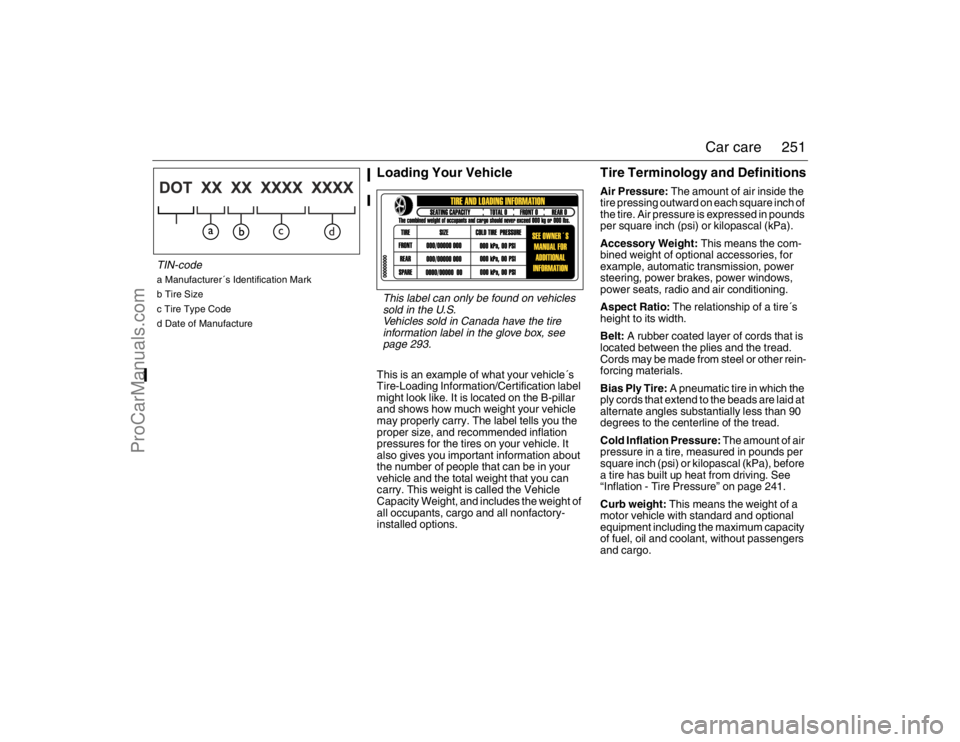
Loading Your VehicleThis is an example of what your vehicle´s
Tire-Loading Information/Certification label
might look like. It is located on the B-pillar
and shows how much weight your vehicle
may properly carry. The label tells you the
proper size, and recommended inflation
pressures for the tires on your vehicle. It
also gives you important information about
the number of people that can be in your
vehicle and the total weight that you can
carry. This weight is called the Vehicle
Capacity Weight, and includes the weight of
all occupants, cargo and all nonfactory-
installed options.
Tire Terminology and DefinitionsAir Pressure: The amount of air inside the
tire pressing outward on each square inch of
the tire. Air pressure is expressed in pounds
per square inch (psi) or kilopascal (kPa).
Accessory Weight: This means the com-
bined weight of optional accessories, for
example, automatic transmission, power
steering, power brakes, power windows,
power seats, radio and air conditioning.
Aspect Ratio: The relationship of a tire´s
height to its width.
Belt: A rubber coated layer of cords that is
located between the plies and the tread.
Cords may be made from steel or other rein-
forcing materials.
Bias Ply Tire: A pneumatic tire in which the
ply cords that extend to the beads are laid at
alternate angles substantially less than 90
degrees to the centerline of the tread.
Cold Inflation Pressure: The amount of air
pressure in a tire, measured in pounds per
square inch (psi) or kilopascal (kPa), before
a tire has built up heat from driving. See
“Inflation - Tire Pressure” on page 241.
Curb weight: This means the weight of a
motor vehicle with standard and optional
equipment including the maximum capacity
of fuel, oil and coolant, without passengers
and cargo.
This label can only be found on vehicles
sold in the U.S.
Vehicles sold in Canada have the tire
information label in the glove box, see
page 293.
TIN-codea Manufacturer´s Identification Mark
b Tire Size
c Tire Type Code
d Date of Manufacture93_U S _M 07.book Page 251 W ednesday, April 12, 2006 9:30 AM
ProCarManuals.com
Page 269 of 304

269 Car care
Other than in extremely cold weather, do not
screen the radiator, e.g. with netting, as this
will greatly diminish its cooling capacity.
Applicable to the manual climate control
system - During cold months the air condi-
tioning should be switched on once or
twice a month and run for 5–10 minutes
during highway driving once the engine is
warm.
This action saves the gaskets in the
compressor from being spoiled. The
compressor uses a lubricant that circu-
lates with the coolant.
Note:
The A/C system cannot be switched on
when the outside temperature is below 32°F
(0°C). Turn on the A/C system when the car
is standing in a warm place. Simplest is to
always have the A/C button pressed in. The
A/C system will then cut in automatically
when the outside temperature is high
enough.
Headlight aimingThe vehicle has a visual optical headlight
aiming system equipped with vertical
aiming device. The aim has been preset at
the factory and should normally not need
further adjustments.
If your headlights are damaged in a crash,
the headlight aim may be affected. If you
believe your headlights need to be re-
aimed, we recommend that you take it to
your Saab dealer for service. However, it is
possible for you to re-aim your headlights as
described in the following procedure.To check the aim, the vehicle should be
properly prepared as follows:
The vehicle shall be placed so that the
headlights are 25 ft (7.6 m) from a light
colored wall or other flat surface. The
aiming area should be darkened, this will
improve your ability to see the beam of the
low beam headlight being aimed.
An optical headlamp aimer can also be
used and will than replace the wall.
The vehicle must have all four wheels on
a perfectly level surface which is level all
the way to the wall or other flat surface.
The vehicle should be placed so it is per-
pendicular to the wall or other flat surface.
The vehicle should be unloaded and fuel
tank full, and one person or 160 lbs.
(75 kg) on the drivers seat.
The vehicle should be fully assembled
and all other work stopped while headlight
aiming is being done.
The vehicle should not have any snow,
ice or mud attached to it.
Tires should be inflated to the prescribed
pressure.
Close all doors.
Rock the vehicle to stabilize the suspen-
sion.
Headlight aiming is done with the vehicle
low beam lamps. The high beam lamps will
be correctly aimed if the low beam lamps
are aimed properly.
WARNING
Before checking/adjusting the headlight
aiming, switch off the engine to avoid
danger of fingers and hands being injured
by moving parts.
The radiator fan can start up even when
the engine is switched off.NOTICETo make sure that your headlights are
aimed properly read all instructions
before beginning. Failure to follow these
instructions could cause damage to
headlight parts or a not correctly aimed
headlight.
93_U S _M 07.book Page 269 W ednesday, April 12, 2006 9:30 AM
ProCarManuals.com
Page 285 of 304

285 Technical data
Fuel
Extra engine oil additives.
Don't add anything to your oil. The recommended oils are all
you will need for good engine performance and protection.
When to change engine oil.
Your vehicle has a display (SID) where time for service will be
shown. Based not only on mileage but also on driving condi-
tions the mileage at which a service will be indicated can vary
considerably.
For this service system to work it is of outmost importance that
the right engine oil is used.
When the message for service is displayed you need to have
the required service done as soon as possible.
After the service your service personnel will reset the service in-
dicator. It is important to reset the service indicator in order to
optimize the time to the next service.
Oil capacity, including filter (oil change)
4-cyl engine ______________________ 6.3 qts. (6.0 l)
V6 engine ________________________ 6.3 qts. (6.0 l)Fuel tank capacity ________________ 16.05 U.S. gal. (61 l)
For optimum performance Saab recom-
mends: _______________________Gasoline engines –
AON 90.
Gasoline with a lower octane rating can be used, although not
lower than AON 87. However, engine performance will fall
slightly and heavy loading and laboring should be avoided. For
optimum performance, use the recommended grade of fuel.
For further information on fuel, see page 159.93_U S _M 07.book Page 285 W ednesday, April 12, 2006 9:30 AM
ProCarManuals.com
Page 300 of 304

300 IndexDetermining correct load, tires
_____ 255
Direction indicator stalk switch _____ 101
Direction indicators
______________ 101
Dome light, Convertible
__________ 232
Dome light, Sport Sedan __________ 231
Donor battery, boost starting
______ 200
Door handles
___________________ 50
Door mirrors
___________________ 124
Drive belt
______________________ 218
Drive belt, length
________________ 287
Driver’s seat with memory
_________ 21
Driving at night
_________________ 197
Driving in cold climates
___________ 187
Driving in deep water
____________ 196
Driving in hot climates ____________ 189
Driving techniques
______________ 185
Driving with a compact wheel fitted
_ 257
Driving with a heavy load on hilly
roads
________________________ 167
Driving with a load
______________ 196
Driving with a roof load ___________ 194
Driving with the trunk lid open
______ 196
EEDR (Event Data Recorders)
______ 278
ESP, anti-skid system
____________ 177
Easy entry, Convertible ____________ 75
Economical motoring
____________ 185
Electric engine heater ____________ 186
Electric heating, front seats
_______ 114
Electric windows
________________ 121Electric windows, Convertible
_______ 79
Electrical system, technical data ____ 286
Electrically adjustable seats
________ 20
Electronic Stability Program (ESP)
__ 177
Electronic steering wheel lock
______ 154
Emergency opening of the narrow
backrest, Sport Sedan
__________ 142
Emergency operation of the
moonroof
_____________________ 132
Engine bay, cleaning
_____________ 263
Engine heater
__________________ 186
Engine immobilizer
_______________ 57
Engine management system
______ 205
Engine number
_________________ 293
Engine oil, checking
_____________ 209
Engine oil, grade
________________ 284
Engine oil, volume _______________ 285
Engine temperature gauge
_________ 90
Engine, description
______________ 204
Engine, technical data ____________ 283
Engines
_______________________ 286
Event Data Recorders (EDR)
______ 278
Extra electrical socket
____________ 136
FFacilitating entry to rear seat,
Convertible
____________________ 75
Factors affecting fuel consumption
__ 185
Filler cap
______________________ 160
Filling a portable fuel container
_____ 161
Filling up
______________________ 159Flat spots, tires
_________________ 245
Floor jack
______________________ 260
Folding down the rear seat
backrest, SportCombi
___________ 143
Folding down the rear seat,
Sport Sedan
__________________ 138
Front fog lights __________________ 101
Front towing eye ________________ 197
Fuel container
__________________ 161
Fuel gauge
_____________________ 91
Fuel grade _____________________ 285
Fuel information
_________________ 161
Functions, car alarm
______________ 60
Fuse panel in luggage compartment
_ 239
Fuse table
_____________________ 238
Fuses
_________________________ 236
GGDO, garage door opener
_________ 126
Gearbox number
________________ 293
General safety instructions,
Convertible
____________________ 64
Glove box
_____________________ 136
Glovebox lighting
________________ 233
HHandbrake
_____________________ 179
Hazard warning lights
____________ 102
Head restraint, Convertible
_________ 76
Head restraints
__________________ 23
93_U S _M 07.book Page 300 W ednesday, April 12, 2006 9:30 AM
ProCarManuals.com
Page 301 of 304

301 Index
Headlight flasher
________________ 100
Headlight levelling ________________ 99
Headlights
______________________ 99
Hood
_________________________ 204
Horn _________________________ 120
Horn button
____________________ 120
IIf a tire goes flat
________________ 250
Ignition switch
__________________ 152
Immobilizer
_____________________ 57
Important considerations for driving
_ 156
Important information, petrol-engined
cars with catalytic converters
_____ 157
Indicator lights
___________________ 84
Inflation, tires __________________ 243
Information about fuel
____________ 161
Instrument illumination, adjusting
___ 100
Interior lighting, Convertible
________ 80
Interior lighting, Sport Sedan and
SportCombi
___________________ 133
Interior rearview mirror
___________ 125
Intermittent malfunctioning, central
locking
_______________________ 52
JJump starting
__________________ 200
KKey
___________________________ 50
Kick-down
_____________________ 166
LLATCH (child safety)
______________ 25
Labeling, tire sidewall ____________ 251
Labels and plates, location
________ 293
Lashing eyes, Sport Sedan ________ 141
Lashing eyes, SportCombi ________ 146
Laying the car up
_______________ 181
Leather upholstery, cleaning
_______ 263
Lighting in luggage compartment,
Convertible
____________________ 81
Limp-home
____________________ 157
Limp-home, automatic transmission
_167
Load carriers, roof
_______________ 194
Load indices, tires _______________ 252
Loading your vehicle _____________ 253
Load-through hatch, Sport Sedan
___ 140
Load-through hatch, SportCombi ___ 145
Locking a car with flat battery
_______ 53
Locks
__________________________ 50
Long-term parking
_______________ 181
Luggage compartment
___________ 138
Luggage compartment lighting,
Convertible
____________________ 81
Luggage compartment lighting,
Sport Sedan ______________ 134
, 142Luggage compartment lighting,
changing
_____________________ 233
MMAXI fuses
____________________ 237
Main instrument panel
_____________ 84
Main/dipped beam
_______________ 100
Maintenance schedule
___________ 274
Manual gear selection ____________ 170
Manual gearbox
_________________ 164
Manual tripping of car alarm
________ 60
Materials used in the car,
reclamation
___________________ 269
Memory, driver’s seat
_____________ 21
Messages on SID, Convertible
______ 73
Milometer
_______________________ 92
Moonroof ______________________ 130
Mug holder ____________________ 134
NNew tires, buying
________________ 246
Night driving
___________________ 197
Number plate lighting, changing
____ 233
OORVR
________________________ 206
Oil capacity, engine
______________ 285
Opening handles
_________________ 50
Opening the soft top, Convertible
____ 66
93_U S _M 07.book Page 301 W ednesday, April 12, 2006 9:30 AM
ProCarManuals.com