spare tire SAAB 9-3 2007 Owners Manual
[x] Cancel search | Manufacturer: SAAB, Model Year: 2007, Model line: 9-3, Model: SAAB 9-3 2007Pages: 304, PDF Size: 26.16 MB
Page 2 of 304

2IntroductionThis manual provides practical guidance on
driving and caring for your Saab.
Although this manual describes the most
important differences between model vari-
ants, it does not specify the equipment or
features included on individual models.
Importation and distribution of Saab auto-
mobiles, spare parts and accessories are
handled exclusively by Saab Cars USA, Inc.
in the United States and by General Motors
of Canada Limited in Canada.
We recommend that you read through the
manual before taking the car out for the first
time and keep it in the car for future refer-
ence.To find a specific item, use the overviews
given on page 3–6. A list of content is given
at the beginning of each section of the
manual, and there is also a comprehensive
index at the back of the book.
Supplied with the car is a Warranty and Ser-
vice Record booklet which contains impor-
tant warranty information and specifies the
regular maintenance to be carried out. Also
included is a Quick Reference Guide, an
Infotainment System manual, tire warran-
ties and (U.S. customers), a dealer directory
with Roadside Assistance Program infor-
mation.
Since the policy at Saab is one of continual
improvement, we retain the right to incorpo-
rate modifications and to alter specifications
during production without prior notice.3 Asterisk means: equipment not fitted in all
cars (can depend on model variant, engine
variant, market specification, options or
accessories).
If you have any questions concerning your
car, its equipment, the warranty conditions,
etc., your Saab dealer will be pleased to
help, or you may call the Saab Customer
Assistance Center in the U.S. at 1-800-955-
9007 or email them at saab-
[email protected]. In Canada, please
contact the Saab Customer Assistance
Center at 1-800-263-1999.
Enjoy the road ahead!
Saab Automobile AB
Saab Automobile AB does not accept liability for
any damage caused by the fitting of spare parts,
exchange parts or accessories that are not
approved by Saab Automobile AB.
WARNING
Failure to heed warnings may cause
personal injury.NOTICENOTICE texts warns of potential damage
to the car if the recommendations are not
followed.
93_U S _M 07.book Page 2 W ednesday, April 12, 2006 9:30 AM
ProCarManuals.com
Page 4 of 304
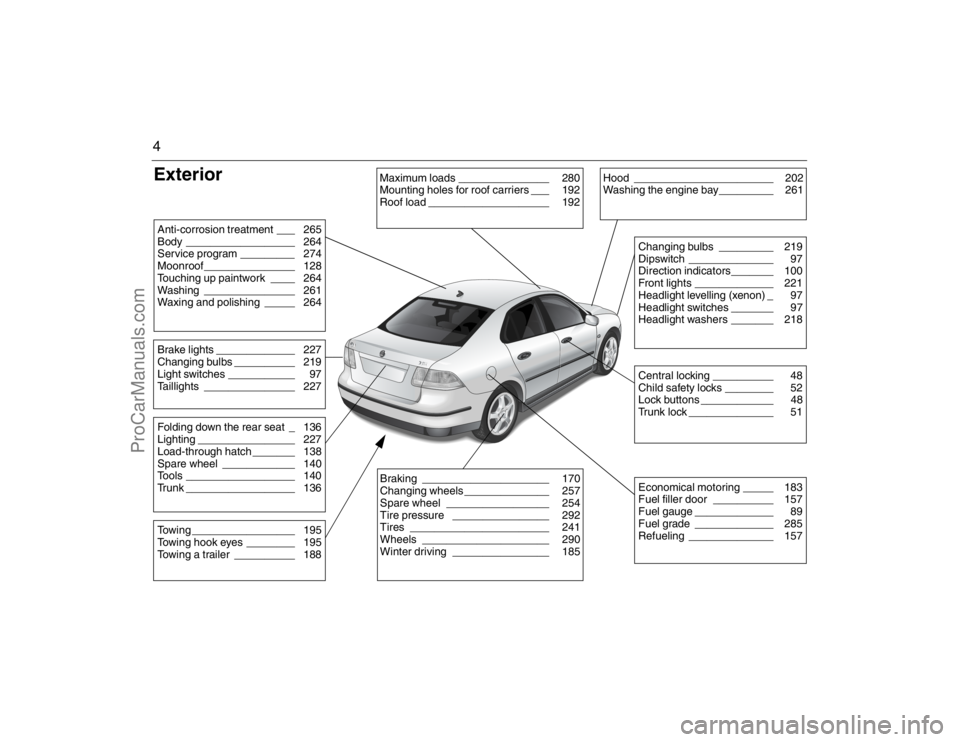
4ExteriorAnti-corrosion treatment ___ 265
Body __________________ 264
Service program _________ 274
Moonroof_______________ 128
Touching up paintwork ____ 264
Washing _______________ 261
Waxing and polishing _____ 264Brake lights _____________ 227
Changing bulbs __________ 219
Light switches ___________ 97
Taillights _______________ 227Towing _________________ 195
Towing hook eyes ________ 195
Towing a trailer __________ 188Folding down the rear seat _ 136
Lighting ________________ 227
Load-through hatch _______ 138
Spare wheel ____________ 140
Tools __________________ 140
Trunk __________________ 136
Maximum loads _______________ 280
Mounting holes for roof carriers ___ 192
Roof load ____________________ 192
Hood _______________________ 202
Washing the engine bay_________ 261
Central locking __________ 48
Child safety locks ________ 52
Lock buttons ____________ 48
Trunk lock ______________ 51Changing bulbs _________ 219
Dipswitch ______________ 97
Direction indicators_______ 100
Front lights _____________ 221
Headlight levelling (xenon) _ 97
Headlight switches _______ 97
Headlight washers _______ 218Economical motoring _____ 183
Fuel filler door __________ 157
Fuel gauge _____________ 89
Fuel grade _____________ 285
Refueling ______________ 157
Braking _____________________ 170
Changing wheels ______________ 257
Spare wheel _________________ 254
Tire pressure ________________ 292
Tires _______________________ 241
Wheels _____________________ 290
Winter driving ________________ 185
93_U S _M 07.book Page 4 W ednesday, April 12, 2006 9:30 AM
ProCarManuals.com
Page 9 of 304
9
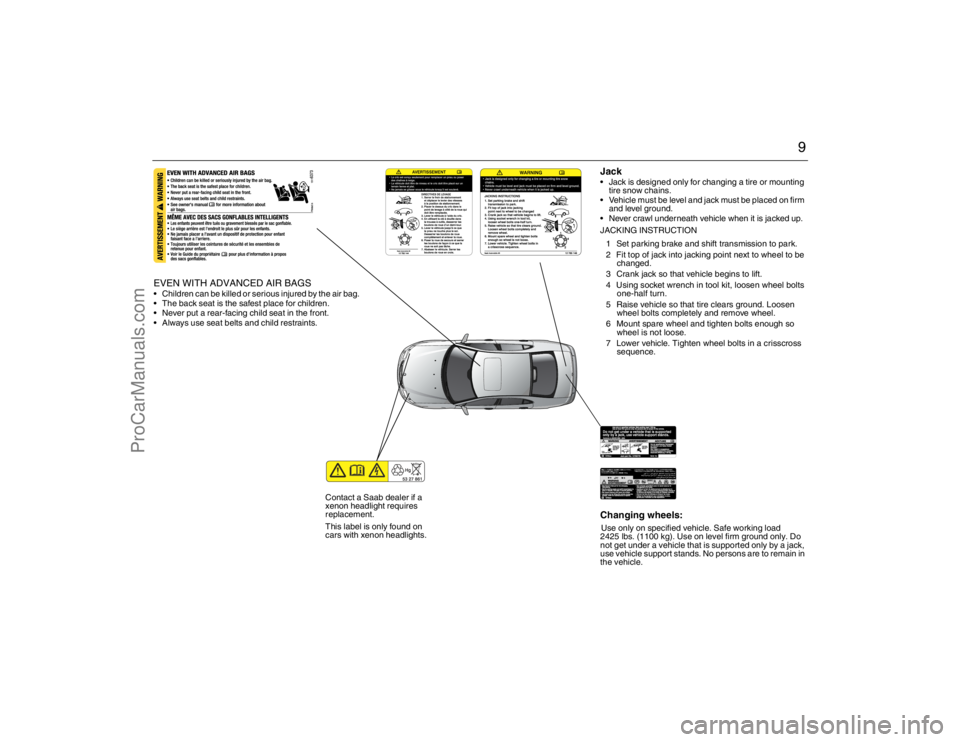
Changing wheels:Use only on specified vehicle. Safe working load
2425 lbs. (1100 kg). Use on level firm ground only. Do
not get under a vehicle that is supported only by a jack,
use vehicle support stands. No persons are to remain in
the vehicle.
Contact a Saab dealer if a
xenon headlight requires
replacement.
This label is only found on
cars with xenon headlights.
EVEN WITH ADVANCED AIR BAGS Children can be killed or serious injured by the air bag.
The back seat is the safest place for children.
Never put a rear-facing child seat in the front.
Always use seat belts and child restraints.
Jack Jack is designed only for changing a tire or mounting
tire snow chains.
Vehicle must be level and jack must be placed on firm
and level ground.
Never crawl underneath vehicle when it is jacked up.
JACKING INSTRUCTION
1 Set parking brake and shift transmission to park.
2 Fit top of jack into jacking point next to wheel to be
changed.
3 Crank jack so that vehicle begins to lift.
4 Using socket wrench in tool kit, loosen wheel bolts
one-half turn.
5 Raise vehicle so that tire clears ground. Loosen
wheel bolts completely and remove wheel.
6 Mount spare wheel and tighten bolts enough so
wheel is not loose.
7 Lower vehicle. Tighten wheel bolts in a crisscross
sequence.
93_U S _M 07.book Page 9 W ednesday, April 12, 2006 9:30 AM
ProCarManuals.com
Page 200 of 304

200 Starting and drivingUsing a battery charger3/starter
unitTo avoid damaging the car’s electrical
system and electronics, the following rules
must be followed when charging the battery
or jump starting the car.
If the charger or starter unit can be set to
different voltages (6V/12V/18V/24V), 12V
must be selected.
Follow the manufacturer’s instructions
supplied with the charger or starter unit.
No other apparatus that are grounded or
connected to the mains must be
connected to the car during charging or
jump starting.
The charger or starter unit must under no
conditions produce a voltage greater
than:
16V continuous
18V for 60 min.
If you are unsure about the charge rating of
the unit, disconnect the battery clamp from
the positive terminal before connecting the
unit to the battery.
For long tripsBefore starting off on a long journey, it is
advisable to have your car inspected by
your Saab dealer.
Obtain a few important items to take along
on your journey, such as spare bulbs, wiper
blades, fuses, a drive belt (poly-V-belt) and
the like.
You can check some points yourself before-
hand:
Check that no oil or fuel leaks out of the
engine or gearbox/transmission.
Check the coolant and power steering
fluid levels. Check also for leaks.
Inspect the drive belt (poly-V-belt) and
replace if it shows any signs of wear.
Check the battery charge.
Check the tires for tread pattern and air
pressure, including the compact spare
tire.
Take an extra remote control and keep it
separate.
Check the brakes.
Check all bulbs.
Check for the presence of the tool kit and
jack in the car.
93_U S _M 07.book Page 200 W ednesday, April 12, 2006 9:30 AM
ProCarManuals.com
Page 201 of 304
201 Car care
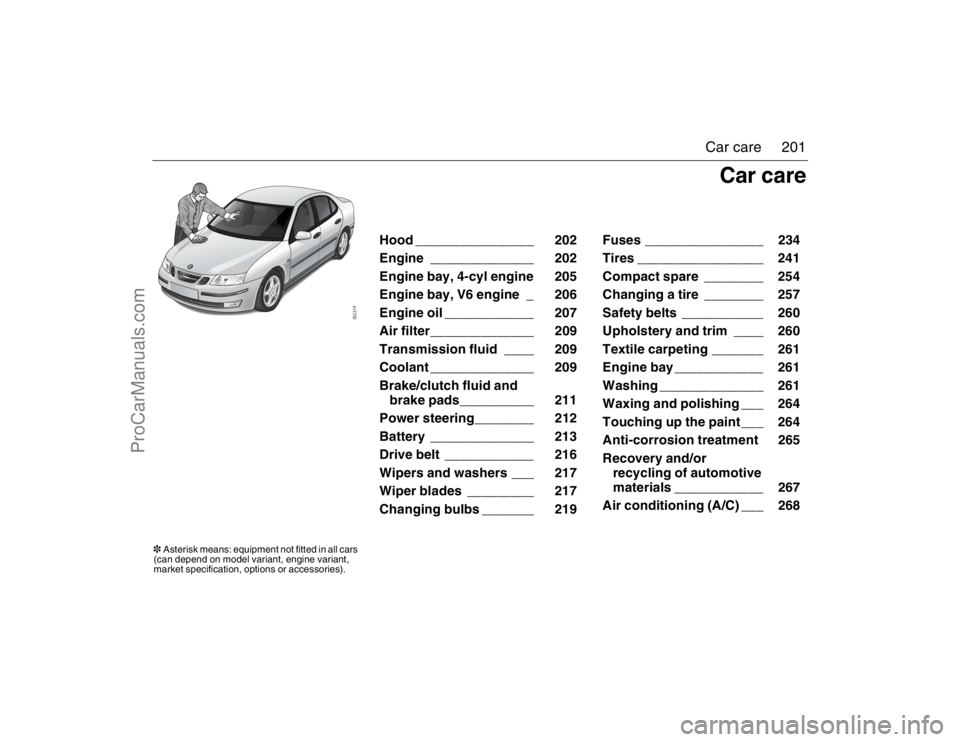
Hood ________________ 202
Engine ______________ 202
Engine bay, 4-cyl engine 205
Engine bay, V6 engine _ 206
Engine oil ____________ 207
Air filter______________ 209
Transmission fluid ____ 209
Coolant ______________ 209
Brake/clutch fluid and
brake pads__________ 211
Power steering________ 212
Battery ______________ 213
Drive belt ____________ 216
Wipers and washers ___ 217
Wiper blades _________ 217
Changing bulbs _______ 219 Fuses ________________ 234
Tires _________________ 241
Compact spare ________ 254
Changing a tire ________ 257
Safety belts ___________ 260
Upholstery and trim ____ 260
Textile carpeting _______ 261
Engine bay ____________ 261
Washing ______________ 261
Waxing and polishing ___ 264
Touching up the paint___ 264
Anti-corrosion treatment 265
Recovery and/or
recycling of automotive
materials ____________ 267
Air conditioning (A/C) ___ 268
Car care
3Asterisk means: equipment not fitted in all cars
(can depend on model variant, engine variant,
market specification, options or accessories).93_U S _M 07.book Page 201 W ednesday, April 12, 2006 9:30 AM
ProCarManuals.com
Page 242 of 304

242 Car careHigh speed operation
If you’ll be driving at high speeds, speeds of
100 mph (160 km/h) or higher, where it is
legal, set the cold inflation pressure to the
maximum inflation pressure shown on the
tire sidewall, or to 35 psi (244 kPa), which-
ever is lower. See the example below.
When you end this high-speed driving,
return to the cold inflation pressure shown
on the Tire and Loading Information label.
See on page 251.
Example:
You’ll find maximum load and inflation pres-
sure molded on the tire’s sidewall, in small
letters near the rim flange. It will read some-
thing like this: Maximum load 690 kg
(1521 lbs) 300 kPa (44 psi) Max. Press
For this example, you would set the inflation
pressure for high-speed driving at 35 psi
(244 kPa).When to checkCheck your tires once a month or more.
Don’t forget your compact spare tire. It
should be at 60 psi (420 kPa).
How to CheckUse a good quality pocket-type gage to
check tire pressure. You can’t tell if your
tires are properly inflated simply by looking
at them. Radial tires may look properly
inflated even when they’re underinflated.
Be sure to put the valve caps back on the
valve stems. They help prevent leaks by
keeping out dirt and moisture.Tire Inspection and RotationTires should be rotated every 10,000 miles
(16 000 km).
Any time you notice unusual wear, rotate
your tires as soon as possible and check
wheel alignment. Also check for damaged
tires or wheels. See “When It Is Time for
New Tires” on page 243 and “Wheel
Replacement” on page 247 for more infor-
mation.
The purpose of regular rotation is to achieve
more uniform wear for all tires on the vehi-
cle. The first rotation is the most important.
When rotating your tires, always use the
correct rotation pattern. Left front tire to left
rear. Left rear tire to right front. Right front to
right rear. Right rear to left front.
Don’t include the compact spare tire in your
tire rotation.
After the tires have been rotated, adjust the
front and rear inflation pressures as shown
on the Tire-Loading Information label. Make
WARNING
Driving at high speeds, 100 mph
(160 km/h) or higher, puts an additional
strain on tires.
Sustained high-speed driving causes
excessive heat build up and can cause
sudden tire failure. You could have a
crash and you or others could be killed.
Some high-speed rated tires require infla-
tion pressure adjustment for high speed
operation. When speed limits and road
conditions are such that a vehicle can be
driven at high speeds, make sure the tires
are rated for high speed operation, in
excellent condition, and set to the correct
cold tire inflation pressure for the vehicle
load.93_U S _M 07.book Page 242 W ednesday, April 12, 2006 9:30 AM
ProCarManuals.com
Page 245 of 304

245 Car care
Uniform Tire Quality GradingQuality grades can be found where applica-
ble on the tire sidewall between tread shoul-
der and maximum section width. For exam-
ple:
Treadwear 200 Traction AA
Temperature A
The following information relates to the
system developed by the United States
National Highway Traffic Safety Administra-
tion, which grades tires by treadwear, trac-
tion and temperature performance. (This
applies only to vehicles sold in the United
States.) The grades are molded on the side-
walls of most passenger car tires. The Uni-
form Tire Quality Grading system does not
apply to deep tread, winter-type snow tires,
space-saver or temporary use spare tires,
tires with nominal rim diameters of 10 to 12
inches (25 to 30 cm), or to some limited-pro-
duction tires.
While the tires available on General Motors
passenger cars and light trucks may vary
with respect to these grades, they must also
conform to federal safety requirements and
additional General Motors Tire Perfor-
mance Criteria (TPC) standards.
NOTICEWide wheels and tires with side walls that
are too low can:
be damaged in potholes, etc.
cause springs, shock absorbers and
wheel bearings and body mountings
to be overloaded.
affect the function of the Electronic
Stability Program (ESP
®).
The speed and load limits of the tires
must not be exceeded; see page 250.
Wheels larger than 17" must not be fitted
on the Saab 9-3 for reasons above. The
permissible offset is 1.61 inch (41 mm).
WARNING
Mixing tires could cause you to lose
control while driving. If you mix tires of
different sizes or types (radial and bias-
belted tires), the vehicle may not handle
properly, and you could have a crash.
Using tires of different sizes may also
cause damage to your vehicle. Be sure to
use the same size and type tires on all
wheels. It’s all right to drive with your
compact spare temporarily, it was devel-
oped for use on your vehicle. See
“Compact spare” on page 254.
WARNING
If you use bias-ply tires on your vehicle,
the wheel rim flanges could develop
cracks after many miles of driving. A tire
and/or wheel could fail suddenly, causing
a crash. Use only radial-ply tires with the
wheels on your vehicle.
93_U S _M 07.book Page 245 W ednesday, April 12, 2006 9:30 AM
ProCarManuals.com
Page 254 of 304

254 Car careWinter tiresWinter (snow) tires are recommended for
winter climates where the majority of your
driving will be done on snow and ice. Winter
tires should be fitted to all four wheels to
maintain a proper balance. Your Saab
dealer can advise you of to the correct size
tire for your car (if different from the original
size) and also supply Saab approved winter
tires pre-mounted on steel or alloy rims.
Winter tires normally use a different speed
rating compared to summer/all season tires.
Make sure not to exceed the stated speed
rating on the tires you use.Tire date codeTires should be regarded as perishable
goods. As the tires age, the rubber becomes
progressively harder, and the roadholding
ability of the tires diminishes. This is partic-
ularly true on winter tires.
Tires have a code that specifies their date of
manufacture. The first two digits denote the
week number and the last two digits the year
followed by a filled triangle.
Compact spareThe compact spare is light and easy to
handle when changing the tire. Its use is
only permitted when a standard tire has sus-
tained a puncture. The maximum life of the
tire is only just over 2,000 miles (3,500 km).
Do not exceed 50 mph (80 km/h) with the
compact spare fitted.
The tire pressure should be 60 psi
(420 kPa). Put the punctured tire in the
spare wheel well under the trunk floor.
Have the standard tire repaired and refitted
as soon as possible.The spare tire, the tools and the jack with its
crank are carried under a panel in the trunk.
Fold the carpeting forward to ease access to
the tools and spare tire.
The screwdriver handle has a “button” for
removing plastic rivets. This type of rivet
must be removed when changing the light
bulb in the trunk lid (see page 228).
Your Saab is equipped with a trip computer
and you can use its “Speed warning” func-
tion, to monitor driving speed since you
must not exceed 50 mph (80 km/h), see
page 90.
WARNING
The spare tire or punctured tire must be
stowed under the trunk floor, and secured
in place with the retaining nut.
93_U S _M 07.book Page 254 W ednesday, April 12, 2006 9:30 AM
ProCarManuals.com
Page 255 of 304
255 Car care
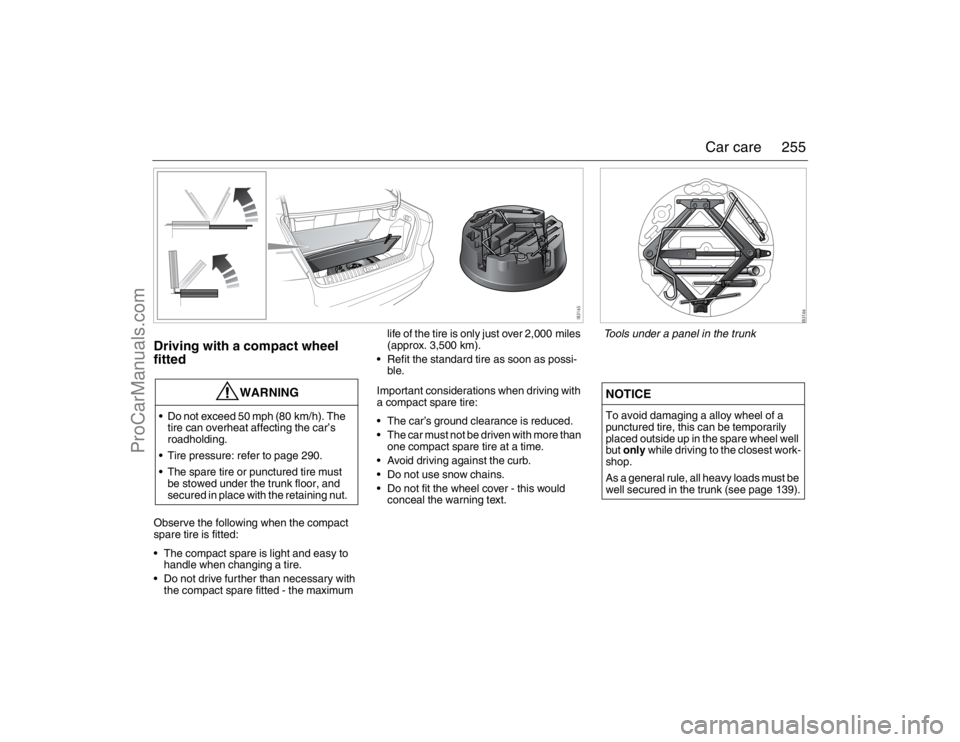
Driving with a compact wheel
fittedObserve the following when the compact
spare tire is fitted:
The compact spare is light and easy to
handle when changing a tire.
Do not drive further than necessary with
the compact spare fitted - the maximum life of the tire is only just over 2,000 miles
(approx. 3,500 km).
Refit the standard tire as soon as possi-
ble.
Important considerations when driving with
a compact spare tire:
The car’s ground clearance is reduced.
The car must not be driven with more than
one compact spare tire at a time.
Avoid driving against the curb.
Do not use snow chains.
Do not fit the wheel cover - this would
conceal the warning text.
WARNING
Do not exceed 50 mph (80 km/h). The
tire can overheat affecting the car’s
roadholding.
Tire pressure: refer to page 290.
The spare tire or punctured tire must
be stowed under the trunk floor, and
secured in place with the retaining nut.
NOTICETo avoid damaging a alloy wheel of a
punctured tire, this can be temporarily
placed outside up in the spare wheel well
but only while driving to the closest work-
shop.
As a general rule, all heavy loads must be
well secured in the trunk (see page 139).Tools under a panel in the trunk
93_U S _M 07.book Page 255 W ednesday, April 12, 2006 9:30 AM
ProCarManuals.com
Page 257 of 304

257 Car care
Changing a tire
WARNING
Lifting a vehicle and getting under it to do
maintenance or repairs is dangerous
without the appropriate safety equipment
and training. The jack provided with your
vehicle is designed only for changing a
flat tire. If it is used for anything else, you
or others could be badly injured or killed if
the vehicle slips off the jack. Use the jack
provided with your vehicle only for chang-
ing a flat tire.
Changing a tire can be dangerous. The
vehicle can slip off the jack and roll over
or fall on you or other people. You and
they could be badly injured or even killed.
Find a level place to change your tire. To
help prevent the vehicle from moving:
1 Set the parking brake firmly.
2 If you have an automatic transmis-
sion, put the shift lever in PARK (P).
For a manual transmission, leave the
car in gear (1st or REVERSE (R)).
3 Turn off the engine and do not restart
while the vehicle is raised.
4 Do not allow passengers to remain in
the vehicle.
To be even more certain the vehicle won't
move, you should put blocks at the front
and rear of the tire farthest away from the
one being changed. That would be the
tire, on the other side, at the opposite end
of the vehicle.
The car jack is designed solely for use
in changing a tire or fitting snow
chains. It must not be used to
support the car during repair work
or servicing.
Never crawl under a car that is
supported only by a jack. Always use
axle stands.
Raising your vehicle too high or with
the jack improperly positioned can
damage the vehicle and even make
the vehicle fall. To help avoid personal
injury and vehicle damage, be sure to
fit the jack lift head into the proper
location before raising the vehicle, and
raise the vehicle only far enough off
the ground so there is enough room for
the spare tire to fit (no more than
25 mm or 1 inch clearance between
the ground and the bottom of the tire).
Switch on the hazard warning lights if
the car is on a road.
The jack should be stored correctly
under the carpeting in the trunk. If it
lies loose in the car, it could thrown
forward and cause personal injury in
the event of a crash or if the car rolls
over.
Grit, salt and rust can clog the inner
threads of the wheel bolts if the car has
been driven for several years exclu-
sively with alloy wheels.
If steel wheels are being installed, the
bolt hole threads in the brake hubs
should be cleaned before the thinner
steel wheels are fitted. It may other-
wise not be possible to achieve the
correct clamping force, despite tight-
ening the wheel bolts to the correct
torque.
93_U S _M 07.book Page 257 W ednesday, April 12, 2006 9:30 AM
ProCarManuals.com