warning SAAB 9-3 2008 Owners Manual
[x] Cancel search | Manufacturer: SAAB, Model Year: 2008, Model line: 9-3, Model: SAAB 9-3 2008Pages: 320, PDF Size: 56.39 MB
Page 182 of 320
182 Starting and drivingSaab Parking
Assistance3
33 3Saab Parking Assistance
Saab Parking Assistance facilitates parking
and reversing. There are four sensors in the
rear bumper that detect objects up to 6 ft
(1.8 meters) behind the car.
If the car is heavily laden, the system may
falsely indicate that there is an object within
the detection range. This is since the sen-
sors are angled towards the ground when
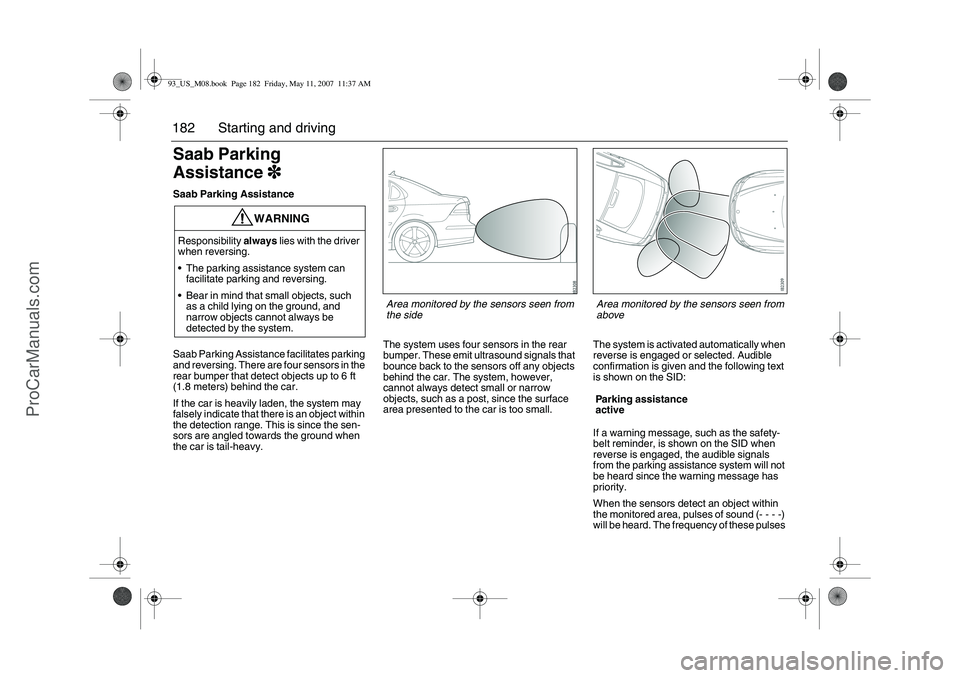
the car is tail-heavy.The system uses four sensors in the rear
bumper. These emit ultrasound signals that
bounce back to the sensors off any objects
behind the car. The system, however,
cannot always detect small or narrow
objects, such as a post, since the surface
area presented to the car is too small.The system is activated automatically when
reverse is engaged or selected. Audible
confirmation is given and the following text
is shown on the SID:
If a warning message, such as the safety-
belt reminder, is shown on the SID when
reverse is engaged, the audible signals
from the parking assistance system will not
be heard since the warning message has
priority.
When the sensors detect an object within
the monitored area, pulses of sound (- - - -)
will be heard. The frequency of these pulses
WARNING
Responsibility always lies with the driver
when reversing.
The parking assistance system can
facilitate parking and reversing.
Bear in mind that small objects, such
as a child lying on the ground, and
narrow objects cannot always be
detected by the system.
Parking assistance
active
Area monitored by the sensors seen from
the side
Area monitored by the sensors seen from
above
93_US_M08.book Page 182 Friday, May 11, 2007 11:37 AM
ProCarManuals.com
Page 186 of 320
186 Starting and drivingto reach its optimum temperature, and
engine wear is at its greatest during this
period. Drive off as soon as possible after
starting the engine and avoid high engine
speeds.
Drive as smoothly and thoughtfully as
possible. Match your driving to the prevail-
ing traffic conditions.
Driving in a low gear gives rise to higher
fuel consumption than driving in a high
gear because of the higher engine speed
for any given road speed. Always shift up
as soon as traffic conditions allow and
drive in the highest gear as much as
possible.
Check the tire pressure once a month.
Incorrect tire pressure increases tire
wear. It is preferable for the tire pressure
to be slightly high than too low. Under-
pressure increases fuel consumption.Check the fuel consumption regularly.
Increased fuel consumption can indicate
that something is wrong and that the car
needs to be checked. We recommend
that you contact a Saab dealer.
Practical road tests have demonstrated that
substantial savings in fuel consumption can
be made if the above advice is followed.
Road conditionsWet roads increase fuel consumption, as do
unpaved roads and driving in hilly country
(the amount of fuel saved driving downhill is
less than the additional amount required to
climb the hill).
Engine block heater3
33 3The following are just some of the benefits
to the car and the environment of using an
engine block heater:
Lower fuel consumption.
Reduced wear on the engine.
Inside of car warms up faster.
Exhaust emissions substantially reduced
over short runs.
The engine heater is effective at outside
temperatures up to 60–70°F (+15 –
+20°C). The warmer it is outside, the
shorter the time the engine heater needs to
be connected. Longer than 1.5 hours is
unnecessary.
If the car is equipped with a removable,
electric cabin heater that is not in use, store
this in the trunk.
WARNING
Never switch off the engine while driving
as the effect of the brakes and power
steering will be greatly reduced.
93_US_M08.book Page 186 Friday, May 11, 2007 11:37 AM
ProCarManuals.com
Page 188 of 320
188 Starting and drivingRemember that tires age: it may therefore
be necessary to change winter tires before
they reach the legal wear limit, as they grad-
ually lose their friction properties with age.
If you get into a front wheel skid and the car
has a manual transmission, the best
response is to freewheel, which means
declutching so that the wheels neither drive
nor brake, and to cautiously steer in the
desired direction.
If the car has automatic transmission, ease
off the accelerator slightly and steer cau-
tiously in the desired direction.
If you get into a rear wheel skid, steer in the
same direction as the movement of the rear
of the car.
Driving with tire chains3
33 3Snow chains must only be fitted to the wheel
and tire dimensions that Saab recommends
in "Technical data" on page 285.
We recommend that you contact a Saab
dealer regarding approved tire chains. See
also page 251.
WARNING
Do not drive at speeds above 30 mph
(50 km/h) when tire chains are fitted.
Tire chains can reduce directional sta-
bility.
Do not fit tire chains to the car’s rear
wheels.
NOTECheck the links frequently for wear.
Check that the chains do not foul the
wheel arch liner at full lock.
Refer to the "Technical data" section
on page 285, for information on wheel
and tire dimensions approved for the
fitting of tire chains.
93_US_M08.book Page 188 Friday, May 11, 2007 11:37 AM
ProCarManuals.com
Page 189 of 320
189 Starting and driving
Driving in hot climatesAlways check the coolant level before start-
ing a journey. When the engine is cold, the
coolant shall lie on or just above the
KALT/COLD mark on the expansion tank
(boundary between the upper and lower
sections of the tank).
At the end of a journey, allow the engine to
idle for 2–3 minutes before switching it off.
If the needle on the temperature gauge
enters the red zone, the following message
will be shown on the SID:
1 Stop the car but do not switch off the
engine. Do not remove the cap on the
cooling system expansion tank, even if
the tank is empty. The engine tempera-
ture should decrease. If the temperature
continues to rise with the engine idling,
the engine must be switched off.2 If the engine is idling and the needle on
the temperature gauge falls, wait until a
normal temperature is shown (about in
the middle of the scale) before switching
off the engine. If the coolant needs to be
topped up, carefully unscrew the
expansion tank cap.
Fill as required with a mixture of 50 %
antifreeze and 50 % clean water. Use an
antifreeze approved by Saab.
3 Have the car’s cooling system checked.
We recommend that you contact a Saab
dealer. Hot engine. Make a
safe stop. Idle engine.
WARNING
Exercise care when opening the hood
if the engine is overheated. Never
remove the expansion tank cap com-
pletely when the engine is hot.
The cooling system is pressurized -
hot coolant and vapour can escape.
These can cause injury to your eyes
and burns. Open the cap slowly to
release the pressure before removing
it.
93_US_M08.book Page 189 Friday, May 11, 2007 11:37 AM
ProCarManuals.com
Page 190 of 320
190 Starting and drivingTowing a trailer3
33 3Make sure you are familiar with the legal
requirements regarding speed limits for
towing, maximum trailer weights, trailer
braking requirements, and also any spe-
cial driving licence provisions.
Trailer hitch attachment3
33 3Trailer hitch attachments are available as
accessories. These are designed for a max-
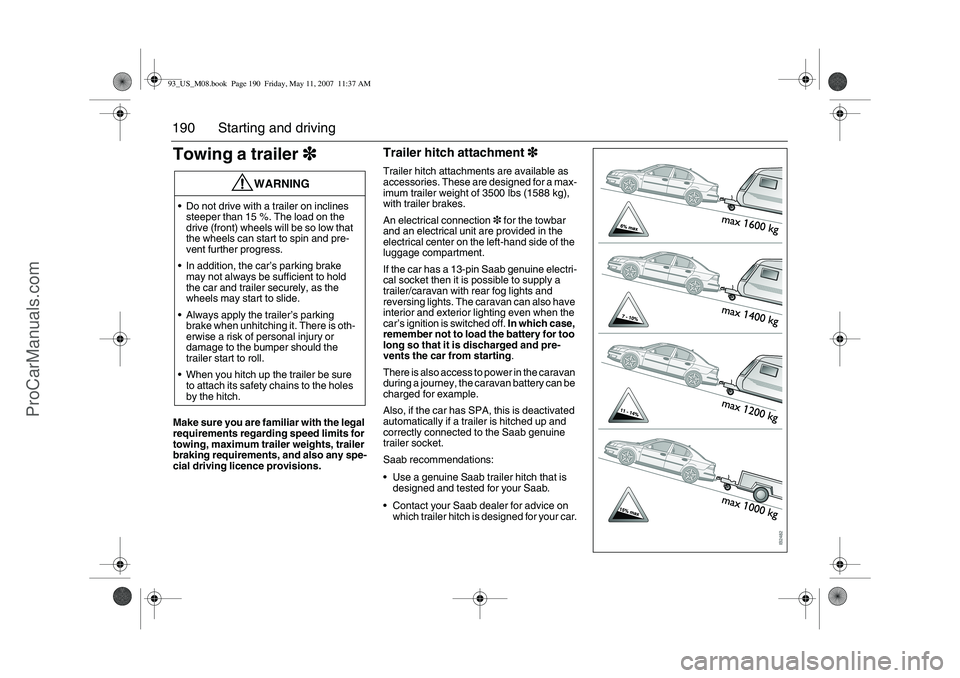
imum trailer weight of 3500 lbs (1588 kg),
with trailer brakes.
An electrical connection3 for the towbar
and an electrical unit are provided in the
electrical center on the left-hand side of the
luggage compartment.
If the car has a 13-pin Saab genuine electri-
cal socket then it is possible to supply a
trailer/caravan with rear fog lights and
reversing lights. The caravan can also have
interior and exterior lighting even when the
car’s ignition is switched off. In which case,
remember not to load the battery for too
long so that it is discharged and pre-
vents the car from starting.
There is also access to power in the caravan
during a journey, the caravan battery can be
charged for example.
Also, if the car has SPA, this is deactivated
automatically if a trailer is hitched up and
correctly connected to the Saab genuine
trailer socket.
Saab recommendations:
Use a genuine Saab trailer hitch that is
designed and tested for your Saab.
Contact your Saab dealer for advice on
which trailer hitch is designed for your car.
WARNING
Do not drive with a trailer on inclines
steeper than 15 %. The load on the
drive (front) wheels will be so low that
the wheels can start to spin and pre-
vent further progress.
In addition, the car’s parking brake
may not always be sufficient to hold
the car and trailer securely, as the
wheels may start to slide.
Always apply the trailer’s parking
brake when unhitching it. There is oth-
erwise a risk of personal injury or
damage to the bumper should the
trailer start to roll.
When you hitch up the trailer be sure
to attach its safety chains to the holes
by the hitch.93_US_M08.book Page 190 Friday, May 11, 2007 11:37 AM
ProCarManuals.com
Page 192 of 320
192 Starting and drivingWhen continuing your journey, manually
select a low gear in which the engine speed
is about 3,500 rpm until the incline eases
(see page 170).
Recommendations for cars with
manual transmissionRises in coolant temperature are indicated
by the temperature gauge in the main instru-
ment panel.
When the needle is just outside the red
zone, the A/C compressor will be switched
off and, on certain engine variants, the max-
imum engine torque will be limited.
When continuing your journey, select a low
gear in which the engine speed is about
3,500 rpm until the incline eases.
Trailer hitch loadThe weight distribution on the trailer makes
a lot of difference to the handling properties
of the car and trailer combination. With a
two-wheel trailer, concentrate the load over
the wheels and keep it as low as possible.
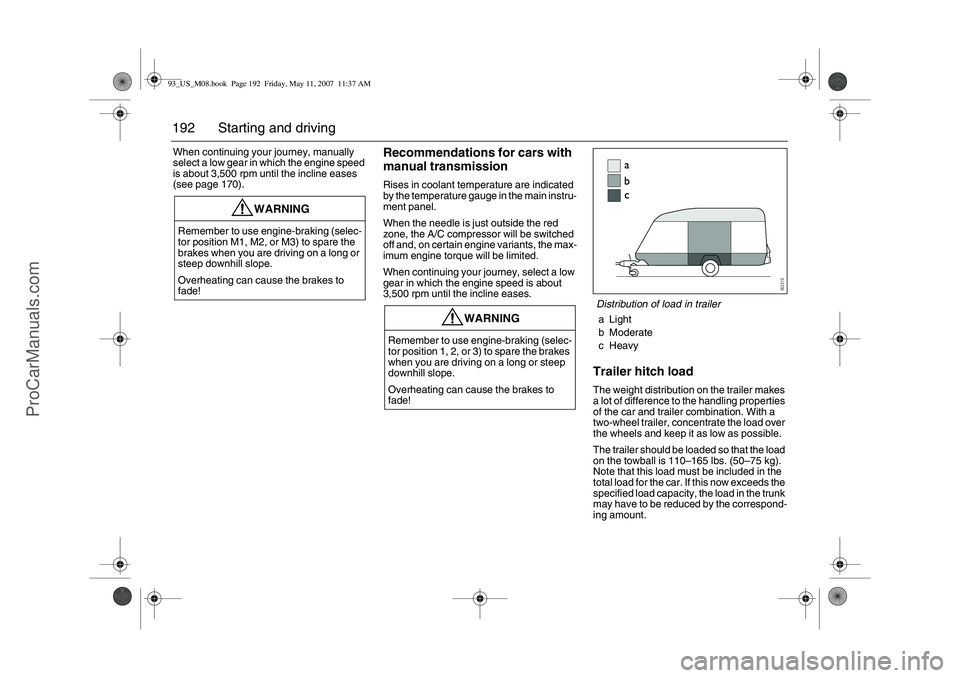
The trailer should be loaded so that the load
on the towball is 110–165 lbs. (50–75 kg).
Note that this load must be included in the
total load for the car. If this now exceeds the
specified load capacity, the load in the trunk
may have to be reduced by the correspond-
ing amount.
WARNING
Remember to use engine-braking (selec-
tor position M1, M2, or M3) to spare the
brakes when you are driving on a long or
steep downhill slope.
Overheating can cause the brakes to
fade!
WARNING
Remember to use engine-braking (selec-
tor position 1, 2, or 3) to spare the brakes
when you are driving on a long or steep
downhill slope.
Overheating can cause the brakes to
fade!
Distribution of load in trailer
aLight
b Moderate
c Heavy
93_US_M08.book Page 192 Friday, May 11, 2007 11:37 AM
ProCarManuals.com
Page 194 of 320
194 Starting and drivingDriving with a roof rack
loadThe maximum permissible roof load is
220 lbs. (100 kg). Note that the roof load
must be included in the car’s maximum per-
missible payload and axle load.
Strong, sturdy roof carriers designed spe-
cially for your car are available from your
Saab dealer. Always secure roof loads
securely.
Fitting roof carriers3
33 3SportSedan and SportCombi without
roof rails
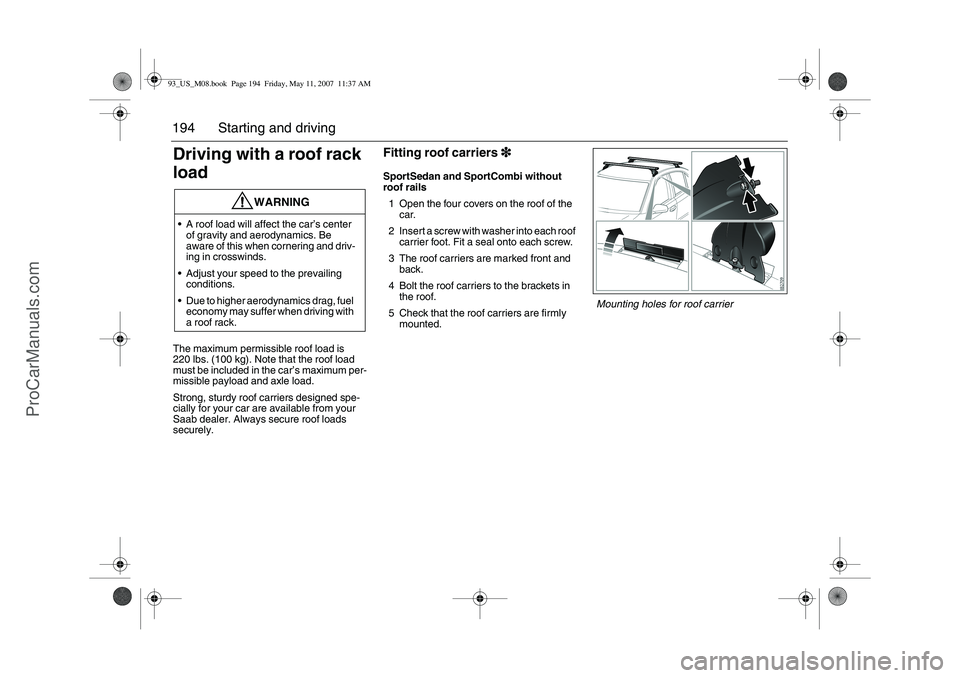
1 Open the four covers on the roof of the
car.
2 Insert a screw with washer into each roof
carrier foot. Fit a seal onto each screw.
3 The roof carriers are marked front and
back.
4 Bolt the roof carriers to the brackets in
the roof.
5 Check that the roof carriers are firmly
mounted.
WARNING
A roof load will affect the car’s center
of gravity and aerodynamics. Be
aware of this when cornering and driv-
ing in crosswinds.
Adjust your speed to the prevailing
conditions.
Due to higher aerodynamics drag, fuel
economy may suffer when driving with
a roof rack.
Mounting holes for roof carrier
93_US_M08.book Page 194 Friday, May 11, 2007 11:37 AM
ProCarManuals.com
Page 196 of 320
196 Starting and drivingDriving with a loadThe handling characteristics are affected by
how the car is loaded.
Driving with the trunk lid
openIf you must drive with the trunk lid open,
close all windows and the moonroof (if
equipped) and set the cabin fan to its high-
est speed setting.
Driving in deep water
NOTEPlace the heaviest load as far forward
and as low as possible in the trunk.
Secure the load to the lashing eyes
(see page 141).
Heavy loads mean that the car’s
center of gravity is further back. As a
result, the car will sway more during
evasive steering.
Never exceed the permissible load of
the roof box, even if there is room for
more.
Ensure that the tire pressure is correct
– slight overinflation is preferable to
underinflation.
The braking distance of a loaded car is
always greater. Keep your distance
from the vehicle in front.
Do not exceed the car’s permissible
gross vehicle weight or axle load (see
page 286).
Roof loads can negatively affect tele-
communication.
For further information on tires see
page 244.
WARNING
Avoid driving with the trunk lid partly or
fully open, since exhaust fumes can be
drawn into the cabin.
NOTEDo not drive in puddles or water deeper
than 7 in. (20 cm) and do not drive faster
than 3–4 mph. Water can otherwise be
sucked into the engine. The engine will be
seriously damaged if water enters the
intake system.
93_US_M08.book Page 196 Friday, May 11, 2007 11:37 AM
ProCarManuals.com
Page 197 of 320
197 Starting and driving
Driving at nightBear in mind the following points, especially
when driving at night:
Nighttime driving requires your full
concentration
Do not rush. Count on your journey taking
slightly longer.
The number of drivers under the influence
of drugs is likely to be greater at night than
during the day.
Do not stare at the headlights of oncom-
ing vehicles.
Avoid driving at night if you have poor
eyesight. Night vision deteriorates with
age.
Keep your car’s headlights, windows and
mirrors clean. Also, if you wear glasses,
make sure they are clean.
Make sure you are well rested before
starting a long journey. Take a break every
other hour.
Only eat light meals. Heavy meals have a
tendency to induce tiredness.
Wild animals prefer to move at dusk and
dawn.
Check the headlight levelling setting (see
page 98).
Towing the car
Front towing eye
WARNING
Remember that the brake servo does
not operate when the engine is off.
Much greater pressure than normal
will therefore be required to operate
the brake pedal.
Nor does the steering servo operate
when the engine is off. The steering
will therefore be much heavier than
usual.
The towing vehicle should always be
heavier than the vehicle on tow.
Never allow passengers to ride in the
car when it is on tow.
Always seek professional help if the
car needs to be recovered.
The ignition switch must be in the ON
position if the car is moved with the
engine not running.
The steering wheel lock must be dis-
engaged before towing the car.
The steering wheel lock disengages
when the remote control is inserted
into the ignition switch, if the battery
has sufficient charge.
WARNING
Make sure that the towing eye is
screwed in tightly. It has a left-hand
thread!
The towing eye is only designed for
towing the car on roads. It must not
be used to pull the car out of a ditch,
for example.
Make sure that all bystanders keep a
suitable distance, in case the towing
eye or tow rope should snap. The
towing eye or tow rope could catapult
off and cause seriously injury.
Never drive with the towing eye fitted
to the front bumper. Return it to its des-
ignated storage space.
93_US_M08.book Page 197 Friday, May 11, 2007 11:37 AM
ProCarManuals.com
Page 200 of 320
200 Starting and drivingJump starting
It is essential when a donor battery is to be
used to jump start the car that the jump
leads be connected correctly to prevent
arcing.
To jump start your vehicle
1 Check the other vehicle. It must have a
12-volt battery with a negative ground
system.2 Get the vehicles close enough so the
jumper cables can reach, but be sure the
vehicles are not touching each other. If a
poor connection on the negative jumper
cable should exist, it is possible for
damage to be caused to electrical
systems/components of either vehicle
should inadvertent contact be made.
You would not be able to start your car
and bad grounding could damage the
electrical systems.
3 Turn off the ignition on both vehicles.
Turn off lights that are not needed, and
radios. This will avoid sparks and help
save both batteries and it could save
your radio.
WARNING
When working on the battery, highly
explosive gas can build up. A spark
could ignite this gas that collects
around the battery. Therefore, always
avoid sparks and open flames in the
vicinity of the battery.
The battery contains corrosive sulphu-
ric acid. Always wear a face mask or
goggles when working on the battery.
If battery acid gets into the eyes or
splashes onto skin or clothing, wash
the affected area liberally with water. If
acid gets into the eyes or a large quan-
tity makes contact with the skin, seek
medical help.
NOTEIgnoring these steps could result in costly
damage to your vehicle that would not be
covered by your warranty.
Trying to start your car by pushing or pull-
ing it could damage your vehicle, even if
you have a manual transmission. If you
have an automatic transmission, your
vehicle cannot be started by pushing or
pulling it.
NOTEIf the other system is not a 12-volt system
with a negative ground, both vehicles can
be damaged.
WARNING
You could be injured if the vehicles roll.
Set the parking brake firmly on each vehi-
cle. Put an automatic transmission in P
(Park) or a manual transmission in Neu-
tral.
93_US_M08.book Page 200 Friday, May 11, 2007 11:37 AM
ProCarManuals.com