warning SAAB 9-3 2008 Manual Online
[x] Cancel search | Manufacturer: SAAB, Model Year: 2008, Model line: 9-3, Model: SAAB 9-3 2008Pages: 320, PDF Size: 56.39 MB
Page 145 of 320
145 Interior equipment
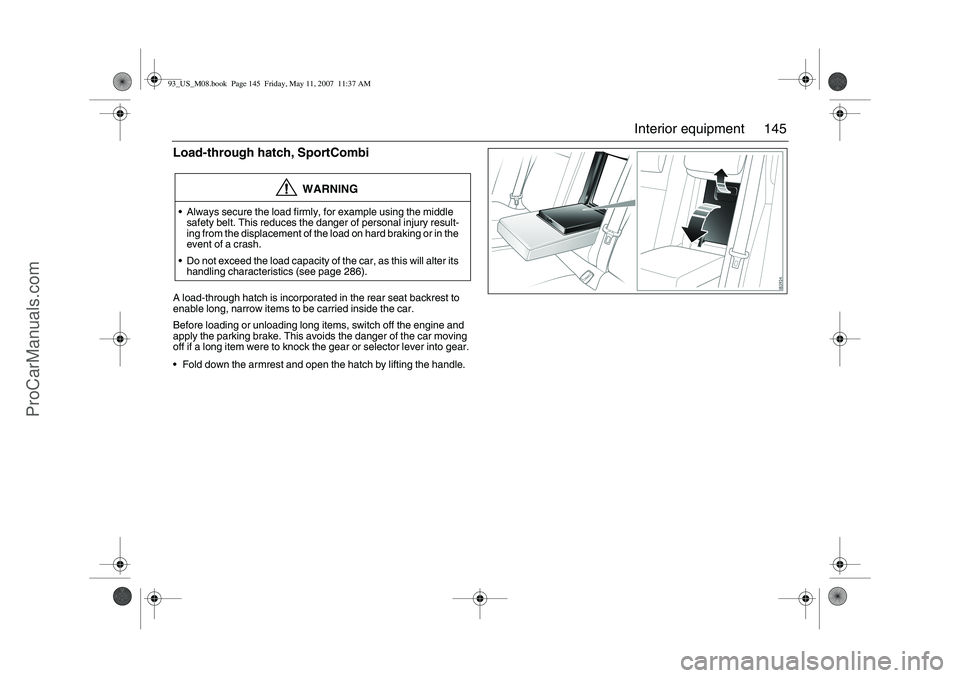
Load-through hatch, SportCombiA load-through hatch is incorporated in the rear seat backrest to
enable long, narrow items to be carried inside the car.
Before loading or unloading long items, switch off the engine and
apply the parking brake. This avoids the danger of the car moving
off if a long item were to knock the gear or selector lever into gear.
Fold down the armrest and open the hatch by lifting the handle.
WARNING
Always secure the load firmly, for example using the middle
safety belt. This reduces the danger of personal injury result-
ing from the displacement of the load on hard braking or in the
event of a crash.
Do not exceed the load capacity of the car, as this will alter its
handling characteristics (see page 286).93_US_M08.book Page 145 Friday, May 11, 2007 11:37 AM
ProCarManuals.com
Page 146 of 320
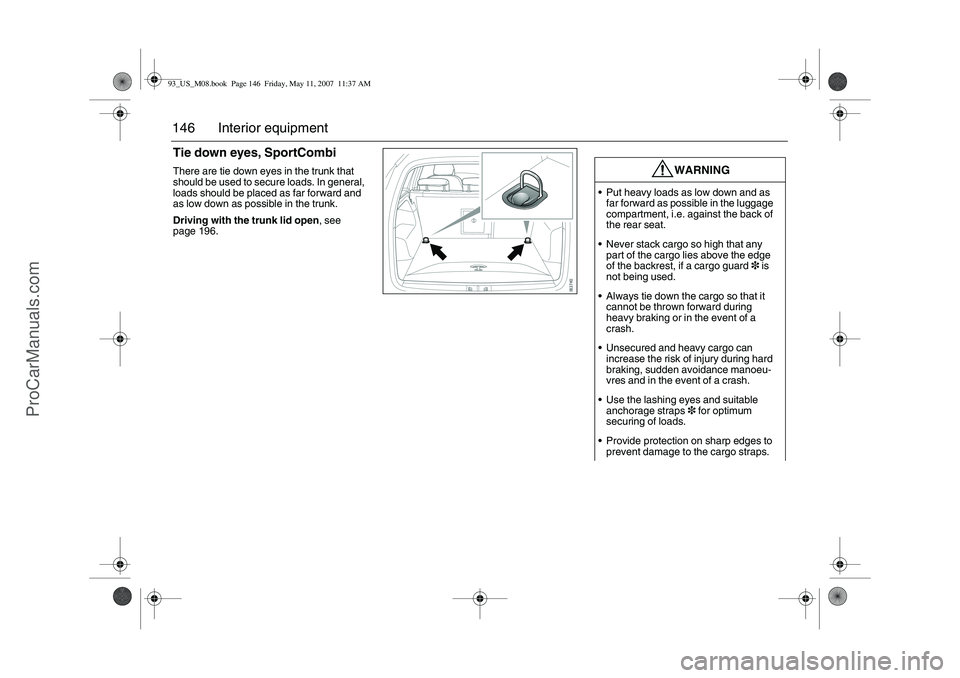
146 Interior equipmentTie down eyes, SportCombiThere are tie down eyes in the trunk that
should be used to secure loads. In general,
loads should be placed as far forward and
as low down as possible in the trunk.
Driving with the trunk lid open, see
page 196.
WARNING
Put heavy loads as low down and as
far forward as possible in the luggage
compartment, i.e. against the back of
the rear seat.
Never stack cargo so high that any
part of the cargo lies above the edge
of the backrest, if a cargo guard3 is
not being used.
Always tie down the cargo so that it
cannot be thrown forward during
heavy braking or in the event of a
crash.
Unsecured and heavy cargo can
increase the risk of injury during hard
braking, sudden avoidance manoeu-
vres and in the event of a crash.
Use the lashing eyes and suitable
anchorage straps3 for optimum
securing of loads.
Provide protection on sharp edges to
prevent damage to the cargo straps.
93_US_M08.book Page 146 Friday, May 11, 2007 11:37 AM
ProCarManuals.com
Page 147 of 320
147 Interior equipment
Cargo net3
33 3
If possible, avoid having the rear seat
folded down when driving with a heavy
load, because the anchoring possibili-
ties are restricted when the rear seat
is in this position. That the rear seat
is in the upright is a basic require-
ment for protection against cargo
displacement in the event of a
crash.
Improve safety by fastening the outer
safetybelts. Check that the red "indi-
cator-flag" next to the opening han-
dles is not visible. If the red "indica-
tor-flag" is visible the backrest is not
locked.
Match your speed and driving style to
how the car is loaded. The handling
characteristics of the car can be
affected since a load in the trunk will
alter the car’s center of gravity.
An object weighing 55 lbs. (25 kg) cor-
responds to a weight of 2200 lbs.
(1,000 kg) in a front-end collision at
32 mph (50 km/h).
Adjust the car’s load (passengers and
luggage) so that the gross vehicle
weight and the axle weight are not
exceeded, see page 286.
WARNING
Never overload the cargo net3. If the
elastic breaks this may cause per-
sonal injury. Do not use a cargo net
that shows signs of wear.
Never use the elastic floor net3 and
elastic side net3 when the rear seat is
folded down. These nets are only
intended to keep light objects tidy, not
for the anchoring of loads.
Secure the load in the luggage com-
partment firmly. Using a cargo net is
not considered as load securing.
The only purpose of a cargo net is to
prevent light objects from being
thrown forward into the cabin during
heavy breaking.
93_US_M08.book Page 147 Friday, May 11, 2007 11:37 AM
ProCarManuals.com
Page 150 of 320
150 Interior equipmentCargo guard3
33 3, SportCombi
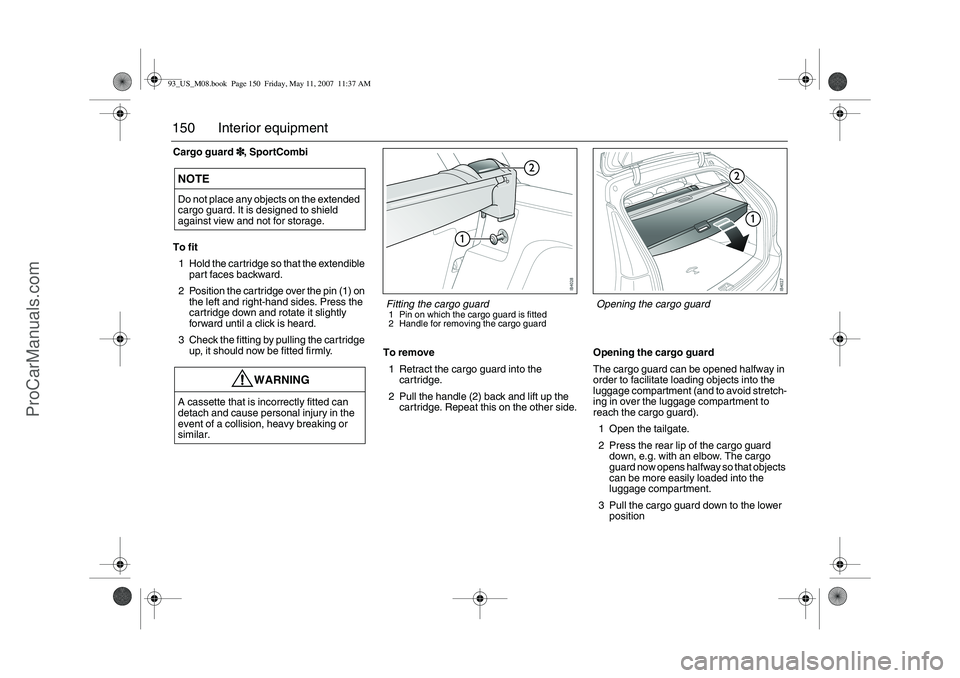
To fit
1 Hold the cartridge so that the extendible
part faces backward.
2 Position the cartridge over the pin (1) on
the left and right-hand sides. Press the
cartridge down and rotate it slightly
forward until a click is heard.
3 Check the fitting by pulling the cartridge
up, it should now be fitted firmly.
To remove
1 Retract the cargo guard into the
cartridge.
2 Pull the handle (2) back and lift up the
cartridge. Repeat this on the other side.Opening the cargo guard
The cargo guard can be opened halfway in
order to facilitate loading objects into the
luggage compartment (and to avoid stretch-
ing in over the luggage compartment to
reach the cargo guard).
1 Open the tailgate.
2 Press the rear lip of the cargo guard
down, e.g. with an elbow. The cargo
guard now opens halfway so that objects
can be more easily loaded into the
luggage compartment.
3 Pull the cargo guard down to the lower
positionNOTEDo not place any objects on the extended
cargo guard. It is designed to shield
against view and not for storage.
WARNING
A cassette that is incorrectly fitted can
detach and cause personal injury in the
event of a collision, heavy breaking or
similar.
Fitting the cargo guard1 Pin on which the cargo guard is fitted
2 Handle for removing the cargo guard
Opening the cargo guard
93_US_M08.book Page 150 Friday, May 11, 2007 11:37 AM
ProCarManuals.com
Page 152 of 320

152 Starting and drivingIgnition switchThe ignition switch is located on the center
console between the front seats. In cars
with automatic transmission, the remote
control can only be removed when the
selector lever is in position P.
To allow the various systems in the car time
to register that the remote control has been
inserted into the ignition switch, do not turn
the remote control for roughly half a second.
LOCK positionThe parking lights, hazard warning lights
and interior lighting can be turned on.
Cars with automatic transmission: Move
the gear lever to P.
The gear lever is locked in position. This is
the only position in which the remote control
can be removed.
Cars with manual transmission: The
remote control can be removed regardless
of the position of the gear lever.
NOTETake care not to spill drinks or to drop
crumbs over the ignition switch. If dirt or
liquid gets into it, the switch may not
operate properly.
If snow from clothing falls into the ignition
switch and melts, the ignition switch can
seize (freeze). Brush snow off clothing
before getting into the car.
WARNING
Always remove the remote control
before leaving children unattended in
the car.
Apply the parking brake before remov-
ing the remote control.
Never remove the remote control
while the car is moving. This will acti-
vate the steering wheel lock and make
it impossible to steer the car.
93_US_M08.book Page 152 Friday, May 11, 2007 11:37 AM
ProCarManuals.com
Page 153 of 320

153 Starting and driving
OFF positionParts of the electrical system are operative.
Do not leave the remote control in the
OFF position with the engine not running
as this could cause the battery to run flat
in a matter of hours.
Cars with automatic transmission: The
gear lever is not locked. See also page 166.
If the ignition switch is turned from ON to
OFF before the car is stationary then turning
to LOCK may not be possible. In which case
turn the ignition switch to the ON position
until the ABS lamp goes out,
approx. 2 seconds. Following which, turn it
back to OFF.
ON positionThe entire electrical system is operative.
Do not leave the remote control in the ON
position when the engine is not running.
Turn the ignition switch to the OFF position
to disconnect the electrical system.
When you turn the ignition switch to ON,
some indicator and warning lights will come
on in the main instrument panel. These
should go out after about 3 seconds.
ST - starter positionThe starter motor operates (automatic
transmission: selector lever must be in P or
N) when the ignition switch is turned to this
position. When released, the ignition switch
will spring back to the ON position.
The car has an electronic restart lock. If the
engine fails to start, the ignition switch must
first be turned back to a position between
OFF and LOCK before the starter motor can
be operated again.
93_US_M08.book Page 153 Friday, May 11, 2007 11:37 AM
ProCarManuals.com
Page 154 of 320

154 Starting and drivingSteering wheel lockThe steering wheel lock is electronic. The
lock engages when the remote control is
removed from the ignition and unlocks when
the remote control is inserted. A click can be
heard when the steering wheel lock locks
and unlocks.
If the car is parked with one front wheel
touching the curb, for example, you may
need to turn the steering wheel slightly
when you insert the remote control to allow
the steering wheel lock to unlock. If you do
not succeed on first attempt you must
remove the remote control before trying
again. Turn the steering wheel and insert
the remote control into the ignition switch.
If the steering wheel lock does not disen-
gage it will not be possible to turn the remote
control in the ignition switch.
The following message is shown on the SID:If a fault arises affecting the steering wheel
lock, the following message will be
displayed on the SID:
If the steering wheel lock malfunctions while
the remote control is in the ignition switch,
this may prevent the removal of the remote
control or prevent the car from being
restarted once the engine has been
switched off.
If you have to leave the car, lock the car by
pressing down the lock buttons on the
doors. Lock the front left door from outside
with the traditional key (see page 50). The
car is now locked but the alarm is inactive.
Starting the engine
Pull out key, turn
steering wheel. Restart.
Steering lock malfunc.
Make a safe stop.
WARNING
When starting the engine:
–Sit down in the driver’s seat.
–Depress the clutch pedal fully (M/T). If
the gear lever is not in the neutral posi-
tion, the clutch pedal must be fully
depressed or the car will jump for-
wards or backwards, which may
cause a crash.
–Never start the car from outside the
vehicle, e.g. through a window that is
down. This could lead to serious per-
sonal injury.
Cars with automatic transmission:
select position P to remove the ignition
key. The key can only be removed in
this gear position.
Carbon monoxide (CO) is a colorless,
odorless, poisonous gas. Be alert to
the danger of CO – always open the
garage doors before starting the
engine in the garage.
Do not rest or sleep in the car when
parked with the engine running. There
is a risk of depressing the accelerator
which could lead to engine damage.
There is also a danger of CO poison-
ing if the exhaust system is leaking.
93_US_M08.book Page 154 Friday, May 11, 2007 11:37 AM
ProCarManuals.com
Page 155 of 320

155 Starting and driving
Starting the engineAvoid racing the engine or loading it heavily
before it has warmed up. Do not drive away
before the warning and indicator lights have
gone out.
The engine has an automatic choke and
should be started as follows:
Cars with manual transmission
To start the engine the clutch pedal must
be fully depressed.
1 Make sure the parking brake is applied.
2 Depress the clutch pedal but do not
touch the accelerator.
3 Start the engine. Let the ignition switch
spring back as soon as the engine has
started and is running smoothly.
Allow the engine to idle for about
10 seconds. Do not apply full throttle for at
least 3 minutes after starting.Cars with automatic transmission
The selector lever must be in the P or N
position.
1 The selector lever must be in the P or N
position.
2 Keep your foot on the brake pedal.
Note! Once the engine has started, the
brake pedal will sink. This is perfectly
normal.
3 Start the engine. Let the ignition switch
spring back as soon as the engine has
started and is running smoothly.
Allow the engine to idle for about
10 seconds. Do not apply full throttle for at
least 3 minutes after starting.
Useful tips on starting the engineIf the engine has failed to start after several
attempts in very cold weather, proceed as
follows:
1 Turn the ignition switch to ON (it is
essential that you turn the ignition to
ON before depressing the accelerator).
2 Press the accelerator to the floor and run
the starter motor for 5-10 seconds. This
will prevent the engine being flooded
(fully depressed accelerator cuts off the
fuel supply).
3 Now start the engine in the normal way
- do not touch the accelerator.
If the engine stalls immediately after starting
(e.g. if the clutch was released too quickly),
do not touch the accelerator when restarting
the engine.
93_US_M08.book Page 155 Friday, May 11, 2007 11:37 AM
ProCarManuals.com
Page 157 of 320

157 Starting and driving
Limp-homeThe engine management system has a
diagnostic feature that checks a number of
internal functions. If a fault is detected in the
throttle valve, the engine management
system will set the throttle system to the
limp-home mode. This means:
idling control will be poor (uneven idling
since regulated by ignition and fuel
supply)
engine performance will be reduced
the cruise control will not function
the capacity of the A/C compressor will be
limited.
If the diagnosis function detects a fault in the
engine management system, the light
"Engine malfunction (CHECK ENGINE)" in
the instrument panel will come on (see
page 83). Have the car checked at a work-
shop as soon as possible. We recommend
that you contact a Saab dealer.
Important considerations with
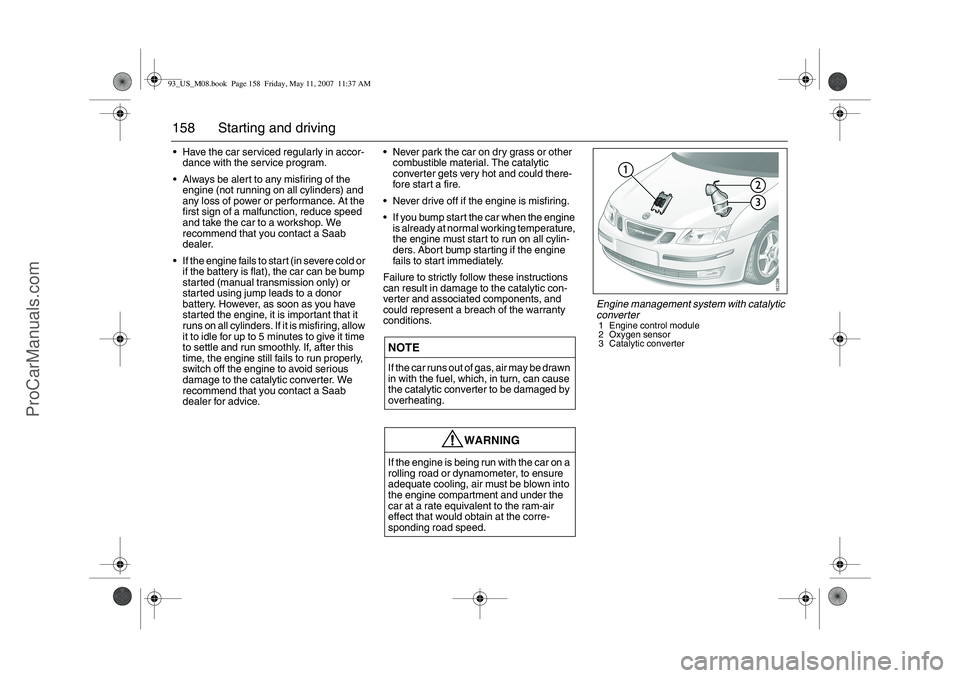
catalytic convertersThe catalytic converter is an emission con-
trol device incorporated in the car’s exhaust
system. It consists of a metal canister with a
honeycomb insert, the cells of which have
walls coated in a catalytic layer (precious
metal alloy).
To ensure that the catalytic converter con-
tinues to function properly, and also to avoid
damage to the converter and its associated
components, the following points must be
observed:
NOTEIf "Engine malfunction (CHECK
ENGINE)" warning light starts to flash
(indicating that the engine is misfiring and
the catalytic converter can be damaged),
ease off the accelerator slightly. The light
should go out or start to shine constantly.
If the light continues to flash despite
easing off the accelerator, you may con-
tinue to drive the car but at the minimum
throttle permitted by the current traffic sit-
uation. Have the car checked as soon as
possible. We recommend that you con-
tact a Saab dealer.
NOTEUse only unleaded gasoline. Leaded gas-
oline is detrimental to the catalyst and
oxygen sensor and will seriously impair
the function of the catalytic converter.
93_US_M08.book Page 157 Friday, May 11, 2007 11:37 AM
ProCarManuals.com
Page 158 of 320
158 Starting and drivingHave the car serviced regularly in accor-
dance with the service program.
Always be alert to any misfiring of the
engine (not running on all cylinders) and
any loss of power or performance. At the
first sign of a malfunction, reduce speed
and take the car to a workshop. We
recommend that you contact a Saab
dealer.
If the engine fails to start (in severe cold or
if the battery is flat), the car can be bump
started (manual transmission only) or
started using jump leads to a donor
battery. However, as soon as you have
started the engine, it is important that it
runs on all cylinders. If it is misfiring, allow
it to idle for up to 5 minutes to give it time
to settle and run smoothly. If, after this
time, the engine still fails to run properly,
switch off the engine to avoid serious
damage to the catalytic converter. We
recommend that you contact a Saab
dealer for advice.Never park the car on dry grass or other
combustible material. The catalytic
converter gets very hot and could there-
fore start a fire.
Never drive off if the engine is misfiring.
If you bump start the car when the engine
is already at normal working temperature,
the engine must start to run on all cylin-
ders. Abort bump starting if the engine
fails to start immediately.
Failure to strictly follow these instructions
can result in damage to the catalytic con-
verter and associated components, and
could represent a breach of the warranty
conditions.
NOTEIf the car runs out of gas, air may be drawn
in with the fuel, which, in turn, can cause
the catalytic converter to be damaged by
overheating.
WARNING
If the engine is being run with the car on a
rolling road or dynamometer, to ensure
adequate cooling, air must be blown into
the engine compartment and under the
car at a rate equivalent to the ram-air
effect that would obtain at the corre-
sponding road speed.
Engine management system with catalytic
converter1 Engine control module
2 Oxygen sensor
3 Catalytic converter
93_US_M08.book Page 158 Friday, May 11, 2007 11:37 AM
ProCarManuals.com