brake SAAB 9-3 2008 User Guide
[x] Cancel search | Manufacturer: SAAB, Model Year: 2008, Model line: 9-3, Model: SAAB 9-3 2008Pages: 320, PDF Size: 56.39 MB
Page 97 of 320
97 Instruments and controls
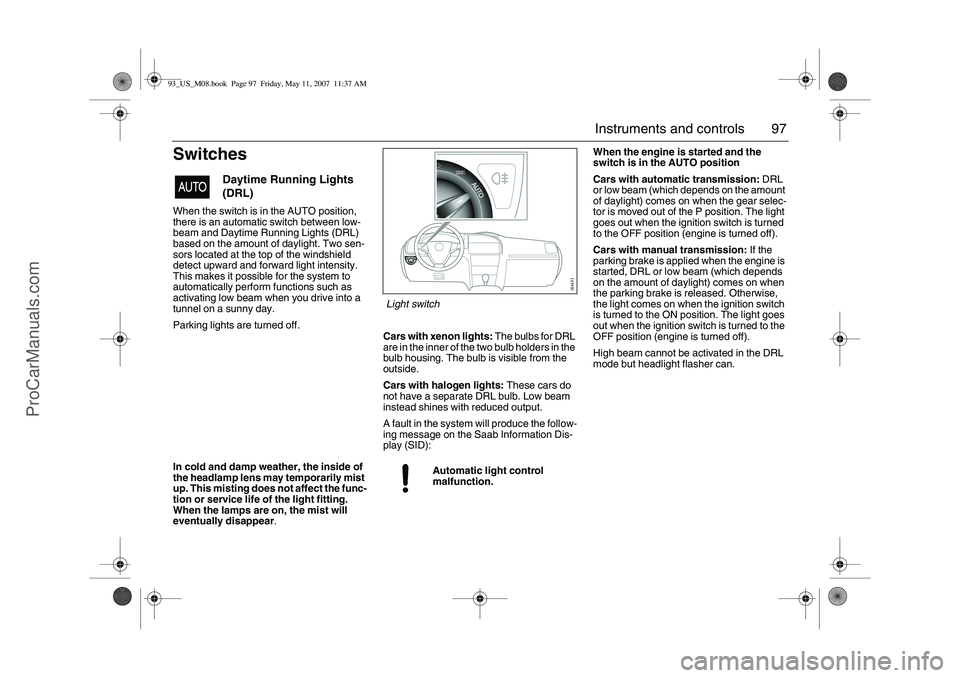
SwitchesWhen the switch is in the AUTO position,
there is an automatic switch between low-
beam and Daytime Running Lights (DRL)
based on the amount of daylight. Two sen-
sors located at the top of the windshield
detect upward and forward light intensity.
This makes it possible for the system to
automatically perform functions such as
activating low beam when you drive into a
tunnel on a sunny day.
Parking lights are turned off.
Cars with xenon lights: The bulbs for DRL
are in the inner of the two bulb holders in the
bulb housing. The bulb is visible from the
outside.
Cars with halogen lights: These cars do
not have a separate DRL bulb. Low beam
instead shines with reduced output.
A fault in the system will produce the follow-
ing message on the Saab Information Dis-
play (SID):When the engine is started and the
switch is in the AUTO position
Cars with automatic transmission: DRL
or low beam (which depends on the amount
of daylight) comes on when the gear selec-
tor is moved out of the P position. The light
goes out when the ignition switch is turned
to the OFF position (engine is turned off).
Cars with manual transmission: If the
parking brake is applied when the engine is
started, DRL or low beam (which depends
on the amount of daylight) comes on when
the parking brake is released. Otherwise,
the light comes on when the ignition switch
is turned to the ON position. The light goes
out when the ignition switch is turned to the
OFF position (engine is turned off).
High beam cannot be activated in the DRL
mode but headlight flasher can.
Daytime Running Lights
(DRL)
Automatic light control
malfunction.
In cold and damp weather, the inside of
the headlamp lens may temporarily mist
up. This misting does not affect the func-
tion or service life of the light fitting.
When the lamps are on, the mist will
eventually disappear.
Light switch
93_US_M08.book Page 97 Friday, May 11, 2007 11:37 AM
ProCarManuals.com
Page 138 of 320

138 Interior equipmentTrunkFolding down the rear seat, SportSedanConvertible: The rear seat cannot be folded.
WARNING
Never drive the car if the backrest is not correctly locked into
position as this increases the risk of personal injury in the
event of heavy braking or a crash.
Never leave a child or animal unattended in the car. During
sunny weather the temperature in the passenger and trunk
can climb to 160–180°F (70–80°C). Small children are very
susceptible to heat stroke.
Keep hands well clear of all moving parts.
Never place heavy objects on the parcel shelf. There is always
a danger of loose objects being thrown forward and causing
injury if the car should brake suddenly or be involved in a
crash. See also page 196.
When folding the backrest back upright, make sure that it is
locked correctly on both sides. This is imperative since the
center safety belt is mounted in the backrest.
When folding the backrest back upright, make sure that it is
locked correctly on both sides. This is imperative since other-
wise objects in the trunk could force their way into the cabin
during heavy breaking or a crash.
Adjust the head restraints for the rear seats to be occupied to
a suitable height before riding in the car.
93_US_M08.book Page 138 Friday, May 11, 2007 11:37 AM
ProCarManuals.com
Page 140 of 320

140 Interior equipmentLoad-through hatch, SportSedanConvertible: There is no load-through hatch.
A load-through hatch is incorporated in the rear seat backrest to
enable long, narrow items to be carried inside the car.
Before loading or unloading long items, switch off the engine and
apply the parking brake. This avoids the danger of the car moving
off if a long item were to knock the gear or selector lever into gear.
Fold down the armrest and open the hatch by lifting the handle.
There is a lock on the rear side of the hatch. Use this to lock or unlock
the hatch.
To lock: Open the hatch and lock the lock. Close the hatch. The
hatch is now locked.
To unlock: Fold down the wide section of the backrest and unlock
the lock. Alternatively, you can unlock the hatch from the trunk.
WARNING
Always secure the load firmly, for example using the middle
safety belt. This reduces the danger of personal injury result-
ing from the displacement of the load on hard braking or in the
event of a crash.
Do not exceed the load capacity of the car, as this will alter its
handling characteristics (see page 286).93_US_M08.book Page 140 Friday, May 11, 2007 11:37 AM
ProCarManuals.com
Page 141 of 320
141 Interior equipment
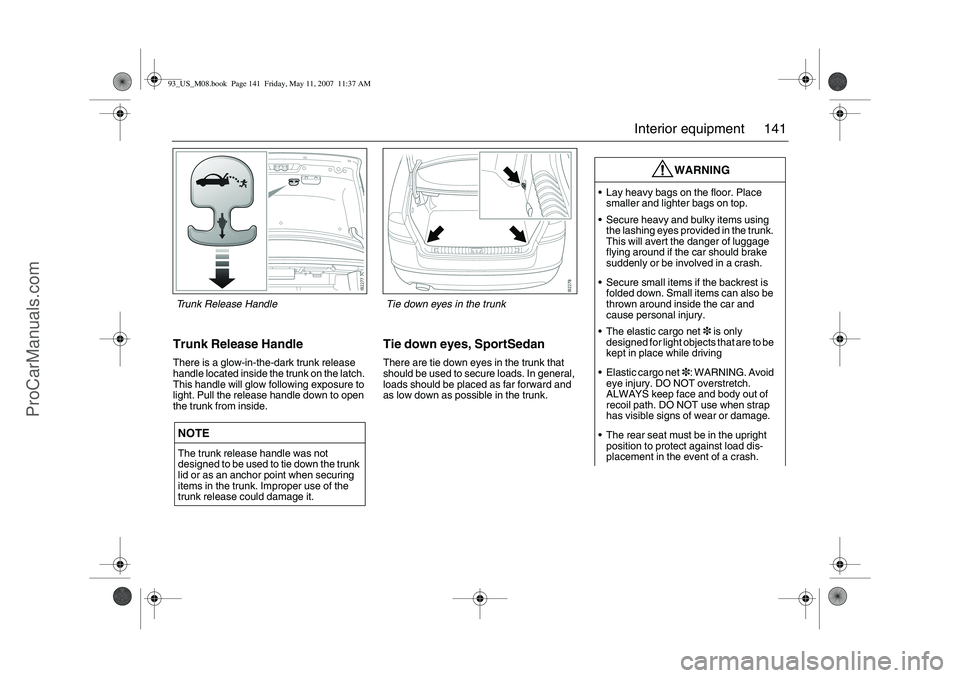
Trunk Release HandleThere is a glow-in-the-dark trunk release
handle located inside the trunk on the latch.
This handle will glow following exposure to
light. Pull the release handle down to open
the trunk from inside.
Tie down eyes, SportSedanThere are tie down eyes in the trunk that
should be used to secure loads. In general,
loads should be placed as far forward and
as low down as possible in the trunk.
NOTEThe trunk release handle was not
designed to be used to tie down the trunk
lid or as an anchor point when securing
items in the trunk. Improper use of the
trunk release could damage it.
WARNING
Lay heavy bags on the floor. Place
smaller and lighter bags on top.
Secure heavy and bulky items using
the lashing eyes provided in the trunk.
This will avert the danger of luggage
flying around if the car should brake
suddenly or be involved in a crash.
Secure small items if the backrest is
folded down. Small items can also be
thrown around inside the car and
cause personal injury.
The elastic cargo net3 is only
designed for light objects that are to be
kept in place while driving
Elastic cargo net3: WARNING. Avoid
eye injury. DO NOT overstretch.
ALWAYS keep face and body out of
recoil path. DO NOT use when strap
has visible signs of wear or damage.
The rear seat must be in the upright
position to protect against load dis-
placement in the event of a crash.
Tie down eyes in the trunk
Trunk Release Handle93_US_M08.book Page 141 Friday, May 11, 2007 11:37 AM
ProCarManuals.com
Page 144 of 320
144 Interior equipment
WARNING
Lay heavy bags on the floor. Place smaller and lighter bags on
top.
Elastic cargo net3: WARNING. Avoid eye injury. DO NOT
overstretch. ALWAYS keep face and body out of recoil path.
DO NOT use when strap has visible signs of wear or damage.
Secure heavy and bulky items using the lashing eyes provided
in the trunk. This will avert the danger of luggage flying around
if the car should brake suddenly or be involved in a crash.
Secure small items if the backrest is folded down. Small items
can also be thrown around inside the car and cause personal
injury.
Do not exceed the load capacity of the car, as this will alter its
handling characteristics (see page 286).93_US_M08.book Page 144 Friday, May 11, 2007 11:37 AM
ProCarManuals.com
Page 145 of 320
145 Interior equipment
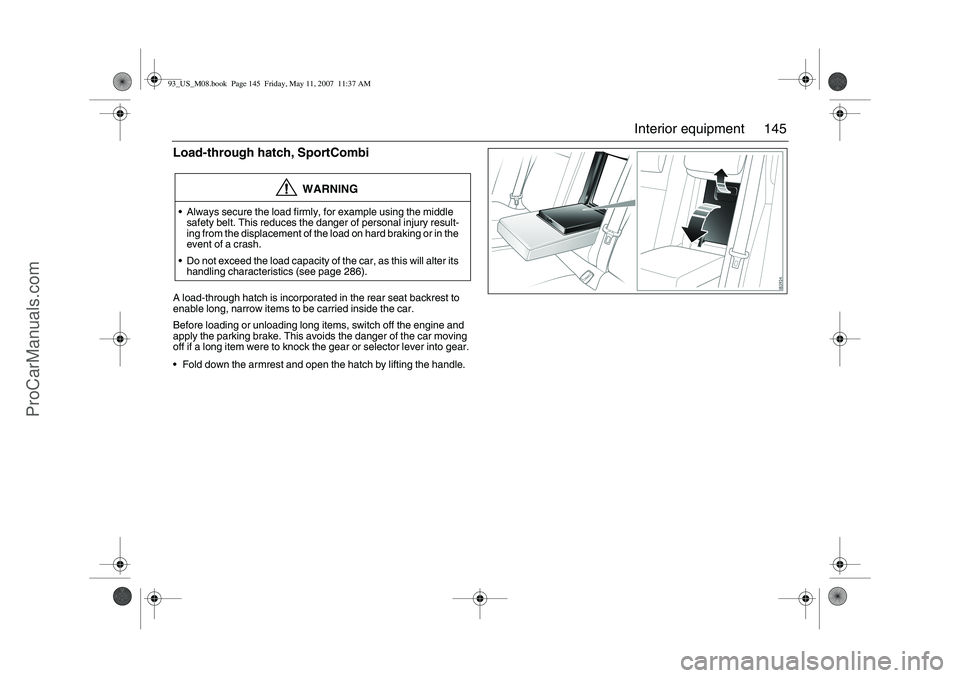
Load-through hatch, SportCombiA load-through hatch is incorporated in the rear seat backrest to
enable long, narrow items to be carried inside the car.
Before loading or unloading long items, switch off the engine and
apply the parking brake. This avoids the danger of the car moving
off if a long item were to knock the gear or selector lever into gear.
Fold down the armrest and open the hatch by lifting the handle.
WARNING
Always secure the load firmly, for example using the middle
safety belt. This reduces the danger of personal injury result-
ing from the displacement of the load on hard braking or in the
event of a crash.
Do not exceed the load capacity of the car, as this will alter its
handling characteristics (see page 286).93_US_M08.book Page 145 Friday, May 11, 2007 11:37 AM
ProCarManuals.com
Page 151 of 320

151 Starting and driving
Ignition switch ________ 152
Steering wheel lock ____ 154
Starting the engine ____ 154
Important considerations
for driving __________ 156
Refueling ____________ 159
Engine Break-in Period _ 163
Manual transmission___ 164
Automatic
transmission3
33 3______ 165
Cruise control ________ 171
Braking ______________ 172
Traction Control System
(TCS) ______________ 175
Electronic Stability
Program ESP
®
______ 177
Parking brake_________ 179
Parking ______________ 179
Saab Parking
Assistance3
33 3________ 182 Economical driving _____ 185
Driving in cold weather__ 187
Driving in hot climates __ 189
Towing a trailer3
33 3______ 190
Driving with a roof rack
load ________________ 194
Driving with a load _____ 196
Driving with the trunk lid
open________________ 196
Driving in deep water ___ 196
Driving at night ________ 197
Towing the car _________ 197
Jump starting _________ 200
For long trips __________ 202
Starting and driving
3Asterisk means: equipment not fitted in all cars
(can depend on model variant, engine variant,
market specification, options or accessories).93_US_M08.book Page 151 Friday, May 11, 2007 11:37 AM
ProCarManuals.com
Page 152 of 320

152 Starting and drivingIgnition switchThe ignition switch is located on the center
console between the front seats. In cars
with automatic transmission, the remote
control can only be removed when the
selector lever is in position P.
To allow the various systems in the car time
to register that the remote control has been
inserted into the ignition switch, do not turn
the remote control for roughly half a second.
LOCK positionThe parking lights, hazard warning lights
and interior lighting can be turned on.
Cars with automatic transmission: Move
the gear lever to P.
The gear lever is locked in position. This is
the only position in which the remote control
can be removed.
Cars with manual transmission: The
remote control can be removed regardless
of the position of the gear lever.
NOTETake care not to spill drinks or to drop
crumbs over the ignition switch. If dirt or
liquid gets into it, the switch may not
operate properly.
If snow from clothing falls into the ignition
switch and melts, the ignition switch can
seize (freeze). Brush snow off clothing
before getting into the car.
WARNING
Always remove the remote control
before leaving children unattended in
the car.
Apply the parking brake before remov-
ing the remote control.
Never remove the remote control
while the car is moving. This will acti-
vate the steering wheel lock and make
it impossible to steer the car.
93_US_M08.book Page 152 Friday, May 11, 2007 11:37 AM
ProCarManuals.com
Page 155 of 320

155 Starting and driving
Starting the engineAvoid racing the engine or loading it heavily
before it has warmed up. Do not drive away
before the warning and indicator lights have
gone out.
The engine has an automatic choke and
should be started as follows:
Cars with manual transmission
To start the engine the clutch pedal must
be fully depressed.
1 Make sure the parking brake is applied.
2 Depress the clutch pedal but do not
touch the accelerator.
3 Start the engine. Let the ignition switch
spring back as soon as the engine has
started and is running smoothly.
Allow the engine to idle for about
10 seconds. Do not apply full throttle for at
least 3 minutes after starting.Cars with automatic transmission
The selector lever must be in the P or N
position.
1 The selector lever must be in the P or N
position.
2 Keep your foot on the brake pedal.
Note! Once the engine has started, the
brake pedal will sink. This is perfectly
normal.
3 Start the engine. Let the ignition switch
spring back as soon as the engine has
started and is running smoothly.
Allow the engine to idle for about
10 seconds. Do not apply full throttle for at
least 3 minutes after starting.
Useful tips on starting the engineIf the engine has failed to start after several
attempts in very cold weather, proceed as
follows:
1 Turn the ignition switch to ON (it is
essential that you turn the ignition to
ON before depressing the accelerator).
2 Press the accelerator to the floor and run
the starter motor for 5-10 seconds. This
will prevent the engine being flooded
(fully depressed accelerator cuts off the
fuel supply).
3 Now start the engine in the normal way
- do not touch the accelerator.
If the engine stalls immediately after starting
(e.g. if the clutch was released too quickly),
do not touch the accelerator when restarting
the engine.
93_US_M08.book Page 155 Friday, May 11, 2007 11:37 AM
ProCarManuals.com
Page 163 of 320
163 Starting and driving
gasoline whether the fuel contains MMT.
Saab does not recommend the use of such
gasolines.
Fuels containing MMT can reduce the life of
spark plugs and the performance of the
emission control system may be affected.
The malfunction indicator lamp may turn on.
If this occurs, return to your authorized Saab
dealer for service.
Fuels in Foreign Countries
If you plan on driving in another country out-
side the United States or Canada, the
proper fuel may be hard to find. Never use
leaded gasoline or any other fuel not recom-
mended in the previous text on fuel. Costly
repairs caused by use of improper fuel
would not be covered by your warranty.
To check the fuel availability, ask an auto
club, or contact a major oil company that
does business in the country where you will
be driving.
Engine Break-in PeriodPistons, cylinder bores and bearings need
time to obtain uniform, wear-resistant
surfaces.
If a new engine is driven too hard, this grad-
ual process of bedding-in will not be possi-
ble and the life of the engine will be short-
ened.
During the first 1,200 miles (2,000 km),
do not exceed 5,000 rpm.
In addition, refrain from driving the car at full
throttle, other than for brief instances,
during the first 1,800 miles (3,000 km).
Wearing in new brake padsNew brake pads take time to bed in, about
90 miles (150 km) if the car is driven largely
under stop-and-go conditions or about
300 miles (500 km) of highway driving.
To extend the useful life of the pads, avoid
hard braking as much as possible.
93_US_M08.book Page 163 Friday, May 11, 2007 11:37 AM
ProCarManuals.com