change time SAAB 9-3 2008 User Guide
[x] Cancel search | Manufacturer: SAAB, Model Year: 2008, Model line: 9-3, Model: SAAB 9-3 2008Pages: 320, PDF Size: 56.39 MB
Page 170 of 320
170 Starting and driving
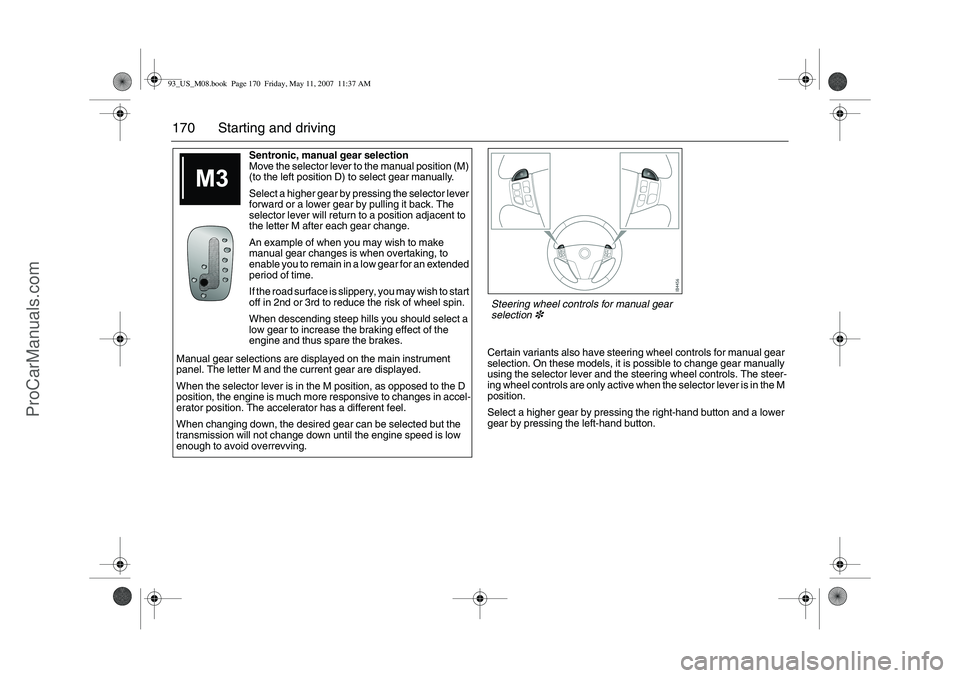
Certain variants also have steering wheel controls for manual gear
selection. On these models, it is possible to change gear manually
using the selector lever and the steering wheel controls. The steer-
ing wheel controls are only active when the selector lever is in the M
position.
Select a higher gear by pressing the right-hand button and a lower
gear by pressing the left-hand button. Sentronic, manual gear selection
Move the selector lever to the manual position (M)
(to the left position D) to select gear manually.
Select a higher gear by pressing the selector lever
forward or a lower gear by pulling it back. The
selector lever will return to a position adjacent to
the letter M after each gear change.
An example of when you may wish to make
manual gear changes is when overtaking, to
enable you to remain in a low gear for an extended
period of time.
If the road surface is slippery, you may wish to start
off in 2nd or 3rd to reduce the risk of wheel spin.
When descending steep hills you should select a
low gear to increase the braking effect of the
engine and thus spare the brakes.
Manual gear selections are displayed on the main instrument
panel. The letter M and the current gear are displayed.
When the selector lever is in the M position, as opposed to the D
position, the engine is much more responsive to changes in accel-
erator position. The accelerator has a different feel.
When changing down, the desired gear can be selected but the
transmission will not change down until the engine speed is low
enough to avoid overrevving.Steering wheel controls for manual gear
selection
3
93_US_M08.book Page 170 Friday, May 11, 2007 11:37 AM
ProCarManuals.com
Page 178 of 320
178 Starting and drivingESP
® system OFF
lights up if:
the system is turned off manually. The car
must be travelling slower than 35 mph
(60 km/h). The TCS is also disengaged.
a fault is detected in the ABS-system
a fault has been detected in the system
and the system has therefore been
switched off. The following message will
be displayed on the SID:
ESP
® system indicator light
When the ignition switch is turned to the ON
position, the lamp is lit for about 4 seconds
while the system performs self-diagnosis.
The light comes on for a short period of
time when the ESP
® system is operative.
Operation of the ESP® system indicates
reduced cohesion between the tires and the
road, and that extra care should be taken by
the driver during continued driving.
Temporarily turning ESP
®
system off
The ESP
® is switched on automatically
when the engine is started.
It may be necessary to switch off the system
if the car has become bogged down, for
instance.
The ESP® system is always engaged
during braking, even if it has been switched
off manually with the ESP
® button.
The cruise control system (if active) will
automatically be disengaged if the ESP
®
system is operative.Disengage the system in Settings.
1Select Settings using the steering
wheel buttons, or .
2 Hold the SET button depressed until a
chime sounds.
3Select ESP.
4 Press the SET button.
5Select ON or OFF.
End by pressing the SET-button.
Go back/modify using the CLR-button.
Stability control failure.
Contact service.
NOTEChanges to the chassis, such as a
change of wheels, shock absorbers or
springs, could affect the function of the
ESP
® system.
Always consult a workshop before chang-
ing any chassis components. We recom-
mend that you contact a Saab dealer.
93_US_M08.book Page 178 Friday, May 11, 2007 11:37 AM
ProCarManuals.com
Page 183 of 320
183 Starting and driving
increases as the car comes closer to the
object.
If you stop the car with reverse gear
engaged, the sound pulse will stop after
2 seconds. The sound pulses will return if
you continue to reverse. If the car rolls for-
ward while reverse is engaged, the system
is silenced.
When the distance to the object is less
than 1 ft. (30 cm), a continuous tone will
be heard.
When an object is approximately 3 ft.
(90 cm) from the car, the sound pulses
change character markedly (frequency
increases). A distance of about 3 ft. (90 cm)
is suitable if you wish to load or unload the
trunk.
If the distance between an object and a
corner sensor does not change for
3 seconds, for example if you are reversing
alongside a wall, the system will switch to
monitoring straight back. The system indi-
cates if the distance to the wall decreases
again.
If a trailer is hitched up and correctly con-
nected to the trailer contact by the tow bar,
the system is automatically deactivated.Reversing alongside a wall
If the distance between an object and a
corner sensor does not change for
2 seconds, for example if you are reversing
alongside a wall, the system will switch to
monitoring straight back. The system indi-
cates if the distance to the wall decreases
again.Cars with trailer hitch
If the car has a trailer hitch and its wiring is
correctly connected to the car’s electrical
system, the Saab Parking Assistance auto-
matically compensates for the protrusion of
the tow bar.
If a camper or trailer is hitched up and the
trailer hitch wiring is correctly connected to
the car’s electrics, the system is automati-
cally deactivated.
You can temporarily deactivate the Saab
Parking Assistance as follows:
Engage reverse and press the CLR
button on the SID control panel.
The system will be reactivated the next time
you engage reverse.
NOTEThe sensors must be kept clean to func-
tion well. Ice, snow and dirt can affect
their sensitivity.
Large quantities of snow or dirt covering
the sensors can prevent the parking
assistance system from detecting any
objects.
Do not spray the sensors with a pressure
washer, as this can damage them.
93_US_M08.book Page 183 Friday, May 11, 2007 11:37 AM
ProCarManuals.com
Page 191 of 320
191 Starting and driving
Recommendations for cars with
automatic transmissionThe following driving time limits are based
on the capacity of the cooling system in hot
weather, i.e. approximately 86°F (+30°C).
The following driving time limits are based
on the capacity of the cooling system in hot
weather, i.e. approximately 104°F (+40°C).When negotiating long hills, bear the follow-
ing important considerations in mind.
Rises in coolant temperature are indicated
by the temperature gauge in the main instru-
ment panel.
The following steps are taken in order as the
temperature of the transmission increases:
Gear change pattern is altered
A/C compressor is switched off
Max. engine torque is reduced
The following message will be displayed on
the SID if the transmission fluid becomes
too hot:
If this message appears, stop the car as
soon as it is safe to do so and allow the
engine to idle until the message has gone
out. The selector lever should be in
position P.
NOTEOnly use a towbar that has been
approved for your car. We recom-
mend that you entrust towbar installa-
tion to an authorized Saab dealer,
which can also provide important
information such as trailer weight.
Your authorized Saab dealer has
information on how the towbar is to be
installed and whether other measures
must be undertaken that could affect
the cooling system or other equipment
We recommend that you contact a
Saab dealer for guidance on how to
connect a trailer hitch.
Exercise care when driving on uneven
roads or against the curb if the car is
heavily laden. This particularly applies
to cars with 17" wheels.
Gradient of
hill, %Max. trailer
weight, lbs.
(kg)Time limit,
minutes
6-8 3330 (1500) unlimited
9-11 3080 (1400) max 15
12-14 2645 (1200) max 15
max 15 2200 (1000) max 15
Gradient of
hill, %Max. trailer
weight, lbs.
(kg)Time limit,
minutes
6-8 2200 (1000) unlimited
9-11 1760 (800) max 15
12-14 1100 (500) max 15
max 15 880 (400) max 15
Gearbox too hot. Make a
safe stop. Open hood.
93_US_M08.book Page 191 Friday, May 11, 2007 11:37 AM
ProCarManuals.com
Page 212 of 320
212 Car careTransmission fluidManual transmission
Check and top up the oil in accordance with
the service program.
Automatic transmission
Check and top up the oil in accordance with
the service program.Coolant
There is an overpressure in the cooling
system. Coolant temperatures can some-
times exceed 212° F (100° C).
If the coolant level drops too low, the follow-
ing message appears on the SID:
The properties of the coolant are retained
for the entire service life of the car. There-
fore, it is not necessary to change the cool-
ant.
The coolant contains 45 % antifreeze and
anti-corrosion fluid. This ratio gives the best
cooling effect. Lower concentrations should
be avoided, in view of the corrosion risk.
Coolants of a different brand could damage
the engine or cooling system. We therefore
recommend strict use of coolants that have
been approved by Saab.Note
If incorrect coolant is used or added, the
life-time properties will be affected. Even if
the coolant is flushed from the system and
replaced with life-time coolant, life-time
properties are no longer retained and the
coolant must then be drained and replaced
at regular intervals.
WARNING
Proceed with caution if the radiator is
boiling when you open the hood.
Never remove the expansion-tank
filler cap when the radiator is boiling.
The cooling system is pressurized –
hot coolant and vapor can escape
when the filler cap is released. These
can cause injury to your eyes and
burns. Loosen the cap carefully, and
let the engine cool before removing
the cap.
Exercise care when adding coolant.
Coolant on hot surfaces constitutes a
fire risk.
Coolant level low.
Refill.
NOTEIf the cooling system needs topping up,
mix the antifreeze with the appropriate
quantity of drinking water or distilled
water before adding it to the system.
If undiluted antifreeze is added, the
engine could still freeze and be damaged.
This is because the antifreeze will not mix
properly with the coolant before the ther-
mostat has opened to allow full circula-
tion.
93_US_M08.book Page 212 Friday, May 11, 2007 11:37 AM
ProCarManuals.com
Page 214 of 320
214 Car careBrake/clutch fluid and
brake padsCheckingBrake fluid should be changed according to
the service program. Refer to the Warranty
and Service Book.
The brake and clutch fluid reservoir is trans-
parent to facilitate checking of the fluid level.
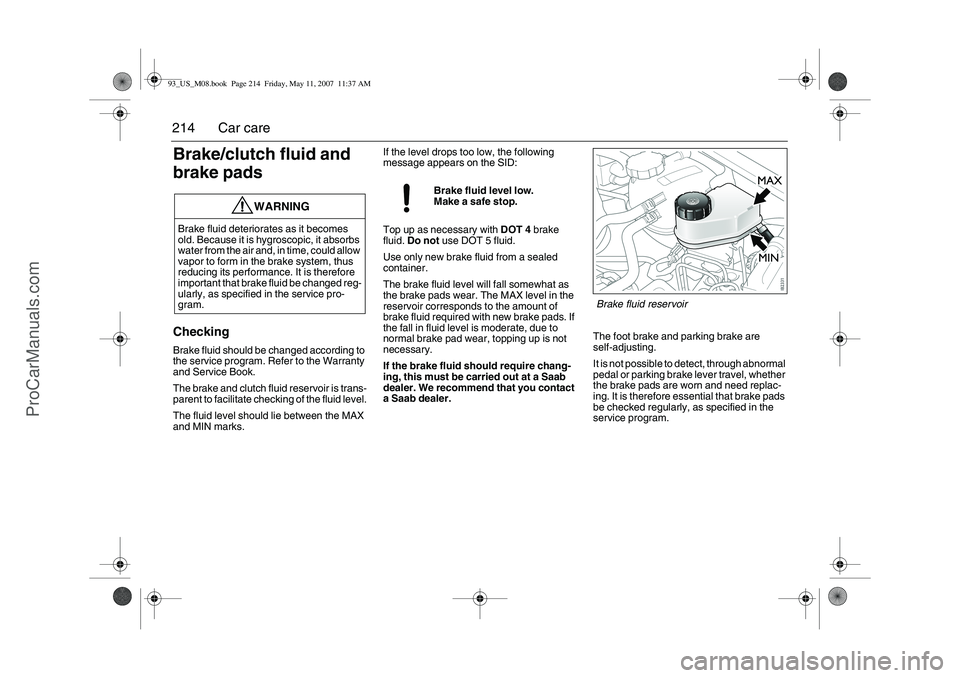
The fluid level should lie between the MAX
and MIN marks.If the level drops too low, the following
message appears on the SID:
Top up as necessary with DOT 4 brake
fluid. Do not use DOT 5 fluid.
Use only new brake fluid from a sealed
container.
The brake fluid level will fall somewhat as
the brake pads wear. The MAX level in the
reservoir corresponds to the amount of
brake fluid required with new brake pads. If
the fall in fluid level is moderate, due to
normal brake pad wear, topping up is not
necessary.
If the brake fluid should require chang-
ing, this must be carried out at a Saab
dealer. We recommend that you contact
a Saab dealer.The foot brake and parking brake are
self-adjusting.
It is not possible to detect, through abnormal
pedal or parking brake lever travel, whether
the brake pads are worn and need replac-
ing. It is therefore essential that brake pads
be checked regularly, as specified in the
service program.
WARNING
Brake fluid deteriorates as it becomes
old. Because it is hygroscopic, it absorbs
water from the air and, in time, could allow
vapor to form in the brake system, thus
reducing its performance. It is therefore
important that brake fluid be changed reg-
ularly, as specified in the service pro-
gram.
Brake fluid level low.
Make a safe stop.
Brake fluid reservoir
93_US_M08.book Page 214 Friday, May 11, 2007 11:37 AM
ProCarManuals.com
Page 220 of 320
220 Car careWipers and washersWiper bladesCheck and clean all wiper blades regularly.
If poor wiper performance is experienced,
clean the windshield with washer fluid. This
is particularly important if the car has been
through an automatic car wash, as these
sometimes leave a wax coating on the wind-
shield.
If wiper performance is still unsatisfactory,
fit new blades.
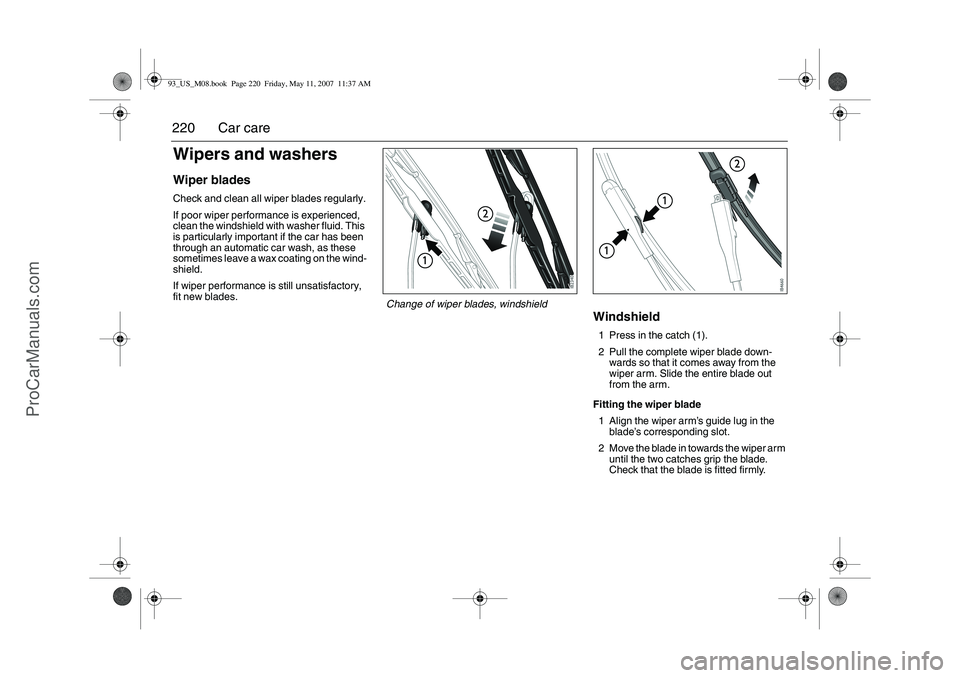
Windshield1 Press in the catch (1).
2 Pull the complete wiper blade down-
wards so that it comes away from the
wiper arm. Slide the entire blade out
from the arm.
Fitting the wiper blade
1 Align the wiper arm’s guide lug in the
blade’s corresponding slot.
2 Move the blade in towards the wiper arm
until the two catches grip the blade.
Check that the blade is fitted firmly.
Change of wiper blades, windshield
93_US_M08.book Page 220 Friday, May 11, 2007 11:37 AM
ProCarManuals.com
Page 223 of 320
223 Car care
Wrong bulb fitted
If a low or main beam bulb of too high a
rating is fitted, a bulb failure message will be
shown on the SID (a too high wattage bulb
can damage the reflector).
If the following message is displayed but the
bulb shines, it is most likely that an incorrect
bulb has been fitted.
Note
When changing bulbs, fit the same type of
bulb (e.g. Long-Life) as that removed.
Headlight aiming, page 275.
Xenon headlights3
33 3Xenon headlights produce roughly two
times as much light as halogen bulbs and
have a significantly longer service life.
The lamp units consist of a gas discharge
lamp containing xenon. When the lights are
switched on a very high voltage activates
the xenon gas. The lamps soon reach full
intensity.
Cars with xenon headlights have automatic
levelling. The levelling system is comprised
of two sensors, one on the front suspension
and one on the rear suspension, and a con-
trol unit by the engine bay fuse box. Head-
light alignment is adjusted automatically to
the car’s load to prevent dazzling drivers in
oncoming traffic.
If a fault is detected in the system, the fol-
lowing message will be displayed on the
SID: Right high beam failure.
WARNING
Xenon headlights are high tension. All
work on xenon headlights, including
changing bulbs, must be carried out by
dealer personnel.
Headlight levelling
malfunction.
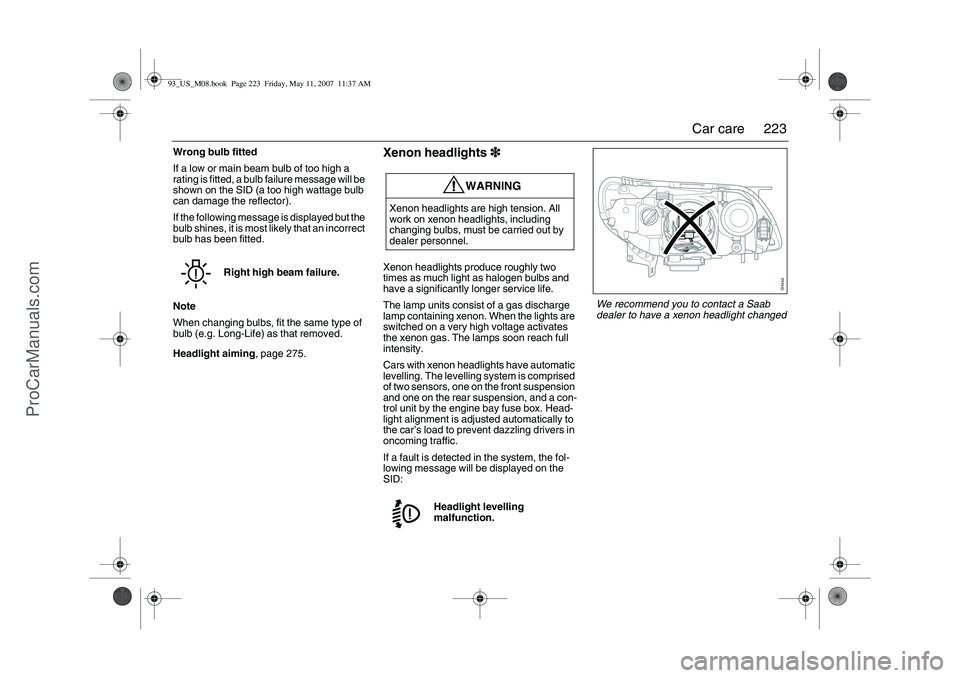
We recommend you to contact a Saab
dealer to have a xenon headlight changed
93_US_M08.book Page 223 Friday, May 11, 2007 11:37 AM
ProCarManuals.com
Page 226 of 320
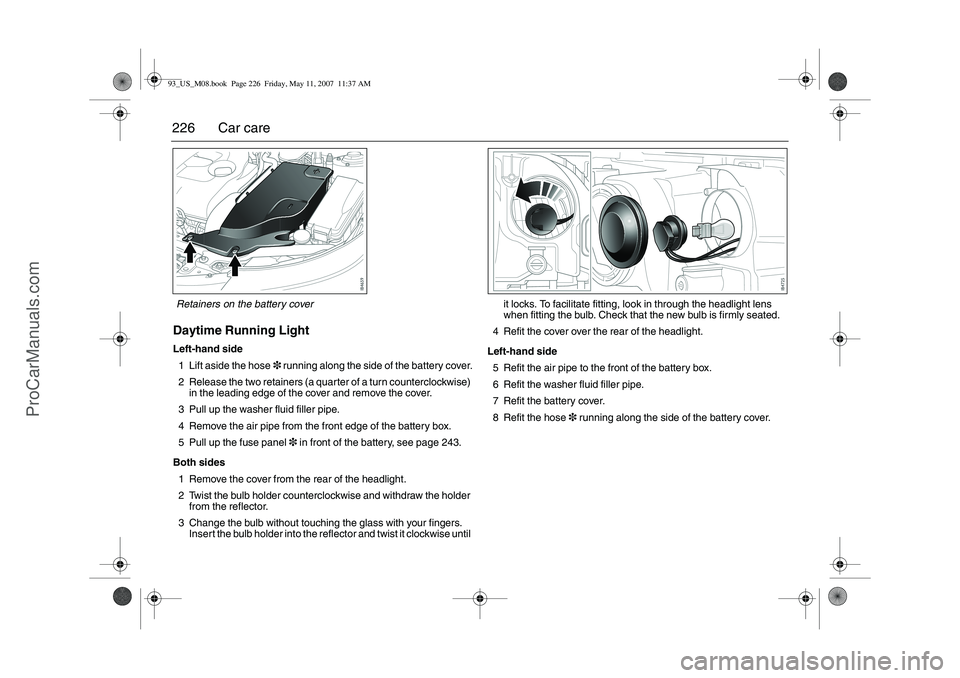
226 Car careDaytime Running LightLeft-hand side
1 Lift aside the hose3 running along the side of the battery cover.
2 Release the two retainers (a quarter of a turn counterclockwise)
in the leading edge of the cover and remove the cover.
3 Pull up the washer fluid filler pipe.
4 Remove the air pipe from the front edge of the battery box.
5 Pull up the fuse panel3 in front of the battery, see page 243.
Both sides
1 Remove the cover from the rear of the headlight.
2 Twist the bulb holder counterclockwise and withdraw the holder
from the reflector.
3 Change the bulb without touching the glass with your fingers.
Insert the bulb holder into the reflector and twist it clockwise until it locks. To facilitate fitting, look in through the headlight lens
when fitting the bulb. Check that the new bulb is firmly seated.
4 Refit the cover over the rear of the headlight.
Left-hand side
5 Refit the air pipe to the front of the battery box.
6 Refit the washer fluid filler pipe.
7 Refit the battery cover.
8 Refit the hose3 running along the side of the battery cover.Retainers on the battery cover93_US_M08.book Page 226 Friday, May 11, 2007 11:37 AM
ProCarManuals.com
Page 246 of 320

246 Car carecertain that all wheel nuts are properly tight-
ened. See page 265.
Flat spottingAll tires get hot, especially on long journeys
or when the car is driven hard. After the car
has been parked with hot tires and the tires
have cooled down, a flat spot can form in the
tire, where it is in contact with the ground.
The same can occur if the car has not been
moved for a long time.
Flat spots can cause vibration that can be
felt through the steering wheel, similar to
that experienced when the wheels need bal-
ancing.
Flat spots of this type disappear once the
tires get hot again, usually after 10–15 miles
(20–25 km) of driving at cruising speed. If
the outdoor temperature is low it takes a
longer distance.
When It Is Time for New TiresOne way to tell when it’s time for new tires is
to check the treadwear indicators, which will
appear when your tires have only 1/16 inch
(1.6 mm) or less of tread remaining.
You need a new tire if any of the following
statements are true:
You can see the indicators at three or
more places around the tire.
You can see cord or fabric showing
through the tire’s rubber.
The tread or sidewall is cracked, cut or
snagged deep enough to show cord or
fabric.
The tire has a bump, bulge or split.
The tire has a puncture, cut or other
damage that can’t be repaired well
because of the size or location of the
damage.
WARNING
Rust or dirt on a wheel, or on the parts to
which it is fastened, can make wheel nuts
become loose after a time. The wheel
could come off and cause an accident.
When you change a wheel, remove any
rust or dirt from places where the wheel
attaches to the vehicle. In an emergency,
you can use a cloth or a paper towel to do
this; but be sure to use a scraper or wire
brush later, if you need to, to get all the
rust or dirt off. See “Changing a tire” on
page 262.93_US_M08.book Page 246 Friday, May 11, 2007 11:37 AM
ProCarManuals.com