tire pressure SAAB 9-3 2008 User Guide
[x] Cancel search | Manufacturer: SAAB, Model Year: 2008, Model line: 9-3, Model: SAAB 9-3 2008Pages: 320, PDF Size: 56.39 MB
Page 212 of 320
212 Car careTransmission fluidManual transmission
Check and top up the oil in accordance with
the service program.
Automatic transmission
Check and top up the oil in accordance with
the service program.Coolant
There is an overpressure in the cooling
system. Coolant temperatures can some-
times exceed 212° F (100° C).
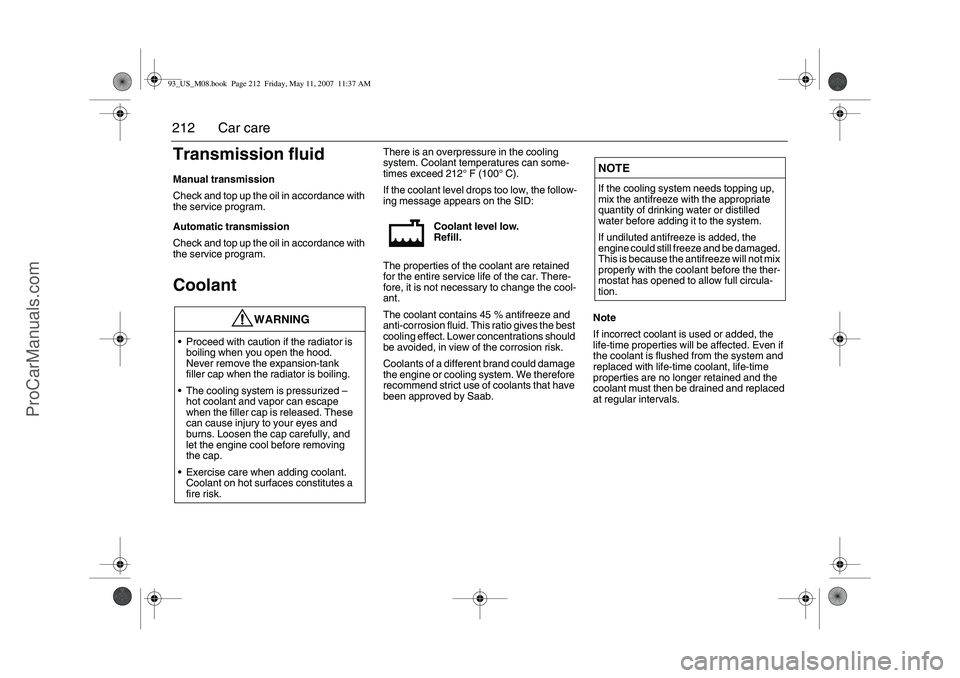
If the coolant level drops too low, the follow-
ing message appears on the SID:
The properties of the coolant are retained
for the entire service life of the car. There-
fore, it is not necessary to change the cool-
ant.
The coolant contains 45 % antifreeze and
anti-corrosion fluid. This ratio gives the best
cooling effect. Lower concentrations should
be avoided, in view of the corrosion risk.
Coolants of a different brand could damage
the engine or cooling system. We therefore
recommend strict use of coolants that have
been approved by Saab.Note
If incorrect coolant is used or added, the
life-time properties will be affected. Even if
the coolant is flushed from the system and
replaced with life-time coolant, life-time
properties are no longer retained and the
coolant must then be drained and replaced
at regular intervals.
WARNING
Proceed with caution if the radiator is
boiling when you open the hood.
Never remove the expansion-tank
filler cap when the radiator is boiling.
The cooling system is pressurized –
hot coolant and vapor can escape
when the filler cap is released. These
can cause injury to your eyes and
burns. Loosen the cap carefully, and
let the engine cool before removing
the cap.
Exercise care when adding coolant.
Coolant on hot surfaces constitutes a
fire risk.
Coolant level low.
Refill.
NOTEIf the cooling system needs topping up,
mix the antifreeze with the appropriate
quantity of drinking water or distilled
water before adding it to the system.
If undiluted antifreeze is added, the
engine could still freeze and be damaged.
This is because the antifreeze will not mix
properly with the coolant before the ther-
mostat has opened to allow full circula-
tion.
93_US_M08.book Page 212 Friday, May 11, 2007 11:37 AM
ProCarManuals.com
Page 240 of 320

240 Car care
Trunk fuse panel, left-hand sideNo. Amp. Function
1–5 MAXI -
6 30 Control module in left rear door
7 30 Control module in right rear door
820Trailer3
9--
1030 Left-hand brake light; rear right turn signal; right tail-
light; right reversing light; high-mounted brake light;
trailer lights
11 - -
12 - -
13 - -
14 - -
15 15 Seat heating, left seat3
16 15 Seat heating, right seat3
17 7.5 Autodimming rearview mirror3; rain sensor3
18 15 Moonroof3
19 - -
20 7.5 XM-radio3, TMC-tuner3
217.5 Saab Parking Assistance (SPA)3; control module in
rear doors; dome light (Convertible)
22 30 Radio3; navigation3
23 7,5 TPMS (automatic tire pressure monitoring system)
2410 Movement sensor3; tilt sensor3; dome light (Con-
ver tible)
25 30 Electrically adjustable driver’s seat with memory3
Trunk fuse panel, SportSedan93_US_M08.book Page 240 Friday, May 11, 2007 11:37 AM
ProCarManuals.com
Page 244 of 320

244 Car careTiresYour new vehicle comes with high-quality
tires made by a leading tire manufacturer. If
you ever have questions about your tire
warranty and where to obtain service, see
your Saab Warranty and Service Record
Booklet for details.
Inflation - Tire PressureThe Tire-Loading Information label shows
the correct inflation pressures for your tires
when they’re cold. “Cold” means your vehi-
cle has been sitting for at least three hours
or driven no more than 1 mile (1.6 km).
Notice: Don’t let anyone tell you that
underinflation or overinflation is all
right. It’s not. If your tires don’t have
enough air (underinflation), you can get
the following:
Too much flexing
Too much heat
Tire overloading
Bad wear
Bad handling
Bad fuel economy
If your tires have too much air (overinfla-
tion), you can get the following:
Unusual wear
Bad handling
Rough ride
Needless damage from road hazardsAdjust the tire pressure to match the current
load and speed of the car (see page 296).
The stated tire pressures apply to cold tires,
i.e. tires that are the same temperature as
the outside air temperature. Tire pressure
increases as the tires become warm (e.g.
during highway driving) by approximately
4 psi (28 kPa). When the temperature of the
tires changes by 50°F (10°C), the tire pres-
sure will change 2 psi (14 kPa).
Never reduce the pressure of a hot tire. If the
tires are hot when you check them, only
increase the pressure, if necessary.
WARNING
Poor maintained and improperly used
tires are dangerous.
Overloading your tires can cause
overheating as a result of too much
friction. You could have an blow-out
and a serious accident. See “Loading
Your Vehicle” on page 254.
Underinflated tires pose the same
danger as overloaded tires. The
resulting accident could cause serious
injury. Check all tires frequently to
maintain the recommended pressure.
Tire pressure should be checked
when your tires are cold.
Overinflated tires are more likely to be
cut, punctured or broken by a sudden
impact – such as when you hit a pot-
hole. Keep tires at the recommended
pressure.
Worn, old tires can cause accidents. If
your tread is badly worn, or if your tires
have been damaged, replace them.93_US_M08.book Page 244 Friday, May 11, 2007 11:37 AM
ProCarManuals.com
Page 245 of 320

245 Car care
High speed operation
If you’ll be driving at high speeds, speeds of
100 mph (160 km/h) or higher, where it is
legal, set the cold inflation pressure to the
maximum inflation pressure shown on the
tire sidewall, or to 35 psi (244 kPa), which-
ever is lower. See the example below.
When you end this high-speed driving,
return to the cold inflation pressure shown
on the Tire and Loading Information label.
See on page 254.
Example
You’ll find maximum load and inflation pres-
sure molded on the tire’s sidewall, in small
letters near the rim flange. It will read some-
thing like this: Maximum load 690 kg
(1521 lbs) 300 kPa (44 psi) Max. Press
For this example, you would set the inflation
pressure for high-speed driving at 35 psi
(244 kPa).When to checkCheck your tires once a month or more.
Don’t forget your compact spare tire. It
should be at 60 psi (420 kPa).
How to CheckUse a good quality pocket-type gage to
check tire pressure. You can’t tell if your
tires are properly inflated simply by looking
at them. Radial tires may look properly
inflated even when they’re underinflated.
Be sure to put the valve caps back on the
valve stems. They help prevent leaks by
keeping out dirt and moisture.Tire Inspection and RotationTires should be rotated every 10,000 miles
(16 000 km).
Any time you notice unusual wear, rotate
your tires as soon as possible and check
wheel alignment. Also check for damaged
tires or wheels. See “When It Is Time for
New Tires” on page 246 and “Wheel
Replacement” on page 250 for more infor-
mation.
The purpose of regular rotation is to achieve
more uniform wear for all tires on the vehi-
cle. The first rotation is the most important.
When rotating your tires, always use the
correct rotation pattern. Left front tire to left
rear. Left rear tire to right front. Right front to
right rear. Right rear to left front.
Don’t include the compact spare tire in your
tire rotation.
After the tires have been rotated, adjust the
front and rear inflation pressures as shown
on the Tire-Loading Information label. Make
WARNING
Driving at high speeds, 100 mph
(160 km/h) or higher, puts an additional
strain on tires.
Sustained high-speed driving causes
excessive heat build up and can cause
sudden tire failure. You could have a
crash and you or others could be killed.
Some high-speed rated tires require infla-
tion pressure adjustment for high speed
operation. When speed limits and road
conditions are such that a vehicle can be
driven at high speeds, make sure the tires
are rated for high speed operation, in
excellent condition, and set to the correct
cold tire inflation pressure for the vehicle
load.93_US_M08.book Page 245 Friday, May 11, 2007 11:37 AM
ProCarManuals.com
Page 252 of 320

252 Car careTire Sidewall LabelingUseful information about a tire is molded
into it´s sidewall.
Tire size: The tire size ia a combination of
letters and numbers used to define a partic-
ular tire´s width, height, aspect ratio, con-
struction type and service description.
Department of Transportation (DOT):
The Department of Transportation (DOT)
code indicates that the tire is in compliance
with the U.S. Department of Transportation
Motor Vehicle Safety standards.
Tire Identification Number (TIN): The let-
ters and numbers following DOT code are
the Tire Identification Number (TIN). The
TIN shows the manufacturer and plant
code, tire size, and date the tire was manu-
factured. The TIN is molded onto both sides
of the tire.
Tire Ply Material: The type of cord and
number of plies in the sidewall and under
the tread.Uniform Tire Quality Grading (UTQG):
Tire manufacturers are required to grade
tires based on the performance factors:
treadwear, traction and temperature resis-
tance. For more information see “Uniform
Tire Quality Grading” on page 248.
Maximum Cold Inflation Load Limit: Max-
imum load that can be carried and the max-
imum pressure needed to support that load.
For information on recommended tire pres-
sure see “Recommended lowest tire pres-
sure, cold tires” on page 296 and “Loading
Your Vehicle” on page 254.
Tire SizeThe following illustration shows an example
of a typical passenger car tire size.
Tire Width: The three-digit number indi-
cates the tire section width in millimeters
from sidewall to sidewall.215/55 R 16 93 H
||||||
abcdef
aTire Width
b Aspect Ratio
c Belt Rating
d Rim diameter
e Load range
f Speed rating
93_US_M08.book Page 252 Friday, May 11, 2007 11:37 AM
ProCarManuals.com
Page 254 of 320
254 Car care
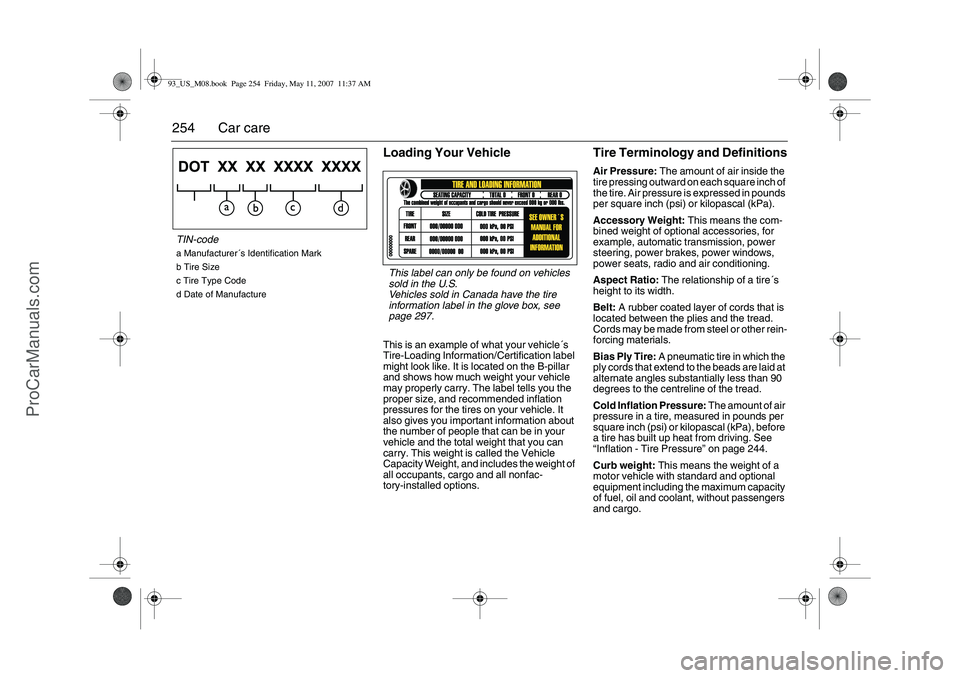
Loading Your VehicleThis is an example of what your vehicle´s
Tire-Loading Information/Certification label
might look like. It is located on the B-pillar
and shows how much weight your vehicle
may properly carry. The label tells you the
proper size, and recommended inflation
pressures for the tires on your vehicle. It
also gives you important information about
the number of people that can be in your
vehicle and the total weight that you can
carry. This weight is called the Vehicle
Capacity Weight, and includes the weight of
all occupants, cargo and all nonfac-
tory-installed options.
Tire Terminology and DefinitionsAir Pressure: The amount of air inside the
tire pressing outward on each square inch of
the tire. Air pressure is expressed in pounds
per square inch (psi) or kilopascal (kPa).
Accessory Weight: This means the com-
bined weight of optional accessories, for
example, automatic transmission, power
steering, power brakes, power windows,
power seats, radio and air conditioning.
Aspect Ratio: The relationship of a tire´s
height to its width.
Belt: A rubber coated layer of cords that is
located between the plies and the tread.
Cords may be made from steel or other rein-
forcing materials.
Bias Ply Tire: A pneumatic tire in which the
ply cords that extend to the beads are laid at
alternate angles substantially less than 90
degrees to the centreline of the tread.
Cold Inflation Pressure: The amount of air
pressure in a tire, measured in pounds per
square inch (psi) or kilopascal (kPa), before
a tire has built up heat from driving. See
“Inflation - Tire Pressure” on page 244.
Curb weight: This means the weight of a
motor vehicle with standard and optional
equipment including the maximum capacity
of fuel, oil and coolant, without passengers
and cargo. This label can only be found on vehicles
sold in the U.S.
Vehicles sold in Canada have the tire
information label in the glove box, see
page 297.
TIN-codea Manufacturer´s Identification Mark
b Tire Size
c Tire Type Code
d Date of Manufacture93_US_M08.book Page 254 Friday, May 11, 2007 11:37 AM
ProCarManuals.com
Page 255 of 320

255 Car care
DOT Markings: A code molded into the
sidewall of a tire signifying that the tire is in
compliance with the U.S. Department of
Transportation motor vehicle safety stan-
dards. The DOT code includes the Tire
Identification Number (TIN), an alphanu-
meric designator which can also identify the
tire manufacturer, production plant, brand
and date of production.
GVWR: Gross Vehicle Weight Rating see
page 287.
GAWR FRT: Gross Axle Weight Rating for
the front axle, see page 287.
GAWR RR: Gross Axle Weight Rating for
the rear axle, see page 287.
Intended Outboard Sidewall: The side of
an asymmetrical tire that must always face
outward when mounted on a vehicle.
Kilopascal (kPa): The metric unit for air
pressure. There are 6.9 kPa to one psi.
Light Truck (LT-Metric) Tire: A tire used
on light duty trucks and some multipurpose
passenger vehicles.
Load Index: An assigned number ranging
from 1 to 279 that corresponds to the load
carrying capacity of a tire.Maximum Load rating: The load rating for
a tire at the maximum permissible inflation
pressure for that tire.
Maximum Loaded Vehicle Weight: The
sum of curb weight; accessory weight; vehi-
cle capacity weight; and production options
weight.
Maximum Permissible Inflation Pres-
sure: The maximum cold inflation pressure
to which a tire may be inflated.
Normal occupant weight: The number of
occupants a vehicle is designed to seat mul-
tipled by 150 pounds (68 kg). See “Loading
Your Vehicle” on page 254.
Occupant Distribution: Designated seat-
ing positions.
Outward Facing Sidewall: The side of a
asymmetrical tire that has a particular side
that faces outward when mounted on a vehi-
cle. The side of the tire that contains a white-
wall bears white lettering or bears manufac-
turer, brand and or model name molding on
the other sidewall of the tire.
Passenger (P-Metric) Tire: A tire used on
passenger cars and some light duty trucks
and multipurpose vehicles.Recommended Inflation Pressure: Vehi-
cle manufacturer´s recommended tire infla-
tion pressure shown on the tire placard, see
“Inflation - Tire Pressure” on page 244 and
“Loading Your Vehicle” on page 254.
Radial Ply Tire: A pneumatic tire in which
the ply cords that extend to the beads are
laid at substantially 90 degrees to the cen-
treline of the tread.
Rim: A metal support for a tire or a tire and
tube assembly upon which the tire beads
are seated.
Sidewall: The portion of a tire between the
tread and the bead.
Speed rating: An alphanumeric code
assigned to a tire indicating the maximum
speed at which a tire can operate.
Traction: The friction between the tire and
the road surface. The amount of grip pro-
vided.
Treadwear Indicators: Narrow bands,
sometimes called “wear bars”, that show
across the tread of a tire when only
2/32 inch of tread remains. See “When It Is
Time for New Tires” on page 246.93_US_M08.book Page 255 Friday, May 11, 2007 11:37 AM
ProCarManuals.com
Page 256 of 320

256 Car careTread Width: The width of the tire´s tread.
UTQGS: Uniform Tire Quality Grade Stan-
dards, a tire information system that pro-
vides consumers with ratings for a tire´s
traction, temperature and treadwear. Rat-
ings are determined by tire manufacturers
using government testing procedures. The
rating are molded into the sidewall of the
tire. See “Uniform Tire Quality Grading” on
page 248.
Vehicle Capacity Weight: Is the number of
designated seating positions multipled by
150 pounds (68 kg) plus the rated cargo
load. See “Loading Your Vehicle” on
page 254.
Vehicle Maximum Load on the Tire: Load
on an individual tire due to curb weight,
accessory weight, occupant weight and
cargo weight.
Vehicle Placard: A label permanently
attached to a vehicle showing original
equipment tire size and the recommended
cold inflation pressure. See “Loading Your
Vehicle” on page 254.
Steps for Determining Correct
Load Limit1 Locate the statement “The
combined weight of occupants and
cargo should never exceed
XXX pounds” on your vehicle´s
placard.
2 Determine the combined weight of
the driver and passengers that will
be riding in your vehicle.
3 Substract the combined weight of
the driver and passengers from
XXX kilograms or XXX pounds.
4 The resulting figure equals the avail-
able amount of cargo and luggage
load capacity. For example, if the
“XXX” amount equals 1400 lbs. and
there will be five 150 lb. passengers
in your vehicle, the amount of avail-
able cargo and luggage load capac-
ity is 650 lbs. (1400–750 (5x150) =
650 lbs.).5 Determine the combined weight of
luggage and cargo being loaded on
the vehicle. That weight may not
safely exceed the available cargo
and luggage load capacity calcu-
lated in Step 4.
6 If your vehicle will be towing a trailer,
load from your trailer will be trans-
ferred to your vehicle. Consult this
manual to determine how this
reduces the available cargo and
luggage load capacity of your vehi-
cle.
93_US_M08.book Page 256 Friday, May 11, 2007 11:37 AM
ProCarManuals.com
Page 257 of 320

257 Car care
Winter tiresWinter (snow) tires are recommended for
winter climates where the majority of your
driving will be done on snow and ice. Winter
tires should be fitted to all four wheels to
maintain a proper balance. Your Saab
dealer can advise you of to the correct size
tire for your car (if different from the original
size) and also supply Saab approved winter
tires pre-mounted on steel or alloy rims.
Winter tires normally use a different speed
rating compared to summer/all season tires.
Make sure not to exceed the stated speed
rating on the tires you use.
Make sure that wheels with sensors for tire
pressure monitoring are fitted during
replacement if the car has automatic tire
pressure monitoring.Tire date codeTires should be regarded as perishable
goods. As the tires age, the rubber becomes
progressively harder, and the roadholding
ability of the tires diminishes. This is partic-
ularly true on winter tires.
Tires have a code that specifies their date of
manufacture. The first two digits denote the
week number and the last two digits the year
followed by a filled triangle.
Automatic tire pressure
monitoring systemThe system consists of a sensor in each
wheel and a receiver. The sensors are
located inside the tire in direct connection
with the air pressure valves.
Make sure that wheels with sensors for tire
pressure monitoring are fitted during
replacement if the car has automatic tire
pressure monitoring.Tire pressure information is transmitted
wirelessly to the receiver.
The system checks the tire pressures when
speed exceeds 19 mph (30 km/h).
The system is self-programming which
means that the wheels can be shifted
around without any need for adjustment.
The spare wheel has no sensor. The system
will trigger a warning/alarm because of that.
The sensor batteries last for 10 years or
around 160 000 km. The battery cannot be
replaced. The whole sensor must be
replaced.
WARNING
The system is an aid to the driver. The
driver always has the responsibility that
the tires have the correct air pressure.
For optimum safety, economy and com-
fort tire pressures should be checked reg-
ularly even if the automatic tire pressure
monitoring has not alarmed.
NOTETire replacement must take place with
great care to avoid damaging the sensors
that are built together with the valves.
Remove the rear side first.
Start to remove the tire opposite the
valve.
During removal the tire machine must
not come closer than ±10° from the
valve.
During fitting, start 20° after the valve
and finish 20° before the valve.
Do not inflate the tire with pressure
higher than 102 psi (700 kPa).
93_US_M08.book Page 257 Friday, May 11, 2007 11:37 AM
ProCarManuals.com
Page 258 of 320

258 Car careThe system does not warn if the tire pres-
sure is too high.If the tire pressure decreasesIf the tire pressure decreases to 6 psi
(41 kPa) below the recommended pressure
then a warning is shown on the SID as to
which tires are affected.
Adjust the pressure as soon as possible.
If the tire pressure continues to decrease
then an alarm is shown on the SID when the
pressure has decreased to 23 psi (159 kPa)
which is the lowest permitted pressure for
the tire.An alarm is also received when leakage is
greater than 3 psi/min. (20 kPa/min.).
Reduce speed (avoid heavy braking and
significant steering wheel movement) and
stop the car as soon as possible at a suita-
ble location. Replace the defective wheel.
The fault message can remain for up to
10 minutes after restarting the car. Then it
disappears if the tire pressure is correct.
Check/adjust the pressure in the other tires
when a fault message is shown.
Note that the tire pressure can decrease
without a puncture. The pressure could
decrease around 3 psi (20 kPa) during a three month period. The outside tempera-
ture could also affect tire pressure.
If the system has triggered a low pressure
warning or alarm then the tire pressure must
be adjusted to the recommended pressure
in order to put out the warning or alarm.
For further information on tire air pres-
sure, see page 244.
Allow 10 minutes for the system to recog-
nize the wheel/sensors positions after fitting
a new set of tires. During this period no low
pressure warning or alarm can be triggered.
Tire pressure low,
front right. Check tires.
Low tire pressure rear
left. Make a safe stop.
Valve with sensor
Valve without sensor
93_US_M08.book Page 258 Friday, May 11, 2007 11:37 AM
ProCarManuals.com