tire pressure SAAB 9-3 2008 Owner's Manual
[x] Cancel search | Manufacturer: SAAB, Model Year: 2008, Model line: 9-3, Model: SAAB 9-3 2008Pages: 320, PDF Size: 56.39 MB
Page 259 of 320

259 Car care
MalfunctionsThe above message is shown on the SID if:
a wheel without pressure sensor has
been fitted (e.g. spare wheel)
one or more pressure sensors are broken
or missing
a fault has arisen in the receiver
a system error has arisen.
Removing a tireRemove the tire with a tire machine. It is
important to follow the instructions for the
tire machine as well.
Do not fit the tire tool in an area ±10° from
the valve.
Start removing opposite the valve.
Remove the rear side first.
Fitting a tireFit the tire with a tire machine. It is important
to follow the instructions for the tire machine
as well.
Start to fit about 20° after the valve.
Finish fitting before an area 20° from the
valve.
Do not inflate the tire to a pressure higher
than 102 psi (700 kPa). Tire pressure system
failure. Contact service.
93_US_M08.book Page 259 Friday, May 11, 2007 11:37 AM
ProCarManuals.com
Page 260 of 320

260 Car careCompact spareThe compact spare is light and easy to
handle when changing the tire. Its use is
only permitted when a standard tire has sus-
tained a puncture. The maximum life of the
tire is only just over 2,000 miles (3,500 km).
Do not exceed 50 mph (80 km/h) with the
compact spare fitted.
The tire pressure should be 60 psi
(420 kPa). Put the punctured tire in the
spare wheel well under the trunk floor.
Have the standard tire repaired and refitted
as soon as possible.The spare tire, the tools and the jack with its
crank are carried under a panel in the trunk.
Fold the carpeting forward to ease access to
the tools and spare tire.
The screwdriver handle has a “button” for
removing plastic rivets. This type of rivet
must be removed when changing the light
bulb in the trunk lid (see page 230).
Your Saab is equipped with a trip computer
and you can use its “Speed warning” func-
tion, to monitor driving speed since you
must not exceed 50 mph (80 km/h), see
page 92.
Driving with a compact wheel
fittedObserve the following when the compact
spare tire is fitted:
The compact spare is light and easy to
handle when changing a tire.
Do not drive further than necessary with
the compact spare fitted - the maximum
life of the tire is only just over 2,000 miles
(approx. 3,500 km).
Refit the standard tire as soon as possi-
ble.
Fitting a spare tire/wheel without pressure
sensor will trigger a malfunction
message, see page 259.
Important considerations when driving with
a compact spare tire:
The car’s ground clearance is reduced.
WARNING
The spare tire or punctured tire must be
stowed under the trunk floor, and secured
in place with the retaining nut.
WARNING
Do not exceed 50 mph (80 km/h). The
tire can overheat affecting the car’s
roadholding.
Tire pressure: refer to page 294.
The spare tire or punctured tire must
be stowed under the trunk floor, and
secured in place with the retaining nut.
93_US_M08.book Page 260 Friday, May 11, 2007 11:37 AM
ProCarManuals.com
Page 272 of 320
272 Car careWhat causes rust?Steel body panels of automobiles are sub-
ject to rusting whenever air and moisture
manage to penetrate the protective finish.
Body panels may rust through if the process
is unchecked. Rusting can occur wherever
water is trapped or where the car’s panels
are continuously damp.
Damage to paint and undercoating by
stones, gravel and minor crashes immedi-
ately exposes metal to air and moisture.
Road salts used for de-icing will collect on
the bottom of the car and promote rusting.
Areas of the country with high humidity have
a greater potential for rust problems, espe-
cially where salt is used on roads or there is
moist sea air. Industrial pollution (fallout)
may also damage paint and promote rust-
ing.
Preventive maintenanceThe following procedures are necessary to
help protect against rusting. Refer also to
the terms and conditions of the Performa-
tion Limited Warranty described in the war-
ranty booklet.
1Wash the car frequently, and wax at
least twice a year. Under adverse
conditions, where there is a rapid
buildup of dirt, sand or road salt, wash
your car at least once a week. After
extreme exposure to salted snow or
slush, evidenced by a white film on the
car, wash the car immediately. Frequent
washing will prevent paint damage from
acid rain and other airborne contami-
nants such as tree sap and bird drop-
pings. If any of these contaminants are
noticed on the car the finish should be
washed immediately.
Begin washing by rinsing the entire car
with water to loosen and flush off heavy
concentrations of dirt (include the
underbody).Sponge the car with a solution of either a
good quality car soap or mild general
purpose (dish washing) detergent and
water.
Rinse car thoroughly with clean water.
After washing, check and clear all
drains in doors and body panels.
Wipe the car dry, preferably using a
chamois.
2Clean the underside of the car during
the winter. Use high pressure water to
clean the car’s underside (floor panels,
wheel wells) at least at mid-winter and in
the spring.
93_US_M08.book Page 272 Friday, May 11, 2007 11:37 AM
ProCarManuals.com
Page 275 of 320
275 Car care
Other than in extremely cold weather, do not
screen the radiator, e.g. with netting, as this
will greatly diminish its cooling capacity.
Applicable to the manual climate control
system - During cold months the air condi-
tioning should be switched on once or
twice a month and run for 5–10 minutes
during highway driving once the engine is
warm.
This action saves the gaskets in the
compressor from being spoiled. The
compressor uses a lubricant that circu-
lates with the coolant.
Note
The A/C system cannot be switched on
when the outside temperature is below 32°F
(0°C). Turn on the A/C system when the car
is standing in a warm place. Simplest is to
always have the A/C button pressed in. The
A/C system will then cut in automatically
when the outside temperature is high
enough.
Headlight aimingThe vehicle has a visual optical headlight
aiming system equipped with vertical
aiming device. The aim has been preset at
the factory and should normally not need
further adjustments.
If your headlights are damaged in a crash,
the headlight aim may be affected. If you
believe your headlights need to be
re-aimed, we recommend that you take it to
your Saab dealer for service. However, it is
possible for you to re-aim your headlights as
described in the following procedure.To check the aim, the vehicle should be
properly prepared as follows:
The vehicle shall be placed so that the
headlights are 25 ft (7.6 m) from a light
colored wall or other flat surface. The
aiming area should be darkened, this will
improve your ability to see the beam of the
low beam headlight being aimed.
An optical headlamp aimer can also be
used and will than replace the wall.
The vehicle must have all four wheels on
a perfectly level surface which is level all
the way to the wall or other flat surface.
The vehicle should be placed so it is
perpendicular to the wall or other flat
surface.
The vehicle should be unloaded and fuel
tank full, and one person or 160 lbs.
(75 kg) on the drivers seat.
The vehicle should be fully assembled
and all other work stopped while headlight
aiming is being done.
The vehicle should not have any snow, ice
or mud attached to it.
Tires should be inflated to the prescribed
pressure.
Close all doors.
Rock the vehicle to stabilize the suspen-
sion.
Headlight aiming is done with the vehicle
low beam lamps. The high beam lamps will
WARNING
Before checking/adjusting the headlight
aiming, switch off the engine to avoid
danger of fingers and hands being injured
by moving parts.
The radiator fan can start up even when
the engine is switched off.NOTETo make sure that your headlights are
aimed properly read all instructions
before beginning. Failure to follow these
instructions could cause damage to
headlight parts or a not correctly aimed
headlight.
93_US_M08.book Page 275 Friday, May 11, 2007 11:37 AM
ProCarManuals.com
Page 288 of 320
288 Technical data
WARNING
The GVW and maximum axle loads must not be exceeded.
Note that if some accessories (e.g. towbar, CD changer) are
fitted, the available load capacity is reduced by the weight of
these.
When carrying a load in the trunk, make sure that it is lashed
down securely, particularly when part or all of the rear seat is
folded down.
Trailer
Trailer with brakes ___________________ Max. 3500 lbs.
(1588 kg)
Trailer without brakes ________________ Max. 1000 lbs.
(450 kg)
Recommended towball load ___________ 110–165 lbs.
(50–75 kg)
See also page 192.
Maximum theoretical towing speed, trailer
with brakes _______________________ 60 mph (100 km/h)
Maximum theoretical towing speed, trailer
without brakes ____________________National restrictions
apply
When towing a trailer, increase the pressure
of the rear tires by 20 kPa (3 psi).
The above speed and weight restrictions are those specified by
Saab Automobile AB.
Note that national restrictions may apply to trailer speeds and
weights (see page 190).
93_US_M08.book Page 288 Friday, May 11, 2007 11:37 AM
ProCarManuals.com
Page 294 of 320
294 Technical dataHydraulic unit for soft top, Convertible
Wheels and tiresOil capacity _______________________ 0.6 qt. (0.6 l)
Oil type __________________________ CHF 11S
All season tires
6.5x16" __________________________ 215/55 R16 97 H
RF/XL
7.5x17" __________________________ 235/45 R17 94V
Summer tires
7.5x17" __________________________ 235/45 R17 94 W
Before changing to wheels/tires of another size, we recommend
that you contact an authorized Saab dealer regarding accept-
able options.
Winter (snow) tires
6.5x16" wheel _____________________ 215/55 R16 93 Q
M+S
7.5x17" __________________________ 235/45 R17 94 Q
M+SSpare wheel
3
Compact spare:
Wheel ___________________________ 4x16"
Tire _____________________________ 125/85 R16 99 M
Pressure _________________________ 420 kPa (60 psi)
Maximum life _____________________ 2200 miles
(3500 km)
Maximum speed ___________________ 50 mph (80 km/h)
Full size spare
Wheel ___________________________ 6.5x16"
Tire _____________________________ 215/55 R16
Pressure _________________________ 250 kPa (36 psi)
Maximum life _____________________ 2200 miles
(3500 km)
Maximum speed ___________________ 50 mph (80 km/h)
93_US_M08.book Page 294 Friday, May 11, 2007 11:37 AM
ProCarManuals.com
Page 296 of 320
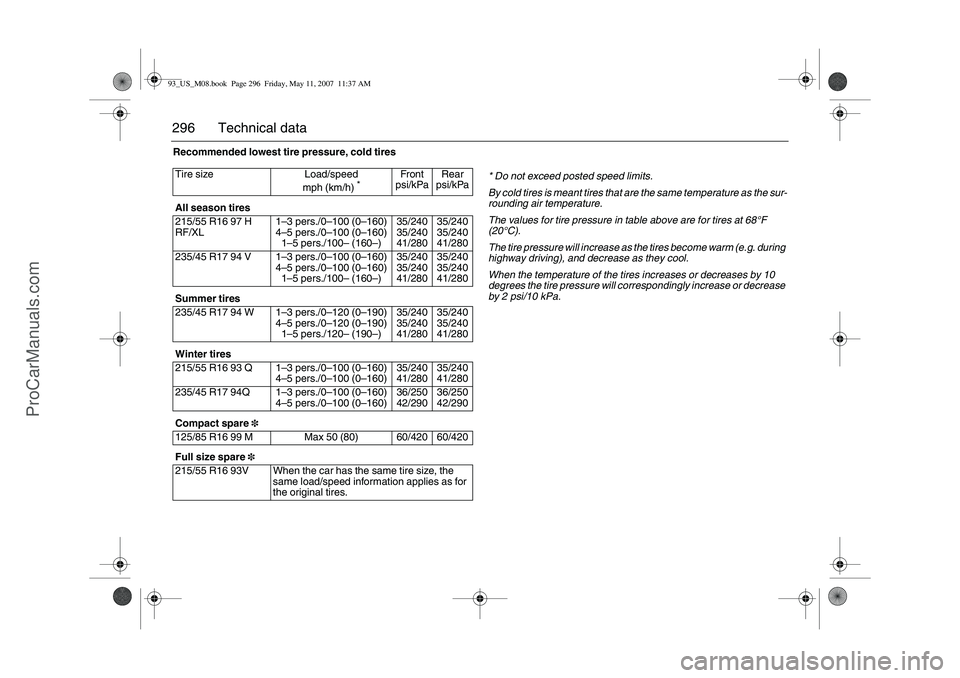
296 Technical dataRecommended lowest tire pressure, cold tires
Tire size Load/speed
mph (km/h)
*
Front
psi/kPaRear
psi/kPa
All season tires
215/55 R16 97 H
RF/XL1–3 pers./0–100 (0–160)
4–5 pers./0–100 (0–160)
1–5 pers./100– (160–)35/240
35/240
41/28035/240
35/240
41/280
235/45 R17 94 V 1–3 pers./0–100 (0–160)
4–5 pers./0–100 (0–160)
1–5 pers./100– (160–)35/240
35/240
41/28035/240
35/240
41/280
Summer tires
235/45 R17 94 W 1–3 pers./0–120 (0–190)
4–5 pers./0–120 (0–190)
1–5 pers./120– (190–)35/240
35/240
41/28035/240
35/240
41/280
Winter tires
215/55 R16 93 Q 1–3 pers./0–100 (0–160)
4–5 pers./0–100 (0–160)35/240
41/28035/240
41/280
235/45 R17 94Q 1–3 pers./0–100 (0–160)
4–5 pers./0–100 (0–160)36/250
42/29036/250
42/290
Compact spare
3
125/85 R16 99 M Max 50 (80) 60/420 60/420
Full size spare
3
215/55 R16 93V When the car has the same tire size, the
same load/speed information applies as for
the original tires.
* Do not exceed posted speed limits.
By cold tires is meant tires that are the same temperature as the sur-
rounding air temperature.
The values for tire pressure in table above are for tires at 68°F
(20°C).
The tire pressure will increase as the tires become warm (e.g. during
highway driving), and decrease as they cool.
When the temperature of the tires increases or decreases by 10
degrees the tire pressure will correspondingly increase or decrease
by 2psi/10kPa.
93_US_M08.book Page 296 Friday, May 11, 2007 11:37 AM
ProCarManuals.com
Page 297 of 320
297 Technical data
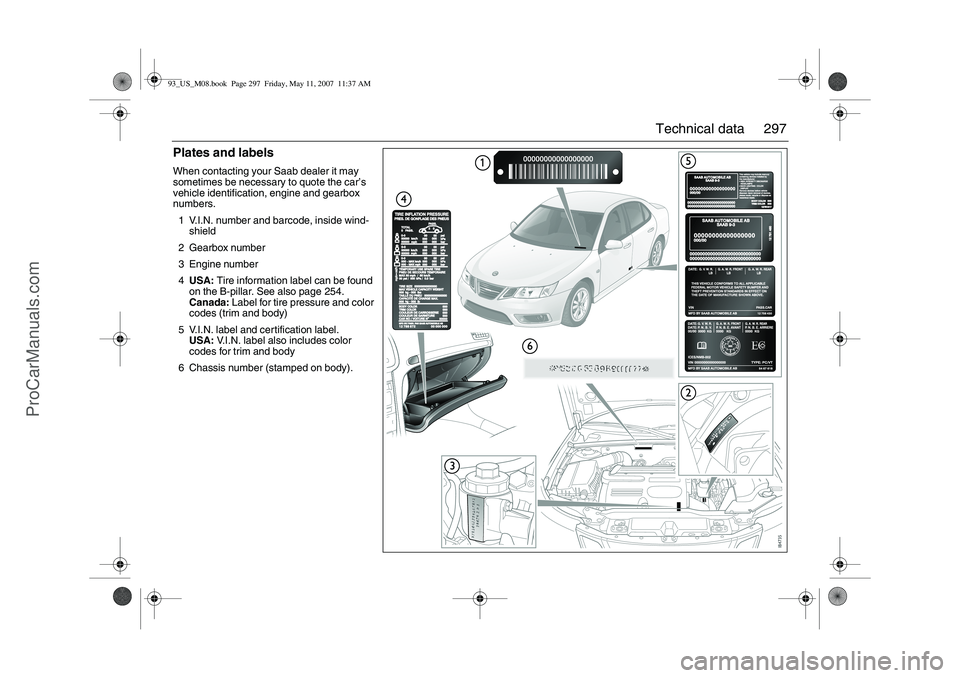
Plates and labelsWhen contacting your Saab dealer it may
sometimes be necessary to quote the car’s
vehicle identification, engine and gearbox
numbers.
1 V.I.N. number and barcode, inside wind-
shield
2 Gearbox number
3 Engine number
4USA: Tire information label can be found
on the B-pillar. See also page 254.
Canada: Label for tire pressure and color
codes (trim and body)
5 V.I.N. label and certification label.
USA: V.I.N. label also includes color
codes for trim and body
6 Chassis number (stamped on body).93_US_M08.book Page 297 Friday, May 11, 2007 11:37 AM
ProCarManuals.com
Page 301 of 320
301 Technical data
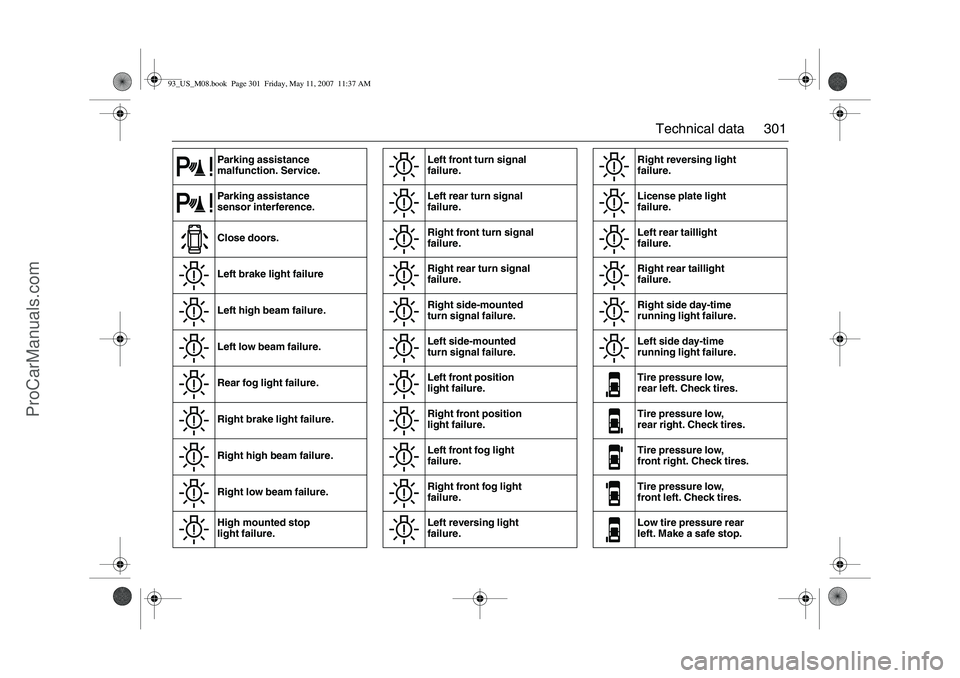
Parking assistance
malfunction. Service.
Parking assistance
sensor interference.
Close doors.
Left brake light failure
Left high beam failure.
Left low beam failure.
Rear fog light failure.
Right brake light failure.
Right high beam failure.
Right low beam failure.
High mounted stop
light failure.
Left front turn signal
failure.
Left rear turn signal
failure.
Right front turn signal
failure.
Right rear turn signal
failure.
Right side-mounted
turn signal failure.
Left side-mounted
turn signal failure.
Left front position
light failure.
Right front position
light failure.
Left front fog light
failure.
Right front fog light
failure.
Left reversing light
failure.
Right reversing light
failure.
License plate light
failure.
Left rear taillight
failure.
Right rear taillight
failure.
Right side day-time
running light failure.
Left side day-time
running light failure.
Tire pressure low,
rear left. Check tires.
Tire pressure low,
rear right. Check tires.
Tire pressure low,
front right. Check tires.
Tire pressure low,
front left. Check tires.
Low tire pressure rear
left. Make a safe stop.
93_US_M08.book Page 301 Friday, May 11, 2007 11:37 AM
ProCarManuals.com
Page 302 of 320
302 Technical data
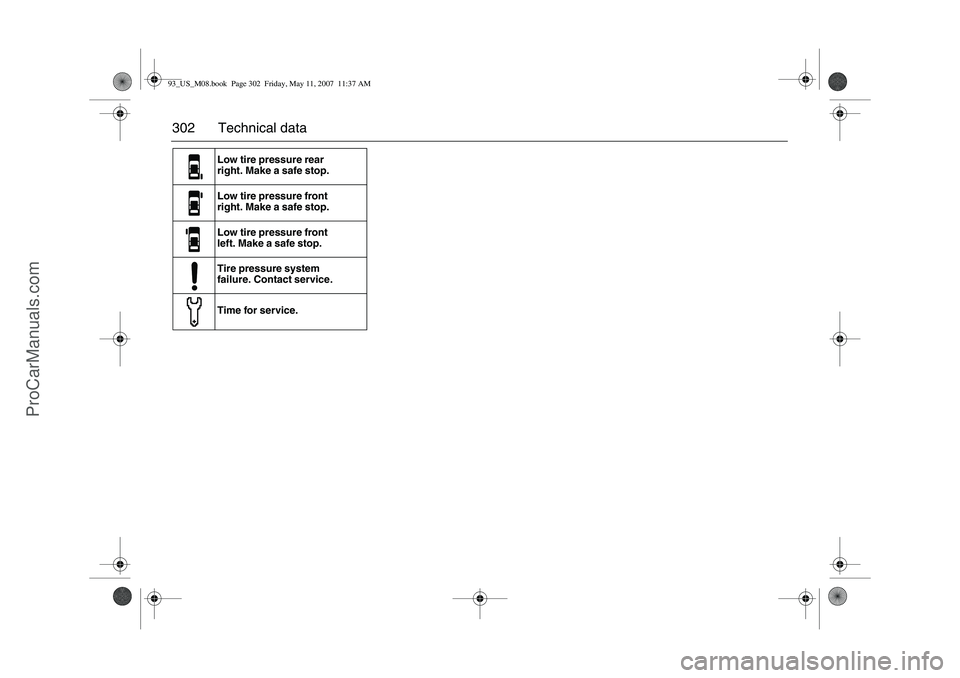
Low tire pressure rear
right. Make a safe stop.
Low tire pressure front
right. Make a safe stop.
Low tire pressure front
left. Make a safe stop.
Tire pressure system
failure. Contact service.
Time for service.
93_US_M08.book Page 302 Friday, May 11, 2007 11:37 AM
ProCarManuals.com